- Market Value (2025): USD 35.5 Bn
- Estimated Value (2026): USD 39.2 Bn
- Forecast Value (2036): USD 106.9 Bn
- CAGR (2026-2036): 10.5%
What is the Biopharmaceutical Cold Chain Third Party Logistics Market forecast to be worth by 2036?
USD 39.2 billion in 2026 to USD 106.9 billion by 2036, at a CAGR 10.5% .
- The biopharmaceutical cold chain third party logistics market size was valued at USD 35.5 billion in 2025, reflected by biologics movement and temperature-controlled medicine supply channels.
- Demand is projected to increase from USD 39.2 billion in 2026 to USD 106.9 billion by 2036.
- Industry is forecast to record a 10.5% CAGR from 2026 to 2036, due to medicine owners and logistics teams planning around temperature proof and release-ready documentation.
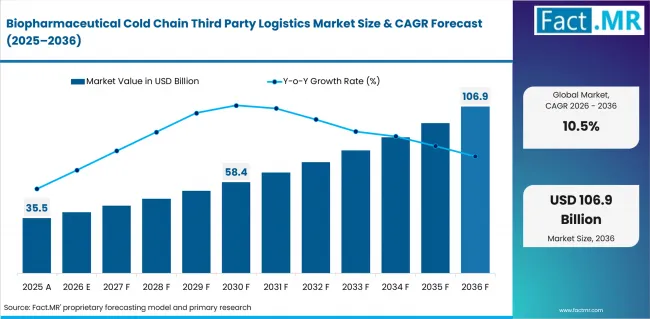
Biopharmaceutical Cold Chain Third Party Logistics Market Value Analysis | Source: Fact.MR
What are the defining numbers behind Biopharmaceutical Cold Chain Third Party Logistics Market growth?
USD 67.7 billion absolute opportunity by 2036, led by SME users and cloud deployment alongside BFSI documentation workflows.
- Demand Drivers in the Market
- Biologic medicine shippers seek validated cold lanes supported by temperature records and release-ready documentation.
- Vaccine programs depend on reliable storage capacity shaped by potency protection across public health distribution routes.
- Clinical supply teams need monitored transport reinforced by trial material handling and patient-specific therapy movement.
- Specialty pharmacy networks require final-mile cold chain proof guided by delivery visibility and exception response.
- Key segments analyzed
- By Service: Transportation is estimated to represent 46% share in 2026, shaped by lane execution and temperature-controlled shipment handling.
- By Temperature range: Refrigerated (2-8C) is forecast to account for 44% share in 2026, reinforced by vaccine and biologics storage needs.
- By Product: Vaccines are projected to secure 34% share in 2026, driven by immunization supply and public health distribution.
- By Mode: Air Freight is anticipated to garner 41% share in 2026, backed by time-sensitive medicine movement and cross-border healthcare logistics.
- Analyst Opinion at Fact.MR
- Shambhu Nath Jha, Senior Analyst at Fact.MR, states, “Biopharma cold chain 3PL has become a proof-led logistics challenge. Demand is expected to favor providers proving temperature control and corrective action discipline. Suppliers are expected to combine validated facilities with shipment visibility and trained healthcare teams.”
- Strategic Implications
- Biologic drug owners are expected to qualify 3PL partners through lane history and deviation response records.
- Vaccine buyers are likely to compare storage density and emergency handling procedures before service selection.
- Logistics providers are anticipated to align healthcare facilities with certified cross-dock and control tower operations.
- Specialty pharmacies should assess delivery consistency and temperature proof before expanding patient-service routes.
UPS announced in June 2026 a USD 48 million investment in 27 temperature-controlled freight cross-dock facilities, supporting 2°C to 8°C, 15°C to 25°C, and frozen medicine needs across global healthcare lanes. Development activity reflects biopharma cold chain 3PL moving toward integrated control over transfers and short-term storage.
India is projected to post 12.3% CAGR through 2036, reflected by national vaccine cold chain reach and biologics manufacturing needs. China is expected to record 11.6% CAGR by 2036, influenced by biologic product approvals and controlled distribution needs. Australia is anticipated to grow at 10.3% CAGR from 2026 to 2036, driven by immunization coverage and long-distance healthcare routes. The United Kingdom is estimated to hold 10.0% CAGR during the study period, shaped by vaccination tracking and specialty medicine movement. The U.S. is forecast to record 9.8% CAGR between 2026 and 2036, reinforced by novel drug approvals and specialty pharmacy routes. Germany is likely to post 9.5% CAGR to 2036, backed by pharmacy distribution and vaccine outreach needs. Japan is expected to expand at 9.2% CAGR to 2036, supported by new drug approvals and quality-led healthcare logistics.
How is the Biopharmaceutical Cold Chain Third Party Logistics Market estimated to break down by segment?
Transportation is likely to lead at 46%; Refrigerated (2-8C) is anticipated to lead at 44%.
Which service category is projected to lead?
Transportation is likely to hold 46% share in 2026.
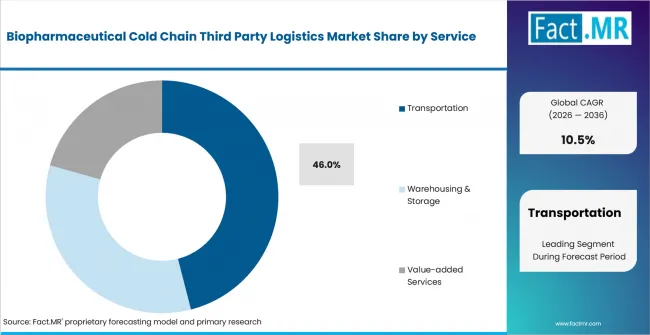
Biopharmaceutical Cold Chain Third Party Logistics Market Analysis By Service | Source: Fact.MR
Transportation is expected to garner 46% share in 2026, driven by temperature-controlled route execution and shipment monitoring. Warehousing & Storage follows as biologics and vaccines require validated holding capacity. Value-added Services remain linked to packaging support, documentation, deviation handling, and shipment release workflows. UNICEF Supply Division reported on May 22, 2025 delivery of 2.787 billion vaccine doses to 99 countries in 2024, reflecting a wide operating base served by outsourced cold chain partners.
Which temperature range is forecast to capture the leading share?
Refrigerated (2-8C) is estimated to secure 44% share in 2026.
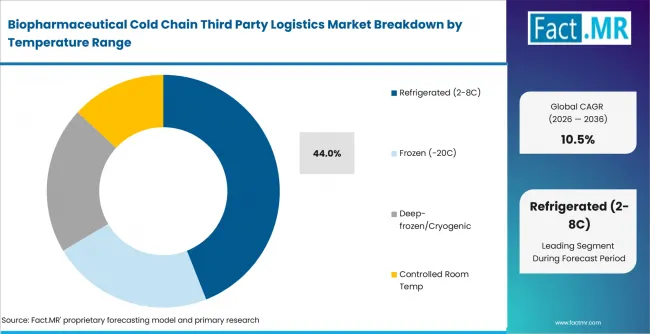
Biopharmaceutical Cold Chain Third Party Logistics Market Analysis By Temperature Range | Source: Fact.MR
Refrigerated (2-8C) is projected to account for 44% share in 2026, led by vaccine storage and biologics handling needs. Frozen (-20C) follows through specialty medicine and sample movement. Deep-frozen/Cryogenic logistics support advanced therapy and clinical material transfer. Controlled Room Temp remains relevant for medicines needing controlled handling without frozen infrastructure. CDC reported in March 2024 vaccine refrigerators should maintain 2°C to 8°C, making continuous temperature control central to cold chain service selection.
Which product category is anticipated to hold the leading position?
Vaccines are projected to represent 34% share in 2026.
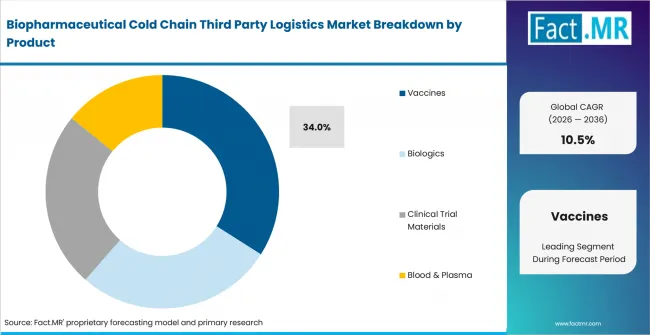
Biopharmaceutical Cold Chain Third Party Logistics Market Analysis By Product | Source: Fact.MR
Vaccines are anticipated to capture 34% share in 2026, supported by immunization programs and public health distribution needs. Biologics follow as high-value therapies require validated temperature control. Clinical Trial Materials support investigational drug movement and protocol-led handling. Blood & Plasma remain linked to strict storage discipline and monitored transport. WHO and UNICEF stated on July 15, 2025 that 85% of infants, around 109 million, completed 3 DTP doses in 2024, reinforcing recurring vaccine logistics requirements.
Which mode is estimated to see the strongest demand?
Air Freight is set to account for 41% share in 2026.
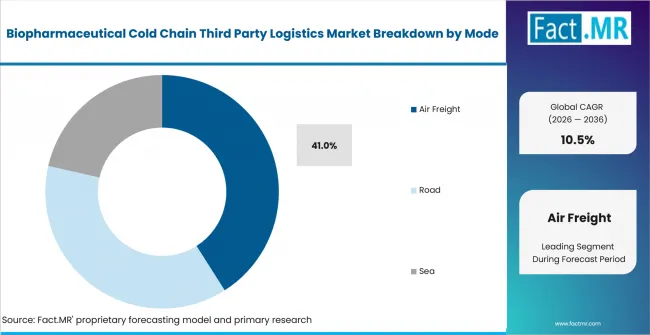
Biopharmaceutical Cold Chain Third Party Logistics Market Analysis By Mode | Source: Fact.MR
Air Freight is estimated to represent 41% share in 2026, shaped by urgent medicine movement and cross-border cold chain needs. Road follows through regional distribution and final-mile healthcare delivery. Sea freight supports planned large-volume movement across longer trade lanes. UPS announced on June 22, 2026 a USD 48 million investment in 27 temperature-controlled freight cross-dock facilities, supporting healthcare shipments across 2°C to 8°C, 15°C to 25°C, and frozen ranges.
What is accelerating Biopharmaceutical Cold Chain Third Party Logistics Market adoption, and what is holding it back?
Biologic shipment proof drives it; validation burden and temperature excursion risk restrain it.
Drivers Impact Analysis
| Driver | (~) % Impact on CAGR | Geographic Relevance | Impact Timeline |
|---|---|---|---|
| Biologic and vaccine shipment growth | +1.8% | United States, China, India | Medium term (2-4 years) |
| Temperature-record compliance | +1.5% | North America and Europe | Short term (<= 2 years) |
| Specialty pharmacy delivery expansion | +1.2% | United States, United Kingdom, Japan | Medium term (2-4 years) |
| Clinical trial cold chain needs | +0.9% | United States, Europe, Australia | Long term (>= 4 years) |
| Public immunization logistics | +0.7% | India, China, Australia | Medium term (2-4 years) |
Source: Fact.MR analysis. Updated Jul 10, 2026
- Biologic and vaccine shipment growth: Medicine shippers face higher evidence needs as temperature-sensitive therapies move through more partners. UNICEF Supply Division reported on May 22, 2025 that 2.787 billion vaccine doses were delivered to 99 countries in 2024. Cold chain 3PL demand is projected to receive support from vaccine movement requiring release-ready documentation.
- Temperature-record compliance: Temperature records influence shipment release and service qualification. CDC stated in March 2024 that vaccine refrigerators should maintain 2°C to 8°C and freezers are expected to maintain -50°C to -15°C. Logistics partners are expected to build stronger monitoring routines around those ranges.
- Specialty pharmacy delivery expansion: Specialty pharmacy delivery needs trained final-mile teams and proof of custody. DHL Supply Chain stated on November 7, 2025 noting the SDS Rx network of more than 200 U.S. locations was integrated into its Life Sciences and Healthcare business. Patient-centered cold delivery is anticipated to support service expansion.
- Clinical trial cold chain needs: Trial sponsors need controlled transport for investigational drugs and patient-specific therapies. DHL Group stated on March 31, 2025 claiming CRYOPDP provides logistics services for clinical trials, biopharma, and cell and gene therapies. Clinical logistics is estimated to raise demand for specialist 3PL capabilities.
- Public immunization logistics: Immunization programs sustain storage and route supervision needs. Gavi reported on May 21, 2026, more than 72 million children were reached through routine immunization in 2024. Public health cold chain work is forecast to support regional logistics capacity.
Opportunity Impact Analysis
| Opportunity | (~) % Impact on CAGR | Geographic Relevance | Impact Timeline |
|---|---|---|---|
| Certified healthcare cross-docks | +1.4% | United States, Europe, Asia Pacific | Short term (<= 2 years) |
| APAC healthcare logistics networks | +1.2% | China, India, Australia | Medium term (2-4 years) |
| Temperature-controlled Indian hubs | +1.0% | India and South Asia | Medium term (2-4 years) |
| North American cold chain network integration | +0.8% | United States and Canada | Long term (>= 4 years) |
Source: Fact.MR analysis. Updated Jul 10, 2026
- Certified healthcare cross-docks: Certified cross-docks reduce handoffs during short storage and transfer windows. UPS stated on June 22, 2026 noting 27 temperature-controlled freight cross-docks are compliant with IATA CEIV Pharma standards. Such assets are projected to support controlled movement for advanced therapies.
- APAC healthcare logistics networks: APAC healthcare trade lanes need qualified sites across several national systems. CEVA Logistics stated on April 15, 2026, it operated across 19 Asia Pacific countries with more than 120 healthcare sites. Regional logistics providers are expected to gain from network depth and compliance coverage.
- Temperature-controlled Indian hubs: India offers expansion space for airfreight-based healthcare logistics. Kuehne+Nagel reported on May 5, 2026, its Hyderabad temperature-controlled facility covered 248 square meters and included 2°C to 8°C and 15°C to 25°C zones. Local hub additions are anticipated to strengthen biologics shipment handling.
- North American cold chain network integration: North American network integration adds deeper specialized healthcare capability for global providers. UPS completed the Andlauer Healthcare Group acquisition on November 3, 2025 for USD 1.6 billion. Integrated infrastructure is estimated to improve temperature-controlled service breadth across Canada and the United States.
Restraints Impact Analysis
| Restraint | (~) % Impact on CAGR | Geographic Relevance | Impact Timeline |
|---|---|---|---|
| Validation and audit burden | -1.3% | United States, Europe, Japan | Medium term (2-4 years) |
| Temperature excursion risk | -1.1% | Global cold lanes | Short term (<= 2 years) |
| Facility qualification delays | -0.8% | Asia Pacific and Europe | Medium term (2-4 years) |
| Last-mile infrastructure gaps | -0.6% | India, China, Australia | Long term (>= 4 years) |
Source: Fact.MR analysis. Updated Jul 10, 2026
- Validation and audit burden: Provider qualification requires written proof across storage and emergency processes. CDC guidance published in March 2024 requires 2 to 7 days of recorded minimum and maximum temperatures before vaccine storage units are ready. Such rules are expected to slow onboarding for untested facilities.
- Temperature excursion risk: Excursion risk increases replacement decisions and release review work. WHO stated on July 15, 2025, 14.3 million children were zero-dose in 2024. Fragile vaccine delivery networks are likely to keep cold chain risk control under scrutiny.
- Facility qualification delays: Facility qualification can add staged capacity instead of rapid full-network deployment. Kuehne+Nagel reported on May 5, 2026, its Hyderabad healthcare facility covered 248 square meters. Focused site additions are projected to require careful validation before wider lane use.
- Last-mile infrastructure gaps: Remote healthcare routes need equipment and power continuity. Press Information Bureau stated on March 17, 2026, India’s vaccine cold chain had nearly 30,000 cold chain points and over 1.06 lakh ice-lined refrigerators and deep freezers. Infrastructure complexity is anticipated to restrain uniform service quality.
How are country markets expected to scale Biopharmaceutical Cold Chain Third Party Logistics Market demand?
India 12.3%; China 11.6%; Australia 10.3%; United Kingdom 10.0%; U.S. 9.8%.
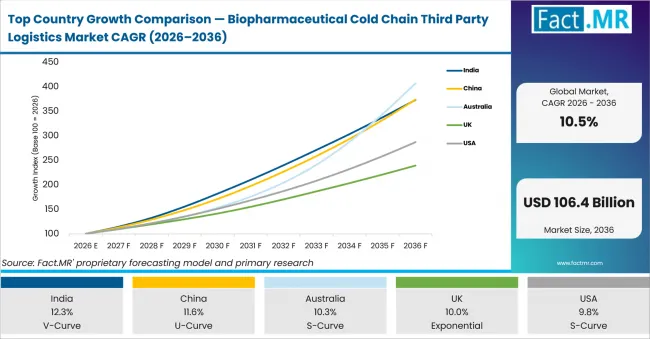
Top Country Growth Comparison Biopharmaceutical Cold Chain Third Party Logistics Market Cagr 2026 2036 | Source: Fact.MR
Regional analysis covers North America, Latin America, Europe, East Asia, South Asia and Pacific, and Middle East and Africa.
Country CAGR
| Country | CAGR |
|---|---|
| India | 12.3% |
| China | 11.6% |
| Australia | 10.3% |
| United Kingdom | 10.0% |
| U.S. | 9.8% |
Source: Fact.MR analysis. Updated Jul 10, 2026
What is driving India’s growth to 2036?
12.3% CAGR by 2036, driven by national vaccine cold chain reach.
India combines vaccine storage reach with biologics manufacturing and public health distribution needs. Market in India is projected to record 12.3% CAGR through 2036, led by logistics providers supporting public and private healthcare routes. Press Information Bureau reported on March 17, 2026 that India’s vaccine cold chain spanned nearly 30,000 cold chain points, supporting nationwide service needs.
How is China scaling biopharma cold chain 3PL demand?
11.6% CAGR from 2026 to 2036, supported by biologic approval activity.
China’s biologics activity keeps temperature-managed distribution close to regulatory and hospital supply cycles. Nature Reviews Drug Discovery reported on February 14, 2025, China’s NMPA approved 93 therapeutic biological product applications in 2024. Demand in China is expected to record 11.6% CAGR during the study period as biologic release and distribution controls increase.
What supports the Australia outlook?
10.3% CAGR between 2026 and 2036, owing to immunization coverage and long-distance routes.
Australia relies on long healthcare routes linking national suppliers with regional facilities. Australia’s Department of Health reported on February 2, 2026, immunization coverage for 5 year olds stood at 93.17% for the annual period ending September 2025. Sector in Australia is anticipated to post 10.3% CAGR during the forecast period, driven by vaccine handling and specialty medicine distribution.
What underpins United Kingdom demand?
10.0% CAGR through 2036, shaped by vaccination tracking and specialty medicine movement.
United Kingdom healthcare logistics demand reflects immunization monitoring and specialty therapy distribution. UK Health Security Agency reported on August 28, 2025 that MMR2 coverage for 5 year olds in England reached 83.7% during 2024 to 2025. Market demand is estimated to advance at 10.0% CAGR between 2026 and 2036 as vaccine outreach and temperature control stay under review.
How does the U.S. market perform?
9.8% CAGR during the study period, reinforced by novel drug approvals and specialty pharmacy routes.
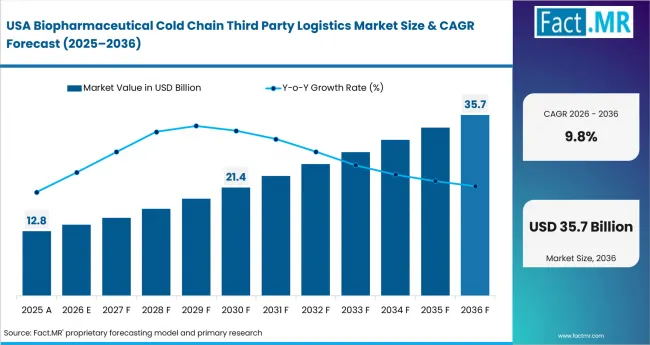
Biopharmaceutical Cold Chain Third Party Logistics Market Country Value Analysis | Source: Fact.MR
United States healthcare logistics remains exposed to pharmacy networks and direct-to-patient delivery. FDA reported in 2026, CDER approved 46 novel drugs in 2025. Sales in the United States are forecast to record 9.8% CAGR by 2036 since new therapy launches require stronger cold chain qualification.
What shapes Germany’s outlook?
9.5% CAGR to 2036, influenced by pharmacy distribution and vaccine outreach needs.
Germany’s healthcare distribution needs reflect pharmacy depth and immunization service planning. Robert Koch Institute reported on December 11, 2025 that influenza vaccination coverage among people aged 60 years and older was 34.5% in the 2024/2025 season. Demand in Germany is likely to post 9.5% CAGR by 2036 as temperature-managed vaccine logistics retain policy attention.
How is Japan positioned in biopharma cold chain 3PL?
9.2% CAGR during the forecast period, supported by approval activity and healthcare quality systems.
Japan relies on quality-led pharmaceutical distribution and strict product handling discipline. PharmaBoardroom reported on August 5, 2025, PMDA concluded FY 2024-25 with 148 approval decisions. Sector in Japan is expected to advance at 9.2% CAGR from 2026 to 2036, led by new medicine movement and release-ready logistics.
Who leads the Biopharmaceutical Cold Chain Third Party Logistics Market?
DHL Supply Chain and UPS Healthcare lead direct healthcare logistics coverage, while FedEx and Kuehne+Nagel strengthen temperature-controlled shipment capabilities.
DHL Supply Chain brings healthcare delivery depth based on SDS Rx and CRYOPDP. UPS Healthcare adds certified cold chain cross-docks and Andlauer Healthcare Group capability across North America.
FedEx supports healthcare shippers through temperature-controlled services and packaging options. Kuehne+Nagel expands healthcare nodes due to HealthChain-compliant facilities. CEVA Logistics adds APAC healthcare site depth, while World Courier and Marken support clinical supply and patient-linked logistics.
What companies are the key providers?
DHL Supply Chain and UPS Healthcare are key providers. FedEx and Kuehne+Nagel are also profiled. CEVA Logistics, World Courier, and Marken complete the company set.
- DHL Supply Chain
- UPS Healthcare
- FedEx
- Kuehne+Nagel
- CEVA Logistics
- World Courier
- Marken
Bibliography
- Australian Department of Health, Disability and Ageing. (2026, February 2). Childhood immunisation coverage. Australian Government.
- Centers for Disease Control and Prevention. (2024, March 29). Vaccine storage and handling toolkit. Centers for Disease Control and Prevention.
- CEVA Logistics. (2026, April 15). Precision with purpose: How CEVA Logistics is elevating healthcare supply chains in APAC. CEVA Logistics.
- DHL Group. (2025, March 31). DHL Group acquires CRYOPDP from Cryoport to strengthen DHL Health Logistics. DHL Group.
- DHL. (2025, November 7). DHL Supply Chain completes acquisition of SDS Rx. DHL.
- FDA. (2026). Novel drug approvals for 2025. U.S. Food and Drug Administration.
- Gavi, the Vaccine Alliance. (2026, May 21). Annual progress report 2024. Gavi.
- Kuehne+Nagel. (2026, May 5). Kuehne+Nagel expands healthcare logistics network with Hyderabad temperature-controlled facility. Kuehne+Nagel.
- Nature Reviews Drug Discovery. (2025, February 14). Approvals by the China NMPA in 2024. Springer Nature.
- PharmaBoardroom. (2025, August 5). Japan PMDA shoots ahead in FY 2024-25 with 148 drug approvals. PharmaBoardroom.
- Press Information Bureau. (2026, March 17). Celebrating the power of vaccines. Government of India.
- Robert Koch Institute. (2025, December 11). Influenza: vaccination coverage among people aged 60 years and older in Germany. Robert Koch Institute.
- UK Health Security Agency. (2025, August 28). Vaccination coverage statistics for children aged up to 5 years, England, April 2024 to March 2025. UK Health Security Agency.
- UNICEF Supply Division. (2025, May 22). UNICEF Supply Annual Report 2024. UNICEF.
- UPS. (2025, November 3). UPS acquires Andlauer Healthcare Group for USD 1.6 billion, accelerating global healthcare logistics leadership. UPS.
- UPS. (2026, June 22). UPS extends complex healthcare logistics lead with USD 48 million investment in temperature-controlled freight cross-dock facilities. UPS.
- WHO. (2025, July 15). Immunization coverage. World Health Organization.
- WHO and UNICEF. (2025, July 15). Global childhood vaccination coverage holds steady, yet over 14 million infants remain unvaccinated. World Health Organization.
This Report Addresses
- The report provides strategic intelligence on the global biopharmaceutical cold chain third-party logistics (3PL) market, focusing on temperature-controlled transportation, warehousing, storage, and distribution services for pharmaceutical and biopharmaceutical products.
- Segment analysis evaluates the market by Service, Temperature Range, Product, Mode, and Region.
- Temperature-range assessment covers refrigerated (2°C–8°C), frozen, and ultra-low-temperature logistics used for sensitive healthcare products.
- Product analysis examines logistics demand for Vaccines, Biologics, Clinical Trial Materials, and Blood & Plasma.
- Transportation analysis covers Air Freight, Road, and Sea logistics used in domestic and international cold-chain networks.
- Service analysis evaluates Transportation, Warehousing & Storage, and Value-added Services.
- Technology assessment reviews real-time temperature monitoring, tracking systems, condition monitoring, compliance documentation, and quality assurance processes used across cold-chain operations.
- Regional outlook evaluates market trends and growth opportunities across North America, Latin America, Europe, East Asia, South Asia & Oceania, and the Middle East & Africa, including key countries such as the U.S., Germany, the U.K., China, India, Japan, and Australia.
- Competitive analysis profiles leading cold-chain logistics providers including DHL Supply Chain, UPS Healthcare, FedEx, Kuehne+Nagel, and other prominent participants active in pharmaceutical logistics.
- The forecast incorporates pharmaceutical production trends, biologics and vaccine demand, healthcare distribution requirements, regulatory developments, and cold-chain infrastructure investments to estimate market size and growth prospects.
What does the Biopharmaceutical Cold Chain Third Party Logistics Market cover?
Temperature-controlled third party logistics for biologics, vaccines, clinical trial materials, and specialty medicines.
Biopharmaceutical cold chain third party logistics covers outsourced storage, transport, monitoring, and documentation for medicines needing controlled conditions. Coverage includes refrigerated, frozen, and controlled-room logistics used by manufacturers, trial sponsors, specialty pharmacies, and public health buyers.
Market coverage differs from general parcel delivery and dry pharmaceutical freight since commercial demand centers on product potency, validated facilities, lane evidence, and release documentation. Packaging material sales remain outside scope unless bundled with outsourced logistics service programs.
What is included in the scope?
Cold chain 3PL operations used for biologics, vaccines, clinical supply, and specialty therapy movement.
Scope includes validated warehousing, refrigerated freight, frozen logistics, thermal packaging support, lane qualification, shipment monitoring, deviation handling, and release documentation. Coverage includes cloud and on-premise systems, services, API/tools, storage, workflow automation, analytics, governance, and integration across healthcare supply chains.
What is excluded from the scope?
General dry freight, in-house cold chain operations, consumer grocery logistics, and standalone packaging sales are outside the scope.
Non-pharma chilled goods, food cold chain, non-regulated parcel shipping, and internal logistics managed fully by drug owners are excluded. Software sold without any healthcare logistics use and storage assets not linked to biopharmaceutical shipment support are also excluded.
How was the analysis built?
120+ sources, 45+ company portfolios, 30+ countries, 20+ interviews.
- Primary Research:
- Primary research includes interviews with healthcare logistics operators, cold chain quality heads, specialty pharmacy teams, vaccine distribution managers, biologics manufacturers, and clinical supply coordinators. It also includes input from warehouse validation teams, route planners, packaging engineers, and healthcare freight buyers involved in controlled medicine movement.
- Desk Research:
- Desk research reviews official immunization data, regulator approval summaries, company facility announcements, healthcare logistics network updates, vaccine storage guidance, and annual public health reports. Official agencies, healthcare organizations, and company materials are reviewed to assess shipment scale, infrastructure additions, and service direction.
- Market-Sizing and Forecasting:
- Forecasting uses immunization demand signals, biologic approval activity, facility expansion evidence, cold chain handling requirements, and company capability checks. Forecast models also assess validation burden, temperature excursion risk, specialty pharmacy delivery, and public vaccine logistics.
- Data Validation and Update Cycle:
- Forecasts are validated through company portfolio mapping, country evidence review, and technical interviews. Updates review official healthcare releases, facility expansion changes, drug approval activity, immunization coverage, and company announcements to keep the market view aligned with current operating conditions.
Segmentation
What is the report’s scope and coverage?
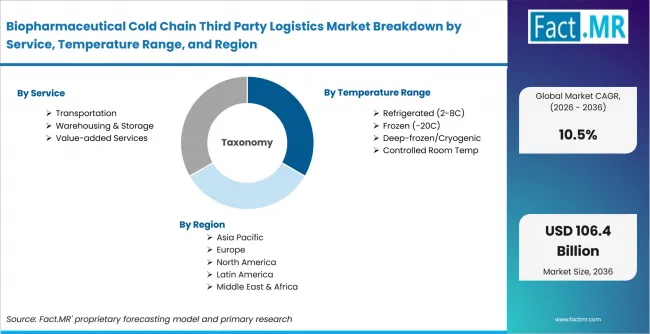
Biopharmaceutical Cold Chain Third Party Logistics Market Breakdown By Service, Temperature Range, And Region | Source: Fact.MR
| Attribute | Details |
|---|---|
| Quantitative Units | USD billion in 2026 to USD billion by 2036 at CAGR |
| Market Definition | Outsourced temperature-controlled logistics and related monitoring support for biologics, vaccines, clinical trial materials, and specialty medicines |
| Service | Transportation; Warehousing & Storage; Value-added Services |
| Temperature Range | Refrigerated (2-8C); Frozen (-20C); Deep-frozen/Cryogenic; Controlled Room Temp |
| Product | Vaccines; Biologics; Clinical Trial Materials; Blood & Plasma |
| Mode | Air Freight; Road; Sea |
| Regions Covered | North America; Latin America; Europe; East Asia; South Asia and Pacific; Middle East and Africa |
| Countries Covered | India; China; Australia; United Kingdom; U.S.; Germany; Japan |
| Key Companies Profiled | DHL Supply Chain; UPS Healthcare; FedEx; Kuehne+Nagel; CEVA Logistics; World Courier; Marken |
| Forecast Period | 2026 to 2036 |
| Approach | Hybrid top-down and bottom-up approach using official immunization data; regulatory approval evidence; company facility checks; cold chain network additions; country CAGRs; segment share alignment |
Source: Fact.MR analysis. Updated Jul 10, 2026
How is the market segmented?
-
Service:
- Transportation
- Warehousing & Storage
- Value-added Services
-
Temperature Range:
- Refrigerated (2-8C)
- Frozen (-20C)
- Deep-frozen/Cryogenic
- Controlled Room Temp
-
Product:
- Vaccines
- Biologics
- Clinical Trial Materials
- Blood & Plasma
-
Mode:
- Air Freight
- Road
- Sea
-
By Region:
- North America
- United States
- Canada
- Latin America
- Brazil
- Mexico
- Europe
- Germany
- United Kingdom
- France
- Italy
- Spain
- East Asia
- China
- Japan
- South Korea
- South Asia and Pacific
- India
- Australia
- Indonesia
- Middle East and Africa
- UAE
- Saudi Arabia
- South Africa
- North America
Frequently Asked Questions
What service segment is expected to lead the Biopharmaceutical Cold Chain Third Party Logistics Market?
Which temperature range is projected to dominate the market?
Which product category is anticipated to generate the highest demand?
What transport mode is expected to lead demand in 2026?
What country is expected to record the most prominent CAGR in the biopharmaceutical cold chain third party logistics market?
How is China anticipated to perform in the biopharmaceutical cold chain third party logistics market?
How is Australia estimated to grow in the biopharmaceutical cold chain third party logistics market?
How is the United Kingdom likely to expand in the biopharmaceutical cold chain third party logistics market?
How is the U.S. projected to grow in the biopharmaceutical cold chain third party logistics market?
How is Germany anticipated to scale in the biopharmaceutical cold chain third party logistics market?
How is Japan predicted to perform in the biopharmaceutical cold chain third party logistics market?
What is the primary driver in the biopharmaceutical cold chain third party logistics market?
What is the main restraint in the biopharmaceutical cold chain third party logistics market?
Who worked on this report


Preview the report firsthand - request a free sample
Free SampleGet the brochure for pricing and purchase details
Download PDF