The Biopsy Closure Device Market is analyzed across its key product, application and end-use segments, with the study covering market dynamics, regional trends and demand outlook, forecast 2026 to 2036.
By Fact.MR Healthcare DeskFact-checked under the Fact.MR editorial processUpdated
10 min read
Biopsy Closure Device Market Forecast and Outlook 2026 to 2036
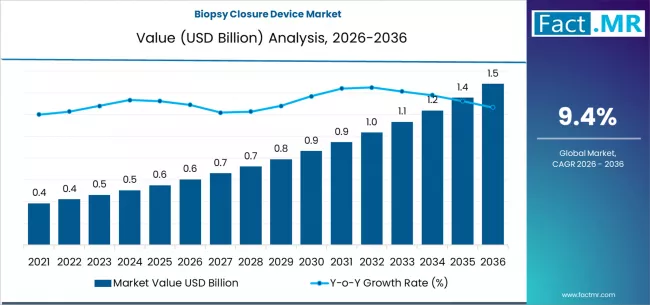
The global biopsy closure device market is projected to total USD 0.60 billion in 2026, advancing to USD 1.48 billion by 2036, achieving a compound annual growth rate of 9.4%. Growth is driven by the escalating global volume of diagnostic and surveillance biopsy procedures, coupled with a rising imperative to minimize post-procedural complications and enhance patient recovery in both hospital and outpatient settings.
Biopsy Closure Device Market Market Value Analysis | Source: Fact.MR
Summary of Biopsy Closure Device Market
Market Snapshot
Global biopsy closure device market revenue stood at USD0.60billionin 2026 and is forecast to reach USD1.48billionby 2036.
At a9.4%CAGRfrom 2026 to 2036, this market is set to expand1.48xin value, adding USD0.88billionin absolute opportunity.
Growth is being driven by increasing procedural volumes of minimally invasive biopsies, where closure devices are essential to reduce complications such as bleeding and infection.
These devices are evolving into precision wound management tools, enabling faster recovery, reduced hospital stays, and improved patient outcomes.
Demand and Growth Drivers
Rising incidence of cancer and chronic diseases is increasing biopsy procedure volumes globally, directly driving demand for closure devices.
Increasing preference for minimally invasive diagnostic procedures is reinforcing the need for efficient and reliable closure solutions.
Growing emphasis on post-procedure complication reduction, particularly bleeding and infection control, is accelerating adoption.
Expansion of ambulatory surgicalcentersand outpatient procedures is supporting demand for quick and effective closure technologies.
Advancements inbioabsorbablematerials and device design are improving clinical outcomes and usability.
Product and Segment View
Collagen-based Plugshold4.3% of product segment share in 2026,emergingas the leading segment due to widespread use in interventional procedures.
Cardiovascular Biopsiesaccount for53.6% of application share in 2026, positioning this as the dominant segment driven by high procedural volumes.
Hospitalsrepresent72.5% of end-use share in 2026, reflecting the concentration of complex biopsy procedures in hospital settings.
Product categories include:
Vascular closure devices
Tissue sealants
Suturing systems
Adhesive-based closure systems
Geography and Competitive Outlook
Growth is supported across North America, Europe, and Asia Pacific, driven by expanding healthcare infrastructure and diagnostic capabilities.
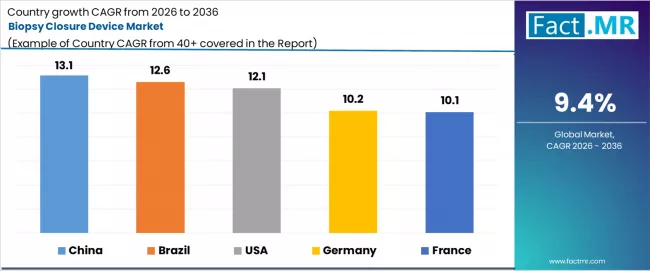
United States (12.1%CAGR),China(13.1%), Germany(10.2%),France(10.1%), Brazil(7.4%),are key growth markets.
Market expansion is closely tied to increasing diagnostic screening rates, healthcare access, and technological advancements in minimally invasive procedures.
Key companies active in this market include Abbott Laboratories, Becton Dickinson and Company, Medtronic, Terumo Corporation, and Teleflex Incorporated.
Biopsy Closure Device Market — At a Glance
Attribute
Details
Market Value 2026
USD0.60billion
Market Value 2036
USD1.48billion
Absolute Dollar Opportunity 2026-2036
USD0.88billion
Total Growth 2026-2036
146.7%
CAGR2026-2036
9.4%
Growth Multiple
1.48x
Key Demand Theme
Increasing adoption of minimally invasive biopsy procedures requiring efficient closure and complication management
North America, Latin America, Western Europe, Eastern Europe, East Asia, South Asia & Pacific, MEA
As biopsy techniques become more frequent and sophisticated, the demand for reliable, rapid hemostasis has transformed closure from an ancillary concern into a critical component of procedural safety and efficiency. These devices address the significant clinical need to prevent bleeding, reduce the risk of hematoma, and potentially shorten recovery times, thereby improving the overall patient experience and streamlining workflow in busy interventional departments. The market's evolution is closely linked to the trend toward minimally invasive tissue sampling across oncology, cardiology, and other specialties, where effective closure is essential for safe same-day discharge. Innovations are increasingly focused on developing solutions that are easy to deploy, compatible with various access sites and patient anatomies, and effective even in patients on anticoagulant therapy. The shift from manual compression to dedicated mechanical or biomaterial-based closure represents a significant advancement in procedural standardization and patient care.
North America, Latin America, Western Europe, Eastern Europe, East Asia, South Asia & Pacific, MEA
Segmental Analysis
By Device Type, Which Technology is a Proven Hemostatic Workhorse?
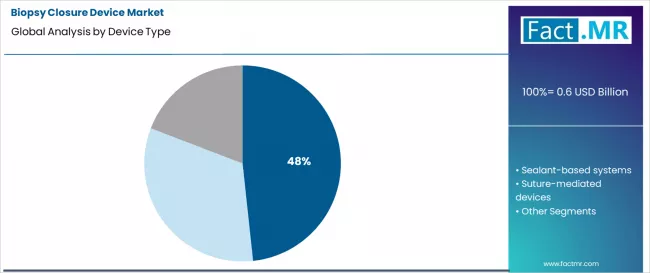
Biopsy Closure Device Market Analysis By Device Type | Source: Fact.MR
Collagen-based plugs command a leading 48.3 percent share. This segment's dominance is attributed to their long-standing clinical history, proven efficacy in promoting rapid clot formation, and versatility across a wide range of biopsy depths and tissue types.
They offer a straightforward, reliable solution that interventionalists trust, particularly for percutaneous procedures in vascular-rich organs, balancing effective hemostasis with ease of use.
By Application, Which High-Risk Procedure Demands Secure Closure?
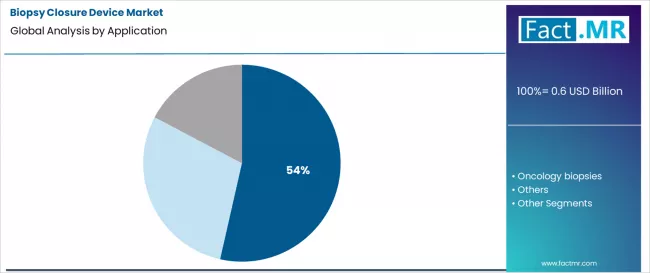
Biopsy Closure Device Market Analysis By Application | Source: Fact.MR
Cardiovascular biopsies represent the leading application with a 53.6 percent share. Endomyocardial biopsy, in particular, is a high-stakes procedure where bleeding into the pericardial space can be catastrophic.
This critical need for absolute hemostatic security in a high-pressure vascular environment drives the adoption and continuous refinement of dedicated closure devices, making it the most demanding and innovation-focused segment.
By End User, Where is the Highest Volume of Complex Biopsies Performed?
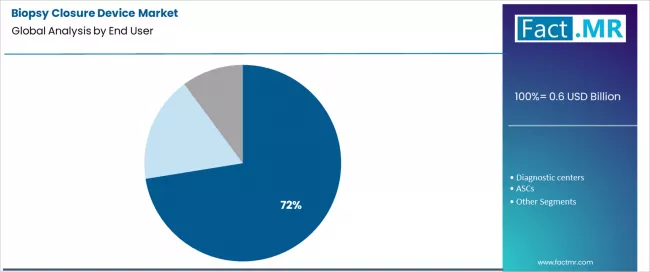
Biopsy Closure Device Market Analysis By End User | Source: Fact.MR
Hospitals constitute the primary end-user segment at 72.5 percent. Tertiary care hospitals and academic medical centers perform the vast majority of complex, deep-tissue, and high-risk biopsies that require assured closure.
The concentration of interventional radiologists, cardiologists, and oncologists, along with the management of patients with multiple comorbidities, centralizes both the need and procurement for these devices within hospital settings.
What are the Principal Drivers, Constraints, and Evolving Dynamics of this Market?
The paramount driver for this market is the global increase in image-guided biopsy procedures, fueled by rising cancer incidence and the expansion of personalized medicine requiring tissue for genomic profiling. A significant restraint is the additional per-procedure cost that closure devices add, which can hinder adoption in budget-constrained settings, leading some providers to default to longer manual compression despite its inefficiencies.
A key opportunity lies in the development of next-generation bioactive sealants that not only achieve hemostasis but also deliver antimicrobial or analgesic agents to the tract, potentially reducing infection risk and post-procedural pain.
The dominant trend is the seamless integration of closure mechanisms into single-use biopsy needle systems, creating an all-in-one "biopsy-and-close" device that streamlines the procedure, reduces inventory, and standardizes outcomes, moving closure from a separate step to an intrinsic part of the tissue sampling process.
Analysis of the Biopsy Closure Device Market by Key Countries
Biopsy Closure Device Market Cagr Analysis By Country | Source: Fact.MR
Country
CAGR 2026 to 2036
China
13.1%
Brazil
12.6%
USA
12.1%
Germany
10.2%
France
10.1%
What drives the USA's High-Volume Interventional Practice and Outpatient Shift?
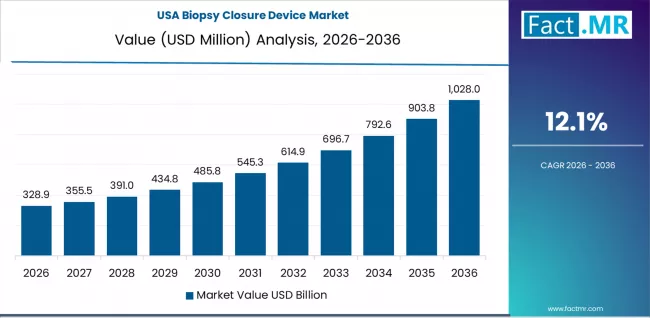
Biopsy Closure Device Market Country Value Analysis | Source: Fact.MR
The high volume of diagnostic biopsies performed annually and the strong economic and clinical push to move these procedures from inpatient to ambulatory settings propels the USA’s 12.1% CAGR. Effective closure devices are essential for enabling safe same-day discharge.
Growth is further driven by the presence of leading device innovators, favorable reimbursement for closure technologies, and rigorous hospital protocols aimed at minimizing complication-related readmissions, making these devices a standard of care in many interventional suites.
How is Brazil's Expanding Diagnostic Infrastructure Influencing Market Growth?
Brazil's 12.6% CAGR is linked to the ongoing expansion and modernization of its diagnostic imaging and oncology care infrastructure. As access to advanced biopsy techniques like core needle and vacuum-assisted biopsy increases in both public and private hospitals, so does the need for reliable post-procedural management.
Market growth is characterized by the adoption of proven, cost-effective closure solutions, particularly collagen plugs, to improve patient safety and throughput in a growing number of procedural centers.
What Strategic Healthcare Modernization Goals Underpin China's Growth?
China's leading 13.1% CAGR is driven by massive investments in upgrading its cancer diagnosis and treatment capabilities as part of broader healthcare modernization. The establishment of numerous new cancer centers and the rapid adoption of image-guided biopsy techniques create a surging demand for associated procedural tools, including closure devices. The market is also shaped by a growing domestic medical device sector actively developing and manufacturing closure products to meet local demand.
What characterizes Germany's Evidence-Based and Protocol-Driven Market?
Germany's 10.2% growth reflects a market where adoption is guided by strong clinical evidence, quality assurance protocols, and a focus on minimizing hospital stays. The well-established system of interventional radiology and day-case surgery supports steady demand for devices that enhance procedural safety and efficiency.
Procurement decisions are heavily influenced by clinical data demonstrating reductions in complication rates and by the recommendations of professional societies, favoring reliable and well-studied technologies.
What defines France's Centralized Health System's Approach to Adoption?
France's 10.1% CAGR is shaped by its centralized healthcare system's focus on standardizing care and controlling costs. The adoption of new medical devices, including biopsy closure systems, is influenced by health technology assessments that evaluate clinical benefit and cost-effectiveness.
Growth is steady, driven by the integration of approved devices into national and hospital-level procedural guidelines for biopsies, particularly in high-volume public hospitals, ensuring their use becomes part of standardized best practice.
Competitive Landscape of the Biopsy Closure Device Market
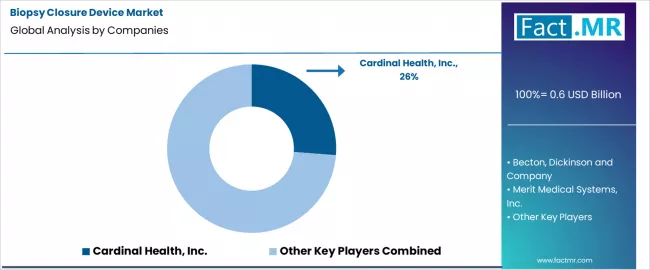
Biopsy Closure Device Market Analysis By Company | Source: Fact.MR
The competitive landscape features a mix of large, diversified medtech corporations with broad interventional portfolios and smaller companies specializing in hemostasis or biopsy technologies. Competition centers on product efficacy, ease of use, and compatibility with different biopsy needles and access routes.
Success is increasingly determined by a company's ability to provide a comprehensive solution that includes not just the closure device itself, but also compatible biopsy instruments and clear, simplified deployment protocols that integrate smoothly into existing clinical workflows.
Companies compete through direct clinical support and training for interventional staff, as well as by generating robust real-world evidence that demonstrates reductions in post-procedural complications and associated costs. Strategic partnerships with biopsy needle manufacturers to create co-packaged or integrated systems are becoming a key differentiator, as they offer a streamlined value proposition to hospitals seeking to optimize procedural efficiency and patient safety.
Key Players in the Biopsy Closure Device Market
Cardinal Health, Inc.
Becton, Dickinson and Company
Merit Medical Systems, Inc.
Terumo Corporation
Teleflex Incorporated
Others
References
European Society of Cardiology. (2025). Guidelines on the Use of Endomyocardial Biopsy. European Heart Journal.
National Comprehensive Cancer Network. (2024). NCCN Clinical Practice Guidelines in Oncology: Principles of Diagnostic Biopsy. NCCN.
Sacks, D., & Matsumoto, A. H. (2024). Society of Interventional Radiology Position Statement on Percutaneous Image-Guided Biopsy. Journal of Vascular and Interventional Radiology.
Swanson, N. A., & Lee, G. K. (2025). Tract Hemostasis after Percutaneous Biopsy: A Review of Current Technologies and Outcomes. Cardiovascular and Interventional Radiology.
World Health Organization. (2025). WHO List of Priority Medical Devices for Cancer Management. WHO.
Cardinal Health, Inc., Becton, Dickinson and Company, Merit Medical Systems, Inc., Terumo Corporation, Teleflex Incorporated, Others
Additional Analysis
Comparative analysis of time-to-hemostasis and complication rates across device types; study of the impact on post-procedure observation time and same-day discharge rates; cost-benefit analysis accounting for potential savings from avoided complications; evaluation of device performance in patients on anticoagulant or antiplatelet therapy; assessment of learning curve and staff training requirements for new closure technologies.
Market by Segments
Device Type :
Collagen-based Plugs
Sealant-based Systems
Suture-mediated Devices
Application :
Cardiovascular Biopsies
Oncology Biopsies
Others
End User :
Hospitals
Diagnostic Centers
ASCs
Region :
North America
USA
Canada
Latin America
Brazil
Mexico
Argentina
Rest of Latin America
Western Europe
Germany
France
Italy
Spain
UK
BENELUX
Rest of Western Europe
Eastern Europe
Russia
Poland
Czech Republic
Rest of Eastern Europe
East Asia
China
Japan
South Korea
Rest of East Asia
South Asia & Pacific
India
ASEAN
Australia
Rest of South Asia & Pacific
MEA
GCC Countries
South Africa
Turkiye
Rest of MEA
Frequently Asked Questions
How big is the biopsy closure device market in 2026?
The global biopsy closure device market is estimated to be valued at USD 0.6 billion in 2026.
What will be the size of biopsy closure device market in 2036?
The market size for the biopsy closure device market is projected to reach USD 1.5 billion by 2036.
How much will be the biopsy closure device market growth between 2026 and 2036?
The biopsy closure device market is expected to grow at a 9.4% CAGR between 2026 and 2036.
What are the key product types in the biopsy closure device market?
The key product types in biopsy closure device market are collagen-based plugs, sealant-based systems and suture-mediated devices.
Which application segment to contribute significant share in the biopsy closure device market in 2026?
In terms of application, cardiovascular biopsies segment to command 53.6% share in the biopsy closure device market in 2026.