Biosurfactants for Oil-Contaminated Soil Cleanup Market
Biosurfactants for Oil-Contaminated Soil Cleanup Market Size and Share Forecast Outlook 2026 to 2036
Biosurfactants for oil-contaminated soil cleanup market is projected to grow from USD 320.0 million in 2026 to USD 845.2 million by 2036, at a CAGR of 10.2%. Rhamnolipids will dominate with a 30.0% market share, while oil spill soil remediation will lead the application type segment with a 36.0% share.
Biosurfactants for Oil-Contaminated Soil Cleanup Market Forecast and Outlook 2026 to 2036
The global market for biosurfactants in oil-contaminated soil cleanup is projected to reach USD 845.21 million by 2036. The market is valued at USD 320.00 million in 2026 and is set to rise at a CAGR of 10.2% during the assessment period.
Key Takeaways from the Biosurfactants for Oil-Contaminated Soil Cleanup Market
- Market Value for 2026: USD 320.00 Million
- Market Value for 2036: USD 845.21 Million
- Forecast CAGR (2026-2036): 10.2%
- Leading Biosurfactant Type Share (2026): Rhamnolipids (30%)
- Leading Application Type Share (2026): Oil Spill Soil Remediation (36%)
- Leading End-Use Sector Share (2026): Environmental Remediation Firms (34%)
- Key Players in the Market: Evonik Industries AG (Biotech), Solvay S.A., Kao Chemicals, Stepan Company, REGENESIS
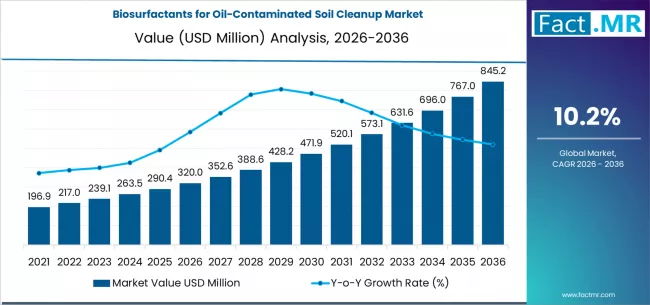
This represents one of the higher growth trajectories in the bioremediation sector, signaling a strong market transition toward biological solutions. By biosurfactant type, rhamnolipids hold a leading 30% share. Oil spill soil remediation represents the dominant application segment at 36%.
Environmental remediation firms constitute the primary end-use sector, accounting for a 34% share. This accelerated growth is propelled by the critical need for effective, environmentally benign solutions to remediate pervasive hydrocarbon pollution. Biosurfactants, produced by microorganisms, offer superior biodegradability, low toxicity, and high effectiveness in mobilizing bound oil from soil particles, making them a preferred green alternative to synthetic surfactants in sensitive environments.
These microbial-derived surfactants are essential for enhancing the bioavailability of hydrocarbons to degrading microbes and facilitating soil washing processes. Their application is central to sustainable remediation strategies that aim to restore contaminated land with minimal ecological disruption.
Biosurfactants for Oil-Contaminated Soil Cleanup Market
| Metric | Value |
|---|---|
| Market Value (2026) | USD 320.00 Million |
| Market Forecast Value (2036) | USD 845.21 Million |
| Forecast CAGR (2026-2036) | 10.2% |
Category
| Category | Segments |
|---|---|
| Biosurfactant Type | Rhamnolipids, Sophorolipids, Lipopeptides (Surfactin, Iturin, etc.), Glycolipids (Mannosylerythritol, Trehalolipids), Other Bio-Based / Microbial Surfactants |
| Application Type | Oil Spill Soil Remediation, Industrial Hydrocarbon Contaminated Sites, Refinery & Petrochemical Waste Sites, Oil Storage & Pipeline Leak Sites, Marine Shoreline & Coastal Soil Cleanup |
| End-Use Sector | Environmental Remediation Firms, Oil & Gas / Petrochemical Companies, Government & Municipal Cleanup Projects, Mining & Industrial Contaminated Sites, Research & Pilot Remediation Programs |
| Region | North America, Latin America, Western Europe, Eastern Europe, East Asia, South Asia & Pacific, MEA |
Segmental Analysis
By Biosurfactant Type, Which Microbial Product is Leading Commercial Adoption?
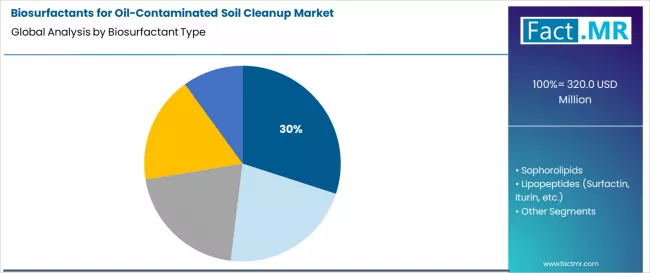
Rhamnolipids lead the segment with a 30% share. This dominance is attributed to their well-researched efficacy, commercial scalability through fermentation processes, and proven ability to reduce surface tension and emulsify crude oil and refined products effectively.
Produced primarily by Pseudomonas aeruginosa, rhamnolipids have become the benchmark biosurfactant for hydrocarbon remediation due to a favorable balance of performance, production economics, and available toxicological data for regulatory acceptance.
By Application Type, Which Scenario Demands the Most Urgent and Effective Cleanup?
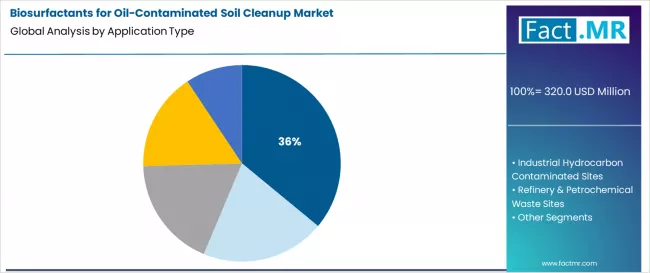
Oil spill soil remediation represents the largest application segment at 36%. Acute land-based spills from tanker accidents, pipeline ruptures, or storage tank failures require immediate intervention to prevent contaminant migration and ecosystem damage.
Biosurfactants are increasingly specified for these emergencies due to their ability to enhance natural attenuation or be used in engineered washing systems without adding persistent chemical liabilities to the already impacted site.
By End-Use Sector, Who are the Primary Specifiers of Green Remediation Technologies?
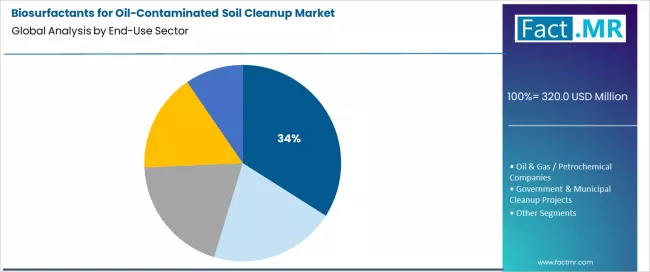
Environmental remediation firms lead the end-use sector with a 34% share. These firms are at the forefront of implementing sustainable remediation technologies on behalf of liable parties.
They evaluate, select, and apply biosurfactants based on technical performance, cost-effectiveness, and their ability to meet regulatory and stakeholder demands for greener cleanup methods. Their role as technology integrators and service providers makes them the central conduit for biosurfactant adoption in the field.
What are the Drivers, Restraints, and Key Trends of the Biosurfactants for Oil-Contaminated Soil Cleanup Market?
The fundamental market driver is the powerful regulatory and societal shift mandating sustainable and non-toxic remediation practices. Regulations restricting the use of synthetic chemicals in sensitive environments and policies promoting green chemistry directly favor biosurfactants. The growing corporate social responsibility (CSR) mandates within the oil and gas sector to minimize their environmental footprint further accelerate the adoption of biological cleanup agents.
A primary restraint is the higher production cost of purified biosurfactants compared to conventional synthetic surfactants, which can be a barrier for large-scale, cost-driven projects. The performance of some biosurfactants can also be sensitive to environmental conditions like pH, salinity, and temperature, requiring careful formulation. A lack of standardized regulatory guidelines specific to biosurfactant application in some regions can also slow approval and deployment.
Key trends include the development of cost-competitive production methods using waste feedstocks to improve economics. There is strong innovation in formulating biosurfactant blends that combine different types to synergistically improve performance across varied conditions. The market is moving toward on-site or in-situ production of biosurfactants by stimulating indigenous microbial communities. Integration with other bioremediation techniques, such as bioaugmentation and nutrient addition, into complete treatment packages is becoming standard practice.
Analysis of the Biosurfactants for Oil-Contaminated Soil Cleanup Market by Key Countries
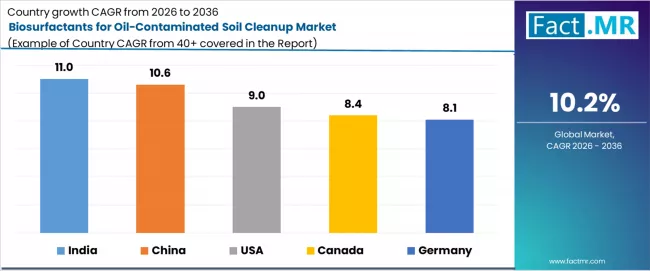
| Country | CAGR (2026-2036) |
|---|---|
| India | 11.00% |
| China | 10.60% |
| USA | 9.00% |
| Canada | 8.40% |
| Germany | 8.10% |
How is India's Rapid Industrialization and Environmental Policy Driving Exceptional Growth?
With an expanding industrial base, frequent incidents of hydrocarbon contamination, and a strong governmental push under initiatives like the National Clean Air Programme and stricter enforcement of environmental restoration fuel India’s leading CAGR of 11.00%.
The need for effective, socially acceptable cleanup solutions for countless industrial zones and fuel depots creates a massive addressable market where biosurfactants are gaining rapid traction as a preferred sustainable technology.
What is the Impact of China's Ecological Civilization Goals on Biosurfactant Adoption?
China's 10.60% growth is supported by its national Beautiful China and soil pollution prevention policies, which incentivize green remediation technologies. As China addresses legacy contamination from its industrial surge, state-backed research and pilot projects are validating and scaling biosurfactant use. The sheer volume of contaminated land needing treatment positions China as a high-growth market for bio-based cleaning agents.
How do US Regulatory Standards and Industry Practices Influence the Market?
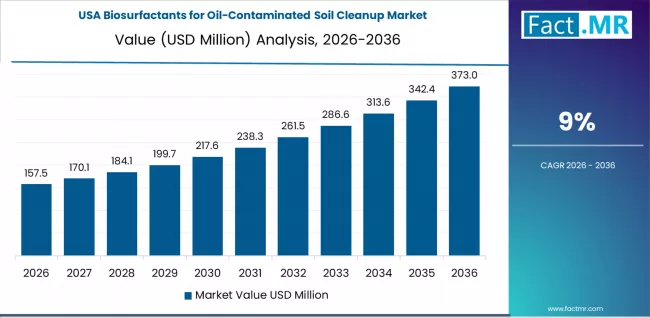
A mature environmental regulatory framework that recognizes green remediation and a sophisticated market that values reduced long-term liability underpin the USA’s 9.00% growth.
The presence of major biosurfactant producers and a network of environmental consulting firms specializing in sustainable remedies facilitates adoption for both emergency spill response and long-term site remediation projects.
Why is Canada's Energy Sector a Key Driver for Biosurfactant Applications?
Canada's 8.40% growth is anchored in its vast oil and gas sector, which generates a continuous need for site remediation, particularly in sensitive boreal and wetland ecosystems. The industry's focus on environmental stewardship and the specific challenge of treating heavy oil and oil sands residues create a strong demand profile for effective, cold-climate-compatible biological agents like biosurfactants.
What Role does Germany's Engineering and Regulatory Precision Play in Market Development?
Germany's 8.10% CAGR reflects its stringent environmental standards and precision-engineering approach to remediation. German projects demand proven, highly effective solutions with documented environmental safety.
This drives demand for high-purity, well-characterized biosurfactants and meticulously planned applications, making Germany a market for advanced, performance-guaranteed biological products.
Competitive Landscape of the Biosurfactants for Oil-Contaminated Soil Cleanup Market
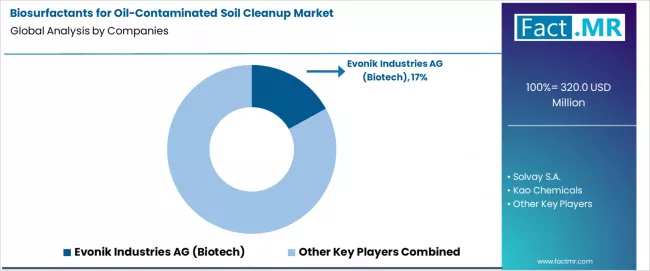
The competitive landscape includes specialty biotechnology firms, diversified chemical companies, and integrated remediation solution providers. Biotechnology leaders like Evonik compete through advanced microbial strain development and fermentation expertise to produce high-performance rhamnolipids and sophorolipids.
Chemical giants like Solvay and Stepan leverage their surfactant science and global supply chains to commercialize biosurfactant lines. Remediation specialists like REGENESIS compete by formulating biosurfactants into ready-to-use remediation products and providing full technical application support. Competition centers on product efficacy data, cost-in-use, sustainability credentials, and the ability to provide robust technical guidance for field success.
Key Players in the Biosurfactants for Oil-Contaminated Soil Cleanup Market
- Evonik Industries AG (Biotech)
- Solvay S.A.
- Kao Chemicals
- Stepan Company
- REGENESIS
Scope of Report
| Items | Values |
|---|---|
| Quantitative Units | USD Million |
| Biosurfactant Type | Rhamnolipids, Sophorolipids, Lipopeptides, Glycolipids, Other Microbial |
| Application Type | Oil Spills, Industrial Sites, Refinery Waste, Pipeline Leaks, Coastal Cleanup |
| End-Use Sector | Remediation Firms, Oil & Gas Companies, Government Projects, Industrial Sites, Research |
| Key Countries | India, China, USA, Canada, Germany |
| Key Companies | Evonik, Solvay, Kao Chemicals, Stepan Company, REGENESIS |
| Additional Analysis | Analysis of critical micelle concentration (CMC) and performance; production pathways (fermentation, extraction); ecotoxicology and biodegradability testing; formulation for soil injection or ex-situ washing; cost-benefit analysis versus synthetic surfactants and other remediation options. |
Market by Segments
-
Biosurfactant Type :
- Rhamnolipids
- Sophorolipids
- Lipopeptides (Surfactin, Iturin, etc.)
- Glycolipids (Mannosylerythritol, Trehalolipids)
- Other Bio-Based / Microbial Surfactants
-
Application Type :
- Oil Spill Soil Remediation
- Industrial Hydrocarbon Contaminated Sites
- Refinery & Petrochemical Waste Sites
- Oil Storage & Pipeline Leak Sites
- Marine Shoreline & Coastal Soil Cleanup
-
End-Use Sector :
- Environmental Remediation Firms
- Oil & Gas/Petrochemical Companies
- Government & Municipal Cleanup Projects
- Mining & Industrial Contaminated Sites
- Research & Pilot Remediation Programs
-
Region :
-
North America
- USA
- Canada
-
Latin America
- Brazil
- Mexico
- Argentina
- Rest of Latin America
-
Western Europe
- Germany
- UK
- France
- Spain
- Italy
- BENELUX
- Rest of Western Europe
-
Eastern Europe
- Russia
- Poland
- Czech Republic
- Rest of Eastern Europe
-
East Asia
- China
- Japan
- South Korea
- Rest of East Asia
-
South Asia & Pacific
- India
- ASEAN
- Australia
- Rest of South Asia & Pacific
-
MEA
- Saudi Arabia
- UAE
- Turkiye
- Rest of MEA
-
Table of Content
- Executive Summary
- Global Market Outlook
- Demand to side Trends
- Supply to side Trends
- Technology Roadmap Analysis
- Analysis and Recommendations
- Market Overview
- Market Coverage / Taxonomy
- Market Definition / Scope / Limitations
- Market Background
- Market Dynamics
- Drivers
- Restraints
- Opportunity
- Trends
- Scenario Forecast
- Demand in Optimistic Scenario
- Demand in Likely Scenario
- Demand in Conservative Scenario
- Opportunity Map Analysis
- Product Life Cycle Analysis
- Supply Chain Analysis
- Investment Feasibility Matrix
- Value Chain Analysis
- PESTLE and Porter’s Analysis
- Regulatory Landscape
- Regional Parent Market Outlook
- Production and Consumption Statistics
- Import and Export Statistics
- Market Dynamics
- Global Market Analysis 2021 to 2025 and Forecast, 2026 to 2036
- Historical Market Size Value (USD Million) Analysis, 2021 to 2025
- Current and Future Market Size Value (USD Million) Projections, 2026 to 2036
- Y to o to Y Growth Trend Analysis
- Absolute $ Opportunity Analysis
- Global Market Pricing Analysis 2021 to 2025 and Forecast 2026 to 2036
- Global Market Analysis 2021 to 2025 and Forecast 2026 to 2036, By Biosurfactant Type
- Introduction / Key Findings
- Historical Market Size Value (USD Million) Analysis By Biosurfactant Type, 2021 to 2025
- Current and Future Market Size Value (USD Million) Analysis and Forecast By Biosurfactant Type, 2026 to 2036
- Rhamnolipids
- Sophorolipids
- Lipopeptides (Surfactin, Iturin, etc.)
- Glycolipids (Mannosylerythritol, Trehalolipids)
- Other Bio-Based / Microbial Surfactants
- Rhamnolipids
- Y to o to Y Growth Trend Analysis By Biosurfactant Type, 2021 to 2025
- Absolute $ Opportunity Analysis By Biosurfactant Type, 2026 to 2036
- Global Market Analysis 2021 to 2025 and Forecast 2026 to 2036, By Application Type
- Introduction / Key Findings
- Historical Market Size Value (USD Million) Analysis By Application Type, 2021 to 2025
- Current and Future Market Size Value (USD Million) Analysis and Forecast By Application Type, 2026 to 2036
- Oil Spill Soil Remediation
- Industrial Hydrocarbon Contaminated Sites
- Refinery & Petrochemical Waste Sites
- Oil Storage & Pipeline Leak Sites
- Marine Shoreline & Coastal Soil Cleanup
- Oil Spill Soil Remediation
- Y to o to Y Growth Trend Analysis By Application Type, 2021 to 2025
- Absolute $ Opportunity Analysis By Application Type, 2026 to 2036
- Global Market Analysis 2021 to 2025 and Forecast 2026 to 2036, By End-Use Sector
- Introduction / Key Findings
- Historical Market Size Value (USD Million) Analysis By End-Use Sector, 2021 to 2025
- Current and Future Market Size Value (USD Million) Analysis and Forecast By End-Use Sector, 2026 to 2036
- Environmental Remediation Firms
- Oil & Gas / Petrochemical Companies
- Government & Municipal Cleanup Projects
- Mining & Industrial Contaminated Sites
- Research & Pilot Remediation Programs
- Environmental Remediation Firms
- Y to o to Y Growth Trend Analysis By End-Use Sector, 2021 to 2025
- Absolute $ Opportunity Analysis By End-Use Sector, 2026 to 2036
- Global Market Analysis 2021 to 2025 and Forecast 2026 to 2036, By Region
- Introduction
- Historical Market Size Value (USD Million) Analysis By Region, 2021 to 2025
- Current Market Size Value (USD Million) Analysis and Forecast By Region, 2026 to 2036
- North America
- Latin America
- Western Europe
- Eastern Europe
- East Asia
- South Asia and Pacific
- Middle East & Africa
- Market Attractiveness Analysis By Region
- North America Market Analysis 2021 to 2025 and Forecast 2026 to 2036, By Country
- Historical Market Size Value (USD Million) Trend Analysis By Market Taxonomy, 2021 to 2025
- Market Size Value (USD Million) Forecast By Market Taxonomy, 2026 to 2036
- By Country
- USA
- Canada
- Mexico
- By Biosurfactant Type
- By Application Type
- By End-Use Sector
- By Country
- Market Attractiveness Analysis
- By Country
- By Biosurfactant Type
- By Application Type
- By End-Use Sector
- Key Takeaways
- Latin America Market Analysis 2021 to 2025 and Forecast 2026 to 2036, By Country
- Historical Market Size Value (USD Million) Trend Analysis By Market Taxonomy, 2021 to 2025
- Market Size Value (USD Million) Forecast By Market Taxonomy, 2026 to 2036
- By Country
- Brazil
- Chile
- Rest of Latin America
- By Biosurfactant Type
- By Application Type
- By End-Use Sector
- By Country
- Market Attractiveness Analysis
- By Country
- By Biosurfactant Type
- By Application Type
- By End-Use Sector
- Key Takeaways
- Western Europe Market Analysis 2021 to 2025 and Forecast 2026 to 2036, By Country
- Historical Market Size Value (USD Million) Trend Analysis By Market Taxonomy, 2021 to 2025
- Market Size Value (USD Million) Forecast By Market Taxonomy, 2026 to 2036
- By Country
- Germany
- UK
- Italy
- Spain
- France
- Nordic
- BENELUX
- Rest of Western Europe
- By Biosurfactant Type
- By Application Type
- By End-Use Sector
- By Country
- Market Attractiveness Analysis
- By Country
- By Biosurfactant Type
- By Application Type
- By End-Use Sector
- Key Takeaways
- Eastern Europe Market Analysis 2021 to 2025 and Forecast 2026 to 2036, By Country
- Historical Market Size Value (USD Million) Trend Analysis By Market Taxonomy, 2021 to 2025
- Market Size Value (USD Million) Forecast By Market Taxonomy, 2026 to 2036
- By Country
- Russia
- Poland
- Hungary
- Balkan & Baltic
- Rest of Eastern Europe
- By Biosurfactant Type
- By Application Type
- By End-Use Sector
- By Country
- Market Attractiveness Analysis
- By Country
- By Biosurfactant Type
- By Application Type
- By End-Use Sector
- Key Takeaways
- East Asia Market Analysis 2021 to 2025 and Forecast 2026 to 2036, By Country
- Historical Market Size Value (USD Million) Trend Analysis By Market Taxonomy, 2021 to 2025
- Market Size Value (USD Million) Forecast By Market Taxonomy, 2026 to 2036
- By Country
- China
- Japan
- South Korea
- By Biosurfactant Type
- By Application Type
- By End-Use Sector
- By Country
- Market Attractiveness Analysis
- By Country
- By Biosurfactant Type
- By Application Type
- By End-Use Sector
- Key Takeaways
- South Asia and Pacific Market Analysis 2021 to 2025 and Forecast 2026 to 2036, By Country
- Historical Market Size Value (USD Million) Trend Analysis By Market Taxonomy, 2021 to 2025
- Market Size Value (USD Million) Forecast By Market Taxonomy, 2026 to 2036
- By Country
- India
- ASEAN
- Australia & New Zealand
- Rest of South Asia and Pacific
- By Biosurfactant Type
- By Application Type
- By End-Use Sector
- By Country
- Market Attractiveness Analysis
- By Country
- By Biosurfactant Type
- By Application Type
- By End-Use Sector
- Key Takeaways
- Middle East & Africa Market Analysis 2021 to 2025 and Forecast 2026 to 2036, By Country
- Historical Market Size Value (USD Million) Trend Analysis By Market Taxonomy, 2021 to 2025
- Market Size Value (USD Million) Forecast By Market Taxonomy, 2026 to 2036
- By Country
- Kingdom of Saudi Arabia
- Other GCC Countries
- Turkiye
- South Africa
- Other African Union
- Rest of Middle East & Africa
- By Biosurfactant Type
- By Application Type
- By End-Use Sector
- By Country
- Market Attractiveness Analysis
- By Country
- By Biosurfactant Type
- By Application Type
- By End-Use Sector
- Key Takeaways
- Key Countries Market Analysis
- USA
- Pricing Analysis
- Market Share Analysis, 2025
- By Biosurfactant Type
- By Application Type
- By End-Use Sector
- Canada
- Pricing Analysis
- Market Share Analysis, 2025
- By Biosurfactant Type
- By Application Type
- By End-Use Sector
- Mexico
- Pricing Analysis
- Market Share Analysis, 2025
- By Biosurfactant Type
- By Application Type
- By End-Use Sector
- Brazil
- Pricing Analysis
- Market Share Analysis, 2025
- By Biosurfactant Type
- By Application Type
- By End-Use Sector
- Chile
- Pricing Analysis
- Market Share Analysis, 2025
- By Biosurfactant Type
- By Application Type
- By End-Use Sector
- Germany
- Pricing Analysis
- Market Share Analysis, 2025
- By Biosurfactant Type
- By Application Type
- By End-Use Sector
- UK
- Pricing Analysis
- Market Share Analysis, 2025
- By Biosurfactant Type
- By Application Type
- By End-Use Sector
- Italy
- Pricing Analysis
- Market Share Analysis, 2025
- By Biosurfactant Type
- By Application Type
- By End-Use Sector
- Spain
- Pricing Analysis
- Market Share Analysis, 2025
- By Biosurfactant Type
- By Application Type
- By End-Use Sector
- France
- Pricing Analysis
- Market Share Analysis, 2025
- By Biosurfactant Type
- By Application Type
- By End-Use Sector
- India
- Pricing Analysis
- Market Share Analysis, 2025
- By Biosurfactant Type
- By Application Type
- By End-Use Sector
- ASEAN
- Pricing Analysis
- Market Share Analysis, 2025
- By Biosurfactant Type
- By Application Type
- By End-Use Sector
- Australia & New Zealand
- Pricing Analysis
- Market Share Analysis, 2025
- By Biosurfactant Type
- By Application Type
- By End-Use Sector
- China
- Pricing Analysis
- Market Share Analysis, 2025
- By Biosurfactant Type
- By Application Type
- By End-Use Sector
- Japan
- Pricing Analysis
- Market Share Analysis, 2025
- By Biosurfactant Type
- By Application Type
- By End-Use Sector
- South Korea
- Pricing Analysis
- Market Share Analysis, 2025
- By Biosurfactant Type
- By Application Type
- By End-Use Sector
- Russia
- Pricing Analysis
- Market Share Analysis, 2025
- By Biosurfactant Type
- By Application Type
- By End-Use Sector
- Poland
- Pricing Analysis
- Market Share Analysis, 2025
- By Biosurfactant Type
- By Application Type
- By End-Use Sector
- Hungary
- Pricing Analysis
- Market Share Analysis, 2025
- By Biosurfactant Type
- By Application Type
- By End-Use Sector
- Kingdom of Saudi Arabia
- Pricing Analysis
- Market Share Analysis, 2025
- By Biosurfactant Type
- By Application Type
- By End-Use Sector
- Turkiye
- Pricing Analysis
- Market Share Analysis, 2025
- By Biosurfactant Type
- By Application Type
- By End-Use Sector
- South Africa
- Pricing Analysis
- Market Share Analysis, 2025
- By Biosurfactant Type
- By Application Type
- By End-Use Sector
- USA
- Market Structure Analysis
- Competition Dashboard
- Competition Benchmarking
- Market Share Analysis of Top Players
- By Regional
- By Biosurfactant Type
- By Application Type
- By End-Use Sector
- Competition Analysis
- Competition Deep Dive
- Evonik Industries AG (Biotech)
- Overview
- Product Portfolio
- Profitability by Market Segments (Product/Age /Sales Channel/Region)
- Sales Footprint
- Strategy Overview
- Marketing Strategy
- Product Strategy
- Channel Strategy
- Solvay S.A.
- Kao Chemicals
- Stepan Company
- REGENESIS
- Evonik Industries AG (Biotech)
- Competition Deep Dive
- Assumptions & Acronyms Used
- Research Methodology
List Of Table
- Table 1: Global Market Value (USD Million) Forecast by Region, 2021 to 2036
- Table 2: Global Market Value (USD Million) Forecast by Biosurfactant Type, 2021 to 2036
- Table 3: Global Market Value (USD Million) Forecast by Application Type, 2021 to 2036
- Table 4: Global Market Value (USD Million) Forecast by End-Use Sector, 2021 to 2036
- Table 5: North America Market Value (USD Million) Forecast by Country, 2021 to 2036
- Table 6: North America Market Value (USD Million) Forecast by Biosurfactant Type, 2021 to 2036
- Table 7: North America Market Value (USD Million) Forecast by Application Type, 2021 to 2036
- Table 8: North America Market Value (USD Million) Forecast by End-Use Sector, 2021 to 2036
- Table 9: Latin America Market Value (USD Million) Forecast by Country, 2021 to 2036
- Table 10: Latin America Market Value (USD Million) Forecast by Biosurfactant Type, 2021 to 2036
- Table 11: Latin America Market Value (USD Million) Forecast by Application Type, 2021 to 2036
- Table 12: Latin America Market Value (USD Million) Forecast by End-Use Sector, 2021 to 2036
- Table 13: Western Europe Market Value (USD Million) Forecast by Country, 2021 to 2036
- Table 14: Western Europe Market Value (USD Million) Forecast by Biosurfactant Type, 2021 to 2036
- Table 15: Western Europe Market Value (USD Million) Forecast by Application Type, 2021 to 2036
- Table 16: Western Europe Market Value (USD Million) Forecast by End-Use Sector, 2021 to 2036
- Table 17: Eastern Europe Market Value (USD Million) Forecast by Country, 2021 to 2036
- Table 18: Eastern Europe Market Value (USD Million) Forecast by Biosurfactant Type, 2021 to 2036
- Table 19: Eastern Europe Market Value (USD Million) Forecast by Application Type, 2021 to 2036
- Table 20: Eastern Europe Market Value (USD Million) Forecast by End-Use Sector, 2021 to 2036
- Table 21: East Asia Market Value (USD Million) Forecast by Country, 2021 to 2036
- Table 22: East Asia Market Value (USD Million) Forecast by Biosurfactant Type, 2021 to 2036
- Table 23: East Asia Market Value (USD Million) Forecast by Application Type, 2021 to 2036
- Table 24: East Asia Market Value (USD Million) Forecast by End-Use Sector, 2021 to 2036
- Table 25: South Asia and Pacific Market Value (USD Million) Forecast by Country, 2021 to 2036
- Table 26: South Asia and Pacific Market Value (USD Million) Forecast by Biosurfactant Type, 2021 to 2036
- Table 27: South Asia and Pacific Market Value (USD Million) Forecast by Application Type, 2021 to 2036
- Table 28: South Asia and Pacific Market Value (USD Million) Forecast by End-Use Sector, 2021 to 2036
- Table 29: Middle East & Africa Market Value (USD Million) Forecast by Country, 2021 to 2036
- Table 30: Middle East & Africa Market Value (USD Million) Forecast by Biosurfactant Type, 2021 to 2036
- Table 31: Middle East & Africa Market Value (USD Million) Forecast by Application Type, 2021 to 2036
- Table 32: Middle East & Africa Market Value (USD Million) Forecast by End-Use Sector, 2021 to 2036
List Of Figures
- Figure 1: Global Market Pricing Analysis
- Figure 2: Global Market Value (USD Million) Forecast 2021 to 2036
- Figure 3: Global Market Value Share and BPS Analysis by Biosurfactant Type, 2026 and 2036
- Figure 4: Global Market Y to o to Y Growth Comparison by Biosurfactant Type, 2026 to 2036
- Figure 5: Global Market Attractiveness Analysis by Biosurfactant Type
- Figure 6: Global Market Value Share and BPS Analysis by Application Type, 2026 and 2036
- Figure 7: Global Market Y to o to Y Growth Comparison by Application Type, 2026 to 2036
- Figure 8: Global Market Attractiveness Analysis by Application Type
- Figure 9: Global Market Value Share and BPS Analysis by End-Use Sector, 2026 and 2036
- Figure 10: Global Market Y to o to Y Growth Comparison by End-Use Sector, 2026 to 2036
- Figure 11: Global Market Attractiveness Analysis by End-Use Sector
- Figure 12: Global Market Value (USD Million) Share and BPS Analysis by Region, 2026 and 2036
- Figure 13: Global Market Y to o to Y Growth Comparison by Region, 2026 to 2036
- Figure 14: Global Market Attractiveness Analysis by Region
- Figure 15: North America Market Incremental Dollar Opportunity, 2026 to 2036
- Figure 16: Latin America Market Incremental Dollar Opportunity, 2026 to 2036
- Figure 17: Western Europe Market Incremental Dollar Opportunity, 2026 to 2036
- Figure 18: Eastern Europe Market Incremental Dollar Opportunity, 2026 to 2036
- Figure 19: East Asia Market Incremental Dollar Opportunity, 2026 to 2036
- Figure 20: South Asia and Pacific Market Incremental Dollar Opportunity, 2026 to 2036
- Figure 21: Middle East & Africa Market Incremental Dollar Opportunity, 2026 to 2036
- Figure 22: North America Market Value Share and BPS Analysis by Country, 2026 and 2036
- Figure 23: North America Market Value Share and BPS Analysis by Biosurfactant Type, 2026 and 2036
- Figure 24: North America Market Y to o to Y Growth Comparison by Biosurfactant Type, 2026 to 2036
- Figure 25: North America Market Attractiveness Analysis by Biosurfactant Type
- Figure 26: North America Market Value Share and BPS Analysis by Application Type, 2026 and 2036
- Figure 27: North America Market Y to o to Y Growth Comparison by Application Type, 2026 to 2036
- Figure 28: North America Market Attractiveness Analysis by Application Type
- Figure 29: North America Market Value Share and BPS Analysis by End-Use Sector, 2026 and 2036
- Figure 30: North America Market Y to o to Y Growth Comparison by End-Use Sector, 2026 to 2036
- Figure 31: North America Market Attractiveness Analysis by End-Use Sector
- Figure 32: Latin America Market Value Share and BPS Analysis by Country, 2026 and 2036
- Figure 33: Latin America Market Value Share and BPS Analysis by Biosurfactant Type, 2026 and 2036
- Figure 34: Latin America Market Y to o to Y Growth Comparison by Biosurfactant Type, 2026 to 2036
- Figure 35: Latin America Market Attractiveness Analysis by Biosurfactant Type
- Figure 36: Latin America Market Value Share and BPS Analysis by Application Type, 2026 and 2036
- Figure 37: Latin America Market Y to o to Y Growth Comparison by Application Type, 2026 to 2036
- Figure 38: Latin America Market Attractiveness Analysis by Application Type
- Figure 39: Latin America Market Value Share and BPS Analysis by End-Use Sector, 2026 and 2036
- Figure 40: Latin America Market Y to o to Y Growth Comparison by End-Use Sector, 2026 to 2036
- Figure 41: Latin America Market Attractiveness Analysis by End-Use Sector
- Figure 42: Western Europe Market Value Share and BPS Analysis by Country, 2026 and 2036
- Figure 43: Western Europe Market Value Share and BPS Analysis by Biosurfactant Type, 2026 and 2036
- Figure 44: Western Europe Market Y to o to Y Growth Comparison by Biosurfactant Type, 2026 to 2036
- Figure 45: Western Europe Market Attractiveness Analysis by Biosurfactant Type
- Figure 46: Western Europe Market Value Share and BPS Analysis by Application Type, 2026 and 2036
- Figure 47: Western Europe Market Y to o to Y Growth Comparison by Application Type, 2026 to 2036
- Figure 48: Western Europe Market Attractiveness Analysis by Application Type
- Figure 49: Western Europe Market Value Share and BPS Analysis by End-Use Sector, 2026 and 2036
- Figure 50: Western Europe Market Y to o to Y Growth Comparison by End-Use Sector, 2026 to 2036
- Figure 51: Western Europe Market Attractiveness Analysis by End-Use Sector
- Figure 52: Eastern Europe Market Value Share and BPS Analysis by Country, 2026 and 2036
- Figure 53: Eastern Europe Market Value Share and BPS Analysis by Biosurfactant Type, 2026 and 2036
- Figure 54: Eastern Europe Market Y to o to Y Growth Comparison by Biosurfactant Type, 2026 to 2036
- Figure 55: Eastern Europe Market Attractiveness Analysis by Biosurfactant Type
- Figure 56: Eastern Europe Market Value Share and BPS Analysis by Application Type, 2026 and 2036
- Figure 57: Eastern Europe Market Y to o to Y Growth Comparison by Application Type, 2026 to 2036
- Figure 58: Eastern Europe Market Attractiveness Analysis by Application Type
- Figure 59: Eastern Europe Market Value Share and BPS Analysis by End-Use Sector, 2026 and 2036
- Figure 60: Eastern Europe Market Y to o to Y Growth Comparison by End-Use Sector, 2026 to 2036
- Figure 61: Eastern Europe Market Attractiveness Analysis by End-Use Sector
- Figure 62: East Asia Market Value Share and BPS Analysis by Country, 2026 and 2036
- Figure 63: East Asia Market Value Share and BPS Analysis by Biosurfactant Type, 2026 and 2036
- Figure 64: East Asia Market Y to o to Y Growth Comparison by Biosurfactant Type, 2026 to 2036
- Figure 65: East Asia Market Attractiveness Analysis by Biosurfactant Type
- Figure 66: East Asia Market Value Share and BPS Analysis by Application Type, 2026 and 2036
- Figure 67: East Asia Market Y to o to Y Growth Comparison by Application Type, 2026 to 2036
- Figure 68: East Asia Market Attractiveness Analysis by Application Type
- Figure 69: East Asia Market Value Share and BPS Analysis by End-Use Sector, 2026 and 2036
- Figure 70: East Asia Market Y to o to Y Growth Comparison by End-Use Sector, 2026 to 2036
- Figure 71: East Asia Market Attractiveness Analysis by End-Use Sector
- Figure 72: South Asia and Pacific Market Value Share and BPS Analysis by Country, 2026 and 2036
- Figure 73: South Asia and Pacific Market Value Share and BPS Analysis by Biosurfactant Type, 2026 and 2036
- Figure 74: South Asia and Pacific Market Y to o to Y Growth Comparison by Biosurfactant Type, 2026 to 2036
- Figure 75: South Asia and Pacific Market Attractiveness Analysis by Biosurfactant Type
- Figure 76: South Asia and Pacific Market Value Share and BPS Analysis by Application Type, 2026 and 2036
- Figure 77: South Asia and Pacific Market Y to o to Y Growth Comparison by Application Type, 2026 to 2036
- Figure 78: South Asia and Pacific Market Attractiveness Analysis by Application Type
- Figure 79: South Asia and Pacific Market Value Share and BPS Analysis by End-Use Sector, 2026 and 2036
- Figure 80: South Asia and Pacific Market Y to o to Y Growth Comparison by End-Use Sector, 2026 to 2036
- Figure 81: South Asia and Pacific Market Attractiveness Analysis by End-Use Sector
- Figure 82: Middle East & Africa Market Value Share and BPS Analysis by Country, 2026 and 2036
- Figure 83: Middle East & Africa Market Value Share and BPS Analysis by Biosurfactant Type, 2026 and 2036
- Figure 84: Middle East & Africa Market Y to o to Y Growth Comparison by Biosurfactant Type, 2026 to 2036
- Figure 85: Middle East & Africa Market Attractiveness Analysis by Biosurfactant Type
- Figure 86: Middle East & Africa Market Value Share and BPS Analysis by Application Type, 2026 and 2036
- Figure 87: Middle East & Africa Market Y to o to Y Growth Comparison by Application Type, 2026 to 2036
- Figure 88: Middle East & Africa Market Attractiveness Analysis by Application Type
- Figure 89: Middle East & Africa Market Value Share and BPS Analysis by End-Use Sector, 2026 and 2036
- Figure 90: Middle East & Africa Market Y to o to Y Growth Comparison by End-Use Sector, 2026 to 2036
- Figure 91: Middle East & Africa Market Attractiveness Analysis by End-Use Sector
- Figure 92: Global Market - Tier Structure Analysis
- Figure 93: Global Market - Company Share Analysis
- FAQs -
How big is the biosurfactants for oil-contaminated soil cleanup market in 2026?
The global biosurfactants for oil-contaminated soil cleanup market is estimated to be valued at USD 320.0 million in 2026.
What will be the size of biosurfactants for oil-contaminated soil cleanup market in 2036?
The market size for the biosurfactants for oil-contaminated soil cleanup market is projected to reach USD 845.2 million by 2036.
How much will be the biosurfactants for oil-contaminated soil cleanup market growth between 2026 and 2036?
The biosurfactants for oil-contaminated soil cleanup market is expected to grow at a 10.2% CAGR between 2026 and 2036.
What are the key product types in the biosurfactants for oil-contaminated soil cleanup market?
The key product types in biosurfactants for oil-contaminated soil cleanup market are rhamnolipids, sophorolipids, lipopeptides (surfactin, iturin, etc.), glycolipids (mannosylerythritol, trehalolipids) and other bio-based / microbial surfactants.
Which application type segment to contribute significant share in the biosurfactants for oil-contaminated soil cleanup market in 2026?
In terms of application type, oil spill soil remediation segment to command 36.0% share in the biosurfactants for oil-contaminated soil cleanup market in 2026.