- Market Value (2025): USD 4.47 Bn
- Estimated Value (2026): USD 4.65 Bn
- Forecast Value (2036): USD 6.87 Bn
- CAGR (2026-2036): 4.0%
What is the Bleached Speciality Kraft Papers Market forecast to be worth by 2036?
USD 4.7 billion in 2026 to USD 6.9 billion by 2036 at a 4.0% CAGR.
- Fact.MR estimates that the market reached USD 4.47 billion in 2025, built mainly on food wraps and coated barrier grades.
- Revenue is set to climb from USD 4.65 billion in 2026 to USD 6.87 billion by 2036 as converters move flexible packs from plastic film to paper.
- The decade will deliver a 4.0% CAGR, since PFAS limits in Europe and the United States widen the use of coated barrier grades.
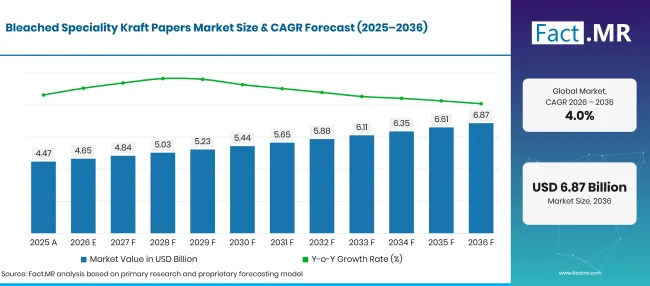
Factmr Bleached Speciality Kraft Papers Market Forecast Global | Source: Fact.MR
| Year | Basis | Market Value (USD billion) |
|---|---|---|
| 2025 | Actual | 4.47 |
| 2026 | Estimate | 4.65 |
| 2036 | Forecast | 6.87 |
| CAGR 2026 to 2036 | Forecast period | 4.0% |
Source: Fact.MR analysis. Updated Oct 21, 2026
What are the defining numbers behind Bleached Speciality Kraft Papers Market growth?
Between 2026 and 2036 the market will add USD 2.2 billion, with barrier-coated food packaging taking the bulk.
- Demand Drivers in the Market
- Food-contact rules in Europe now limit fluorinated grease barriers. Regulation (EU) 2025/40 on packaging and packaging waste has applied since 12 August 2026 and restricts PFAS in food-contact packaging above set thresholds [1]. Converters that relied on fluorochemical treatments for bakery and fast-food wraps are switching to barrier-coated bleached kraft.
- Barrier coatings now let paper protect dry foods that once needed foil or multilayer film. Mondi announced in August 2025 that it was ramping up FunctionalBarrier Paper Ultimate, a recyclable paper with oxygen and water vapor barriers for coffee sticks and tea sachets [2]. Grades of this type run on existing form-fill-seal lines, so brands avoid new machinery.
- Online shopping keeps adding parcels that need light, printable wraps. Eurostat reported that 78% of EU internet users aged 16 to 74 bought or ordered goods or services online in 2025 [3]. Retailers replacing plastic mailers with paper ones buy white kraft for its print surface and tear strength.
- Paper mills are moving machines away from shrinking graphic grades. White machine-glazed and specialty kraft lines give producers a new outlet for fiber once sold into printing paper.
- Medical device makers need clean and strong paper for sterile-barrier packs. Its low lint and uniform surface suit printed peel pouches and sterilization wraps.
- Key Segments Analyzed
- By Product Type: Coated will account for 52.7% share in 2026, since barrier and heat-seal layers carry paper into food packs that uncoated sheets cannot protect.
- By Application: Packaging will take 42.8% share in 2026 as brand owners swap plastic film for paper in wraps, bags and pouches.
- By End-User Industry: Food and Beverage will capture 31.6% share in 2026, owing to food-contact rules that favor clean, bleached fiber.
- By Distribution Channel: Direct Sales will represent 48.3% share in 2026, given that large converters buy full reels against fixed specifications.
- Analyst Opinion at Fact.MR
- Shambhu Nath Jha, Principal Consultant at Fact.MR, states, “Converters now specify bleached specialty kraft as a working barrier material and judge it on grease, moisture and heat-seal results. PFAS limits in Europe and the United States have removed the old fluorochemical shortcut, so coating chemistry decides which grades win food contracts. Mills that can deliver white base paper and coated grades from the same region will hold the stronger position with food, healthcare and e-commerce buyers.”
- Strategic Implications
- Paper producers should widen their heat-sealable and barrier-coated ranges, as buyers now compare paper against film on sealing speed and shelf life.
- Coating developers should document PFAS-free status and food-contact compliance for every grade, so converters can meet the EU limits in force since August 2026 [1].
- Converters should trial white machine-glazed grades on their current pouch and bag lines before committing to new equipment.
- Mills serving large accounts should pair direct contracts with technical trials, since specification buyers pay for steady caliper and coating weight.
The United Kingdom heads the five-country group at 5.0%, as the Plastic Packaging Tax keeps film costlier than paper. Japan follows at 4.5% on paper barrier packs for staple foods and steady online goods sales. Germany tracks the global pace at 4.0%, where EU packaging rules apply directly to converters. A deep pulp base carries Brazil to 3.3%, while the United States closes the list at 3.0% on a mature but parcel-heavy packaging base.
How does the Bleached Speciality Kraft Papers Market break down by segment?
Coated will lead Product Type at 52.7%; Packaging will head Application at 42.8%; Food and Beverage will top End-User Industry at 31.6%; Direct Sales will take first place in Distribution Channel at 48.3%.
Which Product Type leads?
Coated grades hold 52.7% of 2026 sales.
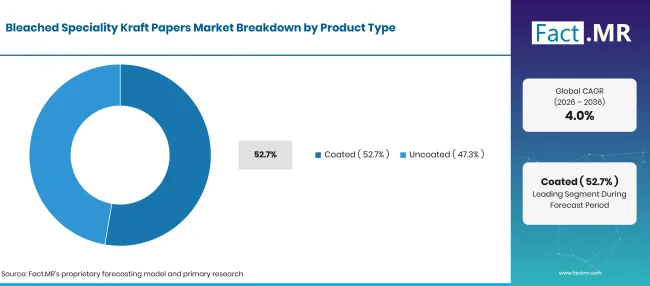
Factmr Bleached Speciality Kraft Papers Market Breakdown Product Type | Source: Fact.MR
| Product Type | Share (2026) |
|---|---|
| Coated (Leading segment) | 52.7% |
| Other segments combined | 47.3%* |
| Total | 100.0% |
Source: Fact.MR analysis. Updated Oct 21, 2026
Food brands need paper that holds back grease and moisture and still seals on a pouch line. Coated bleached kraft does this with extrusion, dispersion or heat-seal layers on a white base that also takes sharp retail print. Converters now use these grades in flexible wraps and food bags that once relied on film, often with paper barrier coatings that keep the pack recyclable in paper streams. Uncoated grades keep their place where buyers value natural texture and tear strength. Bag makers and medical pack converters buy them for carrier bags, interleaving and wrapping. Smooth uncoated sheets also compete with super-calendered kraft papers as base stock for labels and flexible packaging.
What supports Packaging within Application?
Packaging takes 42.8% of 2026 revenue.
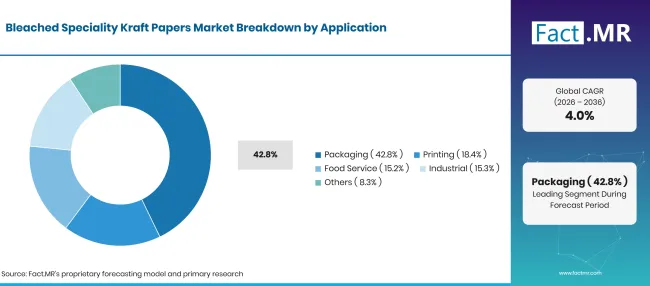
Factmr Bleached Speciality Kraft Papers Market Breakdown Application | Source: Fact.MR
| Application | Share (2026) |
|---|---|
| Packaging (Leading segment) | 42.8% |
| Other segments combined | 57.2%* |
| Total | 100.0% |
Source: Fact.MR analysis. Updated Oct 21, 2026
Brand owners in food, personal care and e-commerce are replacing plastic film with recyclable paper. Bleached kraft gives them strength with a clean white face for print. Demand also gains from the wider move toward paper packaging materials as retailers set recyclability targets. Fiber already carries a large part of the packaging stream in Europe. Eurostat reported that paper and cardboard made up 32.3 million tonnes, or 40.4%, of the 79.7 million tonnes of packaging waste generated in the EU in 2023 [4]. Printing follows packaging through labels and premium wraps, while Food Service relies on takeaway wraps and bakery bags. Industrial buyers take protective wrapping and technical grades.
What leads the End-User Industry segment?
Food and Beverage accounts for 31.6% of 2026 demand.
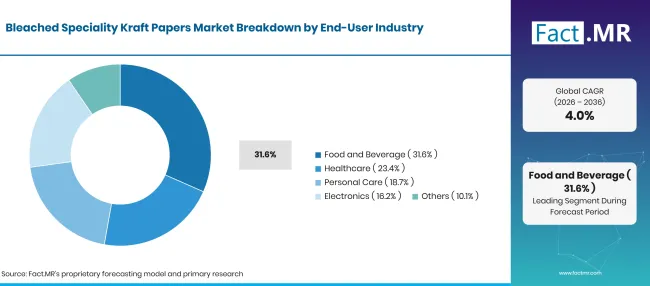
Factmr Bleached Speciality Kraft Papers Market Breakdown End User Industry | Source: Fact.MR
| End-User Industry | Share (2026) |
|---|---|
| Food and Beverage (Leading segment) | 31.6% |
| Other segments combined | 68.4%* |
| Total | 100.0% |
Source: Fact.MR analysis. Updated Oct 21, 2026
Bakers, confectioners and frozen-food packers wrap products that release fat and moisture, so they need grease-resistant paper cleared for direct food contact. Bleached fiber gives a clean and odor-free sheet that eases food-contact approval. Fluorine-free greaseproof paper grades are replacing older treated sheets in this group. In the United States, the Food and Drug Administration determined that 35 food contact notifications for PFAS grease-proofing substances used on paper and paperboard were no longer effective as of January 6, 2025 [5]. Healthcare comes next, using strong and clean paper in sterile medical packaging such as peel pouches and wraps. Personal Care and Electronics buy smaller volumes for premium recyclable wraps and inserts.
How does Distribution Channel shape demand?
Direct Sales represent 48.3% of the 2026 market.
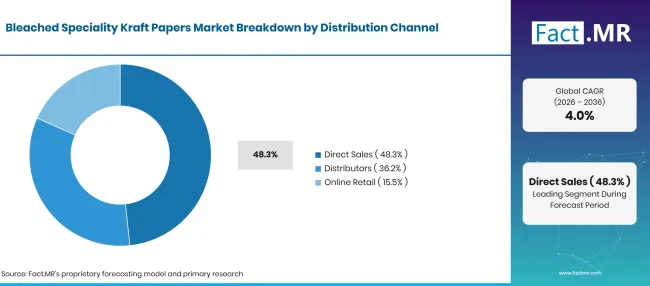
Factmr Bleached Speciality Kraft Papers Market Breakdown Distribution Channel | Source: Fact.MR
| Distribution Channel | Share (2026) |
|---|---|
| Direct Sales (Leading segment) | 48.3% |
| Other segments combined | 51.7%* |
| Total | 100.0% |
Source: Fact.MR analysis. Updated Oct 21, 2026
Converters and brand owners buy full reels against technical specifications that fix basis weight, coating and delivery dates. Long-term contracts give mills steady orders and buyers consistent quality. Distributors serve smaller converters and regional buyers that want mixed grades, short lead times and local stock. Online Retail serves small, repeat orders from print shops and craft packers.
What is accelerating Bleached Speciality Kraft Papers Market adoption, and what is holding it back?
Plastic taxes, PFAS limits and parcel growth are moving buyers toward white kraft papers with barrier coatings. Volatile pulp and energy costs, along with the price gap between coated paper and film, slow the switch for cost-sensitive packs.
Drivers Impact Analysis
| DRIVER | (~) % IMPACT ON CAGR | GEOGRAPHIC RELEVANCE | IMPACT TIMELINE |
|---|---|---|---|
| Regulatory and brand-led migration from plastic to paper-based packaging in food and consumer goods | +1.4% | Global | Short term (<= 2 years) |
| Rising need for grease- and moisture-resistant papers that meet food-contact standards | +1.0% | Global | Medium term (2-4 years) |
| Growing use of clean, high-strength paper in sterile-barrier and medical packaging | +0.5% | North America, Western Europe, East Asia | Medium term (2-4 years) |
| Expanding parcel and takeaway volumes from online retail and food service | +0.3% | Global | Short term (<= 2 years) |
Source: Fact.MR analysis. Updated Oct 21, 2026
Opportunity Impact Analysis
| OPPORTUNITY | (~) % IMPACT ON CAGR | GEOGRAPHIC RELEVANCE | IMPACT TIMELINE |
|---|---|---|---|
| Barrier-coated papers that replace plastic laminates in flexible packaging | +0.6% | Global | Medium term (2-4 years) |
| Recyclable, mono-material paper formats for premium personal care and electronics packaging | +0.4% | Western Europe, North America, East Asia | Medium term (2-4 years) |
| Conversion of idle graphic paper capacity to packaging and specialty grades | +0.3% | Western Europe, East Asia | Long term (>= 4 years) |
| Specification-based supply agreements and digital ordering with converters | +0.2% | North America, Western Europe | Short term (<= 2 years) |
Source: Fact.MR analysis. Updated Oct 21, 2026
Restraints Impact Analysis
| RESTRAINT | (~) % IMPACT ON CAGR | GEOGRAPHIC RELEVANCE | IMPACT TIMELINE |
|---|---|---|---|
| Volatility in pulp prices and energy costs | -0.4% | Global | Short term (<= 2 years) |
| Price premium of barrier-coated grades over plastic films | -0.2% | Global | Medium term (2-4 years) |
| Structural decline in printing and graphic paper demand | -0.1% | Western Europe, North America, East Asia | Long term (>= 4 years) |
Source: Fact.MR analysis. Updated Oct 21, 2026
Which countries are scaling the Bleached Speciality Kraft Papers Market through 2036?
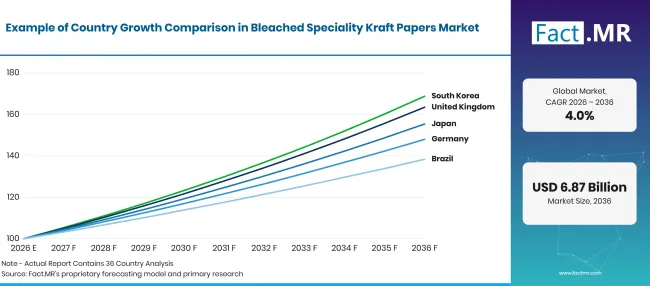
Factmr Bleached Speciality Kraft Papers Market Growth Index | Source: Fact.MR
| Country | CAGR (2026–2036) |
|---|---|
| United Kingdom | 5.0% |
| Japan | 4.5% |
| Germany | 4.0% |
| Brazil | 3.3% |
| United States | 3.0% |
Source: Fact.MR analysis. Updated Oct 21, 2026
What supports adoption in the United Kingdom?
5.0% CAGR, driven by the Plastic Packaging Tax on plastic with low recycled content.
From 1 April 2026, the UK Plastic Packaging Tax rate is £228.82 per tonne for plastic packaging components that contain less than 30% recycled plastic [6]. HMRC statistics show that the tax raised £250 million in the 2025 to 2026 financial year, about 4% less than a year earlier [7]. Retail and food brands are moving to paper wraps and bags, which favors food-safe white kraft.
How is Japan developing demand?
4.5% CAGR, helped by paper barrier packs for staple foods and steady online goods sales.
METI’s e-commerce survey put Japan’s business-to-consumer online sales of goods at JPY 15.2 trillion in 2024, up 3.70%, with an online share of 9.78% [8]. This keeps orders coming for printable paper wraps and mailers. Food packing is shifting as well. In April 2026, Nippon Paper Industries reported that its SHIELDPLUS paper barrier material had been adopted for Zennoh Pearl Rice packs, cutting plastic use by about 38% for the 2 kg size [9].
What is supporting Germany’s adoption?
4.0% CAGR, backed by EU packaging rules that apply directly to German converters.
The German Environment Agency reported that packaging consumption fell 5.8% to 17.92 million tonnes in 2023, while the recycling rate rose to 69.4% [10]. A smaller but more recyclable packaging stream favors fiber over mixed plastics. Destatis also reported that producer prices for paper, paperboard and paper products were 1.5% lower in May 2026 than a year earlier [11]. EU packaging rules, applied directly in every member state, add pressure for compliant food-safe formats [1].
What supports adoption in Brazil?
3.3% CAGR, on the back of a deep pulp base and rising paper imports.
Brazil’s Ministry of Agriculture and Livestock reported record pulp exports in July 2026 of USD 1.06 billion and 1.97 million tonnes [12]. Paper imports grew 18.0% in value from January to July 2026, to about USD 0.7 billion [12]. Abundant bleached pulp gives domestic mills a cost base for white kraft. Cost-sensitive buyers still lean on imports and simpler grades, so growth will stay gradual through 2036.
How does the United States perform?
3.0% CAGR, reflecting a mature packaging base with steady parcel growth.
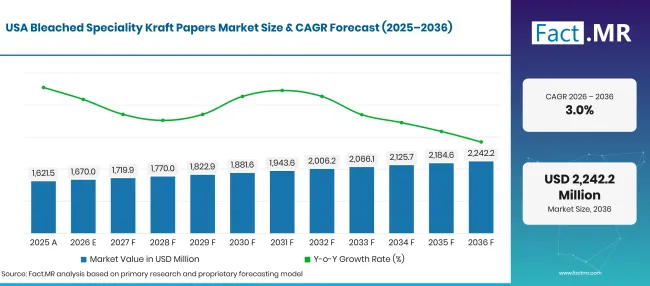
Factmr Bleached Speciality Kraft Papers Market Forecast Usa | Source: Fact.MR
The U.S. Census Bureau reported that retail e-commerce sales totaled USD 340.2 billion in the second quarter of 2026, up 12.2% from a year earlier and equal to 17.1% of total retail sales [13]. A packaging base this large and mature limits the pace of new demand. Parcel growth and the federal exit from PFAS grease-proofing [5] keep orders for white kraft wraps and mailers steady.
Who leads the Bleached Speciality Kraft Papers Market?
Competition separates mills that sell base paper by the reel from producers that sell finished barrier grades.
Integrated groups such as Mondi Group, Billerud and Smurfit Westrock compete on fiber strength, white machine-glazed surfaces and food-contact approval at scale. Billerud markets its Basix white MG papers for bread and pastry bags, and Smurfit Westrock offers a bleached semi-extensible paper for white sacks. Mondi announced in August 2025 that it was expanding output of FunctionalBarrier Paper Ultimate at its Solec plant in Poland [2]. Barrier specialists compete on coating chemistry instead. Sappi said in July 2025 that it would introduce Guard Pro OMH, a new high-barrier paper, at FACHPACK 2025 [14]. Oji Holdings sells O-hajiki, a PFAS-free oil-resistant paper in white and brown, through Oji F-Tex [15]. Nippon Paper Industries pairs bleached kraft wrapping grades with its SHIELDPLUS barrier material. Proven barrier results without fluorochemicals, backed by regional mill supply, will separate the stronger suppliers.
Which companies are the key providers?
Key companies include Mondi Group; Billerud; Smurfit Westrock plc; Sappi Limited; Nippon Paper Industries Co., Ltd.; and Oji Holdings Corporation.
- Mondi Group
- Billerud
- Smurfit Westrock plc
- Sappi Limited
- Nippon Paper Industries Co., Ltd.
- Oji Holdings Corporation
Bibliography
- [1] European Parliament and Council of the European Union. (2025, January 22). Regulation (EU) 2025/40 of the European Parliament and of the Council of 19 December 2024 on packaging and packaging waste, amending Regulation (EU) 2019/1020 and Directive (EU) 2019/904, and repealing Directive 94/62/EC.
- [2] Mondi Group. (2025, August 14). Mondi ramps up FunctionalBarrier Paper Ultimate to meet growing demand for sustainable high-barrier paper-based packaging.
- [3] Eurostat. (2026, February). E-commerce statistics for individuals.
- [4] Eurostat. (2025, October). Packaging waste statistics.
- [5] U.S. Food and Drug Administration. (2025, January 3). FDA Determines Authorization for 35 Food Contact Notifications Related to PFAS Are No Longer Effective.
- [6] HM Revenue & Customs. (2026, February 12). Plastic Packaging Tax: steps to take.
- [7] HM Revenue & Customs. (2026, August 27). Plastic Packaging Tax (PPT) statistics commentary.
- [8] Ministry of Economy, Trade and Industry, Japan. (2025, August). 令和6年度 電子商取引に関する市場調査 報告書 [Fiscal 2024 Market Survey on Electronic Commerce: Report].
- [9] Nippon Paper Industries. (2026, April 30). Environmentally Friendly Paper Barrier Material "SHIELDPLUS®" is Adopted in the Packaging of Zenno Pearl Rice Uonuma Koshihikari.
- [10] Umweltbundesamt. (2026, May 13). Verpackungsverbrauch 2023 gesunken, Recyclingquote gestiegen [Packaging consumption fell in 2023, recycling rate rose].
- [11] Statistisches Bundesamt (Destatis). (2026, June 19). Erzeugerpreise im Mai 2026: +2,2 % gegenüber Mai 2025 [Producer prices in May 2026: +2.2% on May 2025].
- [12] Ministério da Agricultura e Pecuária, Brazil. (2026, August). Nota balança do agronegócio. Mês: julho/2026 [Agribusiness trade balance note. Month: July 2026].
- [13] U.S. Census Bureau. (2026, August 18). Monthly Retail Trade: Quarterly Retail E-Commerce Sales Report, 2nd Quarter 2026.
- [14] Sappi. (2025, July 14). Sappi celebrates future-proof paper packaging at FACHPACK 2025.
- [15] Oji F-Tex. (2026, June 9). 非フッ素耐油紙(O-hajiki) [Non-fluorine oil-resistant paper (O-hajiki)].
This Report Answers
- How are bleached specialty kraft papers used across product type, application, end-user industry and distribution channel?
- Which subsegment leads each segment, and what buyer needs drive its 2026 share?
- How do the five listed countries compare on plastic packaging taxes, PFAS rules and pulp access?
- Where do integrated kraft mills and barrier paper specialists compete, and on what terms?
- Which food-contact rules and packaging waste regulations shape grade selection?
What does the Bleached Speciality Kraft Papers Market cover?
Kraft papers made from bleached chemical pulp and finished for technical, printing and packaging uses form this market. The main grades are coated barrier papers, machine-glazed white kraft, food wraps and uncoated white bag papers.
Coated and uncoated grades are tracked across packaging, printing, food service and industrial applications. Raw material comes mainly from bleached softwood and hardwood kraft pulp.
What is included in the scope?
Bleached kraft papers sold as reels or sheets count in both coated and uncoated forms, including barrier-coated, heat-sealable, machine-glazed and printable grades. Grades within the wider specialty papers category are counted when they use a bleached kraft base.
Where a coated or laminated product uses bleached kraft as its base substrate, only the paper value is recorded. Bags and pouches made by converters are valued at their paper content.
What is excluded from the scope?
Unbleached brown kraft paper, kraftliner and sack paper made from unbleached pulp are left out, along with folding boxboard, solid bleached board and corrugated materials. Tissue, newsprint and standard graphic papers made without kraft pulp add nothing to market revenue.
Plastic films, aluminum foil and laminates without a paper base are not counted, nor is market pulp.
How Was the Analysis Built?
The analysis draws on 120+ sources, 35+ company portfolios, 25+ countries, and more than 20 industry interviews.
- Primary Research: Primary research includes discussions with manufacturers, service providers, technology developers, distributors, end users, and subject-matter experts. These conversations examine purchasing priorities, product adoption, operational challenges, approval requirements, competitive positioning, and the factors that influence wider market acceptance.
- Desk Research: Desk research covers government statistics, regulatory publications, company filings, trade data, technical studies, industry associations, standards, public policy, and other authoritative sources. Every source used in the analysis is documented in the bibliography.
- Market Sizing and Forecasting: Market estimates combine historical performance, demand indicators, pricing and volume trends, segment shares, company participation, country-level growth, adoption patterns, investment activity, and barriers to market expansion.
- Data Validation and Update Cycle: Findings are validated by comparing primary interviews with public data, company activity, regulatory changes, trade patterns, and industry developments. Regular updates review new product launches, capacity changes, partnerships, approvals, and shifts in commercial adoption.
Segmentation
What is the report’s scope and coverage?
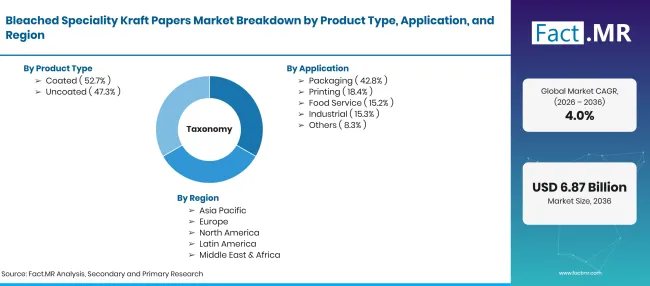
Factmr Bleached Speciality Kraft Papers Market Taxonomy | Source: Fact.MR
| Attribute | Details |
|---|---|
| Quantitative Units | USD billion in 2026 to USD billion by 2036 at CAGR |
| Market Definition | Kraft papers made from bleached chemical pulp and finished with coatings, treatments or surface properties for packaging, printing, food service, industrial and other specialized uses. |
| Product Type | Coated; Uncoated |
| Application | Packaging; Printing; Food Service; Industrial; Others |
| End-User Industry | Food and Beverage; Healthcare; Personal Care; Electronics; Others |
| Distribution Channel | Direct Sales; Distributors; Online Retail |
| Regions Covered | North America; Latin America; Western Europe; Eastern Europe; East Asia; South Asia & Pacific; Middle East & Africa |
| Countries Covered | United Kingdom; Japan; Germany; Brazil; United States |
| Companies Profiled | Mondi Group; Billerud; Smurfit Westrock plc; Sappi Limited; Nippon Paper Industries Co., Ltd.; Oji Holdings Corporation |
| Forecast Period | 2026 to 2036 |
| Approach | Hybrid top-down and bottom-up approach using packaging paper output by country; coated and uncoated grade mix; end-user industry demand; distribution channel mix; and company portfolio review. |
Source: Fact.MR analysis. Updated Oct 21, 2026
How is the market segmented?
-
By Product Type
- Coated
- Uncoated
-
By Application
- Packaging
- Printing
- Food Service
- Industrial
- Others
-
By End-User Industry
- Food and Beverage
- Healthcare
- Personal Care
- Electronics
- Others
-
By Distribution Channel
- Direct Sales
- Distributors
- Online Retail
-
By Region
- North America
- Latin America
- Western Europe
- Eastern Europe
- East Asia
- South Asia & Pacific
- Middle East & Africa
Frequently Asked Questions
How large is the bleached speciality kraft papers market in 2026?
What growth rate will the bleached speciality kraft papers market record from 2026 to 2036?
Which product type leads the bleached speciality kraft papers market?
Which application holds the greatest share of the bleached speciality kraft papers market?
Which end-user industry contributes the most to the bleached speciality kraft papers market?
Which distribution channel leads the bleached speciality kraft papers market?
Which country will record the strongest growth in the bleached speciality kraft papers market?
Who are the main companies in the bleached speciality kraft papers market?
Who worked on this report


Preview the report firsthand - request a free sample
Free SampleGet the brochure for pricing and purchase details
Download PDF