- Market Value (2025): USD 3.8 Bn
- Estimated Value (2026): USD 4.2 Bn
- Forecast Value (2036): USD 14.1 Bn
- CAGR (2026-2036): 12.8%
What is the Blue GIS Technologies Market forecast to be worth by 2036?
USD 4.2 billion in 2026 to USD 14.1 billion by 2036 at a 12.8% CAGR.
- The Blue GIS Technologies Market reached USD 3.8 billion in 2025.
- Demand is projected to increase from USD 4.2 billion in 2026 to USD 14.1 billion by 2036.
- The market is forecast to record 12.8% CAGR from 2026 to 2036 as transmission and distribution utilities, offshore-wind developers, data centers, rail systems and industrial power users expand qualified purchasing and deployment.
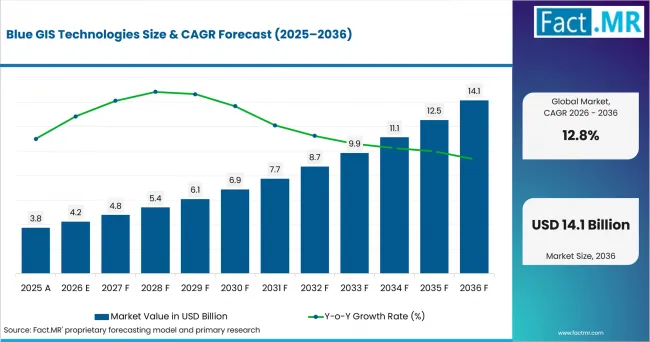
Blue Gis Technologies Value Analysis | Source: Fact.MR
What are the defining numbers behind Blue GIS Technologies Market growth?
Across the ten-year outlook, absolute opportunity totals USD 9.9 billion.
- Demand Drivers in the Market
- Regulation (EU) 2024/573 introduces staged prohibitions on putting specified electrical switchgear using fluorinated greenhouse gases in insulating or breaking media into operation, beginning in 2026 for medium-voltage equipment up to 24 kV and extending to additional voltage classes on later dates, subject to stated derogations.
- Supplier product portfolios position Blue GIS for compact substations, offshore wind, data centers and renewable-energy applications, showing that equipment footprint remains an important design consideration as insulation technologies change.
- SF6-free transition planning must account for equipment-specific operating procedures, service tools, training and spare-parts requirements; IEC 62271-4 also covers handling procedures for insulating and switching gases, including alternatives to SF6.
- Key Segments Analyzed
- By Insulation Technology: Clean-air GIS is expected to hold 34.0% share in 2026 because it avoids SF6 while retaining an enclosed switchgear architecture suited to compact substations.
- By Voltage: 12-36 kV is projected to account for 27.0% share in 2026 as this voltage class covers a broad range of primary and secondary distribution applications facing early SF6-transition decisions.
- By Application: Utility substations are anticipated to capture 42.0% share in 2026 because they contain repeated GIS bays and require long service life, documented switching performance and dependable fleet support.
- By Installation: Indoor GIS is estimated to represent 43.0% share in 2026 because its enclosed and compact design reduces room requirements and limits environmental exposure across urban and industrial sites.
- Analyst Opinion at Fact.MR
- Shambhu Nath Jha, Principal Consultant, Fact.MR, states, "The switch away from SF6 is a fleet-management program, not a one-for-one gas substitution. Utilities need qualified voltage classes, service procedures and long-term spares before scaling new GIS technology."
- Strategic Implications
- Technical teams evaluating SF6-free retrofit bays can borrow qualification logic from electric power equipment where it strengthens proof of the transition to compact SF6-free substations.
- Before standardizing offshore-wind substations, buyers should compare the interface discipline used in transformer insulation systems with the needs of the transition to compact SF6-free substations.
- For compact data-center substations, adjacent experience in motor protection devices can clarify what must be verified to deliver the transition to compact SF6-free substations.
- The implementation plan for gas and condition monitoring should review machine condition monitoring for transferable controls around the transition to compact SF6-free substations.
- A project built on SF6-free retrofit bays can learn from industrial automation systems while preserving a tight focus on the transition to compact SF6-free substations.
How does the Blue GIS Technologies Market break down by segment?
The Blue GIS Technologies Market is analyzed by Insulation Technology, Voltage, Application, and Installation.
Why does Clean-air GIS lead Insulation Technology?
The Clean-air GIS category holds 34.0% share of Insulation Technology in 2026.
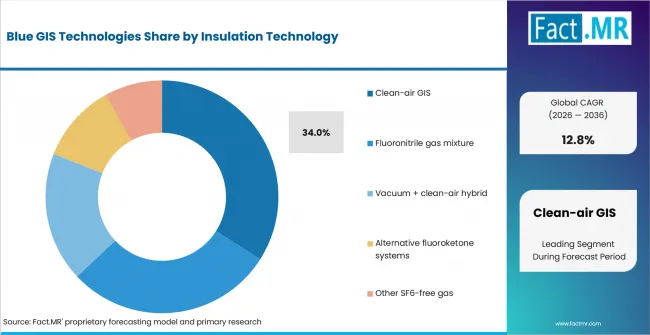
Blue Gis Technologies Analysis By Insulation Technology | Source: Fact.MR
Clean-air designs avoid SF6 while retaining an enclosed switchgear architecture suited to compact substations. Purchasing teams can use Fluoronitrile gas mixture for specialized requirements, whereas the broader operating brief points to Clean-air GIS.
For purchasing, an offer built around Clean-air GIS becomes repeatable only after suppliers translate SF6-free retrofit bays into evidence that addresses installed-base compatibility. The decision is therefore rooted in the transition to compact SF6-free substations.
Why does 12-36 kV lead Voltage?
The 12-36 kV category accounts for 27.0% share of Voltage in 2026.
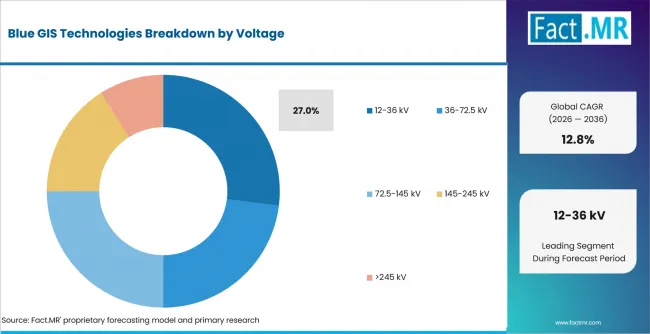
Blue Gis Technologies Analysis By Voltage | Source: Fact.MR
The 12 to 36 kV class covers a wide share of primary and secondary distribution applications facing early SF6 transition decisions. It shows why the leading position across a wider set of voltage use cases is held by 12-36 kV.
The 12-36 kV share creates an opening for offshore-wind substations, but not an automatic sale. Wider use still depends on proof that addresses technology-specific service tools.
Why does Utility substations lead Application?
The Utility substations category holds 42.0% share of Application in 2026.
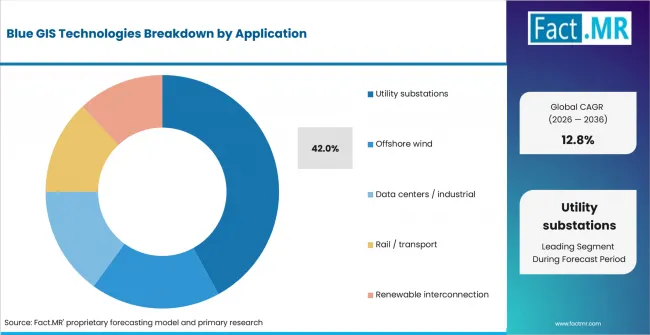
Blue Gis Technologies Analysis By Application | Source: Fact.MR
Utility substations account for repeated GIS bays and require long service life, documented switching performance and fleet support. The more particular fit of Offshore wind limits its repeatability; the Utility substations option is easier to carry across programs.
A credible offer around Utility substations joins product performance with compact data-center substations. If the restraint from type-test and utility approval cycles remains unresolved, transmission and distribution utilities, offshore-wind developers, data centers, rail systems and industrial power users are more likely to keep deployment narrow.
Why does Indoor GIS lead Installation?
The Indoor GIS category leads with 43.0% share of Installation in 2026.
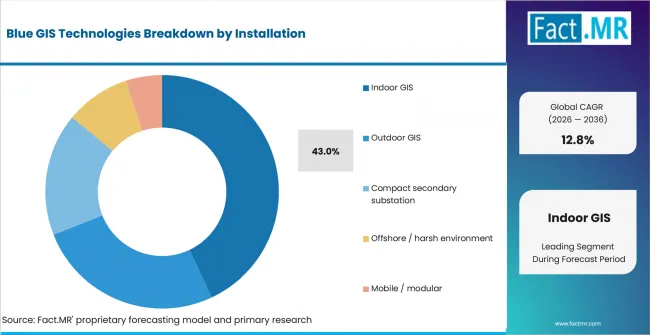
Blue Gis Technologies Analysis By Installation | Source: Fact.MR
Indoor GIS uses enclosure and compactness to reduce room requirements and environmental exposure in urban and industrial sites.
Recurring Indoor GIS demand depends on a workable handoff between product and service. That means delivering gas and condition monitoring without leaving transmission and distribution utilities, offshore-wind developers, data centers, rail systems and industrial power users to absorb voltage-range availability.
What is accelerating Blue GIS Technologies Market adoption, and what is holding it back?
Adoption is supported by staged EU restrictions on F-gas-based switchgear, continuing demand for compact substation equipment, and transition planning for SF6-free equipment. Expansion is constrained by installed-base compatibility, technology-specific service tools, type-test and utility approval cycles, and voltage-range availability.
Drivers Impact Analysis
| DRIVER | (~) % IMPACT ON CAGR | GEOGRAPHIC RELEVANCE | IMPACT TIMELINE |
|---|---|---|---|
| EU Regulation 2024/573 phases in F-gas switchgear restrictions | +2.3% | Global | Short term (<= 2 years) |
| Compact substations sustain GIS demand | +1.8% | Germany and USA | Medium term (2-4 years) |
| SF6-free transition requires new service and handling practices | +1.4% | USA and UK | Long term (>= 4 years) |
Opportunity Impact Analysis
| OPPORTUNITY | (~) % IMPACT ON CAGR | GEOGRAPHIC RELEVANCE | IMPACT TIMELINE |
|---|---|---|---|
| SF6-free retrofit bays | +1.5% | Global | Medium term (2-4 years) |
| Offshore-wind substations | +1.3% | Germany and USA | Short term (<= 2 years) |
| Compact data-center substations | +1.0% | USA and UK | Long term (>= 4 years) |
| Gas and condition monitoring | +0.8% | Global | Medium term (2-4 years) |
Restraints Impact Analysis
| RESTRAINT | (~) % IMPACT ON CAGR | GEOGRAPHIC RELEVANCE | IMPACT TIMELINE |
|---|---|---|---|
| Installed-base compatibility | -1.2% | Global | Short term (<= 2 years) |
| Technology-specific service tools | -0.9% | Germany and USA | Medium term (2-4 years) |
| Type-test and utility approval cycles | -0.7% | Global | Long term (>= 4 years) |
| Voltage-range availability | -0.5% | UK and Japan | Medium term (2-4 years) |
Which countries are scaling the Blue GIS Technologies Market through 2036?
- Germany: The 11.6% growth path points to selective expansion, led by SF6-free retrofit bays rather than undifferentiated replacement.
- USA: A projected 11.9% CAGR brings offshore-wind substations into sharper purchasing focus, particularly for 12-36 kV.
- UK: At 12.2% through 2036, the commercial focus falls on Utility substations and the rollout of compact data-center substations.
- Japan: Through 2036, the 12.6% forecast depends on how quickly buyers qualify Indoor GIS and operationalize gas and condition monitoring.
- France: The market advances at 9.4% where SF6-free retrofit bays can overcome the practical drag from installed-base compatibility.
National growth rates sit on different foundations, from code-led replacement to new project capacity. The report covers North America, Latin America, Western Europe, Eastern Europe, East Asia, South Asia & Pacific, and Middle East & Africa. These pathways frame the Blue GIS Technologies Market outlook.
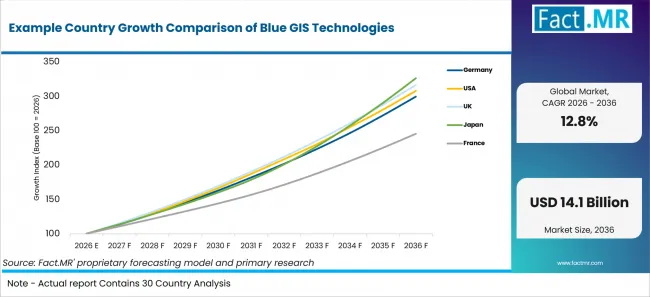
Example Country Growth Comparison Of Blue Gis Technologies | Source: Fact.MR
| Country | CAGR (2026-2036) |
|---|---|
| Germany | 11.6% |
| USA | 11.9% |
| UK | 12.2% |
| Japan | 12.6% |
| France | 9.4% |
What is driving Germany's growth through 2036?
The country is projected to expand at 11.6% CAGR from 2026 to 2036.
Bundesnetzagentur's confirmed Electricity Network Development Plan 2023-2037/2045 calls for substantial expansion and reinforcement of Germany's transmission network.
The purchasing case is strongest for transmission and distribution utilities, offshore-wind developers, data centers, rail systems and industrial power users that can quantify the transition to compact SF6-free substations. Other Clean-air GIS users may wait until references, standards or service coverage reduce the impact of installed-base compatibility.
What is driving USA's growth through 2036?
A projected CAGR of 11.9% places USA on a distinct ten-year adoption path.
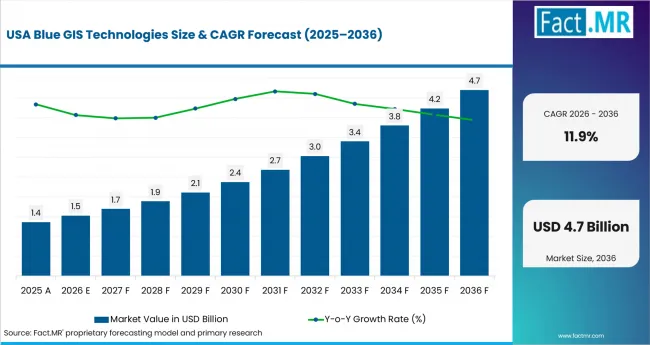
Blue Gis Technologies Country Value Analysis | Source: Fact.MR
DOE's Grid Resilience and Innovation Partnerships program supports grid resilience, modernization and additional grid capacity.
The most actionable opening is offshore-wind substations. The corresponding risk is technology-specific service tools, which can alter timing even when the strategic case is sound.
What is driving UK's growth through 2036?
Through 2036, growth is projected at 12.2% CAGR as buyers act on the transition to compact SF6-free substations.
Ofgem’s RIIO-ED2 Final Determinations set the electricity-distribution price-control framework for Great Britain from 1 April 2023 to 31 March 2028, supporting efficient network investment and the transition toward cleaner, cheaper and more secure energy.
A successful local proposition will pair compact data-center substations with evidence on type-test and utility approval cycles. This balance matters to transmission and distribution utilities, offshore-wind developers, data centers, rail systems and industrial power users before they standardize the purchase.
What is driving Japan's growth through 2036?
The 2026 to 2036 outlook points to 12.6% CAGR.
Japan's Seventh Strategic Energy Plan, approved by Cabinet on February 18, 2025, seeks to achieve stable energy supply, economic growth and decarbonization simultaneously.
Commercial traction should appear first around gas and condition monitoring. If voltage-range availability persists, however, rollout can remain concentrated among technically experienced buyers.
What is driving France's growth through 2036?
France is forecast to record 9.4% CAGR over the assessment period.
RTE's 2025 network-development strategy calls for reinforcement and renewal of France's transmission network to support electrification, reindustrialization and new low-carbon generation.
Execution remains decisive. Vendors need to make SF6-free retrofit bays visible in tender and commissioning documents while preventing installed-base compatibility from shifting risk back to the buyer.
Who leads the Blue GIS Technologies Market?
Publicly evidenced suppliers participating in Blue GIS and switchgear technologies include Siemens Energy, Hitachi Energy, Schneider Electric, GE Vernova, Mitsubishi Electric, and Toshiba Corporation.
Competitive advantage is built through references, qualification records and access to the buyer's installed environment. These assets make the transition to compact SF6-free substations easier to verify before a wider commitment. This is the competitive frame for the Blue GIS Technologies Market.
Vendors that operationalize SF6-free retrofit bays can widen their addressable base. Weak control of installed-base compatibility has the opposite effect.
Which companies are the key providers?
Key companies include Siemens Energy, Hitachi Energy, Schneider Electric, GE Vernova, Mitsubishi Electric, and Toshiba Corporation.
- Siemens Energy
- Hitachi Energy
- Schneider Electric
- GE Vernova
- Mitsubishi Electric
- Toshiba Corporation
Bibliography
- European Parliament, & Council of the European Union. (2024, February 7). Regulation (EU) 2024/573 of the European Parliament and of the Council of 7 February 2024 on fluorinated greenhouse gases, amending Directive (EU) 2019/1937 and repealing Regulation (EU) No 517/2014.
- International Electrotechnical Commission. (2024). High-voltage switchgear and controlgear—Part 200: AC metal-enclosed switchgear and controlgear for rated voltages above 1 kV and up to and including 52 kV (IEC 62271-200:2021+AMD1:2024 CSV).
- Bundesnetzagentur. (2024, March 1). Bundesnetzagentur confirms Electricity Network Development Plan 2023–2037/2045 for climate-neutral transmission network.
- Ministry of Economy, Trade and Industry. (2025, February 18). Cabinet Decision on the Seventh Strategic Energy Plan.
- RTE. (2025, February 13). Principales orientations du schéma de développement du réseau 2025 [Communiqué de presse].
This Report Answers
- The report explains how the Blue GIS Technologies Market develops across Insulation Technology and Voltage.
- Segment analysis identifies Clean-air GIS and 12-36 kV as the principal 2026 reference points.
- Country analysis examines Germany, USA, UK, Japan, and France.
- Competitive analysis reviews Siemens Energy, Hitachi Energy, Schneider Electric, GE Vernova, Mitsubishi Electric, and Toshiba Corporation.
- Opportunity analysis covers SF6-free retrofit bays, offshore-wind substations, compact data-center substations, and gas and condition monitoring.
- Risk analysis evaluates installed-base compatibility, technology-specific service tools, type-test and utility approval cycles, and voltage-range availability.
- The forecast tracks the market from USD 4.2 billion in 2026 to USD 14.1 billion by 2036.
What does the Blue GIS Technologies Market cover?
The Blue GIS Technologies Market covers clean-air, fluoronitrile-mixture, vacuum-hybrid and other qualified Blue GIS equipment and associated monitoring.
Commercial coverage follows purchases made by transmission and distribution utilities, offshore-wind developers, data centers, rail systems and industrial power users. Revenue is counted when the qualifying product, platform or integrated system is supplied for an in-scope application.
What is included in the scope?
The scope includes clean-air, fluoronitrile-mixture, vacuum-hybrid and other qualified Blue GIS equipment and associated monitoring across Insulation Technology, Voltage, Application, and Installation.
Inclusions extend to configuration and integration elements that are inseparable from the in-scope commercial offer. The boundary is applied consistently across Germany, USA, UK, Japan, and France and the seven global regions.
What is excluded from the scope?
The scope excludes conventional SF6 GIS, air-insulated switchgear, standalone gas handling services and circuit breakers sold outside a GIS assembly.
Adjacent categories enter the Blue GIS Technologies Market only when the sold product or service performs the defining function described above. This prevents broader equipment, chemical, software or project revenue from being counted twice.
How Was the Analysis Built?
The analysis draws on 120+ sources, 35+ company portfolios, 25+ countries, and more than 20 industry interviews.
- Primary Research: Primary research includes discussions with manufacturers, service providers, technology developers, distributors, end users, and subject-matter experts. These conversations examine purchasing priorities, product adoption, operational challenges, approval requirements, competitive positioning, and the factors that influence wider market acceptance.
- Desk Research: Desk research covers government statistics, regulatory publications, company filings, trade data, technical studies, industry associations, standards, public policy, and other authoritative sources. Every source used in the analysis is documented in the bibliography.
- Market Sizing and Forecasting: Market estimates combine historical performance, demand indicators, pricing and volume trends, segment shares, company participation, country-level growth, adoption patterns, investment activity, and barriers to market expansion.
- Data Validation and Update Cycle: Findings are validated by comparing primary interviews with public data, company activity, regulatory changes, trade patterns, and industry developments. Regular updates review new product launches, capacity changes, partnerships, approvals, and shifts in commercial adoption.
What is the report's scope and coverage?
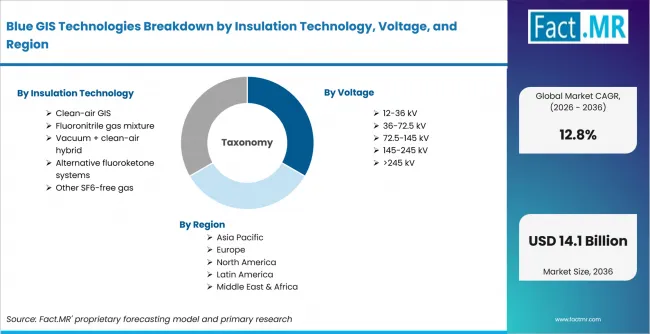
Blue Gis Technologies Breakdown By Insulation Technology, Voltage, And Region | Source: Fact.MR
| Attribute | Details |
|---|---|
| Quantitative Units | USD Billion in 2026 and 2036; CAGR from 2026 to 2036 |
| Market Definition | SF6-free gas-insulated switchgear technologies using clean air, vacuum switching and alternative gas mixtures for compact medium- and high-voltage substations. |
| Insulation Technology | Clean-air GIS; Fluoronitrile gas mixture; Vacuum + clean-air hybrid; Alternative fluoroketone systems; Other SF6-free gas |
| Voltage | 12-36 kV; 36-72.5 kV; 72.5-145 kV; 145-245 kV; >245 kV |
| Application | Utility substations; Offshore wind; Data centers / industrial; Rail / transport; Renewable interconnection |
| Installation | Indoor GIS; Outdoor GIS; Compact secondary substation; Offshore / harsh environment; Mobile / modular |
| Regions Covered | North America; Latin America; Western Europe; Eastern Europe; East Asia; South Asia & Pacific; Middle East & Africa |
| Countries Covered | Germany; USA; UK; Japan; France |
| Key Companies | Siemens Energy; Hitachi Energy; Schneider Electric; GE Vernova; Mitsubishi Electric; Toshiba Corporation |
| Forecast Period | 2026 to 2036 |
| Approach | Hybrid top-down and bottom-up assessment using Insulation Technology, Voltage, Application, and Installation, country deployment, replacement demand and company participation. |
How is the market segmented?
-
By Insulation Technology
- Clean-air GIS
- Fluoronitrile gas mixture
- Vacuum + clean-air hybrid
- Alternative fluoroketone systems
- Other SF6-free gas
-
By Voltage
- 12-36 kV
- 36-72.5 kV
- 72.5-145 kV
- 145-245 kV
- >245 kV
-
By Application
- Utility substations
- Offshore wind
- Data centers / industrial
- Rail / transport
- Renewable interconnection
-
By Installation
- Indoor GIS
- Outdoor GIS
- Compact secondary substation
- Offshore / harsh environment
- Mobile / modular
-
By Region
- North America
- Latin America
- Western Europe
- Eastern Europe
- East Asia
- South Asia & Pacific
- Middle East & Africa