Transformer Insulation Market
Transformer Insulation Market Size and Share Forecast Outlook 2026 to 2036
Transformer insulation market is projected to grow from USD 2.9 billion in 2026 to USD 5.2 billion by 2036, at a CAGR of 6.0%. Liquid Insulation Materials will dominate with a 48.0% market share, while will lead the segment with a 0.0% share.
Transformer Insulation Market Forecast and Outlook 2026 to 2036
The global transformer insulation market is set to grow from USD 2.9 billion in 2026 to USD 5.2 billion by 2036, advancing at a CAGR of 6.0%. Growth is driven by escalating demand for power infrastructure modernization validation, expanding grid infrastructure across regulated markets, and accelerating renewable energy integration requirements among utility and industrial organizations seeking reliable insulation solutions.
Key Takeaways from the Transformer Insulation Market
- Transformer Insulation Market Value (2026): USD 2.9 billion
- Transformer Insulation Market Forecast Value (2036): USD 5.2 billion
- Transformer Insulation Market Forecast CAGR: 6.0%
- Leading Material in Transformer Insulation Market: Liquid Insulation Materials (48.0%)
- Key Growth Regions in Transformer Insulation Market: Asia Pacific, Europe, and Middle East
- Top Players in Transformer Insulation Market: DuPont, Weidmann Electrical Technology AG, Hitachi Energy Ltd., Elantas (Altana AG), Cargill Incorporated
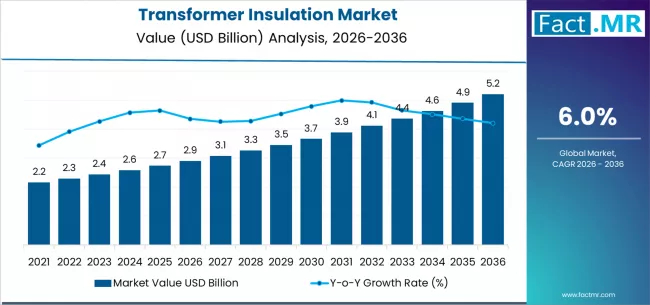
Transformer insulation technologies are increasingly recognized as essential materials for electrical infrastructure practitioners, offering precise dielectric performance capabilities, thermal management assurance, and comprehensive protection characteristics compared to traditional insulation approaches.
Liquid insulation materials dominate the market, favored in power transmission and distribution environments for their established cooling properties, providing effective heat dissipation mechanisms, arc quenching capabilities, and operational acceptance across diverse transformer applications and utility demographics. Users are advancing among material categories as specialized transformer networks expand and grid modernization infrastructure increases accessibility in power-convenient locations with stringent performance structures.
Transformer Insulation Market
| Metric | Value |
|---|---|
| Market Value (2026) | USD 2.9 billion |
| Market Forecast (2036) | USD 5.2 billion |
| Growth Rate | 6.0% CAGR |
Category
| Category | Segments |
|---|---|
| Material Type | Liquid Insulation Materials; Solid Insulation Materials; Gaseous Insulation; Others |
| Region | North America; Europe; Asia Pacific; Latin America; Middle East & Africa |
Segmental Analysis
What makes Liquid Insulation Materials command the Largest Share in the Transformer Insulation Market?
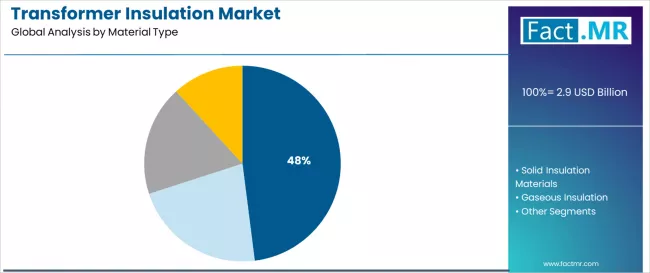
Liquid insulation materials command the leading position in the transformer insulation market with a 48.0% market share. This high share is attributed to its superior cooling characteristics, including established heat dissipation presence, extensive thermal management documentation, and proven dielectric pathways that enable utilities to achieve predictable performance outcomes across varied transformer categories and diverse power demographics.
The segment benefits from dual-function advantages through simultaneous insulation and cooling optimization, effective heat transfer without complex thermal management procedures, and established performance validation documentation without requiring extensive qualification procedures.
What are the Drivers, Restraints, and Key Trends of the Transformer Insulation Market?
The transformer insulation market is driven by rising investments in power infrastructure, grid modernization, and transmission expansion to support reliable electricity delivery. Growing integration of renewable energy sources, including solar and wind installations, is increasing demand for advanced transformer systems and insulation materials capable of handling variable loads. Expanding electrification and EV charging infrastructure further support demand, as utilities require dependable insulation solutions for new and upgraded distribution networks.
Market growth is restrained by high material and equipment costs, which limit transformer replacement and upgrade cycles, particularly in budget-constrained utilities and developing power networks. Environmental concerns and tightening regulations around SF₆ usage also create material selection challenges in regulated regions. Key trends include accelerating adoption of biodegradable and natural ester-based insulation fluids to meet environmental and fire safety requirements, alongside increased deployment of digital monitoring and predictive maintenance technologies to improve transformer reliability and asset lifecycle management.
Analysis of the Transformer Insulation Market by Key Countries
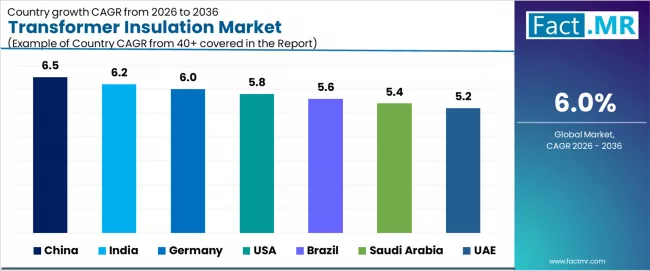
| Country | CAGR 2026-2036 |
|---|---|
| China | 6.5% |
| India | 6.2% |
| Germany | 6.0% |
| USA | 5.8% |
| Brazil | 5.6% |
| Saudi Arabia | 5.4% |
| UAE | 5.2% |
Why Is China Driving the Fastest Growth in Transformer Insulation Demand?
China leads transformer insulation demand with a CAGR of 6.5%, supported by large-scale power infrastructure expansion and ultra-high-voltage transmission development. Growth is concentrated across State Grid, Southern Power Grid, and major provincial networks upgrading capacity for renewable integration and long-distance power transfer. Utilities are adopting advanced insulation materials to meet reliability benchmarks and international quality standards.
Standardized installation protocols combining domestic production and international technology partnerships support consistent performance. Distribution through transformer manufacturers and electrical equipment suppliers, alongside technical certification programs, continues to expand adoption across voltage classes and grid configurations.
How Is India Emerging as a Leader in Rural Electrification Infrastructure?
India’s transformer insulation market is expanding at a CAGR of 6.2%, driven by rural electrification programs and sustained grid investment. Utilities across metropolitan and regional state grids are deploying insulation materials to enhance distribution reliability and expand power access.
Demand is concentrated in distribution transformers, where cost-effective liquid insulation solutions provide cooling and dielectric performance. Growth is reinforced by rising investment in rural grid development and transformer deployment. Adoption aligns with power sector reforms emphasizing reliability documentation and scalable solutions for diverse voltage requirements.
What Positions the USA as a Leader in Grid Modernization?
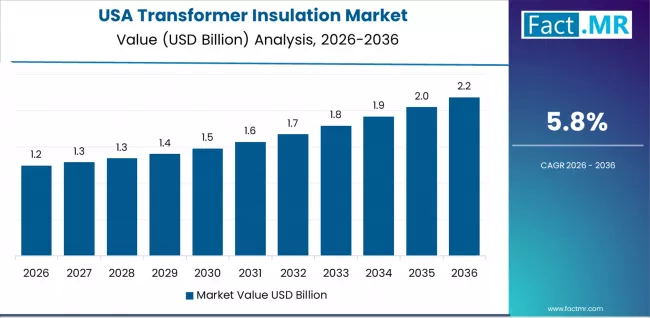
The USA’s market is growing at a CAGR of 5.8%, supported by grid modernization initiatives and regulatory compliance frameworks. Utilities across Texas, California, and Northeast systems are upgrading transmission and distribution networks to accommodate renewable energy and EV charging infrastructure.
Advanced insulation materials are adopted to ensure predictable transformer performance and compliance. Established supplier relationships and performance validation programs support material confidence. Continued investment in grid resilience and clean energy sustains demand for premium insulation solutions.
Why does Germany Excel in Renewable Grid Integration?
Germany’s transformer insulation market is advancing at a CAGR of 6.0%, shaped by renewable energy integration and stringent environmental standards. Demand is strongest across offshore wind corridors, solar-intensive southern regions, and industrial clusters undergoing grid upgrades.
Utilities prioritize insulation materials aligned with sustainability objectives while maintaining thermal and dielectric performance. Biodegradable insulation solutions with detailed lifecycle documentation are gaining traction. Germany’s mature renewable infrastructure and regulatory discipline continue to support consistent adoption.
How is Brazil Leveraging Renewable Energy for Grid Expansion?
Brazil’s market is growing at a CAGR of 5.6%, supported by transmission expansion linked to hydroelectric generation and rising wind energy capacity. Demand is concentrated across Southeast grids, Northeast wind corridors, and remote integration projects. Utilities emphasize insulation reliability and cost efficiency for long-distance power transmission.
Procurement focuses on proven thermal stability and moisture resistance. Continued renewable investment and grid connectivity initiatives sustain adoption aligned with national energy planning objectives.
What drives Saudi Arabia’s Smart City-Led Power Infrastructure Growth?
Saudi Arabia’s transformer insulation market is expanding at a CAGR of 5.4%, driven by Vision 2030 infrastructure programs and smart city development. Demand is concentrated in industrial zones and new urban projects requiring resilient power systems.
Utilities favor insulation materials engineered for high-temperature and desert operating conditions. Emphasis on system integration, quality validation, and long-term performance supports adoption. Infrastructure modernization initiatives continue to elevate demand for advanced insulation solutions.
How does the UAE Demonstrate Electrification and Smart Grid Excellence?
The market for transformer insulation in UAE is growing at a CAGR of 5.2%, supported by smart grid development and advanced infrastructure investment. Utilities and renewable energy operators integrate insulation materials to enhance electrical efficiency and monitoring capabilities.
Demand favors premium solutions compatible with digital monitoring systems and performance analytics. Adoption is concentrated across major emirates prioritizing grid innovation and reliability. The UAE’s technology-led infrastructure strategy sustains consistent demand for high-quality insulation materials aligned with advanced electrical standards.
Competitive Landscape of the Transformer Insulation Market
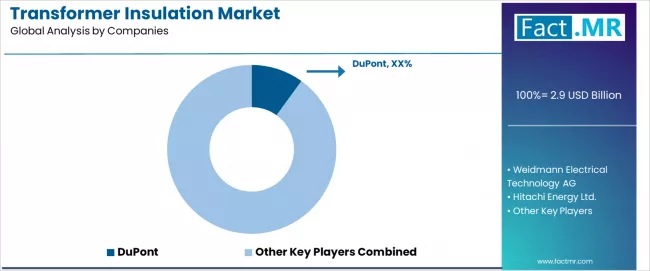
The transformer insulation market exhibits a moderately consolidated structure, with an estimated 30–50 active participants operating across global electrical materials supply chains and regional transformer manufacturing ecosystems. The market reflects a mature technology environment in which established suppliers leverage long-standing utility relationships, material science expertise, and broad insulation portfolios, while smaller and regional players compete through sustainability-focused offerings and targeted pricing strategies.
Competitive strength is shaped by factors extending beyond production scale. Global distribution capabilities allow suppliers to meet diverse utility specifications and serve power transmission operators, distribution networks, and industrial users. Technical support and application engineering remain critical differentiators, as utilities prioritize suppliers with proven dielectric performance knowledge, thermal management expertise, and installation support capabilities. Manufacturing consistency, high-purity material processing, and supply chain quality control further distinguish established suppliers, supported by detailed technical documentation covering dielectric strength, thermal stability, and regulatory compliance.
Emerging differentiation is increasingly evident in biodegradable liquid insulation and advanced composite solid materials, where innovation-driven entrants challenge conventional mineral oil solutions by emphasizing environmental and fire safety advantages. Despite this shift, established liquid insulation categories retain competitive strength through extensive performance validation and deep utility engagement. Suppliers offering integrated insulation portfolios, application-specific formulations, and unified technical support continue to strengthen customer retention beyond transactional material supply.
Key Players in the Transformer Insulation Market
- DuPont
- Weidmann Electrical Technology AG
- Hitachi Energy Ltd.
- Elantas (Altana AG)
- Cargill, Incorporated
- Siemens Energy
- Krempel GmbH
- Apar Industries
- ZIEHL-ABEGG SE
Scope of the Report
| Items | Values |
|---|---|
| Quantitative Units (2026) | USD 2.9 billion |
| Material Type | Liquid Insulation Materials, Solid Insulation Materials, Gaseous Insulation, Others |
| Regions Covered | North America, Europe, Asia Pacific, Latin America, MEA |
| Countries Covered | USA, China, India, Germany, UK, France, Brazil, Saudi Arabia, UAE, and 15+ additional countries |
| Key Companies Profiled | DuPont, Weidmann Electrical Technology AG, Hitachi Energy Ltd., Elantas (Altana AG), Cargill Incorporated, Siemens Energy |
| Additional Attributes | Dollar sales by material categories, regional adoption trends across Asia Pacific, Europe, and Middle East, competitive landscape with established material corporations and specialized insulation companies, utility preferences for liquid insulation materials and thermal performance, integration with power transmission facilities and distribution transformer organizations, innovations in biodegradable materials and composite technologies, and development of sophisticated dielectric systems with enhanced sustainability profiles and comprehensive performance documentation frameworks. |
Transformer Insulation Market by Segments
-
Material Type :
- Liquid Insulation Materials
- Solid Insulation Materials
- Gaseous Insulation
- Others
-
Region :
- North America
- USA
- Canada
- Mexico
- Europe
- Germany
- France
- UK
- Italy
- Spain
- Rest of Europe
- Asia Pacific
- India
- China
- Japan
- South Korea
- ASEAN
- Australia & New Zealand
- Rest of Asia Pacific
- Latin America
- Brazil
- Rest of Latin America
- MEA
- GCC Countries
- South Africa
- Rest of MEA
- North America
Table of Content
- Executive Summary
- Global Market Outlook
- Demand to side Trends
- Supply to side Trends
- Technology Roadmap Analysis
- Analysis and Recommendations
- Market Overview
- Market Coverage / Taxonomy
- Market Definition / Scope / Limitations
- Market Background
- Market Dynamics
- Drivers
- Restraints
- Opportunity
- Trends
- Scenario Forecast
- Demand in Optimistic Scenario
- Demand in Likely Scenario
- Demand in Conservative Scenario
- Opportunity Map Analysis
- Product Life Cycle Analysis
- Supply Chain Analysis
- Investment Feasibility Matrix
- Value Chain Analysis
- PESTLE and Porter’s Analysis
- Regulatory Landscape
- Regional Parent Market Outlook
- Production and Consumption Statistics
- Import and Export Statistics
- Market Dynamics
- Global Market Analysis 2021 to 2025 and Forecast, 2026 to 2036
- Historical Market Size Value (USD Million) Analysis, 2021 to 2025
- Current and Future Market Size Value (USD Million) Projections, 2026 to 2036
- Y to o to Y Growth Trend Analysis
- Absolute $ Opportunity Analysis
- Global Market Pricing Analysis 2021 to 2025 and Forecast 2026 to 2036
- Global Market Analysis 2021 to 2025 and Forecast 2026 to 2036, By Material Type
- Introduction / Key Findings
- Historical Market Size Value (USD Million) Analysis By Material Type, 2021 to 2025
- Current and Future Market Size Value (USD Million) Analysis and Forecast By Material Type, 2026 to 2036
- Liquid Insulation Materials
- Solid Insulation Materials
- Gaseous Insulation
- Others
- Liquid Insulation Materials
- Y to o to Y Growth Trend Analysis By Material Type, 2021 to 2025
- Absolute $ Opportunity Analysis By Material Type, 2026 to 2036
- Global Market Analysis 2021 to 2025 and Forecast 2026 to 2036, By Region
- Introduction
- Historical Market Size Value (USD Million) Analysis By Region, 2021 to 2025
- Current Market Size Value (USD Million) Analysis and Forecast By Region, 2026 to 2036
- North America
- Latin America
- Western Europe
- Eastern Europe
- East Asia
- South Asia and Pacific
- Middle East & Africa
- Market Attractiveness Analysis By Region
- North America Market Analysis 2021 to 2025 and Forecast 2026 to 2036, By Country
- Historical Market Size Value (USD Million) Trend Analysis By Market Taxonomy, 2021 to 2025
- Market Size Value (USD Million) Forecast By Market Taxonomy, 2026 to 2036
- By Country
- USA
- Canada
- Mexico
- By Material Type
- By Country
- Market Attractiveness Analysis
- By Country
- By Material Type
- Key Takeaways
- Latin America Market Analysis 2021 to 2025 and Forecast 2026 to 2036, By Country
- Historical Market Size Value (USD Million) Trend Analysis By Market Taxonomy, 2021 to 2025
- Market Size Value (USD Million) Forecast By Market Taxonomy, 2026 to 2036
- By Country
- Brazil
- Chile
- Rest of Latin America
- By Material Type
- By Country
- Market Attractiveness Analysis
- By Country
- By Material Type
- Key Takeaways
- Western Europe Market Analysis 2021 to 2025 and Forecast 2026 to 2036, By Country
- Historical Market Size Value (USD Million) Trend Analysis By Market Taxonomy, 2021 to 2025
- Market Size Value (USD Million) Forecast By Market Taxonomy, 2026 to 2036
- By Country
- Germany
- UK
- Italy
- Spain
- France
- Nordic
- BENELUX
- Rest of Western Europe
- By Material Type
- By Country
- Market Attractiveness Analysis
- By Country
- By Material Type
- Key Takeaways
- Eastern Europe Market Analysis 2021 to 2025 and Forecast 2026 to 2036, By Country
- Historical Market Size Value (USD Million) Trend Analysis By Market Taxonomy, 2021 to 2025
- Market Size Value (USD Million) Forecast By Market Taxonomy, 2026 to 2036
- By Country
- Russia
- Poland
- Hungary
- Balkan & Baltic
- Rest of Eastern Europe
- By Material Type
- By Country
- Market Attractiveness Analysis
- By Country
- By Material Type
- Key Takeaways
- East Asia Market Analysis 2021 to 2025 and Forecast 2026 to 2036, By Country
- Historical Market Size Value (USD Million) Trend Analysis By Market Taxonomy, 2021 to 2025
- Market Size Value (USD Million) Forecast By Market Taxonomy, 2026 to 2036
- By Country
- China
- Japan
- South Korea
- By Material Type
- By Country
- Market Attractiveness Analysis
- By Country
- By Material Type
- Key Takeaways
- South Asia and Pacific Market Analysis 2021 to 2025 and Forecast 2026 to 2036, By Country
- Historical Market Size Value (USD Million) Trend Analysis By Market Taxonomy, 2021 to 2025
- Market Size Value (USD Million) Forecast By Market Taxonomy, 2026 to 2036
- By Country
- India
- ASEAN
- Australia & New Zealand
- Rest of South Asia and Pacific
- By Material Type
- By Country
- Market Attractiveness Analysis
- By Country
- By Material Type
- Key Takeaways
- Middle East & Africa Market Analysis 2021 to 2025 and Forecast 2026 to 2036, By Country
- Historical Market Size Value (USD Million) Trend Analysis By Market Taxonomy, 2021 to 2025
- Market Size Value (USD Million) Forecast By Market Taxonomy, 2026 to 2036
- By Country
- Kingdom of Saudi Arabia
- Other GCC Countries
- Turkiye
- South Africa
- Other African Union
- Rest of Middle East & Africa
- By Material Type
- By Country
- Market Attractiveness Analysis
- By Country
- By Material Type
- Key Takeaways
- Key Countries Market Analysis
- USA
- Pricing Analysis
- Market Share Analysis, 2025
- By Material Type
- Canada
- Pricing Analysis
- Market Share Analysis, 2025
- By Material Type
- Mexico
- Pricing Analysis
- Market Share Analysis, 2025
- By Material Type
- Brazil
- Pricing Analysis
- Market Share Analysis, 2025
- By Material Type
- Chile
- Pricing Analysis
- Market Share Analysis, 2025
- By Material Type
- Germany
- Pricing Analysis
- Market Share Analysis, 2025
- By Material Type
- UK
- Pricing Analysis
- Market Share Analysis, 2025
- By Material Type
- Italy
- Pricing Analysis
- Market Share Analysis, 2025
- By Material Type
- Spain
- Pricing Analysis
- Market Share Analysis, 2025
- By Material Type
- France
- Pricing Analysis
- Market Share Analysis, 2025
- By Material Type
- India
- Pricing Analysis
- Market Share Analysis, 2025
- By Material Type
- ASEAN
- Pricing Analysis
- Market Share Analysis, 2025
- By Material Type
- Australia & New Zealand
- Pricing Analysis
- Market Share Analysis, 2025
- By Material Type
- China
- Pricing Analysis
- Market Share Analysis, 2025
- By Material Type
- Japan
- Pricing Analysis
- Market Share Analysis, 2025
- By Material Type
- South Korea
- Pricing Analysis
- Market Share Analysis, 2025
- By Material Type
- Russia
- Pricing Analysis
- Market Share Analysis, 2025
- By Material Type
- Poland
- Pricing Analysis
- Market Share Analysis, 2025
- By Material Type
- Hungary
- Pricing Analysis
- Market Share Analysis, 2025
- By Material Type
- Kingdom of Saudi Arabia
- Pricing Analysis
- Market Share Analysis, 2025
- By Material Type
- Turkiye
- Pricing Analysis
- Market Share Analysis, 2025
- By Material Type
- South Africa
- Pricing Analysis
- Market Share Analysis, 2025
- By Material Type
- USA
- Market Structure Analysis
- Competition Dashboard
- Competition Benchmarking
- Market Share Analysis of Top Players
- By Regional
- By Material Type
- Competition Analysis
- Competition Deep Dive
- DuPont
- Overview
- Product Portfolio
- Profitability by Market Segments (Product/Age /Sales Channel/Region)
- Sales Footprint
- Strategy Overview
- Marketing Strategy
- Product Strategy
- Channel Strategy
- Weidmann Electrical Technology AG
- Hitachi Energy Ltd.
- Elantas (Altana AG)
- Cargill, Incorporated
- Siemens Energy
- Krempel GmbH
- Apar Industries
- ZIEHL-ABEGG SE
- DuPont
- Competition Deep Dive
- Assumptions & Acronyms Used
- Research Methodology
List Of Table
- Table 1: Global Market Value (USD Million) Forecast by Region, 2021 to 2036
- Table 2: Global Market Value (USD Million) Forecast by Material Type, 2021 to 2036
- Table 3: North America Market Value (USD Million) Forecast by Country, 2021 to 2036
- Table 4: North America Market Value (USD Million) Forecast by Material Type, 2021 to 2036
- Table 5: Latin America Market Value (USD Million) Forecast by Country, 2021 to 2036
- Table 6: Latin America Market Value (USD Million) Forecast by Material Type, 2021 to 2036
- Table 7: Western Europe Market Value (USD Million) Forecast by Country, 2021 to 2036
- Table 8: Western Europe Market Value (USD Million) Forecast by Material Type, 2021 to 2036
- Table 9: Eastern Europe Market Value (USD Million) Forecast by Country, 2021 to 2036
- Table 10: Eastern Europe Market Value (USD Million) Forecast by Material Type, 2021 to 2036
- Table 11: East Asia Market Value (USD Million) Forecast by Country, 2021 to 2036
- Table 12: East Asia Market Value (USD Million) Forecast by Material Type, 2021 to 2036
- Table 13: South Asia and Pacific Market Value (USD Million) Forecast by Country, 2021 to 2036
- Table 14: South Asia and Pacific Market Value (USD Million) Forecast by Material Type, 2021 to 2036
- Table 15: Middle East & Africa Market Value (USD Million) Forecast by Country, 2021 to 2036
- Table 16: Middle East & Africa Market Value (USD Million) Forecast by Material Type, 2021 to 2036
List Of Figures
- Figure 1: Global Market Pricing Analysis
- Figure 2: Global Market Value (USD Million) Forecast 2021 to 2036
- Figure 3: Global Market Value Share and BPS Analysis by Material Type, 2026 and 2036
- Figure 4: Global Market Y to o to Y Growth Comparison by Material Type, 2021 to 2036
- Figure 5: Global Market Attractiveness Analysis by Material Type
- Figure 6: Global Market Value (USD Million) Share and BPS Analysis by Region, 2026 and 2036
- Figure 7: Global Market Y to o to Y Growth Comparison by Region, 2021 to 2036
- Figure 8: Global Market Attractiveness Analysis by Region
- Figure 9: North America Market Incremental Dollar Opportunity, 2021 to 2036
- Figure 10: Latin America Market Incremental Dollar Opportunity, 2021 to 2036
- Figure 11: Western Europe Market Incremental Dollar Opportunity, 2021 to 2036
- Figure 12: Eastern Europe Market Incremental Dollar Opportunity, 2021 to 2036
- Figure 13: East Asia Market Incremental Dollar Opportunity, 2021 to 2036
- Figure 14: South Asia and Pacific Market Incremental Dollar Opportunity, 2021 to 2036
- Figure 15: Middle East & Africa Market Incremental Dollar Opportunity, 2021 to 2036
- Figure 16: North America Market Value Share and BPS Analysis by Country, 2026 and 2036
- Figure 17: North America Market Value Share and BPS Analysis by Material Type, 2026 and 2036
- Figure 18: North America Market Y to o to Y Growth Comparison by Material Type, 2021 to 2036
- Figure 19: North America Market Attractiveness Analysis by Material Type
- Figure 20: Latin America Market Value Share and BPS Analysis by Country, 2026 and 2036
- Figure 21: Latin America Market Value Share and BPS Analysis by Material Type, 2026 and 2036
- Figure 22: Latin America Market Y to o to Y Growth Comparison by Material Type, 2021 to 2036
- Figure 23: Latin America Market Attractiveness Analysis by Material Type
- Figure 24: Western Europe Market Value Share and BPS Analysis by Country, 2026 and 2036
- Figure 25: Western Europe Market Value Share and BPS Analysis by Material Type, 2026 and 2036
- Figure 26: Western Europe Market Y to o to Y Growth Comparison by Material Type, 2021 to 2036
- Figure 27: Western Europe Market Attractiveness Analysis by Material Type
- Figure 28: Eastern Europe Market Value Share and BPS Analysis by Country, 2026 and 2036
- Figure 29: Eastern Europe Market Value Share and BPS Analysis by Material Type, 2026 and 2036
- Figure 30: Eastern Europe Market Y to o to Y Growth Comparison by Material Type, 2021 to 2036
- Figure 31: Eastern Europe Market Attractiveness Analysis by Material Type
- Figure 32: East Asia Market Value Share and BPS Analysis by Country, 2026 and 2036
- Figure 33: East Asia Market Value Share and BPS Analysis by Material Type, 2026 and 2036
- Figure 34: East Asia Market Y to o to Y Growth Comparison by Material Type, 2021 to 2036
- Figure 35: East Asia Market Attractiveness Analysis by Material Type
- Figure 36: South Asia and Pacific Market Value Share and BPS Analysis by Country, 2026 and 2036
- Figure 37: South Asia and Pacific Market Value Share and BPS Analysis by Material Type, 2026 and 2036
- Figure 38: South Asia and Pacific Market Y to o to Y Growth Comparison by Material Type, 2021 to 2036
- Figure 39: South Asia and Pacific Market Attractiveness Analysis by Material Type
- Figure 40: South Asia and Pacific Market Attractiveness Analysis by rma_anu
- Figure 41: South Asia and Pacific Market Value Share and BPS Analysis by rma_anu, 2026 and 2036
- Figure 42: South Asia and Pacific Market Y to o to Y Growth Comparison by rma_anu, 2021 to 2036
- Figure 43: South Asia and Pacific Market Attractiveness Analysis by rma_anu
- Figure 44: South Asia and Pacific Market Value Share and BPS Analysis by rma_anu, 2026 and 2036
- Figure 45: South Asia and Pacific Market Y to o to Y Growth Comparison by rma_anu, 2021 to 2036
- Figure 46: South Asia and Pacific Market Attractiveness Analysis by rma_anu
- Figure 47: South Asia and Pacific Market Value Share and BPS Analysis by rma_anu, 2026 and 2036
- Figure 48: South Asia and Pacific Market Y to o to Y Growth Comparison by rma_anu, 2021 to 2036
- Figure 49: South Asia and Pacific Market Attractiveness Analysis by rma_anu
- Figure 50: Middle East & Africa Market Value Share and BPS Analysis by Country, 2026 and 2036
- Figure 51: Middle East & Africa Market Value Share and BPS Analysis by Material Type, 2026 and 2036
- Figure 52: Middle East & Africa Market Y to o to Y Growth Comparison by Material Type, 2021 to 2036
- Figure 53: Middle East & Africa Market Attractiveness Analysis by Material Type
- Figure 54: Middle East & Africa Market Value Share and BPS Analysis by rma_anu, 2026 and 2036
- Figure 55: Middle East & Africa Market Y to o to Y Growth Comparison by rma_anu, 2021 to 2036
- Figure 56: Middle East & Africa Market Attractiveness Analysis by rma_anu
- Figure 57: Middle East & Africa Market Value Share and BPS Analysis by rma_anu, 2026 and 2036
- Figure 58: Middle East & Africa Market Y to o to Y Growth Comparison by rma_anu, 2021 to 2036
- Figure 59: Middle East & Africa Market Attractiveness Analysis by rma_anu
- Figure 60: Middle East & Africa Market Value Share and BPS Analysis by rma_anu, 2026 and 2036
- Figure 61: Middle East & Africa Market Y to o to Y Growth Comparison by rma_anu, 2021 to 2036
- Figure 62: Middle East & Africa Market Attractiveness Analysis by rma_anu
- Figure 63: Middle East & Africa Market Value Share and BPS Analysis by rma_anu, 2026 and 2036
- Figure 64: Middle East & Africa Market Y to o to Y Growth Comparison by rma_anu, 2021 to 2036
- Figure 65: Middle East & Africa Market Attractiveness Analysis by rma_anu
- Figure 66: Middle East & Africa Market Value Share and BPS Analysis by rma_anu, 2026 and 2036
- Figure 67: Middle East & Africa Market Y to o to Y Growth Comparison by rma_anu, 2021 to 2036
- Figure 68: Middle East & Africa Market Attractiveness Analysis by rma_anu
- Figure 69: Middle East & Africa Market Value Share and BPS Analysis by rma_anu, 2026 and 2036
- Figure 70: Middle East & Africa Market Y to o to Y Growth Comparison by rma_anu, 2021 to 2036
- Figure 71: Middle East & Africa Market Attractiveness Analysis by rma_anu
- Figure 72: Global Market - Tier Structure Analysis
- Figure 73: Global Market - Company Share Analysis
- FAQs -
How big is the transformer insulation market in 2026?
The global transformer insulation market is estimated to be valued at USD 2.9 billion in 2026.
What will be the size of transformer insulation market in 2036?
The market size for the transformer insulation market is projected to reach USD 5.2 billion by 2036.
How much will be the transformer insulation market growth between 2026 and 2036?
The transformer insulation market is expected to grow at a 6.0% CAGR between 2026 and 2036.
What are the key product types in the transformer insulation market?
The key product types in transformer insulation market are liquid insulation materials, solid insulation materials, gaseous insulation and others.
Which segment to contribute significant share in the transformer insulation market in 2026?
In terms of , segment to command 0.0% share in the transformer insulation market in 2026.