Bone and Joint Health Supplement Market
Bone and Joint Health Supplement Market Size and Share Forecast Outlook 2025 to 2035
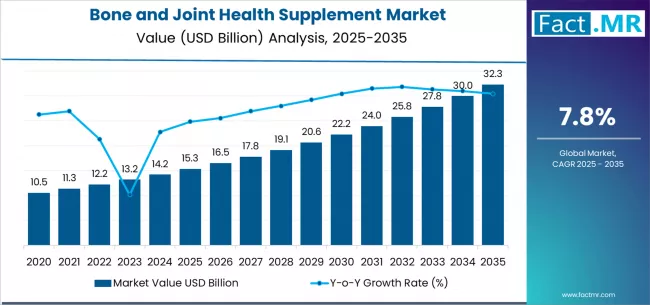
Bone and joint health supplement market is projected to grow from USD 15.3 billion in 2025 to USD 32.3 billion by 2035, at a CAGR of 7.8%. Vitamins will dominate with a 32.4% market share, while tablets will lead the formulation segment with a 33.0% share.
Bone and Joint Health Supplement Market Forecast and Outlook 2025 to 2035
The global bone and joint health supplement market is set to grow from USD 15.3 billion in 2025 to USD 32.3 billion by 2035, adding USD 17.0 billion in new revenue and advancing at a CAGR of 7.8%. Growth is driven by increasing demand for preventative healthcare solutions, expanding retail infrastructure for nutritional supplement across metropolitan markets, and accelerating arthritis management awareness among aging demographics seeking non-pharmaceutical intervention approaches.
Quick Stats for Bone and Joint Health Supplement Market
- Bone and Joint Health Supplement Market Value (2025): USD 15.3 billion
- Bone and Joint Health Supplement Market Forecast Value (2035): USD 32.3 billion
- Bone and Joint Health Supplement Market Forecast CAGR: 7.8%
- Leading Product in Bone and Joint Health Supplement Market: Vitamins
- Key Growth Regions in Bone and Joint Health Supplement Market: Asia Pacific, North America, and Middle East
- Top Players in Bone and Joint Health Supplement Market: Herbalife International of America Inc., GNC Holdings LLC, Nature's Bounty, Amway, Garden of Life

Bone and joint health supplements are increasingly recognized as essential products for wellness retailers and healthcare providers, providing targeted nutritional support, mineral deficiency correction capabilities, and mobility maintenance benefits compared to reactive treatment intervention strategies. Vitamins hold a 32.4% share in 2025, favored in pharmacy and specialty health environments for their foundational nutrition characteristics, providing bone density support, calcium absorption enhancement, and comprehensive skeletal health maintenance across diverse consumer segments and age demographics.
Tablets represent 33.0% and remain fundamental in supplement formulation protocols where consumer familiarity and convenient dosing match consumption expectations and compliance standards. Brick-and-mortar channels at 67.5% are advancing among sales categories as specialized pharmacy networks expand and trained staff availability increases accessibility in consumer-convenient locations with professional consultation structures.
Geographic concentration demonstrates dynamic growth patterns with India leading at 9.4% CAGR and China at 8.9% CAGR, supported by rising micronutrient deficiency awareness, aging population expansion, and preventative healthcare adoption in urban centers. The USA, Brazil, GCC Countries, Germany, and Japan demonstrate robust development through established supplement retail ecosystems, regulatory framework maturity for dietary supplement, and consumer acceptance of preventative nutrition products. Competitive advantage is consolidating around clinical evidence quality, bioavailability enhancement technology, formulation sophistication capabilities, and integrated bone health solution portfolios rather than standalone supplement offerings alone.
The first half of the decade (2025-2030) will witness the market climbing from USD 15.3 billion to approximately USD 22.3 billion, adding USD 7.0 billion in value, which constitutes 41% of the total forecast growth period. This phase will be characterized by the continued dominance of vitamin formulations in pharmacy distribution settings, combined with accelerating adoption of combination supplement technologies in geriatric care applications where comprehensive nutritional support and mineral fortification create favorable health maintenance outcomes.
The latter half (2030-2035) will witness sustained expansion from USD 22.3 billion to USD 32.3 billion, representing an addition of USD 10.0 billion or 59% of the decade's growth, defined by broadening acceptance of advanced delivery formats and integration of bioavailability-enhanced formulations across mainstream pharmacy facilities.
Where revenue comes from - now vs next (industry-level view)
| Period | Primary Revenue Buckets | Share | Notes |
|---|---|---|---|
| Today | Vitamins | 32.4% | Foundational nutrition dominance |
| Tablets | 33.0% | Formulation preference | |
| Brick-and-Mortar | 67.5% | Primary distribution | |
| Adults | 47.3% | Leading consumer group | |
| Bone Density Support | 20.2% | Primary application | |
| Future (3-5 yrs) | Advanced Collagen Formulas | 35-41% | Bioavailability enhancement |
| Combination Supplement | 32-38% | Multi-nutrient protocols | |
| Liquid Formulations | 24-30% | Absorption optimization | |
| E-commerce Channels | 28-34% | Digital distribution expansion | |
| Geriatric-Focused Products | 35-41% | Demographic targeting | |
| Personalized Nutrition | 22-28% | Individual customization | |
| Performance Applications | 26-32% | Athletic market expansion |
Bone and Joint Health Supplement Market Key Takeaways
At-a-Glance Metrics
| Metric | Value |
|---|---|
| Market Value (2025) → | USD 15.3 billion |
| Market Forecast (2035) ↑ | USD 32.3 billion |
| Growth Rate ★ | 7.8% CAGR |
| Leading Product → | Vitamins |
| Primary Sales Channel → | Brick-and-Mortar |
The market demonstrates exceptional fundamentals with vitamins capturing a commanding 32.4% share through superior nutritional foundation characteristics, calcium metabolism support advantages, and established clinical evidence across bone health applications. Brick-and-mortar channels drive primary market demand at 67.5% share, supported by established pharmacy infrastructure and professional consultation environments that maintain consumer trust across diverse demographic segments.
Geographic concentration remains anchored in Asia Pacific and North America with emerging market leadership through aging population expansion and preventative healthcare development, while developed markets show accelerated adoption rates driven by arthritis-conscious demographics and supplement USAge normalization.
Imperatives for Stakeholders in Bone and Joint Health Supplement Market
Design for efficacy and bioavailability, not just nutrient content
- Offer complete bone health solutions: scientifically validated formulations + bioavailability enhancement technology + synergistic nutrient combinations + quality verification systems + clinical evidence documentation.
- Preconfigured supplement protocols: bone density support specifications, mobility enhancement configurations, inflammation management programs, and combination therapy protocols for diverse health requirements.
Regulatory readiness for dietary supplement applications
- Comprehensive clinical testing documentation, good manufacturing practice compliance systems, and supply chain integrity (ingredient traceability, purity verification, potency assurance protocols).
Affordability-by-design approach
- Cost-optimized formulation portfolios, flexible pricing models, retailer margin programs, and transparent dosage cost documentation.
Healthcare professional engagement-focused market penetration
- Established clinical education programs + comprehensive practitioner support (scientific literature, patient education materials, dosing guidelines); direct professional engagement for recommendation development and prescriber confidence building.
Segmental Analysis
The market segments by product into vitamins (32.4%), minerals (21.0%), collagen (16.5%), omega-3 (12.3%), glucosamine (10.2%), and others (7.6%), representing the evolution from basic nutritional supplementation toward sophisticated targeted intervention with clinical validation, bioavailability optimization, and synergistic formulation characteristics.
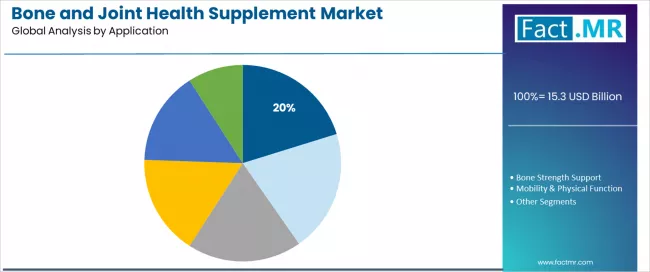
The formulation segmentation divides the market into tablets (33.0%), capsules (26.5%), powders (18.5%), softgels (12.0%), and others (10.0%), reflecting distinct delivery preferences for convenience versus absorption optimization and dosing flexibility. The application segmentation shows bone density support's leading 20.2% position, followed by bone strength support (18.0%), mobility and physical function (17.2%), muscle health and recovery (15.1%), pain relief and inflammation (14.3%), and performance enhancement (15.2%), demonstrating varied health objectives and intervention strategies.
By consumer group, the segmentation reveals adults' commanding 47.3% share, followed by geriatric (27.4%), children (10.1%), pregnant women (8.3%), and infants (6.9%), illustrating age-specific nutritional requirements and life-stage targeting. The sales channel segmentation demonstrates brick-and-mortar's dominant 67.5% position with subsegments including chemists/pharmacies (11.2%), direct selling (8.4%), hypermarkets/supermarkets (6.9%), and health food shops (3.6%), alongside e-commerce (2.4%), reflecting professional guidance importance versus convenience-driven purchasing.
Which Product Type is the Dominant Force in the Bone and Joint Health Supplement Market?
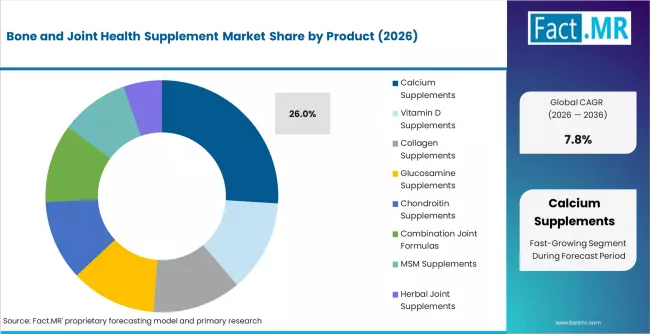
Vitamins command the leading position in the bone and joint health supplement market with a 32.4% market share through superior foundational nutrition characteristics, including calcium absorption facilitation, bone metabolism regulation, and skeletal tissue maintenance capabilities that enable consumers to achieve comprehensive bone health support across varied life stages and diverse health objectives.
The segment benefits from extensive clinical evidence supporting vitamin D and K roles in bone health, widespread physician recommendation patterns, and established consumer awareness without requiring specialized nutritional knowledge. Advanced formulation technology enables vitamin combination optimization, dose standardization precision, and stability enhancement, where product efficacy and safety documentation represent critical healthcare professional trust requirements.
Vitamin D formulations hold significant share within the vitamin segment, appealing to consumers addressing deficiency correction for bone density optimization. Vitamin supplements differentiate through proven clinical outcome documentation, healthcare professional endorsement advantages, and integration with established medical protocols that enhance recommendation confidence while maintaining evidence-based positioning for diverse bone health applications.
Key market characteristics:
- Advanced delivery technologies with optimized absorption enhancement and bioavailability improvement systems for therapeutic efficacy
- Superior safety profiles, enabling long-term supplementation through extensive toxicology documentation and established dosing guidelines
- Comprehensive clinical validation, including bone density studies, fracture prevention trials, and calcium metabolism research for medical recommendation support
Why is the Demand for Mineral-based Bone and Joint Health Supplements Growing?
Minerals maintain substantial market position at 21.0% through structural bone composition characteristics and metabolic co-factor requirements. These nutrients appeal to healthcare professionals and consumers seeking foundational skeletal support, offering direct bone matrix integration and calcium homeostasis regulation through essential mineral provision.
Market adoption is driven by osteoporosis prevention applications, emphasizing mineral density optimization and structural integrity maintenance through targeted supplementation strategies.
Why are Bone and Joint Health Supplement Tables the preferred Format?

Tablets constitute the bulk of all bone and joint health supplement formats with a 33.0% share due to widespread consumer familiarity patterns and established focus on convenient dosing, extended shelf stability, and precise nutrient delivery that maximizes compliance likelihood while maintaining familiar medication-like formats.
Consumers prioritize tablet formats for easy swallowing capabilities, portion control precision, and integration with daily medication routines that enables coordinated health management experiences across multiple supplement categories. The segment benefits from substantial manufacturing infrastructure maturity and quality control frameworks that emphasize tablet-based supplement delivery for standardized dosing across diverse demographic segments.
Coated tablets capture substantial share within the tablet segment, demonstrating consumer preference for easier swallowing characteristics. Supplement mainstreaming incorporates tablet adoption as standard format approaches for nutritional intervention, while pharmaceutical familiarity increases format acceptance that meets convenience requirements and reduces supplement intimidation factors.
What drives Bone Density Support Adoption in Preventative Health Applications?

Bone density support captures leading application share at 20.2% through comprehensive requirements in osteoporosis prevention, skeletal strength maintenance, and mineral density optimization. This application demands scientifically validated supplement protocols capable of addressing bone loss prevention while providing measurable density improvements and fracture risk reduction, appealing to consumers and healthcare professionals seeking evidence-based preventative advantages beyond reactive treatment approaches.
What establishes Adults' Market Leadership in Bone and Joint Health Supplement?

Adults establish market leadership in the bone and joint health supplement sector with commanding 47.3% share due to comprehensive preventative health awareness and sustained focus on long-term skeletal maintenance, mobility preservation strategies, and proactive intervention approaches that maximize healthy aging outcomes while maintaining physical function standards.
Adult consumers and healthcare providers prioritize this demographic for preventative supplementation initiation, peak bone mass maintenance, and integration with overall wellness programs that enables coordinated health optimization experiences across multiple life domains. The segment benefits from substantial health consciousness maturity and preventative medicine frameworks that emphasize adult-focused supplementation for osteoporosis prevention and joint health maintenance across diverse activity levels.
Preventative healthcare adoption incorporates adult supplementation as standard intervention channels for skeletal health preservation, while fitness culture growth increases product utilization that meets performance requirements and reduces age-related decline concerns.
Consumer group dynamics include:
- Strong growth in middle-aged adult segments requiring early intervention protocols and preventative density maintenance
- Increasing adoption in active adult populations for performance optimization and recovery enhancement
- Rising integration with wellness programs for holistic health management and lifestyle disease prevention development
How are Geriatric Consumers Advancing Therapeutic Supplementation Requirements?
Geriatric consumers capture substantial demographic share at 27.4% through established age-related bone loss frameworks, osteoporosis management protocols, and mobility preservation applications. The segment demonstrates specialized nutritional requirements across aging populations, with therapeutic-dose supplementation and combination product applications gaining traction in elderly care programs while clinical monitoring frameworks drive continued physician oversight requiring careful balance between efficacy achievement and safety assurance.
What establishes Brick-and-Mortar's Distribution Leadership in Bone and Joint Health Supplement?

Brick-and-mortar channels establish distribution leadership in the bone and joint health supplement sector with a 67.5% share due to comprehensive professional consultation availability and sustained focus on pharmacist guidance, product authenticity verification, and immediate purchase fulfillment that maximizes consumer confidence while maintaining appropriate healthcare oversight standards.
Consumers and healthcare providers prioritize brick-and-mortar facilities for expert advice access, product quality assurance, and integration with medication management services that enables coordinated health intervention experiences across multiple therapeutic categories. The sector benefits from substantial pharmacy infrastructure maturity and healthcare professional relationships that emphasize in-person supplement delivery for physician-recommended products and condition-specific formulations.
Healthcare integration incorporates brick-and-mortar pharmacies as standard distribution channels for therapeutic supplement, while professional recommendation patterns increase facility preference that meets consultation requirements and reduces self-medication uncertainty factors.
Sales channel dynamics include:
- Strong growth in pharmacy chains requiring standardized product assortments and professional training programs
- Increasing adoption in specialty health stores for premium positioning and expert consultation services
- Rising integration with medical practices for direct dispensing and physician-supervised supplementation program development
How are Chemists/Pharmacies Advancing Professional Guidance Requirements?
Chemists and pharmacies capture substantial brick-and-mortar subsegment share at 11.2% through established healthcare professional frameworks, prescription adjacency positioning, and medication therapy management integration.
The segment demonstrates specialized pharmaceutical expertise across health-conscious consumer populations, with condition-specific supplement recommendations and drug-nutrient interaction screening gaining traction in professional pharmacy services while quality assurance frameworks drive continued pharmacist consultation requiring careful balance between over-the-counter accessibility and professional oversight maintenance.
What are the Drivers, Restraints, and Key Trends of the Bone and Joint Health Supplement Market?
| Category | Factor | Impact | Why It Matters |
|---|---|---|---|
| Driver | Rising aging population & osteoporosis prevalence (demographic shifts, bone health awareness) | ★★★★★ | Population aging enables bone supplement demand for skeletal maintenance; increasing osteoporosis diagnosis drives preventative intervention across geriatric markets and at-risk segments. |
| Driver | Growth in preventative healthcare adoption & wellness consciousness (proactive health management, lifestyle medicine) | ★★★★★ | Drives demand for nutritional intervention solutions and non-pharmaceutical approaches; consumers seeking preventative strategies gain accessible bone health support in convenient formats. |
| Driver | Sports nutrition expansion & athletic performance focus (active lifestyle growth, recovery optimization) | ★★★★☆ | Athletes demand joint health maintenance and bone strength support; fitness culture visibility expanding addressable segments beyond traditional elderly demographics and medical supplement users. |
| Restraint | Regulatory complexity & supplement efficacy scrutiny (varying standards, clinical validation requirements) | ★★★★★ | Manufacturers face compliance challenges and marketing restrictions; increases development costs and affects health claim utilization in evidence-limited products and emerging ingredient categories. |
| Restraint | Consumer skepticism & efficacy perception gaps (limited awareness, inconsistent results) | ★★★☆☆ | Health-conscious consumers face supplement effectiveness uncertainty and quality variation concerns, restricting market penetration and affecting repeat purchase rates in mainstream populations and price-sensitive segments. |
| Trend | Advanced delivery systems & bioavailability enhancement (absorption optimization, targeted release technologies) | ★★★★★ | Growing manufacturer capability for nutrient utilization improvement beyond basic supplementation; advanced formulations become core differentiation strategy for premium therapeutic positioning. |
| Trend | Personalized nutrition & genetic testing integration (individualized supplementation, precision wellness) | ★★★★☆ | Healthcare evolving beyond generic supplementation toward tailored intervention protocols; personalization technology drives enhanced efficacy and consumer engagement in sophisticated wellness environments. |
Analysis of the Bone and Joint Health Supplement Market by Key Countries
The bone and joint health supplement market demonstrates robust regional growth dynamics with emerging leaders including India (9.4% CAGR) and China (8.9% CAGR) driving expansion through micronutrient deficiency awareness and aging population programs. Strong performers encompass Brazil (8.1% CAGR), GCC Countries (7.7% CAGR), and USA (7.4% CAGR), benefiting from established supplement retail infrastructure and preventative health demographics. Developed Markets feature Germany (6.9% CAGR) and Japan (6.5% CAGR), where supplement normalization and healthcare integration support consistent growth patterns.
Regional synthesis reveals Asian markets leading adoption through comprehensive nutritional deficiency positioning and elderly care expansion, while Western countries demonstrate measured growth potential supported by arthritis management preferences and wellness supplement acceptance. Middle Eastern markets show solid development driven by deficiency screening programs and health awareness integration.

| Region/Country | 2025-2035 Growth | How to win | What to watch out |
|---|---|---|---|
| India | 9.4% | Focus on affordable vitamin-mineral portfolios | Distribution challenges; awareness gaps |
| China | 8.9% | Lead with premium aging-focused positioning | Regulatory complexity; quality concerns |
| USA | 7.4% | Provide clinical evidence-based products | Market saturation; efficacy scrutiny |
| Brazil | 8.1% | Offer accessible pricing strategies | Economic volatility; import costs |
| GCC Countries | 7.7% | Push deficiency-screening integration | Limited local manufacturing; import dependency |
| Germany | 6.9% | Maintain quality-focused positioning | Strict regulations; high consumer expectations |
| Japan | 6.5% | Deliver preventive care integration | Aging infrastructure strain; price pressures |
India Drives Fastest Market Growth
India establishes fastest market growth through progressive nutritional deficiency awareness expansion and comprehensive preventative health development, positioning bone and joint health supplement as essential intervention solutions in metropolitan centers and emerging tier-two cities. The country's 9.4% growth rate reflects rising vitamin D deficiency recognition supporting therapeutic supplementation spending and growing middle-class population segments that encourage the deployment of affordable supplement products in diverse retail settings. Growth concentrates in major urban markets, including Mumbai, Delhi, and Bangalore, where pharmacy chains showcase increasing investment capacity for vitamin and mineral product procurement that appeal to health-conscious consumers demanding evidence-based supplementation and professional guidance.
Indian pharmacies are developing expanded supplement sections that combine international premium brands with domestic affordable alternatives, including pharmacy chain health aisle expansion and standalone supplement store growth. Distribution channels through pharmaceutical distributors and healthcare retail suppliers expand market access, while physician recommendation initiatives support adoption across diverse patient types and deficiency severity levels.
China Emerges as Aging Population Market Leader
In Shanghai, Beijing, and Shenzhen regions, pharmacy chains and e-commerce health platforms are adopting bone and joint health supplement as essential aging care offerings for elderly consumers, driven by increasing osteoporosis concerns and growing acceptance of preventative supplementation that emphasizes the importance of skeletal maintenance strategies. The market holds an 8.9% growth rate, supported by online health platform integration and elderly care awareness campaigns that promote supplement adoption for bone density preservation applications.
Chinese consumers are favoring premium international brands that provide comprehensive clinical documentation and quality assurance verification, particularly appealing in metropolitan markets where product authenticity and efficacy credentials represent critical decision factors.
Market expansion benefits from substantial elderly care infrastructure investment and digital health platform establishment that enable widespread distribution of bone health products for diverse aging applications. Industry adoption follows patterns established in preventative healthcare success, where clinical validation and quality positioning drive consumer preference and physician recommendation.
USA Shows Preventative Supplementation Leadership

USA establishes preventative supplementation leadership through comprehensive dietary supplement infrastructure and established bone health awareness ecosystem, integrating bone and joint supplement across pharmacy chains, health food retailers, and medical practices. The country's 7.4% growth rate reflects established FDA regulatory framework maturity and sophisticated arthritis management awareness that support widespread distribution of bone health supplement in pharmacy and wellness applications. Growth concentrates in established health-conscious markets, including California, Florida, and Arizona regions, where retailers showcase supplement category proliferation that appeals to aging consumers seeking verified bone density support and joint mobility maintenance.
American pharmacies leverage established manufacturer relationships and comprehensive quality verification frameworks, including USP certification adoption and third-party testing protocols that create consumer confidence and professional recommendation assurance. The market benefits from substantial clinical research investment and orthopedic specialist partnerships that encourage evidence-based supplementation while supporting continuous formulation improvements and bioavailability enhancement investments.
Brazil Shows Health Supplement Ecosystem Expansion
Brazil establishes robust ecosystem expansion through progressive supplement retail development and increasing preventative health awareness, incorporating bone and joint health products across pharmacy chains and health food stores. The country's 8.1% growth rate reflects growing healthcare accessibility and increasing adoption of nutritional intervention approaches that supports expanding supplement deployment in Brazilian markets. Growth concentrates in major metropolitan regions, including São Paulo, Rio de Janeiro, and Belo Horizonte, where retailers showcase demand for bone health products that appeal to aging consumers seeking affordable supplementation with professional guidance availability.
Brazilian pharmacies focus on accessible pricing strategies and physician-recommended positioning, creating demand for cost-effective supplement platforms that combine therapeutic dosing with affordability advantages. The market benefits from expanding pharmacy chain infrastructure and healthcare professional education programs that support category awareness while maintaining price accessibility important to Brazilian consumer economics.
GCC Countries Show Deficiency Management Integration
GCC Countries establish deficiency management integration through progressive vitamin D screening programs and comprehensive nutritional health initiatives, positioning bone and joint health supplement as essential therapeutic interventions in pharmacy and healthcare settings. The region's 7.7% growth rate reflects established deficiency prevalence recognition and government health screening support that encourages widespread supplement deployment in GCC markets. Growth concentrates in major metropolitan centers, including Dubai, Riyadh, and Doha, where pharmacies showcase premium international product availability that appeals to affluent consumers demanding quality-verified supplementation and medical-grade formulations.
GCC pharmacies prioritize international brand positioning and clinical documentation verification in supplement procurement, creating demand for premium imported products with comprehensive quality certification, including GMP compliance verification and potency testing documentation. The market benefits from established healthcare system sophistication and medical screening infrastructure that provide therapeutic supplementation opportunities and support physician-directed intervention protocols.
Germany Shows Quality-Focused Supplementation Leadership
Germany's advanced supplement market demonstrates sophisticated bone health product integration with documented quality emphasis in ingredient verification and clinical validation through specialized pharmacies and established health food store networks. The country leverages strict pharmaceutical standards and consumer evidence expectations to maintain a 6.9% growth rate. Premium pharmacy chains, including Bavaria, North Rhine-Westphalia, and Baden-Württemberg, showcase efficacy documentation priorities where bone health supplement integrate with established medical cultures and thorough clinical validation practices to optimize therapeutic outcomes and ensure appropriate indication assessment.
German pharmacies prioritize clinical evidence validation and comprehensive quality testing in supplement recommendations, creating demand for pharmaceutical-grade products with extensive documentation characteristics, including clinical trial data, bioavailability studies, and comprehensive safety profiles. The market benefits from established pharmacy profession standards and consumer scientific literacy that provide premium positioning opportunities and compliance with strict German supplement regulations.
Japan Demonstrates Preventive Care Integration

Japan's preventive healthcare market demonstrates established bone health supplement adoption with documented aging care emphasis in nutritional support and skeletal maintenance through comprehensive pharmacy chains and health food retailers. The country maintains a 6.5% growth rate, leveraging traditional preventive medicine culture and aging population awareness in supplement selection. Metropolitan pharmacy markets, including Tokyo, Osaka, and Nagoya regions, showcase elderly care priorities where bone health supplement integrate with established healthcare cultures and comprehensive consultation practices to optimize aging wellness and maintain mobility standards under preventive care frameworks.
Japanese pharmacies prioritize gentle formulation approaches and comprehensive USAge guidance in supplement recommendations, creating demand for senior-friendly products with easy-to-swallow formats, including small tablets and liquid options. The market benefits from established elderly care infrastructure and preventive health culture that provide age-appropriate supplementation opportunities and comply with strict MHLW supplement standards.
Europe Market Split by Country

The bone and joint health supplement market in Europe is projected to grow from USD 3.4 billion in 2025 to USD 7.1 billion by 2035, representing 22.2% of the global market in 2025 and expanding to 22.0% by 2035. Germany is expected to maintain its leadership position with USD 0.9 billion in 2025, accounting for 26.5% of the European market, supported by its advanced pharmacy infrastructure and established preventive health culture.
UK follows with USD 0.7 billion, representing 20.6% of the European market in 2025, driven by comprehensive aging population awareness and pharmacy-based supplement distribution. France holds USD 0.6 billion with 17.6% market share through established wellness lifestyle acceptance and premium health retailer concentration. Italy commands USD 0.5 billion representing 14.7% share, while Spain accounts for USD 0.4 billion or 11.8% in 2025. The rest of Europe region maintains USD 0.3 billion, representing 8.8% of the European market, attributed to increasing bone health awareness in Nordic countries and emerging Eastern European pharmacy sectors implementing supplement programs.
Competitive Landscape of the Bone and Joint Health Supplement Market

The bone and joint health supplement market exhibits a moderately fragmented competitive structure with approximately 70-90 active players operating across global supplement manufacturing networks and regional pharmacy distribution portfolios. Herbalife International of America, Inc. maintains market leadership at a 10.8% share, reflecting strong brand positioning across diverse supplement categories with sophisticated direct selling strategies.
This competitive landscape demonstrates the maturation of bone health supplementation, where established players leverage brand recognition advantages, extensive clinical validation investments, and healthcare professional partnerships to maintain leadership positions, while specialized orthopedic supplement brands and pharmaceutical companies create competitive pressure through medical-grade formulations and prescription-adjacent positioning strategies.
Market leadership is maintained through several critical competitive advantages extending beyond manufacturing capabilities and product portfolios. Global distribution networks enable leading players to navigate diverse regulatory requirements and access varied consumer segments including pharmacy chains, health food retailers, and direct-to-consumer channels.
Clinical validation infrastructure and bioavailability enhancement technology availability represent crucial differentiators in bone health supplement categories, where years of research investment, physician relationship development, and quality assurance frameworks create purchasing preference among healthcare-focused retailers.
Manufacturing efficiency in GMP-certified facilities, ingredient sourcing quality control, and formulation stability optimization separate major brands from generic competitors, while comprehensive clinical documentation addressing bone density outcomes, safety profiles, and dosing protocols strengthen market position and professional recommendation confidence.
The market demonstrates emerging differentiation opportunities in advanced delivery system categories and combination supplement technologies, where traditional single-nutrient products face competition from synergistic formulation entrants offering enhanced efficacy advantages. However, significant competitive advantages persist in established vitamin categories through comprehensive clinical evidence portfolios and healthcare professional relationship depth.
Premium positioning strategies with pharmaceutical-grade quality and clinical validation capabilities command margin premiums through superior professional trust and proven therapeutic standards. Specialized product portfolios combining multiple bone health nutrients with bioavailability enhancement features and condition-specific formulations create comprehensive positioning that justifies higher price points beyond generic vitamin competition. Integrated bone health offerings emphasizing complementary nutrient compatibility, unified professional education support, and cross-indication application programs generate brand loyalty and healthcare professional preferences beyond transactional supplement purchases.
| Stakeholder | What they actually control | Typical strengths | Typical blind spots |
|---|---|---|---|
| Global supplement corporations | Comprehensive portfolios; global distribution; clinical research; marketing budgets | Brand recognition; manufacturing scale; retail relationships; R&D capabilities | Innovation speed; medical credibility; prescription market access; specialized positioning |
| Direct selling companies | Sales force networks; consumer relationships; education programs; brand loyalty | Personal engagement; consumer education; repeat business; testimonial leverage | Retail penetration; professional recommendations; clinical validation; mainstream credibility |
| Pharmaceutical-grade brands | Clinical validation; quality standards; medical positioning; professional relationships | Healthcare credibility; evidence strength; therapeutic positioning; efficacy perception | Price competitiveness; retail visibility; consumer marketing; mainstream accessibility |
| Pharmacy chains | Distribution reach; professional consultation; consumer access; product placement | Customer trust; prescription adjacency; pharmacist guidance; convenience positioning | Product development; clinical research; manufacturing control; brand building |
| Specialized bone health brands | Condition focus; formulation expertise; clinical validation; medical partnerships | Therapeutic credibility; efficacy positioning; professional relationships; specialized knowledge | Production volumes; distribution reach; marketing budgets; category expansion |
Key Players in the Bone and Joint Health Supplement Market
- Herbalife International of America, Inc.
- GNC Holdings, LLC
- Nature's Bounty
- Amway
- Garden of Life
- Thorne
- Solgar Inc.
- Pure Encapsulations, LLC
- Glanbia plc
- NOW Foods
Scope of the Report
| Items | Values |
|---|---|
| Quantitative Units (2025) | USD 15.3 billion |
| Product Type | Vitamins, Minerals, Collagen, Omega-3, Glucosamine, Others |
| Formulation | Tablets, Capsules, Powders, Softgels, Others |
| Application | Bone Density Support, Bone Strength Support, Mobility & Physical Function, Muscle Health & Recovery, Pain Relief & Inflammation, Performance Enhancement |
| Consumer Group | Adults, Geriatric, Children, Pregnant Women, Infants |
| Sales Channel | Brick-and-Mortar (Chemists/Pharmacies, Direct Selling, Hypermarkets/Supermarkets, Health Food Shops), E-commerce |
| Regions Covered | North America, Europe, Asia Pacific, Latin America, mea |
| Countries Covered | usa, China, India, Germany, Japan, Brazil, GCC Countries, and 15+ additional countries |
| Key Companies Profiled | Herbalife International of America Inc., GNC Holdings LLC, Nature's Bounty, Amway, Garden of Life, Thorne, Solgar Inc., Pure Encapsulations LLC |
| Additional Attributes | Dollar sales by product and formulation categories, regional adoption trends across Asia Pacific, North America, and Europe, competitive landscape with established supplement corporations and pharmaceutical-grade brands, consumer preferences for vitamin formulations and tablet formats, integration with pharmacy chains and healthcare professional networks, innovations in bioavailability enhancement technologies and combination formulations, and development of sophisticated clinical validation programs with enhanced efficacy documentation and comprehensive safety profile systems. |
Bone and Joint Health Supplement Market by Segments
-
Product Type :
- Vitamins
- Minerals
- Collagen
- Omega-3
- Glucosamine
- Others
-
Formulation :
- Tablets
- Capsules
- Powders
- Softgels
- Others
-
Application :
- Bone Density Support
- Bone Strength Support
- Mobility & Physical Function
- Muscle Health & Recovery
- Pain Relief & Inflammation
- Performance Enhancement
-
Consumer Group :
- Adults
- Geriatric
- Children
- Pregnant Women
- Infants
-
Sales Channel :
- Brick-and-Mortar
- Chemists/Pharmacies
- Direct Selling
- Hypermarkets/Supermarkets
- Health Food Shops
- E-commerce
- Brick-and-Mortar
-
Region :
- North America
- USA
- Canada
- Mexico
- Europe
- Germany
- UK
- France
- Italy
- Spain
- Rest of Europe
- Asia Pacific
- India
- China
- Japan
- South Korea
- ASEAN
- Australia & New Zealand
- Rest of Asia Pacific
- Latin America
- Brazil
- Rest of Latin America
- MEA
- GCC Countries
- South Africa
- Rest of mea
- North America
Table of Content
- Executive Summary
- Global Market Outlook
- Demand to side Trends
- Supply to side Trends
- Technology Roadmap Analysis
- Analysis and Recommendations
- Market Overview
- Market Coverage / Taxonomy
- Market Definition / Scope / Limitations
- Market Background
- Market Dynamics
- Drivers
- Restraints
- Opportunity
- Trends
- Scenario Forecast
- Demand in Optimistic Scenario
- Demand in Likely Scenario
- Demand in Conservative Scenario
- Opportunity Map Analysis
- Product Life Cycle Analysis
- Supply Chain Analysis
- Investment Feasibility Matrix
- Value Chain Analysis
- PESTLE and Porter’s Analysis
- Regulatory Landscape
- Regional Parent Market Outlook
- Production and Consumption Statistics
- Import and Export Statistics
- Market Dynamics
- Global Market Analysis 2020 to 2024 and Forecast, 2025 to 2035
- Historical Market Size Value (USD Million) Analysis, 2020 to 2024
- Current and Future Market Size Value (USD Million) Projections, 2025 to 2035
- Y to o to Y Growth Trend Analysis
- Absolute $ Opportunity Analysis
- Global Market Pricing Analysis 2020 to 2024 and Forecast 2025 to 2035
- Global Market Analysis 2020 to 2024 and Forecast 2025 to 2035, By Product Type
- Introduction / Key Findings
- Historical Market Size Value (USD Million) Analysis By Product Type, 2020 to 2024
- Current and Future Market Size Value (USD Million) Analysis and Forecast By Product Type, 2025 to 2035
- Vitamins
- Minerals
- Collagen
- Omega-3
- Glucosamine
- Others
- Y to o to Y Growth Trend Analysis By Product Type, 2020 to 2024
- Absolute $ Opportunity Analysis By Product Type, 2025 to 2035
- Global Market Analysis 2020 to 2024 and Forecast 2025 to 2035, By Formulation
- Introduction / Key Findings
- Historical Market Size Value (USD Million) Analysis By Formulation, 2020 to 2024
- Current and Future Market Size Value (USD Million) Analysis and Forecast By Formulation, 2025 to 2035
- Tablets
- Capsules
- Powders
- Softgels
- Others
- Y to o to Y Growth Trend Analysis By Formulation, 2020 to 2024
- Absolute $ Opportunity Analysis By Formulation, 2025 to 2035
- Global Market Analysis 2020 to 2024 and Forecast 2025 to 2035, By Application
- Introduction / Key Findings
- Historical Market Size Value (USD Million) Analysis By Application, 2020 to 2024
- Current and Future Market Size Value (USD Million) Analysis and Forecast By Application, 2025 to 2035
- Bone Density Support
- Bone Strength Support
- Mobility & Physical Function
- Muscle Health & Recovery
- Pain Relief & Inflammation
- Performance Enhancement
- Y to o to Y Growth Trend Analysis By Application, 2020 to 2024
- Absolute $ Opportunity Analysis By Application, 2025 to 2035
- Global Market Analysis 2020 to 2024 and Forecast 2025 to 2035, By Consumer Group
- Introduction / Key Findings
- Historical Market Size Value (USD Million) Analysis By Consumer Group, 2020 to 2024
- Current and Future Market Size Value (USD Million) Analysis and Forecast By Consumer Group, 2025 to 2035
- Adults
- Geriatric
- Children
- Pregnant Women
- Infants
- Y to o to Y Growth Trend Analysis By Consumer Group, 2020 to 2024
- Absolute $ Opportunity Analysis By Consumer Group, 2025 to 2035
- Global Market Analysis 2020 to 2024 and Forecast 2025 to 2035, By Sales Channel
- Introduction / Key Findings
- Historical Market Size Value (USD Million) Analysis By Sales Channel, 2020 to 2024
- Current and Future Market Size Value (USD Million) Analysis and Forecast By Sales Channel, 2025 to 2035
- Brick-and-Mortar
- E-commerce
- Y to o to Y Growth Trend Analysis By Sales Channel, 2020 to 2024
- Absolute $ Opportunity Analysis By Sales Channel, 2025 to 2035
- Global Market Analysis 2020 to 2024 and Forecast 2025 to 2035, By Region
- Introduction
- Historical Market Size Value (USD Million) Analysis By Region, 2020 to 2024
- Current Market Size Value (USD Million) Analysis and Forecast By Region, 2025 to 2035
- North America
- Latin America
- Western Europe
- Eastern Europe
- East Asia
- South Asia and Pacific
- Middle East & Africa
- Market Attractiveness Analysis By Region
- North America Market Analysis 2020 to 2024 and Forecast 2025 to 2035, By Country
- Historical Market Size Value (USD Million) Trend Analysis By Market Taxonomy, 2020 to 2024
- Market Size Value (USD Million) Forecast By Market Taxonomy, 2025 to 2035
- By Country
- USA
- Canada
- Mexico
- By Product Type
- By Formulation
- By Application
- By Consumer Group
- By Sales Channel
- By Country
- Market Attractiveness Analysis
- By Country
- By Product Type
- By Formulation
- By Application
- By Consumer Group
- By Sales Channel
- Key Takeaways
- Latin America Market Analysis 2020 to 2024 and Forecast 2025 to 2035, By Country
- Historical Market Size Value (USD Million) Trend Analysis By Market Taxonomy, 2020 to 2024
- Market Size Value (USD Million) Forecast By Market Taxonomy, 2025 to 2035
- By Country
- Brazil
- Chile
- Rest of Latin America
- By Product Type
- By Formulation
- By Application
- By Consumer Group
- By Sales Channel
- By Country
- Market Attractiveness Analysis
- By Country
- By Product Type
- By Formulation
- By Application
- By Consumer Group
- By Sales Channel
- Key Takeaways
- Western Europe Market Analysis 2020 to 2024 and Forecast 2025 to 2035, By Country
- Historical Market Size Value (USD Million) Trend Analysis By Market Taxonomy, 2020 to 2024
- Market Size Value (USD Million) Forecast By Market Taxonomy, 2025 to 2035
- By Country
- Germany
- UK
- Italy
- Spain
- France
- Nordic
- BENELUX
- Rest of Western Europe
- By Product Type
- By Formulation
- By Application
- By Consumer Group
- By Sales Channel
- By Country
- Market Attractiveness Analysis
- By Country
- By Product Type
- By Formulation
- By Application
- By Consumer Group
- By Sales Channel
- Key Takeaways
- Eastern Europe Market Analysis 2020 to 2024 and Forecast 2025 to 2035, By Country
- Historical Market Size Value (USD Million) Trend Analysis By Market Taxonomy, 2020 to 2024
- Market Size Value (USD Million) Forecast By Market Taxonomy, 2025 to 2035
- By Country
- Russia
- Poland
- Hungary
- Balkan & Baltic
- Rest of Eastern Europe
- By Product Type
- By Formulation
- By Application
- By Consumer Group
- By Sales Channel
- By Country
- Market Attractiveness Analysis
- By Country
- By Product Type
- By Formulation
- By Application
- By Consumer Group
- By Sales Channel
- Key Takeaways
- East Asia Market Analysis 2020 to 2024 and Forecast 2025 to 2035, By Country
- Historical Market Size Value (USD Million) Trend Analysis By Market Taxonomy, 2020 to 2024
- Market Size Value (USD Million) Forecast By Market Taxonomy, 2025 to 2035
- By Country
- China
- Japan
- South Korea
- By Product Type
- By Formulation
- By Application
- By Consumer Group
- By Sales Channel
- By Country
- Market Attractiveness Analysis
- By Country
- By Product Type
- By Formulation
- By Application
- By Consumer Group
- By Sales Channel
- Key Takeaways
- South Asia and Pacific Market Analysis 2020 to 2024 and Forecast 2025 to 2035, By Country
- Historical Market Size Value (USD Million) Trend Analysis By Market Taxonomy, 2020 to 2024
- Market Size Value (USD Million) Forecast By Market Taxonomy, 2025 to 2035
- By Country
- India
- ASEAN
- Australia & New Zealand
- Rest of South Asia and Pacific
- By Product Type
- By Formulation
- By Application
- By Consumer Group
- By Sales Channel
- By Country
- Market Attractiveness Analysis
- By Country
- By Product Type
- By Formulation
- By Application
- By Consumer Group
- By Sales Channel
- Key Takeaways
- Middle East & Africa Market Analysis 2020 to 2024 and Forecast 2025 to 2035, By Country
- Historical Market Size Value (USD Million) Trend Analysis By Market Taxonomy, 2020 to 2024
- Market Size Value (USD Million) Forecast By Market Taxonomy, 2025 to 2035
- By Country
- Kingdom of Saudi Arabia
- Other GCC Countries
- Turkiye
- South Africa
- Other African Union
- Rest of Middle East & Africa
- By Product Type
- By Formulation
- By Application
- By Consumer Group
- By Sales Channel
- By Country
- Market Attractiveness Analysis
- By Country
- By Product Type
- By Formulation
- By Application
- By Consumer Group
- By Sales Channel
- Key Takeaways
- Key Countries Market Analysis
- USA
- Pricing Analysis
- Market Share Analysis, 2024
- By Product Type
- By Formulation
- By Application
- By Consumer Group
- By Sales Channel
- Canada
- Pricing Analysis
- Market Share Analysis, 2024
- By Product Type
- By Formulation
- By Application
- By Consumer Group
- By Sales Channel
- Mexico
- Pricing Analysis
- Market Share Analysis, 2024
- By Product Type
- By Formulation
- By Application
- By Consumer Group
- By Sales Channel
- Brazil
- Pricing Analysis
- Market Share Analysis, 2024
- By Product Type
- By Formulation
- By Application
- By Consumer Group
- By Sales Channel
- Chile
- Pricing Analysis
- Market Share Analysis, 2024
- By Product Type
- By Formulation
- By Application
- By Consumer Group
- By Sales Channel
- Germany
- Pricing Analysis
- Market Share Analysis, 2024
- By Product Type
- By Formulation
- By Application
- By Consumer Group
- By Sales Channel
- UK
- Pricing Analysis
- Market Share Analysis, 2024
- By Product Type
- By Formulation
- By Application
- By Consumer Group
- By Sales Channel
- Italy
- Pricing Analysis
- Market Share Analysis, 2024
- By Product Type
- By Formulation
- By Application
- By Consumer Group
- By Sales Channel
- Spain
- Pricing Analysis
- Market Share Analysis, 2024
- By Product Type
- By Formulation
- By Application
- By Consumer Group
- By Sales Channel
- France
- Pricing Analysis
- Market Share Analysis, 2024
- By Product Type
- By Formulation
- By Application
- By Consumer Group
- By Sales Channel
- India
- Pricing Analysis
- Market Share Analysis, 2024
- By Product Type
- By Formulation
- By Application
- By Consumer Group
- By Sales Channel
- ASEAN
- Pricing Analysis
- Market Share Analysis, 2024
- By Product Type
- By Formulation
- By Application
- By Consumer Group
- By Sales Channel
- Australia & New Zealand
- Pricing Analysis
- Market Share Analysis, 2024
- By Product Type
- By Formulation
- By Application
- By Consumer Group
- By Sales Channel
- China
- Pricing Analysis
- Market Share Analysis, 2024
- By Product Type
- By Formulation
- By Application
- By Consumer Group
- By Sales Channel
- Japan
- Pricing Analysis
- Market Share Analysis, 2024
- By Product Type
- By Formulation
- By Application
- By Consumer Group
- By Sales Channel
- South Korea
- Pricing Analysis
- Market Share Analysis, 2024
- By Product Type
- By Formulation
- By Application
- By Consumer Group
- By Sales Channel
- Russia
- Pricing Analysis
- Market Share Analysis, 2024
- By Product Type
- By Formulation
- By Application
- By Consumer Group
- By Sales Channel
- Poland
- Pricing Analysis
- Market Share Analysis, 2024
- By Product Type
- By Formulation
- By Application
- By Consumer Group
- By Sales Channel
- Hungary
- Pricing Analysis
- Market Share Analysis, 2024
- By Product Type
- By Formulation
- By Application
- By Consumer Group
- By Sales Channel
- Kingdom of Saudi Arabia
- Pricing Analysis
- Market Share Analysis, 2024
- By Product Type
- By Formulation
- By Application
- By Consumer Group
- By Sales Channel
- Turkiye
- Pricing Analysis
- Market Share Analysis, 2024
- By Product Type
- By Formulation
- By Application
- By Consumer Group
- By Sales Channel
- South Africa
- Pricing Analysis
- Market Share Analysis, 2024
- By Product Type
- By Formulation
- By Application
- By Consumer Group
- By Sales Channel
- USA
- Market Structure Analysis
- Competition Dashboard
- Competition Benchmarking
- Market Share Analysis of Top Players
- By Regional
- By Product Type
- By Formulation
- By Application
- By Consumer Group
- By Sales Channel
- Competition Analysis
- Competition Deep Dive
- Herbalife International of America, Inc.
- Overview
- Product Portfolio
- Profitability by Market Segments (Product/Age /Sales Channel/Region)
- Sales Footprint
- Strategy Overview
- Marketing Strategy
- Product Strategy
- Channel Strategy
- GNC Holdings, LLC
- Nature's Bounty
- Amway
- Garden of Life
- Thorne
- Solgar Inc.
- Pure Encapsulations, LLC
- Glanbia plc
- NOW Foods
- Herbalife International of America, Inc.
- Competition Deep Dive
- Assumptions & Acronyms Used
- Research Methodology
List Of Table
- Table 1: Global Market Value (USD Million) Forecast by Region, 2020 to 2035
- Table 2: Global Market Value (USD Million) Forecast by Product Type, 2020 to 2035
- Table 3: Global Market Value (USD Million) Forecast by Formulation, 2020 to 2035
- Table 4: Global Market Value (USD Million) Forecast by Application, 2020 to 2035
- Table 5: Global Market Value (USD Million) Forecast by Consumer Group, 2020 to 2035
- Table 6: Global Market Value (USD Million) Forecast by Sales Channel, 2020 to 2035
- Table 7: North America Market Value (USD Million) Forecast by Country, 2020 to 2035
- Table 8: North America Market Value (USD Million) Forecast by Product Type, 2020 to 2035
- Table 9: North America Market Value (USD Million) Forecast by Formulation, 2020 to 2035
- Table 10: North America Market Value (USD Million) Forecast by Application, 2020 to 2035
- Table 11: North America Market Value (USD Million) Forecast by Consumer Group, 2020 to 2035
- Table 12: North America Market Value (USD Million) Forecast by Sales Channel, 2020 to 2035
- Table 13: Latin America Market Value (USD Million) Forecast by Country, 2020 to 2035
- Table 14: Latin America Market Value (USD Million) Forecast by Product Type, 2020 to 2035
- Table 15: Latin America Market Value (USD Million) Forecast by Formulation, 2020 to 2035
- Table 16: Latin America Market Value (USD Million) Forecast by Application, 2020 to 2035
- Table 17: Latin America Market Value (USD Million) Forecast by Consumer Group, 2020 to 2035
- Table 18: Latin America Market Value (USD Million) Forecast by Sales Channel, 2020 to 2035
- Table 19: Western Europe Market Value (USD Million) Forecast by Country, 2020 to 2035
- Table 20: Western Europe Market Value (USD Million) Forecast by Product Type, 2020 to 2035
- Table 21: Western Europe Market Value (USD Million) Forecast by Formulation, 2020 to 2035
- Table 22: Western Europe Market Value (USD Million) Forecast by Application, 2020 to 2035
- Table 23: Western Europe Market Value (USD Million) Forecast by Consumer Group, 2020 to 2035
- Table 24: Western Europe Market Value (USD Million) Forecast by Sales Channel, 2020 to 2035
- Table 25: Eastern Europe Market Value (USD Million) Forecast by Country, 2020 to 2035
- Table 26: Eastern Europe Market Value (USD Million) Forecast by Product Type, 2020 to 2035
- Table 27: Eastern Europe Market Value (USD Million) Forecast by Formulation, 2020 to 2035
- Table 28: Eastern Europe Market Value (USD Million) Forecast by Application, 2020 to 2035
- Table 29: Eastern Europe Market Value (USD Million) Forecast by Consumer Group, 2020 to 2035
- Table 30: Eastern Europe Market Value (USD Million) Forecast by Sales Channel, 2020 to 2035
- Table 31: East Asia Market Value (USD Million) Forecast by Country, 2020 to 2035
- Table 32: East Asia Market Value (USD Million) Forecast by Product Type, 2020 to 2035
- Table 33: East Asia Market Value (USD Million) Forecast by Formulation, 2020 to 2035
- Table 34: East Asia Market Value (USD Million) Forecast by Application, 2020 to 2035
- Table 35: East Asia Market Value (USD Million) Forecast by Consumer Group, 2020 to 2035
- Table 36: East Asia Market Value (USD Million) Forecast by Sales Channel, 2020 to 2035
- Table 37: South Asia and Pacific Market Value (USD Million) Forecast by Country, 2020 to 2035
- Table 38: South Asia and Pacific Market Value (USD Million) Forecast by Product Type, 2020 to 2035
- Table 39: South Asia and Pacific Market Value (USD Million) Forecast by Formulation, 2020 to 2035
- Table 40: South Asia and Pacific Market Value (USD Million) Forecast by Application, 2020 to 2035
- Table 41: South Asia and Pacific Market Value (USD Million) Forecast by Consumer Group, 2020 to 2035
- Table 42: South Asia and Pacific Market Value (USD Million) Forecast by Sales Channel, 2020 to 2035
- Table 43: Middle East & Africa Market Value (USD Million) Forecast by Country, 2020 to 2035
- Table 44: Middle East & Africa Market Value (USD Million) Forecast by Product Type, 2020 to 2035
- Table 45: Middle East & Africa Market Value (USD Million) Forecast by Formulation, 2020 to 2035
- Table 46: Middle East & Africa Market Value (USD Million) Forecast by Application, 2020 to 2035
- Table 47: Middle East & Africa Market Value (USD Million) Forecast by Consumer Group, 2020 to 2035
- Table 48: Middle East & Africa Market Value (USD Million) Forecast by Sales Channel, 2020 to 2035
List Of Figures
- Figure 1: Global Market Pricing Analysis
- Figure 2: Global Market Value (USD Million) Forecast 2020 to 2035
- Figure 3: Global Market Value Share and BPS Analysis by Product Type, 2025 and 2035
- Figure 4: Global Market Y to o to Y Growth Comparison by Product Type, 2025 to 2035
- Figure 5: Global Market Attractiveness Analysis by Product Type
- Figure 6: Global Market Value Share and BPS Analysis by Formulation, 2025 and 2035
- Figure 7: Global Market Y to o to Y Growth Comparison by Formulation, 2025 to 2035
- Figure 8: Global Market Attractiveness Analysis by Formulation
- Figure 9: Global Market Value Share and BPS Analysis by Application, 2025 and 2035
- Figure 10: Global Market Y to o to Y Growth Comparison by Application, 2025 to 2035
- Figure 11: Global Market Attractiveness Analysis by Application
- Figure 12: Global Market Value Share and BPS Analysis by Consumer Group, 2025 and 2035
- Figure 13: Global Market Y to o to Y Growth Comparison by Consumer Group, 2025 to 2035
- Figure 14: Global Market Attractiveness Analysis by Consumer Group
- Figure 15: Global Market Value Share and BPS Analysis by Sales Channel, 2025 and 2035
- Figure 16: Global Market Y to o to Y Growth Comparison by Sales Channel, 2025 to 2035
- Figure 17: Global Market Attractiveness Analysis by Sales Channel
- Figure 18: Global Market Value (USD Million) Share and BPS Analysis by Region, 2025 and 2035
- Figure 19: Global Market Y to o to Y Growth Comparison by Region, 2025 to 2035
- Figure 20: Global Market Attractiveness Analysis by Region
- Figure 21: North America Market Incremental Dollar Opportunity, 2025 to 2035
- Figure 22: Latin America Market Incremental Dollar Opportunity, 2025 to 2035
- Figure 23: Western Europe Market Incremental Dollar Opportunity, 2025 to 2035
- Figure 24: Eastern Europe Market Incremental Dollar Opportunity, 2025 to 2035
- Figure 25: East Asia Market Incremental Dollar Opportunity, 2025 to 2035
- Figure 26: South Asia and Pacific Market Incremental Dollar Opportunity, 2025 to 2035
- Figure 27: Middle East & Africa Market Incremental Dollar Opportunity, 2025 to 2035
- Figure 28: North America Market Value Share and BPS Analysis by Country, 2025 and 2035
- Figure 29: North America Market Value Share and BPS Analysis by Product Type, 2025 and 2035
- Figure 30: North America Market Y to o to Y Growth Comparison by Product Type, 2025 to 2035
- Figure 31: North America Market Attractiveness Analysis by Product Type
- Figure 32: North America Market Value Share and BPS Analysis by Formulation, 2025 and 2035
- Figure 33: North America Market Y to o to Y Growth Comparison by Formulation, 2025 to 2035
- Figure 34: North America Market Attractiveness Analysis by Formulation
- Figure 35: North America Market Value Share and BPS Analysis by Application, 2025 and 2035
- Figure 36: North America Market Y to o to Y Growth Comparison by Application, 2025 to 2035
- Figure 37: North America Market Attractiveness Analysis by Application
- Figure 38: North America Market Value Share and BPS Analysis by Consumer Group, 2025 and 2035
- Figure 39: North America Market Y to o to Y Growth Comparison by Consumer Group, 2025 to 2035
- Figure 40: North America Market Attractiveness Analysis by Consumer Group
- Figure 41: North America Market Value Share and BPS Analysis by Sales Channel, 2025 and 2035
- Figure 42: North America Market Y to o to Y Growth Comparison by Sales Channel, 2025 to 2035
- Figure 43: North America Market Attractiveness Analysis by Sales Channel
- Figure 44: Latin America Market Value Share and BPS Analysis by Country, 2025 and 2035
- Figure 45: Latin America Market Value Share and BPS Analysis by Product Type, 2025 and 2035
- Figure 46: Latin America Market Y to o to Y Growth Comparison by Product Type, 2025 to 2035
- Figure 47: Latin America Market Attractiveness Analysis by Product Type
- Figure 48: Latin America Market Value Share and BPS Analysis by Formulation, 2025 and 2035
- Figure 49: Latin America Market Y to o to Y Growth Comparison by Formulation, 2025 to 2035
- Figure 50: Latin America Market Attractiveness Analysis by Formulation
- Figure 51: Latin America Market Value Share and BPS Analysis by Application, 2025 and 2035
- Figure 52: Latin America Market Y to o to Y Growth Comparison by Application, 2025 to 2035
- Figure 53: Latin America Market Attractiveness Analysis by Application
- Figure 54: Latin America Market Value Share and BPS Analysis by Consumer Group, 2025 and 2035
- Figure 55: Latin America Market Y to o to Y Growth Comparison by Consumer Group, 2025 to 2035
- Figure 56: Latin America Market Attractiveness Analysis by Consumer Group
- Figure 57: Latin America Market Value Share and BPS Analysis by Sales Channel, 2025 and 2035
- Figure 58: Latin America Market Y to o to Y Growth Comparison by Sales Channel, 2025 to 2035
- Figure 59: Latin America Market Attractiveness Analysis by Sales Channel
- Figure 60: Western Europe Market Value Share and BPS Analysis by Country, 2025 and 2035
- Figure 61: Western Europe Market Value Share and BPS Analysis by Product Type, 2025 and 2035
- Figure 62: Western Europe Market Y to o to Y Growth Comparison by Product Type, 2025 to 2035
- Figure 63: Western Europe Market Attractiveness Analysis by Product Type
- Figure 64: Western Europe Market Value Share and BPS Analysis by Formulation, 2025 and 2035
- Figure 65: Western Europe Market Y to o to Y Growth Comparison by Formulation, 2025 to 2035
- Figure 66: Western Europe Market Attractiveness Analysis by Formulation
- Figure 67: Western Europe Market Value Share and BPS Analysis by Application, 2025 and 2035
- Figure 68: Western Europe Market Y to o to Y Growth Comparison by Application, 2025 to 2035
- Figure 69: Western Europe Market Attractiveness Analysis by Application
- Figure 70: Western Europe Market Value Share and BPS Analysis by Consumer Group, 2025 and 2035
- Figure 71: Western Europe Market Y to o to Y Growth Comparison by Consumer Group, 2025 to 2035
- Figure 72: Western Europe Market Attractiveness Analysis by Consumer Group
- Figure 73: Western Europe Market Value Share and BPS Analysis by Sales Channel, 2025 and 2035
- Figure 74: Western Europe Market Y to o to Y Growth Comparison by Sales Channel, 2025 to 2035
- Figure 75: Western Europe Market Attractiveness Analysis by Sales Channel
- Figure 76: Eastern Europe Market Value Share and BPS Analysis by Country, 2025 and 2035
- Figure 77: Eastern Europe Market Value Share and BPS Analysis by Product Type, 2025 and 2035
- Figure 78: Eastern Europe Market Y to o to Y Growth Comparison by Product Type, 2025 to 2035
- Figure 79: Eastern Europe Market Attractiveness Analysis by Product Type
- Figure 80: Eastern Europe Market Value Share and BPS Analysis by Formulation, 2025 and 2035
- Figure 81: Eastern Europe Market Y to o to Y Growth Comparison by Formulation, 2025 to 2035
- Figure 82: Eastern Europe Market Attractiveness Analysis by Formulation
- Figure 83: Eastern Europe Market Value Share and BPS Analysis by Application, 2025 and 2035
- Figure 84: Eastern Europe Market Y to o to Y Growth Comparison by Application, 2025 to 2035
- Figure 85: Eastern Europe Market Attractiveness Analysis by Application
- Figure 86: Eastern Europe Market Value Share and BPS Analysis by Consumer Group, 2025 and 2035
- Figure 87: Eastern Europe Market Y to o to Y Growth Comparison by Consumer Group, 2025 to 2035
- Figure 88: Eastern Europe Market Attractiveness Analysis by Consumer Group
- Figure 89: Eastern Europe Market Value Share and BPS Analysis by Sales Channel, 2025 and 2035
- Figure 90: Eastern Europe Market Y to o to Y Growth Comparison by Sales Channel, 2025 to 2035
- Figure 91: Eastern Europe Market Attractiveness Analysis by Sales Channel
- Figure 92: East Asia Market Value Share and BPS Analysis by Country, 2025 and 2035
- Figure 93: East Asia Market Value Share and BPS Analysis by Product Type, 2025 and 2035
- Figure 94: East Asia Market Y to o to Y Growth Comparison by Product Type, 2025 to 2035
- Figure 95: East Asia Market Attractiveness Analysis by Product Type
- Figure 96: East Asia Market Value Share and BPS Analysis by Formulation, 2025 and 2035
- Figure 97: East Asia Market Y to o to Y Growth Comparison by Formulation, 2025 to 2035
- Figure 98: East Asia Market Attractiveness Analysis by Formulation
- Figure 99: East Asia Market Value Share and BPS Analysis by Application, 2025 and 2035
- Figure 100: East Asia Market Y to o to Y Growth Comparison by Application, 2025 to 2035
- Figure 101: East Asia Market Attractiveness Analysis by Application
- Figure 102: East Asia Market Value Share and BPS Analysis by Consumer Group, 2025 and 2035
- Figure 103: East Asia Market Y to o to Y Growth Comparison by Consumer Group, 2025 to 2035
- Figure 104: East Asia Market Attractiveness Analysis by Consumer Group
- Figure 105: East Asia Market Value Share and BPS Analysis by Sales Channel, 2025 and 2035
- Figure 106: East Asia Market Y to o to Y Growth Comparison by Sales Channel, 2025 to 2035
- Figure 107: East Asia Market Attractiveness Analysis by Sales Channel
- Figure 108: South Asia and Pacific Market Value Share and BPS Analysis by Country, 2025 and 2035
- Figure 109: South Asia and Pacific Market Value Share and BPS Analysis by Product Type, 2025 and 2035
- Figure 110: South Asia and Pacific Market Y to o to Y Growth Comparison by Product Type, 2025 to 2035
- Figure 111: South Asia and Pacific Market Attractiveness Analysis by Product Type
- Figure 112: South Asia and Pacific Market Value Share and BPS Analysis by Formulation, 2025 and 2035
- Figure 113: South Asia and Pacific Market Y to o to Y Growth Comparison by Formulation, 2025 to 2035
- Figure 114: South Asia and Pacific Market Attractiveness Analysis by Formulation
- Figure 115: South Asia and Pacific Market Value Share and BPS Analysis by Application, 2025 and 2035
- Figure 116: South Asia and Pacific Market Y to o to Y Growth Comparison by Application, 2025 to 2035
- Figure 117: South Asia and Pacific Market Attractiveness Analysis by Application
- Figure 118: South Asia and Pacific Market Value Share and BPS Analysis by Consumer Group, 2025 and 2035
- Figure 119: South Asia and Pacific Market Y to o to Y Growth Comparison by Consumer Group, 2025 to 2035
- Figure 120: South Asia and Pacific Market Attractiveness Analysis by Consumer Group
- Figure 121: South Asia and Pacific Market Value Share and BPS Analysis by Sales Channel, 2025 and 2035
- Figure 122: South Asia and Pacific Market Y to o to Y Growth Comparison by Sales Channel, 2025 to 2035
- Figure 123: South Asia and Pacific Market Attractiveness Analysis by Sales Channel
- Figure 124: Middle East & Africa Market Value Share and BPS Analysis by Country, 2025 and 2035
- Figure 125: Middle East & Africa Market Value Share and BPS Analysis by Product Type, 2025 and 2035
- Figure 126: Middle East & Africa Market Y to o to Y Growth Comparison by Product Type, 2025 to 2035
- Figure 127: Middle East & Africa Market Attractiveness Analysis by Product Type
- Figure 128: Middle East & Africa Market Value Share and BPS Analysis by Formulation, 2025 and 2035
- Figure 129: Middle East & Africa Market Y to o to Y Growth Comparison by Formulation, 2025 to 2035
- Figure 130: Middle East & Africa Market Attractiveness Analysis by Formulation
- Figure 131: Middle East & Africa Market Value Share and BPS Analysis by Application, 2025 and 2035
- Figure 132: Middle East & Africa Market Y to o to Y Growth Comparison by Application, 2025 to 2035
- Figure 133: Middle East & Africa Market Attractiveness Analysis by Application
- Figure 134: Middle East & Africa Market Value Share and BPS Analysis by Consumer Group, 2025 and 2035
- Figure 135: Middle East & Africa Market Y to o to Y Growth Comparison by Consumer Group, 2025 to 2035
- Figure 136: Middle East & Africa Market Attractiveness Analysis by Consumer Group
- Figure 137: Middle East & Africa Market Value Share and BPS Analysis by Sales Channel, 2025 and 2035
- Figure 138: Middle East & Africa Market Y to o to Y Growth Comparison by Sales Channel, 2025 to 2035
- Figure 139: Middle East & Africa Market Attractiveness Analysis by Sales Channel
- Figure 140: Global Market - Tier Structure Analysis
- Figure 141: Global Market - Company Share Analysis
- FAQs -
How big is the bone and joint health supplement market in 2025?
The global bone and joint health supplement market is estimated to be valued at USD 15.3 billion in 2025.
What will be the size of bone and joint health supplement market in 2035?
The market size for the bone and joint health supplement market is projected to reach USD 32.3 billion by 2035.
How much will be the bone and joint health supplement market growth between 2025 and 2035?
The bone and joint health supplement market is expected to grow at a 7.8% CAGR between 2025 and 2035.
What are the key product types in the bone and joint health supplement market ?
The key product types in bone and joint health supplement market are vitamins, minerals, collagen, omega-3, glucosamine and others.
Which formulation segment to contribute significant share in the bone and joint health supplement market in 2025?
In terms of formulation, tablets segment to command 33.0% share in the bone and joint health supplement market in 2025.