- Market Value (2025): USD 2.0 Bn
- Estimated Value (2026): USD 2.4 Bn
- Forecast Value (2036): USD 14.0 Bn
- CAGR (2026-2036): 19.3%
What is the Bot Services Market forecast to be worth by 2036?
USD 2.4 billion in 2026 to USD 14.0 billion by 2036 at a 19.3% CAGR.
- The market stood at USD 2.0 billion in 2025.
- Demand is projected to increase from USD 2.4 billion in 2026 to USD 14.0 billion by 2036.
- The 2026 to 2036 forecast CAGR is 19.3%.
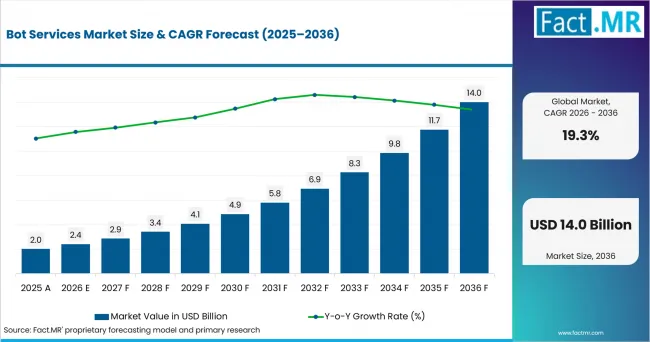
Bot Services Market Value Analysis | Source: Fact.MR
What are the defining numbers behind Bot Services Market growth?
The market is projected to add USD 11.6 billion in value between 2026 and 2036.
- Demand Drivers in the Market
- Enterprise AI adoption is creating a broader installed base for bot deployment: Germany reported AI use in 26% of enterprises in 2025, with text mining, speech recognition, natural-language generation, and workflow automation all represented among users. In the United States, Census Bureau data collected through May 2026 placed overall business AI use around 17% to 20%, with higher adoption among firms with 250 or more employees. These conditions expand the number of organizations able to connect virtual assistants to customer support, internal service, sales, and information workflows.
- Generative orchestration is changing what a bot can execute after interpreting a request. Microsoft Copilot Studio can select tools, knowledge, topics, and connected agents at runtime, while Google Conversational Agents combines generative playbooks with deterministic flows. This lets buyers move from fixed FAQ trees toward bots that retrieve information, call business systems, and complete multi-step tasks, supporting demand for agentic orchestration and related implementation services.
- Business-function automation is extending bot demand beyond contact centers. Brazil’s ICT Enterprises 2025 survey reported AI use across marketing and sales, business-process administration, management, and HR or recruitment among adopting firms, while workflow automation was used by a substantial share of AI-using companies. Bot projects therefore attach to workflow automation when a conversation needs to trigger approvals, data updates, lead routing, employee requests, or transaction steps.
- Cloud and API-based deployment reduce the infrastructure work required to expose bots across websites, mobile apps, contact centers, collaboration tools, and enterprise applications. UK business data for 2025 to 2026 show that AI tools are already being integrated into existing business systems, with integration more common in larger organizations. This supports managed cloud bot platforms, connectors, and robotic automation where conversational requests must reach established back-office systems.
- Key Segments Analyzed
- Customer Service Bots account for 43.7% of Product in 2026 because first-line support, triage, routine information requests, and escalation create recurring bot workloads with clear service-volume economics.
- Customer Engagement accounts for 68.2% of Application in 2026 as organizations use bots to answer questions, retain context, route requests, and maintain response availability across digital channels.
- Enterprise Organizations account for 57.9% of End Use in 2026 because larger organizations have more customer and employee interaction volume, more systems to integrate, and greater capacity to govern AI deployments.
- Artificial Intelligence Platforms account for 74.6% of Technology in 2026 because machine-learning and deep-learning systems provide intent interpretation, response generation, tool selection, and knowledge retrieval for modern bot workflows.
- Cloud Based Bot Platforms account for 35.8% of Formulation in 2026 because public and private cloud environments shorten deployment cycles and support managed scaling across channels and business units.
- Direct Sales account for 61.3% of Distribution Channel in 2026 because enterprise bot projects often require solution design, integration review, data-governance checks, security evaluation, and contracted support before production deployment.
- Analyst Opinion at Fact.MR
- Shambhu Nath Jha, Principal Consultant, Fact.MR ~ “Bot services are moving from scripted conversation toward task execution. The commercial value comes from connecting a user request to trusted knowledge, a system action, or a controlled handoff. Providers that can combine natural-language performance with integration, identity, logging, security, and clear human escalation are positioned for wider enterprise use as bot deployments move into formal business processes.”
- Strategic Implications
- Providers should design bots around measurable workflow outcomes such as resolved support requests, qualified leads, completed employee tasks, or reduced manual processing rather than around conversation volume alone.
- Enterprise buyers should require clear controls for tool access, knowledge sources, authentication, human handoff, and transaction approval as intelligent assistants gain permission to act inside business systems.
- Cloud deployment should be paired with data-residency, logging, model-routing, and integration choices that fit the buyer’s compliance environment instead of assuming one deployment pattern for every workload.
- Suppliers serving the European market need user-facing disclosure controls because Article 50 transparency obligations under the EU AI Act have applied since 2 August 2026 to interactive AI systems such as chatbots and AI agents.
How does the Bot Services Market break down by segment?
The market is segmented by Product, Application, End Use, Technology, Formulation, and Distribution Channel.
Why do Customer Service Bots lead Product?
Customer Service Bots account for 43.7% of the Product segment in 2026.
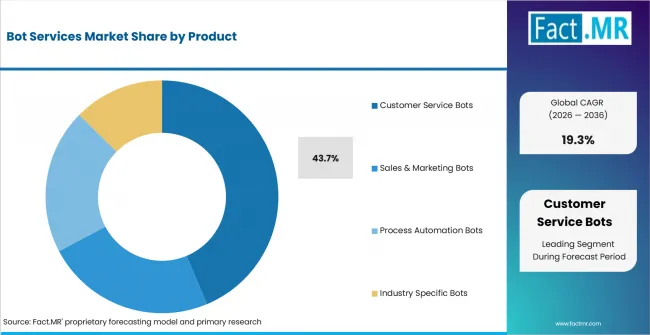
Bot Services Market Analysis By Product | Source: Fact.MR
Customer service produces repeated, structured demand for answers, status checks, triage, account guidance, and escalation. A bot can absorb routine contacts while preserving a handoff path for cases that need a human agent, which gives buyers a direct operational reason to deploy the service.
Google Cloud’s contact-center platform supports virtual agents as a first line of support with escalation to human agents when the bot reaches a knowledge or technical limit. IBM watsonx Assistant similarly supports branded conversational interfaces across applications, devices, and channels, reinforcing the fit between bot services and recurring service workflows.
Why does Customer Engagement lead Application?
Customer Engagement accounts for 68.2% of the Application segment in 2026.
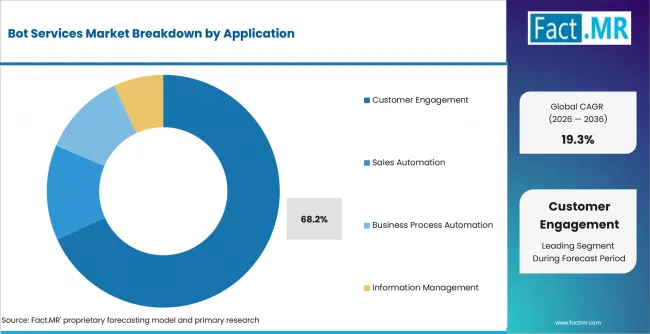
Bot Services Market Analysis By Application | Source: Fact.MR
Engagement combines support, retention, product guidance, account questions, and conversational routing across web, mobile, voice, and messaging channels. The same bot can therefore remain useful across multiple stages of a customer relationship instead of being restricted to one back-office task.
Current enterprise platforms support this multi-channel model. Oracle Digital Assistant can route natural-language requests to specialized skills, while Microsoft Copilot Studio can publish agents across digital channels and connect them with tools and knowledge. This broadens the addressable workflow for sales and service teams without requiring separate user interfaces for every business process.
Why do Enterprise Organizations lead End Use?
Enterprise Organizations account for 57.9% of the End Use segment in 2026.
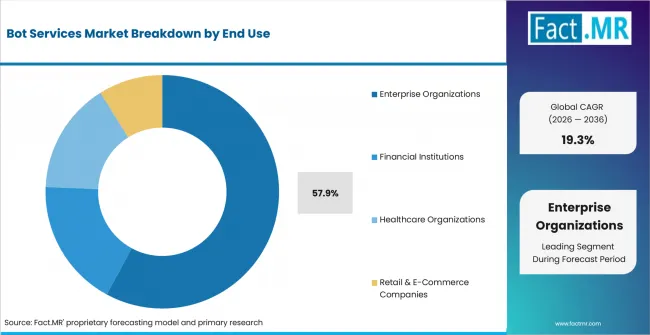
Bot Services Market Analysis By End Use | Source: Fact.MR
Enterprise organizations handle higher interaction volumes and operate more customer, employee, finance, HR, and knowledge systems. This creates more use cases for support bots, process bots, and internal assistants, but it also creates demand for identity controls, integration architecture, monitoring, and service-level support.
Adoption data reinforce this pattern. Germany reported AI use in 57% of enterprises with 250 or more employees in 2025, compared with 23% among enterprises with 10 to 49 employees. U.S. Census Bureau analysis likewise showed materially higher AI use among firms with at least 250 employees during the 2025 to 2026 survey period.
Why do Artificial Intelligence Platforms lead Technology?
Artificial Intelligence Platforms account for 74.6% of the Technology segment in 2026.
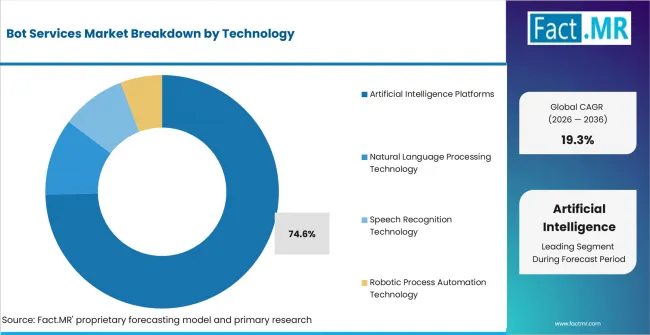
Bot Services Market Analysis By Technology | Source: Fact.MR
The bot layer increasingly depends on AI for interpreting intent, generating responses, retrieving knowledge, selecting tools, and deciding when to ask for missing information. Machine-learning and deep-learning capabilities therefore sit underneath a wider share of customer-facing and internal bot workflows than speech-only or RPA-only technology.
Microsoft’s generative orchestration architecture illustrates the shift: an agent can select topics, tools, knowledge, and connected agents based on the user request and available context. That turns the AI platform into the control layer for both conversation and action.
Why do Cloud Based Bot Platforms lead Formulation?
Cloud Based Bot Platforms account for 35.8% of the Formulation segment in 2026.
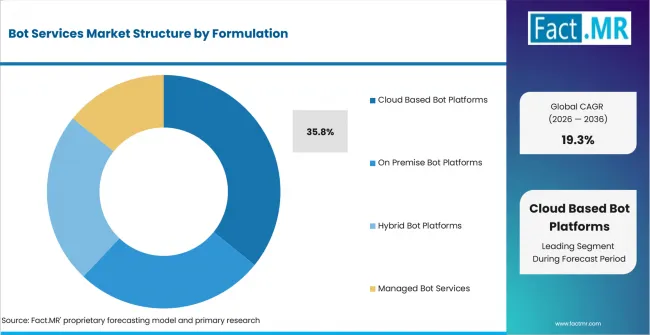
Bot Services Market Analysis By Formulation | Source: Fact.MR
Cloud deployment gives organizations a managed route to model access, APIs, channel connections, scaling, monitoring, and software updates. This reduces the infrastructure burden for teams that need to deploy bots across multiple business units or geographies while preserving public-cloud or private-cloud choices.
IBM lists watsonx Assistant availability across regions including Frankfurt, London, Tokyo, Washington DC, Dallas, and Sydney. Multi-region service availability matters for buyers that need to align bot workloads with enterprise architecture, latency, resilience, and data-handling requirements.
Why does Direct Sales lead Distribution Channel?
Direct Sales account for 61.3% of the Distribution Channel segment in 2026.
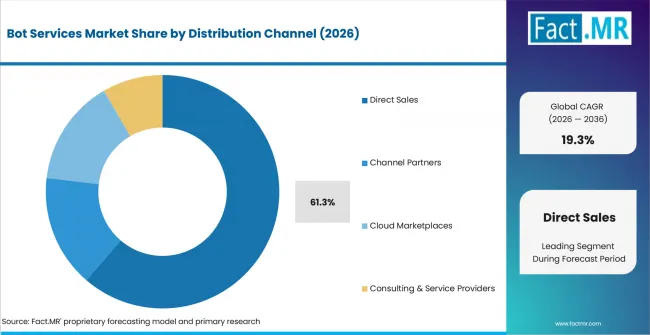
Bot Services Market Analysis By Distribution Channel | Source: Fact.MR
Bot services used in enterprise workflows are rarely purchased as a standalone conversational widget. Buyers often need architecture review, identity integration, system connectors, security assessment, model and knowledge configuration, testing, escalation design, and support commitments before the bot is released to customers or employees.
Direct vendor engagement gives the supplier more control over solution design and gives the buyer a clearer route for technical accountability. Channel partners and cloud marketplaces remain relevant where procurement is standardized, while consulting and managed-service providers become important when deployment requires integration across several systems.
What is accelerating Bot Services Market adoption, and what is holding it back?
Adoption is being accelerated by enterprise AI use, generative orchestration, cloud delivery, natural-language interfaces, and demand to automate customer and employee workflows. Restraints include data-governance requirements, integration complexity, inaccurate or unsupported responses, cybersecurity exposure, and the need for human oversight when a bot can trigger business actions.
Governance is becoming more visible in purchasing. NIST’s Generative AI Profile extends the AI Risk Management Framework to generative systems, while the European Commission’s Article 50 guidance requires people to be informed when they are directly interacting with qualifying AI systems. These requirements push buyers toward platforms that can document behavior, access, logging, disclosure, and escalation controls.
Drivers Impact Analysis
| Factor | (~) % Impact on CAGR | Geographic Relevance | Impact Timeline |
|---|---|---|---|
| Enterprise customer-service automation | 4.8% | USA; Germany; UK; Japan | Near to mid term |
| Generative AI and natural-language orchestration | 4.3% | Global; USA; Germany; UK | Near to mid term |
| Cloud delivery and enterprise-system integration | 3.6% | Global; USA; UK; Germany | Near to mid term |
| Sales, HR, and process-automation use cases | 3.1% | Brazil; USA; Germany; Japan | Mid term |
Source: Fact.MR analysis. Updated Aug 25, 2026
Opportunity Impact Analysis
| Factor | (~) % Impact on CAGR | Geographic Relevance | Impact Timeline |
|---|---|---|---|
| Agent-based task execution across enterprise applications | 3.7% | USA; Germany; UK; Japan | Mid term |
| Voice and multilingual bot deployment | 2.9% | Global; Japan; Germany; Brazil | Mid term |
| Industry-specific bots for finance and healthcare | 2.6% | USA; Germany; UK; Japan | Mid to long term |
| Managed bot operations and integration services | 2.2% | Global | Near to mid term |
Source: Fact.MR analysis. Updated Aug 25, 2026
Restraints Impact Analysis
| Factor | (~) % Impact on CAGR | Geographic Relevance | Impact Timeline |
|---|---|---|---|
| Data privacy, AI governance, and disclosure obligations | -2.8% | European Union; UK; USA; Global | Near to long term |
| Integration complexity across legacy business systems | -2.2% | Global; Japan; Germany | Near to mid term |
| Response errors and weak human-escalation design | -1.8% | Global | Near to long term |
Source: Fact.MR analysis. Updated Aug 25, 2026
Which countries are scaling the Bot Services Market through 2036?
- Germany: enterprise AI use, natural-language technologies, workflow automation, and the implementation of EU AI transparency rules support demand for bot platforms with clear governance and integration controls.
- Brazil: expanding enterprise AI use and strong use of workflow automation among AI adopters create demand for bots that connect marketing, sales, administration, and service processes.
- USA: broad enterprise experimentation with AI, higher adoption in information and finance, and extensive cloud software use support customer-service and internal automation bots across business functions.
- UK: business AI use has continued to rise, while organizations are increasingly integrating AI into existing systems, supporting bots that operate inside customer, productivity, and workflow platforms.
- Japan: AI adoption is spreading across enterprise DX programs, with current use concentrated on efficiency and process speed, creating a practical entry point for bots that automate internal and customer-facing tasks.
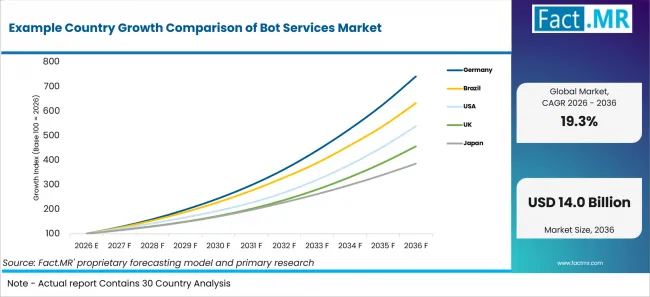
Example Country Growth Comparison Of Bot Services Market | Source: Fact.MR
Country CAGR (2026-2036)
| Country | CAGR (2026-2036) |
|---|---|
| Germany | 22.2% |
| Brazil | 20.3% |
| USA | 18.3% |
| UK | 16.4% |
| Japan | 14.5% |
Source: Fact.MR analysis. Updated Aug 25, 2026
What is driving Germany’s growth through 2036?
Germany is forecast to expand at a 22.2% CAGR from 2026 to 2036.
Destatis reported that 26% of enterprises used AI technologies in 2025. Among AI-using firms, text mining accounted for 52%, speech recognition 42%, natural-language generation 35%, machine learning 23%, and workflow or decision automation 27%. These technologies map directly to the language, voice, learning, and process functions used in bot services.
The regulatory layer is also becoming explicit. Article 50 transparency obligations under the EU AI Act have applied since 2 August 2026, including requirements to inform people when they are directly interacting with qualifying AI systems. Bot suppliers selling into Germany therefore need disclosure, governance, logging, and user-experience controls alongside conversational performance.
What is driving Brazil’s growth through 2036?
Brazil is forecast to expand at a 20.3% CAGR from 2026 to 2036.
Cetic.br reported that 17% of Brazilian enterprises used AI in 2025, with adoption reaching 50% among enterprises with 250 or more employees. Among AI-using firms, workflow automation was used by 68%, while AI was applied in marketing or sales, business-process administration, management, and HR or recruitment.
That application mix creates a direct route for bot services because a conversational front end can capture a request and pass it into lead handling, administrative workflow, employee service, or customer interaction. Growth therefore depends on integration and service design as much as on the language model itself.
What is driving USA’s growth through 2036?
The USA is forecast to expand at an 18.3% CAGR from 2026 to 2036.
U.S. Census Bureau BTOS data collected from December 2025 through May 2026 placed overall business AI use around 17% to 20%, with 37% of firms with at least 250 employees reporting AI use. Information and finance and insurance showed adoption above the national rate, creating a strong operating base for service, knowledge, and transaction bots.
The 2026 AI supplement measures use across business functions including customer service, marketing, HR, finance, IT, and research. This broad functional coverage matters because bot services increasingly compete on the ability to retrieve enterprise context and complete actions across several departments rather than operate as isolated website chat tools.
What is driving UK’s growth through 2036?
The UK is forecast to expand at a 16.4% CAGR from 2026 to 2036.
ONS analysis released in July 2026 reported that around 35% of businesses with 10 or more employees used at least one AI technology, while large language models were used by 18% of businesses. The same analysis found that improving existing business operations was a central purpose of AI use, aligning with bots deployed for service, information access, and workflow execution.
The UK Business Data Survey also found that AI integration into existing business systems was more common among larger firms. That integration pattern supports bot services that need access to CRM, finance, productivity, HR, or workflow data rather than operating only as a standalone chat interface.
What is driving Japan’s growth through 2036?
Japan is forecast to expand at a 14.5% CAGR from 2026 to 2036.
IPA’s DX Trends 2026 reports that AI adoption is spreading among Japanese enterprises, with realized effects concentrated on efficiency and faster work processes. Those outcomes match bot projects used for routine employee requests, knowledge retrieval, customer support, and workflow initiation.
IPA’s 2025 cross-country analysis also showed that generative AI use was more developed among larger Japanese enterprises than among smaller firms. This creates a two-stage opportunity: enterprise deployments can support integrated bot workflows now, while managed and cloud-based services can reduce the implementation burden for smaller organizations over the forecast period.
Who Leads the Bot Services Market?
Microsoft leads the Bot Services Market.
Microsoft competes through Copilot Studio, which combines generative orchestration, knowledge sources, tools, connected agents, workflows, and multi-channel deployment. IBM brings watsonx Assistant and wider watsonx agent capabilities, Google competes through Conversational Agents, Dialogflow, and contact-center virtual agents, and Oracle provides Digital Assistant with natural-language routing across specialized skills and enterprise applications.
Corporate ownership has changed for several providers. Ultimate Software merged with Kronos in 2020 to form UKG. SilkRoad Technology rebranded as Rival in 2023. SAP completed its acquisition of SmartRecruiters in September 2025. These changes affect how current product portfolios and support relationships should be interpreted.
Competitive selection depends on natural-language quality, system integration, identity and access control, knowledge grounding, voice support, tool execution, monitoring, human escalation, geographic service coverage, and the ability to operate within enterprise security and AI-governance requirements.
Which companies are the key providers?
Key companies profiled include Microsoft; IBM; Google; Oracle; Artificial Solutions; PeopleFluent; Greenhouse Software; ClearCompany; Ultimate Software; Silkroad Technology; Trakstar Hire; TalentNest; and SmartRecruiters.
- Microsoft
- IBM
- Oracle
- Artificial Solutions
- PeopleFluent
- Greenhouse Software
- ClearCompany
- Ultimate Software
- Silkroad Technology
- Trakstar Hire
- TalentNest
- SmartRecruiters
Bibliography
- German Federal Statistical Office. (2025). Enterprises using artificial intelligence technologies, by employment size class, 2025. Destatis.
- Cetic.br / NIC.br. (2026). ICT Enterprises 2025: Enterprises that used artificial intelligence technologies. Brazilian Network Information Center.
- Cetic.br / NIC.br. (2026). ICT Enterprises 2025: Enterprises that used artificial intelligence technologies, by type and application. Brazilian Network Information Center.
- U.S. Census Bureau. (2026). Business Trends and Outlook Survey: artificial intelligence use by U.S. businesses. U.S. Department of Commerce.
- U.S. Census Bureau. (2026). The Microstructure of AI Diffusion: Evidence from Firms, Business Functions, and Worker Tasks. Center for Economic Studies.
- Office for National Statistics. (2026). Artificial intelligence in UK businesses: 2023 to 2026. UK Statistics Authority.
- Department for Science, Innovation and Technology. (2026). UK Business Data Survey 2026. UK Government.
- Information-technology Promotion Agency, Japan. (2026). DX Trends 2026: Expanding AI adoption and enterprise digital transformation. IPA.
- Information-technology Promotion Agency, Japan. (2025). DX Trends 2025. IPA.
- European Commission. (2026). Guidelines on transparency obligations for providers and deployers of certain AI systems. European Commission.
- National Institute of Standards and Technology. (2024). Artificial Intelligence Risk Management Framework: Generative Artificial Intelligence Profile. U.S. Department of Commerce.
- Microsoft. (2026). Microsoft Copilot Studio overview and generative orchestration guidance. Microsoft Learn.
- IBM. (2026). watsonx Assistant service and product documentation. IBM.
- Google Cloud. (2026). Conversational Agents, Dialogflow CX, and Contact Center AI virtual-agent documentation. Google.
- Oracle. (2025). Overview of Digital Assistants and Skills. Oracle Cloud Infrastructure Documentation.
- UKG. (2020). UKG Corporate Social Responsibility Report 2020: Ultimate Software and Kronos merger. UKG.
- Rival. (2025). Rival Terms and Conditions Agreement: formerly SilkRoad Technology. Rival.
- SAP. (2025). SAP Completes Acquisition of SmartRecruiters. SAP News Center.
This Report Answers
- Which bot products, applications, technologies, deployment formulations, and distribution routes are included in the market?
- Why do customer-service and engagement workflows account for a large share of bot-service demand?
- How are generative AI, natural-language processing, voice, and robotic process automation changing bot capability?
- Why do enterprise organizations account for a large share of demand?
- How do cloud deployment, direct sales, integration, and managed services affect purchasing?
- How do AI governance, cybersecurity, and user-disclosure requirements influence deployment?
- Which country-specific enterprise AI trends support bot-service adoption?
What does the Bot Services Market cover?
The market covers software platforms and related implementation or managed services used to design, deploy, integrate, operate, and support bots across Product, Application, End Use, Technology, Formulation, and Distribution Channel classifications. Counted revenue includes bot-platform subscriptions or licenses, bot-specific deployment and integration, managed bot services, and associated commercial services when they form part of the bot offering.
What is included in the scope?
- Products: Customer Service Bots, Sales & Marketing Bots, Process Automation Bots, and Industry Specific Bots, including the listed subsegments.
- Applications: Customer Engagement, Sales Automation, Business Process Automation, and Information Management, including the listed subsegments.
- End Use: Enterprise Organizations, Financial Institutions, Healthcare Organizations, and Retail & E-Commerce Companies, including the listed subsegments.
- Technology: Artificial Intelligence Platforms, Natural Language Processing Technology, Speech Recognition Technology, and Robotic Process Automation Technology, including the listed subsegments.
- Formulation: Cloud Based Bot Platforms, On Premise Bot Platforms, Hybrid Bot Platforms, and Managed Bot Services, including the listed subsegments.
- Distribution Channel: Direct Sales, Channel Partners, Cloud Marketplaces, and Consulting & Service Providers, including the listed subsegments.
- Geographic detail: Global market sizing with country analysis for Germany, Brazil, USA, UK, and Japan.
What is excluded from the scope?
- Standalone foundation models, general AI APIs, or data-science platforms are excluded when they are sold without a bot-service deployment or bot-specific commercial layer within the defined market taxonomy.
- Physical industrial robots, autonomous vehicles, drones, and robotic hardware are excluded unless the revenue relates specifically to a software bot or RPA service included in the Technology taxonomy.
- General CRM, ERP, HCM, contact-center, or workflow-software revenue is excluded when the bot capability is only an embedded feature and is not separately attributable to the commercial bot-service offering.
- Consumer voice-assistant devices and general consumer hardware are excluded when the transaction does not fall within an enterprise or commercial bot-service use case defined by the market segmentation.
How Was the Analysis Built?
The analysis maps bot-service demand to the enterprise workflows that cause organizations to purchase a bot platform or associated service: customer support, engagement, sales, process automation, information access, employee service, and industry-specific interaction. Product, application, end use, technology, formulation, distribution, country demand, and supplier positioning are cross-checked so forecast logic reflects commercial bot deployments rather than the broader AI software market.
- Primary Research
- Relevant respondent groups include bot-platform product leaders, conversational-AI developers, enterprise architects, contact-center managers, customer-experience teams, sales-operations leaders, automation teams, HR and recruitment-technology buyers, financial-services and healthcare IT managers, cloud marketplace teams, systems integrators, managed-service providers, security leaders, and AI-governance or data-protection specialists.
- Desk Research
- Desk research uses official enterprise AI-adoption statistics, AI governance and transparency rules, cybersecurity guidance, product documentation, cloud-service information, corporate ownership disclosures, and enterprise digital-transformation research. These sources support analysis of adoption mechanisms, deployment requirements, company status, and competitive positioning.
- Market Sizing and Forecasting
- Sizing links enterprise bot deployments with paid platform usage, implementation and integration activity, managed-service attachment, customer-service volume, sales and workflow use cases, cloud versus on-premise mix, end-use adoption, direct-sales activity, channel contribution, and country-level enterprise AI penetration. Forecasting considers natural-language capability, agent orchestration, integration depth, cloud access, business-process automation, regulation, security, and human-oversight requirements.
- Data Validation and Update Cycle
- Assumptions are checked against current enterprise AI adoption, platform functionality, deployment models, regulatory requirements, channel structure, integration practices, and corporate ownership changes. Updates focus on factors that can alter paid bot adoption, application mix, service attachment, deployment preference, country demand, or supplier positioning.
Segmentation
What is the report's scope and coverage?
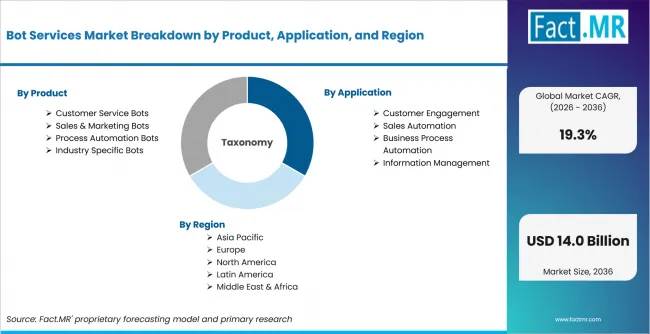
Bot Services Market Breakdown By Product, Application, And Region | Source: Fact.MR
| Attribute | Details |
|---|---|
| Quantitative Units | USD Billion |
| Market Definition | Software platforms and related implementation or managed services used to deploy conversational, workflow, sales, support, information, and industry-specific bots within the supplied taxonomy. |
| Segments Covered | Product; Application; End Use; Technology; Formulation; Distribution Channel |
| Regions Covered | Global |
| Countries Covered | Germany; Brazil; USA; UK; Japan |
| Key Companies Profiled | Microsoft; IBM; Google; Oracle; Artificial Solutions; PeopleFluent; Greenhouse Software; ClearCompany; Ultimate Software; Silkroad Technology; Trakstar Hire; TalentNest; SmartRecruiters |
| Forecast Period | 2026 to 2036 |
| Base Year | 2026 |
| Market Value, 2026 | USD 2.4 billion |
| Market Value, 2036 | USD 14.0 billion |
| CAGR, 2026-2036 | 19.3% |
| Absolute Opportunity | USD 11.6 billion |
| Approach | Hybrid top-down and bottom-up approach using enterprise bot deployments, AI adoption, application mix, platform usage, integration and managed-service attachment, deployment formulation, distribution structure, country growth patterns, and supplier validation. |
Source: Fact.MR analysis. Updated Aug 25, 2026
How is the market segmented?
-
By Product:
- Customer Service Bots
- Text Based Support Bots
- Voice Based Support Bots
- Sales & Marketing Bots
- Lead Generation Bots
- Engagement Bots
- Process Automation Bots
- Workflow Automation Bots
- Data Processing Bots
- Industry Specific Bots
- Healthcare Bots
- Financial Service Bots
- Customer Service Bots
-
By Application:
- Customer Engagement
- Customer Support Applications
- Customer Retention Applications
- Sales Automation
- Lead Management Applications
- Commerce Applications
- Business Process Automation
- Administrative Automation
- Operational Automation
- Information Management
- Knowledge Management Applications
- Data Intelligence Applications
- Customer Engagement
-
By End Use:
- Enterprise Organizations
- Large Enterprises
- Mid Sized Enterprises
- Financial Institutions
- Banking Organizations
- Insurance Organizations
- Healthcare Organizations
- Healthcare Providers
- Healthcare Administrators
- Retail & E-Commerce Companies
- Retail Businesses
- E-Commerce Companies
- Enterprise Organizations
-
By Technology:
- Artificial Intelligence Platforms
- Machine Learning Systems
- Deep Learning Systems
- Natural Language Processing Technology
- Text Processing Systems
- Language Generation Systems
- Speech Recognition Technology
- Voice Input Systems
- Voice Output Systems
- Robotic Process Automation Technology
- Attended Automation Systems
- Unattended Automation Systems
- Artificial Intelligence Platforms
-
By Formulation:
- Cloud Based Bot Platforms
- Public Cloud Platforms
- Private Cloud Platforms
- On Premise Bot Platforms
- Enterprise Deployment Systems
- Dedicated Server Platforms
- Hybrid Bot Platforms
- Integrated Deployment Systems
- Multi Environment Platforms
- Managed Bot Services
- Consulting & Integration Services
- Operations & Maintenance Services
- Cloud Based Bot Platforms
-
By Distribution Channel:
- Direct Sales
- Enterprise Sales Teams
- Vendor Direct Contracts
- Channel Partners
- Technology Resellers
- Value Added Resellers
- Cloud Marketplaces
- Public Cloud Marketplaces
- Private Marketplaces
- Consulting & Service Providers
- System Integrators
- Managed Service Providers
- Direct Sales
Frequently Asked Questions
What is the Bot Services Market value in 2026?
At what CAGR is the market projected to grow?
What is the projected market value by 2036?
Which Product leads the market?
Which Application leads the market?
Which End Use leads the market?
Which Technology leads the market?
Which Formulation leads the market?
Which Distribution Channel leads the market?
Which country records the highest listed CAGR?
Which company leads the Bot Services Market?
Which companies are included in the market assessment?
Who worked on this report


Preview the report firsthand - request a free sample
Free SampleGet the brochure for pricing and purchase details
Download PDF