- Base Value(2025): 2.5 Bn
- Estimated Value(2026): 2.8 Bn
- Forecast Value (2036): 8 Bn
- CAGR (2026 - 2036): 12.3%
Breathable Membrane Market Forecast 2026 to 2036
In 2025, the breathable membrane market was valued at USD 2.5 billion. Based on FMR analysis, demand for breathable membranes is estimated to grow to USD 2.8 billion in 2026 and USD 8 billion by 2036. Fact MR projects a CAGR of 12.3% during the forecast period.
The absolute dollar growth from 2026 to 2036 is USD 5.2 billion. This growth is driven by the increasing adoption of breathable membranes in industries such as construction, automotive, and textiles, where their ability to allow air permeability while maintaining water resistance is highly valued. The growing demand for energy-efficient, sustainable building materials and innovative fabric technologies is further supporting the market. However, challenges such as material cost fluctuations and competition from alternative technologies may impact growth in certain regions.
As Dr Mario Stucki, Chief Executive Officer and Co‑Founder of Dimpora, noted regarding innovation in breathable membrane technology, ‘If you go out of the fluorinated membranes space, you will have the issue that there is a solid polymer layer that transports water molecules based on solid state diffusion, where it is sucked up and released at the other side. However, this method is very slow so not very breathable.’
China leads with a CAGR of 8.2%, driven by the rapid growth of construction and manufacturing sectors. India follows with 7.8%, fueled by increasing construction activities and demand for high-performance materials. Germany grows at 7.4%, supported by strong demand for energy-efficient and sustainable building materials. Brazil shows growth at 6.9%, benefiting from expanding construction and automotive industries. The USA grows at 6.5%, driven by steady demand for breathable membranes in energy-efficient building designs and automotive applications.
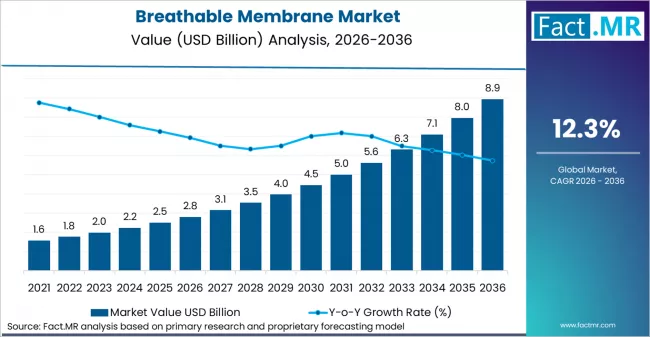
Breathable Membrane Market Market Value Analysis | Source: Fact.MR
Breathable Membrane Market
| Metric | Value |
|---|---|
| Estimated Value in (2026E) | USD 2.8 billion |
| Forecast Value in (2036F) | USD 8 billion |
| Forecast CAGR (2026 to 2036) | 12.3% |
Source: Fact.MR analysis. Updated Mar 4, 2026
Breathable Membrane Market Definition
The breathable membrane market involves the production and sale of semi‑permeable materials that allow moisture vapor to pass through while blocking liquid water, used to enhance comfort, durability, and moisture control in various products.
Market Inclusions
This report covers global and regional market sizes for breathable membranes over a defined forecast period, including material types (PTFE, PU, ePTFE, coated fabrics), applications (apparel, footwear, building construction, medical dressings), and end‑use industries.
Market Exclusions
The scope excludes non‑breathable barrier films and unrelated sheet materials not engineered for moisture vapor transmission. Finished products (garments, footwear) that incorporate breathable membranes without separate membrane market data are omitted.
Research Methodology
- Primary Research: Interviews were conducted with material scientists, manufacturers, and end‑use product designers.
- Desk Research: Data was sourced from industry reports, standards publications, and trade association statistics.
- Market‑Sizing and Forecasting: A hybrid model combining top‑down demand forecasts with bottom‑up shipment and revenue data was used.
- Data Validation and Update Cycle: Findings were validated through expert review and aligned with recent production and trade figures.
Summary of the Breathable Membrane Market
- Market Definition
- The breathable membrane market involves the production and sale of semi-permeable materials that allow moisture vapor to pass through while blocking liquid water. These membranes are used to enhance comfort, durability, and moisture control in various products across industries such as construction, hygiene, healthcare, textiles, and food packaging.
- Demand Drivers
- Growing Adoption in Sustainable Building Materials: The increasing demand for energy-efficient and sustainable building materials is driving the adoption of breathable membranes, particularly in construction applications where moisture control is critical.
- Rising Consumer Demand for Comfort and Hygiene: The growing awareness around personal hygiene and the increasing need for comfort in everyday products, such as medical garments, hygiene products, and protective clothing, are boosting the demand for breathable membranes.
- Technological Advancements: Ongoing innovations in breathable membrane technologies, offering enhanced performance and durability, are supporting the market growth.
- Key Segments Analyzed
- Material Type: Polyethylene is expected to dominate, accounting for 45% of the market share by 2026. Polyethylene-based breathable membranes are popular in applications requiring moisture management, such as hygiene products, textiles, and medical applications, due to their excellent moisture-wicking properties and versatility.
- Application: Hygiene is projected to capture 30% of the market share by 2026. The hygiene sector, including products like diapers, sanitary pads, and adult incontinence products, represents a significant portion of the market due to the demand for breathable materials that provide comfort, breathability, and moisture control.
- Geography: China leads with a CAGR of 8.2%, driven by the rapid growth of the construction sector and the increasing focus on energy-efficient and sustainable building practices. India follows with a 7.8% CAGR, fueled by the growing demand for high-performance materials in the construction and textile sectors.
- Analyst Opinion at Fact MR
- Shambhu Nath Jha, Principal Consultant at Fact MR, highlighted, "The growing focus on sustainability, especially in the construction and textile sectors, is expected to continue fueling the demand for breathable membranes, particularly those made from polyethylene, which offer superior moisture control and breathability."
- Strategic Implications/Executive Takeaways
- Emphasis on Innovation and Sustainability: Companies should focus on developing innovative breathable membrane solutions that meet the growing demand for energy-efficient buildings and sustainable textiles, with a focus on durability and moisture management.
- Targeting Emerging Markets: Expanding market presence in rapidly developing regions like Asia Pacific, where urbanization and infrastructure growth are driving demand for construction materials, will be key to tapping into the growing need for breathable membranes.
- Collaboration with Industry Players: Strategic partnerships with construction companies and textile manufacturers can help ensure product adoption and meet the increasing demand for high-performance breathable membranes.
- Methodology
- Primary Research: Interviews were conducted with material scientists, manufacturers, and end-user product designers.
- Desk Research: Data was sourced from industry reports, standards publications, and trade association statistics.
- Market Sizing & Forecasting: A hybrid model combining top-down demand forecasts with bottom-up shipment and revenue data was used to project market growth.
Segmental Analysis
Breathable Membrane Market Analysis by Material Type
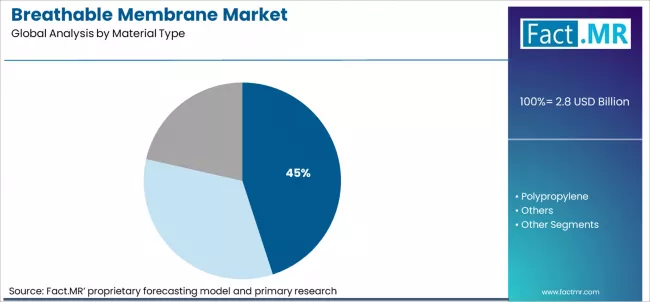
Breathable Membrane Market Analysis By Material Type | Source: Fact.MR
- Market Overview: Polyethylene is projected to capture 45% of the breathable membrane market by 2026. Polyethylene-based breathable membranes are commonly used in applications that require moisture management, such as in hygiene products, textiles, and medical applications due to their excellent moisture-wicking properties and versatility.
- Demand Drivers:
- Waterproof yet Breathable: Polyethylene membranes offer a good balance of water resistance and breathability, making them ideal for use in products that require moisture regulation, such as medical garments, hygiene products, and protective clothing.
- Cost-Effectiveness and Versatility: Polyethylene is an affordable material that can be used in various applications, contributing to its widespread use in breathable membranes. It provides an efficient solution for applications that require both protection from external elements and air circulation.
- Growing Focus on Hygiene and Health: With the increasing demand for personal protective equipment (PPE) and healthcare textiles, polyethylene-based breathable membranes are gaining popularity in products that ensure comfort and hygiene, such as medical gowns, diapers, and incontinence products.
Breathable Membrane Market Analysis by Application
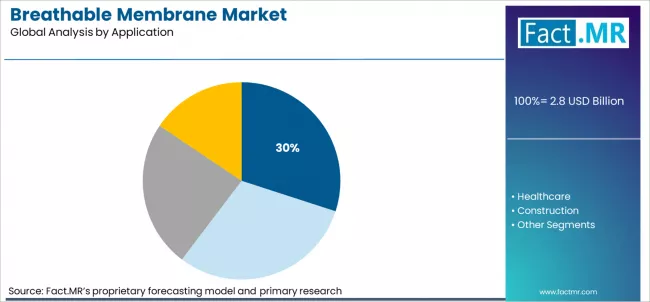
Breathable Membrane Market Analysis By Application | Source: Fact.MR
- Market Overview: Hygiene is expected to account for 30% of the breathable membrane market by 2026. The hygiene sector, including products such as diapers, sanitary pads, and adult incontinence products, represents a significant portion of the market due to the growing demand for products that provide comfort, breathability, and moisture control.
- Demand Drivers:
- Rising Demand for Personal Hygiene Products: With increasing awareness around personal hygiene, the demand for breathable membranes in products like diapers, feminine hygiene products, and adult incontinence products is growing. These products require breathable membranes to keep skin dry and comfortable while preventing irritation.
- Advancements in Hygiene Products: The growing focus on improving the performance and comfort of hygiene products is driving the need for high-quality breathable membranes. These materials offer enhanced moisture control, breathability, and skin protection, making them highly sought after in the hygiene market.
- Health and Comfort Considerations: Breathable membranes help maintain a dry and comfortable environment by allowing moisture to escape while preventing external elements from entering. This is essential for the performance and comfort of hygiene products, which is driving their increased use in this application.
Breathable Membrane Market Drivers, Restraints, and Opportunities
FMR analysts observe that the breathable membrane market is a growth‑aligned, performance‑driven segment anchored in construction, apparel, and industrial applications where moisture control and air permeability are critical. Historically, basic waterproof fabrics and barriers met early needs; as building codes and comfort expectations evolved, structural demand emerged for engineered membranes that allow vapor transmission while blocking liquid water. The 2026 valuation reflects this shift, with uptake tied to green building standards, outdoor gear performance, and moisture‑management requirements across sectors.
While traditional non‑breathable barriers remain in cost‑sensitive uses, advanced breathable membranes with proprietary microstructure and enhanced durability are gaining share. These higher‑value products command premium pricing, contributing to net market value growth even as overall unit volumes grow in line with construction and technical textile adoption.
- Moisture & Comfort Demand: Builders and apparel brands adopt breathable membranes to improve indoor comfort and garment performance versus basic barriers that trap moisture.
- Regulatory & Performance Standards: Building and textile codes that emphasize energy efficiency and moisture control push adoption of certified breathable solutions that meet defined criteria.
- Regional Application Trends: In North America and Europe, stringent building and outdoor performance standards drive higher uptake of advanced membranes, while emerging markets in Asia‑Pacific reflect rapid infrastructure growth.
Regional Analysis
The market analysis covers key global regions, including East Asia, South Asia, Western Europe, North America, and Latin America. It is segmented geographically, with specific market dynamics for each region. The full report provides a detailed market attractiveness analysis.
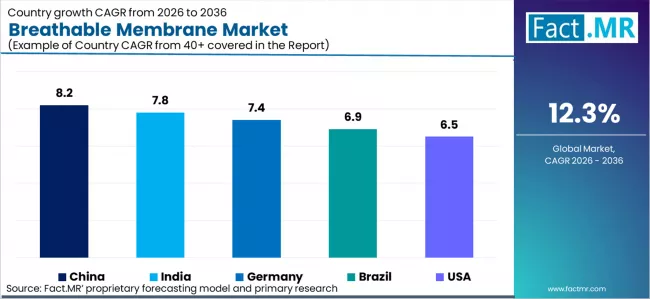
Breathable Membrane Market Cagr Analysis By Country | Source: Fact.MR
| Country | CAGR (2026-2036) |
|---|---|
| China | 8.2% |
| India | 7.8% |
| Germany | 7.4% |
| Brazil | 6.9% |
| USA | 6.5% |
Source: Fact.MR analysis. Updated Mar 4, 2026
Source: Fact MR (FMR) analysis, based on proprietary forecasting model and primary research.
East Asia:
In East Asia, China is the leading market for breathable membranes, driven by the increasing demand for construction materials, growing urbanization, and the rising focus on energy-efficient and sustainable building practices.
- China: Demand for breathable membranes in China is projected to rise at 8.2% CAGR through 2036. China’s rapid urbanization, growing construction sector, and increased focus on energy-efficient buildings continue to support strong market growth.
South Asia:
In South Asia, India is a major market for breathable membranes, supported by the country’s booming construction industry, rising awareness of sustainability, and growing demand for high-performance building materials.
- India: Demand for breathable membranes in India is projected to rise at 7.8% CAGR through 2036. India’s expanding construction industry, government initiatives for energy-efficient buildings, and increasing adoption of sustainable materials continue to drive market growth.
Western Europe:
In Western Europe, Germany is a prominent market for breathable membranes, driven by the country’s strong focus on sustainability, energy-efficient buildings, and the growing adoption of breathable membranes in residential and commercial construction.
- Germany: Demand for breathable membranes in Germany is projected to rise at 7.4% CAGR through 2036. Germany’s strong emphasis on sustainability, increased demand for energy-efficient buildings, and growing adoption of breathable membranes in construction continue to contribute to market growth.
- France: Demand for breathable membranes in France is projected to rise at 6.9% CAGR through 2036. France’s growing interest in energy-efficient building materials and government policies promoting sustainable construction continue to fuel the demand for breathable membranes.
North America:
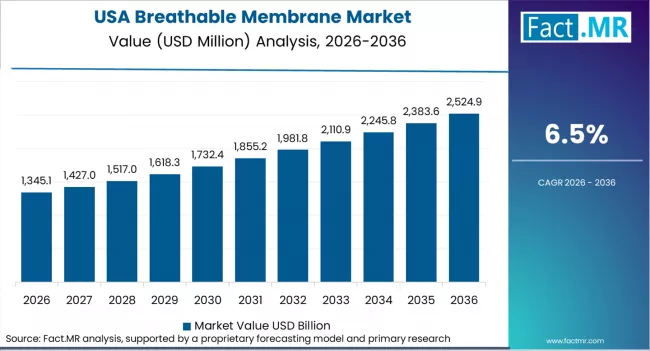
Breathable Membrane Market Country Value Analysis | Source: Fact.MR
In North America, the USA is a significant market for breathable membranes, supported by growing demand for energy-efficient building solutions, increasing construction activities, and rising awareness of sustainable and breathable materials.
- USA: Demand for breathable membranes in the U.S. is projected to rise at 6.5% CAGR through 2036. The USA’s growing focus on energy-efficient and sustainable buildings and increased adoption of breathable membranes in construction continue to support steady market growth.
Latin America:
In Latin America, Brazil is the leading market for breathable membranes, driven by the country’s rising demand for energy-efficient building materials, expanding construction sector, and growing focus on sustainability.
- Brazil: Demand for breathable membranes in Brazil is projected to rise at 6.9% CAGR through 2036. Brazil’s growing construction sector and increasing focus on sustainability continue to contribute to market growth for breathable membranes.
Fact MR's analysis of the Breathable Membrane Market in East Asia, South Asia, Western Europe, North America, and Latin America consists of country-wise assessments that include China, India, Germany, Brazil, and the USA. Readers can find detailed trends, regulatory updates, and company-specific investments shaping the market’s growth in these countries.
What is the Competitive Structure and Buyer Behavior in the Breathable Membrane Market?
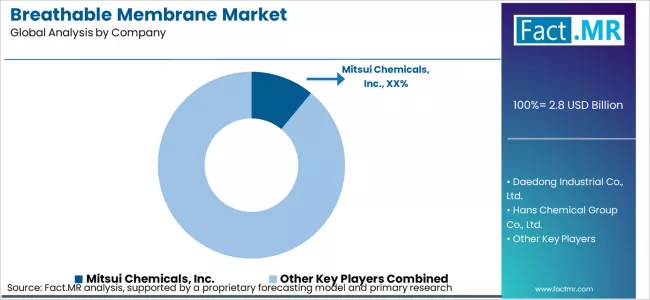
Breathable Membrane Market Analysis By Company | Source: Fact.MR
The breathable membrane market is moderately fragmented, with several large global chemical and materials manufacturers such as Mitsui Chemicals, Inc., Arkema S.A., and Nitto Denko Corporation holding meaningful shares alongside a broad set of regional producers including Daedong Industrial Co., Ltd., Hans Chemical Group Co., Ltd., Hanjin P&C Co., Ltd., and others. While leading firms benefit from scale and brand recognition, smaller and mid‑tier suppliers compete actively in niche applications and local markets. The primary competitive variable is product performance, especially permeability, durability, and substrate compatibility, along with price and supply reliability. Companies with vertically integrated feedstock sourcing and broad polymer portfolios have structural advantages, as they can ensure consistent quality and more stable costs. Established players with global distribution networks and technical support services also appeal to large industrial buyers that require application engineering and supply assurance. Large buyers, such as building material manufacturers and OEMs, exert leverage by qualifying multiple membrane suppliers, negotiating long‑term supply contracts, and integrating membranes into broader procurement frameworks. To manage dependency, these buyers diversify approved sources and standardize specifications, which restrains individual suppliers’ pricing power and shifts competition toward performance, consistency, and service rather than price alone.
Recent Industry Developments
- EU Building Directive (EPBD) Transposition Deadline: EU member states are currently entering the final months of transposing the Energy Performance of Buildings Directive (EU/2024/1275) into national law, with a hard deadline of May 29, 2026. This mandate requires a transition to "Zero-Emission Buildings" (ZEB) for all new public structures, making high-performance breathable membranes essential for airtight, moisture-controlled envelopes.
- PFAS-Free Membrane Industry Transition: Effective throughout early 2026, major manufacturers have completed their transition to PFAS-free design. Driven by the August 2026 deadline for reinforced packaging and textile requirements (Regulation EU 2025/40), companies are scaling production of "Next-Gen" ePE (expanded polyethylene) membranes that eliminate fluorinated "forever chemicals" while maintaining hydrostatic head performance.
- Scaling of Solar-Integrated Roofing Underlays: The 2026 market is seeing a surge in demand for high-temperature resistant membranes specifically designed for roofs with integrated photovoltaics (BIPV). As solar mandates for new commercial buildings over 250m² take effect, roofing underlays are being reformulated to withstand the concentrated thermal pockets created by solar arrays without degradation.
Key Players of the Breathable Membrane Market
- Mitsui Chemicals, Inc.
- Daedong Industrial Co., Ltd.
- Hans Chemical Group Co., Ltd.
- Hanjin P&C Co., Ltd.
- Swanson Plastics Corporation
- FSPG Huahan Polymer Materials Co., Ltd.
- Liansu Wanjia Polymer Materials Co., Ltd.
- Shandong HaiWei Polymer Materials Co., Ltd.
- AvoTeck Group Ltd.
- Shanghai Zihua New Material Technology Co., Ltd.
- Arkema S.A.
- Clopay Plastic Products Company
- Nitto Denko Corporation
Report Scope
| Metric | Value |
|---|---|
| Quantitative Units | USD 2.8 billion (2026) to USD 8 billion (2036), at a CAGR of 12.3% |
| Market Definition | The breathable membrane market includes membranes used for various applications such as hygiene, healthcare, construction, food packaging, and textiles, made from materials like polyethylene and polypropylene. |
| By Material Type | Polyethylene, Polypropylene, Others |
| By Application | Hygiene, Healthcare, Construction, Food Packaging, Textiles, Others |
| Regions Covered | North America, Latin America, Europe, East Asia, South Asia, Oceania, Middle East and Africa |
| Countries Covered | United States, Canada, Mexico, Brazil, Argentina, Germany, France, United Kingdom, Italy, Spain, China, India, Japan, South Korea, Indonesia, Australia, and 40+ countries |
| Key Companies Profiled | Mitsui Chemicals, Inc., Daedong Industrial Co., Ltd., Hans Chemical Group Co., Ltd., Hanjin P&C Co., Ltd., Swanson Plastics Corporation, FSPG Huahan Polymer Materials Co., Ltd., Liansu Wanjia Polymer Materials Co., Ltd., Shandong HaiWei Polymer Materials Co., Ltd., AvoTeck Group Ltd., Shanghai Zihua New Material Technology Co., Ltd., Arkema S.A., Clopay Plastic Products Company, Nitto Denko Corporation |
| Forecast Period | 2026 to 2036 |
| Approach | Hybrid top-down and bottom-up market modeling validated through primary interviews with manufacturers and supported by trade data benchmarking and market research. |
Source: Fact.MR analysis. Updated Mar 4, 2026
Bibliographies
- Arkema S.A. (2023). Performance-driven breathable membranes for energy-efficient buildings. Arkema S.A.
- Daedong Industrial Co., Ltd. (2023). Innovative breathable membranes for the construction industry. Daedong Industrial Co., Ltd.
- Hans Chemical Group Co., Ltd. (2023). Polyethylene-based breathable membranes for the hygiene and healthcare sector. Hans Chemical Group Co., Ltd.
- Mitsui Chemicals, Inc. (2023). Breathable membrane solutions for sustainable construction and textile applications. Mitsui Chemicals, Inc.
- Nitto Denko Corporation. (2023). Advancements in breathable membrane technology for textiles and construction. Nitto Denko Corporation.
- Coveris. (2026, January). PFAS-free design: Transitioning production ahead of 2026 requirements [Industry update]. Coveris.
- European Commission. (2026, March). Energy performance of buildings directive (EU/2024/1275) transposition deadline: Transition to zero-emission buildings. European Commission.
- SOPREMA. (2026). Expansion of manufacturing facilities for high-performance breathable membranes. SOPREMA.
This report addresses:
- Market intelligence enabling comprehensive assessment of leading countries and product segments across the Breathable Membrane Market globally.
- Market volume (sales units) estimates and 10-year revenue forecasts from 2026 to 2036, validated through manufacturer shipment data, channel partner surveys, and country-level demand modeling.
- Growth opportunity mapping across material types (Polyethylene, Polypropylene, and Others), applications (Hygiene, Healthcare, Construction, Food Packaging, Textiles, and Others), and end-use industries.
- Segment and regional revenue forecasts by material type, application, end-user industry, and geography across 40+ countries.
- Competition strategy analysis covering dealer network structure, recent developments, product portfolio, USPs, and market share analysis.
- Product and regulatory compliance tracking aligned with moisture control standards, textile performance requirements, and building code regulations.
- Regulatory impact analysis addressing environmental regulations, building performance standards, and material certifications across key markets.
- Report delivery in PDF, Excel, PowerPoint, and interactive dashboard formats for executive, procurement, and operational planning use.
Segmentation
Breathable Membrane Market Key Segments
-
Material Type :
- Polyethylene
- Polypropylene
- Others
-
Application :
- Hygiene
- Healthcare
- Construction
- Food Packaging
- Textiles
- Others
-
Region :
- North America
- USA
- Canada
- Mexico
- Europe
- Germany
- UK
- France
- Italy
- Spain
- Nordic Countries
- BENELUX
- Rest of Europe
- Asia Pacific
- China
- Japan
- South Korea
- India
- Australia
- Rest of Asia Pacific
- Latin America
- Brazil
- Argentina
- Rest of Latin America
- Middle East and Africa
- Kingdom of Saudi Arabia
- United Arab Emirates
- South Africa
- Rest of Middle East and Africa
- Other Regions
- Oceania
- Central Asia
- Other Markets
- North America
Frequently Asked Questions
How large is the demand for Breathable Membranes in the global market in 2026?
What will be the market size of Breathable Membranes in the global market by 2036?
What is the expected demand growth for Breathable Membranes in the global market between 2026 and 2036?
Which material type is expected to dominate the market?
Which region is expected to show the highest growth rate for Breathable Membranes?
How significant is the growth outlook for India in this market?
What is the growth outlook for Germany in the Breathable Membrane market?
What is the growth forecast for Brazil in the Breathable Membrane market?
What is the growth forecast for the United States in the Breathable Membrane market?
Which company is identified as a leading player in the Breathable Membrane market?
What are Breathable Membranes used for?
What does the Breathable Membrane market include in this report?
How is the market forecast developed in this report?
What is meant by the Breathable Membrane market in this report?
Who worked on this report


Preview the report firsthand - request a free sample
Free SampleGet the brochure for pricing and purchase details
Download PDF