- Base Value(2025): 520.0 Mn
- Estimated Value(2026): 546.0 Mn
- Forecast Value (2036): 889.4 Mn
- CAGR (2026 - 2036): 5.0%
Bromelain Market Analysis and Forecast by Fact.MR
The bromelain market, valued at USD 520.0 million in 2025, is expanding at a 5.0% CAGR toward a USD 889.376 million valuation by 2036. Bromelain is a proteolytic enzyme complex extracted primarily from pineapple stems and fruit, used across food processing, nutraceutical, pharmaceutical, cosmetic, and industrial applications. Growth reflects expanding demand for natural enzyme solutions in meat tenderization and beverage clarification, increasing consumer interest in digestive health supplements, and broadening pharmaceutical research into bromelain's anti-inflammatory and wound healing properties.
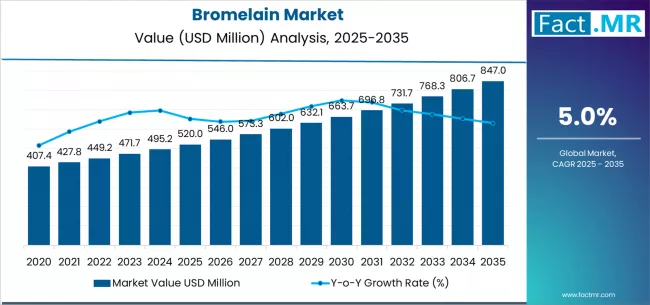
Bromelain Market Market Value Analysis | Source: Fact.MR
Summary of Bromelain Market
- Market Snapshot
- The bromelain market is valued at USD 520.0 million in 2025.
- The market is estimated at USD 546.0 million in 2026 and forecast to reach USD 889.376 million by 2036.
- A CAGR of 5.0% is projected for the 2026 to 2036 forecast period.
- Incremental opportunity of USD 343.376 million is expected between 2026 and 2036.
- Food grade bromelain leads the product segment with a 33.8% share, while food and beverage processing dominates application demand at 37.5%.
- India and China are the top growth markets, with the USA contributing USD 200.054 million in 2025.
- Demand and Growth Drivers
- Meat processing companies are adopting bromelain as a natural tenderization agent to replace chemical tenderizers, driven by clean-label consumer preferences and food safety regulations that restrict synthetic enzyme usage in some jurisdictions.
- The digestive health supplement category is expanding globally, and bromelain's established efficacy in protein digestion and anti-inflammatory activity positions it as a core ingredient in gut health formulations.
- Pharmaceutical research into bromelain's therapeutic applications, including post-surgical inflammation reduction, sinusitis treatment, and wound debridement, is expanding the addressable market beyond traditional food processing.
- Beverage manufacturers are increasing bromelain usage for juice clarification, beer haze removal, and protein stabilization in plant-based drinks, supported by the clean-label advantage of a fruit-derived enzyme.
- Product and Segment View
- Food grade bromelain holds 33.8% of the product segment, consumed primarily by meat processing, beverage clarification, and baking applications.
- Food and beverage processing accounts for 37.5% of application demand, reflecting bromelain's established utility in protein modification and clarification processes.
- Pineapple-derived sources account for 61.7% of the source segment, as pineapple stems remain the most commercially viable feedstock for bromelain extraction.
- Key segmentation includes:
- Product: Food Grade Bromelain, Pharmaceutical Grade Bromelain, Nutraceutical Grade Bromelain, Industrial Grade Bromelain, Specialty Bromelain
- Application: Food and Beverage Processing, Nutraceuticals, Pharmaceuticals, Cosmetics and Personal Care, Industrial Applications
- End Use: Food Manufacturers, Pharmaceutical Companies, Nutraceutical Companies, Cosmetic Manufacturers, Industrial Users
- Source: Pineapple Derived, Leaf and Stem Sources
- Form: Powder Form, Liquid Form, Encapsulated Form
- Purity Level: Medium Purity, High Purity, Ultra High Purity
- Activity Level: High Activity, Medium Activity, Ultra High Activity
- Geography and Competitive Outlook
- North America holds a leading revenue share, with the USA contributing USD 200.054 million in 2025, supported by established nutraceutical and food processing demand.
- South Asia and Pacific leads growth, with India recording a 7.0% CAGR driven by pineapple cultivation expansion and domestic enzyme manufacturing capacity growth.
- East Asia is a significant market, with China at 6.0% CAGR as food processing modernization and nutraceutical demand accelerate.
- Enzybel holds an estimated 11.0% market share, followed by Challenge Bioproducts and DSM-Firmenich in competitive positioning.
- Analyst Opinion
- The bromelain market is at an inflection point where pharmaceutical and nutraceutical applications are beginning to rival traditional food processing demand. Companies that invest in higher-purity extraction methods and GMP-compliant manufacturing will capture the premium end of the market. The supply chain remains concentrated in tropical pineapple-growing regions, creating geographic risk that can be mitigated through contract farming arrangements and multi-origin sourcing. Pricing power resides with producers who can guarantee consistent enzyme activity levels across batches, as food and pharmaceutical buyers penalize variability heavily in their procurement decisions.
Key Growth Drivers, Constraints, and Opportunities
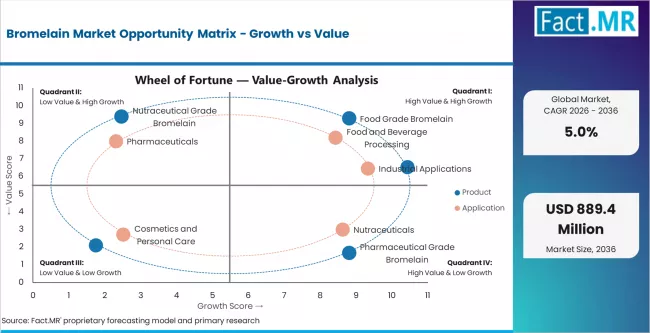
Bromelain Market Opportunity Matrix Growth Vs Value | Source: Fact.MR
Key Factors Driving Growth
- Clean-label reformulation in meat processing is driving bromelain adoption. Major meat processors are replacing chemical tenderizers and synthetic enzymes with fruit-derived bromelain to satisfy consumer demand for recognizable ingredients. The EU's tightening regulations on processing aids favor natural enzyme alternatives.
- Digestive health supplements are one of the fastest-growing nutraceutical categories globally. Bromelain's clinical evidence for improving protein digestion and reducing gastrointestinal inflammation makes it a preferred ingredient in enzyme blend formulations sold through pharmacy and online channels.
- Pharmaceutical development pipelines for bromelain-based therapeutics are expanding. NexoBrid (Vericel/MediWound), a bromelain-based enzymatic debridement agent for burn wounds, received FDA approval, establishing a regulatory precedent for pharmaceutical-grade bromelain applications.
Key Market Constraints
- Raw material supply is geographically concentrated in tropical pineapple-growing regions, primarily Costa Rica, Philippines, Thailand, India, and Brazil. Weather disruptions, disease outbreaks (such as pineapple mealybug wilt), and competing demand for fresh fruit consumption can constrain stem availability for enzyme extraction.
- Enzyme activity standardization varies across manufacturers. The lack of a universally adopted activity measurement standard (GDU vs CDU vs Rorer units) creates procurement complexity for buyers comparing products from different suppliers.
- Storage and stability challenges limit bromelain's shelf life under ambient conditions. The enzyme degrades when exposed to heat, moisture, or extreme pH, requiring cold chain logistics and controlled storage that add costs to the supply chain.
Key Opportunity Areas
- Pharmaceutical-grade bromelain for wound care and anti-inflammatory applications represents a high-margin opportunity. NexoBrid's commercial success demonstrates market viability, and additional clinical trials exploring bromelain for osteoarthritis, sinusitis, and post-surgical recovery are in progress.
- Plant-based protein beverage manufacturing is creating new demand for bromelain as a clarification and bitterness-reduction enzyme. As pea, soy, and oat-based beverages scale production, bromelain's ability to hydrolyze residual proteins and improve mouthfeel is attracting formulator interest.
- Contract farming arrangements between enzyme manufacturers and pineapple growers in India, Thailand, and the Philippines offer supply chain security. Companies that establish dedicated stem-collection programs at pineapple processing facilities can secure raw material access while providing growers with an additional revenue stream from agricultural waste.
Segment-wise Analysis of the Bromelain Market
- Food grade bromelain holds 33.8% of the product segment, driven by established use in meat tenderization, beverage clarification, and baking applications.
- Food and beverage processing accounts for 37.5% of application demand, reflecting bromelain's long-standing role as a natural processing enzyme.
- Powder form dominates the form segment at 54.2%, preferred for its shelf stability, ease of dosing, and compatibility with industrial formulation processes.
Which product grade dominates the Bromelain Market?
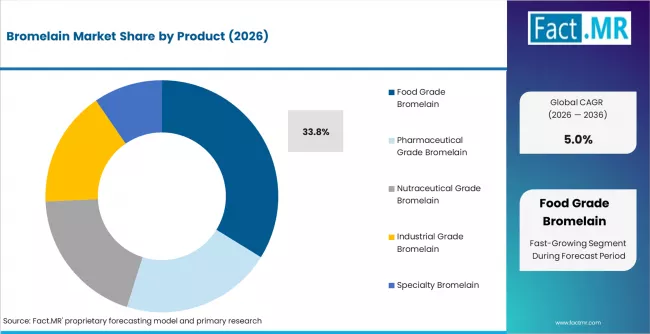
Bromelain Market Analysis By Product | Source: Fact.MR
Food grade bromelain holds 33.8% of the product segment. This grade is characterized by moderate enzyme activity levels (typically 1,200 to 2,400 GDU/g) and is used in meat tenderization, beverage clarification, dough conditioning, and cheese manufacturing. Food grade bromelain is the highest-volume segment because it serves large-scale food processing operations that consume substantial quantities per production run.
Pharmaceutical grade bromelain is the fastest-growing product segment. This grade requires higher purity (above 3,000 GDU/g), stricter microbiological controls, and GMP-compliant manufacturing. Demand is being driven by wound care applications (NexoBrid), anti-inflammatory supplement formulations, and emerging clinical uses. Pharmaceutical grade commands a 3 to 5x price premium over food grade, making it the most commercially attractive segment for manufacturers with the technical capability to produce it.
Which application leads demand in the Bromelain Market?
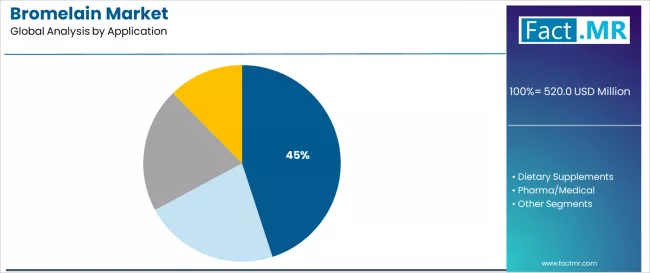
Bromelain Market Analysis By Application | Source: Fact.MR
Food and beverage processing holds 37.5% of application demand. Meat tenderization is the single largest use case within this segment, with bromelain applied as a marinade ingredient or surface treatment to break down connective tissue proteins in beef, pork, and poultry. Beverage clarification is the second-largest food application, where bromelain removes haze-causing proteins from fruit juices, beer, and wine.
Nutraceutical applications hold the second-largest share and are growing faster than food processing. Digestive enzyme supplements containing bromelain, papain, and lipase blends are sold through pharmacy, health food store, and e-commerce channels. The nutraceutical segment values consistent enzyme activity per capsule, driving demand for standardized, high-activity bromelain powders.
Which form leads the Bromelain Market?
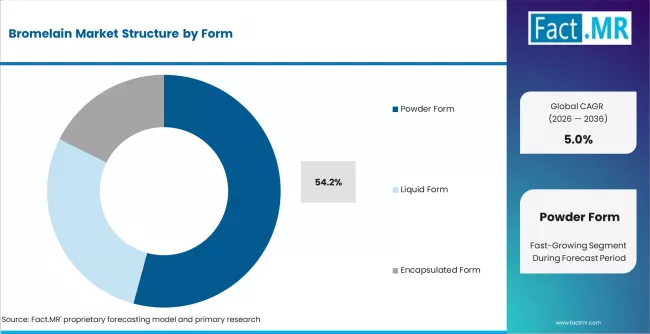
Bromelain Market Analysis By Form | Source: Fact.MR
Powder form accounts for 54.2% of the form segment. Spray-dried bromelain powder offers the best combination of shelf stability, dosing accuracy, and compatibility with both food manufacturing and supplement encapsulation processes. Powder form is also the standard format for international trade, as it can be shipped at ambient temperature in sealed containers without significant activity loss.
Liquid form serves niche applications where immediate enzyme activity is required, such as topical wound care preparations and certain beverage processing operations. Encapsulated forms are used in finished supplement products where delayed release or gastric acid protection is required to deliver active bromelain to the small intestine.
Which Product Trend is Shaping the Next Phase of Growth in the Bromelain Market?
Pharmaceutical-grade bromelain is shaping the next phase of market growth. The FDA approval of NexoBrid (concentrate of proteolytic enzymes enriched in bromelain) for enzymatic debridement of deep partial and full-thickness thermal burns established a regulatory pathway for bromelain as a pharmaceutical active ingredient. This approval shifted industry perception of bromelain from a commodity food enzyme to a viable pharmaceutical input. Several clinical programs are now evaluating bromelain for osteoarthritis pain management, chronic sinusitis treatment, and post-surgical swelling reduction, each of which could create discrete pharmaceutical demand streams independent of food processing volumes.
Vertical integration from pineapple cultivation to enzyme extraction is becoming a competitive differentiator. Companies like Enzybel in Belgium and Challenge Bioproducts in Taiwan have established direct relationships with pineapple processing facilities in Costa Rica, Thailand, and the Philippines to secure stem biomass that would otherwise be discarded as agricultural waste. This waste-to-value model improves supply chain resilience and supports sustainability narratives that resonate with B-corp and ESG-focused buyers. As demand for pharmaceutical-grade bromelain grows, the ability to control raw material quality from field to extraction facility becomes a prerequisite for meeting the stringent batch consistency requirements of pharma customers.
Regional Outlook Across Key Markets
.webp "Top Country Growth Comparison Bromelain Market Cagr (2026 2036)")
Top Country Growth Comparison Bromelain Market Cagr (2026 2036) | Source: Fact.MR
- North America holds a leading revenue share, with the USA contributing USD 200.054 million in 2025 from established nutraceutical, food processing, and emerging pharmaceutical demand.
- South Asia and Pacific leads growth, with India at 7.0% CAGR supported by pineapple cultivation expansion and growing domestic enzyme manufacturing capacity.
- East Asia is a significant growth region, with China at 6.0% CAGR as food processing modernization and health supplement demand scale.
- Europe maintains steady demand, with Germany at 4.0% CAGR shaped by pharmaceutical applications and stringent food processing enzyme regulations.
CAGR Table
| Country | CAGR (%) |
|---|---|
| India | 7.0% |
| China | 6.0% |
| Mexico | 4.5% |
| USA | 4.2% |
| Germany | 4.0% |
| South Korea | 3.6% |
| Japan | 3.0% |
Source: Fact.MR analysis. Updated Apr 30, 2026
Source: Fact.MR analysis, based on proprietary forecasting model and primary research.
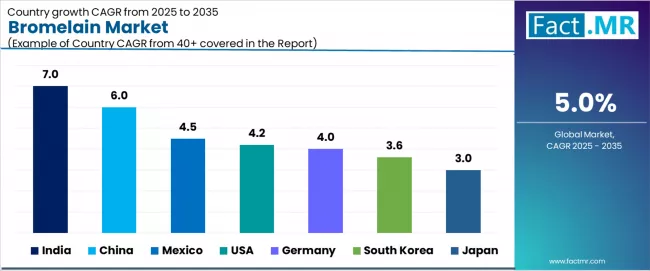
Bromelain Market Cagr Analysis By Country | Source: Fact.MR
India: Pineapple sourcing advantage and enzyme manufacturing growth
India's bromelain market is growing at 7.0% CAGR, supported by the country's position as the world's fifth-largest pineapple producer. States including Meghalaya, Manipur, Assam, and Kerala provide abundant pineapple stem biomass for bromelain extraction. Domestic enzyme manufacturers such as Advanced Enzyme Technologies and Aumgene Biosciences are expanding production capacity to serve both domestic food processing and export markets. India's pharmaceutical industry, the world's largest generic drug producer, represents an emerging demand channel for pharmaceutical-grade bromelain as clinical applications expand.
- India's National Enzyme Mission and biotechnology promotion policies provide institutional support for enzyme manufacturing capacity development.
China: Food processing scale driving enzyme consumption
China's market is expanding at 6.0% CAGR as the country's large-scale food processing sector consumes increasing volumes of processing enzymes. Bromelain is used in meat tenderization across China's massive pork and poultry processing industry, and in beverage clarification for the growing fruit juice and craft beer segments. Guangxi Nanning and other domestic producers supply food-grade bromelain, while imported pharmaceutical-grade product comes from European and Taiwanese manufacturers. China's nutraceutical market is also adopting bromelain in digestive enzyme blends sold through e-commerce platforms.
- China's position as the world's largest meat processing market creates substantial baseline demand for food-grade bromelain as a natural tenderization enzyme.
USA: Nutraceutical and pharmaceutical demand driving premium grades
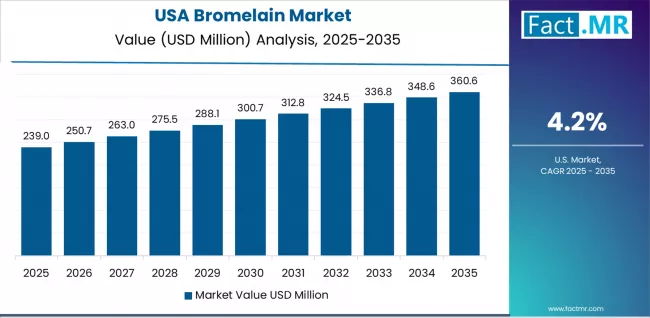
Bromelain Market Country Value Analysis | Source: Fact.MR
The USA contributes USD 200.054 million in 2025, representing the largest single national market. Nutraceutical applications account for a significant share of US demand, with bromelain featured in digestive enzyme supplements sold by brands like NOW Foods, Enzymedica, and Doctor's Best through Amazon, Whole Foods, and pharmacy channels. The pharmaceutical segment is growing following NexoBrid's FDA approval, and additional clinical development programs are attracting investment. Food processing demand centers on meat tenderization for the beef and poultry industries and juice clarification operations.
- US FDA's approval of NexoBrid established a regulatory precedent that is attracting pharmaceutical R&D investment into bromelain-based therapeutic applications.
Germany: Pharmaceutical research and food enzyme regulation
Germany's market grows at 4.0% CAGR, shaped by the country's strong pharmaceutical research infrastructure and strict food enzyme regulations under the EU framework. German pharmaceutical companies and research institutions are active in clinical trials evaluating bromelain for anti-inflammatory and mucolytic applications. The EU Regulation on Food Enzymes (EC 1332/2008) requires pre-market safety evaluation for processing enzymes, creating a compliance barrier that favors established suppliers with complete dossier documentation. German enzyme distributors such as Muhlenchemie serve the European bakery and food processing sector.
- Germany's pharmaceutical and clinical research ecosystem provides a pipeline of new therapeutic applications that are expanding pharmaceutical-grade bromelain demand.
South Korea: Nutraceutical demand and food processing use
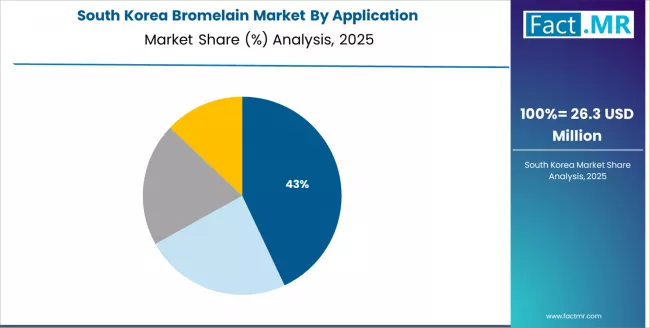
Bromelain Market South Korea Market Share Analysis By Application | Source: Fact.MR
South Korea's market is growing at 3.6% CAGR from a USD 14.147 million base in 2025. Bromelain is used in South Korea's food manufacturing sector for meat tenderization and in the growing health-functional food (HFF) supplement market. South Korean consumers are receptive to enzyme-based digestive supplements, and MFDS approval under the HFF framework provides a credibility mechanism for bromelain-containing products. Import dependence from Southeast Asian and European manufacturers characterizes the supply structure.
- South Korea's health-functional food regulatory pathway enables specific digestive health claims for bromelain supplements, supporting consumer confidence and premium pricing.
Japan: Enzyme technology expertise and aging population demand
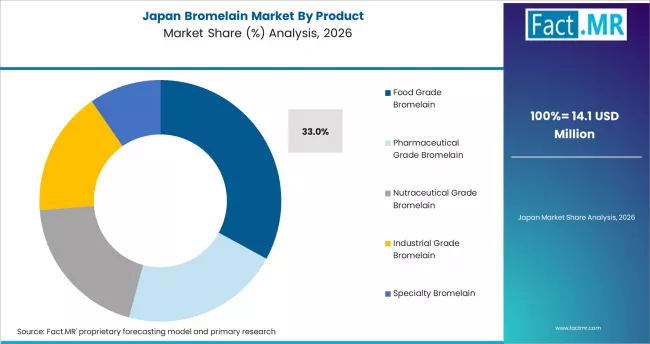
Bromelain Market Japan Market Share Analysis By Product | Source: Fact.MR
Japan's market grows at 3.0% CAGR from a USD 26.705 million base in 2025. Japan has a long history of enzyme technology research and application, with companies like Amano Enzyme maintaining deep technical expertise in proteolytic enzyme production. The aging population creates sustained demand for digestive enzyme supplements, and bromelain is a standard ingredient in Japanese digestive health formulations. Japan's Foods with Function Claims (FFC) system supports specific anti-inflammatory and digestive health claims for bromelain-containing products.
- Japan's enzyme manufacturing expertise and quality control standards make it both a consumer market and a production base for high-purity bromelain destined for pharmaceutical applications.
Mexico: Pineapple production and food processing growth
Mexico's market is expanding at 4.5% CAGR, supported by domestic pineapple production in Veracruz and Oaxaca states that provides local access to stem biomass for enzyme extraction. Mexico's food processing sector, particularly meat and beverage manufacturing, is growing and adopting natural enzyme solutions. Cross-border trade with the USA provides access to both raw material imports and finished bromelain products. The Mexican nutraceutical market is nascent but growing, with bromelain-based digestive supplements entering pharmacy and e-commerce channels.
- Mexico's pineapple cultivation and proximity to the US market create a potential sourcing hub for bromelain raw material supply serving North American manufacturers.
Competitive Benchmarking and Company Positioning
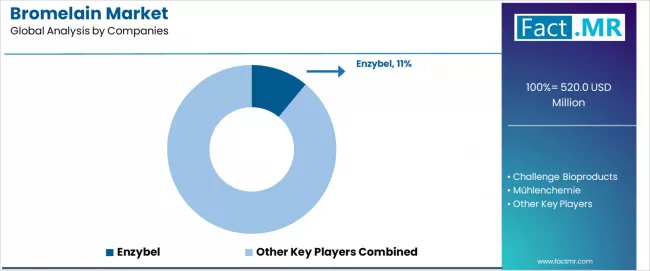
Bromelain Market Analysis By Company | Source: Fact.MR
Bromelain Market Analysis By Company
- Tier 1 (above 10% share): Enzybel holds an estimated 11.0% global share through its vertically integrated pineapple-to-enzyme extraction model and multi-grade product portfolio.
- Tier 2 (5 to 10% share): Challenge Bioproducts, DSM-Firmenich, and Amano Enzyme compete through specialized enzyme production expertise, pharmaceutical-grade capabilities, and global distribution networks.
- Tier 3 (below 5% share): Muhlenchemie, Panacea Biotec, Guangxi Nanning, Aumgene, Advanced Enzyme Technologies, and regional enzyme producers compete on price, regional sourcing advantages, and application-specific technical support.
The bromelain market is structured around a small number of specialized enzyme manufacturers with direct access to pineapple-growing regions. Enzybel, headquartered in Belgium with extraction operations in Costa Rica, has built a vertically integrated model that controls raw material sourcing, extraction, purification, and global distribution. This integration provides quality consistency and supply reliability that pharmaceutical and food processing buyers require.
Challenge Bioproducts in Taiwan and Guangxi Nanning in China compete through proximity to Southeast Asian pineapple sources and cost-competitive manufacturing. These companies primarily serve the food-grade segment, where price sensitivity is higher than in pharmaceutical applications. DSM-Firmenich and Amano Enzyme bring broader enzyme portfolio capabilities, offering bromelain alongside other proteases and specialty enzymes as part of multi-enzyme supply agreements with large food manufacturers.
The competitive dynamic is shifting as pharmaceutical-grade demand grows. Companies that can achieve GMP-compliant manufacturing, provide batch-to-batch activity consistency, and supply complete regulatory documentation (Drug Master Files, certificates of analysis) are capturing the premium pharmaceutical segment. This creates a widening gap between commodity food-grade producers and companies positioned for pharmaceutical supply.
Key Companies in the Bromelain Market
Enzybel, Challenge Bioproducts, Muhlenchemie, Panacea Biotec, Guangxi Nanning, Enzyvia, DSM-Firmenich, Aumgene, Amano Enzyme, Biozym, Chemwell, Advanced Enzyme Technologies, Specialty Enzymes, EnzyMed, and Great Food Group are the primary companies shaping competitive dynamics in the bromelain market.
Recent Industry Developments
- Enzybel: pharmaceutical-grade bromelain capacity expansion (2025)
- Enzybel expanded its GMP-compliant pharmaceutical-grade bromelain production capacity to meet growing demand from wound care and anti-inflammatory therapeutic applications. The expansion was supported by increased pineapple stem procurement from Costa Rica and new purification technology that achieves higher activity concentrations.
- Advanced Enzyme Technologies: bromelain product range expansion in India (2025)
- Advanced Enzyme Technologies launched expanded food-grade and nutraceutical-grade bromelain products for the Indian and export markets. The company leveraged its enzyme manufacturing infrastructure in Maharashtra to produce standardized bromelain powders targeting digestive health supplement formulators.
- DSM-Firmenich: bromelain inclusion in multi-enzyme food processing solutions (2025)
- DSM-Firmenich integrated bromelain into its multi-enzyme processing solutions for meat tenderization and beverage clarification, offering food manufacturers a single-supplier approach for their proteolytic enzyme requirements. The bundled offering simplifies procurement for large food processing customers.
- Amano Enzyme: high-purity bromelain for pharmaceutical applications (2026)
- Amano Enzyme commercialized an ultra-high-purity bromelain grade (above 5,000 GDU/g) targeting pharmaceutical formulation customers. The product is manufactured under pharmaceutical GMP conditions at the company's Japanese production facility and supplied with full regulatory documentation packages.
Leading Companies Shaping the Bromelain Market
-
Global Players
- Enzybel
- DSM-Firmenich
- Amano Enzyme
- Challenge Bioproducts
- Muhlenchemie
- Advanced Enzyme Technologies
-
Regional Players
- Panacea Biotec
- Guangxi Nanning
- Aumgene
- Specialty Enzymes
- Great Food Group
-
Emerging / Start-up Players
- Enzyvia
- Biozym
- Chemwell
- EnzyMed
Sources and Research References
- FAO pineapple production and trade statistics database
- US FDA NexoBrid approval documentation and product labelling information
- European Food Safety Authority (EFSA) food enzyme safety evaluations
- Advanced Enzyme Technologies Annual Report and investor presentations (2025)
- World Enzyme Market reports from industry trade publications
- India Ministry of Food Processing Industries enzyme manufacturing data
- USPTO and EPO patent databases for bromelain therapeutic applications
All numerical data is sourced from Fact.MR proprietary research. Company-specific data is sourced from public filings and verified through primary research. No syndicated market research reports were used.
Key Questions This Report Addresses
- What is the current value and forecast for the global bromelain market?
- Which product grade holds the largest share in the bromelain market?
- What CAGR is projected for the bromelain market from 2026 to 2036?
- Which country is the fastest-growing market for bromelain?
- How is pharmaceutical-grade bromelain affecting market growth?
- What role does pineapple sourcing play in bromelain supply chain dynamics?
- Which companies lead the global bromelain market?
- What is the incremental revenue opportunity in bromelain between 2026 and 2036?
- How does NexoBrid's FDA approval affect the bromelain market?
Bromelain Market Definition
The bromelain market covers enzyme products extracted from pineapple (Ananas comosus) stems, fruit, and leaves, sold in powder, liquid, and encapsulated forms across varying purity and activity levels. Bromelain is a mixture of cysteine proteases with protein-digesting, anti-inflammatory, and fibrinolytic properties. Commercial bromelain is graded by enzyme activity (measured in GDU or CDU per gram) and purity level, with applications spanning food processing, dietary supplements, pharmaceutical formulations, cosmetic products, and industrial processes.
Bromelain Market Inclusions
- Food grade, pharmaceutical grade, nutraceutical grade, industrial grade, and specialty bromelain products.
- Bromelain in powder, liquid concentrate, and encapsulated delivery forms.
- Stem bromelain and fruit bromelain from pineapple-derived sources.
- Bromelain sold through B2B ingredient channels to food, pharmaceutical, nutraceutical, cosmetic, and industrial end users.
Bromelain Market Exclusions
- Other proteolytic enzymes not derived from pineapple (papain, ficin, actinidin).
- Fresh pineapple and pineapple juice sold as consumer food products.
- Pineapple-derived fibers, flavors, or other non-enzyme byproducts.
- Enzyme blends where bromelain is a minor component and not the primary active ingredient.
Bromelain Market Research Methodology
- Bottom-up revenue estimation using enzyme manufacturer production data, ingredient distributor shipment volumes, and end-user procurement records across 40+ countries.
- Primary interviews with enzyme extraction facility managers, food processing technologists, nutraceutical formulators, and pharmaceutical ingredient procurement teams.
- Pineapple production and trade data analysis using FAO statistics and customs records to estimate raw material availability for bromelain extraction.
- Enzyme activity standardization analysis comparing GDU (gelatin digestion units), CDU (casein digestion units), and other activity measurement methods across manufacturers.
- Patent landscape analysis tracking bromelain-related pharmaceutical and nutraceutical applications filed across major patent offices.
- Competitive benchmarking using production capacity data and export records from Enzybel, Challenge Bioproducts, DSM-Firmenich, and 12 other profiled companies.
Segmentation
Scope of Analysis
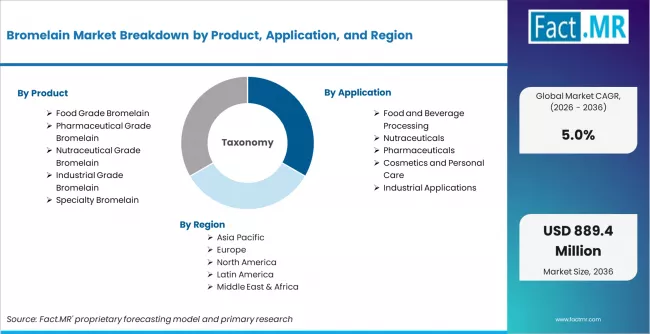
Bromelain Market Breakdown By Product, Application, And Region | Source: Fact.MR
| Parameter | Details |
|---|---|
| Report Title | Bromelain Market |
| Market Value (2025) | USD 520.0 Million |
| Forecast Value (2036) | USD 889.376 Million |
| CAGR (2026 to 2036) | 5.0% |
| Unit | USD Million |
| Segments Covered | Product, Application, End Use, Source, Form, Purity Level, Activity Level |
| Regions Covered | North America, Latin America, Europe, East Asia, South Asia and Pacific, Middle East and Africa |
| Countries Profiled | USA, India, China, Germany, Japan, South Korea, Mexico, and 40+ countries |
| Key Companies | Enzybel, Challenge Bioproducts, Muhlenchemie, Panacea Biotec, Guangxi Nanning, Enzyvia, DSM-Firmenich, Aumgene, Amano Enzyme, Biozym, Chemwell, Advanced Enzyme Technologies, Specialty Enzymes, EnzyMed, Great Food Group |
| Forecast Period | 2026 to 2036 |
| Base Year | 2025 |
| Methodology | Bottom-up estimation, primary interviews, pineapple production data, enzyme activity analysis, patent landscape review, competitive benchmarking |
Source: Fact.MR analysis. Updated Apr 30, 2026
Market Segmentation Analysis
-
Bromelain Market Market Segmented by Product:
- Food Grade Bromelain
- Standard Activity Bromelain
- High Activity Bromelain
- Pharmaceutical Grade Bromelain
- Clinical Grade Enzyme Bromelain
- Pure Enzyme Isolates
- Nutraceutical Grade Bromelain
- Digestive Enzyme Blends
- Anti Inflammatory Formulations
- Industrial Grade Bromelain
- Food Processing Enzyme
- Meat Tenderizing Enzyme
- Specialty Bromelain
- Microencapsulated Bromelain
- Enteric Coated Bromelain
- Combined Enzyme Systems
- Food Grade Bromelain
-
Bromelain Market Market Segmented by Application:
- Food and Beverage Processing
- Meat Tenderization
- Baking Industry Applications
- Beverage Clarification
- Nutraceuticals
- Digestive Health Supplements
- Inflammation Management Supplements
- Pharmaceuticals
- Anti Inflammatory Drugs
- Post Surgical Recovery Formulations
- Sinus and Respiratory Treatments
- Cosmetics and Personal Care
- Skin Exfoliation Products
- Anti Swelling Formulations
- Industrial Applications
- Protein Hydrolysis
- Bioprocessing Enzymes
- Food and Beverage Processing
-
Bromelain Market Market Segmented by End Use:
- Food Manufacturers
- Meat Processing Companies
- Bakery Producers
- Pharmaceutical Companies
- Drug Formulators
- Clinical Nutrition Developers
- Nutraceutical Companies
- Supplement Brands
- Functional Health Companies
- Cosmetic Manufacturers
- Skincare Product Companies
- Industrial Users
- Biotechnology Firms
- Food Processing Plants
- Food Manufacturers
-
Bromelain Market Market Segmented by Source:
- Pineapple Derived
- Fruit Stem Extraction
- Fruit Waste Utilization
- Leaf and Stem Sources
- Alternative Bromelain Extraction
- Industrial Byproduct Recovery
- Pineapple Derived
-
Bromelain Market Market Segmented by Form:
- Powder Form
- Spray Dried Bromelain
- Fine Enzyme Powder
- Liquid Form
- Concentrated Enzyme Solution
- Stabilized Liquid Bromelain
- Encapsulated Form
- Enteric Coated Capsules
- Microencapsulated Enzyme Systems
- Powder Form
-
Bromelain Market Market Segmented by Purity Level:
- Medium Purity
- Low Purity
- Crude Enzyme Extracts
- Standard Industrial Bromelain
- Refined Food Grade Enzyme
- Functional Bromelain Blends
- High Purity
- 90–95 Percent Enzyme Activity
- Pharmaceutical Grade Bromelain
- Ultra High Purity
- Clinical Grade Enzyme Isolates
- Standardized Activity Units
- Medium Purity
-
Bromelain Market Market Segmented by Activity Level:
- High Activity
- Low Activity
- Standard Enzyme Units
- Medium Activity
- Moderate Proteolytic Activity
- Ultra High Activity
- Clinical Enzyme Potency Grade
- High Activity
-
Bromelain Market Market by Region:
- North America
- USA
- Canada
- Mexico
- Latin America
- Brazil
- Chile
- Rest of Latin America
- Western Europe
- Germany
- UK
- Italy
- Spain
- France
- Nordic
- BENELUX
- Rest of Western Europe
- Eastern Europe
- Russia
- Poland
- Hungary
- Balkan & Baltic
- Rest of Eastern Europe
- East Asia
- China
- Japan
- South Korea
- South Asia and Pacific
- India
- ASEAN
- Australia & New Zealand
- Rest of South Asia and Pacific
- Middle East & Africa
- Kingdom of Saudi Arabia
- Other GCC Countries
- Turkiye
- South Africa
- Other African Union
- Rest of Middle East & Africa
- North America
Frequently Asked Questions
What is the bromelain market worth in 2025?
What CAGR is projected for the bromelain market?
Which product grade leads the bromelain market?
Which country is the fastest-growing bromelain market?
Which company leads the bromelain market?
What is the forecast value of the bromelain market in 2036?
Which application dominates bromelain demand?
Who worked on this report


Preview the report firsthand - request a free sample
Free SampleGet the brochure for pricing and purchase details
Download PDF