Buttermilk Powder Market Size, Share, Growth and Forecast (2026 - 2036)

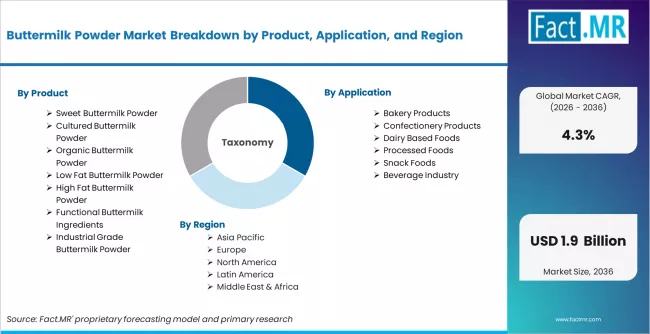
Buttermilk Powder Market is segmented by Product (Sweet Buttermilk Powder, Cultured Buttermilk Powder, Organic Buttermilk Powder, Low Fat Buttermilk Powder, High Fat Buttermilk Powder, Functional Buttermilk Ingredients, Industrial Grade Buttermilk Powder), Application (Bakery Products, Confectionery Products, Dairy Based Foods, Processed Foods, Snack Foods, Beverage Industry), End Use (Food Manufacturers, Dairy Industry, Food Service Industry, Nutraceutical Companies, Retail Brands), and Region, with forecasts covering the period from 2026 to 2036.

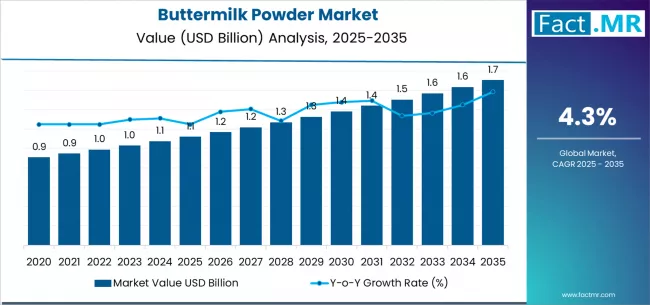
According to Fact.MR estimates, the global buttermilk powder market market was valued at USD 1.2 billion in 2025. The market is projected to reach USD 1.3 billion in 2026 and is expected to grow to USD 1.9 billion by 2036, expanding at a CAGR of 4.3%. Sweet Buttermilk Powder is anticipated to account for 31.8% of the product segment in 2026, while Bakery Products is expected to remain the leading application with around 34.9% share.

Buttermilk Powder Market Analysis and Forecast by Fact.MR

The buttermilk powder market, valued at USD 1.2 billion in 2025, is expanding at a 4.3% CAGR toward a USD 1.907 billion valuation by 2036. Buttermilk powder is a spray-dried or roller-dried dairy ingredient used extensively in bakery, confectionery, dairy-based foods, and processed food applications. Growth is being supported by expanding industrial bakery production in emerging economies, increasing demand for shelf-stable dairy ingredients in processed food manufacturing, and the functional properties of buttermilk powder as an emulsifier, flavor enhancer, and texture modifier in food formulations.
Buttermilk Powder Market Market Value Analysis

Summary of Buttermilk Powder Market

  • Market Snapshot
    • The buttermilk powder market is valued at USD 1.2 billion in 2025.
    • The market is estimated at USD 1.252 billion in 2026 and forecast to reach USD 1.907 billion by 2036.
    • A CAGR of 4.3% is projected for the 2026 to 2036 forecast period.
    • Incremental opportunity of USD 0.655 billion is expected between 2026 and 2036.
    • Sweet buttermilk powder leads the product segment with a 31.8% share, while bakery products dominate application demand at 34.9%.
    • India and China are the top growth markets, with the USA contributing USD 0.438 billion in 2025.
  • Demand and Growth Drivers
    • Industrial bakery expansion across South Asia and East Asia is increasing demand for buttermilk powder as a consistent, shelf-stable ingredient that improves dough hydration, crumb texture, and flavor development in commercial bread and pastry production.
    • Processed food manufacturers are substituting liquid buttermilk with powder to reduce cold chain dependency, extend ingredient shelf life, and simplify supply chain logistics across multi-site production operations.
    • Clean-label reformulation trends are driving food companies to replace synthetic emulsifiers and acidulants with buttermilk powder, which offers natural emulsification and tangy flavor profiles acceptable for label-conscious consumers.
    • Growth in the snack food and convenience food segments in emerging markets is creating incremental demand for buttermilk powder as a seasoning base and coating ingredient in savory snack manufacturing.
  • Product and Segment View
    • Sweet buttermilk powder holds 31.8% of the product segment, widely used in bakery and confectionery formulations for its mild flavor and functional properties.
    • Bakery products account for 34.9% of application demand, reflecting buttermilk powder's established role in bread, pancake, biscuit, and cake production.
    • Cow milk based sources hold 52.4% of the source segment, driven by the dominant share of cow milk in global dairy processing operations.
    • Key segmentation includes:
      • Product: Sweet Buttermilk Powder, Cultured Buttermilk Powder, Organic Buttermilk Powder, Low Fat Buttermilk Powder, High Fat Buttermilk Powder, Functional Buttermilk Ingredients, Industrial Grade Buttermilk Powder
      • Application: Bakery Products, Confectionery Products, Dairy Based Foods, Processed Foods, Snack Foods, Beverage Industry
      • End Use: Food Manufacturers, Dairy Industry, Food Service Industry, Nutraceutical Companies, Retail Brands
      • Form: Spray Dried Powder, Agglomerated Powder, Roller Dried Powder
      • Source: Cow Milk Based, Buffalo Milk Based, Mixed Dairy Source, Organic Milk Source
  • Geography and Competitive Outlook
    • Europe holds a large revenue share, supported by established dairy processing infrastructure in Germany, France, and the Netherlands where buttermilk is a co-product of butter manufacturing.
    • South Asia and Pacific leads growth, with India recording a 6.2% CAGR driven by rapid expansion of organized bakery and processed food manufacturing.
    • North America is a mature market, with the USA contributing USD 0.438 billion in 2025 and demand tied to industrial bakery and food service applications.
    • Arla Foods holds an estimated 11.0% market share, followed by Fonterra and Lactalis in competitive positioning.
  • Analyst Opinion
    • The buttermilk powder market is fundamentally a B2B ingredient market tied to the expansion of industrial food processing. Growth is less about consumer trends and more about how food manufacturers optimize their ingredient supply chains. Companies that can guarantee consistent quality, competitive pricing, and reliable supply of buttermilk powder across seasons will capture long-term contracts. The organic and functional segments offer margin upside, but the bulk of volume growth will come from standard sweet and cultured grades consumed by large bakery and processed food operations in India, China, and Southeast Asia.

Key Growth Drivers, Constraints, and Opportunities
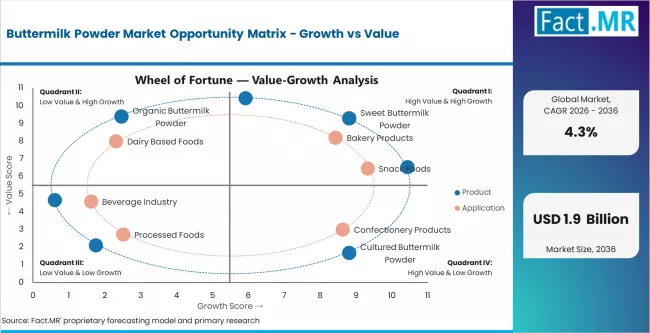
Buttermilk Powder Market Opportunity Matrix Growth Vs Value

Key Factors Driving Growth

  • Industrial bakery production is expanding rapidly in India, China, and Southeast Asia. Commercial bread, biscuit, and cake manufacturing requires consistent, shelf-stable ingredients, and buttermilk powder offers functional advantages over liquid dairy in high-volume automated production lines.
  • Butter production growth, particularly in Europe and Oceania, increases the available supply of liquid buttermilk for drying. As global butter demand grows at 3 to 4% annually, the co-product buttermilk stream expands proportionally, providing raw material for increased powder production.
  • Food manufacturers are consolidating ingredient supplier bases and favoring dairy companies that can supply multiple powder grades (sweet, cultured, organic) from single production facilities, reducing procurement complexity and logistics costs.

Key Market Constraints

  • Buttermilk powder is a co-product of butter manufacturing, meaning its supply is determined by butter demand rather than its own market dynamics. If butter production slows or shifts geographically, buttermilk powder availability can become constrained or misaligned with demand centers.
  • Price competition from skim milk powder and whey-based alternatives limits buttermilk powder's ability to command pricing premiums. Food formulators can substitute alternative dairy powders in many applications, creating price ceiling pressure.
  • Quality variability across production batches, particularly in fat content, protein levels, and flavor profiles, creates formulation challenges for food manufacturers requiring tight specification tolerances in automated production.

Key Opportunity Areas

  • Organic buttermilk powder commands a 20 to 35% price premium over conventional grades and is gaining demand from clean-label bakery brands in Europe and North America. Supply remains limited, creating an opportunity for dairy cooperatives to convert organic milk streams into premium-priced buttermilk powder.
  • Functional buttermilk ingredients, including buttermilk-derived phospholipid concentrates (MFGM), are attracting attention from nutraceutical and infant formula manufacturers for their cognitive and gut health properties, opening a high-value application outside traditional food manufacturing.
  • Emerging market food manufacturers in India, Nigeria, and Indonesia are scaling processed food production, creating new demand for shelf-stable dairy ingredients that can be stored and transported without refrigeration in tropical climates.

Segment-wise Analysis of the Buttermilk Powder Market

  • Sweet buttermilk powder holds 31.8% of the product segment, favored for its mild flavor and versatile functionality in bakery and confectionery applications.
  • Bakery products account for 34.9% of application demand, with buttermilk powder used for dough conditioning, flavor development, and crumb structure improvement.
  • Spray dried powder dominates the form segment at 44.2%, preferred for its solubility, consistency, and suitability for large-scale food manufacturing.

Which product type dominates the Buttermilk Powder Market?
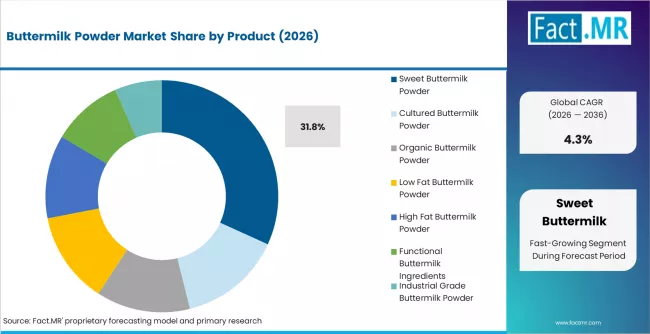
Buttermilk Powder Market Analysis By Product

Sweet buttermilk powder holds 31.8% of the product segment. This grade is produced directly from the liquid byproduct of sweet cream butter manufacturing, without additional fermentation. Its mild, slightly sweet flavor and consistent functional properties make it the default choice for industrial bakery operations, where it improves bread dough extensibility, enhances Maillard browning in baked goods, and contributes to tender crumb structures in cakes and muffins.

Cultured buttermilk powder holds the second-largest product share. Produced by fermenting buttermilk with lactic acid bacteria before drying, cultured grades deliver a tangy flavor profile suited to pancake mixes, ranch-style seasonings, and marinated meat applications. The fermentation step also improves the powder's emulsification properties, making it preferred in salad dressing and sauce manufacturing.

Which application leads demand in the Buttermilk Powder Market?
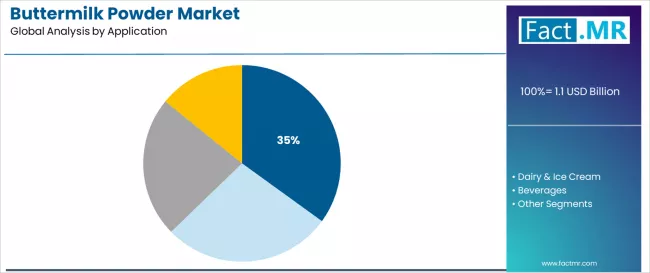
Buttermilk Powder Market Analysis By Application

Bakery products hold 34.9% of application demand. Buttermilk powder's acidic pH activates baking soda leavening, improves gluten network development, and extends shelf life through moisture retention in finished baked goods. Commercial bread, biscuit, and cake producers use buttermilk powder as a cost-effective alternative to liquid buttermilk, eliminating cold storage requirements and enabling consistent formulation across production batches.

Confectionery and processed food applications are growing segments. Buttermilk powder contributes caramelization flavor in toffees and fudge, while its emulsifying phospholipids improve fat distribution in chocolate and compound coatings. In processed foods, buttermilk powder is used in cream-style soups, instant sauces, and seasoning blends where dairy richness and body are required.

Which form leads the Buttermilk Powder Market?
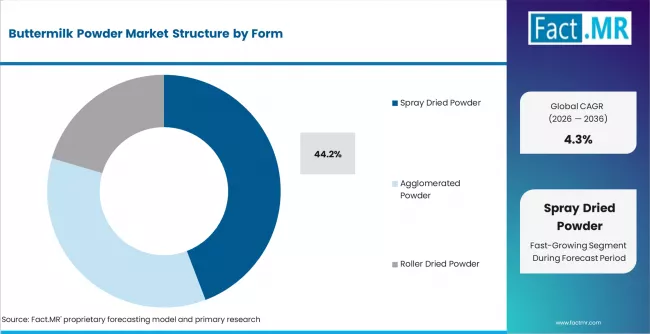
Buttermilk Powder Market Analysis By Form

Spray dried powder accounts for 44.2% of the form segment. Spray drying produces a fine, free-flowing powder with good solubility and consistent particle size, making it the preferred production method for food manufacturing applications. The process preserves the functional proteins and phospholipids in buttermilk while achieving moisture levels below 4%, ensuring extended shelf life.

Roller dried powder serves niche applications where a denser, flaked texture is preferred. Agglomerated powder, produced by rewetting spray-dried particles to form larger granules, is used in retail-packaged mixes where instant dissolution in water is a consumer requirement.

Which Product Trend is Shaping the Next Phase of Growth in the Buttermilk Powder Market?

Milk fat globule membrane (MFGM) extraction from buttermilk is shaping the next phase of value creation in this market. Buttermilk is the richest commercial source of MFGM phospholipids, which have demonstrated cognitive development and gut barrier function benefits in clinical studies. Infant formula manufacturers are sourcing MFGM-enriched buttermilk fractions to bridge the compositional gap between bovine and human milk. Companies like Arla Foods Ingredients and Fonterra have commercialized MFGM concentrates derived from buttermilk processing streams, creating a high-margin revenue stream from what was historically treated as a low-value co-product.

Organic and grass-fed buttermilk powder is emerging as a differentiated ingredient in premium bakery and clean-label food manufacturing. European and New Zealand dairy cooperatives with certified organic herds are directing their buttermilk streams into premium powder grades that command 20 to 35% price premiums over conventional product. This segment is supply-constrained because organic butter production volumes remain a small fraction of total output. Brands that secure long-term organic buttermilk powder supply agreements will have a procurement advantage as clean-label reformulation accelerates among mid-size bakery and snack manufacturers.

Regional Outlook Across Key Markets

Top Country Growth Comparison Buttermilk Powder Market Cagr (2026 2036)

  • Europe holds a leading revenue share, supported by large-scale butter production in Germany, France, Ireland, and the Netherlands that generates substantial buttermilk co-product supply.
  • South Asia and Pacific leads growth, with India at 6.2% CAGR driven by rapid expansion of organized bakery and processed food production.
  • North America is a mature market, with the USA contributing USD 0.438 billion in 2025 from established industrial bakery and food service demand.
  • East Asia is a growing importer, with China at 5.5% CAGR as processed food manufacturing scales and domestic dairy processing capacity expands.

CAGR Table

Country CAGR (%)
India 6.2%
China 5.5%
Mexico 4.0%
Germany 3.7%
USA 3.6%
South Korea 3.2%
Japan 2.6%

Source: Fact.MR analysis, based on proprietary forecasting model and primary research.
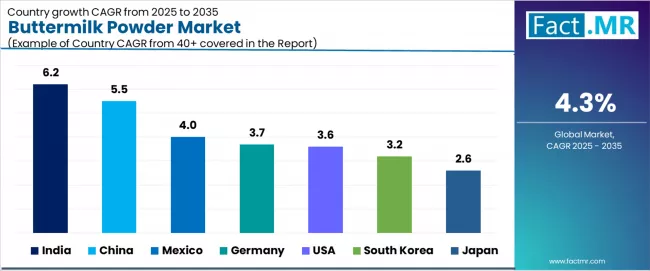
Buttermilk Powder Market Cagr Analysis By Country

India: organized bakery expansion creating ingredient demand

India's buttermilk powder market is growing at 6.2% CAGR, driven by the rapid expansion of organized bakery chains such as Britannia, Parle, and ITC's Sunfeast division. India's packaged bread market alone has been growing at over 8% annually, and each production facility requires consistent supplies of dairy-based ingredients. Domestic dairy cooperatives including Amul (GCMMF) and Nandini (KMF) are investing in spray drying capacity to convert liquid buttermilk, traditionally consumed as a fresh beverage in South India, into industrial powder grades for food manufacturing use. Buffalo milk-based buttermilk powder is a uniquely Indian product, offering higher fat and protein content suited to local confectionery and sweet manufacturing applications.

  • India's butter production is expanding rapidly, increasing the available buttermilk stream for powder conversion and reducing import dependency for this ingredient.

China: processed food manufacturing driving import demand

China's market is expanding at 5.5% CAGR, driven by a large and growing processed food manufacturing sector. Chinese bakery production has grown substantially as Western-style bread, cakes, and pastries gain consumer popularity in urban areas. Domestic buttermilk powder production remains limited relative to demand, making China a net importer from New Zealand, Europe, and the USA. Fonterra and European dairy cooperatives supply bulk sweet buttermilk powder to Chinese food manufacturers through ingredient distribution networks.

  • China's dairy import infrastructure and established trade relationships with New Zealand and European suppliers facilitate buttermilk powder procurement for domestic food manufacturers.

USA: mature industrial demand with organic segment growth
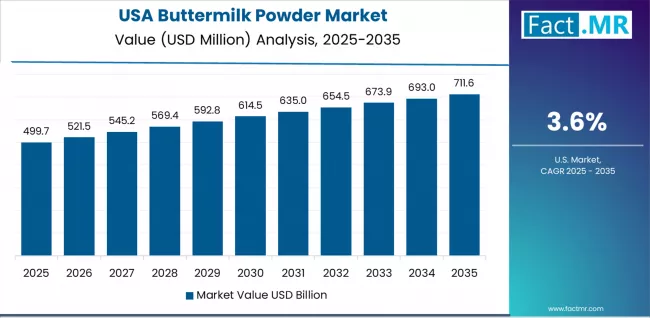
Buttermilk Powder Market Country Value Analysis

The USA contributes USD 0.438 billion in 2025, with demand concentrated in industrial bakery, food service, and retail pancake/baking mix applications. Growth at 3.6% CAGR is moderate, reflecting a mature market where volume expansion comes from incremental processed food production growth rather than new application development. The organic segment is the primary growth driver, with brands like Bob's Red Mill and King Arthur Flour sourcing organic buttermilk powder for premium baking mixes. Dairy Farmers of America (DFA) and Land O'Lakes are the primary domestic producers.

  • US retail demand for buttermilk powder is concentrated in baking mix products, where shelf-stable powder format eliminates the challenge of liquid buttermilk's short refrigerated shelf life.

Germany: butter co-product supply supporting ingredient leadership

Germany's market grows at 3.7% CAGR, anchored by the country's position as Europe's largest butter producer. German dairy cooperatives including DMK Group and Hochwald Foods generate substantial buttermilk streams from butter manufacturing, which are processed into food-grade powders for domestic use and intra-EU trade. German food manufacturers demand tight specification tolerances for buttermilk powder used in premium bakery and confectionery production. Organic buttermilk powder from certified German dairies commands premium pricing in the EU and export markets.

  • Germany's dual role as a major butter producer and food manufacturing hub creates a vertically integrated supply chain for buttermilk powder production and consumption.

South Korea: imported ingredient supporting bakery growth
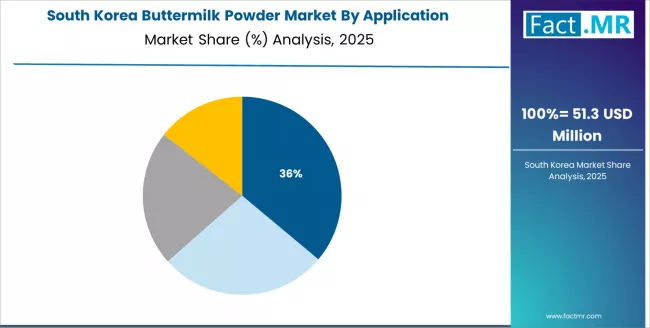
Buttermilk Powder Market South Korea Market Share Analysis By Application

South Korea's market is growing at 3.2% CAGR from a USD 0.04 billion base in 2025. The Korean bakery market, led by chains like Paris Baguette and Tous les Jours, drives demand for buttermilk powder as a functional ingredient in bread and pastry production. South Korea imports the majority of its buttermilk powder from New Zealand and Australia, as domestic dairy processing capacity is oriented toward fluid milk and fermented dairy products rather than butter and powder manufacturing.

  • South Korea's premium bakery culture and consumer willingness to pay for quality baked goods support demand for high-specification buttermilk powder grades.

Japan: food service and convenience food applications
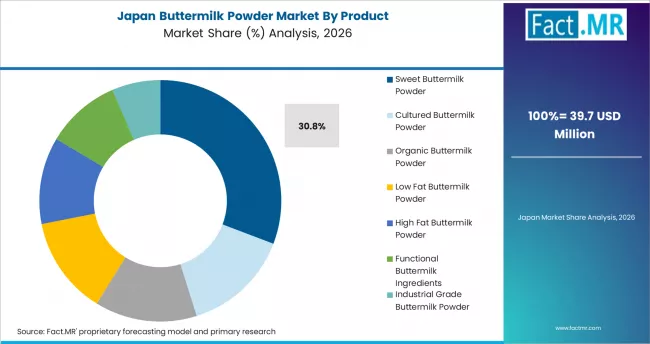
Buttermilk Powder Market Japan Market Share Analysis By Product

Japan's market grows at 2.6% CAGR from a USD 0.057 billion base in 2025. Japanese food manufacturers use buttermilk powder primarily in pancake mixes, convenience store bakery items, and prepared food products. Demand is stable rather than fast-growing, reflecting Japan's mature food processing industry and population dynamics. Domestic production by Meiji and Morinaga Milk Industry supplements imports from Oceania. Japanese food manufacturers place emphasis on traceability and contamination testing, requiring suppliers to meet stringent quality assurance documentation standards.

  • Japan's convenience store ecosystem (over 56,000 locations) generates consistent demand for buttermilk powder through its in-store bakery and prepared food programs.

Mexico: processed food sector growth creating new demand

Mexico's market is expanding at 4.0% CAGR as the country's processed food and bakery manufacturing sector scales. Large producers such as Grupo Bimbo, the world's largest baking company by sales volume, consume buttermilk powder across their Mexican production facilities. Mexico imports buttermilk powder primarily from the USA, benefiting from geographic proximity and USMCA trade provisions. The growing popularity of pancake and waffle mixes among Mexican consumers is creating a small but expanding retail channel for buttermilk powder products.

  • Mexico's position as home to Grupo Bimbo's headquarters and primary manufacturing base creates concentrated institutional demand for buttermilk powder ingredients.

Competitive Benchmarking and Company Positioning
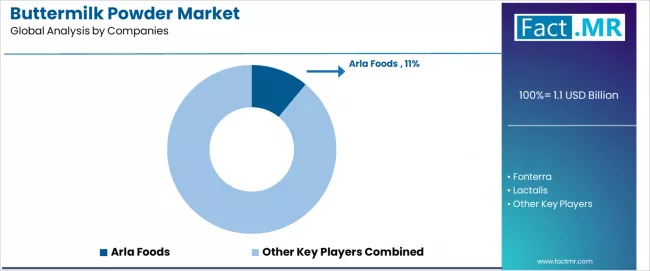
Buttermilk Powder Market Analysis By Company

Buttermilk Powder Market Analysis By Company

  • Tier 1 (above 10% share): Arla Foods holds an estimated 11.0% global share through its ingredient division's extensive buttermilk powder production across European and Middle Eastern facilities.
  • Tier 2 (5 to 10% share): Fonterra, Lactalis, and FrieslandCampina compete through global dairy ingredient distribution networks and multi-grade product portfolios.
  • Tier 3 (below 5% share): Saputo, Kerry, Ornua, Amul, Glanbia, Hoogwegt, and regional dairy cooperatives compete on price, regional proximity, and application-specific technical support.

The buttermilk powder market is dominated by large dairy cooperatives and multinational dairy companies that produce buttermilk powder as a co-product of their butter manufacturing operations. Arla Foods, Fonterra, and FrieslandCampina control substantial production volumes because they process large shares of their member farmers' milk supply into butter, generating predictable buttermilk streams for powder production. This co-product nature means that buttermilk powder pricing and availability are linked to butter market dynamics rather than independent supply-demand fundamentals.

Competition in this market centers on specification consistency, supply reliability, and logistics capability rather than brand differentiation. Food manufacturers select buttermilk powder suppliers based on protein content, fat levels, solubility index, and microbiological quality parameters. Long-term supply contracts between major dairy companies and food manufacturers (such as Grupo Bimbo, Mondelez, or Nestle) account for a substantial share of global buttermilk powder trade.

Ingredient distributors including Hoogwegt, Interfood, and Ornua play a meaningful intermediary role, aggregating production from multiple dairy cooperatives and offering food manufacturers blended supply solutions that mitigate single-source risk.

Key Companies in the Buttermilk Powder Market

Arla Foods, Fonterra, Lactalis, FrieslandCampina, Saputo, Kerry, Ornua, Amul, Glanbia, Hoogwegt, Ingredia, DFA, Agropur, Alpen Food Group, and Valio are the primary companies shaping competitive dynamics in the buttermilk powder market.

Recent Industry Developments

  • Arla Foods Ingredients: MFGM concentrate commercialization (2025)
    • Arla Foods Ingredients expanded its milk fat globule membrane (MFGM) product range derived from buttermilk processing, targeting infant formula and clinical nutrition applications. The company scaled production at its Denmark facility to meet growing demand from infant formula manufacturers in Asia and Europe.
  • Fonterra: spray drying capacity expansion in New Zealand (2025)
    • Fonterra commissioned additional spray drying capacity at its Edendale site to process increased buttermilk volumes from expanding butter production. The investment positions Fonterra to serve growing demand from Asian food manufacturers importing buttermilk powder for bakery and confectionery applications.
  • Amul (GCMMF): buttermilk powder production scaling in India (2025)
    • Amul invested in new spray drying facilities to convert liquid buttermilk from its butter production operations into food-grade powder for the domestic food manufacturing market. This reduces India's import dependency and provides domestic bakery producers with a locally sourced, cost-competitive ingredient option.
  • FrieslandCampina: organic buttermilk powder launch for EU bakery market (2026)
    • FrieslandCampina launched a certified organic buttermilk powder grade targeting premium bakery manufacturers in the EU. The product is sourced from the cooperative's organic dairy farmer members and carries EU organic certification, commanding a 25% premium over conventional grades.

Leading Companies Shaping the Buttermilk Powder Market

  • Global Players

    • Arla Foods
    • Fonterra
    • Lactalis
    • FrieslandCampina
    • Saputo
    • Kerry
  • Regional Players

    • Ornua
    • Amul
    • Glanbia
    • DFA
    • Agropur
  • Emerging / Start-up Players

    • Hoogwegt
    • Ingredia
    • Alpen Food Group
    • Valio

Sources and Research References

  • USDA Foreign Agricultural Service dairy production and trade data
  • Eurostat dairy production statistics and intra-EU trade flows
  • FAO dairy commodity price and production databases
  • Arla Foods Annual Report and Ingredients Division presentations (2025)
  • Fonterra Annual Report and Co-operative financial statements (2025)
  • FSSAI (Food Safety and Standards Authority of India) dairy product regulations
  • Grupo Bimbo Annual Report and ingredient procurement disclosures (2025)

All numerical data is sourced from Fact.MR proprietary research. Company-specific data is sourced from public filings and verified through primary research. No syndicated market research reports were used.

Key Questions This Report Addresses

  • What is the current value and forecast for the global buttermilk powder market?
  • Which product type holds the largest share in the buttermilk powder market?
  • What CAGR is projected for the buttermilk powder market from 2026 to 2036?
  • Which country is the fastest-growing market for buttermilk powder?
  • How does butter production volume affect buttermilk powder supply?
  • What role does MFGM extraction play in buttermilk powder market value creation?
  • Which companies lead the global buttermilk powder market?
  • What is the incremental revenue opportunity in buttermilk powder between 2026 and 2036?
  • How does organic buttermilk powder pricing compare to conventional grades?

Buttermilk Powder Market Definition

The buttermilk powder market covers dried buttermilk products manufactured through spray drying, roller drying, or agglomeration processes. These products are used as functional dairy ingredients in food manufacturing, providing emulsification, acidification, flavor, and texture properties in bakery, confectionery, dairy, processed food, snack, and beverage applications. Buttermilk powder is produced as a co-product of butter manufacturing, with the liquid buttermilk stream separated, pasteurized, concentrated, and dried for commercial use.

Buttermilk Powder Market Inclusions

  • Sweet buttermilk powder, cultured buttermilk powder, and organic buttermilk powder produced from cow, buffalo, or mixed dairy sources.
  • Industrial grade buttermilk powder used in large-scale food manufacturing and food service operations.
  • Functional buttermilk ingredients and buttermilk-derived concentrates sold as food processing inputs.
  • Buttermilk powder distributed through B2B channels (food ingredient distributors, direct manufacturer supply) and retail channels.

Buttermilk Powder Market Exclusions

  • Liquid buttermilk sold as a consumer beverage product.
  • Whole milk powder, skim milk powder, and other non-buttermilk dairy powders.
  • Whey-based dairy ingredient powders (whey protein concentrate, whey permeate).
  • Butter and cream products from which buttermilk is a co-product.

Buttermilk Powder Market Research Methodology

  • Bottom-up revenue estimation using dairy processor production data, ingredient distributor shipment records, and food manufacturer procurement volumes across 40+ countries.
  • Primary interviews with dairy ingredient procurement managers, bakery production engineers, and dairy cooperative export managers.
  • Trade data analysis tracking buttermilk powder import/export volumes using customs classification codes across major dairy trading nations.
  • Production volume triangulation using butter output data from USDA, Eurostat, and FAO to estimate buttermilk co-product availability.
  • Pricing analysis across spot and contract markets for sweet and cultured buttermilk powder grades in key trading regions.
  • Competitive benchmarking using annual reports and production capacity data from Arla Foods, Fonterra, Lactalis, FrieslandCampina, and 11 other profiled companies.

Scope of Analysis

Buttermilk Powder Market Breakdown By Product, Application, And Region

Parameter Details
Report Title Buttermilk Powder Market
Market Value (2025) USD 1.2 Billion
Forecast Value (2036) USD 1.907 Billion
CAGR (2026 to 2036) 4.3%
Unit USD Billion
Segments Covered Product, Application, End Use, Form, Source
Regions Covered North America, Latin America, Europe, East Asia, South Asia and Pacific, Middle East and Africa
Countries Profiled USA, India, China, Germany, Japan, South Korea, Mexico, and 40+ countries
Key Companies Arla Foods, Fonterra, Lactalis, FrieslandCampina, Saputo, Kerry, Ornua, Amul, Glanbia, Hoogwegt, Ingredia, DFA, Agropur, Alpen Food Group, Valio
Forecast Period 2026 to 2036
Base Year 2025
Methodology Bottom-up estimation, primary interviews, trade data analysis, production volume triangulation, pricing analysis, competitive benchmarking

Market Segmentation Analysis

  • Buttermilk Powder Market Market Segmented by Product:

    • Sweet Buttermilk Powder
      • Spray Dried Sweet Buttermilk
      • Roller Dried Sweet Buttermilk
    • Cultured Buttermilk Powder
      • Fermented Buttermilk Powder
      • Probiotic Enhanced Buttermilk Powder
    • Organic Buttermilk Powder
      • Certified Organic Dairy Buttermilk
      • Non GMO Buttermilk Powder
    • Low Fat Buttermilk Powder
      • Reduced Fat Dairy Powder
      • Skim Buttermilk Powder
    • High Fat Buttermilk Powder
      • Full Cream Buttermilk Powder
    • Functional Buttermilk Ingredients
      • High Protein Buttermilk Powder
      • Fortified Dairy Powder Blends
    • Industrial Grade Buttermilk Powder
      • Bulk Dairy Ingredient Grade
      • Food Processing Grade
  • Buttermilk Powder Market Market Segmented by Application:

    • Bakery Products
      • Bread and Rolls
      • Cakes and Pastries
      • Biscuits and Cookies
    • Confectionery Products
      • Chocolate Based Products
      • Cream Filled Products
    • Dairy Based Foods
      • Ice Cream Production
      • Yogurt and Fermented Products
    • Processed Foods
      • Ready Meals
      • Soups and Sauces
    • Snack Foods
      • Savory Snacks
      • Extruded Snacks
    • Beverage Industry
      • Instant Beverage Mixes
      • Functional Dairy Drinks
  • Buttermilk Powder Market Market Segmented by End Use:

    • Food Manufacturers
      • Bakery Manufacturers
      • Snack Producers
    • Dairy Industry
      • Ice Cream Producers
      • Fermented Dairy Producers
    • Food Service Industry
      • Horeca Sector
      • Industrial Kitchens
    • Nutraceutical Companies
      • Functional Food Brands
      • Protein Enriched Products
    • Retail Brands
      • Private Label Dairy Brands
      • Branded Food Companies
  • Buttermilk Powder Market Market Segmented by End Use:

    • Food Manufacturers
      • Bakery Manufacturers
      • Snack Producers
    • Dairy Industry
      • Ice Cream Producers
      • Fermented Dairy Producers
    • Food Service Industry
      • Horeca Sector
      • Industrial Kitchens
    • Nutraceutical Companies
      • Functional Food Brands
      • Protein Enriched Products
    • Retail Brands
      • Private Label Dairy Brands
      • Branded Food Companies
  • Buttermilk Powder Market Market Segmented by Form:

    • Spray Dried Powder
      • Fine Dairy Powder
      • Instant Soluble Powder
    • Agglomerated Powder
      • Instant Mix Powder
      • Granulated Dairy Powder
    • Roller Dried Powder
      • Traditional Drying Method Powder
      • Industrial Grade Powder
  • Buttermilk Powder Market Market Segmented by Source:

    • Cow Milk Based
      • Bovine Milk Derived Buttermilk
    • Buffalo Milk Based
      • High Fat Dairy Source
    • Mixed Dairy Source
      • Blended Milk Buttermilk Production
    • Organic Milk Source
      • Pasture Raised Dairy Systems
      • Non Antibiotic Milk Sources
  • Buttermilk Powder Market Market by Region:

    • North America
      • USA
      • Canada
      • Mexico
    • Latin America
      • Brazil
      • Chile
      • Rest of Latin America
    • Western Europe
      • Germany
      • UK
      • Italy
      • Spain
      • France
      • Nordic
      • BENELUX
      • Rest of Western Europe
    • Eastern Europe
      • Russia
      • Poland
      • Hungary
      • Balkan & Baltic
      • Rest of Eastern Europe
    • East Asia
      • China
      • Japan
      • South Korea
    • South Asia and Pacific
      • India
      • ASEAN
      • Australia & New Zealand
      • Rest of South Asia and Pacific
    • Middle East & Africa
      • Kingdom of Saudi Arabia
      • Other GCC Countries
      • Turkiye
      • South Africa
      • Other African Union
      • Rest of Middle East & Africa

- Frequently Asked Questions -

What is the buttermilk powder market worth in 2025?

The global buttermilk powder market is valued at USD 1.2 billion in 2025.

What CAGR is projected for the buttermilk powder market?

The market is projected to grow at a 4.3% CAGR from 2026 to 2036.

Which product type leads the buttermilk powder market?

Sweet buttermilk powder holds a 31.8% share of the product segment.

Which country is the fastest-growing buttermilk powder market?

India is the fastest-growing market with a 6.2% CAGR through 2036.

Which company leads the buttermilk powder market?

Arla Foods holds an estimated 11.0% global market share.

What is the forecast value of the buttermilk powder market in 2036?

The market is forecast to reach USD 1.907 billion by 2036.

Which application dominates buttermilk powder demand?

Bakery products hold a 34.9% share of application demand.

Table of Content

  1. Executive Summary
    • Global Market Outlook
    • Demand to side Trends
    • Supply to side Trends
    • Technology Roadmap Analysis
    • Analysis and Recommendations
  2. Market Overview
    • Market Coverage / Taxonomy
    • Market Definition / Scope / Limitations
  3. Research Methodology
    • Chapter Orientation
    • Analytical Lens and Working Hypotheses
      • Market Structure, Signals, and Trend Drivers
      • Benchmarking and Cross-market Comparability
      • Market Sizing, Forecasting, and Opportunity Mapping
    • Research Design and Evidence Framework
      • Desk Research Programme (Secondary Evidence)
        • Company Annual and Sustainability Reports
        • Peer-reviewed Journals and Academic Literature
        • Corporate Websites, Product Literature, and Technical Notes
        • Earnings Decks and Investor Briefings
        • Statutory Filings and Regulatory Disclosures
        • Technical White Papers and Standards Notes
        • Trade Journals, Industry Magazines, and Analyst Briefs
        • Conference Proceedings, Webinars, and Seminar Materials
        • Government Statistics Portals and Public Data Releases
        • Press Releases and Reputable Media Coverage
        • Specialist Newsletters and Curated Briefings
        • Sector Databases and Reference Repositories
        • Fact.MR Internal Proprietary Databases and Historical Market Datasets
        • Subscription Datasets and Paid Sources
        • Social Channels, Communities, and Digital Listening Inputs
        • Additional Desk Sources
      • Expert Input and Fieldwork (Primary Evidence)
        • Primary Modes
          • Qualitative Interviews and Expert Elicitation
          • Quantitative Surveys and Structured Data Capture
          • Blended Approach
        • Why Primary Evidence is Used
        • Field Techniques
          • Interviews
          • Surveys
          • Focus Groups
          • Observational and In-context Research
          • Social and Community Interactions
        • Stakeholder Universe Engaged
          • C-suite Leaders
          • Board Members
          • Presidents and Vice Presidents
          • R&D and Innovation Heads
          • Technical Specialists
          • Domain Subject-matter Experts
          • Scientists
          • Physicians and Other Healthcare Professionals
        • Governance, Ethics, and Data Stewardship
          • Research Ethics
          • Data Integrity and Handling
      • Tooling, Models, and Reference Databases
    • Data Engineering and Model Build
      • Data Acquisition and Ingestion
      • Cleaning, Normalisation, and Verification
      • Synthesis, Triangulation, and Analysis
    • Quality Assurance and Audit Trail
  4. Market Background
    • Market Dynamics
      • Drivers
      • Restraints
      • Opportunity
      • Trends
    • Scenario Forecast
      • Demand in Optimistic Scenario
      • Demand in Likely Scenario
      • Demand in Conservative Scenario
    • Opportunity Map Analysis
    • Product Life Cycle Analysis
    • Supply Chain Analysis
    • Investment Feasibility Matrix
    • Value Chain Analysis
    • PESTLE and Porter’s Analysis
    • Regulatory Landscape
    • Regional Parent Market Outlook
    • Production and Consumption Statistics
    • Import and Export Statistics
  5. Global Market Analysis 2021 to 2025 and Forecast, 2026 to 2036
    • Historical Market Size Value (USD Million) Analysis, 2021 to 2025
    • Current and Future Market Size Value (USD Million) Projections, 2026 to 2036
      • Y to o to Y Growth Trend Analysis
      • Absolute $ Opportunity Analysis
  6. Global Market Pricing Analysis 2021 to 2025 and Forecast 2026 to 2036
  7. Global Market Analysis 2021 to 2025 and Forecast 2026 to 2036, By Product
    • Introduction / Key Findings
    • Historical Market Size Value (USD Million) Analysis By Product , 2021 to 2025
    • Current and Future Market Size Value (USD Million) Analysis and Forecast By Product , 2026 to 2036
      • Sweet Buttermilk Powder
        • Spray Dried Sweet Buttermilk
        • Roller Dried Sweet Buttermilk
      • Cultured Buttermilk Powder
        • Fermented Buttermilk Powder
        • Probiotic Enhanced Buttermilk Powder
      • Organic Buttermilk Powder
        • Certified Organic Dairy Buttermilk
        • Non GMO Buttermilk Powder
      • Low Fat Buttermilk Powder
        • Reduced Fat Dairy Powder
        • Skim Buttermilk Powder
      • High Fat Buttermilk Powder
        • Full Cream Buttermilk Powder
      • Functional Buttermilk Ingredients
        • High Protein Buttermilk Powder
        • Fortified Dairy Powder Blends
      • Industrial Grade Buttermilk Powder
        • Bulk Dairy Ingredient Grade
        • Food Processing Grade
    • Y to o to Y Growth Trend Analysis By Product , 2021 to 2025
    • Absolute $ Opportunity Analysis By Product , 2026 to 2036
  8. Global Market Analysis 2021 to 2025 and Forecast 2026 to 2036, By Application
    • Introduction / Key Findings
    • Historical Market Size Value (USD Million) Analysis By Application, 2021 to 2025
    • Current and Future Market Size Value (USD Million) Analysis and Forecast By Application, 2026 to 2036
      • Bakery Products
        • Bread and Rolls
        • Cakes and Pastries
        • Biscuits and Cookies
      • Confectionery Products
        • Chocolate Based Products
        • Cream Filled Products
      • Dairy Based Foods
        • Ice Cream Production
        • Yogurt and Fermented Products
      • Processed Foods
        • Ready Meals
        • Soups and Sauces
      • Snack Foods
        • Savory Snacks
        • Extruded Snacks
      • Beverage Industry
        • Instant Beverage Mixes
        • Functional Dairy Drinks
    • Y to o to Y Growth Trend Analysis By Application, 2021 to 2025
    • Absolute $ Opportunity Analysis By Application, 2026 to 2036
  9. Global Market Analysis 2021 to 2025 and Forecast 2026 to 2036, By End Use
    • Introduction / Key Findings
    • Historical Market Size Value (USD Million) Analysis By End Use, 2021 to 2025
    • Current and Future Market Size Value (USD Million) Analysis and Forecast By End Use, 2026 to 2036
      • Food Manufacturers
        • Bakery Manufacturers
        • Snack Producers
      • Dairy Industry
        • Ice Cream Producers
        • Fermented Dairy Producers
      • Food Service Industry
        • Horeca Sector
        • Industrial Kitchens
      • Nutraceutical Companies
        • Functional Food Brands
        • Protein Enriched Products
      • Retail Brands
        • Private Label Dairy Brands
        • Branded Food Companies
    • Y to o to Y Growth Trend Analysis By End Use, 2021 to 2025
    • Absolute $ Opportunity Analysis By End Use, 2026 to 2036
  10. Global Market Analysis 2021 to 2025 and Forecast 2026 to 2036, By End Use
    • Introduction / Key Findings
    • Historical Market Size Value (USD Million) Analysis By End Use, 2021 to 2025
    • Current and Future Market Size Value (USD Million) Analysis and Forecast By End Use, 2026 to 2036
      • Food Manufacturers
        • Bakery Manufacturers
        • Snack Producers
      • Dairy Industry
        • Ice Cream Producers
        • Fermented Dairy Producers
      • Food Service Industry
        • Horeca Sector
        • Industrial Kitchens
      • Nutraceutical Companies
        • Functional Food Brands
        • Protein Enriched Products
      • Retail Brands
        • Private Label Dairy Brands
        • Branded Food Companies
    • Y to o to Y Growth Trend Analysis By End Use, 2021 to 2025
    • Absolute $ Opportunity Analysis By End Use, 2026 to 2036
  11. Global Market Analysis 2021 to 2025 and Forecast 2026 to 2036, By Form
    • Introduction / Key Findings
    • Historical Market Size Value (USD Million) Analysis By Form, 2021 to 2025
    • Current and Future Market Size Value (USD Million) Analysis and Forecast By Form, 2026 to 2036
      • Spray Dried Powder
        • Fine Dairy Powder
        • Instant Soluble Powder
      • Agglomerated Powder
        • Instant Mix Powder
        • Granulated Dairy Powder
      • Roller Dried Powder
        • Traditional Drying Method Powder
        • Industrial Grade Powder
    • Y to o to Y Growth Trend Analysis By Form, 2021 to 2025
    • Absolute $ Opportunity Analysis By Form, 2026 to 2036
  12. Global Market Analysis 2021 to 2025 and Forecast 2026 to 2036, By Source
    • Introduction / Key Findings
    • Historical Market Size Value (USD Million) Analysis By Source, 2021 to 2025
    • Current and Future Market Size Value (USD Million) Analysis and Forecast By Source, 2026 to 2036
      • Cow Milk Based
        • Bovine Milk Derived Buttermilk
      • Buffalo Milk Based
        • High Fat Dairy Source
      • Mixed Dairy Source
        • Blended Milk Buttermilk Production
      • Organic Milk Source
        • Pasture Raised Dairy Systems
        • Non Antibiotic Milk Sources
    • Y to o to Y Growth Trend Analysis By Source, 2021 to 2025
    • Absolute $ Opportunity Analysis By Source, 2026 to 2036
  13. Global Market Analysis 2021 to 2025 and Forecast 2026 to 2036, By Region
    • Introduction
    • Historical Market Size Value (USD Million) Analysis By Region, 2021 to 2025
    • Current Market Size Value (USD Million) Analysis and Forecast By Region, 2026 to 2036
      • North America
      • Latin America
      • Western Europe
      • Eastern Europe
      • East Asia
      • South Asia and Pacific
      • Middle East & Africa
    • Market Attractiveness Analysis By Region
  14. North America Market Analysis 2021 to 2025 and Forecast 2026 to 2036, By Country
    • Historical Market Size Value (USD Million) Trend Analysis By Market Taxonomy, 2021 to 2025
    • Market Size Value (USD Million) Forecast By Market Taxonomy, 2026 to 2036
      • By Country
        • USA
        • Canada
        • Mexico
      • By Product
      • By Application
      • By End Use
      • By End Use
      • By Form
      • By Source
    • Market Attractiveness Analysis
      • By Country
      • By Product
      • By Application
      • By End Use
      • By End Use
      • By Form
      • By Source
    • Key Takeaways
  15. Latin America Market Analysis 2021 to 2025 and Forecast 2026 to 2036, By Country
    • Historical Market Size Value (USD Million) Trend Analysis By Market Taxonomy, 2021 to 2025
    • Market Size Value (USD Million) Forecast By Market Taxonomy, 2026 to 2036
      • By Country
        • Brazil
        • Chile
        • Rest of Latin America
      • By Product
      • By Application
      • By End Use
      • By End Use
      • By Form
      • By Source
    • Market Attractiveness Analysis
      • By Country
      • By Product
      • By Application
      • By End Use
      • By End Use
      • By Form
      • By Source
    • Key Takeaways
  16. Western Europe Market Analysis 2021 to 2025 and Forecast 2026 to 2036, By Country
    • Historical Market Size Value (USD Million) Trend Analysis By Market Taxonomy, 2021 to 2025
    • Market Size Value (USD Million) Forecast By Market Taxonomy, 2026 to 2036
      • By Country
        • Germany
        • UK
        • Italy
        • Spain
        • France
        • Nordic
        • BENELUX
        • Rest of Western Europe
      • By Product
      • By Application
      • By End Use
      • By End Use
      • By Form
      • By Source
    • Market Attractiveness Analysis
      • By Country
      • By Product
      • By Application
      • By End Use
      • By End Use
      • By Form
      • By Source
    • Key Takeaways
  17. Eastern Europe Market Analysis 2021 to 2025 and Forecast 2026 to 2036, By Country
    • Historical Market Size Value (USD Million) Trend Analysis By Market Taxonomy, 2021 to 2025
    • Market Size Value (USD Million) Forecast By Market Taxonomy, 2026 to 2036
      • By Country
        • Russia
        • Poland
        • Hungary
        • Balkan & Baltic
        • Rest of Eastern Europe
      • By Product
      • By Application
      • By End Use
      • By End Use
      • By Form
      • By Source
    • Market Attractiveness Analysis
      • By Country
      • By Product
      • By Application
      • By End Use
      • By End Use
      • By Form
      • By Source
    • Key Takeaways
  18. East Asia Market Analysis 2021 to 2025 and Forecast 2026 to 2036, By Country
    • Historical Market Size Value (USD Million) Trend Analysis By Market Taxonomy, 2021 to 2025
    • Market Size Value (USD Million) Forecast By Market Taxonomy, 2026 to 2036
      • By Country
        • China
        • Japan
        • South Korea
      • By Product
      • By Application
      • By End Use
      • By End Use
      • By Form
      • By Source
    • Market Attractiveness Analysis
      • By Country
      • By Product
      • By Application
      • By End Use
      • By End Use
      • By Form
      • By Source
    • Key Takeaways
  19. South Asia and Pacific Market Analysis 2021 to 2025 and Forecast 2026 to 2036, By Country
    • Historical Market Size Value (USD Million) Trend Analysis By Market Taxonomy, 2021 to 2025
    • Market Size Value (USD Million) Forecast By Market Taxonomy, 2026 to 2036
      • By Country
        • India
        • ASEAN
        • Australia & New Zealand
        • Rest of South Asia and Pacific
      • By Product
      • By Application
      • By End Use
      • By End Use
      • By Form
      • By Source
    • Market Attractiveness Analysis
      • By Country
      • By Product
      • By Application
      • By End Use
      • By End Use
      • By Form
      • By Source
    • Key Takeaways
  20. Middle East & Africa Market Analysis 2021 to 2025 and Forecast 2026 to 2036, By Country
    • Historical Market Size Value (USD Million) Trend Analysis By Market Taxonomy, 2021 to 2025
    • Market Size Value (USD Million) Forecast By Market Taxonomy, 2026 to 2036
      • By Country
        • Kingdom of Saudi Arabia
        • Other GCC Countries
        • Turkiye
        • South Africa
        • Other African Union
        • Rest of Middle East & Africa
      • By Product
      • By Application
      • By End Use
      • By End Use
      • By Form
      • By Source
    • Market Attractiveness Analysis
      • By Country
      • By Product
      • By Application
      • By End Use
      • By End Use
      • By Form
      • By Source
    • Key Takeaways
  21. Key Countries Market Analysis
    • USA
      • Pricing Analysis
      • Market Share Analysis, 2025
        • By Product
        • By Application
        • By End Use
        • By End Use
        • By Form
        • By Source
    • Canada
      • Pricing Analysis
      • Market Share Analysis, 2025
        • By Product
        • By Application
        • By End Use
        • By End Use
        • By Form
        • By Source
    • Mexico
      • Pricing Analysis
      • Market Share Analysis, 2025
        • By Product
        • By Application
        • By End Use
        • By End Use
        • By Form
        • By Source
    • Brazil
      • Pricing Analysis
      • Market Share Analysis, 2025
        • By Product
        • By Application
        • By End Use
        • By End Use
        • By Form
        • By Source
    • Chile
      • Pricing Analysis
      • Market Share Analysis, 2025
        • By Product
        • By Application
        • By End Use
        • By End Use
        • By Form
        • By Source
    • Germany
      • Pricing Analysis
      • Market Share Analysis, 2025
        • By Product
        • By Application
        • By End Use
        • By End Use
        • By Form
        • By Source
    • UK
      • Pricing Analysis
      • Market Share Analysis, 2025
        • By Product
        • By Application
        • By End Use
        • By End Use
        • By Form
        • By Source
    • Italy
      • Pricing Analysis
      • Market Share Analysis, 2025
        • By Product
        • By Application
        • By End Use
        • By End Use
        • By Form
        • By Source
    • Spain
      • Pricing Analysis
      • Market Share Analysis, 2025
        • By Product
        • By Application
        • By End Use
        • By End Use
        • By Form
        • By Source
    • France
      • Pricing Analysis
      • Market Share Analysis, 2025
        • By Product
        • By Application
        • By End Use
        • By End Use
        • By Form
        • By Source
    • India
      • Pricing Analysis
      • Market Share Analysis, 2025
        • By Product
        • By Application
        • By End Use
        • By End Use
        • By Form
        • By Source
    • ASEAN
      • Pricing Analysis
      • Market Share Analysis, 2025
        • By Product
        • By Application
        • By End Use
        • By End Use
        • By Form
        • By Source
    • Australia & New Zealand
      • Pricing Analysis
      • Market Share Analysis, 2025
        • By Product
        • By Application
        • By End Use
        • By End Use
        • By Form
        • By Source
    • China
      • Pricing Analysis
      • Market Share Analysis, 2025
        • By Product
        • By Application
        • By End Use
        • By End Use
        • By Form
        • By Source
    • Japan
      • Pricing Analysis
      • Market Share Analysis, 2025
        • By Product
        • By Application
        • By End Use
        • By End Use
        • By Form
        • By Source
    • South Korea
      • Pricing Analysis
      • Market Share Analysis, 2025
        • By Product
        • By Application
        • By End Use
        • By End Use
        • By Form
        • By Source
    • Russia
      • Pricing Analysis
      • Market Share Analysis, 2025
        • By Product
        • By Application
        • By End Use
        • By End Use
        • By Form
        • By Source
    • Poland
      • Pricing Analysis
      • Market Share Analysis, 2025
        • By Product
        • By Application
        • By End Use
        • By End Use
        • By Form
        • By Source
    • Hungary
      • Pricing Analysis
      • Market Share Analysis, 2025
        • By Product
        • By Application
        • By End Use
        • By End Use
        • By Form
        • By Source
    • Kingdom of Saudi Arabia
      • Pricing Analysis
      • Market Share Analysis, 2025
        • By Product
        • By Application
        • By End Use
        • By End Use
        • By Form
        • By Source
    • Turkiye
      • Pricing Analysis
      • Market Share Analysis, 2025
        • By Product
        • By Application
        • By End Use
        • By End Use
        • By Form
        • By Source
    • South Africa
      • Pricing Analysis
      • Market Share Analysis, 2025
        • By Product
        • By Application
        • By End Use
        • By End Use
        • By Form
        • By Source
  22. Market Structure Analysis
    • Competition Dashboard
    • Competition Benchmarking
    • Market Share Analysis of Top Players
      • By Regional
      • By Product
      • By Application
      • By End Use
      • By End Use
      • By Form
      • By Source
  23. Competition Analysis
    • Competition Deep Dive
      • Arla Foods
        • Overview
        • Product Portfolio
        • Profitability by Market Segments (Product/Age /Sales Channel/Region)
        • Sales Footprint
        • Strategy Overview
          • Marketing Strategy
          • Product Strategy
          • Channel Strategy
      • Fonterra
      • Lactalis
      • FrieslandCampina
      • Saputo
      • Kerry
      • Ornua
      • Amul
      • Glanbia
      • Hoogwegt
      • Ingredia
      • DFA
      • Agropur
      • Alpen Food Group
      • Valio
  24. Assumptions & Acronyms Used

List Of Table

  • Table 1: Global Market Value (USD Million) Forecast by Region, 2021 to 2036
  • Table 2: Global Market Value (USD Million) Forecast by Product , 2021 to 2036
  • Table 3: Global Market Value (USD Million) Forecast by Application, 2021 to 2036
  • Table 4: Global Market Value (USD Million) Forecast by End Use, 2021 to 2036
  • Table 5: Global Market Value (USD Million) Forecast by End Use, 2021 to 2036
  • Table 6: Global Market Value (USD Million) Forecast by Form, 2021 to 2036
  • Table 7: Global Market Value (USD Million) Forecast by Source, 2021 to 2036
  • Table 8: North America Market Value (USD Million) Forecast by Country, 2021 to 2036
  • Table 9: North America Market Value (USD Million) Forecast by Product , 2021 to 2036
  • Table 10: North America Market Value (USD Million) Forecast by Application, 2021 to 2036
  • Table 11: North America Market Value (USD Million) Forecast by End Use, 2021 to 2036
  • Table 12: North America Market Value (USD Million) Forecast by End Use, 2021 to 2036
  • Table 13: North America Market Value (USD Million) Forecast by Form, 2021 to 2036
  • Table 14: North America Market Value (USD Million) Forecast by Source, 2021 to 2036
  • Table 15: Latin America Market Value (USD Million) Forecast by Country, 2021 to 2036
  • Table 16: Latin America Market Value (USD Million) Forecast by Product , 2021 to 2036
  • Table 17: Latin America Market Value (USD Million) Forecast by Application, 2021 to 2036
  • Table 18: Latin America Market Value (USD Million) Forecast by End Use, 2021 to 2036
  • Table 19: Latin America Market Value (USD Million) Forecast by End Use, 2021 to 2036
  • Table 20: Latin America Market Value (USD Million) Forecast by Form, 2021 to 2036
  • Table 21: Latin America Market Value (USD Million) Forecast by Source, 2021 to 2036
  • Table 22: Western Europe Market Value (USD Million) Forecast by Country, 2021 to 2036
  • Table 23: Western Europe Market Value (USD Million) Forecast by Product , 2021 to 2036
  • Table 24: Western Europe Market Value (USD Million) Forecast by Application, 2021 to 2036
  • Table 25: Western Europe Market Value (USD Million) Forecast by End Use, 2021 to 2036
  • Table 26: Western Europe Market Value (USD Million) Forecast by End Use, 2021 to 2036
  • Table 27: Western Europe Market Value (USD Million) Forecast by Form, 2021 to 2036
  • Table 28: Western Europe Market Value (USD Million) Forecast by Source, 2021 to 2036
  • Table 29: Eastern Europe Market Value (USD Million) Forecast by Country, 2021 to 2036
  • Table 30: Eastern Europe Market Value (USD Million) Forecast by Product , 2021 to 2036
  • Table 31: Eastern Europe Market Value (USD Million) Forecast by Application, 2021 to 2036
  • Table 32: Eastern Europe Market Value (USD Million) Forecast by End Use, 2021 to 2036
  • Table 33: Eastern Europe Market Value (USD Million) Forecast by End Use, 2021 to 2036
  • Table 34: Eastern Europe Market Value (USD Million) Forecast by Form, 2021 to 2036
  • Table 35: Eastern Europe Market Value (USD Million) Forecast by Source, 2021 to 2036
  • Table 36: East Asia Market Value (USD Million) Forecast by Country, 2021 to 2036
  • Table 37: East Asia Market Value (USD Million) Forecast by Product , 2021 to 2036
  • Table 38: East Asia Market Value (USD Million) Forecast by Application, 2021 to 2036
  • Table 39: East Asia Market Value (USD Million) Forecast by End Use, 2021 to 2036
  • Table 40: East Asia Market Value (USD Million) Forecast by End Use, 2021 to 2036
  • Table 41: East Asia Market Value (USD Million) Forecast by Form, 2021 to 2036
  • Table 42: East Asia Market Value (USD Million) Forecast by Source, 2021 to 2036
  • Table 43: South Asia and Pacific Market Value (USD Million) Forecast by Country, 2021 to 2036
  • Table 44: South Asia and Pacific Market Value (USD Million) Forecast by Product , 2021 to 2036
  • Table 45: South Asia and Pacific Market Value (USD Million) Forecast by Application, 2021 to 2036
  • Table 46: South Asia and Pacific Market Value (USD Million) Forecast by End Use, 2021 to 2036
  • Table 47: South Asia and Pacific Market Value (USD Million) Forecast by End Use, 2021 to 2036
  • Table 48: South Asia and Pacific Market Value (USD Million) Forecast by Form, 2021 to 2036
  • Table 49: South Asia and Pacific Market Value (USD Million) Forecast by Source, 2021 to 2036
  • Table 50: Middle East & Africa Market Value (USD Million) Forecast by Country, 2021 to 2036
  • Table 51: Middle East & Africa Market Value (USD Million) Forecast by Product , 2021 to 2036
  • Table 52: Middle East & Africa Market Value (USD Million) Forecast by Application, 2021 to 2036
  • Table 53: Middle East & Africa Market Value (USD Million) Forecast by End Use, 2021 to 2036
  • Table 54: Middle East & Africa Market Value (USD Million) Forecast by End Use, 2021 to 2036
  • Table 55: Middle East & Africa Market Value (USD Million) Forecast by Form, 2021 to 2036
  • Table 56: Middle East & Africa Market Value (USD Million) Forecast by Source, 2021 to 2036

List Of Figures

  • Figure 1: Global Market Pricing Analysis
  • Figure 2: Global Market Value (USD Million) Forecast 2021-2036
  • Figure 3: Global Market Value Share and BPS Analysis by Product, 2026 and 2036
  • Figure 4: Global Market Y-o-Y Growth Comparison by Product,2026 to 2036
  • Figure 5: Global Market Attractiveness Analysis by Product
  • Figure 6: Global Market Value Share and BPS Analysis by Application, 2026 and 2036
  • Figure 7: Global Market Y-o-Y Growth Comparison by Application,2026 to 2036
  • Figure 8: Global Market Attractiveness Analysis by Application
  • Figure 9: Global Market Value Share and BPS Analysis by End Use, 2026 and 2036
  • Figure 10: Global Market Y-o-Y Growth Comparison by End Use,2026 to 2036
  • Figure 11: Global Market Attractiveness Analysis by End Use
  • Figure 12: Global Market Value Share and BPS Analysis by End Use, 2026 and 2036
  • Figure 13: Global Market Y-o-Y Growth Comparison by End Use,2026 to 2036
  • Figure 14: Global Market Attractiveness Analysis by End Use
  • Figure 15: Global Market Value Share and BPS Analysis by Form, 2026 and 2036
  • Figure 16: Global Market Y-o-Y Growth Comparison by Form,2026 to 2036
  • Figure 17: Global Market Attractiveness Analysis by Form
  • Figure 18: Global Market Value Share and BPS Analysis by Source, 2026 and 2036
  • Figure 19: Global Market Y-o-Y Growth Comparison by Source,2026 to 2036
  • Figure 20: Global Market Attractiveness Analysis by Source
  • Figure 21: Global Market Value (USD Million) Share and BPS Analysis by Region, 2026 and 2036
  • Figure 22: Global Market Y-o-Y Growth Comparison by Region,2026 to 2036
  • Figure 23: Global Market Attractiveness Analysis by Region
  • Figure 24: North America Market Incremental Dollar Opportunity,2026 to 2036
  • Figure 25: Latin America Market Incremental Dollar Opportunity,2026 to 2036
  • Figure 26: Western Europe Market Incremental Dollar Opportunity,2026 to 2036
  • Figure 27: Eastern Europe Market Incremental Dollar Opportunity,2026 to 2036
  • Figure 28: East Asia Market Incremental Dollar Opportunity,2026 to 2036
  • Figure 29: South Asia and Pacific Market Incremental Dollar Opportunity,2026 to 2036
  • Figure 30: Middle East & Africa Market Incremental Dollar Opportunity,2026 to 2036
  • Figure 31: North America Market Value Share and BPS Analysis by Country, 2026 and 2036
  • Figure 32: North America Market Value Share and BPS Analysis by Product, 2026 and 2036
  • Figure 33: North America Market Y-o-Y Growth Comparison by Product,2026 to 2036
  • Figure 34: North America Market Attractiveness Analysis by Product
  • Figure 35: North America Market Value Share and BPS Analysis by Application, 2026 and 2036
  • Figure 36: North America Market Y-o-Y Growth Comparison by Application,2026 to 2036
  • Figure 37: North America Market Attractiveness Analysis by Application
  • Figure 38: North America Market Value Share and BPS Analysis by End Use, 2026 and 2036
  • Figure 39: North America Market Y-o-Y Growth Comparison by End Use,2026 to 2036
  • Figure 40: North America Market Attractiveness Analysis by End Use
  • Figure 41: North America Market Value Share and BPS Analysis by End Use, 2026 and 2036
  • Figure 42: North America Market Y-o-Y Growth Comparison by End Use,2026 to 2036
  • Figure 43: North America Market Attractiveness Analysis by End Use
  • Figure 44: North America Market Value Share and BPS Analysis by Form, 2026 and 2036
  • Figure 45: North America Market Y-o-Y Growth Comparison by Form,2026 to 2036
  • Figure 46: North America Market Attractiveness Analysis by Form
  • Figure 47: North America Market Value Share and BPS Analysis by Source, 2026 and 2036
  • Figure 48: North America Market Y-o-Y Growth Comparison by Source,2026 to 2036
  • Figure 49: North America Market Attractiveness Analysis by Source
  • Figure 50: Latin America Market Value Share and BPS Analysis by Country, 2026 and 2036
  • Figure 51: Latin America Market Value Share and BPS Analysis by Product, 2026 and 2036
  • Figure 52: Latin America Market Y-o-Y Growth Comparison by Product,2026 to 2036
  • Figure 53: Latin America Market Attractiveness Analysis by Product
  • Figure 54: Latin America Market Value Share and BPS Analysis by Application, 2026 and 2036
  • Figure 55: Latin America Market Y-o-Y Growth Comparison by Application,2026 to 2036
  • Figure 56: Latin America Market Attractiveness Analysis by Application
  • Figure 57: Latin America Market Value Share and BPS Analysis by End Use, 2026 and 2036
  • Figure 58: Latin America Market Y-o-Y Growth Comparison by End Use,2026 to 2036
  • Figure 59: Latin America Market Attractiveness Analysis by End Use
  • Figure 60: Latin America Market Value Share and BPS Analysis by End Use, 2026 and 2036
  • Figure 61: Latin America Market Y-o-Y Growth Comparison by End Use,2026 to 2036
  • Figure 62: Latin America Market Attractiveness Analysis by End Use
  • Figure 63: Latin America Market Value Share and BPS Analysis by Form, 2026 and 2036
  • Figure 64: Latin America Market Y-o-Y Growth Comparison by Form,2026 to 2036
  • Figure 65: Latin America Market Attractiveness Analysis by Form
  • Figure 66: Latin America Market Value Share and BPS Analysis by Source, 2026 and 2036
  • Figure 67: Latin America Market Y-o-Y Growth Comparison by Source,2026 to 2036
  • Figure 68: Latin America Market Attractiveness Analysis by Source
  • Figure 69: Western Europe Market Value Share and BPS Analysis by Country, 2026 and 2036
  • Figure 70: Western Europe Market Value Share and BPS Analysis by Product, 2026 and 2036
  • Figure 71: Western Europe Market Y-o-Y Growth Comparison by Product,2026 to 2036
  • Figure 72: Western Europe Market Attractiveness Analysis by Product
  • Figure 73: Western Europe Market Value Share and BPS Analysis by Application, 2026 and 2036
  • Figure 74: Western Europe Market Y-o-Y Growth Comparison by Application,2026 to 2036
  • Figure 75: Western Europe Market Attractiveness Analysis by Application
  • Figure 76: Western Europe Market Value Share and BPS Analysis by End Use, 2026 and 2036
  • Figure 77: Western Europe Market Y-o-Y Growth Comparison by End Use,2026 to 2036
  • Figure 78: Western Europe Market Attractiveness Analysis by End Use
  • Figure 79: Western Europe Market Value Share and BPS Analysis by End Use, 2026 and 2036
  • Figure 80: Western Europe Market Y-o-Y Growth Comparison by End Use,2026 to 2036
  • Figure 81: Western Europe Market Attractiveness Analysis by End Use
  • Figure 82: Western Europe Market Value Share and BPS Analysis by Form, 2026 and 2036
  • Figure 83: Western Europe Market Y-o-Y Growth Comparison by Form,2026 to 2036
  • Figure 84: Western Europe Market Attractiveness Analysis by Form
  • Figure 85: Western Europe Market Value Share and BPS Analysis by Source, 2026 and 2036
  • Figure 86: Western Europe Market Y-o-Y Growth Comparison by Source,2026 to 2036
  • Figure 87: Western Europe Market Attractiveness Analysis by Source
  • Figure 88: Eastern Europe Market Value Share and BPS Analysis by Country, 2026 and 2036
  • Figure 89: Eastern Europe Market Value Share and BPS Analysis by Product, 2026 and 2036
  • Figure 90: Eastern Europe Market Y-o-Y Growth Comparison by Product,2026 to 2036
  • Figure 91: Eastern Europe Market Attractiveness Analysis by Product
  • Figure 92: Eastern Europe Market Value Share and BPS Analysis by Application, 2026 and 2036
  • Figure 93: Eastern Europe Market Y-o-Y Growth Comparison by Application,2026 to 2036
  • Figure 94: Eastern Europe Market Attractiveness Analysis by Application
  • Figure 95: Eastern Europe Market Value Share and BPS Analysis by End Use, 2026 and 2036
  • Figure 96: Eastern Europe Market Y-o-Y Growth Comparison by End Use,2026 to 2036
  • Figure 97: Eastern Europe Market Attractiveness Analysis by End Use
  • Figure 98: Eastern Europe Market Value Share and BPS Analysis by End Use, 2026 and 2036
  • Figure 99: Eastern Europe Market Y-o-Y Growth Comparison by End Use,2026 to 2036
  • Figure 100: Eastern Europe Market Attractiveness Analysis by End Use
  • Figure 101: Eastern Europe Market Value Share and BPS Analysis by Form, 2026 and 2036
  • Figure 102: Eastern Europe Market Y-o-Y Growth Comparison by Form,2026 to 2036
  • Figure 103: Eastern Europe Market Attractiveness Analysis by Form
  • Figure 104: Eastern Europe Market Value Share and BPS Analysis by Source, 2026 and 2036
  • Figure 105: Eastern Europe Market Y-o-Y Growth Comparison by Source,2026 to 2036
  • Figure 106: Eastern Europe Market Attractiveness Analysis by Source
  • Figure 107: East Asia Market Value Share and BPS Analysis by Country, 2026 and 2036
  • Figure 108: East Asia Market Value Share and BPS Analysis by Product, 2026 and 2036
  • Figure 109: East Asia Market Y-o-Y Growth Comparison by Product,2026 to 2036
  • Figure 110: East Asia Market Attractiveness Analysis by Product
  • Figure 111: East Asia Market Value Share and BPS Analysis by Application, 2026 and 2036
  • Figure 112: East Asia Market Y-o-Y Growth Comparison by Application,2026 to 2036
  • Figure 113: East Asia Market Attractiveness Analysis by Application
  • Figure 114: East Asia Market Value Share and BPS Analysis by End Use, 2026 and 2036
  • Figure 115: East Asia Market Y-o-Y Growth Comparison by End Use,2026 to 2036
  • Figure 116: East Asia Market Attractiveness Analysis by End Use
  • Figure 117: East Asia Market Value Share and BPS Analysis by End Use, 2026 and 2036
  • Figure 118: East Asia Market Y-o-Y Growth Comparison by End Use,2026 to 2036
  • Figure 119: East Asia Market Attractiveness Analysis by End Use
  • Figure 120: East Asia Market Value Share and BPS Analysis by Form, 2026 and 2036
  • Figure 121: East Asia Market Y-o-Y Growth Comparison by Form,2026 to 2036
  • Figure 122: East Asia Market Attractiveness Analysis by Form
  • Figure 123: East Asia Market Value Share and BPS Analysis by Source, 2026 and 2036
  • Figure 124: East Asia Market Y-o-Y Growth Comparison by Source,2026 to 2036
  • Figure 125: East Asia Market Attractiveness Analysis by Source
  • Figure 126: South Asia and Pacific Market Value Share and BPS Analysis by Country, 2026 and 2036
  • Figure 127: South Asia and Pacific Market Value Share and BPS Analysis by Product, 2026 and 2036
  • Figure 128: South Asia and Pacific Market Y-o-Y Growth Comparison by Product,2026 to 2036
  • Figure 129: South Asia and Pacific Market Attractiveness Analysis by Product
  • Figure 130: South Asia and Pacific Market Value Share and BPS Analysis by Application, 2026 and 2036
  • Figure 131: South Asia and Pacific Market Y-o-Y Growth Comparison by Application,2026 to 2036
  • Figure 132: South Asia and Pacific Market Attractiveness Analysis by Application
  • Figure 133: South Asia and Pacific Market Value Share and BPS Analysis by End Use, 2026 and 2036
  • Figure 134: South Asia and Pacific Market Y-o-Y Growth Comparison by End Use,2026 to 2036
  • Figure 135: South Asia and Pacific Market Attractiveness Analysis by End Use
  • Figure 136: South Asia and Pacific Market Value Share and BPS Analysis by End Use, 2026 and 2036
  • Figure 137: South Asia and Pacific Market Y-o-Y Growth Comparison by End Use,2026 to 2036
  • Figure 138: South Asia and Pacific Market Attractiveness Analysis by End Use
  • Figure 139: South Asia and Pacific Market Value Share and BPS Analysis by Form, 2026 and 2036
  • Figure 140: South Asia and Pacific Market Y-o-Y Growth Comparison by Form,2026 to 2036
  • Figure 141: South Asia and Pacific Market Attractiveness Analysis by Form
  • Figure 142: South Asia and Pacific Market Value Share and BPS Analysis by Source, 2026 and 2036
  • Figure 143: South Asia and Pacific Market Y-o-Y Growth Comparison by Source,2026 to 2036
  • Figure 144: South Asia and Pacific Market Attractiveness Analysis by Source
  • Figure 145: Middle East & Africa Market Value Share and BPS Analysis by Country, 2026 and 2036
  • Figure 146: Middle East & Africa Market Value Share and BPS Analysis by Product, 2026 and 2036
  • Figure 147: Middle East & Africa Market Y-o-Y Growth Comparison by Product,2026 to 2036
  • Figure 148: Middle East & Africa Market Attractiveness Analysis by Product
  • Figure 149: Middle East & Africa Market Value Share and BPS Analysis by Application, 2026 and 2036
  • Figure 150: Middle East & Africa Market Y-o-Y Growth Comparison by Application,2026 to 2036
  • Figure 151: Middle East & Africa Market Attractiveness Analysis by Application
  • Figure 152: Middle East & Africa Market Value Share and BPS Analysis by End Use, 2026 and 2036
  • Figure 153: Middle East & Africa Market Y-o-Y Growth Comparison by End Use,2026 to 2036
  • Figure 154: Middle East & Africa Market Attractiveness Analysis by End Use
  • Figure 155: Middle East & Africa Market Value Share and BPS Analysis by End Use, 2026 and 2036
  • Figure 156: Middle East & Africa Market Y-o-Y Growth Comparison by End Use,2026 to 2036
  • Figure 157: Middle East & Africa Market Attractiveness Analysis by End Use
  • Figure 158: Middle East & Africa Market Value Share and BPS Analysis by Form, 2026 and 2036
  • Figure 159: Middle East & Africa Market Y-o-Y Growth Comparison by Form,2026 to 2036
  • Figure 160: Middle East & Africa Market Attractiveness Analysis by Form
  • Figure 161: Middle East & Africa Market Value Share and BPS Analysis by Source, 2026 and 2036
  • Figure 162: Middle East & Africa Market Y-o-Y Growth Comparison by Source,2026 to 2036
  • Figure 163: Middle East & Africa Market Attractiveness Analysis by Source
  • Figure 164: Global Market - Tier Structure Analysis
  • Figure 165: Global Market - Company Share Analysis

Buttermilk Powder Market