- Market Value (2025): USD 0.8 Bn
- Estimated Value (2026): USD 0.8 Bn
- Forecast Value (2036): USD 1.3 Bn
- CAGR (2026-2036): 4.7%
What is the Camera Straps Market forecast to be worth by 2036?
USD 0.8 billion in 2026 to USD 1.3 billion by 2036 at a 4.7% CAGR.
- The Camera Straps Market reached approximately USD 0.8 billion in 2025.
- Demand is projected to increase from USD 0.8 billion in 2026 to USD 1.3 billion by 2036.
- The market is projected to expand at a 4.7% CAGR from 2026 to 2036.
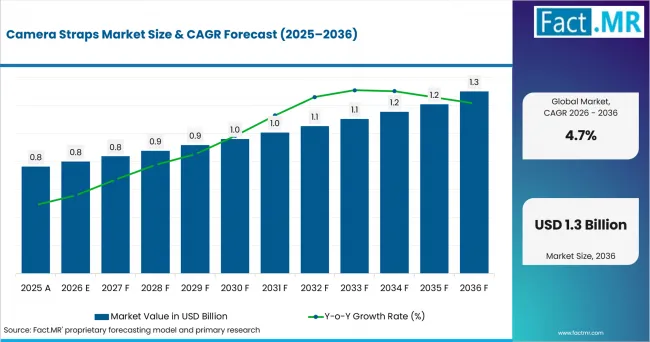
Camera Straps Market Value Analysis | Source: Fact.MR
What are the defining numbers behind Camera Straps Market growth?
An absolute opportunity of USD 500 million is expected between 2026 and 2036.
- Demand Drivers in the Market
- Dedicated-camera shipments are giving the accessory market a larger active equipment base. The Camera & Imaging Products Association reported 9.44 million digital-camera shipments in 2025, up 11.2% year on year, including 6.31 million mirrorless cameras. Each new body can create demand for a more comfortable, secure or configurable strap, while equipment renewal also supports adjacent purchases such as camera bags.
- Professional photographers continue to work on location while carrying relatively heavy equipment. The U.S. Bureau of Labor Statistics notes that photographers often stand or walk for long periods while carrying gear and that many are self-employed. This makes load distribution, fast access and equipment security meaningful purchasing criteria, particularly when heavier bodies and cinema lenses are part of the working kit.
- Quick-release and modular attachment systems are turning straps into configurable workflow accessories rather than fixed neck cords. Peak Design uses an Anchor Link system that can shift a strap between sling, neck and shoulder carry, while OP/TECH USA offers quick-disconnect systems across several camera straps. The same need to move quickly between hand-held shooting and mounted support is visible around tripod dollies and other professional support equipment.
- Travel and destination photography are sustaining use cases where security, comfort and low carrying weight matter. Eurostat recorded nearly 3.1 billion nights in EU tourist accommodation in 2025, while Japan and South Korea have also reported strong inbound travel activity. These conditions support straps designed for walking, street shooting and repeated camera access, even as compact smart cameras broaden the range of imaging devices carried by consumers.
- Online retail makes specialist strap designs easier to compare by carry style, connector type, camera compatibility and material. Eurostat reported that 78% of EU internet users bought or ordered goods or services online in 2025, while U.S. Census Bureau data placed e-commerce at 17.1% of U.S. retail sales in the second quarter of 2026. Digital channels also expose camera users to adjacent creator accessories such as smartphone gimbals, increasing cross-shopping around portable imaging gear.
- Key Segments Analyzed
- Neck Camera Straps account for 43.8% of Product in 2026 because two-point neck carry is familiar, broadly compatible and keeps the camera immediately available while freeing both hands between shots.
- Professional Photography represents 68.4% of Application in 2026 as paid photographers use cameras for longer periods, carry higher-value equipment and place greater weight on comfort, retention and rapid access.
- Professional Photographers account for 52.7% of End Use in 2026 because repeated field and studio use creates more frequent demand for secure straps, replacement webbing and workflow-specific carry systems.
- Online Retail Channels account for 57.3% of Distribution Channel in 2026 as e-commerce gives buyers access to a wider range of lengths, materials, connector systems and specialist brands than many local stores can stock.
- Analyst Opinion at Fact.MR
- Shambhu Nath Jha, Principal Consultant, Fact.MR, states, “Camera straps are increasingly purchased as working interfaces between the user and the camera rather than as simple bundled accessories. Professional and enthusiast buyers are comparing how a strap manages weight, how quickly it releases, whether it stays secure during movement and whether it can move across multiple camera bodies. Suppliers that make those functions easy to understand and reliable in daily use are better positioned to win replacement and upgrade purchases.”
- Strategic Implications
- Strap suppliers should design around camera weight and shooting duration, with clearer load guidance for compact mirrorless bodies, full-frame systems and heavier professional rigs.
- Quick-release systems should balance speed with visible retention and connector compatibility so photographers can change carry modes without creating uncertainty around equipment security.
- Nylon products can remain the volume base, but suppliers can use padding, weave construction, anti-slip surfaces and mixed-material detailing to create meaningful performance tiers without relying on styling alone.
- Online retail should be supported by precise compatibility information, carry-style demonstrations and replacement-connector availability because these details reduce hesitation when buyers cannot test a strap in person.
How does the Camera Straps Market break down by segment?
The market is segmented by Product, Application, End Use, Technology, Formulation and Distribution Channel.
Why do Neck Camera Straps lead Product?
Neck Camera Straps are projected to account for a 43.8% share in 2026.
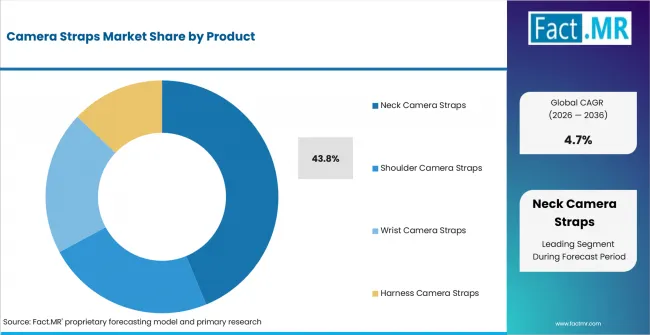
Camera Straps Market Analysis By Product | Source: Fact.MR
Neck straps lead because they use a familiar two-point attachment and keep a camera ready without requiring a separate belt, harness or bag. This makes them suitable across casual, travel and professional photography, and the format can be padded or adjusted without changing the underlying carry method.
OP/TECH USA describes neck-oriented camera straps with adjustable webbing and load-management features for both smaller mirrorless cameras and heavier SLR or DSLR equipment. That range illustrates why the format can cover a broad installed base instead of being limited to one camera class.
Why does Professional Photography lead Application?
Professional Photography is projected to account for a 68.4% share in 2026.
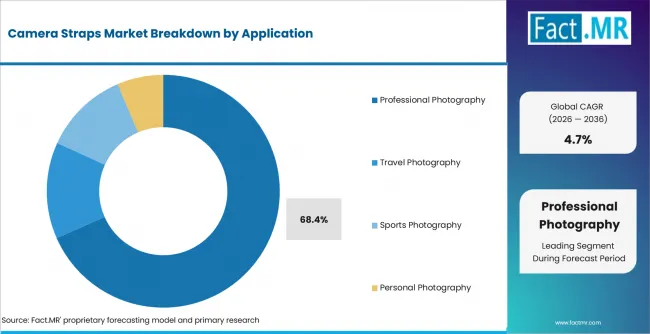
Camera Straps Market Analysis By Application | Source: Fact.MR
Professional photography leads because straps are used as part of the working setup for weddings, commercial shoots, news assignments and location work. Long shooting periods increase the value of weight distribution, while repeated movement raises the importance of secure attachment and rapid camera access.
The U.S. Bureau of Labor Statistics notes that photographers often work on location, may travel and can spend long periods standing or walking while carrying heavy equipment. Those conditions create a stronger functional case for premium straps than occasional home or hobby use.
Why do Professional Photographers lead End Use?
Professional Photographers are projected to account for a 52.7% share in 2026.
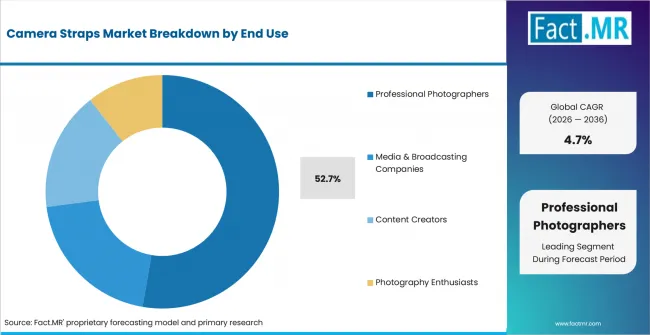
Camera Straps Market Analysis By End Use | Source: Fact.MR
Professional photographers lead end use because the strap is exposed to more operating hours, more camera changes and higher consequences from accidental drops. Freelance and studio photographers may also own several bodies or lens combinations, increasing the need for straps that can be reassigned quickly across equipment.
In the United States, 66% of photographer jobs were self-employed in 2024 according to the Bureau of Labor Statistics. Self-employed users directly control accessory purchasing, making comfort, durability and fast setup part of day-to-day operating decisions rather than centralized corporate procurement.
Why does Quick Release Technology lead Technology?
Quick Release Technology is projected to account for a 31.6% share in 2026.
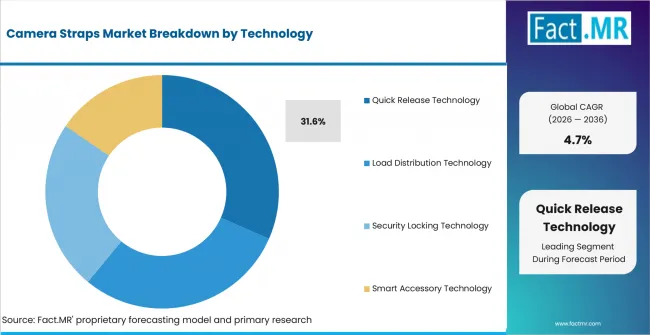
Camera Straps Market Analysis By Technology | Source: Fact.MR
Quick release leads because photographers frequently move a camera between carry, hand-held and support configurations. A connector that detaches without rethreading the camera lug reduces setup time and allows the same camera to move from a neck or shoulder strap to a tripod, gimbal or hand strap during a shoot.
Peak Design states that its Anchor Link system can reconfigure a camera strap between sling, neck and shoulder carry, while OP/TECH USA offers quick-disconnect connectors on several camera straps. These systems show how connection hardware has become a product feature in its own right rather than a hidden attachment detail.
Why do Nylon Based Straps lead Formulation?
Nylon Based Straps are projected to account for a 74.9% share in 2026.
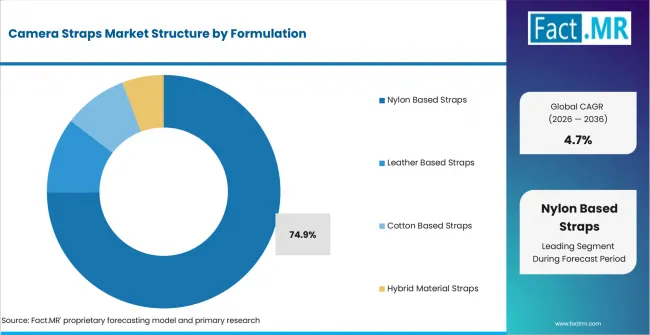
Camera Straps Market Analysis By Formulation | Source: Fact.MR
Nylon leads because webbing can provide high tensile strength at low weight and can be woven in widths that accept common buckles, adjusters and attachment loops. It also works across entry-level and professional price points, allowing manufacturers to vary padding and hardware without changing the basic structural material.
OP/TECH USA specifies nylon webbing in professional camera straps designed for heavier equipment, and Peak Design offers woven nylon in its current strap range. The material therefore supports both utility-focused and premium designs, which helps it cover a wider portion of the market than leather-only or cotton-only constructions.
Why do Online Retail Channels lead Distribution Channel?
Online Retail Channels are projected to account for a 57.3% share in 2026.
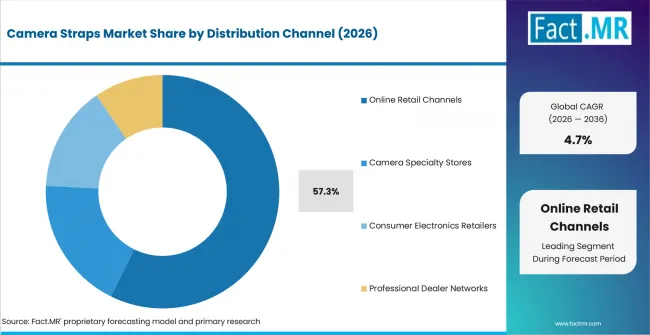
Camera Straps Market Analysis By Distribution Channel | Source: Fact.MR
Online channels lead because camera straps are highly differentiated by length, width, carry style, connector, material and color, yet most products are compact and inexpensive to ship. E-commerce therefore allows specialist brands to display a broader assortment than a physical store can reasonably dedicate shelf space to.
Eurostat reported that 78% of EU internet users purchased goods or services online in 2025. In the United States, the Census Bureau estimated that e-commerce represented 17.1% of total retail sales in the second quarter of 2026. These purchasing habits strengthen direct brand websites and large online marketplaces as practical discovery and replacement channels for camera accessories.
What is accelerating Camera Straps Market adoption, and what is holding it back?
Dedicated-camera shipments, professional photography workflows, travel activity, quick-release designs and online product discovery are supporting demand. Growth is moderated by smartphone substitution, the long usable life of a well-made strap, low-cost unbranded alternatives and the need for buyers to trust connector strength and camera compatibility.
Drivers Impact Analysis
| Factor | (~) % Impact on CAGR | Geographic Relevance | Impact Timeline |
|---|---|---|---|
| Growth in dedicated-camera and mirrorless shipments | +0.7% | Global | Short term (≤ 2 years) |
| Professional demand for ergonomic load distribution | +0.5% | USA, UK and Europe | Short term (≤ 2 years) |
| Travel and location-photography activity | +0.4% | Europe, Japan and South Korea | Medium term (2-4 years) |
| Quick-release and modular carry upgrades | +0.3% | Global | Medium term (2-4 years) |
| Expansion of online accessory retail | +0.2% | Global | Short term (≤ 2 years) |
Opportunity Impact Analysis
| Factor | (~) % Impact on CAGR | Geographic Relevance | Impact Timeline |
|---|---|---|---|
| Premium straps for heavier professional camera rigs | +0.4% | USA, UK and Germany | Medium term (2-4 years) |
| Cross-compatible quick-release connector ecosystems | +0.3% | Global | Medium term (2-4 years) |
| Travel-focused lightweight and anti-slip designs | +0.3% | France, Italy, Japan and South Korea | Medium term (2-4 years) |
| Direct-to-consumer customization and premium materials | +0.2% | Global | Long term (≥ 4 years) |
| Accessory bundling across camera and support ecosystems | +0.2% | Global | Long term (≥ 4 years) |
Restraints Impact Analysis
| Factor | (~) % Impact on CAGR | Geographic Relevance | Impact Timeline |
|---|---|---|---|
| Smartphone substitution for casual dedicated-camera use | -0.6% | Global | Short term (≤ 2 years) |
| Low-cost unbranded straps and price compression | -0.4% | Global | Short term (≤ 2 years) |
| Long replacement cycle of durable strap products | -0.3% | Developed markets | Medium term (2-4 years) |
| Connector compatibility and equipment-security concerns | -0.2% | Global | Medium term (2-4 years) |
| Higher input cost for premium webbing and hardware | -0.1% | Global | Long term (≥ 4 years) |
Which countries are scaling the Camera Straps Market through 2036?
- USA: A large self-employed photographer base and regular location work support replacement and upgrade purchases for straps that manage equipment weight, security and rapid access.
- UK: A broad creative economy supports photography, media, advertising and content-production activity, creating demand for carry systems used across studio, event and location workflows.
- France: High domestic and international tourism activity supports travel and urban photography, where secure lightweight carry and quick camera access are practical purchase drivers.
- Germany: Record tourism nights and strong domestic multi-day travel support outdoor and travel photography use cases, increasing the value of comfortable straps for extended walking and repeated shooting.
- Italy: High tourism intensity across heritage cities and leisure destinations sustains demand from travelers and photography enthusiasts for portable, secure camera-carry accessories.
- South Korea: Expanding inbound tourism and K-content-linked travel increase the volume of image and video creation around events, urban destinations and cultural experiences, supporting creator-focused strap demand.
- Japan: A mature domestic camera ecosystem, continued mirrorless activity and strong inbound tourism support demand for compact, well-engineered straps across enthusiasts and professional users.
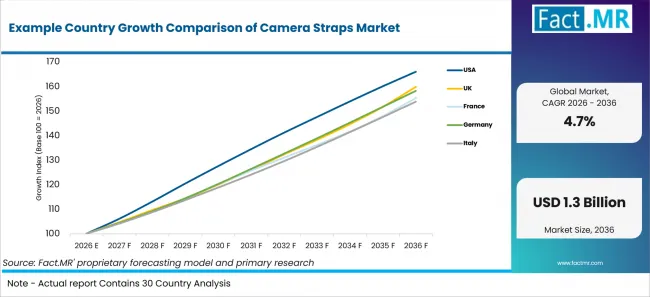
Example Country Growth Comparison Of Camera Straps Market | Source: Fact.MR
Country CAGR (2026-2036)
| Country | CAGR, 2026-2036 |
|---|---|
| USA | 5.2% |
| UK | 4.8% |
| France | 4.5% |
| Germany | 4.7% |
| Italy | 4.4% |
| South Korea | 5.0% |
| Japan | 4.6% |
What is driving USA's growth through 2036?
The USA is forecast to expand at a 5.2% CAGR from 2026 to 2036.
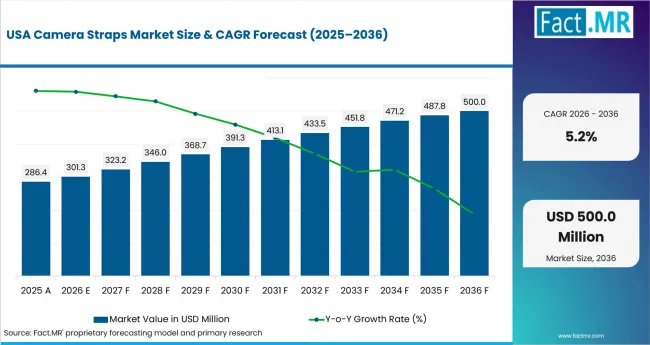
Camera Straps Market Country Value Analysis | Source: Fact.MR
The U.S. market is supported by a large base of working photographers with direct control over accessory purchases. The Bureau of Labor Statistics counted about 151,200 photographer jobs in 2024 and reported that 66% were self-employed. It also notes that photographers may travel and often carry heavy equipment while standing or walking for long periods.
Those working conditions favor straps that improve weight distribution and allow quick camera access. Online availability reinforces replacement purchasing: the U.S. Census Bureau reported that e-commerce accounted for 17.1% of retail sales in the second quarter of 2026, helping specialist camera-accessory brands reach buyers beyond local camera stores.
What is driving UK's growth through 2036?
The UK is forecast to expand at a 4.8% CAGR from 2026 to 2036.
The UK has a deep creative-economy base that supports commercial image production, events, advertising, film and digital content. The Department for Culture, Media and Sport estimated 2.46 million filled jobs in the creative industries in 2025 and 4.3 million filled jobs in the wider creative economy.
That concentration sustains professional and semi-professional camera use across studio and location work. Strap suppliers can address this market through reliable quick-release systems, compact carry for mirrorless bodies and more supportive options for heavier camera-and-lens combinations used during longer assignments.
What is driving France's growth through 2036?
France is forecast to expand at a 4.5% CAGR from 2026 to 2036.
France combines a strong resident travel base with substantial international visitor activity. Insee recorded 465.4 million nights in collective tourist accommodation in 2025, including 148.8 million nights by foreign visitors. In the fourth quarter of 2025, non-resident hotel attendance also increased year on year.
Travel-heavy usage favors straps that stay secure while walking, fit into compact camera bags and allow repeated access without removing other gear. These needs are particularly relevant for urban, heritage, landscape and short-stay travel photography, where users balance camera availability against carrying comfort.
What is driving Germany's growth through 2036?
Germany is forecast to expand at a 4.7% CAGR from 2026 to 2036.
Germany recorded 497.5 million guest overnight stays in 2025, a new record according to Destatis. The statistical office also reported 169 million domestic multi-day trips in 2025, above the pre-pandemic level. This creates a large volume of travel occasions in which dedicated cameras are carried for extended periods rather than used only at home.
Long walking days and outdoor travel increase the relevance of padded neck straps, shoulder carry and load-distribution features. German buyers also have access to specialist photography retail and direct online channels, supporting comparison of premium materials, connector systems and ergonomic designs.
What is driving Italy's growth through 2036?
Italy is forecast to expand at a 4.4% CAGR from 2026 to 2036.
Tourism remains a strong use environment for photography equipment. Istat reported more than 535 million tourism nights across hotel and extra-hotel accommodation in 2025, with foreign visitors accounting for 55.3% of the total. Major heritage cities and regional destinations therefore sustain recurring travel-photography activity throughout the year.
For strap suppliers, the practical opportunity is concentrated in secure, lightweight and visually differentiated designs that work well during walking, sightseeing and short trips. Online channels also allow smaller specialist brands to reach enthusiasts who may not find a broad strap assortment in general electronics retail.
What is driving South Korea's growth through 2036?
South Korea is forecast to expand at a 5.0% CAGR from 2026 to 2036.
South Korea is benefiting from the interaction of tourism and content creation. The Ministry of Culture, Sports and Tourism reported 10.71 million international visitors in the first half of 2026, with visitor growth from the Americas and Europe supported by K-content-linked promotion and expanded travel access.
Concerts, cultural districts, urban tourism and creator activity all involve frequent photo and video capture. This supports straps that can move quickly between carry and shooting positions, while compact mirrorless equipment creates demand for lighter neck, shoulder and wrist formats that remain secure in crowded locations.
What is driving Japan's growth through 2036?
Japan is forecast to expand at a 4.6% CAGR from 2026 to 2036.
Japan combines a mature camera-user base with a strong imaging-product ecosystem. CIPA reported 996,328 digital-camera shipments to Japan in 2025, while mirrorless cameras remained the majority of interchangeable-lens shipments globally. This keeps a broad installed base of dedicated cameras in active use and supports replacement accessories designed around compact and professional bodies.
Tourism adds another use case. JNTO recorded 18.14 million visitor arrivals from January through May 2025, up 23.9% year on year. High volumes of urban and destination travel favor straps that combine compact packing, secure retention and fast access during walking and public-transport use.
Who Leads the Camera Straps Market?
Key players in the Camera Straps Market include Peak Design, BlackRapid, OP/TECH USA, COOPH (Cooperative of Photography GmbH), ALTURAPHOTO, Gordy's Camera Straps, Movo, WANDRD, Lowepro and Nikon.
Competition is shaped by carry comfort, connector reliability, adjustment speed, material durability, compatibility with different camera bodies and the ability to explain these features clearly online. Specialist strap brands compete through focused ergonomics and attachment systems, while broader camera-accessory brands benefit from established distribution and cross-selling with bags, cases and support equipment.
Peak Design emphasizes reconfigurable quick-connect attachments, BlackRapid competes through cross-body sling layouts that keep the camera mobile below a fixed shoulder pad, and OP/TECH USA uses neoprene, nylon webbing and load-management features across neck and shoulder products. These approaches illustrate how brands differentiate through the way a camera moves on the body rather than through appearance alone.
Direct-to-consumer retail also lowers the barrier for smaller specialists because customers can compare strap length, material, color and camera connection systems online. Established camera and bag brands retain an advantage where buyers prefer accessory compatibility, dealer availability or a familiar brand alongside the rest of their equipment.
Which companies are the key providers?
Peak Design, BlackRapid, OP/TECH USA, COOPH (Cooperative of Photography GmbH), ALTURAPHOTO, Gordy's Camera Straps, Movo, WANDRD, Lowepro and Nikon.
- Peak Design
- BlackRapid
- OP/TECH USA
- COOPH (Cooperative of Photography GmbH)
- ALTURAPHOTO
- Gordy's Camera Straps
- Movo
- WANDRD
- Lowepro
- Nikon
Bibliography
- Camera & Imaging Products Association. (2026). 2026 Outlook on the Shipment by Product-Type Concerning Cameras and Related Goods. CIPA.
- U.S. Bureau of Labor Statistics. (2025). Photographers, Occupational Outlook Handbook. U.S. Department of Labor.
- U.S. Census Bureau. (2026). Quarterly Retail E-Commerce Sales, Second Quarter 2026. U.S. Department of Commerce.
- Eurostat. (2026). E-commerce Statistics for Individuals, 2025. European Commission.
- Eurostat. (2026). Another Record Year for EU Tourism in 2025. European Commission.
- Department for Culture, Media and Sport, United Kingdom. (2026). Economic Estimates: Employment January 2025 to December 2025 for DCMS Sectors. UK Government.
- Federal Statistical Office of Germany. (2026). Tourism in Germany in 2025: Another Record for Guest Overnight Stays. Destatis.
- Federal Statistical Office of Germany. (2026). Fewer Trips, but Record Level of Multi-Day Domestic Travel in 2025. Destatis.
- National Institute of Statistics and Economic Studies, France. (2026). Tourist Accommodation Capacity and Attendance, Annual Data 2025. Insee.
- National Institute of Statistics and Economic Studies, France. (2026). Tourism Occupancy in Hotels and Short-Stay Accommodation, Fourth Quarter 2025. Insee.
- Italian National Institute of Statistics. (2026). From the Grand Tour to Mass Tourism: The Transformation of Tourism in Italy. Istat.
- Ministry of Culture, Sports and Tourism, Republic of Korea. (2026). K-Culture Boom Reaches Western and Long-Haul Inbound Markets. Government of the Republic of Korea.
- Japan National Tourism Organization. (2025). Number of Visitor Arrivals to Japan, May 2025. JNTO.
- Peak Design. (2026). Slide Camera Strap. Peak Design.
- OP/TECH USA. (2026). Pro Strap/Pro Loop Strap. OP/TECH USA.
- BlackRapid. (2026). Camera Slings. BlackRapid.
This Report Answers
- Which camera-strap formats are best aligned with professional, travel, sports and personal photography?
- How do quick-release systems and load-distribution features affect strap selection?
- Which materials and retail channels are shaping camera-strap purchasing through 2036?
- How do country-level photography, creative-economy and tourism conditions influence demand?
- Which competitive capabilities matter for specialist strap brands, accessory suppliers and camera OEMs?
What does the Camera Straps Market cover?
The Camera Straps Market covers dedicated carrying and retention systems designed for cameras, including neck straps, shoulder straps, wrist straps and harness systems. Revenue is counted for commercially supplied strap products sold through the specified online, specialty, electronics and professional dealer channels.
The assessment covers Product, Application, End Use, Technology, Formulation and Distribution Channel across the specified country markets, including products designed for professional, travel, sports and personal photography.
What is included in the scope?
The scope includes padded and adjustable neck straps, crossbody and traditional shoulder straps, wrist loops and hand-grip straps, and single- or dual-camera harness systems. It includes mechanical and magnetic quick-release systems, load-distribution features, security-retention features and smart accessory functions where these are integrated into the camera strap.
Materials include nylon-based, leather-based, cotton-based and hybrid constructions as specified in the segmentation. Sales through e-commerce platforms, brand-owned websites, camera specialty stores, consumer electronics retailers and professional dealer networks are included.
What is excluded from the scope?
The scope excludes camera bags sold without an integrated strap product, standalone tripods, monopods, gimbals, camera cages and hand grips that do not function as a camera-retention strap. Smartphone-only lanyards and wearable straps designed primarily for phones are outside the market unless the product is explicitly sold for dedicated camera use.
Replacement buckles, clips and webbing sold only as components are excluded unless they are sold as part of a complete camera-strap or connector system. Free promotional cords and non-commercial improvised carry solutions are also outside the revenue definition.
How Was the Analysis Built?
The analysis combines official camera-shipment statistics, photographer and creative-economy indicators, retail e-commerce data, tourism activity, company product portfolios and interviews with participants across the camera-accessory value chain.
- Primary Research: Interviews with camera-accessory suppliers, specialty retailers, professional photographers, studio users and content creators examine carry preferences, replacement cycles, connector compatibility, comfort, material choice and channel behavior.
- Desk Research: The review covers camera and lens shipment data, photographer employment, creative-industry activity, e-commerce adoption, travel patterns and company technical documentation. External sources used in the article are recorded in the bibliography.
- Market Sizing and Forecasting: Estimates combine the active dedicated-camera base, camera shipments, accessory attach rates, replacement frequency, product mix, professional-use intensity, material mix, channel mix and country-level demand conditions.
- Data Validation and Update Cycle: Findings are cross-checked against current company offerings, channel availability and changes in camera shipments, tourism activity, professional workflows and accessory design. Updates account for changes in quick-release adoption, material mix, online retail and dedicated-camera use.
What is the report's scope and coverage?
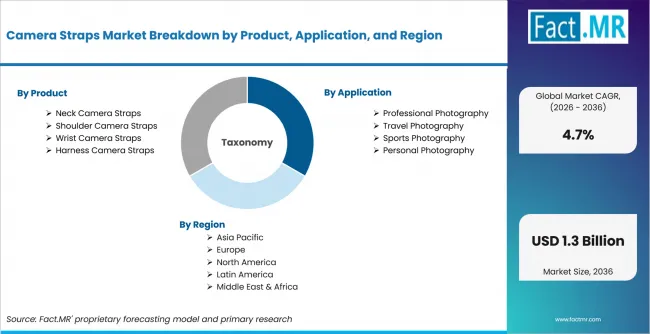
Camera Straps Market Breakdown By Product, Application, And Region | Source: Fact.MR
| Attribute | Details |
|---|---|
| Quantitative Units | USD billion |
| Market Definition | Dedicated straps, slings, wrist systems and harnesses used to secure and carry cameras across the specified applications, users, technologies, materials and channels |
| Segments Covered | Product; Application; End Use; Technology; Formulation; Distribution Channel |
| Regions Covered | North America; Latin America; Europe; East Asia; South Asia and Pacific; Middle East and Africa |
| Countries Covered | USA; UK; France; Germany; Italy; South Korea; Japan |
| Key Companies Profiled | Peak Design; BlackRapid; OP/TECH USA; COOPH (Cooperative of Photography GmbH); ALTURAPHOTO; Gordy's Camera Straps; Movo; WANDRD; Lowepro; Nikon |
| Forecast Period | 2026 to 2036 |
| Base Year | 2025 |
| Market Value, 2026 | USD 0.8 billion |
| Market Value, 2036 | USD 1.3 billion |
| CAGR, 2026-2036 | 4.7% |
| Absolute Opportunity | USD 0.5 billion |
| Approach | Hybrid top-down and bottom-up approach using camera shipments, active equipment base, accessory attach rates, replacement cycles, segment mix, channel mix and country demand validation |
How is the market segmented?
-
By Product:
- Neck Camera Straps
- Padded Neck Straps
- Adjustable Neck Straps
- Shoulder Camera Straps
- Crossbody Shoulder Straps
- Traditional Shoulder Straps
- Wrist Camera Straps
- Loop Wrist Straps
- Hand Grip Straps
- Harness Camera Straps
- Single Camera Harnesses
- Dual Camera Harnesses
- Neck Camera Straps
-
By Application:
- Professional Photography
- Wedding Photography
- Commercial Photography
- Travel Photography
- Adventure Travel Photography
- Urban Travel Photography
- Sports Photography
- Field Sports Photography
- Motorsports Photography
- Personal Photography
- Hobby Photography
- Content Creation Photography
- Professional Photography
-
By End Use:
- Professional Photographers
- Freelance Photographers
- Studio Photographers
- Media & Broadcasting Companies
- News Agencies
- Broadcast Networks
- Content Creators
- Digital Influencers
- Video Production Creators
- Photography Enthusiasts
- Amateur Users
- Advanced Hobbyists
- Professional Photographers
-
By Technology:
- Quick Release Technology
- Mechanical Quick Release Systems
- Magnetic Quick Release Systems
- Load Distribution Technology
- Weight Balancing Systems
- Shock Absorption Systems
- Security Locking Technology
- Anti Theft Systems
- Safety Retention Systems
- Smart Accessory Technology
- Tracking Enabled Systems
- Modular Accessory Systems
- Quick Release Technology
-
By Formulation:
- Nylon Based Straps
- Ballistic Nylon Straps
- Woven Nylon Straps
- Leather Based Straps
- Genuine Leather Straps
- Synthetic Leather Straps
- Cotton Based Straps
- Canvas Cotton Straps
- Woven Cotton Straps
- Hybrid Material Straps
- Leather Nylon Hybrid Straps
- Technical Composite Straps
- Nylon Based Straps
-
By Distribution Channel:
- Online Retail Channels
- E Commerce Platforms
- Brand Owned Websites
- Camera Specialty Stores
- Independent Camera Stores
- Chain Camera Retailers
- Consumer Electronics Retailers
- Large Format Retailers
- Department Stores
- Professional Dealer Networks
- Authorized Dealers
- B2B Supply Partners
- Online Retail Channels
-
By Region:
- North America
- Latin America
- Western Europe
- Eastern Europe
- East Asia
- South Asia and Pacific
- Middle East & Africa