- Base Value(2025): 45.9 Bn
- Estimated Value(2026): 51.4 Bn
- Forecast Value (2036): 159.6 Bn
- CAGR (2026 - 2036): 12.0%
Smart Camera Market Forecast and Outlook By Fact.MR
In 2025, the smart camera market was valued at USD 45.9 billion. Based on Fact.MR analysis, demand for smart cameras is estimated to grow to USD 51.4 billion in 2026 and USD 159.6 billion by 2036. FACT.MR projects a CAGR of 12.0% during the forecast period.
FACT.MR analysis indicates that the smart camera market is expected to generate an absolute dollar opportunity of USD 108.2 billion between 2026 and 2036. This transformational expansion reflects accelerating deployment of AI-embedded imaging in autonomous vehicles, smart city surveillance infrastructure, industrial quality inspection systems, and consumer smart home devices. Growth is moderated by supply chain concentration of CMOS image sensor manufacturing in East Asian fabs, data privacy regulation compliance costs under GDPR and China's PIPL restricting facial recognition deployments, and cybersecurity vulnerability concerns in networked smart camera infrastructure. The smart camera market is expanding rapidly as AI edge inference capabilities are embedded into surveillance, automotive, and industrial imaging systems.
Country growth reflects smart city investment, automotive ADAS adoption, and industrial automation deployment. China leads at 9.0% CAGR driven by state-backed public security camera network expansion and intelligent transportation system deployment. South Korea follows at 8.8% supported by semiconductor fab visual inspection and automotive camera system investment. The United States posts 8.6% driven by federal surveillance infrastructure modernisation and automotive ADAS camera adoption. Germany records 8.3% through automotive ADAS procurement and industrial machine vision deployment. The United Kingdom grows at 8.1% through public space surveillance upgrade and retail analytics programmes. France advances at 8.0% through urban smart city camera infrastructure investment, with mature markets in Western Europe generating replacement demand constrained by GDPR facial recognition enforcement costs.
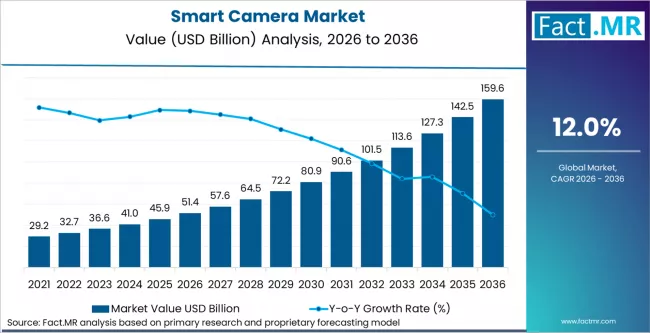
Smart Camera Market Market Value Analysis | Source: Fact.MR
| Metric | Value |
|---|---|
| Estimated Value in 2026 | USD 51.4 billion |
| Forecast Value in 2036 | USD 159.6 billion |
| Forecast CAGR (2026 to 2036) | 12.0% |
Source: Fact.MR analysis. Updated Mar 13, 2026
Market Definition of Smart Camera Market
The smart camera market includes AI-enabled cameras that capture and process visual data in real time for analytics such as object detection, facial recognition, and automated inspection.
Market Inclusions
Includes global forecasts from 2026 to 2036 by component and application covering AI network cameras, ADAS cameras, industrial machine vision cameras, medical imaging cameras, and consumer IoT cameras.
Market Exclusions
Excludes standard CCTV without AI processing, standalone image sensors, smartphones used mainly for photography, and external video management software platforms.
Research Methodology
- Primary Research: Interviews with security integrators, automotive OEM camera buyers, machine vision engineers, smart city procurement officers, and smart camera OEM managers.
- Desk Research: Sources include surveillance programme tenders, automotive safety regulations, industrial vision standards, OEM reports, and semiconductor industry publications.
- Market Sizing and Forecasting: Hybrid model using smart camera shipment volumes, ASP by AI capability, government procurement contracts, and automotive camera content per vehicle.
- Data Validation and Update Cycle: Forecasts validated using OEM revenues, procurement databases, automotive production statistics, and expert interviews.
Summary of Smart Camera Market
- Market Definition
- The smart camera market includes AI-enabled imaging devices providing real-time detection, recognition, and inspection analytics for security, transportation, industry, healthcare, and smart homes.
- Demand Drivers
- Smart city safety programmes are driving adoption of AI surveillance cameras for traffic monitoring and public security.
- Automotive ADAS mandates are increasing the number of cameras installed per vehicle.
- Industrial automation is boosting demand for AI-powered machine vision cameras in manufacturing.
- Key Segments Analyzed
- By Component: Image sensors lead with about 37% share in 2026 due to their critical role in camera performance.
- By Application: Transportation and automotive systems lead with about 38% share in 2026 due to ADAS and traffic monitoring demand.
- By Geography: China shows the fastest growth at about 9.0% CAGR through 2036 due to large-scale surveillance and smart city deployment.
- Analyst Opinion at FACT.MR
- Shambhu Nath Jha, Principal Consultant at Fact.MR, states that CXOs will find this report helpful in understanding how AI-enabled edge processing and embedded neural processors are transforming smart cameras into intelligent sensing platforms.
- Strategic Implications
- Manufacturers should integrate neural processing units into cameras to enable faster on-device AI analytics.
- Companies should obtain ISO 26262 and GDPR compliance for automotive and surveillance deployments.
- Vendors should build industry-specific analytics software for inspection, retail monitoring, and healthcare applications.
- Methodology
- Market sizing used shipment volumes and average selling prices validated with OEM revenue disclosures.
- Surveillance tenders, ADAS regulations, and industrial automation data supported demand analysis.
- Forecasts incorporated smart city investment, vehicle camera integration trends, and manufacturing automation adoption.
Segmental Analysis
Smart Camera Market Analysis by Component
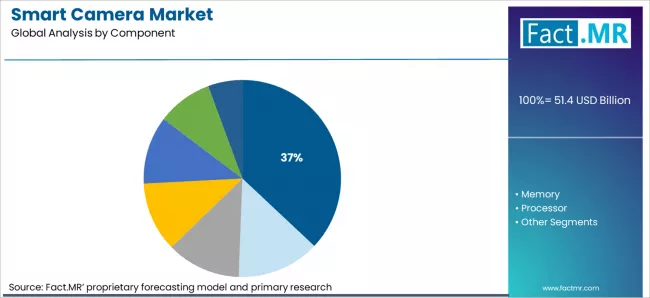
Smart Camera Market Analysis By Component | Source: Fact.MR
Based on FACT.MR analysis, image sensors are projected to hold about 37% share in 2026 because sensor performance determines image quality and AI detection accuracy.
- Sony Image Sensor Investment: Sony Semiconductor Solutions expanded stacked CMOS image sensor production at its Nagasaki facility in February 2025. The IMX900 sensor series targets automotive ADAS, industrial inspection, and security cameras with built-in AI processing capability. [5]
- Axis Camera AI Processor Technology: Axis Communications introduced the ARTPEC-9 system-on-chip in October 2024 with integrated deep learning acceleration for its Q-series smart cameras used in retail analytics and traffic monitoring. [6]
- Image Sensor Automotive Adoption Trend: The International Image Sensor Society reported average image sensors per vehicle increased from 4.2 in 2022 to 7.8 in 2024 due to ADAS camera adoption. [7]
Smart Camera Market Analysis by Application
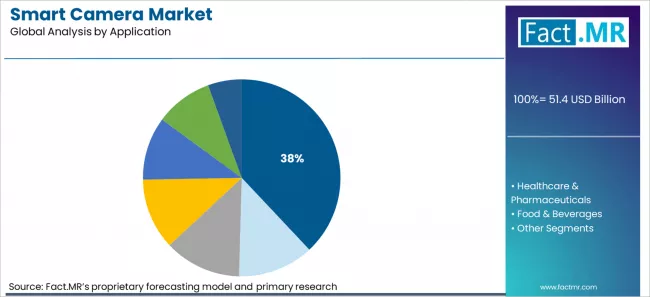
Smart Camera Market Analysis By Application | Source: Fact.MR
Based on FACT.MR analysis, transportation and automotive systems are expected to hold about 38% share in 2026 due to smart city traffic monitoring and multi-camera ADAS systems in vehicles.
- Hanwha Vision Transportation Investment: Hanwha Vision expanded its AI traffic camera portfolio in January 2025 including licence plate recognition cameras deployed at about 480 intersections in South Korea. [8]
- Honeywell Healthcare Smart Camera Technology: Honeywell launched the Pro-Watch smart camera system in November 2024 enabling AI patient monitoring and fall detection for hospital environments. [9]
- Food Safety Smart Camera Trend: The US FDA’s updated Food Safety Modernization Act guidance in August 2024 highlighted AI-enabled visual inspection cameras for production monitoring and foreign object detection in food processing. [10]
Drivers, Restraints, and Opportunities
FACT.MR analysts observe that the smart camera market, valued at USD 45.9 billion in 2025, has shifted from basic surveillance hardware to AI-enabled vision platforms. Falling CMOS sensor costs and advances in edge AI chips have enabled real-time computer vision at industrial and consumer scale.
The market is moving from simple video capture devices to AI analytics cameras. Standard network cameras without on-device AI are losing share, while AI-enabled cameras offering object detection and automated alerts command higher prices and drive revenue growth.
- EU AI Act High-Risk Surveillance: The EU AI Act enforcement beginning in February 2025 classifies real-time biometric identification in public spaces as high-risk AI. Vendors must meet strict transparency, accuracy, and oversight requirements, creating regulatory barriers for low-cost suppliers. [2]
- China Smart City Infrastructure: China expanded its Skynet and Sharp Eyes surveillance programmes in 2024. The National Development and Reform Commission approved CNY 80 billion in digital infrastructure investment supporting AI-enabled camera deployment across about 300 cities. [3]
- ADAS Automotive Camera Mandate: Euro NCAP 2025 safety rules require driver monitoring and front-facing ADAS cameras for five-star ratings. This regulation is increasing camera content per vehicle across European automotive production. [4]
Regional Analysis
The smart camera market is analysed across Asia Pacific, Europe, North America, Latin America, and Middle East and Africa, covering 30+ countries with distinct demand profiles shaped by public security investment, automotive production scale, industrial automation adoption, and data privacy regulatory frameworks. The full report offers market attractiveness analysis based on smart city programme procurement timelines, ADAS adoption rates, and surveillance regulation compliance investment benchmarks.
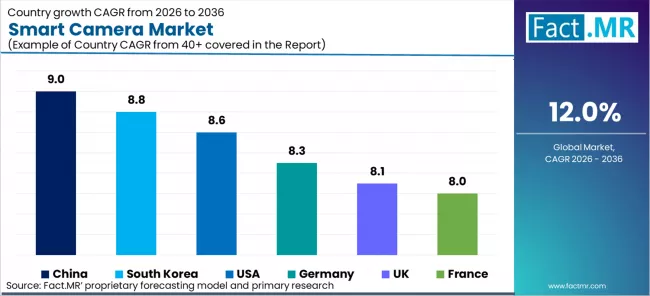
Smart Camera Market Cagr Analysis By Country | Source: Fact.MR
| Country | CAGR (2026-2036) |
|---|---|
| China | 9.0% |
| South Korea | 8.8% |
| United States | 8.6% |
| Germany | 8.3% |
| United Kingdom | 8.1% |
| France | 8.0% |
Source: Fact.MR analysis. Updated Mar 13, 2026
Source: Fact.MR (FACT.MR) analysis, based on proprietary forecasting model and primary research
Asia Pacific Smart Camera Market Analysis
Asia Pacific remains the largest deployment region due to government surveillance investment and strong automotive electronics manufacturing.
- China: Government-backed infrastructure is pushing adoption, with demand projected to grow at 9.0% CAGR through 2036. In October 2024, the National Development and Reform Commission approved CNY 80 billion for Skynet and Sharp Eyes smart surveillance expansion across about 300 cities. Hikvision reported 9% growth in domestic government procurement revenue in Q3 2024 supported by traffic monitoring and railway station surveillance upgrades. MIIT issued updated AI smart camera standards in November 2024 covering edge inference and cybersecurity certification.
- South Korea: Infrastructure digitisation and automotive electronics demand support growth of 8.8% CAGR through 2036. The Ministry of Science and ICT expanded the Digital New Deal 2.0 programme in September 2024 with KRW 2.1 trillion funding for AI traffic monitoring systems across 15 metropolitan areas. Samsung Semiconductor reported 31% growth in automotive image sensor revenue in Q4 2024 driven by Hyundai and Kia ADAS demand. Hanwha Vision deployed AI traffic analytics cameras at 480 intersections under the national intelligent transportation system programme.
FACT.MR's analysis of the smart camera market in Asia Pacific consists of country-wise assessment that includes China, Japan, South Korea, India, ASEAN, Australia and New Zealand, and Rest of South Asia and Pacific. Readers can find country-level CAGR forecasts, smart city procurement benchmarks, automotive camera adoption data, and surveillance compliance investment trends.
Europe Smart Camera Market Analysis
Europe’s market is shaped by strict AI regulation, GDPR compliance, and automotive safety requirements that favour certified smart camera platforms.
- Germany: Industrial automation and automotive safety systems drive growth at 8.3% CAGR through 2036. Bosch expanded its FLEXIDOME IP AI camera line for manufacturing clients such as BMW, Volkswagen, and BASF. Germany’s Federal Office for Information Security released TR-03180 surveillance cybersecurity standards in December 2024 influencing procurement rules. Bosch also allocated EUR 600 million for ADAS camera and radar sensor development for European OEMs.
- United Kingdom: Government surveillance compliance and public transport security support market expansion of 8.1% CAGR through 2036. The Home Office updated CCTV rules in October 2024 requiring AI transparency documentation for public deployments. Avigilon reported 17% growth in UK smart camera contracts in Q3 2024 supported by Transport for London upgrades. Network Rail announced AI camera deployment at 142 railway stations in its January 2025 infrastructure programme.
- France: Smart city infrastructure and event-driven security investment support 8.0% CAGR through 2036. After the Paris 2024 Olympics, Île-de-France approved EUR 120 million for permanent AI surveillance networks across the Greater Paris area. Axis Communications recorded strong revenue growth from French retail analytics and city monitoring projects. CNIL issued updated facial recognition guidance in September 2024 influencing procurement standards.
FACT.MR's analysis of the smart camera market in Europe consists of country-wise assessment that includes Germany, France, the United Kingdom, Italy, Spain, Nordic countries, BENELUX, and Rest of Western Europe. Readers can find EU AI Act compliance tracking, GDPR surveillance requirements, ADAS camera adoption benchmarks, and country-level forecasts by component and application.
North America Smart Camera Market Analysis
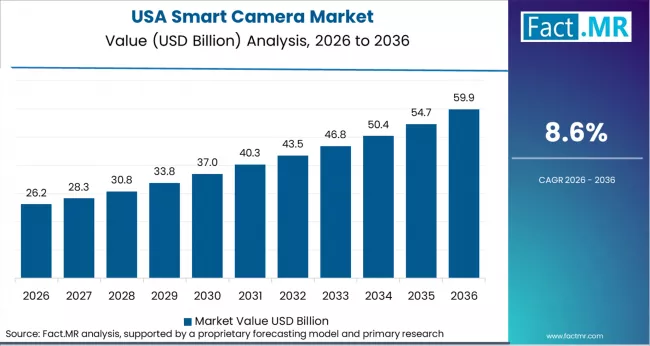
Smart Camera Market Country Value Analysis | Source: Fact.MR
North America generates the highest value per smart camera due to enterprise security demand and advanced automotive safety systems.
- United States: Federal infrastructure security funding and ADAS regulation support growth at 8.6% CAGR through 2036. The Department of Homeland Security announced USD 2.4 billion in Homeland Security Grant funding in October 2024 supporting surveillance upgrades across municipalities and transit systems. Motorola Solutions reported 12% growth in its video security and analytics segment in Q4 2024 driven by Avigilon deployments.
FACT.MR's analysis of the smart camera market in North America consists of country-wise assessment that includes the United States, Canada, and Mexico. Readers can find DHS surveillance funding data, NHTSA ADAS camera mandate timelines, enterprise security adoption benchmarks, and country-level forecasts by component and application.
Competitive Aligners for Market Players
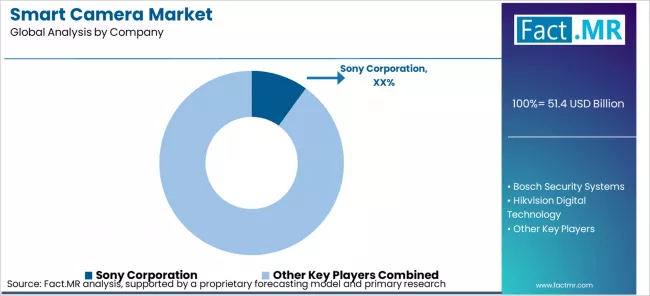
Smart Camera Market Analysis By Company | Source: Fact.MR
The global smart camera market has a mixed competitive structure. Premium AI-enabled camera platforms are relatively concentrated among a few technology leaders, while standard network camera products remain highly competitive with many manufacturers. Companies such as Hikvision and Dahua dominate global shipment volumes due to their cost-efficient manufacturing and strong presence in domestic Chinese procurement programmes. However, regulatory restrictions in markets such as the United States, the United Kingdom, and Australia have limited their participation in certain government and critical infrastructure projects. In these regulated environments, vendors such as Axis Communications, Avigilon (Motorola Solutions), and Bosch Security Systems maintain stronger positions because their products meet strict cybersecurity, AI transparency, and compliance standards.
Technology integration is becoming the key differentiator. Axis Communications benefits from its proprietary ARTPEC system-on-chip architecture, which allows the company to optimise AI inference directly within its camera platforms. Sony Semiconductor Solutions also holds an advantage through its leadership in CMOS image sensor technology, supplying sensors to both its own products and competing camera manufacturers. Meanwhile, Avigilon leverages its integration within Motorola Solutions to combine smart cameras with public safety communication systems.
Enterprise and government buyers typically avoid single-vendor dependency by using multi-vendor procurement frameworks and open standards such as ONVIF. However, proprietary AI analytics software and behaviour detection algorithms create switching costs, giving established vendors leverage in software licensing and long-term service contracts.
Key Players
- Sony Corporation
- Bosch Security Systems
- Hikvision Digital Technology
- Axis Communications
- FLIR Systems
- Dahua Technology
- Samsung Techwin (Hanwha)
- Avigilon (Motorola Solutions)
- Honeywell Security
- Panasonic i-PRO Sensing Solutions
Bibliography
- [1] European Commission. (2025). EU Artificial Intelligence Act First Enforcement Phase: High-Risk AI System Classification for Real-Time Remote Biometric Identification and Surveillance Camera Compliance Requirements. February 2025.
- [2] National Development and Reform Commission, People's Republic of China. (2024). Digital Infrastructure Investment Approval: Smart City Camera Network Expansion Under Skynet and Sharp Eyes Public Security Programmes Across 300 New Cities. October 2024.
- [3] Euro NCAP. (2024). Euro NCAP 2025 Assessment Protocol: Driver Monitoring System, Lane Departure Warning, and Front-Facing ADAS Camera Requirements for Five-Star Safety Rating Compliance. October 2024.
- [4] Sony Semiconductor Solutions Corporation. (2025). Production Expansion Announcement: Stacked CMOS Image Sensor Nagasaki Facility Expansion for Automotive ADAS, Industrial Inspection, and AI Security Camera Applications Using IMX900 Series. February 2025.
- [5] Axis Communications AB. (2024). Product Launch: ARTPEC-9 System-on-Chip Deep Learning Accelerator and Q-Series AI Smart Camera for Retail Analytics, Traffic Management, and Industrial Monitoring Applications. October 2024.
- [6] International Image Sensor Society. (2024). IISW 2024 Market Survey: Automotive Image Sensor Category Growth, Per-Vehicle Sensor Count 2022-2024, and ADAS Camera Content Expansion Data. November 2024.
- [7] Hanwha Vision Co., Ltd. (2025). Press Release: AI Traffic Analytics Camera Contract for South Korea Intelligent Transportation System-480 Intersection Deployment and Licence Plate Recognition System Integration. January 2025.
- [8] Honeywell International Inc. (2024). Product Launch: Pro-Watch AI Patient Monitoring and Access Control Smart Camera System for HIPAA-Compliant Healthcare Facility Deployment in North America and Europe. November 2024.
- [9] U.S. Food and Drug Administration. (2024). FSMA Preventive Controls Guidance Update: Automated Visual Inspection Systems Including AI-Enabled Smart Cameras as Validated Continuous Production Monitoring Approach for Food Manufacturing. August 2024.
This Report Addresses
- Strategic intelligence on EU AI Act surveillance compliance, China NDRC smart city camera investment, Euro NCAP ADAS camera mandates, US DHS security grant procurement, and NHTSA pedestrian AEB camera rules shaping demand through 2036.
- Market forecast from USD 51.4 billion in 2026 to USD 159.6 billion by 2036 at 12.0% CAGR, segmented by component, application, and region.
- Growth opportunity mapping across China’s Skynet and Sharp Eyes expansion, South Korea ITS camera upgrades, Germany BSI-certified industrial demand, UK Network Rail and TfL deployments, and US NHTSA automotive camera mandates.
- Country CAGR outlook for China 9.0%, South Korea 8.8%, United States 8.6%, Germany 8.3%, United Kingdom 8.1%, and France 8.0%, supported by smart city investment, automotive mandates, and industrial automation demand.
- Competitive analysis of Sony, Bosch Security Systems, Hikvision, Axis Communications, FLIR Systems, Dahua, Hanwha, Avigilon, Honeywell Security, and Panasonic i-PRO covering AI analytics capabilities, procurement eligibility, and OEM supply strategies.
- Technology tracking covering on-device neural processing units, ARTPEC and IMX AI sensor platforms, ONVIF open analytics architectures, encrypted edge video storage, and ISO 26262-certified ADAS camera systems.
- Regulatory analysis including EU AI Act biometric surveillance rules, GDPR data impact requirements, China MIIT AI camera standards, US NDAA procurement restrictions, BSI TR-03180 cybersecurity guidelines, and NHTSA AEB camera mandates.
- Report delivered in PDF, Excel datasets, PowerPoint summary, and dashboard formats supported by procurement databases, OEM disclosures, automotive production statistics, and primary research interviews.
Segmentation
Scope of Report
| Attribute | Details |
|---|---|
| Quantitative Units | USD 51.4 billion (2026) to USD 159.6 billion (2036), at a CAGR of 12.0% |
| Market Definition | AI-embedded imaging devices that capture, process, and analyse visual data in real time for surveillance, traffic management, quality inspection, healthcare diagnostics, and consumer applications. |
| Component Segmentation | Image Sensor, Memory, Processor, Communication Interface, Lens, Display, Others |
| Application Segmentation | Transportation and Automotive, Healthcare & Pharmaceuticals, Food & Beverages, Military & Defense, Commercial Areas, Consumer Segments, Others |
| Application Coverage | Traffic and vehicle monitoring, automated quality inspection, patient monitoring, perimeter security surveillance, retail analytics, defence situational awareness, and consumer smart home monitoring. |
| Regions Covered | Asia Pacific, Europe, North America, Latin America, Middle East and Africa |
| Countries Covered | China, Japan, South Korea, India, Australia and New Zealand, ASEAN, Rest of South Asia and Pacific, Germany, UK, France, Italy, Spain, Nordic, BENELUX, Rest of Western Europe, Russia, Poland, Hungary, USA, Canada, Mexico, Brazil, Chile, Ecuador, Rest of Latin America, Saudi Arabia, GCC, Turkey, South Africa, Rest of MEA |
| Key Companies Profiled | Sony Corporation, Bosch Security Systems, Hikvision Digital Technology, Axis Communications, FLIR Systems, Dahua Technology, Samsung Techwin (Hanwha), Avigilon (Motorola Solutions), Honeywell Security, Panasonic i-PRO Sensing Solutions |
| Forecast Period | 2026 to 2036 |
| Approach | Hybrid top-down and bottom-up model using smart camera unit shipment volumes, average selling prices by application and component, government surveillance procurement data, and primary interviews with security integrators and automotive OEM procurement leads. |
Source: Fact.MR analysis. Updated Mar 13, 2026
Smart Camera Market by Segments
-
By Component:
- Image Sensor
- Memory
- Processor
- Communication Interface
- Lens
- Display
- Others
-
By Application:
- Transportation and Automotive Systems
- Healthcare & Pharmaceuticals
- Food & Beverages
- Military & Defense
- Commercial Areas
- Consumer Segments
- Others
-
By Region:
- North America
- United States
- Canada
- Mexico
- Latin America
- Brazil
- Chile
- Ecuador
- Rest of Latin America
- Western Europe
- Germany
- United Kingdom
- France
- Italy
- Spain
- Nordic
- BENELUX
- Rest of Western Europe
- Eastern Europe
- Russia
- Poland
- Hungary
- Balkan and Baltic
- Rest of Eastern Europe
- East Asia
- China
- Japan
- South Korea
- South Asia and Pacific
- India
- ASEAN
- Australia and New Zealand
- Rest of South Asia and Pacific
- Middle East and Africa
- Kingdom of Saudi Arabia
- Other GCC Countries
- Turkey
- South Africa
- Other African Union
- Rest of Middle East and Africa
- North America
Frequently Asked Questions
How large is the smart camera market in 2025?
What will the market size be in 2026?
What is the projected market size by 2036?
What is the expected CAGR?
Which component segment leads the market?
Which application segment dominates?
Which country shows the fastest growth?
What is the primary restraint?
Who worked on this report


Preview the report firsthand - request a free sample
Free SampleGet the brochure for pricing and purchase details
Download PDF