
- Market Value (2025): USD 140.0 Mn
- Estimated Value (2026): USD 156.8 Mn
- Forecast Value (2036): USD 465.7 Mn
- CAGR (2026-2036): 11.5%
Cannabis-based Alcoholic Beverages Market Forecast and Outlook 2026 to 2036
The cannabis-based alcoholic beverages market is valued at USD 156.8 million in 2026 and is projected to reach USD 465.7 million by 2036. Demand for cannabis-based alcoholic beverages is likely to grow at a CAGR of 11.5% over the forecast period.
In April 2025, the Netherlands began the experimental phase of its Controlled Cannabis Supply Chain Experiment, allowing participating coffee shops to obtain cannabis from designated growers. The programme provides a regulated setting for cannabis distribution and product monitoring. Beverage manufacturers exploring cannabinoid formulations must separately assess alcohol licensing, ingredient permissions and product safety requirements.
Key Takeaways from Cannabis-based Alcoholic Beverages Market
- Cannabis-based Alcoholic Beverages Market Value (2025): USD 140.0 million
- Cannabis-based Alcoholic Beverages Market Value (2026): USD 156.8 million
- Cannabis-based Alcoholic Beverages Market Forecast Value (2036): USD 465.7 million
- Cannabis-based Alcoholic Beverages Market Forecast CAGR (2026-2036): 11.5%
- Leading Product Type: Cannabis-infused beer (31.0%)
- Key Market Participants: Tilray Brands, Heineken, House of Saka, Canopy Growth, Bloom & Barrel
- Key Growth Countries: Germany, Netherlands, Switzerland, United States, South Korea
In June 2025, South Korea's Ministry of Food and Drug Safety clarified that cannabidiol (CBD) is classified as cannabis regardless of its extraction source. The clarification is relevant to beverage manufacturers considering hemp-derived ingredients for alcoholic and non-alcoholic formulations. Producers must establish whether cannabinoid ingredients can legally be used before developing products for commercial distribution. Different national rules concerning THC, CBD and alcohol create separate market-entry conditions for beverage companies.
Cannabis-based Alcoholic Beverages Market
| Metric | Value |
|---|---|
| Estimated Value in (2026) | USD 156.8 million |
| Forecast Value in (2036) | USD 465.7 million |
| Forecast CAGR (2026 to 2036) | 11.5% |
Source: Fact.MR analysis.
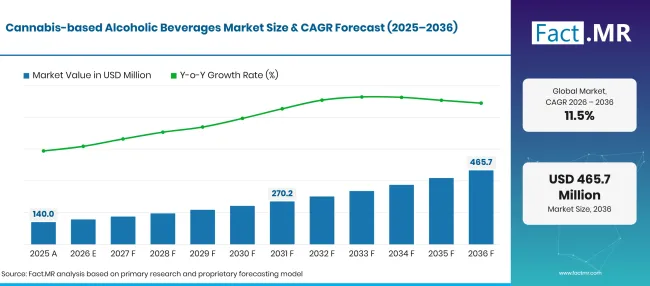
Cannabis Based Alcoholic Beverages Market Forecast Global | Source: Fact.MR
Category
| Category | Segments |
|---|---|
| Product Type | Cannabis-infused beer, Dealcoholised infused beer and wine, Cannabis-infused wine, Hemp-derived CBD beer and wine, Spirit-based infused drinks |
| Cannabinoid | THC, CBD, Mixed THC and CBD, Minor cannabinoids (CBN, CBG) |
| Alcohol Content | Full strength (above 3.5% ABV), Dealcoholised (up to 0.5% ABV), Mid strength (above 1.5% to 3.5% ABV), Low alcohol (above 0.5% to 1.5% ABV) |
| Packaging | Cans, Glass bottles, Draft and kegs, Multi-pack and gift formats |
| Region | Germany; Netherlands; Switzerland; United States; South Korea |
Source: Fact.MR analysis. Updated Nov 27, 2026
Segmental Analysis
What makes cannabis-infused beer the leading product type segment in the Cannabis-based Alcoholic Beverages Market?
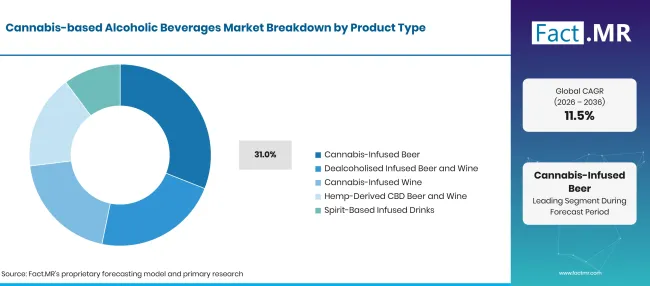
Cannabis Based Alcoholic Beverages Market Breakdown Product Type | Source: Fact.MR
Cannabis-infused beer holds a 31.0% revenue share in 2026, equivalent to approximately USD 48.6 million. Beer-style formulations offer opportunities for beverage developers exploring cannabis-derived ingredients and alternative product formats. However, alcoholic products must meet applicable ingredient and licensing requirements. Non-alcoholic cannabinoid drinks require separate classification, particularly where regulations restrict combining THC or CBD with alcohol.
Which factors support THC as the largest cannabinoid segment in the Cannabis-based Alcoholic Beverages Market?
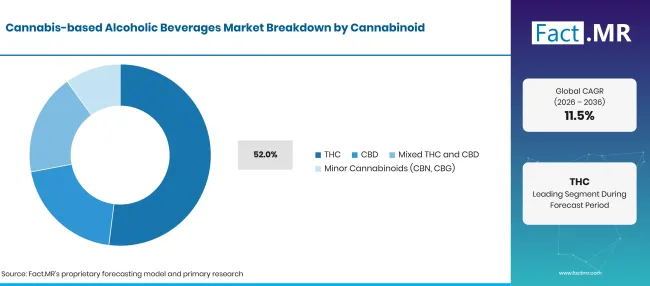
Cannabis Based Alcoholic Beverages Market Breakdown Cannabinoid | Source: Fact.MR
The supplied forecast assigns THC an estimated USD 81.5 million and a 52.0% share in 2026. This allocation has not been validated for alcohol-containing products. In the United States, FDA restrictions on THC-containing foods and federal alcohol requirements limit qualifying products.
What makes full strength (above 3.5% ABV) the leading alcohol content segment in the Cannabis-based Alcoholic Beverages Market?
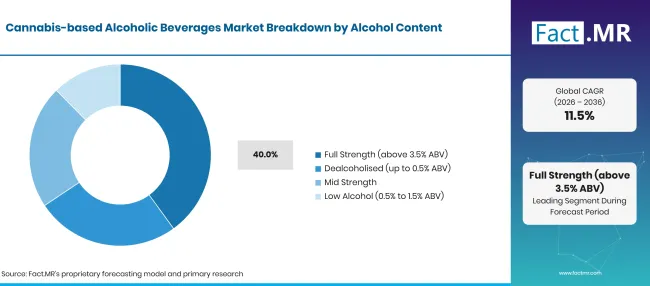
Cannabis Based Alcoholic Beverages Market Breakdown Alcohol Content | Source: Fact.MR
The supplied forecast assigns full-strength beverages above 3.5% alcohol by volume a 40.0% share, or approximately USD 62.7 million, in 2026. This allocation is not established by evidence of lawful commercial sales. Their classification separates conventional-strength alcoholic formulations from dealcoholized cannabinoid drinks. Commercial availability depends on local cannabis and alcohol regulations, including ingredient approvals.
Which factors support cans as the largest packaging segment in the Cannabis-based Alcoholic Beverages Market?
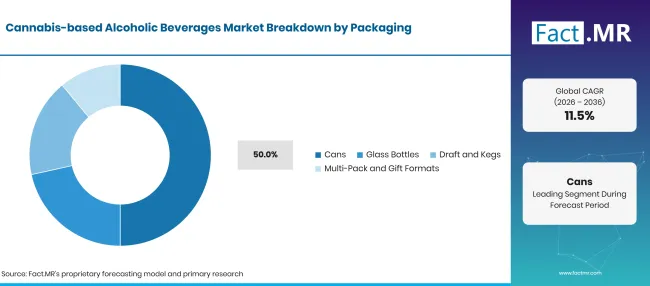
Cannabis Based Alcoholic Beverages Market Breakdown Packaging | Source: Fact.MR
Cans lead the packaging category with an estimated 50.0% revenue share in 2026, approximately USD 78.4 million. Their lightweight construction, convenient handling and suitability for single-serving beverages offer practical advantages for manufacturers. Glass bottles and specialty containers serve alternative packaging requirements.
Cannabis-based Alcoholic Beverages Market-Drivers, Restraints & Trends
Drivers
Beverage developers are exploring cannabis-derived ingredients for new drink formulations, including beer-style and low-alcohol concepts. Interest in cannabinoid beverages creates product development opportunities, although commercial alcoholic versions require separate regulatory approval. Manufacturers must establish lawful ingredient use before introducing such products.
Restraints
Restrictions on combining cannabinoids with alcohol limit commercial opportunities across several markets. Producers face licensing requirements, ingredient approval procedures and rules governing product promotion. Maintaining consistent cannabinoid concentrations also presents formulation challenges, particularly when manufacturers develop beverages with different alcohol strengths.
Trend
Dealcoholized Infused Drinks: Beverage companies are exploring dealcoholized beer and wine concepts containing cannabis-derived ingredients. These formulations allow developers to examine alternative beverage formats, although legal permissions vary across jurisdictions.
Trend
Water-Soluble Cannabinoids: Formulators are examining water-dispersible cannabinoid ingredients to achieve more uniform distribution in beverage products. Emulsification and other processing methods can improve ingredient dispersion, while finished-product testing remains important for dose consistency. Commercial use also depends on applicable cannabis, food and alcohol regulations.
Cannabis-based Alcoholic Beverages Market Analysis by Key Country
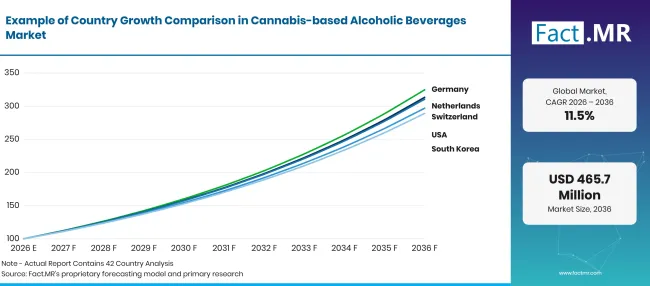
Cannabis Based Alcoholic Beverages Market Growth Index | Source: Fact.MR
| Country | CAGR (2026-2036) |
|---|---|
| Germany | 12.5% |
| Netherlands | 12.1% |
| Switzerland | 12.0% |
| United States | 11.5% |
| South Korea | 11.2% |
Source: Fact.MR analysis. Updated Nov 27, 2026
Why is Germany the fastest-growing market for cannabis-based alcoholic beverages?
Demand for cannabis-based alcoholic beverages in Germany is anticipated to increase at a 12.5% CAGR over the forecast period.
Germany's Consumer Cannabis Act, in force since April 1, 2024, permits private cultivation and non-commercial cultivation associations under specified conditions. In April 2026, the Federal Ministry of Health said the second evaluation of the Act showed an urgent need for action. Beverage manufacturers exploring THC-infused beer and wine must meet separate ingredient and alcohol licensing requirements.
How is demand for cannabis-based alcoholic beverages developing in the Netherlands?
Sales of cannabis-based alcoholic beverages in the Netherlands are anticipated to grow at a 12.1% CAGR by 2036.
The Dutch government began its Controlled Cannabis Supply Chain Experiment on April 7, 2025, allowing participating coffee shops to obtain cannabis from regulated growers. This programme provides experience with controlled cannabis distribution, while alcoholic beverage formulations remain subject to separate legal requirements.
What is driving cannabis-based alcoholic beverages demand in Switzerland?
Demand for cannabis-based alcoholic beverages in Switzerland is anticipated to expand at a 12.0% CAGR over the next decade.
The Swiss Federal Office of Public Health authorizes scientific pilot trials in which registered participants can legally buy cannabis, and its January 2026 report covered seven ongoing trials. These programmes examine consumer behaviour, regulated access and public health outcomes. Beverage developers exploring cannabinoid-infused alcoholic formulations must establish product-specific permissions before commercial distribution.
What is shaping cannabis-based alcoholic beverages demand in the United States?
Sales of cannabis-based alcoholic beverages in the United States are anticipated to rise at an 11.5% CAGR over the ten-year outlook.
State-level cannabis regulations create different conditions for beverage development and distribution. The U.S. Food and Drug Administration maintains restrictions on adding THC and CBD to foods entering interstate commerce. The Alcohol and Tobacco Tax and Trade Bureau will not approve formulas or labels for alcohol beverages that contain a controlled substance under federal law, including marijuana, and THC or CBD derived from parts of the cannabis plant outside the hemp exclusions are controlled substances regardless of state law. Under Public Laws 119-37 and 119-103, most changes to the federal hemp definition, including the revised per-container threshold, are scheduled for December 11, 2026. Certain synthetic cannabinoid exclusions took effect on November 12, 2026.
Why is growth slower for cannabis-based alcoholic beverages in South Korea?
The supplied forecast assigns South Korea an 11.2% CAGR for 2026–2036, but the restrictions on cannabinoid ingredients do not establish a lawful commercial market supporting this estimate.
Strict controls on cannabis-derived ingredients influence beverage development and potential commercial activity. In June 2025, South Korea's Ministry of Food and Drug Safety clarified that cannabidiol is classified as cannabis regardless of its extraction source. Beverage manufacturers considering cannabinoid ingredients must comply with these restrictions and obtain appropriate authorization.
Competitive Landscape for Cannabis-based Alcoholic Beverages Market
Cannabis-based alcoholic beverages present a distinct competitive environment because cannabis permissions and alcohol regulations determine which products can enter commercial distribution. Tilray Brands operates across cannabis and alcoholic beverages, with its Mollo and XMG ranges serving the non-alcoholic cannabinoid category. Heineken, a conventional brewer, owns Lagunitas, which launched Hi-Fi Hops, a non-alcoholic THC-infused sparkling water, in 2018. House of Saka produces alcohol-removed cannabis-infused wines in Napa Valley, and Canopy Growth sells THC-infused soft drinks in Canada under its Deep Space Propulsion brand. Bloom & Barrel has developed cannabis-infused wine alternatives using alcohol-removed formulations.
In January 2026, Tilray promoted Mollo and XMG cannabis beverages in Canada, along with zero-proof spirits, non-alcoholic beers and hemp-derived THC beverages, as alternatives to conventional alcoholic drinks during Dry January. Product formulation, cannabinoid content and distribution permissions remain important competitive considerations. U.S. federal requirements also restrict the use of certain cannabis-derived ingredients in alcoholic beverages.
Recent Developments
- In May 2025, Tilray Brands introduced XMG Atomic Sours in its non-alcoholic cannabis portfolio. This development concerns an adjacent beverage category rather than sales of alcohol-containing cannabis beverages.
- In February 2025, Canopy Growth expanded its Deep Space Propulsion soft drink range. These non-alcoholic products represent an adjacent market and do not establish demand for alcohol-containing cannabis beverages.
Key Players in Cannabis-based Alcoholic Beverages Market
Key companies operating in the market include Tilray Brands, Heineken, House of Saka, Canopy Growth, and Bloom & Barrel.
- Tilray Brands
- Heineken
- House of Saka
- Canopy Growth
- Bloom & Barrel
Bibliography
- Alcohol and Tobacco Tax and Trade Bureau. (2025, November 17). Frequently asked question: Alcohol beverage formulas and labels-Cannabis and hemp ingredients. U.S. Department of the Treasury.
- Bloom & Barrel. (2026, June 30). Bloom & Barrel launches non-alcoholic THC-infused wine designed for connection, without compromise.
- Canopy Growth Corporation. (2025, February 13). Canopy Growth expands Deep Space Propulsion beverage lineup with two new flavours: Rocket Root Beer and Charged Cream Soda.
- Canopy Growth Corporation. (2026, June 15). Canopy Growth reports fourth quarter and fiscal year 2026 financial results.
- Federal Ministry of Health, Germany. (2026, April 1). Second evaluation of the partial legalization of cannabis.
- Federal Office of Public Health. (2026, January 13). Analysis of the results of cannabis pilot trials in Swiss cities—Part 2, mid-2024 to mid-2025.
- Government of the Netherlands. (2025, April 2). Experimental phase of the Controlled Cannabis Supply Chain Experiment (‘weed experiment’) starts on 7 April.
- Government of the Netherlands. (2026, September 9). Study in support of the Controlled Cannabis Supply Chain Experiment: Report on the first follow-up measurement 2025-Summary.
- Heineken Holding N.V. (2026, February 11). Heineken Holding N.V. reports 2025 full year results.
- Ministry of Food and Drug Safety, Republic of Korea. (2025, June 10). Cannabidiol (CBD) is classified as cannabis regardless of extraction source.
- Tilray Brands, Inc. (2025, May 14). Tilray Brands announces the launch of XMG Atomic Sours: New THC beverages and edibles.
- Tilray Brands, Inc. (2026, January 5). Enhance your Dry January with mindful sipping: Try Tilray's Mollo and XMG cannabis beverages.
- Tilray Brands, Inc. (2026, January 6). Tilray Brands expands Dry January offerings with zero-proof spirits, non-alcoholic beers and hemp-derived THC beverages.
- U.S. Food and Drug Administration. (2026). FDA regulation of cannabis and cannabis-derived products, including cannabidiol (CBD).
- United States Congress. (2026, September 2). Public Law 119-103, section 2019.
Segmentation
Scope of Report
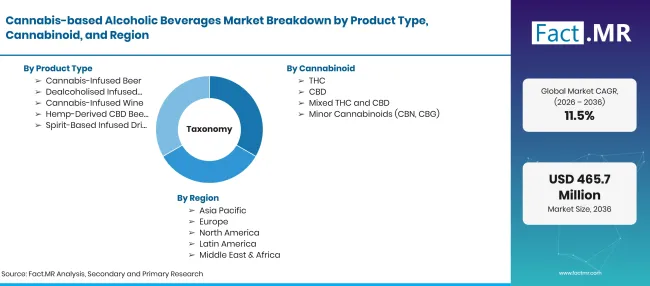
Cannabis Based Alcoholic Beverages Market Taxonomy | Source: Fact.MR
| Items | Values |
|---|---|
| Quantitative Units (2026) | USD 156.8 Million |
| Product Type | Cannabis-infused beer, Dealcoholised infused beer and wine, Cannabis-infused wine, Hemp-derived CBD beer and wine, Spirit-based infused drinks |
| Cannabinoid | THC, CBD, Mixed THC and CBD, Minor cannabinoids (CBN, CBG) |
| Alcohol Content | Full strength (above 3.5% ABV), Dealcoholised (up to 0.5% ABV), Mid strength (above 1.5% to 3.5% ABV), Low alcohol (above 0.5% to 1.5% ABV) |
| Packaging | Cans, Glass bottles, Draft and kegs, Multi-pack and gift formats |
| Regions Covered | North America, Latin America, Europe, Asia Pacific, Middle East & Africa |
| Countries Covered | Germany, Netherlands, Switzerland, United States, South Korea, and other countries |
| Key Companies Profiled | Tilray Brands, Heineken, House of Saka, Canopy Growth, Bloom & Barrel |
| Additional Attributes | Dollar revenue in the Cannabis-based Alcoholic Beverages Market is segmented by product type, cannabinoid, alcohol content and packaging and region. |
Source: Fact.MR analysis. Updated Nov 27, 2026
Cannabis-based Alcoholic Beverages Market by Segments
-
Product Type
- Cannabis-infused beer
- Dealcoholised infused beer and wine
- Cannabis-infused wine
- Hemp-derived CBD beer and wine
- Spirit-based infused drinks
-
Cannabinoid
- THC
- CBD
- Mixed THC and CBD
- Minor cannabinoids (CBN, CBG)
-
Alcohol Content
- Full strength (above 3.5% ABV)
- Dealcoholised (up to 0.5% ABV)
- Mid strength (above 1.5% to 3.5% ABV)
- Low alcohol (above 0.5% to 1.5% ABV)
-
Packaging
- Cans
- Glass bottles
- Draft and kegs
- Multi-pack and gift formats
-
Region:
- North America
- United States
- Canada
- Mexico
- Europe
- Germany
- United Kingdom
- France
- Italy
- Spain
- Netherlands
- Switzerland
- Rest of Europe
- Asia Pacific
- China
- India
- Japan
- South Korea
- Australia and New Zealand
- Rest of Asia Pacific
- Latin America
- Brazil
- Argentina
- Rest of Latin America
- Middle East & Africa
- GCC Countries
- South Africa
- Rest of Middle East & Africa
- North America
Table of Contents
Key Takeaways
- Market Size and CAGR
- Top Growth Driver
- Fastest Growing Segment
- Leading Region
- Key Companies
- Emerging Opportunities

