
- Market Value (2025): USD 138.0 Mn
- Estimated Value (2026): USD 150.0 Mn
- Forecast Value (2036): USD 345.5 Mn
- CAGR (2026-2036): 8.7%
Clean-Label Anti-Caking Systems Market Forecast and Outlook 2026 to 2036
As per the Fact.MR analysis, the clean-label anti-caking systems market crossed a valuation of USD 138.0 million in 2025 and is projected to grow from USD 150.0 million in 2026 to USD 345.5 million by 2036. Demand for clean-label anti-caking systems is likely to grow at a CAGR of 8.7% over the forecast period.
Demand for clean-label anti-caking systems is rising as makers of seasonings, drink powders, supplements, grated cheese and bakery mixes remove silicon dioxide, tricalcium phosphate and other synthetic flow agents from labels, yet still need powders that stay free-flowing in humid conditions. Manufacturers of clean-label anti-caking systems are offering rice hull concentrates, native and treated starches, plant fibers, cellulose and natural mineral blends that absorb moisture and separate particles. For example, in September 2026, Roquette reported that group turnover rose 9% to EUR 2.586 billion, with growth in fibre and protein sales. Similar plant-based ingredient growth is projected to drive sales of clean-label anti-caking systems.
Key Takeaways from the Clean-Label Anti-Caking Systems Market
- Clean-Label Anti-Caking Systems Market Value (2025): USD 138.0 million
- Clean-Label Anti-Caking Systems Market Value (2026): USD 150.0 million
- Clean-Label Anti-Caking Systems Market Forecast Value (2036): USD 345.5 million
- Clean-Label Anti-Caking Systems Market Forecast CAGR (2026-2036): 8.7%
- Leading Product Type: Starch anti-caking (25.9%)
- Key Market Participants: Ribus, J. Rettenmaier & Söhne, Ingredion, Cargill, Roquette
- Key Growth Regions: United Kingdom, Netherlands, Denmark, Switzerland, Japan
In August 2026, U.S. health agencies proposed making GRAS notification mandatory and advanced a federal definition of ultra-processed foods. Demand for clean-label anti-caking systems is growing as brands expect additives such as silicon dioxide to count against them under new definitions and retailer policies. Manufacturers of clean-label anti-caking systems are positioning plant-based flow agents as simple swaps. Similar policy pressure is projected to drive sales of clean-label anti-caking systems across Europe, Japan and North America.
Clean-Label Anti-Caking Systems Market
| Metric | Value |
|---|---|
| Estimated Value in (2026) | USD 150.0 million |
| Forecast Value in (2036) | USD 345.5 million |
| Forecast CAGR (2026 to 2036) | 8.7% |
Source: Fact.MR analysis.
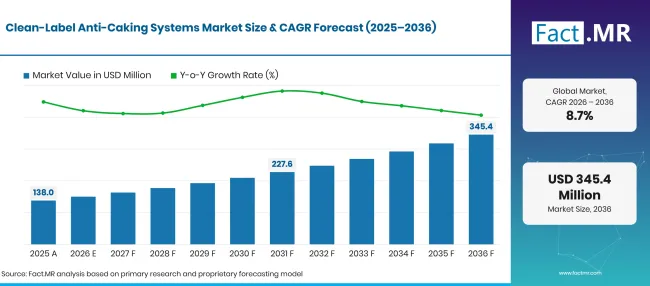
Clean Label Anti Caking Systems Forecast Global | Source: Fact.MR
Category
| Category | Segments |
|---|---|
| Product Type | Starch anti-caking, Rice anti-caking concentrate, Cellulose anti-caking, Fiber blend anti-caking, Natural mineral anti-caking |
| Product Form | Encapsulated, Dry powder, Granule and agglomerate, Custom premix, Liquid concentrate |
| Application | Bakery and confectionery, Savory and other, Dairy and alternatives, Nutrition and supplements, Beverages |
| Buyer Type | Nutrition brand, Food manufacturer, Contract formulator, Ingredient blender, Beverage producer |
| Region | United Kingdom; Netherlands; Denmark; Switzerland; Japan |
Source: Fact.MR analysis.
Segmental Analysis
Why do starch anti-caking systems lead product demand in the Clean-Label Anti-Caking Systems Market?
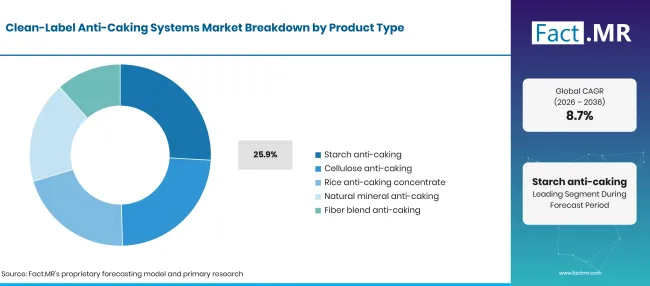
Clean Label Anti Caking Systems Breakdown Product Type | Source: Fact.MR
Demand for Starch anti-caking systems account for 25.9% of the clean-label anti-caking systems market in 2026, about USD 38.9 million, because fine native and physically treated starches coat particles, absorb surface moisture and appear on labels simply as starch or flour, at a cost that suits high-volume products such as shredded cheese and seasoning blends. They are widely available. Manufacturers of clean-label anti-caking systems are selecting starches with low moisture and fine particle size. Similar label and cost advantages are projected to keep starch systems the leading product type.
How is the encapsulated form leading demand in the Clean-Label Anti-Caking Systems Market?
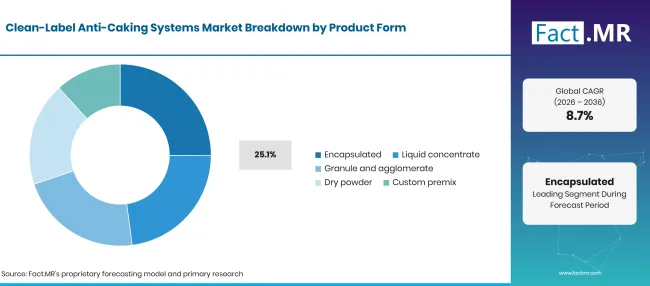
Clean Label Anti Caking Systems Breakdown Product Form | Source: Fact.MR
Sale of encapsulated formats holds 25.1% of clean-label anti-caking systems revenue in 2026, about USD 37.7 million, because the most effective way to stop caking in very hygroscopic ingredients, such as salts, acids, sweeteners and choline, is to coat the particles themselves with fat, starch or fiber so that moisture never reaches them. Coating also masks taste. Manufacturers of clean-label anti-caking systems are offering coated ingredients and carrier systems. Similar moisture challenges are projected to keep encapsulated the leading product form.
Why do bakery and confectionery lead application demand in the Clean-Label Anti-Caking Systems Market?
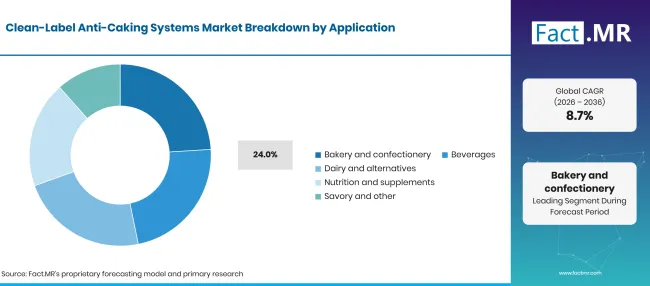
Clean Label Anti Caking Systems Breakdown Application | Source: Fact.MR
Bakery and confectionery to represent 24.0% of clean-label anti-caking systems revenue in 2026, about USD 36.0 million, as icing sugar, cake and pancake mixes, cocoa and dusting powders, decorations and baking powders all contain fine, sticky particles that clump without a flow agent. Bakers want mixes that pour and dose accurately. Manufacturers of clean-label anti-caking systems are replacing phosphates and silicates in these mixes. Similar powder handling needs are projected to keep bakery and confectionery the leading application.
How are nutrition brands leading buyer demand in the Clean-Label Anti-Caking Systems Market?
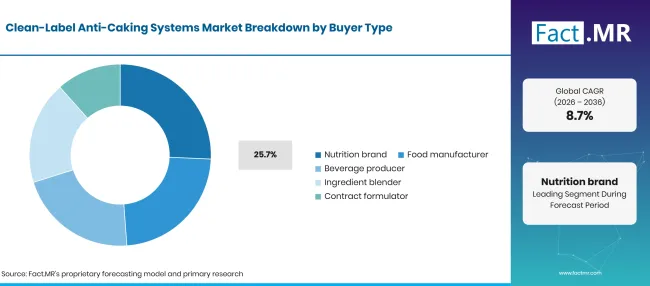
Clean Label Anti Caking Systems Breakdown Buyer Type | Source: Fact.MR
Sales of nutrition brands to capture 25.7% of clean-label anti-caking systems revenue in 2026, about USD 38.6 million, because supplement, sports nutrition and meal-replacement powders and capsules are sold to label-reading consumers, and brands advertise formulas free from silica and magnesium stearate. Capsule filling also needs good flow. Manufacturers of clean-label anti-caking systems are supplying rice-based flow aids to these brands. Similar label scrutiny is projected to keep nutrition brands the leading buyer type, as in the clean-label anti-caking agents market.
Clean-Label Anti-Caking Systems Market-Drivers, Restraints & Trends
Drivers:
Demand for clean-label anti-caking systems is rising as powdered nutrition grows quickly. For example, Glanbia reported in November 2026 that its Optimum Nutrition brand grew 25.8% in the first nine months of the year, and Synadiet reported that French supplement sales passed EUR 3 billion in 2025. Manufacturers of clean-label anti-caking systems are benefiting as more protein, vitamin and drink powders are launched with short labels. Similar growth is projected to drive sales of clean-label anti-caking systems.
Restraints:
Sales clean-label anti-caking systems is constrained by higher usage levels and cost than silicon dioxide and by weaker performance in very humid conditions. For example, Ingredion reported in November 2026 that raw material costs for tapioca reduced texture segment operating income by USD 10 million, showing how crop costs affect starch-based products. Similar cost and performance gaps are projected to slow switching. The key players of clean-label anti-caking systems must optimize dose and particle size.
Opportunity: Rice-Based and Organic Flow Aids
Demand for rice hull and rice extract flow agents is rising in organic and natural products. The manufacturing companies are certifying organic grades for supplements and seasonings. The UK Food Standards Agency published consumer guidance on food supplements in June 2026. Similar attention to supplement ingredients is projected to drive sales of clean-label anti-caking systems, alongside the nutraceutical supplements market.
Trend: Fibers With Added Function
In November 2026, Tate & Lyle reported strong growth in fiber ingredients. Demand for fibers that improve powder flow while adding nutritional value is rising. Similar dual-purpose ingredients are projected to drive sales of clean-label anti-caking systems. Manufacturers of clean-label anti-caking systems are drawing on the food-grade cellulose market
Clean-Label Anti-Caking Systems Market by Analysis by Key Country
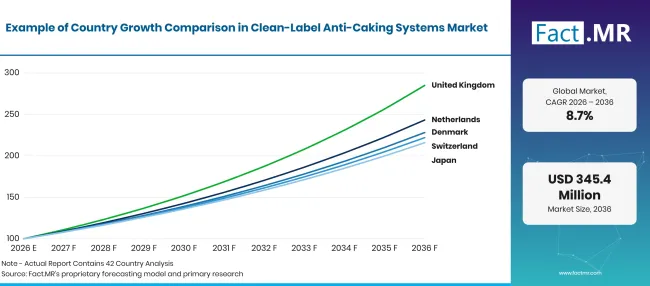
Clean Label Anti Caking Systems Growth Index | Source: Fact.MR
| Country | CAGR (2026-2036) |
|---|---|
| United Kingdom | 11.0% |
| Netherlands | 9.3% |
| Denmark | 8.6% |
| Switzerland | 8.3% |
| Japan | 8.0% |
Source: Fact.MR analysis.
What is driving clean-label anti-caking systems demand in the United Kingdom?
In June 2026, the UK Food Standards Agency issued new consumer guidance on food supplements, and advertising restrictions on less healthy foods have applied since 5 January 2026, both of which sharpen attention on product composition.
Demand for clean-label anti-caking systems in the United Kingdom is projected to grow at an 11.0% CAGR, the fastest among the five key countries, as UK sports nutrition, seasoning and supplement brands remove synthetic flow agents. Manufacturers of clean-label anti-caking systems are serving UK powder blenders. Similar scrutiny is projected to drive sales in the United Kingdom.
How are ingredient producers supporting clean-label anti-caking systems sales in the Netherlands?
Sales of clean-label anti-caking systems in the Netherlands are estimated to grow at a 9.3% CAGR as Dutch nutrition and seasoning producers reformulate for export.
Royal Avebe launched new clean-label potato starch ingredients in November 2026, and dsm-firmenich reported momentum in early-life nutrition, a major Dutch powder industry. Manufacturing companies of clean-label anti-caking systems are serving Dutch powder plants. Similar activity is projected to drive sales in the Netherlands.
What is shaping clean-label anti-caking systems demand in Denmark?
Demand for clean-label anti-caking systems in Denmark is projected to increase at an 8.6% CAGR as Danish dairy and ingredient exporters supply powders to demanding markets.
The Danish food cluster accounts for more than 25% of the country's goods exports, and Arla Foods Ingredients invested in its Danmark Protein site in August 2026. The manufacturing company of clean-label anti-caking systems are serving Danish powder producers. Similar export focus is projected to drive sales in Denmark.
How is nutrition manufacturing shaping clean-label anti-caking systems sales in Switzerland?
Sales of clean-label anti-caking systems in Switzerland are anticipated to record at an 8.3% CAGR as global nutrition companies based there develop cleaner powder formulas.
Nestlé reported nine-month 2026 organic growth of 3.7%, and dsm-firmenich raised its growth outlook in November. The key players of clean-label anti-caking systems are working with Swiss nutrition and premix producers. Similar product renewal is projected to support sales in Switzerland.
Why is growth slower for clean-label anti-caking systems in Japan?
Demand for clean-label anti-caking systems in Japan is forecast to grow at an 8.0% CAGR, the slowest among the five countries, as Japanese labeling rules and consumer attitudes toward permitted additives create less pressure to replace conventional flow agents, and humid summers demand strong performance.
Food makers announced 20,187 price increases for 2026, which keeps cost in focus. Manufacturers of clean-label anti-caking systems are targeting premium supplements. Similar conditions are projected to moderate growth in Japan.
Competitive Landscape for Clean-Label Anti-Caking Systems Market
Competition in the clean-label anti-caking systems market involves specialists in natural flow aids and large starch and fiber producers. Ribus competes with rice-based flow agents for supplements and foods, J. Rettenmaier & Söhne competes with plant fibers and cellulose, and Ingredion, Cargill and Roquette compete with functional starches and fibers and global application support. Buyers select clean-label anti-caking systems on flow performance, usage level, label wording, organic status and cost.
From 2025 onward, competition shifted toward replacing silicon dioxide in nutrition powders. U.S. agencies moved to define ultra-processed foods in 2026, powdered nutrition brands grew strongly, and starch and fiber suppliers reported higher sales. Manufacturers that match synthetic flow agents at practical doses are best placed to grow.
Recent Developments
- In November 2026, Glanbia reported 25.8% growth for Optimum Nutrition in the first nine months of 2026.
- In November 2026, Royal Avebe launched new clean-label potato starch ingredients.
- In September 2026, Roquette reported a 9% rise in group turnover.
- In August 2026, U.S. agencies advanced a proposed definition of ultra-processed foods.
Key Players in Clean-Label Anti-Caking Systems Market
Key companies operating in the market include Ribus, J. Rettenmaier & Söhne, Ingredion, Cargill, and Roquette.
- Ribus
- J. Rettenmaier & Söhne
- Ingredion
- Cargill
- Roquette
Bibliography
- Checkpoint Surgical. (2026, August 20). Checkpoint Surgical expands peripheral nerve portfolio with new flexible nerve conduit.
- Food Standards Agency. (2026, June 25). Food supplements: Guidance for consumers.
- Glanbia plc. (2026, November 4). Q3 2026 interim management statement.
- Ingredion Incorporated. (2026, November 5). Ingredion Incorporated reports third quarter 2026 results.
- IN Food. (2026, September 25). Roquette grows protein and fibre sales.
- Synadiet. (2026, February 12). Santé mentale, numérique, pouvoir d’achat, compléments alimentaires : la santé du quotidien devient une priorité pour les Français.
- U.S. Department of Health and Human Services. (2026, August 10). Secretary Kennedy announces landmark food policy reforms to advance President Trump’s MAHA agenda.
Segmentation
Scope of Report
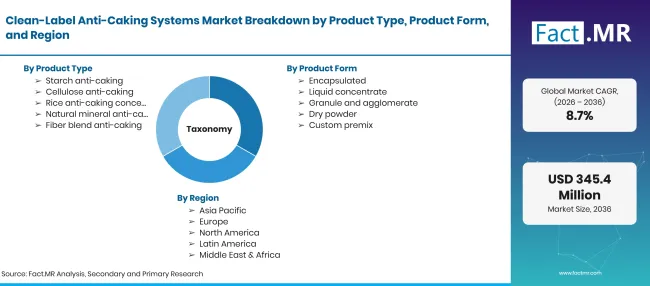
Clean Label Anti Caking Systems Taxonomy | Source: Fact.MR
| Items | Values |
|---|---|
| Quantitative Units (2026) | USD 150.0 Million |
| Product Type | Starch anti-caking, Rice anti-caking concentrate, Cellulose anti-caking, Fiber blend anti-caking, Natural mineral anti-caking |
| Product Form | Encapsulated, Dry powder, Granule and agglomerate, Custom premix, Liquid concentrate |
| Application | Bakery and confectionery, Savory and other, Dairy and alternatives, Nutrition and supplements, Beverages |
| Buyer Type | Nutrition brand, Food manufacturer, Contract formulator, Ingredient blender, Beverage producer |
| Regions Covered | North America, Latin America, Europe, East Asia, South Asia and Pacific, Middle East & Africa |
| Countries Covered | United Kingdom, Netherlands, Denmark, Switzerland, Japan, and other countries |
| Key Companies Profiled | Ribus, J. Rettenmaier & Söhne, Ingredion, Cargill, Roquette |
| Additional Attributes | Dollar revenue in the Clean-Label Anti-Caking Systems Market is segmented by product type (starch, rice concentrate, cellulose, fiber blend, natural mineral anti-caking), product form, application, buyer type and region. |
Source: Fact.MR analysis. Updated 18 Nov 2026
Clean-Label Anti-Caking Systems Market by Segments
-
Product Type
- Starch anti-caking
- Rice anti-caking concentrate
- Cellulose anti-caking
- Fiber blend anti-caking
- Natural mineral anti-caking
-
Product Form
- Encapsulated
- Dry powder
- Granule and agglomerate
- Custom premix
- Liquid concentrate
-
Application
- Bakery and confectionery
- Savory and other
- Dairy and alternatives
- Nutrition and supplements
- Beverages
-
Buyer Type
- Nutrition brand
- Food manufacturer
- Contract formulator
- Ingredient blender
- Beverage producer
-
Region:
- North America
- United States
- Canada
- Mexico
- Europe
- Germany
- United Kingdom
- France
- Italy
- Spain
- Rest of Europe
- Asia Pacific
- China
- India
- Japan
- South Korea
- Australia
- Rest of Asia Pacific
- Latin America
- Brazil
- Mexico
- Argentina
- Rest of Latin America
- Middle East & Africa
- GCC Countries
- South Africa
- Rest of Middle East & Africa
- North America
Table of Contents
Key Takeaways
- Market Size and CAGR
- Top Growth Driver
- Fastest Growing Segment
- Leading Region
- Key Companies
- Emerging Opportunities

