
- Market Value (2025): USD 128.8 Mn
- Estimated Value (2026): USD 140.0 Mn
- Forecast Value (2036): USD 322.4 Mn
- CAGR (2026-2036): 8.7%
Fermented Dairy Culture Blends Market Forecast and Outlook 2026 to 2036
The fermented dairy culture blends market reached a derived estimate of USD 128.8 million in 2025. The market is projected to grow from USD 140.0 million in 2026 to USD 322.4 million by 2036, expanding at a CAGR of 8.7% over the forecast period.
Cheese and yogurt makers are turning to specialized culture blends to achieve consistent taste, texture and fermentation across production batches. This is encouraging suppliers to expand starter cultures, probiotic combinations and bioprotective solutions for different dairy applications. In September 2025, dsm-firmenich introduced four new Dairy Safe™ culture rotations for cheese varieties, focusing on reliable acidification, flavor development and spoilage protection. Further momentum came in November 2026, when Novonesis reported 12% organic growth in Food & Beverages, highlighting the expanding commercial opportunity for fermentation solutions.
Key Takeaways from the Fermented Dairy Culture Blends Market
- Sales of fermented dairy culture blends stood at USD 128.79 million in 2025
- Fermented Dairy Culture Blends Market Value (2026): USD 140.0 million
- Fermented Dairy Culture Blends Market Forecast Value (2036): USD 322.4 million
- Fermented Dairy Culture Blends Market Forecast CAGR (2026-2036): 8.7%
- Leading Product Type: Cheese starter blends (26.8%)
- Key Market Participants: Novonesis, IFF, DSM-Firmenich, Sacco System, Lallemand, CSK Food Enrichment
- Key Growth Regions: Denmark, United States, Germany, France, Japan
Europe's expanding cheese industry is creating fresh opportunities for fermented dairy culture suppliers. The USDA forecast in July 2026 that EU cheese production would reach 11.1 million tonnes, up nearly 2% year over year, as processors favor cheese over lower-return dairy products. This growth is encouraging culture developers to refine phage-resistant starter rotations and flavor adjuncts that improve fermentation reliability and cheese consistency. Similar production trends across the United States and Japan are likely to strengthen adoption of specialized culture blends.
Fermented Dairy Culture Blends Market
| Metric | Value |
|---|---|
| Estimated Value (2025) | USD 128.8 million (derived estimate) |
| Estimated Value (2026) | USD 140.0 million |
| Forecast Value (2036) | USD 322.4 million |
| Forecast CAGR (2026 to 2036) | 8.7% |
Source: Fact.MR analysis. Updated Nov 26, 2026
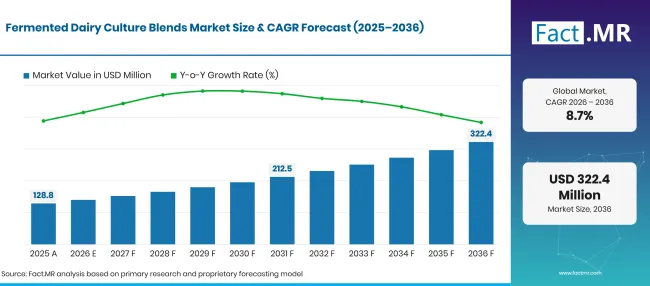
Fermented Dairy Culture Blends Forecast Global | Source: Fact.MR
Category
| Category | Segments |
|---|---|
| Product Type | Cheese starter blends, Functional probiotic dairy, Kefir cultures, Protective dairy cultures, Yogurt starter blends |
| Product Form | Liquid concentrate, Dry powder, Custom premix, Encapsulated, Granule and agglomerate |
| Application | Cheese, Plant-based fermented alternatives, Yogurt and fermented milk, Fermented dairy drinks, Sour cream and butter |
| Buyer Type | Artisan dairies, Cheese makers, Dairy processors, Plant-based brands, Contract manufacturers |
| Region | Denmark; United States; Germany; France; Japan |
Source: Fact.MR analysis. Updated Nov 26, 2026
Segmental Analysis
Why do cheese starter blends lead product demand in the Fermented Dairy Culture Blends Market?
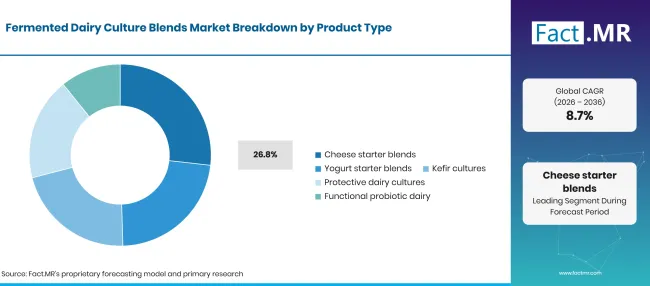
Fermented Dairy Culture Blends Breakdown Product Type | Source: Fact.MR
Cheese starter blends lead with a 26.8% share in 2026, equivalent to USD 37.5 million. Their wide strain selection supports distinct acidification, texture and ripening requirements across cheddar, gouda, mozzarella and Swiss-style cheeses. In September 2025, dsm-firmenich launched four Dairy Safe™ culture rotations with improved phage robustness and more consistent acidification for several cheese varieties. Adjunct and protective cultures are also gaining traction as cheesemakers focus on flavor development and product stability.
How is liquid concentrate leading form demand in the Fermented Dairy Culture Blends Market?
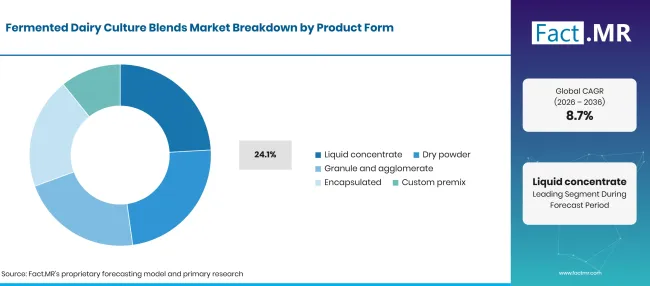
Fermented Dairy Culture Blends Breakdown Product Form | Source: Fact.MR
Liquid concentrate captures 24.1% of 2026 revenue, equivalent to USD 33.7 million. Its ready-to-dose format fits automated fermentation lines and removes the rehydration step, making it attractive to large dairy plants. Frozen and freeze-dried cultures are also gaining ground, particularly where storage life and transport flexibility matter. The wider fermented dairy category remains active: USDA data show U.S. yogurt production rose 5.5% year over year from January to May 2026.
Why does cheese lead application demand in the Fermented Dairy Culture Blends Market?
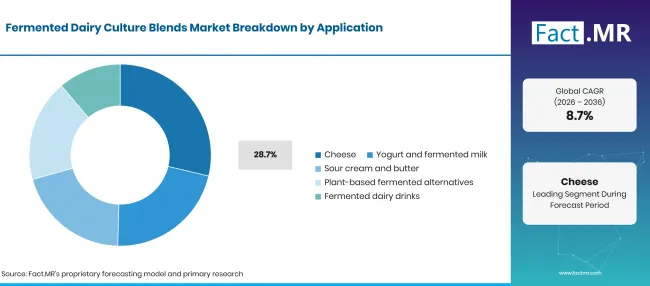
Fermented Dairy Culture Blends Breakdown Application | Source: Fact.MR
Cheese is the largest application, with a 28.7% share worth USD 40.2 million in 2026. Culture selection influences acidification, moisture retention, flavor and ripening, making it central to consistent cheese output. USDA forecast EU cheese production at 11 million metric tons in 2026, 0.8% above 2025, with processors prioritizing cheese production. Yogurt and kefir applications are also expanding as producers introduce fermented products with varied textures, flavors and functional attributes.
How are artisan dairies leading buyer demand in the Fermented Dairy Culture Blends Market?
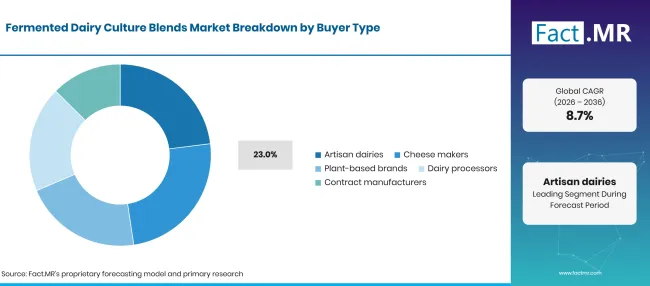
Fermented Dairy Culture Blends Breakdown Buyer Type | Source: Fact.MR
Artisan dairies lead buyer demand with a 23.0% share, equal to USD 32.2 million in 2026. Their varied cheese, yogurt and kefir recipes favor smaller culture packs and blends tailored to individual batches. A 2025 EU CAP Network case study highlighted investment by an independent Normandy cheese maker to modernize Camembert production while preserving its traditional PDO method. Industrial dairies are also increasing culture purchases as automation and higher production volumes raise requirements for consistent fermentation at scale.
Fermented Dairy Culture Blends Market-Drivers, Restraints & Trends
Drivers: Rising International Dairy Trade Expands Culture Requirements
Growing cross-border cheese and dairy sales are encouraging processors to expand fermentation capacity, creating a larger customer base for culture blends. USDEC reported that U.S. dairy export value reached USD 8.18 billion through September 2026, putting full-year exports on course to exceed USD 10 billion. As cheese and yogurt plants increase output for overseas markets, reliable starter cultures become essential for consistent batches and product quality.
Restraints: Refrigerated Handling and Strain Costs Pressure Margins
Culture blends are sensitive to storage conditions, making refrigerated transport and inventory management costly, particularly for smaller dairies and buyers in markets with weaker cold-chain infrastructure. Dependence on specialist strains can also narrow supplier choices and raise switching costs. IFF’s third-quarter 2026 results showed a mixed picture: Food Biosciences recorded mid-single-digit growth, while its Health business declined. Such uneven performance highlights the challenge of sustaining premium culture sales across different end markets.
Trend: Bioprotective Cultures Create New Shelf-Life Opportunities
Dairies are turning to protective cultures to limit spoilage while reducing reliance on preservatives and keeping ingredient labels simpler. In September 2025, dsm-firmenich introduced four Dairy Safe™ culture rotations for hard, semi-hard and continental-style cheeses, with improved phage robustness and more consistent acidification. Wider adoption of these solutions opens opportunities for culture developers across cheese, yogurt and other chilled fermented dairy categories.
Trend: Plant-Based Fermentation Broadens the Market’s Reach
Fermentation expertise is increasingly relevant beyond conventional dairy as food companies refine plant-based products made from soy, oats and other ingredients. Danone reported 3.6% like-for-like growth in its combined dairy and plant-based business in the third quarter of 2026. This creates room for culture developers to adapt fermentation processes to different plant substrates, opening a wider market for specialized microbial blends.
Fermented Dairy Culture Blends Market by Analysis by Key Country
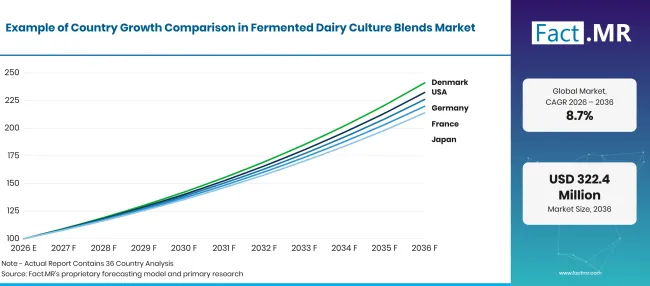
Fermented Dairy Culture Blends Growth Index | Source: Fact.MR
| Country | CAGR (2026-2036) |
|---|---|
| Denmark | 9.2% |
| United States | 8.8% |
| Germany | 8.5% |
| France | 8.2% |
| Japan | 7.9% |
Source: Fact.MR analysis. Updated Nov 26, 2026
What is driving fermented dairy culture blends demand in Denmark?
Denmark’s export-oriented dairy sector creates a strong requirement for dependable fermentation cultures across large cheese-processing operations. Danish Dairy Board statistics show that the country produced 525 million kg of cheese in 2025, with exports reaching 502 million kg.
Such extensive production and overseas distribution increase the importance of cultures that deliver consistent flavor, texture and ripening. Continued investment in cheese quality and specialized dairy processing is likely to widen opportunities for fermented culture blends.
How is cheese expansion supporting fermented dairy culture blends sales in the United States?
A broad cheese and yogurt manufacturing base is strengthening the market for fermented dairy cultures in the United States. USDA figures show that cumulative yogurt production reached 2.32 billion pounds from January to May 2026, up 6.1% from the same period in 2025.
Higher output creates recurring requirements for starter and functional cultures, while interest in probiotic dairy products encourages manufacturers to explore more specialized blends.
What is shaping fermented dairy culture blends demand in Germany?
Germany’s substantial cheese industry offers culture manufacturers a sizeable customer base. According to Germany’s Federal Ministry of Agriculture statistics, domestic dairies produced around 2.8 million tonnes of cheese in 2025, an increase of 0.5% over 2024. Cheese imports also rose by nearly 5% to 997,800 tonnes.
Production across fresh, semi-hard and other cheese varieties calls for different fermentation profiles, encouraging processors to source cultures suited to individual recipes and manufacturing conditions.
How is cheese tradition shaping fermented dairy culture blends sales in France?
France’s diverse cheese-making tradition keeps demand for specialized fermentation cultures active, from fresh varieties to soft-ripened and hard cheeses. The French agriculture ministry reported that cheese production excluding processed cheese reached 606,664 tonnes in January-April 2026, up 1.3% year over year. Fresh cheese production increased 6.1% over the same period.
This range of products creates opportunities for tailored starter and adjunct blends, while yogurt and fermented milk production adds another source of culture purchases.
Why is growth slower for fermented dairy culture blends in Japan?
Japan’s reliance on imported natural cheese creates opportunities for culture suppliers serving domestic dairy processors. The Ministry of Agriculture, Forestry and Fisheries reported that total cheese consumption reached 326,415 tonnes in fiscal 2024, up 3.5% year over year, while natural cheese imports rose 4.0% to 253,047 tonnes.
Local cheese production and growing interest in varied cheese styles are encouraging processors to improve fermentation quality and broaden their product ranges, supporting demand for specialized culture blends.
Competitive Landscape for Fermented Dairy Culture Blends Market
Competition in the fermented dairy culture blends market is concentrated among established bioscience companies, including Novonesis, IFF, dsm-firmenich, Sacco System, Lallemand and CSK Food Enrichment. Their portfolios compete on fermentation reliability, flavor development, phage resistance, cheese yield and technical support. Recent launches show how competition is evolving: IFF introduced CHOOZIT® LIFT in June 2025 to reduce water and energy use in semi-hard cheese production, while dsm-firmenich launched four Dairy Safe™ culture rotations in September 2025 for improved bioprotection and consistent acidification.
Recent Developments
- On October 1, 2026, Novonesis completed the acquisition of Australian biotechnology company MicroBioGen to strengthen its yeast development capabilities and expand its industrial fermentation expertise.
- On May 29, 2026, IFF entered into an agreement to sell its Food Ingredients business to CVC Capital Partners for approximately USD 4.3 billion. IFF will retain a 10% minority stake in the business.
- On August 30, 2025, dsm-firmenich inaugurated a new animal nutrition and health plant in Jadcherla, Hyderabad, India, to expand its feed additive production capacity and strengthen its presence in the Indian market.
- On January 29, 2026, Sacco System signed a development and commercialization agreement with Concerto Biosciences to advance the discovery of next-generation microbial ingredients.
- On October 12, 2026, Lallemand announced the acquisition of IFF's Meat Cultures portfolio to expand its specialty cultures offering and strengthen its food fermentation business.
Key Players in Fermented Dairy Culture Blends Market
Key companies operating in the market include Novonesis, IFF, DSM-Firmenich, Sacco System, Lallemand, and CSK Food Enrichment.
- Novonesis
- IFF
- DSM-Firmenich
- Sacco System
- Lallemand
- CSK Food Enrichment
Bibliography
- Agreste. (2026). Infos rapides lait: Avril 2026. Ministère de l’Agriculture et de la Souveraineté alimentaire.
- Destatis. (2026). Production im Verarbeitenden Gewerbe: Deutschland, Jahre, Güterverzeichnis (9-Steller). Statistisches Bundesamt.
- European Commission. (2025). Investment to improve work conditions and enhance the Camembert production in Normandy. EU CAP Network.
- Ministry of Agriculture, Forestry and Fisheries. (2025). Food and agriculture: Trends in food consumption and the relationship between food and agriculture. Government of Japan.
- Statistics Denmark. (2026). Livestock production: Production of dairy products.
- U.S. Department of Agriculture, Economic Research Service. (2026). Livestock, dairy, and poultry outlook: July 2026.
- U.S. Department of Agriculture, Foreign Agricultural Service. (2026). Dairy and products semi-annual: European Union (Report No. E42026-0043).
Segmentation
Scope of Report
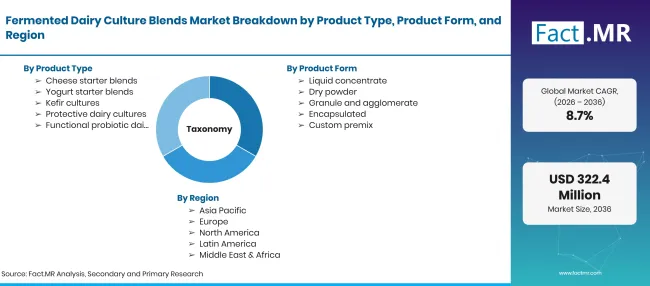
Fermented Dairy Culture Blends Taxonomy | Source: Fact.MR
| Items | Values |
|---|---|
| Quantitative Units (2026) | USD 140.0 Million |
| Product Type | Cheese starter blends, Functional probiotic dairy, Kefir cultures, Protective dairy cultures, Yogurt starter blends |
| Product Form | Liquid concentrate, Dry powder, Custom premix, Encapsulated, Granule and agglomerate |
| Application | Cheese, Plant-based fermented alternatives, Yogurt and fermented milk, Fermented dairy drinks, Sour cream and butter |
| Buyer Type | Artisan dairies, Cheese makers, Dairy processors, Plant-based brands, Contract manufacturers |
| Regions Covered | North America, Latin America, Europe, East Asia, South Asia and Pacific, Middle East & Africa |
| Countries Covered | Denmark, United States, Germany, France, Japan, and other countries |
| Key Companies Profiled | Novonesis, IFF, DSM-Firmenich, Sacco System, Lallemand, CSK Food Enrichment |
| Additional Attributes | Dollar revenue in the Fermented Dairy Culture Blends Market is segmented by product type (cheese starter blends, functional probiotic dairy, kefir cultures, protective dairy cultures, yogurt starter blends), product form, application, buyer type and region. |
Source: Fact.MR analysis. Updated Nov 26, 2026
Fermented Dairy Culture Blends Market by Segments
-
Product Type
- Cheese starter blends
- Functional probiotic dairy
- Kefir cultures
- Protective dairy cultures
- Yogurt starter blends
-
Product Form
- Liquid concentrate
- Dry powder
- Custom premix
- Encapsulated
- Granule and agglomerate
-
Application
- Cheese
- Plant-based fermented alternatives
- Yogurt and fermented milk
- Fermented dairy drinks
- Sour cream and butter
-
Buyer Type
- Artisan dairies
- Cheese makers
- Dairy processors
- Plant-based brands
- Contract manufacturers
-
Region:
- North America
- United States
- Canada
- Mexico
- Europe
- Germany
- United Kingdom
- France
- Italy
- Spain
- Rest of Europe
- Asia Pacific
- China
- India
- Japan
- South Korea
- Australia
- Rest of Asia Pacific
- Latin America
- Brazil
- Mexico
- Argentina
- Rest of Latin America
- Middle East & Africa
- GCC Countries
- South Africa
- Rest of Middle East & Africa
- North America
Table of Contents
Key Takeaways
- Market Size and CAGR
- Top Growth Driver
- Fastest Growing Segment
- Leading Region
- Key Companies
- Emerging Opportunities

