
- Market Value (2025): USD 155.2 Mn
- Estimated Value (2026): USD 170.0 Mn
- Forecast Value (2036): USD 421.3 Mn
- CAGR (2026-2036): 9.5%
Plant-Based Whipping Systems Market Forecast and Outlook 2026 to 2036
As per the Fact.MR analysis, the plant-based whipping systems market was valued at USD 155.2 million in 2025 and is projected to grow from USD 170.0 million in 2026 to USD 421.3 million by 2036. Demand for plant-based whipping systems is likely to grow at a CAGR of 9.5% over the forecast period.
Demand for plant-based whipping systems is rising as bakeries, dessert makers, food service operators and beverage brands replace dairy cream, egg white and milk protein foams with plant ingredients that whip to high volume, hold their shape and suit vegan, allergen-free and lower-cost recipes. Manufacturers of plant-based whipping systems are offering pea, potato, soy and chickpea protein foaming agents, aquafaba powders and blended systems with plant fats, emulsifiers and stabilizers. For example, in September 2026, U.S. data showed egg prices 20.6% lower than a year earlier after earlier spikes, and UK farmers reported an egg shortage during 2026. Similar egg supply swings are projected to drive sales of plant-based whipping systems as bakers seek stable alternatives.
Key Takeaways from the Plant-Based Whipping Systems Market
- Plant-Based Whipping Systems Market Value (2025): USD 155.2 million
- Plant-Based Whipping Systems Market Value (2026): USD 170.0 million
- Plant-Based Whipping Systems Market Forecast Value (2036): USD 421.3 million
- Plant-Based Whipping Systems Market Forecast CAGR (2026-2036): 9.5%
- Leading Product Type: Blended plant whipping (23.2%)
- Key Market Participants: Roquette, Cargill, Ingredion, Palsgaard, Kerry Group, Cosucra
- Key Growth Regions: France, Netherlands, United States, Denmark, United Kingdom
In June 2026, GFI Europe reported that Europe's plant-based food retail market grew as prices became more competitive, with plant-based meat volumes in France up 16.8%. Demand for plant-based whipping systems is growing as plant-based desserts, creams and bakery products gain shelf space. Manufacturers of plant-based whipping systems are improving overrun and foam stability to match dairy. Similar retail growth is projected to drive sales of plant-based whipping systems across Europe and the United States.
Plant-Based Whipping Systems Market
| Metric | Value |
|---|---|
| Estimated Value in (2026) | USD 170.0 million |
| Forecast Value in (2036) | USD 421.3 million |
| Forecast CAGR (2026 to 2036) | 9.5% |
Source: Fact.MR analysis.
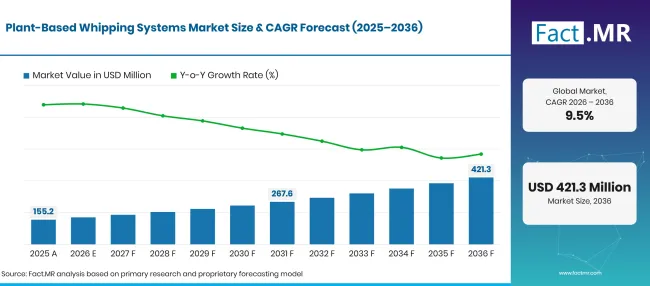
Plant Based Whipping Systems Forecast Global | Source: Fact.MR
Category
| Category | Segments |
|---|---|
| Product Type | Blended plant whipping, Pea-protein whipping, Aquafaba-based whipping, Potato-protein whipping, Soy-protein whipping |
| Product Form | Dry powder, Liquid concentrate, Encapsulated, Granule and agglomerate, Custom premix |
| Application | Savory and other, Beverages, Dairy and alternatives, Bakery and confectionery, Nutrition and supplements |
| Buyer Type | Ingredient blender, Beverage producer, Food manufacturer, Nutrition brand, Contract formulator |
| Region | France; Netherlands; United States; Denmark; United Kingdom |
Source: Fact.MR analysis.
Segmental Analysis
Why do blended plant whipping systems lead product demand in the Plant-Based Whipping Systems Market?
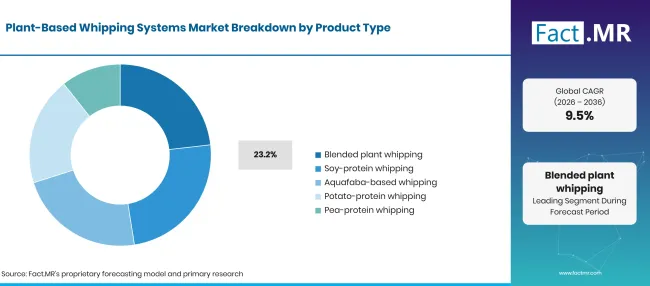
Plant Based Whipping Systems Breakdown Product Type | Source: Fact.MR
Demand for Blended plant whipping systems account for 23.2% of the plant-based whipping systems market in 2026, about USD 39.4 million, because no single plant protein matches cream or egg white on its own, so suppliers combine proteins that foam quickly with others that stabilize, plus hydrocolloids, to deliver volume, firmness and neutral taste together. Blends also even out raw material variation. Manufacturers of plant-based whipping systems are optimizing ratios for each use. Their demand reflects the need to combine plant proteins, fats and hydrocolloids to achieve the aeration, firmness, stability and mouthfeel associated with conventional cream. Individual plant proteins often lack the functional properties required for consistent whipping, making blended formulations more suitable for commercial applications. Eurostat reported that the value of EU food product manufacturing increased by 3.8% in 2025, according to statistics published in August 2026. This expanding production base creates opportunities for specialised whipping ingredients.
How is dry powder leading form demand in the Plant-Based Whipping Systems Market?
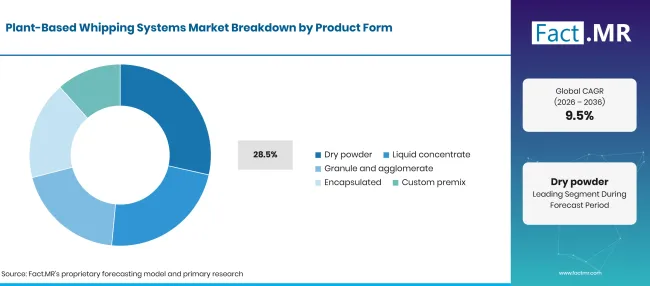
Plant Based Whipping Systems Breakdown Product Form | Source: Fact.MR
Sales of Dry powder accounts for 28.5% of plant-based whipping systems revenue in 2026, about USD 48.4 million, because powdered whipping bases store at room temperature for months, ship without refrigeration and are reconstituted with cold water or plant milk when needed. Bakeries and mix makers prefer this. India's Ministry of Food Processing Industries reported that processed food exports increased to 20.4% of agricultural exports in 2024-25, compared with 13.7% in 2014-15. Expanding processed food trade highlights the importance of ingredients with convenient storage and distribution characteristics. Manufacturers of plant-based whipping systems are spray drying fat-containing whipping bases. Similar logistics benefits are projected to keep dry powder the leading product form, as in the whipping agent market.
Why do savory applications lead demand in the Plant-Based Whipping Systems Market?
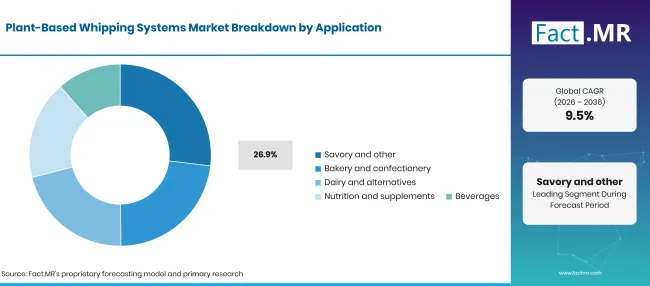
Plant Based Whipping Systems Breakdown Application | Source: Fact.MR
Savory and other applications account for 26.9% of plant-based whipping systems revenue in 2026, about USD 45.7 million, as aerated mousses, whipped dips and spreads, vegan mayonnaise-style sauces, cooking creams and foamed toppings for food service all rely on stable plant foams and emulsions. Chefs use them hot and cold. Manufacturers of plant-based whipping systems are developing heat- and acid-stable versions. Similar menu uses are projected to keep savory and other the leading application. The UK government's 2026 Food Statistics in Your Pocket report valued non-residential catering at GBP 46.1 billion in gross value added in 2024, while food and drink manufacturing contributed GBP 39.3 billion. These established commercial channels create opportunities for specialised plant-based whipping ingredients across food production and catering.
How are ingredient blenders leading buyer demand in the Plant-Based Whipping Systems Market?
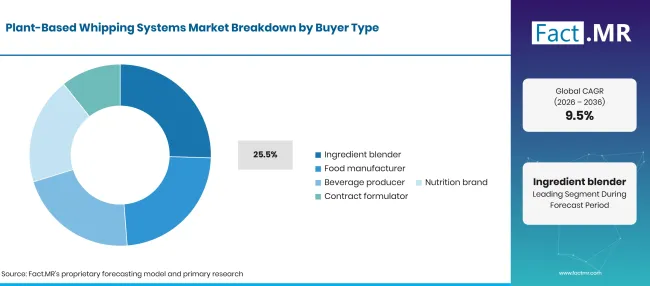
Plant Based Whipping Systems Breakdown Buyer Type | Source: Fact.MR
Demand for Ingredient blenders account for 25.5% of plant-based whipping systems revenue in 2026, about USD 43.4 million, because bakery ingredient and stabilizer companies build foaming proteins into complete mixes for whipped toppings, sponge cakes, meringues and mousses that they sell to bakers and food service. They supply the application know-how. Manufacturers of plant-based whipping systems are partnering with these blenders, in line with the vegan baking ingredients market. Similar mix-based selling is projected to keep ingredient blenders the leading buyer type. Bakery ingredient companies and specialist formulators help manufacturers achieve consistent whipping performance in toppings, sponge cakes, meringues and mousses. India's Ministry of Food Processing Industries reported that the food processing sector achieved an average annual growth rate of 6.55% over the nine years ending 2023-24. This expanding processing base creates opportunities for specialised ingredient blending and formulation services.
Plant-Based Whipping Systems Market-Drivers, Restraints & Trends
Drivers:
Demand for plant-based whipping systems is rising as plant protein suppliers grow and invest. For example, Roquette reported in September 2026 that group turnover rose 9% to EUR 2.586 billion with growth in protein sales, and the Good Food Institute reported that investment in Europe-headquartered plant-based companies reached USD 216 million, ahead of North America. Manufacturers of plant-based whipping systems are benefiting from wider availability of functional pea and potato proteins. Similar investment is projected to drive sales of plant-based whipping systems.
Restraints:
Sales of plant-based whipping systems is constrained by taste and performance gaps versus dairy cream and by falling egg prices in some markets. For example, the USDA expected U.S. retail egg prices to fall 29.4% in 2026, which reduces the cost incentive to replace egg white. Similar price shifts are projected to slow switching in price-led bakery. Manufacturers of plant-based whipping systems must match dairy on taste and stability.
Opportunity: Egg-Free Aeration in Bakery
Demand for egg-free sponge, meringue and macaron systems is rising for vegan and allergen-free ranges. Manufacturers are launching potato and chickpea protein foaming agents. British Baker named free-from finalists in its awards in September 2026. Similar product launches are projected to drive sales of plant-based whipping systems, alongside the plant-based egg replacers market.
Trend: Barista and Dessert Foams
In October 2026, Danone reported that its dairy and plant-based business grew 3.6% like for like, with brands including Alpro performing strongly. Demand for plant-based creams and barista foams is rising in retail and cafes. Similar category growth is projected to drive sales of plant-based whipping systems. Manufacturers of plant-based whipping systems are pairing proteins with ingredients from the emulsifier market.
Plant-Based Whipping Systems Market by Analysis by Key Country
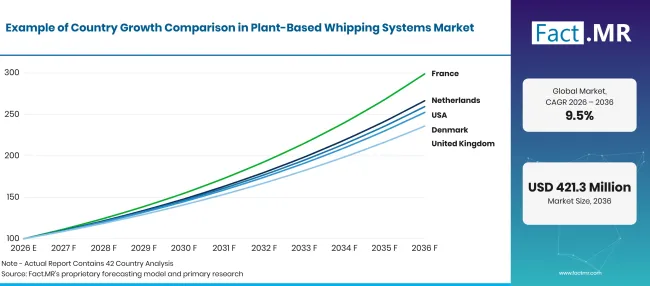
Plant Based Whipping Systems Growth Index | Source: Fact.MR
| Country | CAGR (2026-2036) |
|---|---|
| France | 11.6% |
| Netherlands | 10.3% |
| United States | 10.0% |
| Denmark | 9.7% |
| United Kingdom | 9.0% |
Source: Fact.MR analysis.
What is driving plant-based whipping systems demand in France?
In June 2026, GFI Europe reported that plant-based meat was France's fastest-growing plant-based category, with volume up 16.8%, and Roquette, based in northern France, reported higher protein sales in September.
Demand for plant-based whipping systems in France is forecast to grow at an 11.6% CAGR, the fastest among the five key countries, as French pastry makers and dessert brands develop plant-based creams and mousses. Manufacturers of plant-based whipping systems are serving French pastry suppliers. Similar momentum is projected to drive sales in France.
How is potato protein supporting plant-based whipping systems sales in the Netherlands?
Sales of plant-based whipping systems in the Netherlands are estimated to grow at 10.3% CAGR in plant-based whipping systems sales, with potato protein offering an important functional ingredient opportunity.
Dutch ingredient manufacturers can leverage established expertise in starch processing and plant-protein applications to develop foaming and stabilising solutions for bakery creams and desserts. Statistics Netherlands reported that food-product manufacturing output stood at an index of 101.4 in September 2026, although it remained 5.4% below September 2025. This indicates that suppliers must compete through ingredient performance, application development and cost efficiency rather than relying solely on broader manufacturing expansion.
What is shaping plant-based whipping systems demand in the United States?
Demand for plant-based whipping systems in the United States is projected to increase at a 10.0% CAGR as commercial bakeries, restaurants and foodservice operators seek versatile topping solutions.
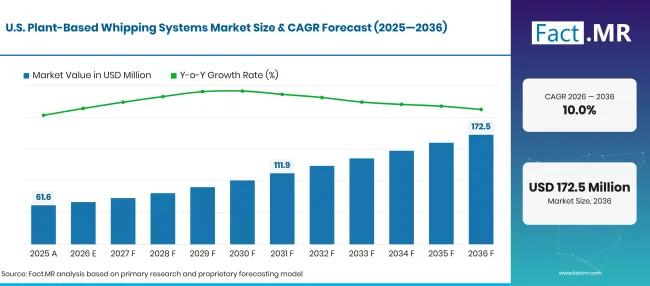
Plant Based Whipping Systems Forecast Usa | Source: Fact.MR
The USDA Economic Research Service reported that foodservice sales reached USD 1.41 trillion in 2025, with 56.3% of total food expenditure occurring away from home. This substantial commercial food channel creates opportunities for plant-based whipped toppings, dessert creams and ready-to-use bakery preparations. Suppliers such as Cargill and Ingredion can address manufacturers' requirements for stable emulsions, consistent aeration and scalable production.
How is emulsifier expertise shaping plant-based whipping systems sales in Denmark?
Sales of plant-based whipping systems in Denmark are anticipated to grow at a 9.7% CAGR as Danish ingredient firms lead in emulsifiers and whipping technology.
Palsgaard is a specialist in plant-based emulsifier systems for whipped products, and the Danish food cluster accounts for more than 25% of the country's goods exports. Manufacturers of plant-based whipping systems are developing systems for export. Danish suppliers such as Palsgaard bring expertise in emulsifiers that help manufacturers achieve stable foam structures, improved texture and consistent whipping performance. Statistics Denmark reported that the country's food, beverage and tobacco manufacturing production index reached 100.9 in September 2026, based on 2021 as the base year. This established industrial base provides opportunities for ingredient suppliers to develop specialised whipping systems for domestic bakeries and international food manufacturers.
Why is growth slower for plant-based whipping systems in the United Kingdom?
Demand for plant-based whipping systems in the United Kingdom is projected to grow at a 9.0% CAGR, the slowest among the five countries, as the UK plant-based market is already well developed, with 31% of households buying plant-based meat in 2025, and advertising rules on less healthy foods affect desserts.
An egg shortage in 2026 did prompt bakers to test alternatives. Manufacturers of plant-based whipping systems are focusing on free-from bakery. The UK Government's Food Statistics Pocketbook, updated in July 2026, reported that food and drink manufacturing contributed £39.3 billion in gross value added in 2024. Consumer expenditure on food and alcoholic drinks reached £303.3 billion in 2025. These figures demonstrate the scale of the domestic food industry, although suppliers must differentiate products through affordability, taste and functional performance.
Competitive Landscape for Plant-Based Whipping Systems Market
Competition in the plant-based whipping systems market involves plant protein producers and emulsifier specialists. Roquette and Cosucra compete with pea proteins designed for foaming, Cargill and Ingredion compete with plant proteins, texturizers and application support, Palsgaard competes with emulsifier and stabilizer systems for whipped products, and Kerry Group competes with complete plant-based cream and topping bases. Buyers select plant-based whipping systems on overrun, foam stability, taste, allergen status and cost.
From 2025 onward, competition shifted toward dairy-like performance and egg replacement. Roquette reported higher protein sales in 2026, European plant-based retail grew, and egg supply and prices swung in the UK and United States. Manufacturers that deliver neutral-tasting, stable foams at competitive cost are best placed to grow.
Recent Developments
- In October 2026, Danone reported 3.6% like-for-like growth in its dairy and plant-based business.
- In September 2026, Roquette reported a 9% rise in turnover with growth in protein sales.
- In September 2026, USDA data showed U.S. egg prices 20.6% lower than a year earlier.
- In June 2026, GFI Europe reported growth in Europe's plant-based food retail market.
Key Players in Plant-Based Whipping Systems Market
Key companies operating in the market include Roquette, Cargill, Ingredion, Palsgaard, Kerry Group, and Cosucra.
- Roquette
- Cargill
- Ingredion
- Palsgaard
- Kerry Group
- Cosucra
Bibliography
- British Baker. (2026, September 7). Finalists announced for Free-from Bakery Product of the Year 2026. British Baker.
- Danone. (2026, October 28). 2026 third-quarter sales.
- Good Food Institute Europe. (2026, June 9). Europe’s plant-based food retail market grows as prices become more competitive, but good taste remains key.
- Good Food Institute. (2026). 2026 state of the industry: Plant-based meat, seafood, eggs, dairy, and ingredients.
- Roquette. (2026, September 24). Strategic transformation supports Roquette’s H1 2026 performance.
- U.S. Department of Agriculture, Economic Research Service. (2026, October 23). Food price outlook: Summary findings.
Segmentation
Scope of Report
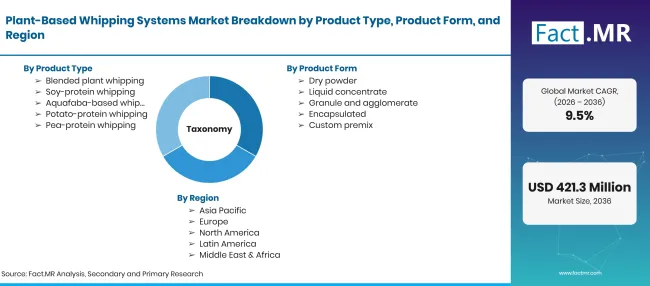
Plant Based Whipping Systems Taxonomy | Source: Fact.MR
| Items | Values |
|---|---|
| Quantitative Units (2026) | USD 170.0 Million |
| Product Type | Blended plant whipping, Pea-protein whipping, Aquafaba-based whipping, Potato-protein whipping, Soy-protein whipping |
| Product Form | Dry powder, Liquid concentrate, Encapsulated, Granule and agglomerate, Custom premix |
| Application | Savory and other, Beverages, Dairy and alternatives, Bakery and confectionery, Nutrition and supplements |
| Buyer Type | Ingredient blender, Beverage producer, Food manufacturer, Nutrition brand, Contract formulator |
| Regions Covered | North America, Latin America, Europe, East Asia, South Asia and Pacific, Middle East & Africa |
| Countries Covered | France, Netherlands, United States, Denmark, United Kingdom, and other countries |
| Key Companies Profiled | Roquette, Cargill, Ingredion, Palsgaard, Kerry Group, Cosucra |
| Additional Attributes | Dollar revenue in the Plant-Based Whipping Systems Market is segmented by product type (blended plant, pea-protein, aquafaba-based, potato-protein, soy-protein whipping), product form, application, buyer type and region. |
Source: Fact.MR analysis.
Plant-Based Whipping Systems Market by Segments
-
Product Type
- Blended plant whipping
- Pea-protein whipping
- Aquafaba-based whipping
- Potato-protein whipping
- Soy-protein whipping
-
Product Form
- Dry powder
- Liquid concentrate
- Encapsulated
- Granule and agglomerate
- Custom premix
-
Application
- Savory and other
- Beverages
- Dairy and alternatives
- Bakery and confectionery
- Nutrition and supplements
-
Buyer Type
- Ingredient blender
- Beverage producer
- Food manufacturer
- Nutrition brand
- Contract formulator
-
Region:
- North America
- United States
- Canada
- Mexico
- Europe
- Germany
- United Kingdom
- France
- Italy
- Spain
- Rest of Europe
- Asia Pacific
- China
- India
- Japan
- South Korea
- Australia
- Rest of Asia Pacific
- Latin America
- Brazil
- Mexico
- Argentina
- Rest of Latin America
- Middle East & Africa
- GCC Countries
- South Africa
- Rest of Middle East & Africa
- North America
Table of Contents
Key Takeaways
- Market Size and CAGR
- Top Growth Driver
- Fastest Growing Segment
- Leading Region
- Key Companies
- Emerging Opportunities

