- Market Value (2025): USD 1.3 Bn
- Estimated Value (2026): USD 1.4 Bn
- Forecast Value (2036): USD 3.6 Bn
- CAGR (2026-2036): 9.8%
What is the Cannabis Packaging Equipment Market forecast to be worth by 2036?
USD 1.4 billion in 2026 to USD 3.6 billion by 2036 at a 9.8% CAGR.
- The cannabis packaging equipment market was valued at approximately USD 1.3 billion in 2025.
- Demand is projected to increase from USD 1.4 billion in 2026 to USD 3.6 billion by 2036.
- The market is forecast to expand at a 9.8% CAGR from 2026 to 2036.
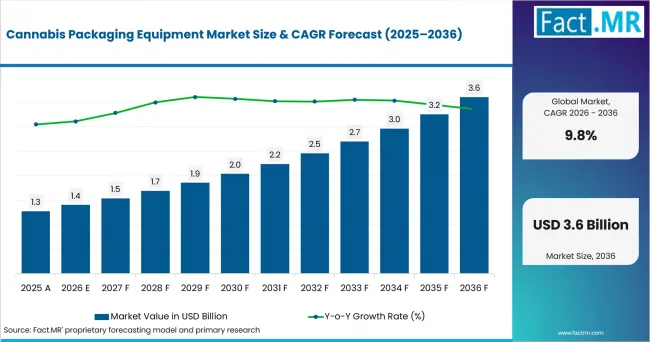
Cannabis Packaging Equipment Market Value Analysis | Source: Fact.MR
What are the defining numbers behind Cannabis Packaging Equipment Market growth?
An absolute opportunity of USD 2.2 billion is expected between 2026 and 2036.
- Demand Drivers in the Market
- Regulated packaging specifications convert compliance into equipment demand. California requires retail cannabis goods to use child-resistant packaging and also requires tamper evidence, with resealability for multi-serving packages. Producers therefore need controlled filling, sealing, capping, and inspection steps that can produce repeatable packages rather than relying on manual closure checks. This supports wider packaging automation across licensed production lines.
- Product-format expansion increases the number of machine configurations required inside a cannabis plant. Flower relies on weight-based filling and gentle handling, pre-rolls require tube or pouch loading, edibles require counting or weigh filling, and concentrates may use vials or syringes. Multi-format producers therefore purchase modular machines and change parts that can accommodate several container and dosage formats without rebuilding the complete line.
- Label control is an operating requirement rather than a final marketing step. California requires manufactured cannabis products to be in final retail form before transfer for compliance testing and specifies outer-panel information such as product identity, net weight or volume, universal symbol, package date, and cannabinoid information. Packaging lines therefore need label application and verification that remains synchronized with the correct batch and container format.
- Medical cannabis production frameworks are widening the regulated manufacturing base outside North America. Brazil introduced a revised 2026 framework for manufacture and import of medicinal cannabis products, with additional rules covering labeling, dispensing, classification, and export. Germany also reported a substantial increase in medical cannabis flower imports after its Medical Cannabis Act took effect. These changes increase the number of facilities that must convert bulk product into controlled, documented packs.
- Automation addresses repetitive labor and fill-weight control. Cannabis flower, gummies, capsules, and pre-rolls are sold in tightly defined unit weights or counts, making overfill expensive and underfill unacceptable. Checkweighers, recipe-based fillers, vision stations, and connected controls reduce rework while giving operators production records that can be reviewed when deviations occur.
- Key Segments Analyzed
- Primary Packaging Equipment accounts for 42.8% of Product in 2026 because weighing, filling, sealing, and labeling directly create the retail-ready pack before secondary handling begins.
- Fully Automatic Systems hold 51.9% of Automation Level in 2026 as licensed producers seek repeatable fill weights and higher throughput with fewer manual handoffs.
- IoT Enabled Machines account for 36.7% of Smart Packaging Equipment in 2026 because machine-status data, recipe tracking, and predictive service help reduce unplanned line stoppages.
- Flower Packaging represents 33.5% of Packaging Format in 2026 because dried flower requires precise weight dosing and gentle product handling before sealing.
- Plastic Based Packaging Systems account for 44.1% of Material Compatibility in 2026, supported by pouches, tubes, and rigid plastic containers that can incorporate heat seals and child-resistant closure designs.
- Licensed Producers hold 47.6% of End Use in 2026 because they carry direct responsibility for packaging output before products move into regulated distribution channels.
- Analyst Opinion at Fact.MR
- Shambhu Nath Jha, Principal Consultant at Fact.MR, states, “Cannabis packaging equipment demand is moving from standalone filling toward integrated lines that can verify weight, apply labels and close child-resistant packages without adding manual inspection at every step. Suppliers that can handle several cannabis formats on one line are better placed to support producers as product portfolios widen.”
- Strategic Implications
- Equipment suppliers should design cannabis lines around rapid format change rather than one fixed package. A producer may move between flower, pre-rolls, gummies, and concentrates, so tooling changes and recipe control can influence utilization more than nominal machine speed.
- Primary packaging vendors can strengthen account value by integrating checkweighing, label verification, and seal inspection around the filler. Each additional automated verification step reduces the amount of product that must be isolated for manual rework.
- Service capability matters because a stopped cannabis line can hold regulated inventory upstream. Remote diagnostics, stocked change parts, and preventive maintenance programs can therefore influence equipment selection alongside purchase price.
- Manufacturers serving medical markets should maintain documentation that supports pharmaceutical-style qualification and traceability. Markets such as Brazil, the UK, Germany, and Japan place cannabis activity within tightly controlled regulatory channels, making documentation and validation part of the buying decision.
How does the Cannabis Packaging Equipment Market break down by segment?
The market is segmented by Product, Automation Level, Smart Packaging Equipment, Packaging Format, Material Compatibility, and End Use.
Why does Primary Packaging Equipment lead Product?
Primary Packaging Equipment is projected to account for a 42.8% share in 2026.
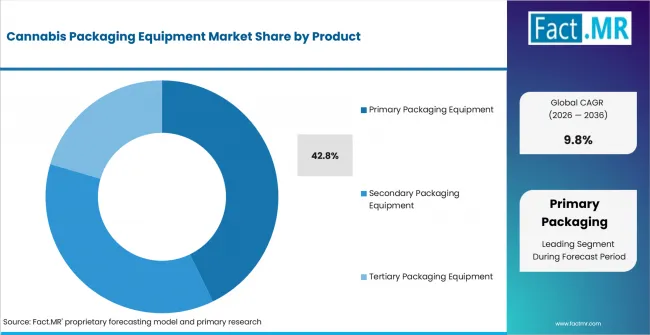
Cannabis Packaging Equipment Market Analysis By Product | Source: Fact.MR
Primary equipment leads because cannabis must be measured and enclosed before it can enter cartoning, case packing, or pallet handling. Flower, edibles, and concentrates all require a direct product-contact step such as filling or counting, followed by sealing or capping. This makes primary machinery a required production stage across nearly every commercial format.
The category also captures the value of dosing accuracy. Net-weight and volumetric systems control product giveaway while preparing containers for downstream labeling and inspection. This purchasing logic overlaps with broader filling machinery demand, where accurate dosing is central to line performance.
Why do Fully Automatic Systems lead Automation Level?
Fully Automatic Systems are projected to account for a 51.9% share in 2026.
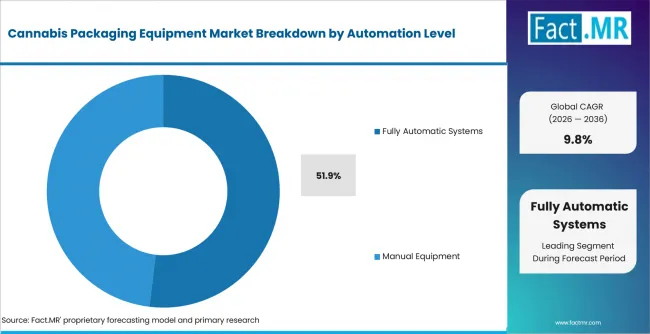
Cannabis Packaging Equipment Market Analysis By Automation Level | Source: Fact.MR
Fully automatic systems lead because repeated cannabis pack-out involves several sequential actions that become costly when performed by hand: product dosing, container presentation, closure application, label placement, and rejection of off-spec packs. Integrating these steps reduces operator touch points and makes output more consistent across shifts.
Automation also helps licensed producers manage labor variability. Once recipes and acceptable weight ranges are stored in the control system, operators can change products without rebuilding every machine setting from the start. The benefit becomes more material as a facility runs several package sizes or short production campaigns.
Why do IoT Enabled Machines lead Smart Packaging Equipment?
IoT Enabled Machines are projected to account for a 36.7% share in 2026.
IoT-enabled machines lead because cannabis production lines benefit from live visibility into run rate, stoppages, recipe settings, and reject events. When packaging is part of a regulated manufacturing workflow, operators need to know whether a deviation originated at filling, sealing, labeling, or downstream handling.
Connected controls also support preventive service and remote diagnostics. This is especially useful for producers running specialized cannabis machines alongside conventional packaging equipment. The same digital logic extends to industrial labels and traceability workflows, where product information must remain aligned with the correct package and batch.
Why does Flower Packaging lead Packaging Format?
Flower Packaging is projected to account for a 33.5% share in 2026.
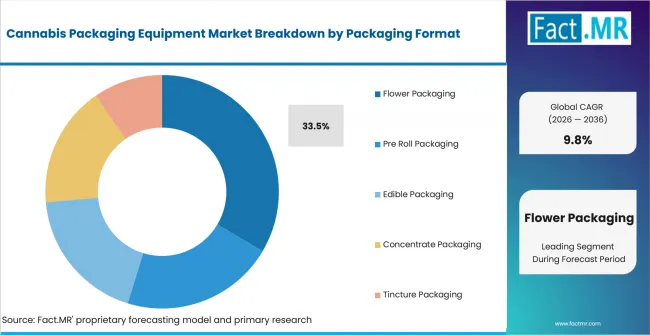
Cannabis Packaging Equipment Market Analysis By Packaging Format | Source: Fact.MR
Flower packaging leads because dried cannabis is sold by weight and its physical structure makes handling more difficult than free-flowing granular products. Equipment must portion small target weights without crushing product, then transfer the dose into a pouch, jar, or other retail container with limited product loss.
The workflow is therefore equipment-intensive even before labeling begins. Multihead or net weigh fillers can feed premade pouches or containers, while seal integrity protects the finished pack during distribution. Flexible flower packs also create demand adjacent to form-fill sealing where repeatable seals and controlled film handling determine line reliability.
Why do Plastic Based Packaging Systems lead Material Compatibility?
Plastic Based Packaging Systems are projected to account for a 44.1% share in 2026.
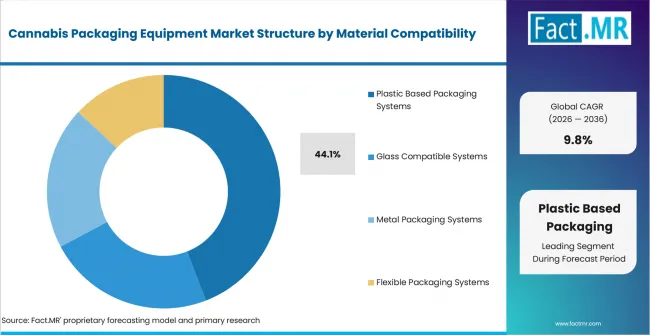
Cannabis Packaging Equipment Market Analysis By Material Compatibility | Source: Fact.MR
Plastic-based systems lead because cannabis producers use flexible pouches, tubes, bottles, and rigid containers across flower, pre-rolls, edibles, and concentrates. These formats support heat sealing, induction sealing, tamper evidence, and several child-resistant closure designs while keeping container weight low.
For equipment buyers, plastic compatibility also offers format flexibility. The same line architecture can often be adapted through change parts, sealing tools, or container guides instead of replacing the complete machine. This lowers the cost of adding a new package size or product presentation.
Why do Licensed Producers lead End Use?
Licensed Producers are projected to account for a 47.6% share in 2026.
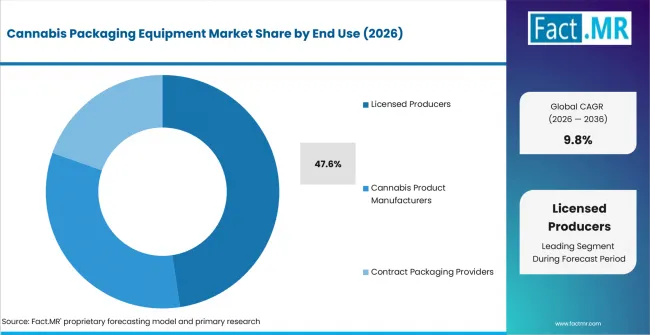
Cannabis Packaging Equipment Market Analysis By End Use | Source: Fact.MR
Licensed producers lead because packaging sits inside the controlled path between processed cannabis and regulated distribution. They must ensure that fill quantity, container closure, label information, and pack condition are correct before the lot moves forward. That makes packaging machinery part of production infrastructure rather than an outsourced finishing step for many facilities.
As production volumes rise, these operators also add secondary packaging to reduce manual handling after retail units are completed. Cartons and cases protect finished units through warehousing and shipment, supporting demand for case packing around higher-throughput cannabis facilities.
What is accelerating Cannabis Packaging Equipment Market adoption, and what is holding it back?
Adoption is being accelerated by regulated packaging requirements, broader product-format portfolios, and the need to automate filling and inspection, while regulatory fragmentation, capital cost, and frequent package changeovers can slow investment decisions.
Drivers Impact Analysis
| Factor | (~) % Impact on CAGR | Geographic Relevance | Impact Timeline |
|---|---|---|---|
| Child-resistant and tamper-evident compliance requirements | +2.8% | USA; Germany; Brazil | Medium term (2-4 years) |
| Automation for fill accuracy and labor reduction | +2.3% | USA; Germany; Brazil | Long term (>= 4 years) |
| Expansion across flower, pre-roll, edible and concentrate formats | +1.7% | USA; Germany; UK | Medium term (2-4 years) |
| Labeling, inspection and production-data integration | +1.2% | USA; Brazil; Japan | Long term (>= 4 years) |
Source: Fact.MR analysis. Updated Aug 25, 2026
Opportunity Impact Analysis
| Factor | (~) % Impact on CAGR | Geographic Relevance | Impact Timeline |
|---|---|---|---|
| IoT and vision-enabled line monitoring | +1.8% | USA; Germany; Japan | Long term (>= 4 years) |
| Modular multi-format packaging lines | +1.4% | Global | Medium term (2-4 years) |
| Medical cannabis production expansion | +1.2% | Germany; Brazil; UK; Japan | Long term (>= 4 years) |
| Retrofit and compliance-upgrade services | +0.9% | USA; Brazil; Germany | Medium term (2-4 years) |
Source: Fact.MR analysis. Updated Aug 25, 2026
Restraints Impact Analysis
| Factor | (~) % Impact on CAGR | Geographic Relevance | Impact Timeline |
|---|---|---|---|
| Regulatory fragmentation and legal uncertainty | -1.6% | USA; Germany; UK | Long term (>= 4 years) |
| Capital cost for smaller licensed operators | -1.2% | Global | Short term (<= 2 years) |
| Utilization risk in volatile production markets | -0.8% | USA; Brazil | Medium term (2-4 years) |
| Format and closure changeover complexity | -0.6% | Global | Medium term (2-4 years) |
Source: Fact.MR analysis. Updated Aug 25, 2026
Which countries are scaling the Cannabis Packaging Equipment Market through 2036?
- Germany: Medical cannabis imports increased sharply after the Medical Cannabis Act took effect in April 2024, expanding the volume of flower and other regulated products that must move through compliant handling and packaging workflows. Cultivation associations also face neutral-packaging and product-information requirements, reinforcing the need for controlled pack preparation.
- Brazil: Anvisa introduced a revised 2026 framework covering manufacture and import of medicinal cannabis products and aligned additional rules for labeling, dispensing, classification, and export. New production permissions and adaptation requirements create packaging-line qualification and retrofit work for authorized operators.
- USA: State frameworks create direct equipment requirements. California requires child-resistant and tamper-evident retail packaging, resealability for multi-serving packs, and final-form labeling before manufactured products move to compliance testing. These rules support filling, sealing, capping, labeling, and verification equipment.
- UK: Cannabis-based medicinal products operate through controlled-drug and medicines licensing. Manufacturers and importers therefore need packaging processes that can fit documented medicinal-product workflows rather than ordinary consumer-goods pack-out.
- Japan: The amended cannabis-control framework introduced residual delta-9 THC limits for products and new cultivation licence categories. Packaging demand is therefore tied to tightly controlled medical and cannabinoid product channels where product identity, containment, and compliant release remain important.
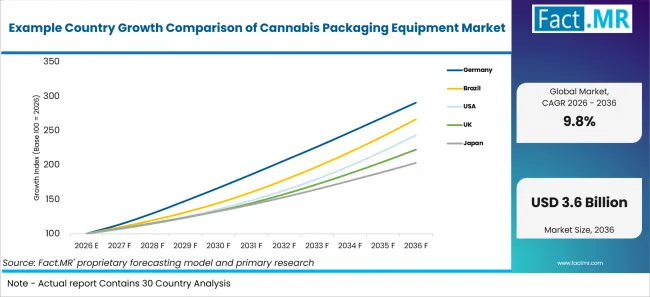
Example Country Growth Comparison Of Cannabis Packaging Equipment Market | Source: Fact.MR
Country CAGR (2026-2036)
| Country | CAGR (2026-2036) |
|---|---|
| Germany | 11.3% |
| Brazil | 10.3% |
| USA | 9.3% |
| UK | 8.3% |
| Japan | 7.4% |
Source: Fact.MR analysis. Updated Aug 25, 2026
What is driving Germany’s growth through 2036?
Germany is forecast to expand at an 11.3% CAGR from 2026 to 2036.
Growth is supported by the expansion of the medical cannabis supply chain after the Medical Cannabis Act took effect in April 2024. Germany’s Federal Ministry of Health reported that imports of medical cannabis flower increased from around 19 tonnes in the first half of 2024 to around 80 tonnes in the first half of 2025. More imported and domestically handled product increases the volume that pharmacies, distributors, and specialized processors must receive, portion, label, and package under controlled conditions.
Packaging requirements also extend beyond medical distribution. Cultivation associations must use neutral packaging when passing cannabis to members, while accompanying product information covers weight, harvest date, best-before date, variety, and average THC and CBD content. Equipment that supports accurate portioning and consistent labeling therefore has a defined compliance role.
What is driving Brazil’s growth through 2036?
Brazil is forecast to expand at a 10.3% CAGR from 2026 to 2036.
Brazil’s 2026 regulatory changes create a new equipment cycle around medicinal cannabis. Anvisa’s RDC 1.015/2026 replaced the earlier framework for manufacture and import of cannabis products, while RDC 1.023/2026 aligned rules for labeling, dispensing, product classification, and export. Existing authorized products also required adaptation to the revised framework.
Brazil also established sanitary controls for legal-entity cultivation for medicinal, pharmaceutical, and research purposes. As regulated local production develops, processors will need controlled packaging steps that connect product traceability with filling, closure, label application, and final pack inspection.
What is driving the USA’s growth through 2036?
The USA is forecast to expand at a 9.3% CAGR from 2026 to 2036.
Growth is driven by state-level packaging rules that translate directly into equipment functions. In California, cannabis goods sold at licensed retailers must use child-resistant packaging. Final-form packages must also be tamper evident, and multi-serving packs must be resealable. These requirements support heat sealers, cappers, closure-handling systems, and inspection stations across flower and manufactured-product lines.
Manufactured cannabis products must be packaged and labeled for retail sale before transfer to a licensed distributor for regulatory compliance testing. Required information includes product identity, net weight or volume, the universal symbol, packaging date, and cannabinoid data. Producers therefore need label handling that remains synchronized with product and batch records before release.
What is driving the UK’s growth through 2036?
The UK is forecast to expand at an 8.3% CAGR from 2026 to 2036.
UK demand is concentrated in medicinal and controlled-drug channels. The MHRA’s guidance on unlicensed medicinal products explicitly covers cannabis-based products for medicinal use, while manufacture, import, distribution, and supply of these products operate under medicines rules and relevant licensing. This favors equipment that can support small-batch, documented packaging rather than mass recreational retail throughput.
The Home Office also treats cannabis and several controlled cannabinoids under controlled-drug licensing. Companies handling such materials need authorization for activities such as production, possession, import, export, and supply. Packaging machinery used in this environment must therefore fit validated facility procedures, controlled material handling, and traceable batch release.
What is driving Japan’s growth through 2036?
Japan is forecast to expand at a 7.4% CAGR from 2026 to 2036.
Japan’s amended cannabis and narcotics framework is creating a regulated pathway for medical and cannabinoid products while retaining strict control over delta-9 THC. The first stage of the reform took effect in December 2024 and introduced residual delta-9 THC limits for different product forms, followed by additional cultivation-related implementation in March 2025.
This structure keeps packaging demand focused on controlled production rather than broad recreational retail. Producers and importers need pack formats that preserve product identity and support accurate labeling around composition and legal thresholds, which favors precise filling and verification equipment in authorized manufacturing settings.
Who Leads the Cannabis Packaging Equipment Market?
Cannabis Packaging Machinery leads the Cannabis Packaging Equipment Market.
Competition is shaped by the ability to handle cannabis-specific dosing, frequent format changes, child-resistant package configurations, and line integration. Dura-Pack competes through weighing and filling systems designed for flower, edibles, gummies, and related cannabis products, while ActionPac focuses on precision weighing and pre-roll automation.
Paxiom, Canapa Solutions, and WeighPack Systems operate within the same broader packaging-automation platform, giving customers access to weigh filling, bagging, container filling, pre-roll automation, labeling, and end-of-line integration through related brands. Buyers therefore evaluate these names less as isolated machine vendors and more as connected sources for complete line architecture and service.
Ohlson Packaging is now an Ohlson product brand within nVenia, which Duravant formed by combining Ohlson with other packaging businesses. All-Fill and Viking Masek compete through broader filling and packaging machinery portfolios that can be adapted to cannabis applications, while Cannaline participates more directly through cannabis packaging formats and child-resistant container solutions.
Which companies are the key providers?
Key companies profiled include Cannabis Packaging Machinery; Dura-Pack; Paxiom; Canapa Solutions; ActionPac Scales and Automation; Ohlson Packaging Inc.; All-Fill Inc.; Viking Masek Global Packaging; WeighPack Systems Inc.; and Cannaline Cannabis Packaging Solution.
- Cannabis Packaging Machinery
- Dura-Pack
- Paxiom
- Canapa Solutions
- ActionPac Scales and Automation
- Ohlson Packaging Inc.
- All-Fill Inc.
- Viking Masek Global Packaging
- WeighPack Systems Inc.
- Cannaline Cannabis Packaging Solution
Bibliography
- Federal Ministry of Health, Germany. (2026). Frequently Asked Questions on the Cannabis Act. Federal Ministry of Health.
- Federal Ministry of Health, Germany. (2025). Questions and Answers on the Amendment to the Medical Cannabis Act. Federal Ministry of Health.
- Brazilian Health Regulatory Agency (Anvisa). (2026). Questions and Answers on the Sanitary Authorization of Cannabis Products. Government of Brazil.
- Brazilian Health Regulatory Agency (Anvisa). (2026). Anvisa Aligns Standards with Cannabis Rules Approved in January. Government of Brazil.
- Brazilian Health Regulatory Agency (Anvisa). (2026). RDCs No. 1.012/2026 and No. 1.013/2026. Government of Brazil.
- California Department of Cannabis Control. (2023). Packaging Requirements: Final Form Cannabis Goods. State of California.
- California Department of Cannabis Control. (2024). Labeling Requirements: Manufactured Cannabis Products in Final Form. State of California.
- California Department of Cannabis Control. (2023). Child-Resistant Packaging. State of California.
- Medicines and Healthcare products Regulatory Agency. (2025). Supply Unlicensed Medicinal Products (Specials). UK Government.
- Home Office. (2024). Drug Licensing Factsheet: Cannabis, CBD and Other Cannabinoids. UK Government.
- Ministry of Health, Labour and Welfare, Japan. (2025). Implementation of the Amended Cannabis Control Act and Narcotics and Psychotropics Control Act. Government of Japan.
- Paxiom Group. (2026). Paxiom Brands: WeighPack, EndFlex, ValTara and Canapa Solutions. Paxiom.
- Paxiom Group. (2026). High Precision Check Weighers for Cannabis Products. Paxiom.
- Dura-Pack. (2026). Cannabis Packaging Equipment and Machines. Dura-Pack.
- ActionPac. (2022). Automated Packaging Solutions for Cannabis Products. ActionPac Scales and Automation.
- Duravant. (2021). Duravant Launches nVenia, a Duravant Operating Company. Duravant.
This Report Answers
- How are cannabis packaging-equipment purchases changing as regulated producers automate more packaging steps?
- Which equipment categories and operating formats shape purchasing decisions across cannabis production lines?
- How do child-resistant, tamper-evident, labeling, and traceability requirements influence machine specifications?
- Which country markets are developing distinct packaging-equipment demand mechanisms through regulated medical and adult-use frameworks?
- How are integration, service capability, format flexibility, and digital controls shaping competition among equipment suppliers?
What does the Cannabis Packaging Equipment Market cover?
The Cannabis Packaging Equipment Market covers machinery and integrated systems used to prepare cannabis flower, pre-rolls, edibles, concentrates and tinctures for regulated distribution. Revenue includes primary, secondary and tertiary packaging equipment, together with the automation, smart-machine, material-compatibility and end-use categories included in the market.
Included machinery can weigh, fill, seal, label, carton, case-pack, shrink-wrap, palletize, strap, inspect or monitor cannabis packaging workflows.
What is included in the scope?
Included products are Primary Packaging Equipment, Secondary Packaging Equipment and Tertiary Packaging Equipment and their subsegments. Coverage also includes Fully Automatic Systems and Manual Equipment; IoT Enabled Machines and Robotic Packaging Systems; flower, pre-roll, edible, concentrate and tincture formats; and machinery compatible with plastic, glass, metal and flexible packaging materials.
End-use coverage includes Licensed Producers, Cannabis Product Manufacturers and Contract Packaging Providers, including cultivation, processing, pre-roll, edible and concentrate-production subgroups. Country analysis covers Germany, Brazil, the USA, the UK and Japan within the broader regional framework.
What is excluded from the scope?
The market excludes cannabis cultivation equipment, extraction systems, laboratory testing equipment, HVAC systems, security systems, and general processing machinery that does not perform a packaging function. Packaging materials sold without associated equipment are also outside the equipment revenue base.
Retail dispensing systems, consumer cannabis products, pharmaceutical ingredients and logistics services are excluded unless the transaction is specifically for cannabis packaging equipment. General-purpose machinery is counted only when sold for an included cannabis packaging workflow.
How Was the Analysis Built?
The analysis combines equipment-side and buyer-side assessment across packaging functions, product formats, automation levels, end users and country markets.
- Primary Research:
- Interviews focus on packaging-equipment manufacturers, system integrators, licensed cannabis producers, cannabis product manufacturers, contract packers, plant engineering teams, packaging managers, distributors, and service organizations. Discussions test purchase criteria such as fill accuracy, format flexibility, line speed, validation, service coverage, and capital budgeting.
- Desk Research:
- Desk research covers cannabis regulators, health ministries, medicines agencies, controlled-drug licensing authorities, packaging rules, company equipment literature, machine specifications, and technical material on weighing, filling, sealing, labeling, inspection, and end-of-line automation.
- Market Sizing and Forecasting:
- Market sizing considers packaging-equipment installations, replacement and retrofit demand, production-line automation levels, cannabis product-format mix, licensed manufacturing activity, packaging-compliance requirements, equipment pricing, and adoption by covered end users. Forecasts test how these variables change across the covered countries and segment structure.
- Data Validation and Update Cycle:
- Findings are cross-checked across supplier portfolios, end-user operating requirements, regulatory changes, and country-specific market activity. Updates review equipment launches, ownership changes, packaging-rule revisions, production expansion, and shifts in the mix of cannabis product formats.
Segmentation
What is the report's scope and coverage?
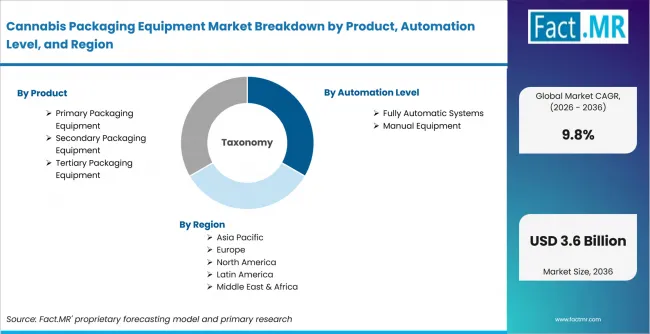
Cannabis Packaging Equipment Market Breakdown By Product, Automation Level, And Region | Source: Fact.MR
| Attribute | Details |
|---|---|
| Quantitative Units | USD billion |
| Market Definition | Packaging machinery and integrated systems used to prepare covered cannabis products for regulated distribution. |
| Segments Covered | Product; Automation Level; Smart Packaging Equipment; Packaging Format; Material Compatibility; End Use |
| Regions Covered | North America; Latin America; Europe; East Asia; South Asia and Pacific; Middle East and Africa |
| Countries Covered | Germany; Brazil; USA; UK; Japan |
| Key Companies Profiled | Cannabis Packaging Machinery; Dura-Pack; Paxiom; Canapa Solutions; ActionPac Scales and Automation; Ohlson Packaging Inc.; All-Fill Inc.; Viking Masek Global Packaging; WeighPack Systems Inc.; Cannaline Cannabis Packaging Solution |
| Forecast Period | 2026 to 2036 |
| Base Year | 2026 |
| Market Value, 2026 | USD 1.4 billion |
| Market Value, 2036 | USD 3.6 billion |
| CAGR, 2026-2036 | 9.8% |
| Absolute Opportunity | USD 2.2 billion |
| Approach | Hybrid equipment-side and demand-side model using machine installations, automation level, packaging-format mix, regulated manufacturing activity, equipment pricing, and end-user adoption. |
Source: Fact.MR analysis. Updated Aug 25, 2026
How is the market segmented?
-
By Product
- Primary Packaging Equipment
- Filling Machines
- Sealing Machines
- Labeling Machines
- Secondary Packaging Equipment
- Cartoning Machines
- Case Packing Machines
- Shrink Wrapping Machines
- Tertiary Packaging Equipment
- Palletizing Systems
- Strapping Machines
- Primary Packaging Equipment
-
By Automation Level
- Fully Automatic Systems
- Manual Equipment
-
By Smart Packaging Equipment
- IoT Enabled Machines
- Real Time Monitoring Systems
- Predictive Maintenance Systems
- Robotic Packaging Systems
- Pick And Place Robots
- Automated Handling Systems
- IoT Enabled Machines
-
By Packaging Format
- Flower Packaging
- Pre Roll Packaging
- Edible Packaging
- Gummy Packaging Lines
- Chocolate And Confectionery Lines
- Concentrate Packaging
- Vial Filling Systems
- Syringe Filling Systems
- Tincture Packaging
- Flower Packaging
-
By Material Compatibility
- Plastic Based Packaging Systems
- Glass Compatible Systems
- Metal Packaging Systems
- Flexible Packaging Systems
- Plastic Based Packaging Systems
-
By End Use
- Licensed Producers
- Cultivation Facilities
- Processing Facilities
- Cannabis Product Manufacturers
- Pre Roll Manufacturers
- Edibles Manufacturers
- Concentrate Producers
- Contract Packaging Providers
- Licensed Producers
Frequently Asked Questions
What is the Cannabis Packaging Equipment Market value in 2026?
At what CAGR is the market projected to grow?
What is the projected market value by 2036?
Which Product category leads the market?
Which Automation Level leads the market?
Which Smart Packaging Equipment category leads the market?
Which Packaging Format leads the market?
Which Material Compatibility category leads the market?
Which End Use leads the market?
Which country has the leading listed CAGR?
Which company leads the Cannabis Packaging Equipment Market?
Which companies are included in the market assessment?
Who worked on this report


Preview the report firsthand - request a free sample
Free SampleGet the brochure for pricing and purchase details
Download PDF