Cardiometabolic-Sleep Comorbidity Treatment Market (2026 - 2036)

Cardiometabolic-Sleep Comorbidity Treatment Market Size and Share Forecast Outlook 2026 to 2036

Core Findings

    Cardiometabolic-Sleep Comorbidity Treatment Market Forecast and Outlook 2026 to 2036

    Cardiometabolic-Sleep Comorbidity Treatment Market moves from USD 8.6 billion in 2026 to USD 22.3 billion by 2036, reflecting a 10% CAGR.

    Cardiometabolic-Sleep Comorbidity Treatment Market Key Takeaways

    • Cardiometabolic-Sleep Comorbidity Treatment Market Value (2026): USD 8.6 billion
    • Cardiometabolic-Sleep Comorbidity Treatment Market Forecast Value (2036): USD 22.3 billion
    • Cardiometabolic-Sleep Comorbidity Treatment Market Forecast CAGR: 10.0%
    • Leading Treatment Component in Cardiometabolic-Sleep Comorbidity Treatment Market: PAP therapy and sleep apnea devices
    • Key Growth Regions in Cardiometabolic-Sleep Comorbidity Treatment Market: North America, Europe, Asia Pacific, Latin America, Middle East & Africa
    • Top Players in Cardiometabolic-Sleep Comorbidity Treatment Market: Novo Nordisk, ResMed, Eli Lilly, Philips, AstraZeneca
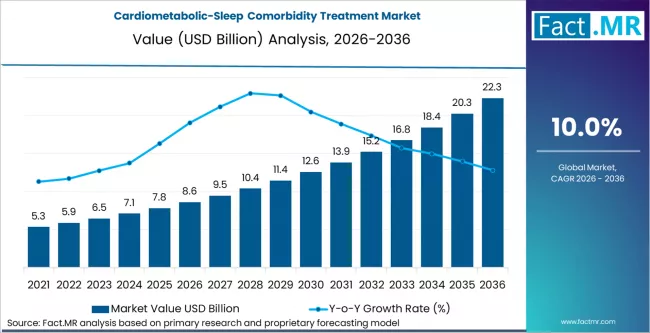
    Cardiometabolic Sleep Comorbidity Treatment Market Market Value Analysis

    The structural change sits in how care is produced and purchased. Early volume came from fragmented programs tied to single clinics and narrow cohorts. Current growth depends on standardized care pathways that link screening, diagnostics, therapy titration, and longitudinal follow up under unified protocols.

    Device suppliers, drug vendors, and service operators align around fixed specifications and shared data definitions. Manufacturing scale shows up in kit assembly, device logistics, and repeatable service scheduling. Payers and hospital groups evaluate vendors on documentation depth, audit readiness, and predictable delivery windows. Contract awards follow platforms that run with low variance across sites. Capacity planning uses patient throughput and refill cycles as governing limits. Adoption friction declines as integration risk falls. Volume migration reflects procurement normalization across large cardiology, endocrinology, and sleep medicine networks.

    Cardiometabolic-Sleep Comorbidity Treatment Market

    Metric Value
    Market Value (2026) USD 8.6 billion
    Forecast Value (2036) USD 22.3 billion
    Forecast CAGR (2026-2036) 10.0%

    Category

    Category Segments
    Treatment Components (Integrated) PAP therapy and sleep apnea devices; Weight-loss pharmacotherapy (GLP-1 and others) in OSA patients; Hypertension and diabetes meds optimization programs; Remote monitoring and risk stratification analytics; Lifestyle and care-management services
    Comorbidity Pathways OSA and obesity management; OSA and hypertension or CV risk control; OSA and type-2 diabetes management; Heart failure and sleep-disordered breathing; Other metabolic sleep phenotypes
    End User or Channel Hospitals and cardiometabolic clinics; Sleep clinics or DME networks; Retail pharmacy channel; Payers or population health managers; Others
    Region North America; Europe; Asia Pacific; Latin America; Middle East & Africa

    Cardiometabolic-Sleep Comorbidity Treatment Market Segmental Analysis

    By Treatment Components, Why Do PAP Therapy and Sleep Apnea Devices Form the Core of the Cardiometabolic-Sleep Comorbidity Treatment Market?

    Cardiometabolic Sleep Comorbidity Treatment Market Analysis By Treatment Components (integrated)

    Fact.MR tracking indicates that PAP therapy and sleep apnea devices account for 30% share because they address the most immediate and measurable failure in combined cardiometabolic and sleep care, which is untreated nocturnal airway collapse. The unmet need is not broader lifestyle guidance but dependable physiological control during sleep. For patients, the value is strictly functional and tied to daily symptom relief and risk containment. The therapy becomes part of routine life rather than a discretionary intervention. For providers, it anchors the entire treatment sequence and defines clinical accountability. Its dominance reflects the role of device based control as the starting point for integrated risk management across cardiometabolic pathways.

    By Comorbidity Pathways, Why Does OSA Plus Obesity Management Represent the Largest Care Pathway in the Cardiometabolic-Sleep Comorbidity Treatment Market?
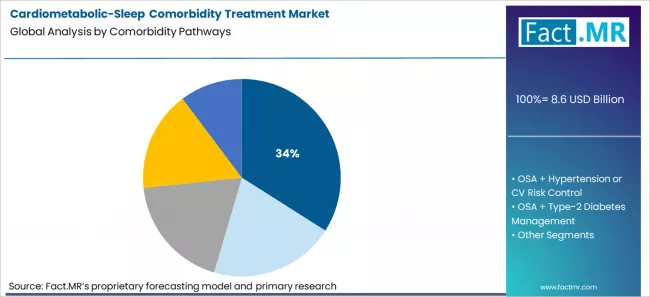
    Cardiometabolic Sleep Comorbidity Treatment Market Analysis By Comorbidity Pathways

    In Fact.MR primary research, OSA combined with obesity management represents 34% share because this pairing concentrates risk, cost, and clinical visibility in a single patient profile. The unmet need is coordinated care for two reinforcing conditions that neither resolve alone. Patients do not view this pathway as elective optimization. They encounter it as a sustained management obligation that affects mobility, work capacity, and long term health planning. The value proposition remains practical rather than reassuring. For health systems, this pathway justifies continuous follow up and structured programs. Its scale reflects how combined weight and sleep intervention has become a standard, repeatable care track rather than a specialized exception.

    Country

    Country Driver Restraint Trend
    USA Guidelines link sleep to cardiometabolic risk Reimbursement and underdiagnosis Integrated cardiology sleep clinics
    UK NHS prevention focus on sleep and obesity Regional service variation Cross specialty metabolic sleep pathways
    Germany Strong sleep apnea registries and evidence Complex diagnostics in community care Risk stratification using sleep metrics
    China Hospital data linking OSA to diabetes and CVD Urban rural access gap Hospital led tele sleep screening
    India Rising diabetes and obesity burden Few sleep labs and specialists Lifestyle plus sleep combined programs

    Analysis of the Cardiometabolic-Sleep Comorbidity Treatment Market by Key Country
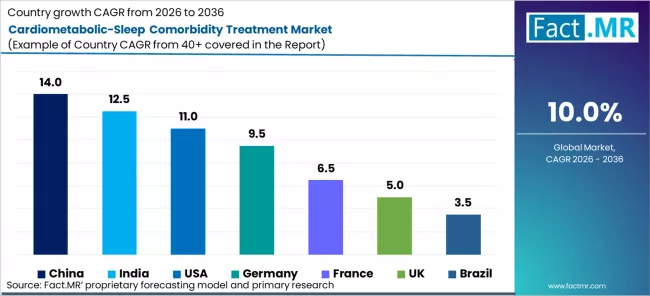
    Cardiometabolic Sleep Comorbidity Treatment Market Cagr Analysis By Country

    Country CAGR (2026-2036)
    USA 11.0%
    China 14.0%
    India 12.5%
    Germany 9.5%
    France 6.5%
    UK 5.0%
    Brazil 3.5%

    The report covers an in-depth analysis of 40+ countries; top-performing countries are highlighted below.

    How Is the Cardiometabolic Sleep Comorbidity Treatment Sector Taking Shape in the United States?

    An 11% annual expansion through 2036 fits the way large American hospital systems now structure chronic disease care. Patients with diabetes, hypertension, and obesity already return for scheduled reviews several times each year. Sleep assessment enters this cycle as an added clinical step rather than a separate referral. Once departments share patient records and care plans, treatment duration extends and follow up becomes routine. Employers and insurers support combined programs that aim to reduce admissions and medication escalation. Revenue growth appears through higher treatment density per patient and longer care cycles, not through changes in diagnosis rates or population size.

    What Explains the Scale of Cardiometabolic Sleep Treatment Growth in China?

    A 14% growth path through 2036 matches the operating scale of major Chinese urban hospitals. Single institutions manage patient volumes comparable to entire regional systems elsewhere. When hypertension and diabetes clinics add sleep screening, large patient pools move into combined care pathways at once. Provincial hospital groups copy these workflows across networks rather than site by site. Clinical teams follow standardized protocols tied to administrative systems. Treatment volume rises through replication of existing service models, not through advertising or patient self-selection. The expansion rate follows the speed at which these combined clinics spread across city hospital networks over time.

    Why Is India Showing Rapid Uptake in This Treatment Segment?

    A 12.5% growth path through 2036 follows changes inside private hospital chains and large diagnostic groups. Many patients arrive with several chronic conditions and receive fragmented care across departments. Group providers now package cardiology, diabetes, and sleep services into single programs to keep patients inside one system for longer periods. Diagnosis rates remain secondary to retention and monitoring frequency. Revenue per patient increases as care shifts toward structured follow up contracts. The category expands through longer treatment relationships and bundled service models rather than through sudden shifts in disease prevalence across the population.

    How Is This Category Developing Inside the German Healthcare System?

    Germany’s 9.5% growth profile aligns with a system built around formal treatment pathways and documentation requirements. Patients with metabolic disease already move through specialist networks under defined schedules. Sleep assessment enters these pathways only after guideline review and reimbursement alignment. Hospitals and sickness funds control how quickly combined programs appear. Demographic structure limits rapid volume change. Expansion comes from deeper management of existing patients and slow inclusion of combined protocols into routine care. The category grows through procedural acceptance and clinical standard setting rather than through rapid service redesign or commercial promotion.

    What Sets the Pace for This Treatment Area in France?

    A 6.5% annual increase corresponds to the way chronic disease care operates inside the French public hospital system. Complex patients already receive coordinated follow up across specialties. Sleep evaluation joins these programs mainly for higher risk cases. National funding decisions and care pathway definitions determine how many centers offer combined services. The focus stays on stabilizing existing patients rather than enrolling new groups. Growth follows incremental changes inside established programs and specialist clinics, which keeps expansion steady and limited by administrative capacity and staffing availability.

    Why Does the United Kingdom Show Slower Growth in This Segment?

    A 5% yearly expansion reflects how the NHS manages competing priorities across chronic care services. Cardiometabolic clinics already face long waiting lists and staff constraints. Combined sleep management appears mainly inside pilot projects and specialist units. National rollout depends on budget reviews and service planning cycles. Patients enter through referral systems that limit rapid scaling. Demand remains present due to disease burden. Service capacity caps the number of programs that can operate at any time. Expansion stays gradual as integrated care models compete with other funded clinical priorities.

    What Explains the Low Growth Rate in Brazil?

    Brazil’s 3.5% growth pattern follows the uneven structure of specialist care across regions. Private hospital groups offer combined programs in major cities, while public system coverage remains limited. Many patients still receive separate treatment for metabolic and sleep conditions. Screening stays concentrated in urban centers. Insurance coverage and household income differences shape access to long term programs. Category expansion depends on private sector investment and employer health plans rather than coordinated national rollout, which keeps progress slow and confined to selected healthcare networks.

    Who Determines Access, Sequencing, And Long Term Control in Cardiometabolic Sleep Comorbidity Treatment Pathways?
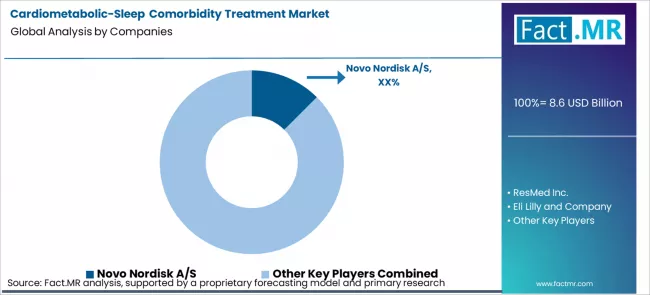
    Cardiometabolic Sleep Comorbidity Treatment Market Analysis By Company

    Entry into cardiometabolic sleep comorbidity treatment is determined less by product choice and more by where patients are first captured within the care system. Obesity, diabetes, and obstructive sleep apnea frequently coexist, and clinical literature documents both their high overlap and the effect of apnea treatment on blood pressure and metabolic control. Novo Nordisk and Eli Lilly reach patients through established metabolic disease clinics, where multi-year prescribing and follow up structures already exist. AstraZeneca operates within cardiopulmonary treatment frameworks that link respiratory risk management to broader chronic disease control. ResMed and Philips occupy the operational layer, since diagnosis, titration, and adherence monitoring depend on their installed device bases and data systems. Evidence that weight reduction can reduce apnea severity further connects these pathways. Competitive advantage now follows control over referral routing, reimbursement alignment, and workflow execution. Scale and process discipline protect position more reliably than any single therapeutic or device asset.

    Key Players in Cardiometabolic-Sleep Comorbidity Treatment Market

    • Novo Nordisk A/S
    • ResMed Inc.
    • Eli Lilly and Company
    • Philips N.V.
    • AstraZeneca PLC
    • Others

    Scope of the Report

    Items Values
    Quantitative Units (2026) USD billion
    Treatment Components (Integrated) PAP therapy and sleep apnea devices, weight-loss pharmacotherapy (GLP-1 and others) in OSA patients, hypertension and diabetes meds optimization programs, remote monitoring and risk stratification analytics, lifestyle and care-management services
    Comorbidity Pathways OSA and obesity management, OSA and hypertension or CV risk control, OSA and type-2 diabetes management, heart failure and sleep-disordered breathing, other metabolic sleep phenotypes
    End User or Channel Hospitals and cardiometabolic clinics, sleep clinics or DME networks, retail pharmacy channel, payers or population health managers, others
    Regions Covered Asia Pacific, Europe, North America, Latin America, Middle East & Africa
    Countries Covered United States, Canada, Mexico, Germany, United Kingdom, France, Italy, Spain, China, Japan, South Korea, India, Australia & New Zealand, ASEAN, Brazil, Chile, Saudi Arabia, Turkey, South Africa, and other regional markets
    Key Companies Profiled Novo Nordisk A/S, ResMed Inc., Eli Lilly and Company, Philips N.V., AstraZeneca PLC
    Additional Attributes Dollar by sales by treatment component, comorbidity pathway, and channel; focus on integrated cardiometabolic sleep pathways, standardized protocols, and audit-ready delivery; demand driven by obesity, diabetes, and OSA overlap management across hospital networks

    Cardiometabolic-Sleep Comorbidity Treatment Market Segmentation

    • Treatment Components (Integrated) :

      • PAP Therapy & Sleep Apnea Devices
      • Weight-Loss Pharmacotherapy (GLP-1 & Others) in OSA Patients
      • Hypertension/Diabetes Meds Optimization Programs
      • Remote Monitoring & Risk Stratification Analytics
      • Lifestyle & Care-Management Services
    • Comorbidity Pathways :

      • OSA + Obesity Management
      • OSA + Hypertension or CV Risk Control
      • OSA + Type-2 Diabetes Management
      • Heart Failure + Sleep-Disordered Breathing
      • Other Metabolic Sleep Phenotypes
    • End User or Channel :

      • Hospitals & Cardiometabolic Clinics
      • Sleep Clinics or DME Networks
      • Retail Pharmacy Channel
      • Payers or Population Health Managers
      • Others
    • Region :

      • Asia Pacific
        • China
        • Japan
        • South Korea
        • India
        • Australia & New Zealand
        • ASEAN
        • Rest of Asia Pacific
      • Europe
        • Germany
        • United Kingdom
        • France
        • Italy
        • Spain
        • Nordic
        • BENELUX
        • Rest of Europe
      • North America
        • United States
        • Canada
        • Mexico
      • Latin America
        • Brazil
        • Chile
        • Rest of Latin America
      • Middle East & Africa
        • Kingdom of Saudi Arabia
        • Other GCC Countries
        • Turkey
        • South Africa
        • Other African Union
        • Rest of Middle East & Africa

    References

    • U.S. Department of Health and Human Services, National Institutes of Health, National Heart, Lung, and Blood Institute. (2025, January 9). Sleep apnea: Causes and risk factors.
    • U.S. Department of Health and Human Services, National Institutes of Health, National Heart, Lung, and Blood Institute. (2025). Sleep apnea research.
    • Centers for Disease Control and Prevention. (2025). Sleep: Chronic disease indicators. U.S. Department of Health and Human Services.
    • Centers for Disease Control and Prevention. (2025). Sleep apnea screening for commercial drivers.U.S. Department of Health and Human Services.

    Table of Content

    1. Executive Summary
      • Global Market Outlook
      • Demand to side Trends
      • Supply to side Trends
      • Technology Roadmap Analysis
      • Analysis and Recommendations
    2. Market Overview
      • Market Coverage / Taxonomy
      • Market Definition / Scope / Limitations
    3. Research Methodology
      • Chapter Orientation
      • Analytical Lens and Working Hypotheses
        • Market Structure, Signals, and Trend Drivers
        • Benchmarking and Cross-market Comparability
        • Market Sizing, Forecasting, and Opportunity Mapping
      • Research Design and Evidence Framework
        • Desk Research Programme (Secondary Evidence)
          • Company Annual and Sustainability Reports
          • Peer-reviewed Journals and Academic Literature
          • Corporate Websites, Product Literature, and Technical Notes
          • Earnings Decks and Investor Briefings
          • Statutory Filings and Regulatory Disclosures
          • Technical White Papers and Standards Notes
          • Trade Journals, Industry Magazines, and Analyst Briefs
          • Conference Proceedings, Webinars, and Seminar Materials
          • Government Statistics Portals and Public Data Releases
          • Press Releases and Reputable Media Coverage
          • Specialist Newsletters and Curated Briefings
          • Sector Databases and Reference Repositories
          • FMR Internal Proprietary Databases and Historical Market Datasets
          • Subscription Datasets and Paid Sources
          • Social Channels, Communities, and Digital Listening Inputs
          • Additional Desk Sources
        • Expert Input and Fieldwork (Primary Evidence)
          • Primary Modes
            • Qualitative Interviews and Expert Elicitation
            • Quantitative Surveys and Structured Data Capture
            • Blended A8oach
          • Why Primary Evidence is Used
          • Field Techniques
            • Interviews
            • Surveys
            • Focus Groups
            • Observational and In-context Research
            • Social and Community Interactions
          • Stakeholder Universe Engaged
            • C-suite Leaders
            • Board Members
            • Presidents and Vice Presidents
            • R&D and Innovation Heads
            • Technical Specialists
            • Domain Subject-matter Experts
            • Scientists
            • Physicians and Other Healthcare Professionals
          • Governance, Ethics, and Data Stewardship
            • Research Ethics
            • Data Integrity and Handling
        • Tooling, Models, and Reference Databases
      • Data Engineering and Model Build
        • Data Acquisition and Ingestion
        • Cleaning, Normalisation, and Verification
        • Synthesis, Triangulation, and Analysis
      • Quality Assurance and Audit Trail
    4. Market Background
      • Market Dynamics
        • Drivers
        • Restraints
        • Opportunity
        • Trends
      • Scenario Forecast
        • Demand in Optimistic Scenario
        • Demand in Likely Scenario
        • Demand in Conservative Scenario
      • Opportunity Map Analysis
      • Product Life Cycle Analysis
      • Supply Chain Analysis
      • Investment Feasibility Matrix
      • Value Chain Analysis
      • PESTLE and Porter’s Analysis
      • Regulatory Landscape
      • Regional Parent Market Outlook
      • Production and Consumption Statistics
      • Import and Export Statistics
    5. Global Market Analysis 2021 to 2025 and Forecast, 2026 to 2036
      • Historical Market Size Value (USD Million) Analysis, 2021 to 2025
      • Current and Future Market Size Value (USD Million) Projections, 2026 to 2036
        • Y to o to Y Growth Trend Analysis
        • Absolute $ Opportunity Analysis
    6. Global Market Pricing Analysis 2021 to 2025 and Forecast 2026 to 2036
    7. Global Market Analysis 2021 to 2025 and Forecast 2026 to 2036, By Treatment Components (Integrated)
      • Introduction / Key Findings
      • Historical Market Size Value (USD Million) Analysis By Treatment Components (Integrated), 2021 to 2025
      • Current and Future Market Size Value (USD Million) Analysis and Forecast By Treatment Components (Integrated), 2026 to 2036
        • PAP Therapy & Sleep Apnea Devices
        • Weight-Loss Pharmacotherapy (GLP-1 & Others) in OSA Patients
        • Hypertension/Diabetes Meds Optimization Programs
        • Remote Monitoring & Risk Stratification Analytics
        • Lifestyle & Care-Management Services
      • Y to o to Y Growth Trend Analysis By Treatment Components (Integrated), 2021 to 2025
      • Absolute $ Opportunity Analysis By Treatment Components (Integrated), 2026 to 2036
    8. Global Market Analysis 2021 to 2025 and Forecast 2026 to 2036, By Comorbidity Pathways
      • Introduction / Key Findings
      • Historical Market Size Value (USD Million) Analysis By Comorbidity Pathways, 2021 to 2025
      • Current and Future Market Size Value (USD Million) Analysis and Forecast By Comorbidity Pathways, 2026 to 2036
        • OSA + Obesity Management
        • OSA + Hypertension or CV Risk Control
        • OSA + Type-2 Diabetes Management
        • Heart Failure + Sleep-Disordered Breathing
        • Other Metabolic Sleep Phenotypes
      • Y to o to Y Growth Trend Analysis By Comorbidity Pathways, 2021 to 2025
      • Absolute $ Opportunity Analysis By Comorbidity Pathways, 2026 to 2036
    9. Global Market Analysis 2021 to 2025 and Forecast 2026 to 2036, By End User or Channel
      • Introduction / Key Findings
      • Historical Market Size Value (USD Million) Analysis By End User or Channel, 2021 to 2025
      • Current and Future Market Size Value (USD Million) Analysis and Forecast By End User or Channel, 2026 to 2036
        • Hospitals & Cardiometabolic Clinics
        • Sleep Clinics or DME Networks
        • Retail Pharmacy Channel
        • Payers or Population Health Managers
        • Others
      • Y to o to Y Growth Trend Analysis By End User or Channel, 2021 to 2025
      • Absolute $ Opportunity Analysis By End User or Channel, 2026 to 2036
    10. Global Market Analysis 2021 to 2025 and Forecast 2026 to 2036, By Region
      • Introduction
      • Historical Market Size Value (USD Million) Analysis By Region, 2021 to 2025
      • Current Market Size Value (USD Million) Analysis and Forecast By Region, 2026 to 2036
        • North America
        • Latin America
        • Western Europe
        • Eastern Europe
        • East Asia
        • South Asia and Pacific
        • Middle East & Africa
      • Market Attractiveness Analysis By Region
    11. North America Market Analysis 2021 to 2025 and Forecast 2026 to 2036, By Country
      • Historical Market Size Value (USD Million) Trend Analysis By Market Taxonomy, 2021 to 2025
      • Market Size Value (USD Million) Forecast By Market Taxonomy, 2026 to 2036
        • By Country
          • USA
          • Canada
          • Mexico
        • By Treatment Components (Integrated)
        • By Comorbidity Pathways
        • By End User or Channel
      • Market Attractiveness Analysis
        • By Country
        • By Treatment Components (Integrated)
        • By Comorbidity Pathways
        • By End User or Channel
      • Key Takeaways
    12. Latin America Market Analysis 2021 to 2025 and Forecast 2026 to 2036, By Country
      • Historical Market Size Value (USD Million) Trend Analysis By Market Taxonomy, 2021 to 2025
      • Market Size Value (USD Million) Forecast By Market Taxonomy, 2026 to 2036
        • By Country
          • Brazil
          • Chile
          • Rest of Latin America
        • By Treatment Components (Integrated)
        • By Comorbidity Pathways
        • By End User or Channel
      • Market Attractiveness Analysis
        • By Country
        • By Treatment Components (Integrated)
        • By Comorbidity Pathways
        • By End User or Channel
      • Key Takeaways
    13. Western Europe Market Analysis 2021 to 2025 and Forecast 2026 to 2036, By Country
      • Historical Market Size Value (USD Million) Trend Analysis By Market Taxonomy, 2021 to 2025
      • Market Size Value (USD Million) Forecast By Market Taxonomy, 2026 to 2036
        • By Country
          • Germany
          • UK
          • Italy
          • Spain
          • France
          • Nordic
          • BENELUX
          • Rest of Western Europe
        • By Treatment Components (Integrated)
        • By Comorbidity Pathways
        • By End User or Channel
      • Market Attractiveness Analysis
        • By Country
        • By Treatment Components (Integrated)
        • By Comorbidity Pathways
        • By End User or Channel
      • Key Takeaways
    14. Eastern Europe Market Analysis 2021 to 2025 and Forecast 2026 to 2036, By Country
      • Historical Market Size Value (USD Million) Trend Analysis By Market Taxonomy, 2021 to 2025
      • Market Size Value (USD Million) Forecast By Market Taxonomy, 2026 to 2036
        • By Country
          • Russia
          • Poland
          • Hungary
          • Balkan & Baltic
          • Rest of Eastern Europe
        • By Treatment Components (Integrated)
        • By Comorbidity Pathways
        • By End User or Channel
      • Market Attractiveness Analysis
        • By Country
        • By Treatment Components (Integrated)
        • By Comorbidity Pathways
        • By End User or Channel
      • Key Takeaways
    15. East Asia Market Analysis 2021 to 2025 and Forecast 2026 to 2036, By Country
      • Historical Market Size Value (USD Million) Trend Analysis By Market Taxonomy, 2021 to 2025
      • Market Size Value (USD Million) Forecast By Market Taxonomy, 2026 to 2036
        • By Country
          • China
          • Japan
          • South Korea
        • By Treatment Components (Integrated)
        • By Comorbidity Pathways
        • By End User or Channel
      • Market Attractiveness Analysis
        • By Country
        • By Treatment Components (Integrated)
        • By Comorbidity Pathways
        • By End User or Channel
      • Key Takeaways
    16. South Asia and Pacific Market Analysis 2021 to 2025 and Forecast 2026 to 2036, By Country
      • Historical Market Size Value (USD Million) Trend Analysis By Market Taxonomy, 2021 to 2025
      • Market Size Value (USD Million) Forecast By Market Taxonomy, 2026 to 2036
        • By Country
          • India
          • ASEAN
          • Australia & New Zealand
          • Rest of South Asia and Pacific
        • By Treatment Components (Integrated)
        • By Comorbidity Pathways
        • By End User or Channel
      • Market Attractiveness Analysis
        • By Country
        • By Treatment Components (Integrated)
        • By Comorbidity Pathways
        • By End User or Channel
      • Key Takeaways
    17. Middle East & Africa Market Analysis 2021 to 2025 and Forecast 2026 to 2036, By Country
      • Historical Market Size Value (USD Million) Trend Analysis By Market Taxonomy, 2021 to 2025
      • Market Size Value (USD Million) Forecast By Market Taxonomy, 2026 to 2036
        • By Country
          • Kingdom of Saudi Arabia
          • Other GCC Countries
          • Turkiye
          • South Africa
          • Other African Union
          • Rest of Middle East & Africa
        • By Treatment Components (Integrated)
        • By Comorbidity Pathways
        • By End User or Channel
      • Market Attractiveness Analysis
        • By Country
        • By Treatment Components (Integrated)
        • By Comorbidity Pathways
        • By End User or Channel
      • Key Takeaways
    18. Key Countries Market Analysis
      • USA
        • Pricing Analysis
        • Market Share Analysis, 2025
          • By Treatment Components (Integrated)
          • By Comorbidity Pathways
          • By End User or Channel
      • Canada
        • Pricing Analysis
        • Market Share Analysis, 2025
          • By Treatment Components (Integrated)
          • By Comorbidity Pathways
          • By End User or Channel
      • Mexico
        • Pricing Analysis
        • Market Share Analysis, 2025
          • By Treatment Components (Integrated)
          • By Comorbidity Pathways
          • By End User or Channel
      • Brazil
        • Pricing Analysis
        • Market Share Analysis, 2025
          • By Treatment Components (Integrated)
          • By Comorbidity Pathways
          • By End User or Channel
      • Chile
        • Pricing Analysis
        • Market Share Analysis, 2025
          • By Treatment Components (Integrated)
          • By Comorbidity Pathways
          • By End User or Channel
      • Germany
        • Pricing Analysis
        • Market Share Analysis, 2025
          • By Treatment Components (Integrated)
          • By Comorbidity Pathways
          • By End User or Channel
      • UK
        • Pricing Analysis
        • Market Share Analysis, 2025
          • By Treatment Components (Integrated)
          • By Comorbidity Pathways
          • By End User or Channel
      • Italy
        • Pricing Analysis
        • Market Share Analysis, 2025
          • By Treatment Components (Integrated)
          • By Comorbidity Pathways
          • By End User or Channel
      • Spain
        • Pricing Analysis
        • Market Share Analysis, 2025
          • By Treatment Components (Integrated)
          • By Comorbidity Pathways
          • By End User or Channel
      • France
        • Pricing Analysis
        • Market Share Analysis, 2025
          • By Treatment Components (Integrated)
          • By Comorbidity Pathways
          • By End User or Channel
      • India
        • Pricing Analysis
        • Market Share Analysis, 2025
          • By Treatment Components (Integrated)
          • By Comorbidity Pathways
          • By End User or Channel
      • ASEAN
        • Pricing Analysis
        • Market Share Analysis, 2025
          • By Treatment Components (Integrated)
          • By Comorbidity Pathways
          • By End User or Channel
      • Australia & New Zealand
        • Pricing Analysis
        • Market Share Analysis, 2025
          • By Treatment Components (Integrated)
          • By Comorbidity Pathways
          • By End User or Channel
      • China
        • Pricing Analysis
        • Market Share Analysis, 2025
          • By Treatment Components (Integrated)
          • By Comorbidity Pathways
          • By End User or Channel
      • Japan
        • Pricing Analysis
        • Market Share Analysis, 2025
          • By Treatment Components (Integrated)
          • By Comorbidity Pathways
          • By End User or Channel
      • South Korea
        • Pricing Analysis
        • Market Share Analysis, 2025
          • By Treatment Components (Integrated)
          • By Comorbidity Pathways
          • By End User or Channel
      • Russia
        • Pricing Analysis
        • Market Share Analysis, 2025
          • By Treatment Components (Integrated)
          • By Comorbidity Pathways
          • By End User or Channel
      • Poland
        • Pricing Analysis
        • Market Share Analysis, 2025
          • By Treatment Components (Integrated)
          • By Comorbidity Pathways
          • By End User or Channel
      • Hungary
        • Pricing Analysis
        • Market Share Analysis, 2025
          • By Treatment Components (Integrated)
          • By Comorbidity Pathways
          • By End User or Channel
      • Kingdom of Saudi Arabia
        • Pricing Analysis
        • Market Share Analysis, 2025
          • By Treatment Components (Integrated)
          • By Comorbidity Pathways
          • By End User or Channel
      • Turkiye
        • Pricing Analysis
        • Market Share Analysis, 2025
          • By Treatment Components (Integrated)
          • By Comorbidity Pathways
          • By End User or Channel
      • South Africa
        • Pricing Analysis
        • Market Share Analysis, 2025
          • By Treatment Components (Integrated)
          • By Comorbidity Pathways
          • By End User or Channel
    19. Market Structure Analysis
      • Competition Dashboard
      • Competition Benchmarking
      • Market Share Analysis of Top Players
        • By Regional
        • By Treatment Components (Integrated)
        • By Comorbidity Pathways
        • By End User or Channel
    20. Competition Analysis
      • Competition Deep Dive
        • Novo Nordisk A/S
          • Overview
          • Product Portfolio
          • Profitability by Market Segments (Product/Age /Sales Channel/Region)
          • Sales Footprint
          • Strategy Overview
            • Marketing Strategy
            • Product Strategy
            • Channel Strategy
        • ResMed Inc.
        • Eli Lilly and Company
        • Philips N.V.
        • AstraZeneca PLC
        • Others
    21. Assumptions & Acronyms Used

    List Of Table

    • Table 1: Global Market Value (USD Million) Forecast by Region, 2021 to 2036
    • Table 2: Global Market Value (USD Million) Forecast by Treatment Components (Integrated), 2021 to 2036
    • Table 3: Global Market Value (USD Million) Forecast by Comorbidity Pathways, 2021 to 2036
    • Table 4: Global Market Value (USD Million) Forecast by End User or Channel, 2021 to 2036
    • Table 5: North America Market Value (USD Million) Forecast by Country, 2021 to 2036
    • Table 6: North America Market Value (USD Million) Forecast by Treatment Components (Integrated), 2021 to 2036
    • Table 7: North America Market Value (USD Million) Forecast by Comorbidity Pathways, 2021 to 2036
    • Table 8: North America Market Value (USD Million) Forecast by End User or Channel, 2021 to 2036
    • Table 9: Latin America Market Value (USD Million) Forecast by Country, 2021 to 2036
    • Table 10: Latin America Market Value (USD Million) Forecast by Treatment Components (Integrated), 2021 to 2036
    • Table 11: Latin America Market Value (USD Million) Forecast by Comorbidity Pathways, 2021 to 2036
    • Table 12: Latin America Market Value (USD Million) Forecast by End User or Channel, 2021 to 2036
    • Table 13: Western Europe Market Value (USD Million) Forecast by Country, 2021 to 2036
    • Table 14: Western Europe Market Value (USD Million) Forecast by Treatment Components (Integrated), 2021 to 2036
    • Table 15: Western Europe Market Value (USD Million) Forecast by Comorbidity Pathways, 2021 to 2036
    • Table 16: Western Europe Market Value (USD Million) Forecast by End User or Channel, 2021 to 2036
    • Table 17: Eastern Europe Market Value (USD Million) Forecast by Country, 2021 to 2036
    • Table 18: Eastern Europe Market Value (USD Million) Forecast by Treatment Components (Integrated), 2021 to 2036
    • Table 19: Eastern Europe Market Value (USD Million) Forecast by Comorbidity Pathways, 2021 to 2036
    • Table 20: Eastern Europe Market Value (USD Million) Forecast by End User or Channel, 2021 to 2036
    • Table 21: East Asia Market Value (USD Million) Forecast by Country, 2021 to 2036
    • Table 22: East Asia Market Value (USD Million) Forecast by Treatment Components (Integrated), 2021 to 2036
    • Table 23: East Asia Market Value (USD Million) Forecast by Comorbidity Pathways, 2021 to 2036
    • Table 24: East Asia Market Value (USD Million) Forecast by End User or Channel, 2021 to 2036
    • Table 25: South Asia and Pacific Market Value (USD Million) Forecast by Country, 2021 to 2036
    • Table 26: South Asia and Pacific Market Value (USD Million) Forecast by Treatment Components (Integrated), 2021 to 2036
    • Table 27: South Asia and Pacific Market Value (USD Million) Forecast by Comorbidity Pathways, 2021 to 2036
    • Table 28: South Asia and Pacific Market Value (USD Million) Forecast by End User or Channel, 2021 to 2036
    • Table 29: Middle East & Africa Market Value (USD Million) Forecast by Country, 2021 to 2036
    • Table 30: Middle East & Africa Market Value (USD Million) Forecast by Treatment Components (Integrated), 2021 to 2036
    • Table 31: Middle East & Africa Market Value (USD Million) Forecast by Comorbidity Pathways, 2021 to 2036
    • Table 32: Middle East & Africa Market Value (USD Million) Forecast by End User or Channel, 2021 to 2036

    List Of Figures

    • Figure 1: Global Market Pricing Analysis
    • Figure 2: Global Market Value (USD Million) Forecast 2021 to 2036
    • Figure 3: Global Market Value Share and BPS Analysis by Treatment Components (Integrated), 2026 and 2036
    • Figure 4: Global Market Y to o to Y Growth Comparison by Treatment Components (Integrated), 2026 to 2036
    • Figure 5: Global Market Attractiveness Analysis by Treatment Components (Integrated)
    • Figure 6: Global Market Value Share and BPS Analysis by Comorbidity Pathways, 2026 and 2036
    • Figure 7: Global Market Y to o to Y Growth Comparison by Comorbidity Pathways, 2026 to 2036
    • Figure 8: Global Market Attractiveness Analysis by Comorbidity Pathways
    • Figure 9: Global Market Value Share and BPS Analysis by End User or Channel, 2026 and 2036
    • Figure 10: Global Market Y to o to Y Growth Comparison by End User or Channel, 2026 to 2036
    • Figure 11: Global Market Attractiveness Analysis by End User or Channel
    • Figure 12: Global Market Value (USD Million) Share and BPS Analysis by Region, 2026 and 2036
    • Figure 13: Global Market Y to o to Y Growth Comparison by Region, 2026 to 2036
    • Figure 14: Global Market Attractiveness Analysis by Region
    • Figure 15: North America Market Incremental Dollar Opportunity, 2026 to 2036
    • Figure 16: Latin America Market Incremental Dollar Opportunity, 2026 to 2036
    • Figure 17: Western Europe Market Incremental Dollar Opportunity, 2026 to 2036
    • Figure 18: Eastern Europe Market Incremental Dollar Opportunity, 2026 to 2036
    • Figure 19: East Asia Market Incremental Dollar Opportunity, 2026 to 2036
    • Figure 20: South Asia and Pacific Market Incremental Dollar Opportunity, 2026 to 2036
    • Figure 21: Middle East & Africa Market Incremental Dollar Opportunity, 2026 to 2036
    • Figure 22: North America Market Value Share and BPS Analysis by Country, 2026 and 2036
    • Figure 23: North America Market Value Share and BPS Analysis by Treatment Components (Integrated), 2026 and 2036
    • Figure 24: North America Market Y to o to Y Growth Comparison by Treatment Components (Integrated), 2026 to 2036
    • Figure 25: North America Market Attractiveness Analysis by Treatment Components (Integrated)
    • Figure 26: North America Market Value Share and BPS Analysis by Comorbidity Pathways, 2026 and 2036
    • Figure 27: North America Market Y to o to Y Growth Comparison by Comorbidity Pathways, 2026 to 2036
    • Figure 28: North America Market Attractiveness Analysis by Comorbidity Pathways
    • Figure 29: North America Market Value Share and BPS Analysis by End User or Channel, 2026 and 2036
    • Figure 30: North America Market Y to o to Y Growth Comparison by End User or Channel, 2026 to 2036
    • Figure 31: North America Market Attractiveness Analysis by End User or Channel
    • Figure 32: Latin America Market Value Share and BPS Analysis by Country, 2026 and 2036
    • Figure 33: Latin America Market Value Share and BPS Analysis by Treatment Components (Integrated), 2026 and 2036
    • Figure 34: Latin America Market Y to o to Y Growth Comparison by Treatment Components (Integrated), 2026 to 2036
    • Figure 35: Latin America Market Attractiveness Analysis by Treatment Components (Integrated)
    • Figure 36: Latin America Market Value Share and BPS Analysis by Comorbidity Pathways, 2026 and 2036
    • Figure 37: Latin America Market Y to o to Y Growth Comparison by Comorbidity Pathways, 2026 to 2036
    • Figure 38: Latin America Market Attractiveness Analysis by Comorbidity Pathways
    • Figure 39: Latin America Market Value Share and BPS Analysis by End User or Channel, 2026 and 2036
    • Figure 40: Latin America Market Y to o to Y Growth Comparison by End User or Channel, 2026 to 2036
    • Figure 41: Latin America Market Attractiveness Analysis by End User or Channel
    • Figure 42: Western Europe Market Value Share and BPS Analysis by Country, 2026 and 2036
    • Figure 43: Western Europe Market Value Share and BPS Analysis by Treatment Components (Integrated), 2026 and 2036
    • Figure 44: Western Europe Market Y to o to Y Growth Comparison by Treatment Components (Integrated), 2026 to 2036
    • Figure 45: Western Europe Market Attractiveness Analysis by Treatment Components (Integrated)
    • Figure 46: Western Europe Market Value Share and BPS Analysis by Comorbidity Pathways, 2026 and 2036
    • Figure 47: Western Europe Market Y to o to Y Growth Comparison by Comorbidity Pathways, 2026 to 2036
    • Figure 48: Western Europe Market Attractiveness Analysis by Comorbidity Pathways
    • Figure 49: Western Europe Market Value Share and BPS Analysis by End User or Channel, 2026 and 2036
    • Figure 50: Western Europe Market Y to o to Y Growth Comparison by End User or Channel, 2026 to 2036
    • Figure 51: Western Europe Market Attractiveness Analysis by End User or Channel
    • Figure 52: Eastern Europe Market Value Share and BPS Analysis by Country, 2026 and 2036
    • Figure 53: Eastern Europe Market Value Share and BPS Analysis by Treatment Components (Integrated), 2026 and 2036
    • Figure 54: Eastern Europe Market Y to o to Y Growth Comparison by Treatment Components (Integrated), 2026 to 2036
    • Figure 55: Eastern Europe Market Attractiveness Analysis by Treatment Components (Integrated)
    • Figure 56: Eastern Europe Market Value Share and BPS Analysis by Comorbidity Pathways, 2026 and 2036
    • Figure 57: Eastern Europe Market Y to o to Y Growth Comparison by Comorbidity Pathways, 2026 to 2036
    • Figure 58: Eastern Europe Market Attractiveness Analysis by Comorbidity Pathways
    • Figure 59: Eastern Europe Market Value Share and BPS Analysis by End User or Channel, 2026 and 2036
    • Figure 60: Eastern Europe Market Y to o to Y Growth Comparison by End User or Channel, 2026 to 2036
    • Figure 61: Eastern Europe Market Attractiveness Analysis by End User or Channel
    • Figure 62: East Asia Market Value Share and BPS Analysis by Country, 2026 and 2036
    • Figure 63: East Asia Market Value Share and BPS Analysis by Treatment Components (Integrated), 2026 and 2036
    • Figure 64: East Asia Market Y to o to Y Growth Comparison by Treatment Components (Integrated), 2026 to 2036
    • Figure 65: East Asia Market Attractiveness Analysis by Treatment Components (Integrated)
    • Figure 66: East Asia Market Value Share and BPS Analysis by Comorbidity Pathways, 2026 and 2036
    • Figure 67: East Asia Market Y to o to Y Growth Comparison by Comorbidity Pathways, 2026 to 2036
    • Figure 68: East Asia Market Attractiveness Analysis by Comorbidity Pathways
    • Figure 69: East Asia Market Value Share and BPS Analysis by End User or Channel, 2026 and 2036
    • Figure 70: East Asia Market Y to o to Y Growth Comparison by End User or Channel, 2026 to 2036
    • Figure 71: East Asia Market Attractiveness Analysis by End User or Channel
    • Figure 72: South Asia and Pacific Market Value Share and BPS Analysis by Country, 2026 and 2036
    • Figure 73: South Asia and Pacific Market Value Share and BPS Analysis by Treatment Components (Integrated), 2026 and 2036
    • Figure 74: South Asia and Pacific Market Y to o to Y Growth Comparison by Treatment Components (Integrated), 2026 to 2036
    • Figure 75: South Asia and Pacific Market Attractiveness Analysis by Treatment Components (Integrated)
    • Figure 76: South Asia and Pacific Market Value Share and BPS Analysis by Comorbidity Pathways, 2026 and 2036
    • Figure 77: South Asia and Pacific Market Y to o to Y Growth Comparison by Comorbidity Pathways, 2026 to 2036
    • Figure 78: South Asia and Pacific Market Attractiveness Analysis by Comorbidity Pathways
    • Figure 79: South Asia and Pacific Market Value Share and BPS Analysis by End User or Channel, 2026 and 2036
    • Figure 80: South Asia and Pacific Market Y to o to Y Growth Comparison by End User or Channel, 2026 to 2036
    • Figure 81: South Asia and Pacific Market Attractiveness Analysis by End User or Channel
    • Figure 82: Middle East & Africa Market Value Share and BPS Analysis by Country, 2026 and 2036
    • Figure 83: Middle East & Africa Market Value Share and BPS Analysis by Treatment Components (Integrated), 2026 and 2036
    • Figure 84: Middle East & Africa Market Y to o to Y Growth Comparison by Treatment Components (Integrated), 2026 to 2036
    • Figure 85: Middle East & Africa Market Attractiveness Analysis by Treatment Components (Integrated)
    • Figure 86: Middle East & Africa Market Value Share and BPS Analysis by Comorbidity Pathways, 2026 and 2036
    • Figure 87: Middle East & Africa Market Y to o to Y Growth Comparison by Comorbidity Pathways, 2026 to 2036
    • Figure 88: Middle East & Africa Market Attractiveness Analysis by Comorbidity Pathways
    • Figure 89: Middle East & Africa Market Value Share and BPS Analysis by End User or Channel, 2026 and 2036
    • Figure 90: Middle East & Africa Market Y to o to Y Growth Comparison by End User or Channel, 2026 to 2036
    • Figure 91: Middle East & Africa Market Attractiveness Analysis by End User or Channel
    • Figure 92: Global Market - Tier Structure Analysis
    • Figure 93: Global Market - Company Share Analysis

    - FAQs -

    How big is the cardiometabolic-sleep comorbidity treatment market in 2026?

    The global cardiometabolic-sleep comorbidity treatment market is estimated to be valued at USD 8.6 billion in 2026.

    What will be the size of cardiometabolic-sleep comorbidity treatment market in 2036?

    The market size for the cardiometabolic-sleep comorbidity treatment market is projected to reach USD 22.3 billion by 2036.

    How much will be the cardiometabolic-sleep comorbidity treatment market growth between 2026 and 2036?

    The cardiometabolic-sleep comorbidity treatment market is expected to grow at a 10.0% CAGR between 2026 and 2036.

    What are the key product types in the cardiometabolic-sleep comorbidity treatment market?

    The key product types in cardiometabolic-sleep comorbidity treatment market are pap therapy & sleep apnea devices, weight-loss pharmacotherapy (glp-1 & others) in osa patients, hypertension/diabetes meds optimization programs, remote monitoring & risk stratification analytics and lifestyle & care-management services.

    Which comorbidity pathways segment to contribute significant share in the cardiometabolic-sleep comorbidity treatment market in 2026?

    In terms of comorbidity pathways, osa + obesity management segment to command 34.0% share in the cardiometabolic-sleep comorbidity treatment market in 2026.

    Cardiometabolic-Sleep Comorbidity Treatment Market