- Market Value (2025): USD 1.2 Bn
- Estimated Value (2026): USD 1.3 Bn
- Forecast Value (2036): USD 3.7 Bn
- CAGR (2026-2036): 10.8%
What is the Carrot Prebiotic Fibers Market forecast to be worth by 2036?
USD 1.3 billion in 2026 to USD 3.7 billion by 2036, at 10.8% CAGR.
- The Carrot Prebiotic Fibers Market was valued at USD 1.2 billion in 2025.
- Demand is projected to increase from USD 1.3 billion in 2026 to USD 3.7 billion by 2036.
- The market is forecast to record 10.8% CAGR from 2026 to 2036 as bakery brands, supplement formulators and pet nutrition companies use carrot-derived fiber in cleaner label systems.
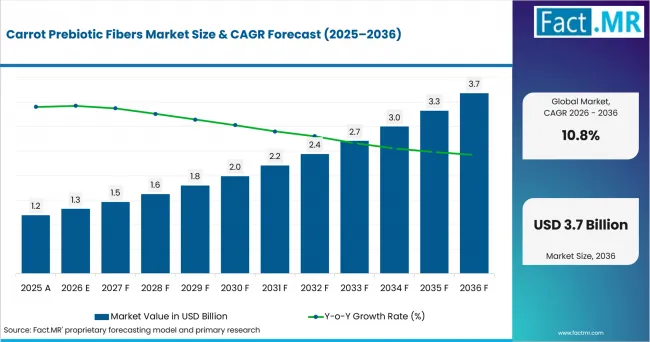
Carrot Prebiotic Fibers Market Value Analysis | Source: Fact.MR
What are the defining numbers behind Carrot Prebiotic Fibers Market growth?
USD 2.4 billion absolute opportunity by 2036, led by carrot pomace fiber, drying & milling and bakery & snacks.
- Demand Drivers in the Market
- Bakery and snack formulators need vegetable-origin fiber that improves water control while preserving familiar product labels.
- Supplement developers are expected to use carrot fiber where prebiotic positioning needs a recognizable plant source and powder compatibility.
- Pet nutrition brands are anticipated to use carrot-derived fibers in treats and dry formats where fiber content and ingredient familiarity help product positioning.
- U.S. crop availability supports upstream processing, with USDA NASS reporting in February 2026 that carrot production reached 26.7 million cwt in 2025.
- Key Segments Analyzed
- By Ingredient Type: Carrot pomace fiber is projected to hold 38.00% share in 2026 owing to side-stream availability and broad use in dry food systems.
- By Processing: Drying & milling is expected to account for 40.00% share in 2026 because it creates stable powder formats for bakery, snacks and sachets.
- By Functional Benefit: Prebiotic and fermentable fiber is anticipated to capture 31.00% share in 2026 as brands link digestive positioning with recognizable vegetable ingredients.
- By Application: Bakery & snacks are estimated to represent 28.00% share in 2026 due to high recipe flexibility and routine use of powder ingredients.
- Analyst Opinion at Fact.MR
- Shambhu Nath Jha, Principal Consultant at Fact.MR states, “Carrot prebiotic fiber is commercially interesting because it joins nutrition language with processing value. The market is expected to reward suppliers that prove fiber content, particle control and sensory fit in real recipes. Brands need vegetable identity and a powder that behaves predictably during production.”
- Strategic Implications
- Fiber suppliers should document particle size, hydration behavior and fermentable-fiber positioning so formulators can compare carrot grades with apple, citrus and cereal fibers.
- Food brands should place carrot fiber first in applications where vegetable identity adds label value and the ingredient improves water binding.
- Supplement developers should review claim language carefully. EFSA’s health-claims page, last reviewed on April 3, 2025, states that, as of 2023, more than 260 health claims had been approved for use in the EU by the European Commission.
- Pet nutrition companies should test palatability early because carrot notes and powder texture can change treat acceptance at higher inclusion levels.
The UK is expected to record 13.4% CAGR through 2036, supported by food-manufacturing scale and bakery reformulation. The USA is projected to post 12.2% CAGR through crop availability and supplement use. Germany is anticipated to reach 11.6% CAGR owing to vegetable output and plant-fiber processing depth. France is forecast to advance at 10.8% CAGR due to carrot supply and supplement declaration controls. Canada is estimated to hold 9.7% CAGR as field vegetable output supports regional formulation work.
How does the Carrot Prebiotic Fibers Market break down by segment?
Carrot pomace fiber leads at 38.00%; drying & milling leads at 40.00%.
Which Ingredient Type dominates?
Carrot pomace fiber holds 38.00% share in 2026.
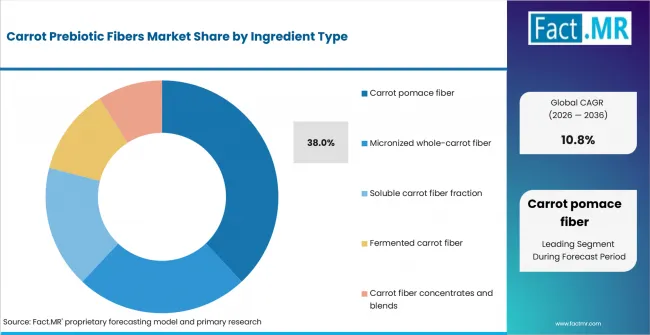
Carrot Prebiotic Fibers Market Analysis By Ingredient Type | Source: Fact.MR
Carrot pomace fiber is projected to lead the ingredient-type segment at 38.00% share in 2026 because it offers processors a practical route for using carrot side streams. Micronized whole-carrot fiber follows where formulators need color identity and a fuller vegetable story. Soluble carrot fiber fraction serves applications that need smoother mouthfeel and easier dispersion. The segment connects naturally with carrot fiber usage where brands need both fiber enrichment and recognizable plant sourcing.
What leads the Processing segment?
Drying & milling accounts for 40.00% share in 2026.
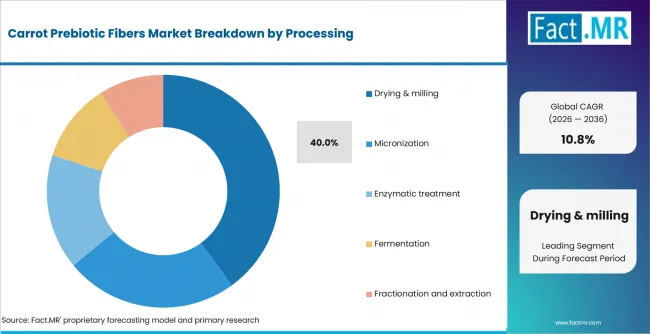
Carrot Prebiotic Fibers Market Analysis By Processing | Source: Fact.MR
Drying & milling is expected to account for 40.00% share in 2026 as powder stability remains central to bakery, snack and supplement handling. Micronization serves finer textures when grittiness must be controlled. Enzymatic treatment supports targeted functionality where formulators want improved dispersion or softer texture. Drying remains useful where processors need shelf-stable ingredients that can move from vegetable input into repeatable powder grades for industrial recipes.
How does Functional Benefit shape demand?
Prebiotic and fermentable fiber captures 31.00% share in 2026.
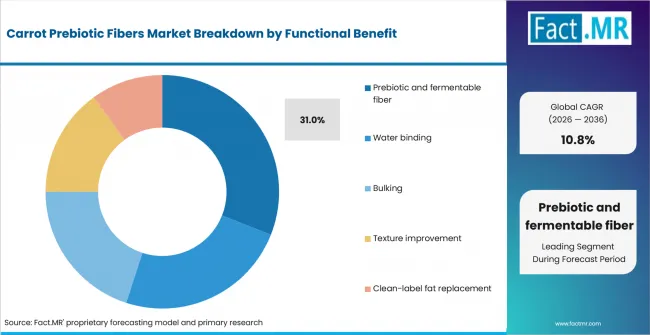
Carrot Prebiotic Fibers Market Analysis By Functional Benefit | Source: Fact.MR
Prebiotic and fermentable fiber is anticipated to capture 31.00% share in 2026 as nutrition teams seek digestive-positioned fibers with consumer-friendly plant identity. Water binding remains relevant in baked goods and pet products where moisture control affects texture. Bulking is used when brands need fiber contribution and recipe structure. These roles position carrot fiber alongside prebiotic fiber categories that rely on credible functionality and clear label language.
What supports Bakery & snacks within Application?
Bakery & snacks represent 28.00% share in 2026.
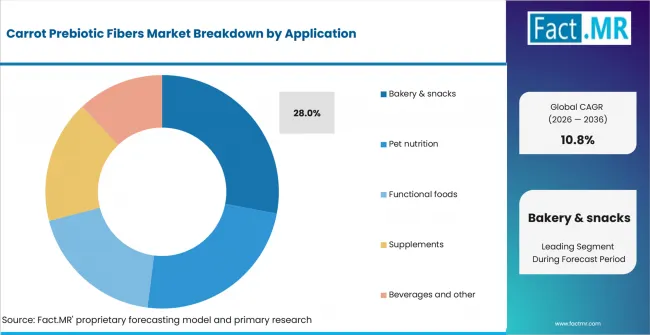
Carrot Prebiotic Fibers Market Analysis By Application | Source: Fact.MR
Bakery & snacks are estimated to represent 28.00% share in 2026 due to routine use of dry powders and room for fiber claims in everyday foods. Pet nutrition follows where vegetable fibers support treat texture and digestive-positioned messaging. Functional foods use carrot fiber in bars, mixes and convenient formats. USDA Economic Research Service reported in June 2026 that inflation-adjusted U.S. food spending reached USD 2.51 trillion in 2025, highlighting the substantial scale of the U.S. food market for ingredient and formulation applications.
What is accelerating Carrot Prebiotic Fibers Market adoption, and what is holding it back?
Clean-label fiber demand drives it; texture and claim validation restrain it.
Drivers Impact Analysis
| Driver | (~) % Impact on CAGR | Geographic Relevance | Impact Timeline |
|---|---|---|---|
| Clean-label fiber enrichment in bakery and snacks | +1.8% | North America, Western Europe | Short term (<= 2 years) |
| Vegetable side-stream use by processors | +1.4% | Europe, North America | Medium term (2-4 years) |
| Digestive-positioned supplements and functional foods | +1.2% | USA, UK, Canada | Short term (<= 2 years) |
| Pet nutrition interest in recognizable vegetable fibers | +0.9% | North America, Western Europe | Medium term (2-4 years) |
- Clean-label fiber enrichment: Bakery and snack brands are expected to use carrot fiber where fiber addition must support texture. Powder compatibility reduces reformulation friction in dry mixes and baked systems. The role aligns with food fiber applications that combine nutritional positioning with recipe function.
- Vegetable side-stream use: Carrot pomace gives processors a route to convert by-products into higher-value ingredients. Drying and milling make the material easier to store and ship. Suppliers that control microbiology and particle size are expected to gain more repeat business from larger brands.
- Digestive-positioned nutrition: Supplement and functional-food developers are projected to favor carrot fiber where plant identity helps communication. The channel fits powder-based fibers because developers can blend them into sachets, capsules and functional-food formats with clear label guidance. That audience supports continued interest in convenient fiber formats.
- Pet nutrition use: Pet brands are anticipated to use carrot fiber in treats and dry products where vegetable inclusions fit familiar label language. The ingredient can help bind moisture and support texture. Product teams still need palatability trials because carrot taste and color can influence acceptance.
Opportunity Impact Analysis
| Opportunity | (~) % Impact on CAGR | Geographic Relevance | Impact Timeline |
|---|---|---|---|
| Powder formats for bakery and snack reformulation | +1.3% | Global | Short term (<= 2 years) |
| Pet treats with recognizable vegetable ingredients | +0.9% | North America, Europe | Medium term (2-4 years) |
| Blends with other plant fibers for texture tuning | +0.7% | Global | Medium term (2-4 years) |
- Powder formats: Dry carrot fiber is likely to expand in applications that use flour, starch and flavor systems. Powder handling lets formulators trial small adjustments before wider rollout. This route links well with fruit and vegetable powder formats that serve shelf-stable product development.
- Pet treats: Treat manufacturers are expected to test carrot fiber where the ingredient provides both recognizable origin and texture support. The best fit is likely in baked treats and soft chews. Suppliers that offer palatability guidance can shorten formulation cycles.
- Plant-fiber blends: Carrot fiber can be blended with citrus, apple or cereal fibers when a recipe needs a more balanced hydration profile. The opportunity is strongest where formulators need texture improvement and fiber addition. It extends the role of dietary fiber ingredients beyond single-source systems.
Restraints Impact Analysis
| Restraint | (~) % Impact on CAGR | Geographic Relevance | Impact Timeline |
|---|---|---|---|
| Color and flavor limits in light formulations | -0.6% | Global | Short term (<= 2 years) |
| Health-claim and prebiotic substantiation burden | -0.5% | Europe, North America | Medium term (2-4 years) |
| Competing fibers with established technical files | -0.4% | Global | Medium term (2-4 years) |
- Color and flavor limits: Carrot fiber can change the appearance of pale bakery fillings, beverage powders and supplements. Higher inclusion rates can add vegetable notes. These limits make early sensory testing central to adoption.
- Claim substantiation: Prebiotic positioning is constrained by evidence requirements and local claim rules. The burden is heavier in supplement and functional-food channels. Brands therefore ask for fermentability data, fiber method details and label guidance before approving a new grade.
- Competing fiber systems: Apple, citrus, wheat and cellulose fibers have established usage histories in many food plants. Carrot fiber must prove equal or better performance in target recipes. Suppliers need application data that shows when carrot origin adds value beyond texture alone.
Which countries are scaling Carrot Prebiotic Fibers Market through 2036?
- The country comparison spans 3.68 percentage points across the forecast period.
- The UK remains 1.20 percentage points above the USA through food-manufacturing scale and snack reformulation.
- The USA remains 0.64 percentage point above Germany as crop availability and supplement use support market entry.
- Germany remains 0.76 percentage point above France through carrot output and plant-fiber processing depth.
- France remains 1.08 percentage points above Canada as carrot supply and supplement declaration systems shape demand.
- Canada closes the displayed range through vegetable production growth and natural-health-product discipline.
Comparable CAGRs create different entry conditions due to crop supply, food-manufacturing scale, claim control and application fit. Full report coverage includes North America, Latin America, Western Europe, Eastern Europe, East Asia, South Asia & Pacific, Middle East & Africa.
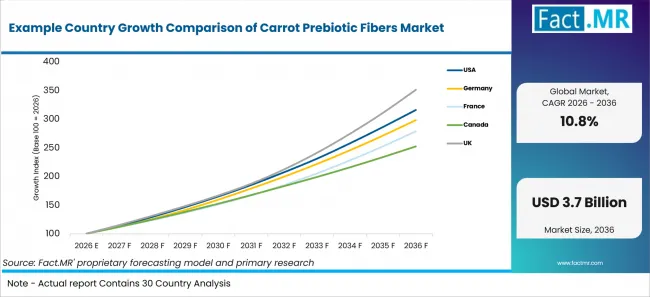
Example Country Growth Comparison Of Carrot Prebiotic Fibers Market | Source: Fact.MR
| Country | CAGR (2026-2036) |
|---|---|
| United Kingdom | 13.4% |
| United States | 12.2% |
| Germany | 11.6% |
| France | 10.8% |
| Canada | 9.7% |
What supports the United Kingdom outlook?
13.4% CAGR, supported by food-manufacturing scale and bakery/snack reformulation.
UK food manufacturing gives carrot fiber suppliers a clear route into bakery and snack systems. The UK to record a 13.4% CAGR through 2036. ONS reported in July 2026 that manufacture of food represented 22.9% of total UK manufacturers' sales in 2025.
How is the United States scaling demand?
12.2% CAGR, driven by crop availability and supplement use.
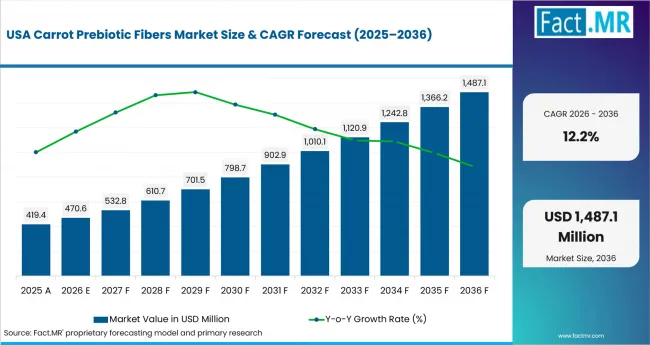
Carrot Prebiotic Fibers Market Country Value Analysis | Source: Fact.MR
U.S. food and supplement developers already sell into a broad nutrition audience. The USA to post a 12.2% CAGR through 2036. CDC NCHS reported in May 2026 that 60.2% of U.S. adults age 20 and older used any dietary supplement in the past 30 days during August 2021–August 2023.
What supports Germany's growth?
11.6% CAGR, backed by vegetable output and plant-fiber processing depth.
Germany combines vegetable supply with established plant-fiber know-how. Germany to reach an 11.6% CAGR through 2036. Destatis reported in February 2026 that Germany’s carrot harvest reached 865,678.7 tonnes in 2025.
What underpins France's outlook?
10.8% CAGR, shaped by carrot supply and supplement declaration controls.
France has a direct carrot supply base for vegetable-derived fiber ingredients. France to advance at a 10.8% CAGR through 2036. Agreste reported in April 2026 that French fresh-market carrot production was projected at 368,000 tonnes for the 2025–2026 campaign.
How is Canada developing demand?
9.7% CAGR, led by vegetable production growth and natural-health-product controls.
Canada's field vegetable base supports carrot-derived fiber applications in food and nutrition products. Canada to record a 9.7% CAGR through 2036. Statistics Canada reported in February 2026 that total vegetable production increased 8.0% to 2.6 billion kilograms in 2025, providing vegetable-supply context for the analysis.
Who leads the Carrot Prebiotic Fibers Market?
Ingredion is a direct exact-match provider identified in public company evidence. On June 2, 2026, Ingredion acquired BeniCaros®, a patented prebiotic fiber made from upcycled carrot pomace and positioned for immune-health applications.
VanRijsingenGreen directly offers KaroPRO®, a functional carrot fiber made from carrot pomace with high water-binding capacity. Its public product materials position KaroPRO® around functional fiber performance, including texture, mouthfeel and viscosity, while explicit prebiotic positioning is established separately by Ingredion’s BeniCaros®.
Which companies are the key providers?
Key companies include Ingredion, VanRijsingenGreen, PEKTOS AG, Bolthouse Fresh, and Fiberk.
- Ingredion
- VanRijsingenGreen
- PEKTOS AG
- Bolthouse Fresh
- Fiberk
Bibliography
- Stierman, B., Couch, C. A., Gahche, J. J., & Mishra, S. (2026, May 21). Dietary supplement use: United States, August 2021–August 2023 (NCHS Data Brief No. 561). National Center for Health Statistics.
- European Food Safety Authority. (2025, April 3). Health claims.
- Federal Statistical Office (Destatis). (2026, February 26). Holdings, agricultural area, yield and harvest volume 2025.
- Raulo, S., & Leduc, J. (2026, April 28). Carotte. De bons volumes en 2025-2026, mais une valorisation limitée. Agreste.
- Office for National Statistics. (2026, July 24). UK manufacturers' sales by product: 2025.
- Statistics Canada. (2026, February 16). Fruit and vegetable production, 2025.
- Zeballos, E., & Sinclair, W. (2026, June 11). Total U.S. food spending reached $2.51 trillion in 2025. Economic Research Service, U.S. Department of Agriculture.
- U.S. Department of Agriculture, National Agricultural Statistics Service. (2026, February 12). Vegetables 2025 summary.
- Ingredion Incorporated. (2026, June 2). Ingredion acquires Benicaros® -- a prebiotic fiber that supports immune health at extremely low daily dosage/intake.
This Report Answers
- The report explains where carrot prebiotic fibers are used across ingredient type and processing route.
- Segment analysis identifies the leading subsegments and the formulation reasons behind their shares. It connects carrot systems with adjacent insoluble dietary fiber use where water binding and bulking matter.
- Country analysis examines the listed markets and the food, supplement and crop mechanisms that support adoption. It considers how fruit and vegetable processing supports ingredient availability.
- Competitive analysis reviews providers across vegetable fibers, prebiotic fibers and application formulation. It places broad fiber suppliers beside carrot-specific ingredient formats.
- Application analysis assesses carrot fiber use in bakery and snack formulations. The section covers supplement, pet nutrition and beverage use cases.
- It compares carrot fiber with soluble corn fiber ingredients and low-fermentability dietary fibers where tolerance and texture are central.
What does the Carrot Prebiotic Fibers Market cover?
The Carrot Prebiotic Fibers Market covers carrot-derived fibers used to add fiber content and improve recipe function. It includes carrot pomace fiber and micronized whole-carrot fiber. Soluble carrot fiber fraction, fermented carrot fiber and carrot fiber blends are included for foods, supplements and pet nutrition.
The assessment covers ingredient formats that are sold as powders, concentrates or blends. It reviews applications that overlap with fruit and vegetable powder systems and fiber-forward formulations where brands need recognizable fiber sources.
What is included in the scope?
The scope includes carrot-derived fibers used for prebiotic and fermentable-fiber positioning. Water binding, bulking, texture improvement and clean-label fat replacement are covered. Included products are dry milled and micronized carrot fibers. Enzyme-treated, fermented and fractionated carrot fibers are covered.
It covers ingredient sales into bakery and snacks. Coverage extends to pet nutrition; functional foods; supplements; beverages; and other formulated products. The buyer base includes food manufacturers, supplement developers, pet nutrition brands and ingredient distributors.
What is excluded from the scope?
The scope excludes fresh carrots sold for direct consumption and carrot juice sold as a finished beverage. Isolated vitamins, synthetic prebiotics and unrelated fiber systems fall outside coverage when carrot origin is absent from the ingredient offer.
General dietary-fiber markets are discussed only where they provide context for carrot-based fiber use. Broader dietary fiber ingredients and food fiber categories remain outside the revenue boundary unless carrot-derived material is part of the product.
How Was the Analysis Built?
The analysis draws on 120+ sources, 35+ company portfolios, 25+ countries, and more than 20 industry interviews.
- Primary Research: Primary research includes discussions with manufacturers, service providers, technology developers, distributors, end users, and subject-matter experts. These conversations examine purchasing priorities, product adoption, operational challenges, approval requirements, competitive positioning, and the factors that influence wider market acceptance.
- Desk Research: Desk research covers government statistics, regulatory publications, company filings, trade data, technical studies, industry associations, standards, public policy, and other authoritative sources. Every source used in the analysis is documented in the bibliography.
- Market Sizing and Forecasting: Market estimates combine historical performance, demand indicators, pricing and volume trends, segment shares, company participation, country-level growth, adoption patterns, investment activity, and barriers to market expansion.
- Data Validation and Update Cycle: Findings are validated by comparing primary interviews with public data, company activity, regulatory changes, trade patterns, and industry developments. Regular updates review new product launches, capacity changes, partnerships, approvals, and shifts in commercial adoption.
What is the report's scope and coverage?
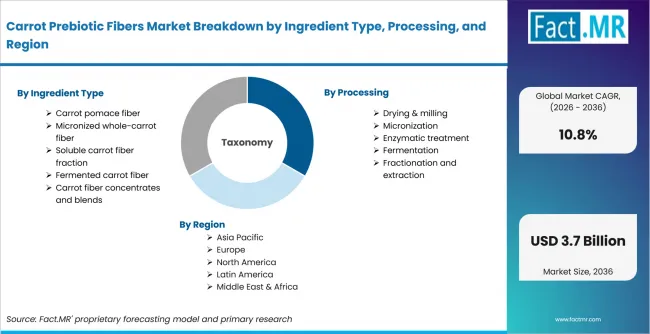
Carrot Prebiotic Fibers Market Breakdown By Ingredient Type, Processing, And Region | Source: Fact.MR
| Attribute | Details |
|---|---|
| Quantitative Units | USD billion in 2026 to USD billion by 2036 at a CAGR |
| Market Definition | Carrot-derived fiber ingredients used for prebiotic positioning, water binding, bulking, texture improvement and clean-label fat replacement in food, supplement and pet nutrition applications. |
| Ingredient Type | Carrot pomace fiber; Micronized whole-carrot fiber; Soluble carrot fiber fraction; Fermented carrot fiber; Carrot fiber concentrates and blends |
| Processing | Drying & milling; Micronization; Enzymatic treatment; Fermentation; Fractionation and extraction |
| Functional Benefit | Prebiotic and fermentable fiber; Water binding; Bulking; Texture improvement; Clean-label fat replacement |
| Application | Bakery & snacks; Pet nutrition; Functional foods; Supplements; Beverages and other |
| Regions Covered | North America; Latin America; Western Europe; Eastern Europe; East Asia; South Asia & Pacific; Middle East & Africa |
| Countries Covered | United States; Germany; France; Canada; United Kingdom |
| Key Companies Profiled | Ingredion; VanRijsingenGreen; PEKTOS AG; Bolthouse Fresh; Fiberk |
| Forecast Period | 2026 to 2036 |
| Approach | Hybrid top-down and bottom-up approach using carrot processing output, fiber formulation use, application mix, country demand indicators and provider portfolio review. |
How is the market segmented?
-
By Ingredient Type
- Carrot pomace fiber
- Micronized whole-carrot fiber
- Soluble carrot fiber fraction
- Fermented carrot fiber
- Carrot fiber concentrates and blends
-
By Processing
- Drying & milling
- Micronization
- Enzymatic treatment
- Fermentation
- Fractionation and extraction
-
By Functional Benefit
- Prebiotic and fermentable fiber
- Water binding
- Bulking
- Texture improvement
- Clean-label fat replacement
-
By Application
- Bakery & snacks
- Pet nutrition
- Functional foods
- Supplements
- Beverages and other
-
By Region
- North America
- Latin America
- Western Europe
- Eastern Europe
- East Asia
- South Asia & Pacific
- Middle East & Africa