- Market Value (2025): USD 2.73 Mn
- Estimated Value (2026): USD 2.89 Mn
- Forecast Value (2036): USD 5.02 Mn
- CAGR (2026-2036): 5.7%
What is the Cartoning Equipment Market forecast to be worth by 2036?
USD 2.89 billion in 2026 to USD 5.02 billion by 2036 at a 5.7% CAGR.
- As per Fact.MR analysis, the cartoning equipment market reached USD 2.73 billion in 2025.
- Demand will increase from USD 2.89 billion in 2026 to USD 5.02 billion by 2036.
- The market is forecast to grow at a 5.7% CAGR from 2026 to 2036 as packaged food and pharmaceutical plants upgrade secondary packing lines.
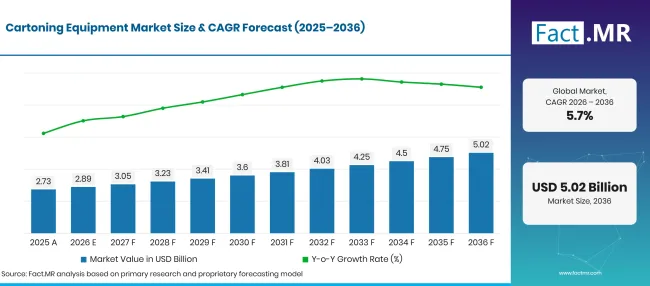
Factmr Cartoning Equipment Market Forecast Global | Source: Fact.MR
| Year | Basis | Market Value (USD billion) |
|---|---|---|
| 2025 | Actual | 2.74 |
| 2026 | Estimate | 2.90 |
| 2036 | Forecast | 5.00 |
| CAGR 2026 to 2036 | Forecast period | 5.7% |
Source: Fact.MR analysis. Updated Oct 13, 2026
What are the defining numbers behind Cartoning Equipment Market growth?
USD 2.1 billion in absolute chance between 2026 and 2036.
- Demand Drivers in the Market
- Food producers need cartoning machines that can handle different pack sizes without slowing production. Machine selection depends on how smoothly products move from the feeder into a closed carton.
- British food processors run a wide range of packaging lines with different carton sizes and closing styles. Equipment suppliers can improve sales by showing reliable performance during format changes in everyday factory conditions.
- Packaging teams compare a machine's operating range with the carton sizes used in production. Horizontal machines are suitable for products that move in a continuous flow, while vertical machines are used for products loaded from the top.
- Pharmaceutical manufacturers place strong focus on accurate carton coding and reliable leaflet insertion. Fault detection and batch-change checks remain key areas during equipment approval.
- Key Segments Analyzed
- By Product Type: Horizontal Cartoning Machines holds 42.7% share in 2026 because side-loading works with established high-volume packing layouts.
- By Application: Food and Beverage represents 38.2% share in 2026, reflecting routine secondary packing of shelf-ready goods.
- By Automation Level: Automatic machines capture 62.3% share in 2026 as plants look to link forming and closing functions.
- By End-User: Food and Beverage Industry represents 37.6% share in 2026, with repeat orders tied to factory line upgrades.
- Analyst Opinion at Fact.MR
- Shambhu Nath Jha, Principal Consultant at Fact.MR, states, “Cartoners are evaluated as part of the overall packaging line because feeder timing and carton size affect production output. Manufacturers prefer equipment that can handle different product formats and comes with reliable service support.”
- Strategic Implications
- Equipment manufacturers can clearly explain changeover steps and specify the carton types each machine can handle. Clear specifications make it easier for plants to compare options before testing equipment.
- Food processors need to check whether carton loading matches the speed of upstream packaging equipment and allows a smooth restart after each format change. Proper planning helps maintain production output.
- Pharmaceutical packaging teams need to review leaflet insertion and code inspection along with carton closing. These checks help maintain accuracy across medicine packs.
- Service teams need to keep commonly used spare parts readily available and train technicians to identify feeding issues before they disrupt the packaging line.
Germany is forecast to grow at a CAGR of 7.0% as manufacturers invest in automation upgrades. The United Kingdom follows with 6.5% growth, while Japan is projected to grow at 5.3%. The United States is estimated at 4.6%, and Brazil at 4.0%, reflecting differences in production capacity and equipment replacement plans.
How does the Cartoning Equipment Market break down by segment?
Horizontal Cartoning Machines 42.7%; Food and Beverage 38.2%; Automatic 62.3%; Food and Beverage Industry 37.6%.
Which Product Type dominates?
Horizontal Cartoning Machines account for 42.7% share in 2026.
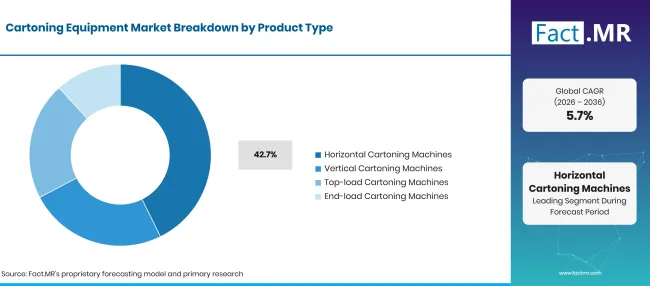
Factmr Cartoning Equipment Market Breakdown Product Type | Source: Fact.MR
| Product Type | Share (2026) |
|---|---|
| Horizontal Cartoning Machines (Leading segment) | 42.7% |
| Other segments combined | 57.3%* |
| Total | 100.0% |
Source: Fact.MR analysis. Updated Oct 13, 2026
Horizontal cartoners are used on production lines where products move in a steady flow and are loaded into cartons from the side. Operators compare feeding accuracy and the time required to change between carton sizes.
Vertical machines use a different loading method, with products entering from the top. Top-load machines handle products arranged in groups, while end-load machines are used for products that need to be pushed into the carton.
What leads the Application segment?
Food and Beverage holds 38.2% share in 2026.
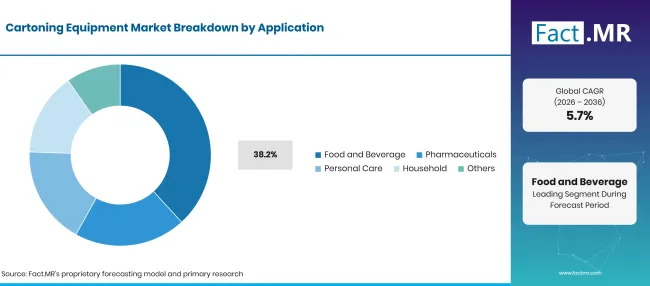
Factmr Cartoning Equipment Market Breakdown Application | Source: Fact.MR
| Application | Share (2026) |
|---|---|
| Food and Beverage (Leading segment) | 38.2% |
| Other segments combined | 61.8%* |
| Total | 100.0% |
Source: Fact.MR analysis. Updated Oct 13, 2026
Food processors use folding cartons to pack products for store shelves and movement within production facilities. Different carton materials and closing styles influence equipment requirements. Pharmaceutical manufacturers place strong focus on product protection and accurate printed information on packs.
Personal care companies pay close attention to carton appearance and product protection. Household goods manufacturers choose machines that can handle different product shapes while keeping production costs under control.
How does Automation Level shape sales?
Automatic equipment represents 62.3% share in 2026.
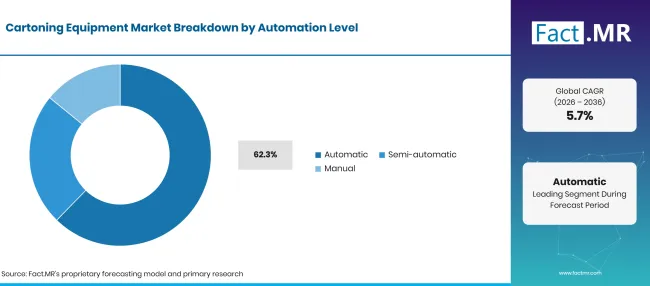
Factmr Cartoning Equipment Market Breakdown Automation Level | Source: Fact.MR
| Automation Level | Share (2026) |
|---|---|
| Automatic (Leading segment) | 62.3% |
| Other segments combined | 37.7%* |
| Total | 100.0% |
Source: Fact.MR analysis. Updated Oct 13, 2026
Automatic cartoners help companies pack products faster and with less manual effort. Semi-automatic machines are often used for shorter production runs where operators still play a part in the process.
Manual packing remains suitable for low-volume products or items that need careful placement. Manufacturers usually compare workforce requirements and format-change time before choosing a machine. Easy access for maintenance can also help keep operating costs under control.
Which End-User segment accounts for the largest share?
Food and Beverage Industry leads with 37.6% share in 2026.
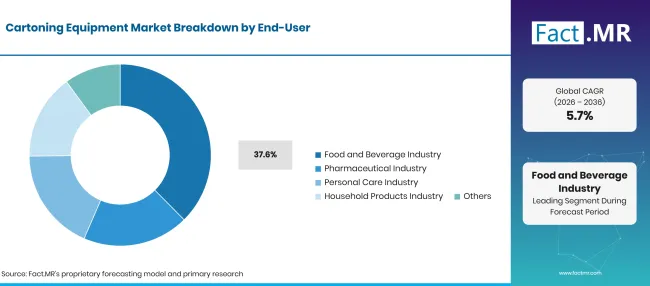
Factmr Cartoning Equipment Market Breakdown End User | Source: Fact.MR
| End-User | Share (2026) |
|---|---|
| Food and Beverage Industry (Leading segment) | 37.6% |
| Other segments combined | 62.4%* |
| Total | 100.0% |
Source: Fact.MR analysis. Updated Oct 13, 2026
Food and beverage producers use cartoners to pack products neatly before distribution. Pharmaceutical companies often include extra checks during packaging, especially for printed codes and enclosed leaflets. Personal care manufacturers choose machines that maintain good pack appearance and handle small products carefully.
Household goods producers need equipment that can work with different carton sizes and product shapes. Reliable service support becomes important when multiple shifts depend on the same packaging line.
What is accelerating Cartoning Equipment Market adoption, and what is holding it back?
Easy integration with existing production lines supports equipment sales. However, the cost of format changes and the risk of production interruptions influence investment decisions.
Drivers Impact Analysis
| Driver | (~) % Impact on CAGR | Geographic Relevance | Impact Timeline |
|---|---|---|---|
| Automatic line integration | +1.0% | Global | Medium term |
| Packaging format changes | +0.8% | Western Europe, North America | Medium term |
| Food packaging output | +0.7% | Global | Short term |
| Pack inspection integration | +0.5% | Global | Long term |
Source: Fact.MR analysis. Updated Oct 13, 2026
Opportunity Impact Analysis
| Opportunity | (~) % Impact on CAGR | Geographic Relevance | Impact Timeline |
|---|---|---|---|
| Modular changeover systems | +0.7% | Global | Medium term |
| Pharma secondary packing | +0.5% | Western Europe, East Asia | Medium term |
| Retrofit controls | +0.4% | North America, Europe | Short term |
| Compact production lines | +0.3% | Global | Long term |
Source: Fact.MR analysis. Updated Oct 13, 2026
Restraints Impact Analysis
| Restraint | (~) % Impact on CAGR | Geographic Relevance | Impact Timeline |
|---|---|---|---|
| Capital spending constraints | -0.7% | Global | Short term |
| Installation downtime | -0.5% | Global | Medium term |
| Carton format complexity | -0.4% | Global | Medium term |
| Maintenance skills gaps | -0.3% | Emerging markets | Long term |
Source: Fact.MR analysis. Updated Oct 13, 2026
Which countries are scaling the Cartoning Equipment Market through 2036?
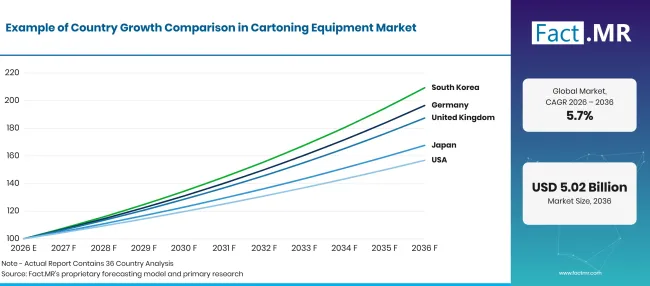
Factmr Cartoning Equipment Market Growth Index | Source: Fact.MR
| Country | CAGR (2026–2036) |
|---|---|
| Germany | 7.0% |
| United Kingdom | 6.5% |
| Japan | 5.3% |
| United States | 4.6% |
| Brazil | 4.0% |
Source: Fact.MR analysis. Updated Oct 13, 2026
What supports cartoning equipment adoption in Germany?
7.0% CAGR, shaped by prepared food output and machinery integration.
German food and pharmaceutical manufacturers use cartoners that can handle frequent pack-size changes and maintain reliable product loading. Destatis reported ready-meal production of EUR 4.5 billion in the first three quarters of 2025 [1]. Manufacturing orders also increased by 7.8% in December 2025 [4]. Before approving new equipment, buyers review leaflet handling, inspection features, maintenance access, carton-size flexibility, and compatibility with existing production lines.
What supports cartoning equipment adoption in the United Kingdom?
6.5% CAGR, shaped by food production and diversified packaging lines.
UK food processors use cartoners that can handle changing retail pack sizes while maintaining good sealing quality. The Office for National Statistics reported that food manufacturing accounted for 22.9% of manufacturers’ sales in 2025 [2]. Food and drink manufacturing also generated GBP 39.3 billion in gross value added during 2024 [5]. Equipment purchases depend on service support, available floor space, carton handling, and the flexibility needed across different packaging lines.
What supports cartoning equipment adoption in Japan?
5.3% CAGR, shaped by compact factory layouts and precision handling.
Japanese manufacturers use compact cartoners that fit existing factory layouts and handle products accurately. The Statistics Bureau reported employment of 68.49 million in August 2026 [6], making workforce efficiency a consideration in automation decisions. METI also published 2025 production statistics for food-processing and packaging machinery [9].
What supports cartoning equipment adoption in the United States?
4.6% CAGR, shaped by equipment renewal across food and pharmaceutical plants.
U.S. manufacturers compare cartoners based on speed, checking features, and how easily they fit into existing production lines. The Census Bureau reported manufacturing shipments of USD 598.7 billion in April 2025 [3], showing the size of the manufacturing industry. Pharmaceutical companies review coding and error-detection features, while food brands prefer machines that are easy to use across different plants.
What supports cartoning equipment adoption in Brazil?
4.0% CAGR, shaped by food-processing capacity and gradual automation.
Brazilian food processors add automatic cartoners step by step while continuing to use packaging equipment. IBGE reported raw milk purchases of 27.51 billion litres in 2025 [7], providing a large base for dairy packaging. Industrial production also increased 1.8% in January 2026 [8]. Buyers look at financing costs, local service support, and staff training.
Who leads the Cartoning Equipment Market?
Competition will include specialist cartoner manufacturers as well as broader packaging equipment companies. I.M.A. Industria Macchine Automatiche S.p.A., Marchesini Group S.p.A., and Syntegon Technology GmbH will serve pharmaceutical packaging applications. Coesia S.p.A. and R.A Jones will operate in packaged-goods machinery. Douglas Machine Inc. and Bradman Lake Group will provide cartoning and related secondary packaging solutions. Buyers will compare machine design and service support before making a selection.
The difference between suppliers will often become clearer after installation. A food processor will assess how well carton feeding matches existing product flow, while a pharmaceutical facility will focus on inspection systems and batch records. Tetra Pak International S.A. and Krones AG will remain broader processing and packaging equipment suppliers. The historical Bosch Packaging Technology name will continue to be linked to the business now operating as Syntegon, and both will be treated as part of the same corporate lineage in market analysis.
Which companies are the key providers?
Key companies include Syntegon Technology GmbH; Tetra Pak International S.A.; Krones AG; Coesia S.p.A.; I.M.A. Industria Macchine Automatiche S.p.A.; Marchesini Group S.p.A.; Douglas Machine Inc.; Bradman Lake Group; and R.A Jones.
- Syntegon Technology GmbH (formerly Bosch Packaging Technology)
- Tetra Pak International S.A.
- Krones AG
- Coesia S.p.A.
- I.M.A. Industria Macchine Automatiche S.p.A.
- Marchesini Group S.p.A.
- Douglas Machine Inc.
- Bradman Lake Group
- R.A Jones
Bibliography
- [1] Statistisches Bundesamt (Destatis). (2026, January 14). Produktion von Fertiggerichten binnen fünf Jahren mengenmäßig um 25,6 % gestiegen.
- [2] Office for National Statistics. (2026, July 24). UK manufacturers’ sales by product: 2025.
- [3] U.S. Census Bureau. (2025, June 3). Monthly full report on manufacturers’ shipments, inventories and orders: April 2025.
- [4] Statistisches Bundesamt (Destatis). (2026, February 5). New orders in manufacturing in December 2025: +7.8% on the previous month.
- [5] Department for Environment, Food & Rural Affairs. (2026, July 29). Food statistics in your pocket.
- [6] Statistics Bureau of Japan. (2026, October 2). Labour Force Survey: August 2026.
- [7] Instituto Brasileiro de Geografia e Estatística. (2026, March 18). Em 2025, Brasil registra a maior produção de leite, couro e ovos da história; abate de bovinos, frangos e suínos também é recorde.
- [8] Instituto Brasileiro de Geografia e Estatística. (2026, March 6). Industrial production up 1.8% in January.
- [9] Ministry of Economy, Trade and Industry. (2026, June 30). 2025 annual report: Time-series table 2140—Food-processing machinery, packaging machinery and packing machinery [Data set]. e-Stat.
This Report Answers
- How the product type and loading orientation of cartoners affect plant installation decisions.
- Why food and beverage factories represent an established customer group for carton automation.
- Which automation choices fit continuous production and shorter packaging runs.
- How the five covered countries differ in packaging investment conditions.
- Which equipment makers serve carton loading and downstream packing needs.
What does the Cartoning Equipment Market cover?
The market covers cartoners that erect, load and close folding cartons for packed goods. It includes automatic and semi-automatic equipment as well as manually assisted machines. Related case packing machines belong to a separate downstream category. Finished cartons can move from a cartoner to case packing machines at the next packing stage.
Related folding carton packaging uses pre-scored board to create the retail pack handled by a cartoning machine. Carton board properties and blank design influence feeding and closing settings.
What is included in the scope?
Equipment revenue includes carton-forming and product-loading functions within commercially sold cartoning systems. Change parts supplied with equipment are treated as machine components. Related machinery retrofit modules may extend the working life of existing production lines.
Controls upgrades can extend machine usefulness when the existing mechanical cartoner remains in good condition. Equipment makers often review feeders and carton handling before proposing a replacement.
What is excluded from the scope?
The scope excludes standalone carton board production and printing. It also excludes filling systems that make primary packs without loading them into folding cartons. Separate case packers, palletizers and warehouse sortation equipment are outside the direct revenue boundary.
Case packing is a downstream task in which finished consumer cartons are placed inside outer shipping cases. It is separate from the cartoning machine scope.
How Was the Analysis Built?
The analysis draws on 120+ sources, 35+ company portfolios, 25+ countries, and more than 20 industry interviews.
- Primary Research: Primary research includes discussions with manufacturers, service providers, technology developers, distributors, end users, and subject-matter experts. These conversations examine purchasing priorities, product adoption, operational challenges, approval requirements, competitive positioning, and the factors that influence wider market acceptance.
- Desk Research: Desk research covers government statistics, regulatory publications, company filings, trade data, technical studies, industry associations, standards, public policy, and other authoritative sources. Every source used in the analysis is documented in the bibliography.
- Market Sizing and Forecasting: Market estimates combine historical performance, demand indicators, pricing and volume trends, segment shares, company participation, country-level growth, adoption patterns, investment activity, and barriers to market expansion.
- Data Validation and Update Cycle: Findings are validated by comparing primary interviews with public data, company activity, regulatory changes, trade patterns, and industry developments. Regular updates review new product launches, capacity changes, partnerships, approvals, and shifts in commercial adoption.
Segmentation
What is the report’s scope and coverage?
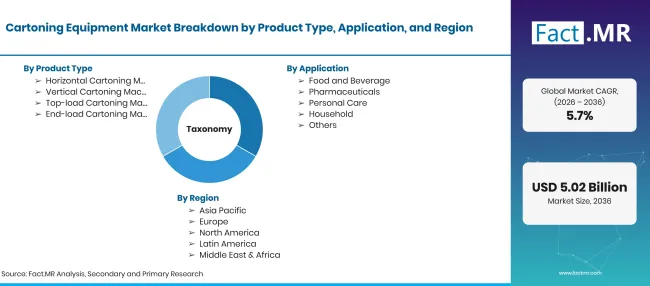
Factmr Cartoning Equipment Market Taxonomy | Source: Fact.MR
| Attribute | Details |
|---|---|
| Quantitative Units | USD billion in 2026 to USD billion by 2036 at CAGR |
| Market Definition | Equipment that erects folding cartons, inserts products and closes packs within secondary packaging operations. |
| Product Type | Horizontal Cartoning Machines; Vertical Cartoning Machines; Top-load Cartoning Machines; End-load Cartoning Machines |
| Application | Food and Beverage; Pharmaceuticals; Personal Care; Household; Others |
| Automation Level | Automatic; Semi-automatic; Manual |
| End-User | Food and Beverage Industry; Pharmaceutical Industry; Personal Care Industry; Household Products Industry; Others |
| Regions Covered | North America; Latin America; Western Europe; Eastern Europe; East Asia; South Asia & Pacific; Middle East & Africa |
| Countries Covered | Germany; United Kingdom; Japan; United States; Brazil |
| Forecast Period | 2026 to 2036 |
| Approach | Comparative review of secondary packaging applications, machine configurations and end-user purchasing factors. |
Source: Fact.MR analysis. Updated Oct 13, 2026
How is the market segmented?
-
By Product Type
- Horizontal Cartoning Machines
- Vertical Cartoning Machines
- Top-load Cartoning Machines
- End-load Cartoning Machines
-
By Application
- Food and Beverage
- Pharmaceuticals
- Personal Care
- Household
- Others
-
By Automation Level
- Automatic
- Semi-automatic
- Manual
-
By End-User
- Food and Beverage Industry
- Pharmaceutical Industry
- Personal Care Industry
- Household Products Industry
- Others
-
By Region
- North America
- Latin America
- Western Europe
- Eastern Europe
- East Asia
- South Asia & Pacific
- Middle East & Africa
Frequently Asked Questions
How big is the cartoning equipment market in 2026?
What is the forecast CAGR for cartoning equipment?
Which product type holds the main share?
Who are the main companies in the Cartoning Equipment market?
Who worked on this report


Preview the report firsthand - request a free sample
Free SampleGet the brochure for pricing and purchase details
Download PDF