- Market Value (2025): USD 18.2 Bn
- Estimated Value (2026): USD 19.0 Bn
- Forecast Value (2036): USD 30.0 Bn
- CAGR (2026-2036): 4.7%
What is the Casement Windows Market forecast to be worth by 2036?
USD 19.0 billion in 2026 to USD 30.0 billion by 2036 at a 4.7% CAGR.
- The casement windows market stood at USD 18.2 billion in 2025, with homes accounting for most installed units.
- By 2036, revenue will reach USD 30.0 billion, up from USD 19.0 billion in 2026, as owners of older buildings trade single-pane and drafty units for sealed, insulated ones.
- A 4.7% CAGR will hold from 2026 to 2036, helped by tighter building energy codes in Europe and North America.
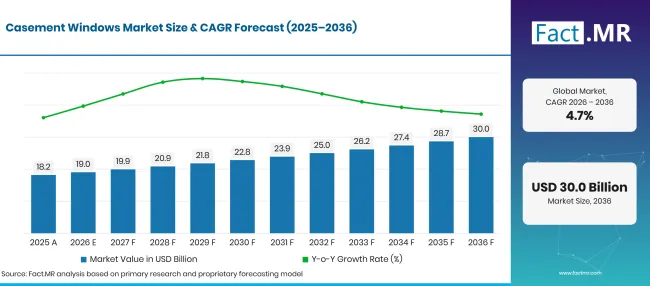
Casement Windows Market Forecast Global | Source: Fact.MR
| Year | Basis | Market Value (USD billion) |
|---|---|---|
| 2025 | Actual | 18.2 |
| 2026 | Estimate | 19.0 |
| 2036 | Forecast | 30.0 |
| CAGR 2026 to 2036 | Forecast period | 4.7% |
Source: Fact.MR analysis. Updated Oct 30, 2026
What are the defining numbers behind Casement Windows Market growth?
The 2026 to 2036 period adds USD 11.0 billion in new value, led by uPVC frames and residential replacement work.
- Demand Drivers in the Market
- Window upgrades cut energy use in buildings that are already standing. Lawrence Berkeley National Laboratory found in February 2025 that upgrading windows in existing U.S. commercial buildings could reduce site energy use by 4% to 6% in typical buildings and by up to 26% in buildings with the greatest potential [1]. Owners can capture those savings during a refit without rebuilding the facade.
- Renovation keeps window volumes steady even when new building slows. Germany’s window and facade association put the national window market at 12.75 million standard units in 2024 and forecast 13.11 million units in 2026, with renovation covering almost 70% of demand [2]. Casement and tilt-turn sashes share most of that refit work in Central Europe.
- Building energy rules are tightening across the European Union. In July 2026, the European Commission opened infringement steps against all 27 member states for not fully transposing the recast Energy Performance of Buildings Directive, and it noted that the EU annual energy renovation rate stands at only 1% [3]. National renovation plans under the directive will steer more homeowners toward certified, low-leakage windows.
- Triple glazing is moving down into value product lines. In October 2025, Andersen added a triple-pane glass option to its 100 Series casement, awning and picture windows, aimed at builders who must meet stricter energy codes [4]. Wider access to triple panes lets mid-priced projects reach performance levels once limited to premium frames.
- Low upkeep favors uPVC frames in rental and owner-occupied housing. Vinyl profiles do not need painting, resist moisture and accept laminated wood-look finishes.
- Key Segments Analyzed
- By Product Type: uPVC will hold 78.5% share in 2026, since extruded multi-chamber profiles give good insulation at a lower price than wood or aluminum.
- By Application: Residential Use will account for 62.5% share in 2026, owing to replacement projects in older houses and steady flows of new apartments.
- By Glazing Type: Double Glazed will capture 55.7% share in 2026, as two-pane sealed units meet most current energy codes at a moderate cost.
- Analyst Opinion at Fact.MR
- Shambhu Nath Jha, Principal Consultant at Fact.MR, states, “Casement windows win where buyers want an airtight seal and a full opening for fresh air, and that pairing is hard for sliding formats to match. uPVC will keep the bulk of volume because fabricators can turn profiles into finished units quickly and at low cost. The next gains will come from triple glazing and better installation practice in renovation, where most of the stock is still poorly insulated.”
- Strategic Implications
- Window fabricators should publish tested U-values, air permeability and water tightness for each casement size, since energy-code checks now ask for certified figures.
- Profile extruders should expand recycled-content uPVC and wood-look laminates that let one system serve both budget and heritage-style homes.
- Glass processors should prepare insulating-glass capacity for triple-pane units as value window lines begin to offer them.
- Installers and dealers should train crews in airtight fitting and offer clear warranties, given that poor installation erases much of the gain from a high-performance frame.
Germany will grow at 5.4%, where renovation work keeps window volumes steady despite weak new building. Brazil follows at 4.9% with federal social housing contracts feeding demand for low-cost frames. The United States will advance at 4.5% as replacement projects and code updates lift sales of insulated units. A 4.0% pace in the United Kingdom reflects home upgrades funded through energy-efficiency schemes. Japan rounds out the group at 3.5%, with subsidies for insulated window retrofits offsetting fewer housing starts.
How does the Casement Windows Market break down by segment?
uPVC will lead Product Type at 78.5%; Residential Use will top Application at 62.5%; Double Glazed will head Glazing Type at 55.7%.
Which Product Type leads?
uPVC takes 48.2% of 2026 sales.
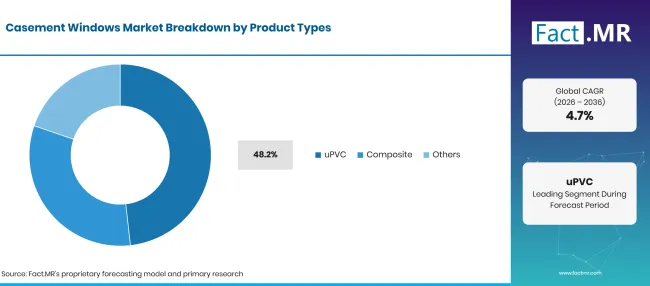
Casement Windows Market Breakdown Product Types | Source: Fact.MR
| Product Type | Share (2026) |
|---|---|
| uPVC (Leading segment) | 78.5% |
| Other segments combined | 21.5%* |
| Total | 100.0% |
Source: Fact.MR analysis. Updated Oct 30, 2026
Fabricators prefer PVC-U profiles because they cut, weld and assemble them in-house with standard equipment. Multi-chamber extrusions with steel reinforcement keep sashes rigid and hold U-values down. Most frames start as uPVC compounds supplied by profile extruders to regional window shops. Composite frames combine wood, fiberglass or aluminum skins with insulating cores. They serve buyers who want slimmer sightlines, darker colors or higher wind loads. Many North American producers also sell all-vinyl ranges, and demand for vinyl replacement windows closely tracks casement uptake in that region.
What supports Residential Use within Application?
Residential Use represents 62.5% of 2026 revenue.
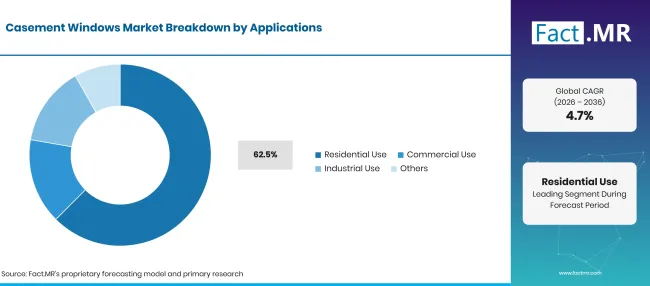
Casement Windows Market Breakdown Applications | Source: Fact.MR
| Application | Share (2026) |
|---|---|
| Residential Use (Leading segment) | 62.5% |
| Other segments combined | 37.5%* |
| Total | 100.0% |
Source: Fact.MR analysis. Updated Oct 30, 2026
Homeowners choose casements for kitchens, bedrooms and stairwells, where a crank or lever opens the full sash for air. Replacement work forms a large part of household demand, since older frames can be swapped without structural change. Commercial buildings use casements in offices, schools and small retail units, mostly where operable windows aid natural ventilation. The LBNL study [1] showed that upgrading glazing in existing commercial stock can yield sizable energy savings. Larger office projects often specify casement inserts inside curtain wall and facade systems. Industrial and other uses need impact resistance, security hardware or special sizes.
How does Glazing Type shape demand?
Double Glazed units capture 55.7% of 2026 sales.
| Glazing Type | Share (2026) |
|---|---|
| Double Glazed (Leading segment) | 55.7% |
| Other segments combined | 44.3%* |
| Total | 100.0% |
Source: Fact.MR analysis. Updated Oct 30, 2026
Double glazing has become the default for new casement frames in most temperate regions. A sealed unit of two panes with a gas-filled cavity cuts heat loss sharply compared with single panes. Builders rely on insulated architectural flat glass to supply standard sizes at short lead times. Triple glazing is gaining ground in cold climates and passive-house projects, though the heavier sash needs stronger hinges. Insulating-glass makers depend on warm-edge insulating glass spacers to limit condensation at the pane edge. Single glazing remains in low-cost housing and in warm regions with mild winters.
What is accelerating Casement Windows Market adoption, and what is holding it back?
Replacement of drafty windows and stricter energy codes keep orders flowing to fabricators across both homes and offices. Premium frames, high installation costs and slow housing starts in several countries cause many buyers to postpone projects.
Drivers Impact Analysis
| DRIVER | (~) % IMPACT ON CAGR | GEOGRAPHIC RELEVANCE | IMPACT TIMELINE |
|---|---|---|---|
| Replacement of aging windows with sealed, insulated casement units | +1.6% | Global | Short term (<= 2 years) |
| Residential construction and home renovation activity | +1.3% | Global | Medium term (2-4 years) |
| Demand for low-maintenance uPVC frames and improved glazing | +0.9% | Western Europe, North America, East Asia | Medium term (2-4 years) |
| Building energy-performance rules and renovation programs | +0.9% | Western Europe, North America | Long term (>= 4 years) |
Source: Fact.MR analysis. Updated Oct 30, 2026
Opportunity Impact Analysis
| OPPORTUNITY | (~) % IMPACT ON CAGR | GEOGRAPHIC RELEVANCE | IMPACT TIMELINE |
|---|---|---|---|
| Retrofit programs for poorly insulated homes and commercial buildings | +0.7% | Western Europe, North America, East Asia | Medium term (2-4 years) |
| Triple-pane options in mid-priced casement lines | +0.5% | Global | Medium term (2-4 years) |
| Custom casement designs for premium homes and architectural projects | +0.4% | Western Europe, North America | Long term (>= 4 years) |
| Wider installer and dealer networks in developing housing markets | +0.3% | Latin America, South Asia & Pacific | Short term (<= 2 years) |
Source: Fact.MR analysis. Updated Oct 30, 2026
Restraints Impact Analysis
| RESTRAINT | (~) % IMPACT ON CAGR | GEOGRAPHIC RELEVANCE | IMPACT TIMELINE |
|---|---|---|---|
| High purchase and installation costs for premium windows | -0.4% | Global | Short term (<= 2 years) |
| Weak housing starts and tight renovation budgets | -0.3% | Global | Short term (<= 2 years) |
| Competition from sliding, tilt-and-turn and other window designs | -0.2% | Global | Medium term (2-4 years) |
| Installation errors and uneven local building requirements | -0.1% | Global | Medium term (2-4 years) |
Source: Fact.MR analysis. Updated Oct 30, 2026
Which countries are scaling the Casement Windows Market through 2036?
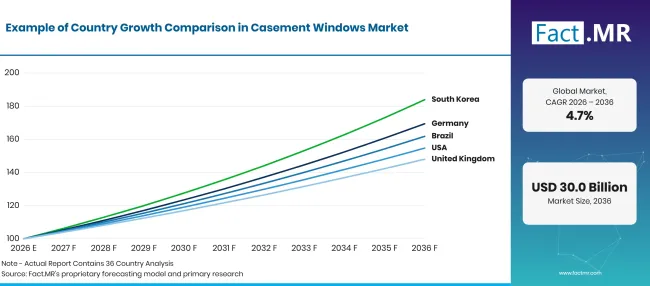
Casement Windows Market Growth Index | Source: Fact.MR
| Country | CAGR (2026 to 2036) |
|---|---|
| Germany | 5.4% |
| Brazil | 4.9% |
| United States | 4.5% |
| United Kingdom | 4.0% |
| Japan | 3.5% |
Source: Fact.MR analysis. Updated Oct 30, 2026
What supports Germany’s adoption?
5.4% CAGR, reflecting a window trade in which renovation outweighs new building.
New housing in Germany has slowed sharply, which pushes window makers toward refits. The Federal Statistical Office reported that 206,600 dwellings were completed in 2025, 18.0% fewer than a year earlier [5]. The national stock still grew to about 44.0 million dwellings by the end of 2025 [6]. Many of those homes carry older frames that owners will replace as EU energy rules move into national law.
How is Brazil developing demand?
4.9% CAGR, driven by federal social housing contracts.
Brazil’s housing program has become a steady source of window orders for builders. According to the federal government news agency, Minha Casa, Minha Vida had contracted more than 1.9 million units since 2023, backed by a record budget of about R$180 billion in 2025 [7]. Developers on these projects favor affordable frames that resist humidity and heavy rain, which suits uPVC casements.
What is supporting the United States’ adoption?
4.5% CAGR, helped by replacement projects and tighter energy codes.
American builders kept new housing close to 2024 levels. The U.S. Census Bureau estimated that 1,358,700 housing units were started in 2025, while 1,497,800 units were completed [8]. Every completed home needs a full window package, and a large stock of older houses keeps the replacement channel busy. Casements are common in kitchens and over sinks, where a crank handle is easier to reach than a sash lift.
How is the United Kingdom scaling demand?
4.0% CAGR, as homeowners balance renovation costs against upgrade needs.
New supply in England has eased. The Ministry of Housing, Communities and Local Government counted 208,600 net additional dwellings in 2024 to 2025, down 6% from the prior year [9]. Government schemes kept retrofit work moving, with around 126,900 households upgraded across all schemes in 2025, according to the Department for Energy Security and Net Zero [10]. Window and door measures count within the insulation work these schemes fund.
How does Japan perform?
3.5% CAGR, with window retrofit subsidies offsetting fewer housing starts.
Japan’s housing pipeline is shrinking. The Ministry of Land, Infrastructure, Transport and Tourism reported 740,667 new housing starts in 2025, down 6.5% and the third yearly fall in a row [11]. Retrofit support fills part of the gap. Under the Ministry of the Environment, the window renovation program for 2025 carried a budget of 135 billion yen and paid up to 2 million yen per home for insulated window upgrades [12]. Casements compete with sliding windows, still the common format in Japanese homes.
Who leads the Casement Windows Market?
Three groups shape competition. North American brands Andersen, Marvin and Pella sell complete casement windows through dealers, builders and home centers, across vinyl, fiberglass, clad wood and aluminum ranges. Andersen widened access to energy-code performance in October 2025 when it added a triple-pane glass option to its 100 Series casement windows, built with its Fibrex composite frame [4].
YKK AP supplies StyleView and StyleGuard casements for residential construction, including impact-resistant versions. Profile system houses form the second group: VEKA, profine (through its Kömmerling brand) and Deceuninck extrude PVC-U profiles that hundreds of local fabricators turn into finished casements. The third group is regional brands such as Fenesta in India, which makes and installs uPVC casement windows directly for homeowners. Certified thermal values, profile recycling and dependable installer networks will decide who gains share among fabricators and homeowners.
Which companies are the key providers?
Key companies include Andersen Corporation; Marvin; Pella Corporation; YKK AP; VEKA; profine Group; Deceuninck; and Fenesta.
- Andersen Corporation
- Marvin
- Pella Corporation
- YKK AP
- VEKA
- profine Group
- Deceuninck
- Fenesta
Bibliography
- [1] Lawrence Berkeley National Laboratory. (2025, February 27). Energy impacts of nationwide window upgrades in commercial buildings.
- [2] Verband Fenster + Fassade. (2025, October 6). Wirtschaftsprognosen 2025 und 2026 [Economic forecasts for 2025 and 2026].
- [3] European Commission, Directorate-General for Energy. (2026, July 15). The Commission calls on EU countries to transpose the reinforced rules on the energy performance of buildings.
- [4] Andersen Windows. (2025, October 22). Andersen Adds Triple-Pane Glass Option to 100 Series Product Portfolio.
- [5] Statistisches Bundesamt (Destatis). (2026, May 22). 18,0 % weniger fertiggestellte Wohnungen im Jahr 2025 [18.0% fewer dwellings completed in 2025].
- [6] Statistisches Bundesamt (Destatis). (2026, July 16). 44,0 Millionen Wohnungen in Deutschland zum Jahresende 2025 [44.0 million dwellings in Germany at the end of 2025].
- [7] Agência Gov, Government of Brazil. (2026, January 2). Minha Casa, Minha Vida alcança resultados históricos em 2025 [Minha Casa, Minha Vida achieves historic results in 2025].
- [8] U.S. Census Bureau. (2026, February 18). Monthly New Residential Construction, December 2025.
- [9] Ministry of Housing, Communities and Local Government. (2025, November 20). Housing supply: net additional dwellings, England: 2024 to 2025.
- [10] Department for Energy Security and Net Zero. (2026, March 19). Household Energy Efficiency Statistics, detailed report 2025.
- [11] Ministry of Land, Infrastructure, Transport and Tourism, Japan. (2026, January 30).[Building Construction Statistics Survey Report, 2025 annual total].
- [12] Ministry of the Environment, Japan. (2025).[Advanced Window Renovation 2025 Program]: program overview.
This Report Answers
- Casement window revenue is split by frame material, end use and glazing type for 2026 and 2036.
- Why uPVC frames, residential projects and double glazing hold first place in their segments, and how composite and triple-glazed units are gaining ground.
- Housing completions, retrofit schemes and energy rules explain the different growth paths of Germany, Brazil, the United States, the United Kingdom and Japan.
- Window brands, profile system houses and regional fabricators are compared by role in the supply chain.
- Readers can see how thermal performance, installation quality and purchase cost affect buying decisions.
What does the Casement Windows Market cover?
Finished casement windows with side-hinged sashes form the core of this study. Units vary by frame material, glazing, opening size, hardware, finish and weather seals, and they are grouped as uPVC, composite and other frames.
Demand comes from new homes, renovation, replacement projects and non-residential buildings. Manufacturers sell through dealers, specialist installers, building-material retailers, online stores and direct project contracts. Revenue is counted at the value of the complete window unit.
What is included in the scope?
Complete casement windows sold for new construction and replacement in residential, commercial, industrial and other settings are counted, whatever the sales channel. Combination units that join a casement sash with a fixed light are counted when the opening sash is side-hinged.
Custom-sized and impact-rated casements are covered when sold as finished units. Glazing bonded with insulated glass sealants is valued as part of the window, not as a separate item.
What is excluded from the scope?
Sliding, fixed, double-hung and tilt-and-turn windows lie outside the core valuation, even though they compete for the same openings. Doors and other building-envelope products are not counted.
Standalone profiles, loose glass, hinges and handles sold as separate components are left out. Installation labor billed apart from the window, along with repair and maintenance services, is also not part of window revenue.
How Was the Analysis Built?
The analysis draws on 120+ sources, 35+ company portfolios, 25+ countries, and more than 20 industry interviews.
- Primary Research: Primary research includes discussions with manufacturers, service providers, technology developers, distributors, end users, and subject-matter experts. These conversations examine purchasing priorities, product adoption, operational challenges, approval requirements, competitive positioning, and the factors that influence wider market acceptance.
- Desk Research: Desk research covers government statistics, regulatory publications, company filings, trade data, technical studies, industry associations, standards, public policy, and other authoritative sources. Every source used in the analysis is documented in the bibliography.
- Market Sizing and Forecasting: Market estimates combine historical performance, demand indicators, pricing and volume trends, segment shares, company participation, country-level growth, adoption patterns, investment activity, and barriers to market expansion.
- Data Validation and Update Cycle: Findings are validated by comparing primary interviews with public data, company activity, regulatory changes, trade patterns, and industry developments. Regular updates review new product launches, capacity changes, partnerships, approvals, and shifts in commercial adoption.
Segmentation
What is the report’s scope and coverage?
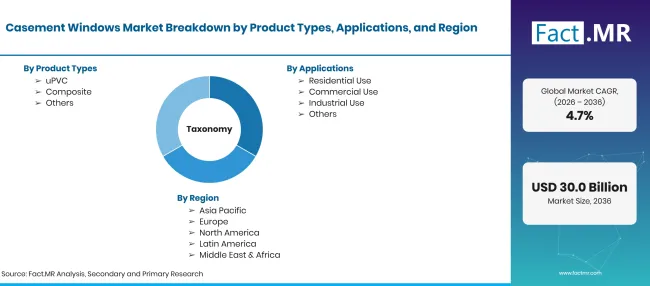
Casement Windows Market Taxonomy | Source: Fact.MR
| Attribute | Details |
|---|---|
| Quantitative Units | USD billion |
| Market Definition | Casement windows are side-hinged windows whose sashes swing open, usually outward, by crank, lever or push bar. The market covers finished casement units sold for residential, commercial, industrial and other buildings. |
| Product Type | uPVC; Composite; Others |
| Application | Residential Use; Commercial Use; Industrial Use; Others |
| Glazing Type | Single Glazed; Double Glazed; Triple Glazed |
| Regions Covered | North America; Latin America; Western Europe; Eastern Europe; East Asia; South Asia & Pacific; Middle East & Africa |
| Countries Covered | Germany; Brazil; United States; United Kingdom; Japan |
| Companies Profiled | Andersen Corporation; Marvin; Pella Corporation; YKK AP; VEKA; profine Group; Deceuninck; Fenesta |
| Forecast Period | 2026 to 2036 |
| Approach | Hybrid top-down and bottom-up approach using housing completions, window renovation volumes, frame material and glazing mix, application demand and manufacturer portfolio review. |
Source: Fact.MR analysis. Updated Oct 30, 2026
How is the market segmented?
-
By Product Type
- uPVC
- Composite
- Others
-
By Application
- Residential Use
- Commercial Use
- Industrial Use
- Others
-
By Glazing Type
- Single Glazed
- Double Glazed
- Triple Glazed
-
By Region
- North America
- Latin America
- Western Europe
- Eastern Europe
- East Asia
- South Asia & Pacific
- Middle East & Africa
Frequently Asked Questions
How large is the casement windows market in 2026?
What growth rate will the casement windows market record from 2026 to 2036?
Which product type leads the casement windows market?
Which application leads the casement windows market?
Which glazing type leads the casement windows market?
Which country will grow the most in the casement windows market?
Who are the main companies in the casement windows market?
Who worked on this report


Preview the report firsthand - request a free sample
Free SampleGet the brochure for pricing and purchase details
Download PDF