- Market Value (2025): USD 4.4 Bn
- Estimated Value (2026): USD 4.67 Bn
- Forecast Value (2036): USD 8.41 Bn
- CAGR (2026-2036): 6.1%
What is the Industrial Cleaning Wipes Market forecast to be worth by 2036?
USD 4.7 billion in 2026 to USD 8.4 billion by 2036 at a 6.1% CAGR.
- Fact.MR estimates that industrial cleaning wipes reached USD 4.4 billion in 2025.
- Worldwide sales are projected to rise from USD 4.67 billion in 2026 to USD 8.41 billion by 2036.
- A 6.1% CAGR for 2026 to 2036 reflects cleaning needs in production plants and other business facilities.
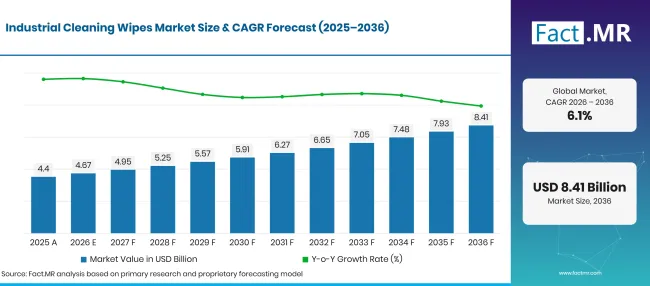
Industrial Cleaning Wipes Market Forecast Global | Source: Fact.MR
| Year | Basis | Market Value (USD billion) |
|---|---|---|
| 2025 | Actual | 4.4 |
| 2026 | Estimate | 4.67 |
| 2036 | Forecast | 8.41 |
| CAGR 2026 to 2036 | Forecast period | 6.1% |
Source: Fact.MR analysis. Updated Oct 31, 2026
What are the defining numbers behind Industrial Cleaning Wipes Market growth?
USD 3.7 billion in additional market value by 2036, with wet wipes and synthetic fibers accounting for large shares of 2026 sales.
- Demand Drivers in the Market
- Factory maintenance teams use disposable wipes to remove oil and work residue near equipment where loose cleaning cloths are inconvenient. In August 2026, Eurostat reported that the EU’s value of sold production, measured at constant prices, increased by 2.9% in 2025 compared with 2024 [1].
- Workplace hygiene teams buy wipes that fit the cleaning method used in each work area. Product labels need to distinguish ordinary cleaning from disinfecting claims because the required treatment and contact time depend on the task.
- Maintenance teams pay attention to the amount of liquid carried by a wipe. A sheet that holds together during scrubbing reduces loose fibers on machinery and helps staff finish a task without picking up another sheet.
- Distributors and facility operators weigh pack size against waste. Large refill containers suit fixed workstations, while smaller packs serve technicians who travel between equipment and buildings.
- Key Segments Analyzed
- By Product Type: Wet Wipes account for 45.3% of 2026 revenue, reflecting ready-to-use cleaning at workstations.
- By Application: Manufacturing represents 28.5% of 2026 demand, as routine equipment cleaning requires a steady supply of wiping material.
- By Material Type: Synthetic Fiber holds 52.8% of 2026 value because durable sheets suit oil and grease removal.
- By End-User: Industrial users represent 52.8% of 2026 revenue through maintenance and production-floor cleaning.
- By Distribution Channel: Supermarkets/Hypermarkets capture 38.2% of 2026 value across the defined channel categories.
- Analyst Opinion at Fact.MR
- Shambhu Nath Jha, Principal Consultant at Fact.MR, states, “The main question for industrial wipe brands is whether the product cleans the intended surface in fewer passes while staying intact. Equipment shops often need a stronger sheet than an office needs, so the same wipe design does not fit every customer. Clear product instructions and dependable refill availability are likely to have greater commercial value than broad product claims.”
- Strategic Implications
- Manufacturers should label intended surfaces and cleaning applications clearly so facility managers can compare products with confidence.
- Industrial distributors should match pack quantities to actual workstation use and make refill ordering straightforward.
- Plant operators should assess cleaning performance on their own surfaces before selecting a wipe for regular maintenance.
- Retail channel managers should distinguish workplace-grade products from ordinary household cleaning sheets in product listings.
Germany is forecast to record a 7.8% CAGR through 2036, while Brazil follows at 7.1%. The USA is projected to advance at 6.5% as industrial and commercial facilities buy cleaning consumables. The UK is projected to post 5.8% growth, while Japan is expected to expand at 5.1%. Country demand patterns depend on cleaning tasks and the industries served by local suppliers.
How does the Industrial Cleaning Wipes Market break down by segment?
Wet Wipes lead Product Type at 45.3%; Synthetic Fiber leads Material Type at 52.8%; Industrial end-users account for 52.8%.
Which Product Type dominates?
Wet Wipes account for 45.3% of 2026 market value.
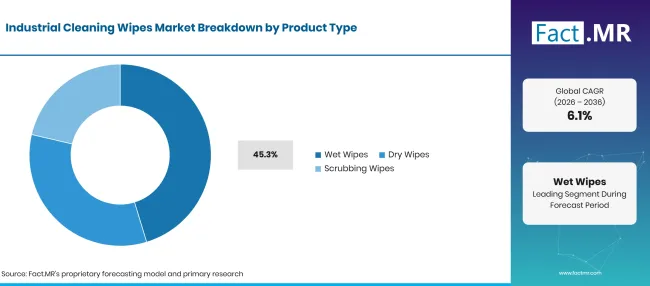
Industrial Cleaning Wipes Market Breakdown Product Type | Source: Fact.MR
| Which Product Type dominates | Share (2026) |
|---|---|
| Wet Wipes (Leading segment) | 45.3% |
| Other segments combined | 54.7% |
| Total | 100.0% |
Source: Fact.MR analysis. Updated Oct 31, 2026
Wet wipes arrive ready for use and fit maintenance jobs where staff need to remove a spot of grease or dirt quickly. Dry wipes offer flexibility when a plant uses its own approved cleaning solution. Scrubbing wipes serve jobs that need more surface friction. Buyers compare absorbency and the risk of leftover fibers. Packaging also affects how much liquid remains in a container after repeated opening.
Application?
Manufacturing leads with 28.5% of 2026 market value.
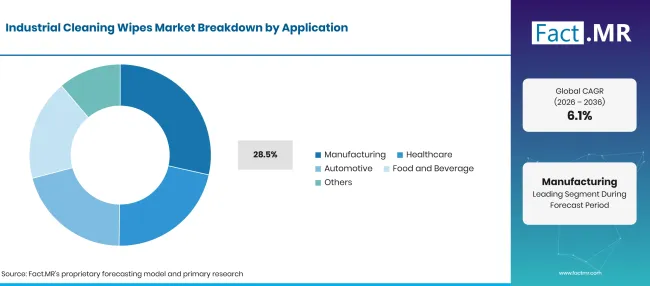
Industrial Cleaning Wipes Market Breakdown Application | Source: Fact.MR
| Application | Share (2026) |
|---|---|
| Manufacturing (Leading segment) | 28.5% |
| Other segments combined | 71.5% |
| Total | 100.0% |
Source: Fact.MR analysis. Updated Oct 31, 2026
Manufacturing sites clean tools and work surfaces during operating shifts. Some tasks call for removing oils before equipment inspection, while other tasks involve wiping routine dust. Healthcare customers make separate choices for cleaning surfaces that may require disinfecting instructions. Automotive uses include shop-floor wiping. Food and beverage operations also consider whether the wipe and any chemical used are suitable for the work area.
Material Type?
Synthetic Fiber captures 52.8% of 2026 market value.
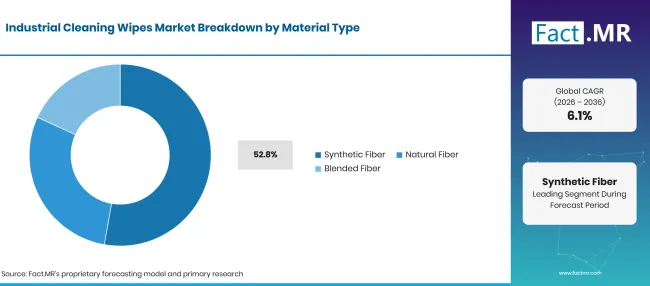
Industrial Cleaning Wipes Market Breakdown Material Type | Source: Fact.MR
| Material Type | Share (2026) |
|---|---|
| Synthetic Fiber (Leading segment) | 52.8% |
| Other segments combined | 47.2% |
| Total | 100.0% |
Source: Fact.MR analysis. Updated Oct 31, 2026
Synthetic fibers are used in sheets designed to retain strength during wet wiping or scrubbing. Their performance depends on the construction of the wipe and the cleaning liquid. Natural fibers may suit applications where absorbency is more relevant than abrasion resistance. Blended fibers combine material properties for particular work tasks. Facility managers benefit from testing lint release and surface compatibility under real cleaning conditions.
End-User?
Industrial represents 52.8% of 2026 market value.
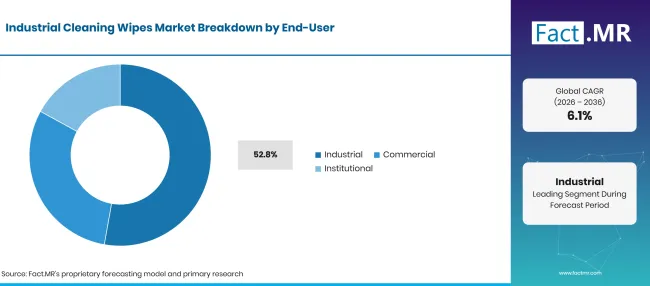
Industrial Cleaning Wipes Market Breakdown End User | Source: Fact.MR
| End-User | Share (2026) |
|---|---|
| Industrial (Leading segment) | 52.8% |
| Other segments combined | 47.2% |
| Total | 100.0% |
Source: Fact.MR analysis. Updated Oct 31, 2026
Industrial facilities need a repeat supply of wipes near machinery and maintenance stations. Commercial customers often favor standard packs for counters and general work areas, while institutional teams organize cleaning products around shared buildings. The distinction affects pack size and product labeling. For factories, a wipe that works on oily equipment has a different role from a wipe selected for office furniture.
Distribution Channel?
Supermarkets/Hypermarkets hold 38.2% of 2026 market value.
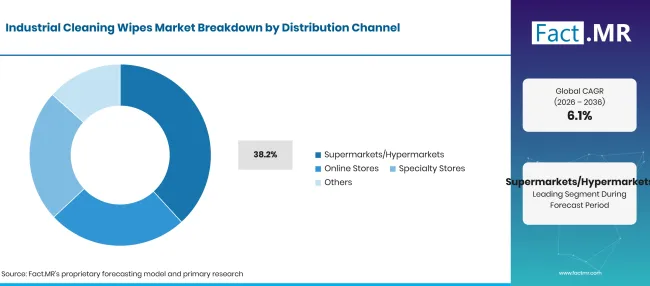
Industrial Cleaning Wipes Market Breakdown Distribution Channel | Source: Fact.MR
| Distribution Channel | Share (2026) |
|---|---|
| Supermarkets/Hypermarkets (Leading segment) | 38.2% |
| Other segments combined | 61.8% |
| Total | 100.0% |
Source: Fact.MR analysis. Updated Oct 31, 2026
Supermarkets and hypermarkets offer visible shelf pricing for standard cleaning wipes and bulk packs. Online stores allow repeat ordering and product comparison, which is useful when a facility already knows the grade it needs. Specialty stores can help customers select a wipe for a particular cleaning task. Direct industrial supply and distributor arrangements may also serve specialized worksite needs within the broader channel structure.
What is accelerating Industrial Cleaning Wipes Market adoption, and what is holding it back?
Sales will be supported by routine factory cleaning and ready-to-use wet formats. Refill packs and low-lint products will support additional sales. Material compatibility, waste handling requirements, reusable cloths and uneven industrial activity may slow wider uptake.
Drivers Impact Analysis
| DRIVER | (~) % IMPACT ON CAGR | GEOGRAPHIC RELEVANCE | IMPACT TIMELINE |
|---|---|---|---|
| Routine manufacturing cleaning | +1.2% | Global | Short term |
| Ready-to-use wet wiping | +1.0% | Global | Short term |
| Equipment maintenance requirements | +0.8% | Manufacturing markets | Medium term |
| Workplace refill convenience | +0.6% | Global | Medium term |
Source: Fact.MR analysis. Updated Oct 31, 2026
Opportunity Impact Analysis
| OPPORTUNITY | (~) % IMPACT ON CAGR | GEOGRAPHIC RELEVANCE | IMPACT TIMELINE |
|---|---|---|---|
| Refill packs for workstations | +0.7% | Global | Medium term |
| Low-lint equipment wiping | +0.6% | Industrial economies | Medium term |
| Targeted automotive cleaning | +0.5% | Germany, Brazil, USA | Medium term |
| Food-area suitable product lines | +0.4% | Global | Long term |
Source: Fact.MR analysis. Updated Oct 31, 2026
Restraints Impact Analysis
| RESTRAINT | (~) % IMPACT ON CAGR | GEOGRAPHIC RELEVANCE | IMPACT TIMELINE |
|---|---|---|---|
| Material and cleaning-liquid compatibility | -0.6% | Global | Short term |
| Waste handling requirements | -0.5% | Global | Medium term |
| Competition from reusable cloths | -0.4% | Global | Medium term |
| Uneven industrial production | -0.3% | Manufacturing markets | Short term |
Source: Fact.MR analysis. Updated Oct 31, 2026
Which countries are scaling the Industrial Cleaning Wipes Market through 2036?
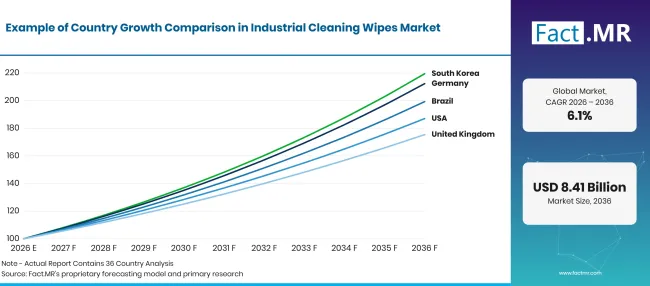
Industrial Cleaning Wipes Market Growth Index | Source: Fact.MR
| Country | CAGR (2026 to 2036) |
|---|---|
| Germany | 7.8% |
| Brazil | 7.1% |
| USA | 6.5% |
| UK | 5.8% |
| Japan | 5.1% |
Source: Fact.MR analysis. Updated Oct 31, 2026
What supports Germany’s industrial cleaning wipes outlook?
7.8% CAGR, tied to equipment upkeep and industrial cleaning routines.
German plant managers select wiping materials around machinery care and surface compatibility. In February 2026 Destatis reported that German machinery and equipment output fell 2.6% in 2025 [2]. Maintenance work still requires sheets that hold together during grease removal, especially when teams clean equipment between service tasks. A second official indicator showed Germany's total industrial production declined 1.1% in 2025. German distributors can compete through clear usage guidance and steady supply of approved product grades.
How is Brazil developing industrial cleaning wipe demand?
7.1% CAGR, linked to factory operations and maintenance supply.
Brazilian workshops depend on dependable cleaning sheets for greasy tools and factory benches. In February 2026 IBGE reported that Brazilian industrial production increased 0.6% during 2025 [3]. Such production activity gives distributors a regular base of maintenance-related cleaning tasks. An IBGE release also recorded a 1.2% month-on-month reduction in industrial production in December 2025. Operators may respond to changing work schedules by adjusting orders and keeping standard wipe packs close to equipment.
What shapes the USA market for industrial cleaning wipes?
6.5% CAGR, supported by factory maintenance and workplace service needs.
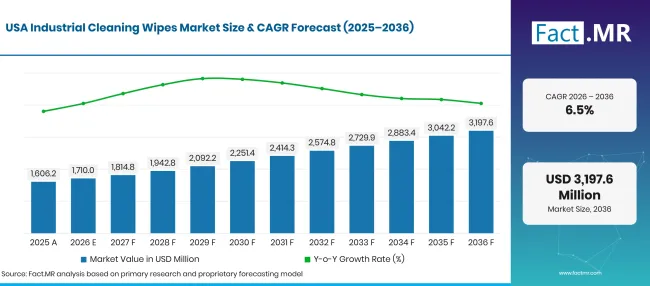
Industrial Cleaning Wipes Market Forecast Usa | Source: Fact.MR
American factory sites choose wipes according to the residue being removed and the surfaces workers clean. Industrial hand wipes and dry shop cloths serve different tasks, so clear pack instructions help teams avoid unsuitable products. In June 2026 the Federal Reserve published an industrial production index of 102.6 for May 2026 on its 2017 base [4]. Plant work creates ongoing cleaning needs near service benches and machinery.
How is the UK market likely to develop?
5.8% CAGR, shaped by industrial cleaning standards and buying channels.
UK customers select cleaning cloths for machine care and routine surface work in factories and commercial premises. In September 2026 the Office for National Statistics reported that UK manufacturing output increased 0.5% in the three months to July 2026 [5]. Ready-to-use wipes can save a separate preparation step when staff clean approved surfaces between tasks. The ONS recorded a 0.5% fall in total UK production output over the same period. Changes in output can influence shift schedules and short-term use of consumable supplies.
What supports Japan’s industrial wipe purchases?
5.1% CAGR, tied to tool care and consistent cleaning methods.
Japanese industrial teams rely on consistent handling instructions when wiping tools and finished surfaces. The Japan Institute for Labour Policy and Training reported in May 2026 that Japan’s industrial production index stood at 100.9 for 2025 on a 2020 base [6]. This official series describes factory conditions that can affect cleaning supplies during daily work. Protected packaging helps maintain sheet condition across shifts.
Who supplies the Industrial Cleaning Wipes Market?
Suppliers include specialist industrial wiping suppliers and broader hygiene companies. Essity’s Tork range includes industrial cleaning cloths in folded and roll formats, while ITW Pro Brands offers SCRUBS pre-moistened industrial cleaning towels for hands and surfaces.
Kimberly-Clark competes through workplace wiping products. Companies with more general cleaning portfolios serve related institutional needs, though product selection still depends on the specific wipe range and intended application.
Which companies are the key providers?
Key companies include Kimberly-Clark Corporation; 3M Company; Essity AB (Tork); Illinois Tool Works Inc. (ITW Pro Brands/SCRUBS); The Procter & Gamble Company; The Clorox Company; Reckitt Benckiser Group plc; Ecolab Inc.; Georgia-Pacific LLC; Henkel AG & Co. KGaA.
- Kimberly-Clark Corporation
- 3M Company
- Essity AB (Tork)
- Illinois Tool Works Inc. (ITW Pro Brands/SCRUBS)
- The Procter & Gamble Company
- The Clorox Company
- Reckitt Benckiser Group plc
- Ecolab Inc.
- Georgia-Pacific LLC
- Henkel AG & Co. KGaA
Bibliography
- [1] Eurostat. (2026, August 24). EU industrial production rebounds in 2025.
- [2] Statistisches Bundesamt (Destatis). (2026, February 6). Production in December 2025: -1.9% on the previous month.
- [3] Instituto Brasileiro de Geografia e Estatística. (2026, February 3). Produção industrial recua 1,2% em dezembro.
- [4] Board of Governors of the Federal Reserve System. (2026, June 15). Industrial production and capacity utilization: G.17.
- [5] Office for National Statistics. (2026, September 11). Index of Production, UK: July 2026.
- [6] Japan Institute for Labour Policy and Training. (2026, May 1). Main labor economic indicators.
This Report Answers
- The report compares wet, dry and scrubbing wipes by the cleaning task each format serves.
- Application analysis explains why plant equipment cleaning differs from healthcare and food-area work.
- Material analysis examines sheet strength and surface compatibility for synthetic, natural and blended fibers.
- Country analysis covers factory and workplace cleaning in Germany, Brazil, the USA, the UK and Japan.
- Competitive analysis compares specialist wiping products with wider professional cleaning portfolios.
What does the Industrial Cleaning Wipes Market cover?
Industrial cleaning wipes are sheets used to remove workplace residue from equipment or other work surfaces. Products include ready-to-use wet wipes and dry sheets that are used separately with an appropriate cleaning solution. Some products are made for tougher rubbing or specific oils.
What is included in the scope?
Sales of wet wipes, dry wipes and scrubbing wipes made for industrial and professional cleaning are included.
Applications cover manufacturing, healthcare, automotive and food and beverage work areas. Industrial, commercial and institutional purchasers form the end-user categories.
What is excluded from the scope?
Ordinary household personal-care wipes, infant wipes and unrelated paper products are outside this industrial cleaning definition.
Cleaning liquids sold separately are also outside the wipe product boundary. Products marketed only for skin care are not treated as industrial surface-cleaning wipes.
How Was the Analysis Built?
The analysis draws on 120+ sources, 35+ company portfolios, 25+ countries, and more than 20 industry interviews.
- Primary Research: Primary research includes discussions with manufacturers, service providers, technology developers, distributors, end users, and subject-matter experts. These conversations examine purchasing priorities, product adoption, operational challenges, approval requirements, competitive positioning, and the factors that influence wider market acceptance.
- Desk Research: Desk research covers government statistics, regulatory publications, company filings, trade data, technical studies, industry associations, standards, public policy, and other authoritative sources. Every source used in the analysis is documented in the bibliography.
- Market Sizing and Forecasting: Market estimates combine historical performance, demand indicators, pricing and volume trends, segment shares, company participation, country-level growth, adoption patterns, investment activity, and barriers to market expansion.
- Data Validation and Update Cycle: Findings are validated by comparing primary interviews with public data, company activity, regulatory changes, trade patterns, and industry developments. Regular updates review new product launches, capacity changes, partnerships, approvals, and shifts in commercial adoption.
Segmentation
What is the report’s scope and coverage?
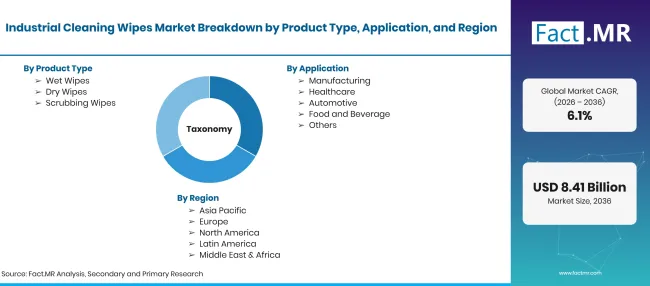
Industrial Cleaning Wipes Market Taxonomy | Source: Fact.MR
| Attribute | Details |
|---|---|
| Quantitative Units | USD billion |
| Market Definition | Disposable and reusable industrial-grade wet or dry sheets for cleaning work surfaces and equipment. |
| Product Type | Wet Wipes; Dry Wipes; Scrubbing Wipes |
| Application | Manufacturing; Healthcare; Automotive; Food and Beverage; Others |
| Material Type | Synthetic Fiber; Natural Fiber; Blended Fiber |
| End-User | Industrial; Commercial; Institutional |
| Distribution Channel | Supermarkets/Hypermarkets; Online Stores; Specialty Stores; Others |
| Regions Covered | North America; Latin America; Western Europe; Eastern Europe; East Asia; South Asia & Pacific; Middle East & Africa |
| Countries Covered | Germany; Brazil; USA; UK; Japan |
| Companies Profiled | Kimberly-Clark Corporation; 3M Company; Essity AB (Tork); Illinois Tool Works Inc. (ITW Pro Brands/SCRUBS); The Procter & Gamble Company; The Clorox Company; Reckitt Benckiser Group plc; Ecolab Inc.; Georgia-Pacific LLC; Henkel AG & Co. KGaA |
| Forecast Period | 2026 to 2036 |
| Approach | Bottom-up examination of cleaning tasks, use frequency, product types and distribution arrangements. |
Source: Fact.MR analysis. Updated Oct 31, 2026
How is the market segmented?
-
By Product Type
- Wet Wipes
- Dry Wipes
- Scrubbing Wipes
-
By Application
- Manufacturing
- Healthcare
- Automotive
- Food and Beverage
- Others
-
By Material Type
- Synthetic Fiber
- Natural Fiber
- Blended Fiber
-
By End-User
- Industrial
- Commercial
- Institutional
-
By Distribution Channel
- Supermarkets/Hypermarkets
- Online Stores
- Specialty Stores
- Others
-
By Region
- North America
- Latin America
- Western Europe
- Eastern Europe
- East Asia
- South Asia & Pacific
- Middle East & Africa
Frequently Asked Questions
How big is the industrial cleaning wipes market in 2026?
What is its CAGR between 2026 and 2036?
Which product type holds the main 2026 share?
Which end-user group has the stated leading share?
Who are the main companies in the industrial cleaning wipes market?
Who worked on this report


Preview the report firsthand - request a free sample
Free SampleGet the brochure for pricing and purchase details
Download PDF