Cell Culture Supplements Market
Cell Culture Supplements Market Size and Share Forecast Outlook 2025 to 2035
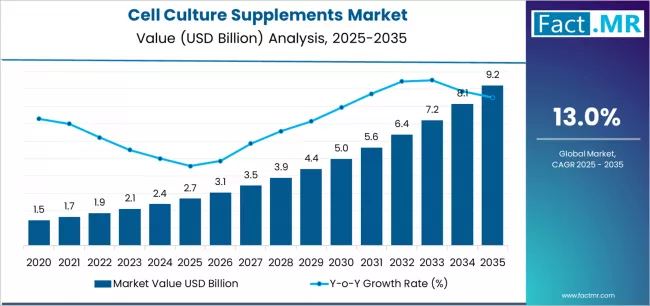
Cell culture supplements market is projected to grow from USD 2.7 billion in 2025 to USD 9.2 billion by 2035, at a CAGR of 13.0%. Protein-Based & Recombinant Supplements will dominate with a 42.5% market share, while biopharmaceutical manufacturing will lead the application type segment with a 48.7% share.
Cell Culture Supplements Market Forecast and Outlook 2025 to 2035
The global cell culture supplements market is projected to grow from USD 2.7 billion in 2025 to approximately USD 9.2 billion by 2035, recording an extraordinary absolute increase of USD 6.5 billion over the forecast period. This translates into a total growth of 237.0%, with the market forecast to expand at a compound annual growth rate (CAGR) of 13.0% between 2025 and 2035.
Demand for cell culture supplements is expected to grow by over 3.4X during this period, supported by exponential demand for advanced biopharmaceutical manufacturing capabilities, rising adoption of cell and gene therapy protocols, and growing emphasis on biologics production innovation and bioprocessing optimization across global pharmaceutical manufacturing operations.
Quick Stats on Cell Culture Supplements Market
- Cell Culture Supplements Market Value (2025): USD 2.7 billion
- Cell Culture Supplements Market Forecast Value (2035): USD 9.2 billion
- Cell Culture Supplements Market Forecast CAGR (2025 to 2035): 13.0%
- Leading Product Type in Cell Culture Supplements Market: Protein-based & Recombinant Supplements (42.5%)
- Leading Application Type in Cell Culture Supplements Market: Biopharmaceutical Manufacturing (48.7%)
- Leading End-Use Category in Cell Culture Supplements Market: Pharmaceutical & Biotechnology Companies (41.6%)
- Key Growth Regions in Cell Culture Supplements Market: North America, Asia Pacific, and Europe
- Key Players in Cell Culture Supplements Market: Merck KGaA, Thermo Fisher Scientific, HiMedia Laboratories, Danaher, Sartorius AG, Corning Incorporated, R&D Systems (Bio-Techne), STEMCELL Technologies, Repligen Corporation, Proteintech Group, Inc

The cell culture supplements market is positioned for substantial expansion, driven by increasing recognition of biologics manufacturing importance, growing biopharmaceutical production volumes with enhanced quality standards, and rising adoption of advanced cell culture technologies across pharmaceutical and biotechnology research platforms globally.
The market demonstrates robust fundamentals supported by expanding biomanufacturing facility networks, pharmaceutical companies' focus on recombinant protein production protocols, and rising recognition of cell culture supplements as critical manufacturing components in achieving enhanced product yields, consistent cell growth capabilities, and quality assurance effectiveness within modern biopharmaceutical manufacturing architectures across diverse therapeutic applications.
Market growth is underpinned by technological innovations in cell culture supplement formulations, particularly protein-based and chemically defined supplement development, which offer enhanced reproducibility, improved cell viability outcomes, and superior compatibility with comprehensive biomanufacturing protocols prevalent in contemporary pharmaceutical production.
Biopharmaceutical manufacturers increasingly prioritize supplement solutions that deliver optimal balance between production efficiency, formulation consistency, and cost-effectiveness while adhering to increasingly stringent regulatory standards and quality requirements across global pharmaceutical markets.
The convergence of biologics manufacturing expansion in developed economies, cell therapy development acceleration in innovative healthcare markets, and biomanufacturing infrastructure advancement in emerging regions creates multifaceted growth opportunities for cell culture supplement providers and bioprocessing technology operators.
The biopharmaceutical landscape is experiencing transformative changes as manufacturers adopt sophisticated supplement formulations including animal component-free alternatives, xeno-free protein supplements, and chemically defined media components that enable enhanced regulatory compliance and reproducible manufacturing processes.
These technological advancements are complemented by evolving bioprocessing capabilities encompassing serum-free culture systems, advanced growth factor formulations, and innovative attachment factor technologies that significantly improve production yields and product quality outcomes.
The integration of process analytical technologies and quality-by-design principles further expands cell culture supplement optimization, particularly benefiting large-scale biomanufacturing operations and specialized cell therapy production facilities where formulation consistency and regulatory compliance remain paramount.
Between 2025 and 2030, the cell culture supplements market is projected to expand from USD 2.7 billion to USD 5.0 billion, demonstrating strong foundational growth driven by global biopharmaceutical manufacturing expansion, increasing adoption of cell therapy production platforms, and initial deployment of advanced supplement formulations across biologics and regenerative medicine manufacturing facilities. This growth phase establishes market infrastructure, validates advanced supplement technologies, and creates comprehensive supply networks supporting global pharmaceutical manufacturing operations.
From 2030 to 2035, the market is forecast to reach USD 9.2 billion, driven by mature biologics manufacturing penetration, next-generation cell therapy production requiring sophisticated culture supplements, and comprehensive integration of chemically defined formulations demanding enhanced quality control capabilities. The growing adoption of personalized medicine manufacturing, specialized bioprocessing techniques, and regulatory compliance enhancement initiatives will drive demand for comprehensive cell culture supplement solutions with enhanced performance characteristics and seamless biomanufacturing system integration functionality.
Cell Culture Supplements Market Key Takeaways
| Metric | Value |
|---|---|
| Estimated Value (2025E) | USD 2.7 billion |
| Forecast Value (2035F) | USD 9.2 billion |
| Forecast CAGR (2025 to 2035) | 13.0% |
Why is the Cell Culture Supplements Market Growing?
Market expansion is being supported by the exponential increase in biopharmaceutical production spending and the corresponding need for sophisticated cell culture technologies in biologics manufacturing applications across global pharmaceutical operations.
Biopharmaceutical manufacturers are increasingly focused on advanced supplement formulations that can improve production yields, enhance product consistency, and optimize bioprocessing protocols while meeting stringent regulatory requirements.
The proven efficacy of specialized cell culture supplements in various therapeutic production applications makes them an essential component of comprehensive biomanufacturing strategies and pharmaceutical production management programs.
The growing emphasis on quality-by-design principles and biomanufacturing process optimization is driving demand for advanced supplement formulations that meet stringent performance specifications and operational requirements for pharmaceutical applications.
Biopharmaceutical manufacturers' preference for reliable, high-performance supplement solutions that can ensure consistent production outcomes is creating opportunities for innovative formulation technologies and customized bioprocessing solutions.
The rising influence of regulatory standards and pharmaceutical quality requirements is also contributing to increased adoption of premium-grade cell culture supplements across different therapeutic categories and manufacturing systems requiring advanced bioprocessing technology.
Opportunity Pathways - Cell Culture Supplements Market
The cell culture supplements market represents a transformative growth opportunity, expanding from USD 2.7 billion in 2025 to USD 9.2 billion by 2035 at a 13.0% CAGR. As biopharmaceutical manufacturers prioritize production optimization, quality consistency, and regulatory excellence in complex biologics manufacturing environments, cell culture supplements have evolved from a basic media component to an essential manufacturing element enabling precise cell growth control, comprehensive product quality strategies, and multi-parameter optimization operations across biopharmaceutical production platforms and therapeutic manufacturing applications.
The convergence of biologics manufacturing acceleration, increasing cell therapy production penetration, advanced formulation technology integration, and stringent regulatory compliance mandates creates momentum in demand. High-performance protein-based supplements offering superior production outcomes, cost-effective chemically defined solutions balancing functionality with economics, and specialized formulations for cell therapy applications will capture market premiums, while geographic expansion into high-growth Asian biomanufacturing markets and emerging pharmaceutical ecosystems will drive volume leadership. Biopharmaceutical manufacturer emphasis on process innovation and product reliability provides structural support.
- Pathway A - Protein-based & Recombinant Supplements Segment Dominance: Leading with 42.5% market share, protein-based and recombinant supplement applications drive primary demand through complex biopharmaceutical manufacturing workflows requiring comprehensive growth factor support for cell culture optimization. Advanced formulation protocols enabling improved cell viability, reduced batch variability, and enhanced production efficiency command premium pricing from pharmaceutical manufacturers requiring stringent performance specifications and regulatory compliance. Expected revenue pool: USD 1.2-3.9 billion.
- Pathway B - Biopharmaceutical Manufacturing Application Leadership: Dominating with 48.7% market share through optimal balance of production necessity and manufacturing scale requirements, biopharmaceutical manufacturing applications serve most cell culture supplement requirements while meeting diverse production demands. This application type addresses both monoclonal antibody production and recombinant protein manufacturing expectations, making it the preferred category for pharmaceutical companies and contract manufacturing organizations seeking comprehensive production capabilities. Opportunity: USD 1.3-4.5 billion.
- Pathway C - Asian Market Acceleration: USA (14.7% CAGR) and China (14.2% CAGR) lead global growth through biologics manufacturing expansion, cell therapy infrastructure development, and biopharmaceutical production capability advancement. Strategic partnerships with local pharmaceutical manufacturers, formulation localization expertise, and manufacturing network optimization enable the expansion of cell culture supplements in major biopharmaceutical production hubs. Geographic expansion upside: USD 2.1-5.3 billion.
- Pathway D - Pharmaceutical & Biotechnology Companies End-Use Segment: Pharmaceutical and biotechnology companies with 41.6% market share serve critical biomanufacturing applications requiring specialized supplements for diverse therapeutic production. Optimized supplement formulations supporting multiple cell line requirements, production system specifications, and proven manufacturing effectiveness maintain significant volumes from biopharmaceutical companies and biologics manufacturing facilities. Revenue potential: USD 1.1-3.8 billion.
- Pathway E - Advanced Formulation Technologies & Chemically Defined Integration: Companies investing in sophisticated serum-free formulations, xeno-free supplement innovations, and advanced chemically defined systems gain competitive advantages through consistent production delivery and quality assurance. Advanced capabilities enabling customized formulation specifications and rapid protocol development capture premium pharmaceutical partnerships. Technology premium: USD 0.9-3.2 billion.
- Pathway F - Supply Chain Optimization & Technical Excellence: Specialized manufacturing facilities, strategic bioprocessing integration, and reliable quality control systems create competitive differentiation in pharmaceutical markets requiring consistent supplement availability. Companies offering guaranteed formulation quality, comprehensive technical support services, and regulatory documentation assistance gain preferred supplier status with quality-focused biopharmaceutical manufacturers. Supply chain value: USD 0.8-2.8 billion.
- Pathway G - Emerging Applications & Market Development: Beyond traditional biopharmaceutical manufacturing applications, cell culture supplements in organoid culture systems, tissue engineering programs, and specialized research applications represent growth opportunities. Companies developing new formulation protocols, supporting innovation initiatives, and expanding into adjacent cell culture and regenerative medicine markets capture incremental demand while diversifying revenue streams. Emerging opportunity: USD 0.6-2.1 billion.
Segmental Analysis
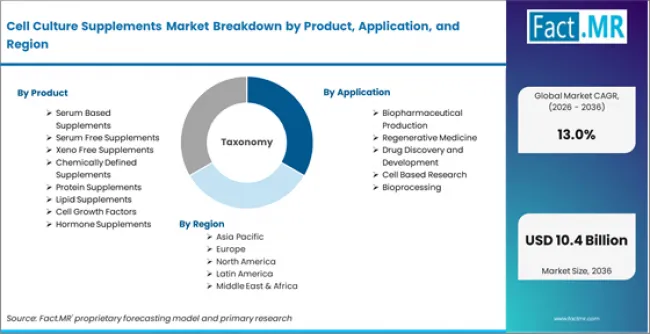
The market is segmented by product type, application type, end-use category, and region. By product type, the market is divided into serum-based supplements, protein-based & recombinant supplements, chemically defined supplements, and others. Based on application type, the market is categorized into biopharmaceutical manufacturing, cell & gene therapy, drug discovery, and others.
By end-use category, the market is segmented into cell culture media manufacturers, pharmaceutical & biotechnology companies, CDMOs/CMOs & CROs, and academic & research institutes. Regionally, the market is divided into Asia Pacific, North America, Europe, Latin America, and Middle East & Africa.
What drives Protein-based & Recombinant Supplements' Market Leadership?

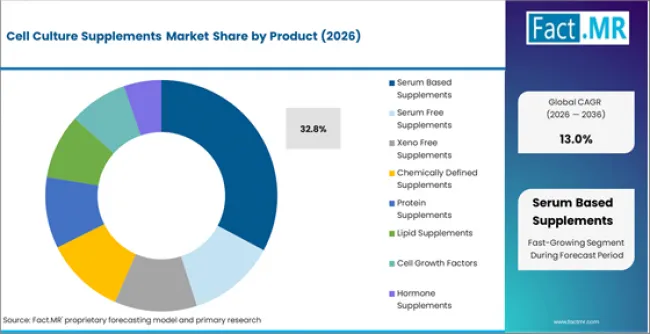
The protein-based & recombinant supplements segment is projected to account for 42.5% of the cell culture supplements market in 2025, reaffirming its position as the category's dominant product specification. Biopharmaceutical manufacturers increasingly recognize the optimal balance of cell growth enhancement and production consistency offered by protein-based supplement formulations for biologics manufacturing applications, particularly in monoclonal antibody production operations and recombinant protein production environments.
This product category addresses both cell viability requirements and manufacturing scalability demands while providing reliable growth outcomes across diverse biopharmaceutical operations. This segment forms the foundation of most biopharmaceutical manufacturing protocols for large-scale biologics production and therapeutic protein manufacturing, as it represents the most functionally effective and commercially established product category in the cell culture supplements industry.
Clinical validation standards and extensive manufacturing application continue to strengthen confidence in protein-based supplements among pharmaceutical operators and bioprocessing professionals. With increasing recognition of growth factor importance on production metrics and quality requirements, protein-based cell culture supplements align with both current manufacturing practices and biopharmaceutical production evolution goals, making them the central growth driver of comprehensive bioprocessing strategies across multiple therapeutic platforms.
Why does Biopharmaceutical Manufacturing Command the Majority Market Share by Application?

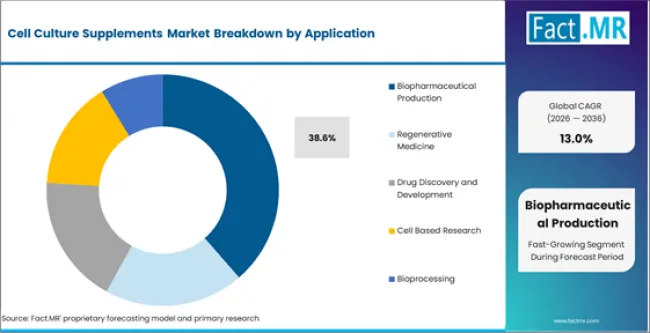
Biopharmaceutical manufacturing application type is projected to represent 48.7% of cell culture supplements demand in 2025, underscoring its role as the primary application category driving market adoption and supplement technology deployment. Pharmaceutical manufacturers recognize that biopharmaceutical manufacturing requirements, including diverse production scales, varied therapeutic protein specifications, and comprehensive quality control protocols, provide the largest addressable market that research applications cannot match in production complexity and commercial value.
Supplements utilized in biopharmaceutical manufacturing offer enhanced production capabilities and broad formulation compatibility essential for serving monoclonal antibody production and recombinant protein manufacturing requirements. The segment is supported by the expanding nature of global biologics production development, requiring supplements capable of addressing large-scale manufacturing, commercial production optimization, and regulatory compliance interventions, and the increasing recognition that advanced supplement formulations can improve product quality and manufacturing consistency.
Manufacturers are increasingly adopting chemically defined supplement technologies that mandate sophisticated formulation integration for optimal production response and regulatory compliance. As understanding of cell culture optimization capabilities advances and manufacturing standards become more sophisticated, production-enabled biopharmaceutical applications will continue to play a crucial role in comprehensive pharmaceutical manufacturing differentiation strategies.
How do Pharmaceutical & Biotechnology Companies Demonstrate End-Use Prominence?

Pharmaceutical & biotechnology companies account for 41.6% of the cell culture supplements market in 2025, establishing its position as the leading customer segment. Pharmaceutical manufacturers increasingly recognize that internal manufacturing operations, encompassing biologics production facilities, therapeutic development laboratories, and quality control operations, represent the most commercially significant and technologically demanding category requiring specialized supplement solutions due to production scale and regulatory complexity.
This end-use category addresses both commercial manufacturing requirements and research development demands while delivering critical production outcomes across varied therapeutic portfolios. The segment is supported by the continuing nature of biologics development expansion in pharmaceutical companies, driven by therapeutic innovation, biosimilar production growth, and cell therapy manufacturing requiring immediate supplement access.
Pharmaceutical manufacturers are increasingly focusing on advanced quality control protocols that enhance manufacturing reliability and product consistency while maintaining regulatory compliance standards. As biopharmaceutical production expertise expands and manufacturing capabilities grow, pharmaceutical company supplement utilization will continue to serve a crucial role in ensuring product quality and production efficiency within the global biotechnology market.
What are the Drivers, Restraints, and Key Trends of the Cell Culture Supplements Market?
The cell culture supplements market is advancing rapidly due to increasing recognition of biologics manufacturing importance and growing demand for specialized bioprocessing solutions across the pharmaceutical sector.
The market faces challenges, including formulation cost pressures in price-sensitive research segments, limited availability of animal component-free alternatives in emerging markets, and concerns about supplement standardization in developing biomanufacturing facilities. Innovation in supplement technologies and advanced formulation development continues to influence product development and market expansion patterns.
Proliferation of Chemically Defined Formulations and Serum-Free Technologies
The accelerating adoption of sophisticated chemically defined platforms is enabling the development of more reproducible biopharmaceutical manufacturing applications and production protocols that can meet stringent regulatory and quality requirements.
Pharmaceutical manufacturers demand comprehensive formulation control for cell culture supplements, including precisely defined component specifications and batch-to-batch consistency formulations that are particularly important for achieving regulatory compliance requirements in complex therapeutic applications.
Chemically defined supplement technologies provide access to standardized manufacturing processes that can optimize production scalability and enhance product quality while maintaining cost-effectiveness for diverse pharmaceutical manufacturing environments.
Integration of Process Analytical Technologies and Quality-by-Design Principles
Modern biopharmaceutical organizations are incorporating advanced technologies such as real-time monitoring systems, metabolic profiling capabilities, and process optimization interfaces to enhance supplement utilization and manufacturing efficiency.
These systems improve production control opportunities, enable seamless formulation optimization transitions, and provide better integration between cell culture processes and biopharmaceutical quality systems throughout the manufacturing experience.
Advanced analytical capabilities also enable customized supplement protocols and early identification of production deviations or process inefficiencies, supporting proactive intervention management and improved manufacturing outcomes.
Analysis of the Cell Culture Supplements Market by Key Countries

| Country | CAGR (2025 to 2035) |
|---|---|
| USA | 14.7% |
| China | 14.2% |
| India | 13.8% |
| Germany | 13.0% |
| UK | 12.5% |
| Japan | 12.1% |
| South Korea | 11.4% |
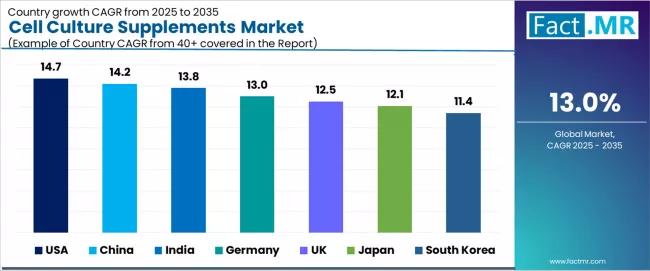
The cell culture supplements market is experiencing exceptional growth globally, with USA leading at a 14.7% CAGR through 2035, driven by strong biotech base, leading position in cell & gene therapy development, and extensive biopharmaceutical manufacturing infrastructure across major production centers. China follows at 14.2%, supported by expansion of biologics manufacturing capabilities, rising pharmaceutical production volumes, and comprehensive biomanufacturing modernization initiatives. India records 13.8% growth, benefiting from low-cost biotech production advantages and stem-cell R&D growth acceleration.
Germany demonstrates 13.0% growth, emphasizing high R&D investment and pharma-industry collaboration excellence. The UK shows 12.5% growth with strong clinical trial ecosystem and biopharmaceutical research focus. Japan records 12.1% growth, representing aging population healthcare demands and regenerative medicine emphasis, while South Korea shows 11.4% growth, representing heavy government support in biomanufacturing sector development.
How does USA Demonstrate Market Leadership with Biotech Excellence?

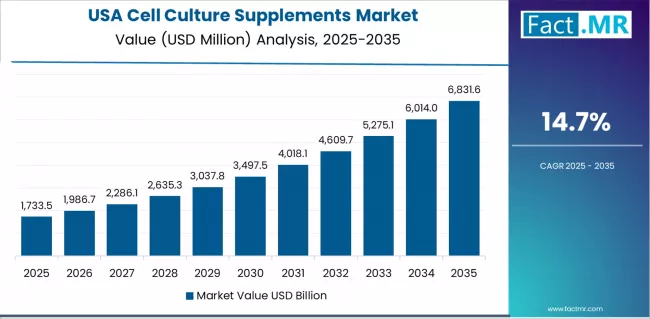
The cell culture supplements market in USA is projected to exhibit exceptional growth with a CAGR of 14.7% through 2035, driven by the world's most advanced biopharmaceutical industry and leading position in cell and gene therapy innovation as an essential component for therapeutic development and commercial manufacturing enhancement. The country's sophisticated bioprocessing ecosystem and extensive pharmaceutical manufacturing infrastructure are creating significant opportunities for supplement deployment across both commercial biologics production and emerging cell therapy manufacturing segments.
Major international supplement providers and domestic manufacturers are establishing comprehensive production facilities to serve the expanding population of pharmaceutical companies and contract manufacturers requiring advanced cell culture solutions across monoclonal antibody production, recombinant protein manufacturing, and cell therapy development facilities throughout USA's diverse biopharmaceutical and biotechnology regions.
The USA government's strategic emphasis on biopharmaceutical innovation and manufacturing capability development is driving substantial investments in bioprocessing technologies and advanced manufacturing infrastructure. This policy support, combined with the country's robust pharmaceutical industry and extensive research funding, creates a favorable environment for cell culture supplement market development. American pharmaceutical manufacturers are increasingly focusing on domestic manufacturing capability enhancement to improve supply chain resilience, with advanced cell culture supplements representing a key component in this bioprocessing capability building.
- Government initiatives supporting biopharmaceutical manufacturing expansion and therapeutic innovation are driving demand for specialized cell culture supplements across commercial production and research segments
- Manufacturing capacity expansion and bioprocessing technology advancement are supporting appropriate utilization of advanced supplements among pharmaceutical companies and contract manufacturing facilities nationwide
- Pharmaceutical companies and biotechnology firms are increasingly recognizing cell culture optimization importance in production efficiency, creating new manufacturing demand capabilities
- Rising bioprocessing investment and growing awareness of quality control benefits are accelerating advanced supplement adoption across therapeutic categories
What makes China Demonstrate Manufacturing Leadership with Biologics Expansion?
The cell culture supplements market in China is expanding at a CAGR of 14.2%, supported by massive biologics manufacturing expansion, rapidly growing pharmaceutical production capacity, and advancing biopharmaceutical manufacturing integration across the country's developing industrial and research corridors.
The country's aggressive pharmaceutical industry development and increasing sophistication of bioprocessing platforms are driving demand for specialized supplement solutions in both biosimilar production and innovative biologics applications. International supplement manufacturers and domestic producers are establishing production capacity to serve the growing demand for quality cell culture solutions while supporting the country's position as a leading biopharmaceutical manufacturing market.
China's biopharmaceutical sector continues to benefit from favorable government policies, expanding manufacturing infrastructure, and growing investment in biologics production capability. The country's focus on pharmaceutical industry modernization is driving investments in critical bioprocessing technologies including cell culture supplements and advanced manufacturing systems. This development is particularly important for cell culture supplement applications, as manufacturers seek reliable supply sources for production materials to enhance manufacturing capabilities and reduce dependence on international supply networks.
- Rising focus on biopharmaceutical self-sufficiency and improving domestic manufacturing capabilities are creating opportunities for advanced supplement solutions
- Growing biosimilar production volumes and innovative biologics manufacturing are supporting increased deployment of specialized cell culture supplements across therapeutic categories
- Expanding pharmaceutical education capacity and emerging quality standards are driving innovative applications of cell culture supplements in commercial and research applications
- Manufacturing capability advancement is enabling delivery of sophisticated production protocols, supporting market growth and reducing international supply dependence
Why does India Maintain Cost-Effective Manufacturing Leadership?
The cell culture supplements market in India is projected to exhibit strong growth with a CAGR of 13.8% through 2035, driven by low-cost biotech production advantages and expanding stem-cell research infrastructure. The country's position as a cost-competitive pharmaceutical manufacturer and growing biotechnology sector are creating significant opportunities for supplement integration across both contract manufacturing and domestic pharmaceutical production applications. Indian pharmaceutical manufacturers are leveraging production cost advantages to serve the growing demand for specialized cell culture solutions while supporting the country's position as a major pharmaceutical production economy.
The Indian market benefits from strong pharmaceutical manufacturing infrastructure supporting biologics production growth, enabling optimized supplement deployment and comprehensive bioprocessing integration. This development is particularly important for cell culture supplement applications, as manufacturers seek cost-effective production solutions that maximize manufacturing efficiency while ensuring quality compliance in commercial pharmaceutical production and contract manufacturing environments.
Strategic Market Considerations:
- Contract manufacturing expansion and growing biosimilar production leading growth with focus on cost-effectiveness and production quality applications
- Manufacturing economics and growing pharmaceutical production capacity are driving diverse supplement portfolios from basic growth supplements to advanced chemically defined formulation platforms
- Pharmaceutical manufacturing excellence and biotech sector growth supporting competitive positioning in Asian biopharmaceutical markets
- Quality standards implementation and regulatory harmonization beginning to influence supplement specifications and advanced formulation adoption timelines
How does Germany Maintain Pharmaceutical Industry Leadership?
Germany's advanced biopharmaceutical market demonstrates sophisticated cell culture supplement deployment with documented effectiveness in biologics manufacturing platforms and therapeutic production applications through integration with cutting-edge bioprocessing technologies and quality control protocols.
The country leverages pharmaceutical industry excellence and comprehensive R&D infrastructure to maintain a 13.0% CAGR through 2035. Pharmaceutical manufacturing facilities, including major production sites in leading industrial centers and university research collaborations, showcase advanced supplement implementations where sophisticated formulation protocols integrate with comprehensive quality systems and ongoing research initiatives to optimize production efficiency and therapeutic outcomes.
German pharmaceutical manufacturers prioritize quality assurance and long-term manufacturing reliability in bioprocessing operations, creating demand for premium cell culture supplements with advanced features, including high-purity formulations and integration with European pharmaceutical manufacturing standards. The market benefits from established biopharmaceutical infrastructure and commitment to research excellence that drives continuous formulation advancement.
Strategic Market Considerations:
- Biologics production and biosimilar manufacturing segments leading growth with focus on quality assurance and comprehensive formulation protocol applications
- Stringent manufacturing quality requirements are driving sophisticated supplement portfolios from conventional growth factor formulations to advanced chemically defined platform systems
- Pharmaceutical industry excellence and research leadership supporting competitive positioning in European biomanufacturing markets
- Professional standards and academic collaboration emphasizing evidence-based approaches and continuous manufacturing quality improvement
What drives UK’s Market Growth with Clinical Trial Excellence?
The UK's expanding cell culture supplements market demonstrates accelerating adoption with a 12.5% CAGR through 2035, driven by strong clinical trial ecosystem, comprehensive biopharmaceutical research programs, and sophisticated manufacturing standards across major pharmaceutical production regions.
The country's leadership in clinical research and therapeutic development is creating substantial demand for advanced cell culture solutions across diverse biologics production and cell therapy development platforms. The pharmaceutical companies and research institutions are increasingly prioritizing advanced supplement formulations that incorporate quality-controlled production protocols for optimal manufacturing outcomes and regulatory compliance enhancement.
Market dynamics focus on high-quality cell culture supplements that balance advanced formulation capabilities with regulatory considerations important to UK pharmaceutical standards and therapeutic development requirements. Growing domestic biopharmaceutical manufacturing expertise creates opportunities for integrated production development programs and advanced supplement technology deployment.
Strategic Market Considerations:
- Biologics production and cell therapy development segments leading growth with focus on research excellence and evidence-based formulation protocol applications
- Diverse pharmaceutical production requirements are driving varied supplement portfolios from general cell culture applications to specialized therapeutic production platforms
- Manufacturing quality optimization supported by extensive pharmaceutical industry expertise and clinical research program excellence
- Pharmaceutical manufacturer preferences emphasizing proven production outcomes and comprehensive technical documentation in cell culture supplement applications
How does Japan Demonstrate Regenerative Medicine Focus?

Japan's expanding cell culture supplements market demonstrates accelerating adoption with a 12.1% CAGR through 2035, driven by aging population healthcare demands, precision medicine methodologies, and comprehensive regenerative medicine development protocols across major pharmaceutical research regions.
The country's emphasis on therapeutic innovation and meticulous manufacturing practice is creating substantial demand for sophisticated cell culture solutions across diverse cell therapy platforms and specialized pharmaceutical applications. Japanese pharmaceutical manufacturers and research institutions are increasingly prioritizing advanced supplement formulations that incorporate precision quality control technologies for optimal production outcomes and regulatory compliance enhancement.
Market dynamics focus on high-quality cell culture supplements that balance advanced formulation capabilities with reliability considerations important to Japanese pharmaceutical practice standards and long-term therapeutic development requirements. Growing domestic cell therapy expertise creates opportunities for integrated manufacturing excellence programs and advanced supplement protocol deployment.
Strategic Market Considerations:
- Regenerative medicine and cell therapy segments demonstrating focused growth with emphasis on manufacturing precision and comprehensive quality applications
- High-quality production requirements driving premium supplement specifications with advanced purity characteristics and production outcome optimization
- Manufacturing excellence supported by pharmaceutical industry expertise and precision bioprocessing delivery capabilities
- Pharmaceutical manufacturer preferences emphasizing proven reliability and comprehensive validation in cell culture supplement applications
What drives South Korea’s Market Growth with Government Support?

South Korea's expanding cell culture supplements market demonstrates accelerating adoption with a 11.4% CAGR through 2035, driven by heavy government support in biomanufacturing sector, comprehensive pharmaceutical industry development, and strategic biotechnology investment across major production regions.
The country's emphasis on biopharmaceutical self-sufficiency and advanced manufacturing capability is creating substantial demand for sophisticated cell culture solutions across diverse biologics production platforms and specialized therapeutic applications. Korean pharmaceutical manufacturers and biotechnology companies are increasingly prioritizing advanced supplement formulations that incorporate government-supported innovation programs for optimal manufacturing outcomes and technology advancement.
Market dynamics focus on advanced cell culture supplements that balance manufacturing capability enhancement with strategic industry development considerations important to Korean pharmaceutical standards and biotechnology sector requirements. Growing domestic biomanufacturing expertise creates opportunities for integrated production capability programs and advanced supplement technology deployment.
Strategic Market Considerations:
- Biosimilar production and innovative biologics segments leading growth with focus on manufacturing capability and strategic industry development applications
- Government support initiatives driving comprehensive supplement portfolios from conventional cell culture applications to advanced biomanufacturing platforms
- Manufacturing capability supported by pharmaceutical industry investment and strategic biotechnology development programs
- Pharmaceutical manufacturer preferences emphasizing domestic supply development and comprehensive technical capability in cell culture supplement applications
Europe Market Split by Country

The cell culture supplements market in Europe is projected to grow from USD 0.6 billion in 2025 to USD 1.5 billion by 2035, registering a CAGR of 9.6% over the forecast period. Germany is expected to maintain its leadership position with a 35.2% market share in 2025, rising to 36.1% by 2035, supported by its dominant pharmaceutical industry infrastructure, comprehensive bioprocessing research capabilities, and advanced biomanufacturing excellence throughout major pharmaceutical production facilities and biotechnology research networks.
The UK follows with a 26.4% share in 2025, projected to reach 27.2% by 2035, driven by clinical trial ecosystem excellence, cell therapy development emphasis, and expanding biopharmaceutical research sophistication serving both domestic and European markets. France holds a 18.9% share in 2025, expected to increase to 19.3% by 2035, supported by comprehensive pharmaceutical manufacturing infrastructure and biologics production capabilities. Italy commands a 10.8% share in 2025, projected to reach 10.2% by 2035, while Spain accounts for 6.5% in 2025, expected to reach 6.1% by 2035.
The rest of Europe region, including Nordic countries with advanced biotechnology sectors, Eastern European emerging manufacturing markets, and smaller Western European research centers, is anticipated to hold 2.2% in 2025, declining slightly to 1.1% by 2035, attributed to market consolidation toward larger core markets with established biopharmaceutical infrastructure and cell culture supplement expertise.
Competitive Landscape of the Cell Culture Supplements Market

The cell culture supplements market is characterized by intense competition among established pharmaceutical supply companies, specialized bioprocessing solution providers, and comprehensive life sciences organizations focused on delivering high-quality, reliable, and innovative supplement formulations.
Companies are investing in formulation development programs, advanced manufacturing facility expansion, strategic pharmaceutical partnership establishment, and comprehensive technical support initiatives to deliver effective, efficient, and reliable cell culture solutions that meet stringent pharmaceutical quality standards and customer expectations. Product standardization, regulatory compliance emphasis, and manufacturing excellence strategies are central to strengthening product portfolios and market presence.
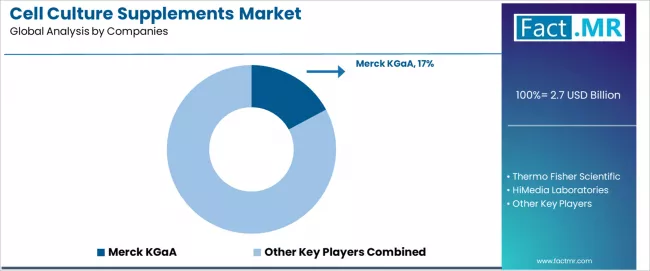
Merck KGaA leads the market with a 17.2% market share, offering comprehensive cell culture supplement solutions with a focus on chemically defined formulation expertise and advanced bioprocessing capabilities for biopharmaceutical manufacturing applications.
Thermo Fisher Scientific provides specialized supplement platforms with emphasis on large-scale production support and comprehensive technical service capabilities across global pharmaceutical markets.
HiMedia Laboratories focuses on cost-effective supplement solutions and comprehensive product portfolios serving emerging biopharmaceutical communities. Danaher delivers advanced bioprocessing excellence with strong quality control capabilities and manufacturing optimization integration.
Sartorius AG operates with a focus on bringing specialized cell culture technologies to pharmaceutical manufacturing markets and bioprocessing applications. Corning Incorporated provides comprehensive bioprocessing solutions emphasizing surface modification expertise and cell culture optimization capabilities.
R&D Systems (Bio-Techne) specializes in growth factor supplements and protein-based formulations with emphasis on research application support. Repligen Corporation delivers specialized bioprocessing technologies to enhance manufacturing efficiency and provide comprehensive cell culture optimization solutions.
STEMCELL Technologies and Proteintech Group, Inc focus on specialized research applications and protein-based supplement solutions, emphasizing formulation quality and comprehensive technical protocols through dedicated specialty product strategies.
Key Players in the Cell Culture Supplements Market
- Merck KGaA
- Thermo Fisher Scientific
- HiMedia Laboratories
- Danaher
- Sartorius AG
- Corning Incorporated
- R&D Systems (Bio-Techne)
- STEMCELL Technologies
- Repligen Corporation
- Proteintech Group, Inc
Scope of the Report
| Items | Values |
|---|---|
| Quantitative Units (2025) | USD 2.7 Billion |
| Product Type | Serum-based Supplements, Protein-based & Recombinant Supplements, Chemically Defined Supplements, Others |
| Application Type | Biopharmaceutical Manufacturing, Cell & Gene Therapy, Drug Discovery, Others |
| End-Use Category | Cell Culture Media Manufacturers, Pharmaceutical & Biotechnology Companies, CDMOs/CMOs & CROs, Academic & Research Institutes |
| Regions Covered | Asia Pacific, North America, Europe, Latin America, Middle East & Africa |
| Countries Covered | USA, Germany, UK, Japan, India, China, South Korea and 40+ countries |
| Key Companies Profiled | Merck KGaA, Thermo Fisher Scientific, HiMedia Laboratories, Danaher, Sartorius AG, Corning Incorporated, R&D Systems (Bio-Techne), STEMCELL Technologies, Repligen Corporation, Proteintech Group, Inc |
| Additional Attributes | Dollar sales by product type, application type, end-use category, regional demand trends, competitive landscape, pharmaceutical manufacturer preferences for specific cell culture supplements, integration with comprehensive biomanufacturing systems, innovations in formulation development, bioprocessing technology advancement, and manufacturing optimization capabilities |
Cell Culture Supplements Market by Segments
-
Product Type :
- Serum-Based Supplements
- Protein-Based & Recombinant Supplements
- Chemically Defined Supplements
- Others
-
Application Type :
- Biopharmaceutical Manufacturing
- Cell & Gene Therapy
- Drug Discovery
- Others
-
End-Use Category :
- Cell Culture Media Manufacturers
- Pharmaceutical & Biotechnology Companies
- CDMOs/CMOs & CROs
- Academic & Research Institutes
-
Region :
- Asia Pacific
- China
- India
- Japan
- South Korea
- ASEAN
- Australia & New Zealand
- Rest of Asia Pacific
- North America
- United States
- Canada
- Mexico
- Europe
- Germany
- France
- United Kingdom
- Italy
- Spain
- Nordic
- BENELUX
- Rest of Europe
- Latin America
- Brazil
- Argentina
- Chile
- Rest of Latin America
- Middle East & Africa
- Kingdom of Saudi Arabia
- Other GCC Countries
- Turkey
- South Africa
- Other African Countries
- Rest of Middle East & Africa
- Asia Pacific
Table of Content
- Executive Summary
- Global Market Outlook
- Demand to side Trends
- Supply to side Trends
- Technology Roadmap Analysis
- Analysis and Recommendations
- Market Overview
- Market Coverage / Taxonomy
- Market Definition / Scope / Limitations
- Market Background
- Market Dynamics
- Drivers
- Restraints
- Opportunity
- Trends
- Scenario Forecast
- Demand in Optimistic Scenario
- Demand in Likely Scenario
- Demand in Conservative Scenario
- Opportunity Map Analysis
- Product Life Cycle Analysis
- Supply Chain Analysis
- Investment Feasibility Matrix
- Value Chain Analysis
- PESTLE and Porter’s Analysis
- Regulatory Landscape
- Regional Parent Market Outlook
- Production and Consumption Statistics
- Import and Export Statistics
- Market Dynamics
- Global Market Analysis 2020 to 2024 and Forecast, 2025 to 2035
- Historical Market Size Value (USD Million) Analysis, 2020 to 2024
- Current and Future Market Size Value (USD Million) Projections, 2025 to 2035
- Y to o to Y Growth Trend Analysis
- Absolute $ Opportunity Analysis
- Global Market Pricing Analysis 2020 to 2024 and Forecast 2025 to 2035
- Global Market Analysis 2020 to 2024 and Forecast 2025 to 2035, By Product Type
- Introduction / Key Findings
- Historical Market Size Value (USD Million) Analysis By Product Type, 2020 to 2024
- Current and Future Market Size Value (USD Million) Analysis and Forecast By Product Type, 2025 to 2035
- Protein-Based & Recombinant Supplements
- Serum-Based Supplements
- Chemically Defined Supplements
- Others
- Y to o to Y Growth Trend Analysis By Product Type, 2020 to 2024
- Absolute $ Opportunity Analysis By Product Type, 2025 to 2035
- Global Market Analysis 2020 to 2024 and Forecast 2025 to 2035, By Application Type
- Introduction / Key Findings
- Historical Market Size Value (USD Million) Analysis By Application Type, 2020 to 2024
- Current and Future Market Size Value (USD Million) Analysis and Forecast By Application Type, 2025 to 2035
- Biopharmaceutical Manufacturing
- Cell & Gene Therapy
- Drug Discovery
- Others
- Y to o to Y Growth Trend Analysis By Application Type, 2020 to 2024
- Absolute $ Opportunity Analysis By Application Type, 2025 to 2035
- Global Market Analysis 2020 to 2024 and Forecast 2025 to 2035, By End-Use Category
- Introduction / Key Findings
- Historical Market Size Value (USD Million) Analysis By End-Use Category, 2020 to 2024
- Current and Future Market Size Value (USD Million) Analysis and Forecast By End-Use Category, 2025 to 2035
- Pharmaceutical & Biotechnology Companies
- Cell Culture Media Manufacturers
- CDMOs/CMOs & CROs
- Academic & Research Institutes
- Y to o to Y Growth Trend Analysis By End-Use Category, 2020 to 2024
- Absolute $ Opportunity Analysis By End-Use Category, 2025 to 2035
- Global Market Analysis 2020 to 2024 and Forecast 2025 to 2035, By Region
- Introduction
- Historical Market Size Value (USD Million) Analysis By Region, 2020 to 2024
- Current Market Size Value (USD Million) Analysis and Forecast By Region, 2025 to 2035
- North America
- Latin America
- Western Europe
- Eastern Europe
- East Asia
- South Asia and Pacific
- Middle East & Africa
- Market Attractiveness Analysis By Region
- North America Market Analysis 2020 to 2024 and Forecast 2025 to 2035, By Country
- Historical Market Size Value (USD Million) Trend Analysis By Market Taxonomy, 2020 to 2024
- Market Size Value (USD Million) Forecast By Market Taxonomy, 2025 to 2035
- By Country
- USA
- Canada
- Mexico
- By Product Type
- By Application Type
- By End-Use Category
- By Country
- Market Attractiveness Analysis
- By Country
- By Product Type
- By Application Type
- By End-Use Category
- Key Takeaways
- Latin America Market Analysis 2020 to 2024 and Forecast 2025 to 2035, By Country
- Historical Market Size Value (USD Million) Trend Analysis By Market Taxonomy, 2020 to 2024
- Market Size Value (USD Million) Forecast By Market Taxonomy, 2025 to 2035
- By Country
- Brazil
- Chile
- Rest of Latin America
- By Product Type
- By Application Type
- By End-Use Category
- By Country
- Market Attractiveness Analysis
- By Country
- By Product Type
- By Application Type
- By End-Use Category
- Key Takeaways
- Western Europe Market Analysis 2020 to 2024 and Forecast 2025 to 2035, By Country
- Historical Market Size Value (USD Million) Trend Analysis By Market Taxonomy, 2020 to 2024
- Market Size Value (USD Million) Forecast By Market Taxonomy, 2025 to 2035
- By Country
- Germany
- UK
- Italy
- Spain
- France
- Nordic
- BENELUX
- Rest of Western Europe
- By Product Type
- By Application Type
- By End-Use Category
- By Country
- Market Attractiveness Analysis
- By Country
- By Product Type
- By Application Type
- By End-Use Category
- Key Takeaways
- Eastern Europe Market Analysis 2020 to 2024 and Forecast 2025 to 2035, By Country
- Historical Market Size Value (USD Million) Trend Analysis By Market Taxonomy, 2020 to 2024
- Market Size Value (USD Million) Forecast By Market Taxonomy, 2025 to 2035
- By Country
- Russia
- Poland
- Hungary
- Balkan & Baltic
- Rest of Eastern Europe
- By Product Type
- By Application Type
- By End-Use Category
- By Country
- Market Attractiveness Analysis
- By Country
- By Product Type
- By Application Type
- By End-Use Category
- Key Takeaways
- East Asia Market Analysis 2020 to 2024 and Forecast 2025 to 2035, By Country
- Historical Market Size Value (USD Million) Trend Analysis By Market Taxonomy, 2020 to 2024
- Market Size Value (USD Million) Forecast By Market Taxonomy, 2025 to 2035
- By Country
- China
- Japan
- South Korea
- By Product Type
- By Application Type
- By End-Use Category
- By Country
- Market Attractiveness Analysis
- By Country
- By Product Type
- By Application Type
- By End-Use Category
- Key Takeaways
- South Asia and Pacific Market Analysis 2020 to 2024 and Forecast 2025 to 2035, By Country
- Historical Market Size Value (USD Million) Trend Analysis By Market Taxonomy, 2020 to 2024
- Market Size Value (USD Million) Forecast By Market Taxonomy, 2025 to 2035
- By Country
- India
- ASEAN
- Australia & New Zealand
- Rest of South Asia and Pacific
- By Product Type
- By Application Type
- By End-Use Category
- By Country
- Market Attractiveness Analysis
- By Country
- By Product Type
- By Application Type
- By End-Use Category
- Key Takeaways
- Middle East & Africa Market Analysis 2020 to 2024 and Forecast 2025 to 2035, By Country
- Historical Market Size Value (USD Million) Trend Analysis By Market Taxonomy, 2020 to 2024
- Market Size Value (USD Million) Forecast By Market Taxonomy, 2025 to 2035
- By Country
- Kingdom of Saudi Arabia
- Other GCC Countries
- Turkiye
- South Africa
- Other African Union
- Rest of Middle East & Africa
- By Product Type
- By Application Type
- By End-Use Category
- By Country
- Market Attractiveness Analysis
- By Country
- By Product Type
- By Application Type
- By End-Use Category
- Key Takeaways
- Key Countries Market Analysis
- USA
- Pricing Analysis
- Market Share Analysis, 2024
- By Product Type
- By Application Type
- By End-Use Category
- Canada
- Pricing Analysis
- Market Share Analysis, 2024
- By Product Type
- By Application Type
- By End-Use Category
- Mexico
- Pricing Analysis
- Market Share Analysis, 2024
- By Product Type
- By Application Type
- By End-Use Category
- Brazil
- Pricing Analysis
- Market Share Analysis, 2024
- By Product Type
- By Application Type
- By End-Use Category
- Chile
- Pricing Analysis
- Market Share Analysis, 2024
- By Product Type
- By Application Type
- By End-Use Category
- Germany
- Pricing Analysis
- Market Share Analysis, 2024
- By Product Type
- By Application Type
- By End-Use Category
- UK
- Pricing Analysis
- Market Share Analysis, 2024
- By Product Type
- By Application Type
- By End-Use Category
- Italy
- Pricing Analysis
- Market Share Analysis, 2024
- By Product Type
- By Application Type
- By End-Use Category
- Spain
- Pricing Analysis
- Market Share Analysis, 2024
- By Product Type
- By Application Type
- By End-Use Category
- France
- Pricing Analysis
- Market Share Analysis, 2024
- By Product Type
- By Application Type
- By End-Use Category
- India
- Pricing Analysis
- Market Share Analysis, 2024
- By Product Type
- By Application Type
- By End-Use Category
- ASEAN
- Pricing Analysis
- Market Share Analysis, 2024
- By Product Type
- By Application Type
- By End-Use Category
- Australia & New Zealand
- Pricing Analysis
- Market Share Analysis, 2024
- By Product Type
- By Application Type
- By End-Use Category
- China
- Pricing Analysis
- Market Share Analysis, 2024
- By Product Type
- By Application Type
- By End-Use Category
- Japan
- Pricing Analysis
- Market Share Analysis, 2024
- By Product Type
- By Application Type
- By End-Use Category
- South Korea
- Pricing Analysis
- Market Share Analysis, 2024
- By Product Type
- By Application Type
- By End-Use Category
- Russia
- Pricing Analysis
- Market Share Analysis, 2024
- By Product Type
- By Application Type
- By End-Use Category
- Poland
- Pricing Analysis
- Market Share Analysis, 2024
- By Product Type
- By Application Type
- By End-Use Category
- Hungary
- Pricing Analysis
- Market Share Analysis, 2024
- By Product Type
- By Application Type
- By End-Use Category
- Kingdom of Saudi Arabia
- Pricing Analysis
- Market Share Analysis, 2024
- By Product Type
- By Application Type
- By End-Use Category
- Turkiye
- Pricing Analysis
- Market Share Analysis, 2024
- By Product Type
- By Application Type
- By End-Use Category
- South Africa
- Pricing Analysis
- Market Share Analysis, 2024
- By Product Type
- By Application Type
- By End-Use Category
- USA
- Market Structure Analysis
- Competition Dashboard
- Competition Benchmarking
- Market Share Analysis of Top Players
- By Regional
- By Product Type
- By Application Type
- By End-Use Category
- Competition Analysis
- Competition Deep Dive
- Merck KGaA
- Overview
- Product Portfolio
- Profitability by Market Segments (Product/Age /Sales Channel/Region)
- Sales Footprint
- Strategy Overview
- Marketing Strategy
- Product Strategy
- Channel Strategy
- Thermo Fisher Scientific
- HiMedia Laboratories
- Danaher
- Sartorius AG
- Corning Incorporated
- R&D Systems (Bio-Techne)
- STEMCELL Technologies
- Repligen Corporation
- Proteintech Group, Inc
- Merck KGaA
- Competition Deep Dive
- Assumptions & Acronyms Used
- Research Methodology
List Of Table
- Table 1: Global Market Value (USD Million) Forecast by Region, 2020 to 2035
- Table 2: Global Market Value (USD Million) Forecast by Product Type, 2020 to 2035
- Table 3: Global Market Value (USD Million) Forecast by Application Type, 2020 to 2035
- Table 4: Global Market Value (USD Million) Forecast by End-Use Category, 2020 to 2035
- Table 5: North America Market Value (USD Million) Forecast by Country, 2020 to 2035
- Table 6: North America Market Value (USD Million) Forecast by Product Type, 2020 to 2035
- Table 7: North America Market Value (USD Million) Forecast by Application Type, 2020 to 2035
- Table 8: North America Market Value (USD Million) Forecast by End-Use Category, 2020 to 2035
- Table 9: Latin America Market Value (USD Million) Forecast by Country, 2020 to 2035
- Table 10: Latin America Market Value (USD Million) Forecast by Product Type, 2020 to 2035
- Table 11: Latin America Market Value (USD Million) Forecast by Application Type, 2020 to 2035
- Table 12: Latin America Market Value (USD Million) Forecast by End-Use Category, 2020 to 2035
- Table 13: Western Europe Market Value (USD Million) Forecast by Country, 2020 to 2035
- Table 14: Western Europe Market Value (USD Million) Forecast by Product Type, 2020 to 2035
- Table 15: Western Europe Market Value (USD Million) Forecast by Application Type, 2020 to 2035
- Table 16: Western Europe Market Value (USD Million) Forecast by End-Use Category, 2020 to 2035
- Table 17: Eastern Europe Market Value (USD Million) Forecast by Country, 2020 to 2035
- Table 18: Eastern Europe Market Value (USD Million) Forecast by Product Type, 2020 to 2035
- Table 19: Eastern Europe Market Value (USD Million) Forecast by Application Type, 2020 to 2035
- Table 20: Eastern Europe Market Value (USD Million) Forecast by End-Use Category, 2020 to 2035
- Table 21: East Asia Market Value (USD Million) Forecast by Country, 2020 to 2035
- Table 22: East Asia Market Value (USD Million) Forecast by Product Type, 2020 to 2035
- Table 23: East Asia Market Value (USD Million) Forecast by Application Type, 2020 to 2035
- Table 24: East Asia Market Value (USD Million) Forecast by End-Use Category, 2020 to 2035
- Table 25: South Asia and Pacific Market Value (USD Million) Forecast by Country, 2020 to 2035
- Table 26: South Asia and Pacific Market Value (USD Million) Forecast by Product Type, 2020 to 2035
- Table 27: South Asia and Pacific Market Value (USD Million) Forecast by Application Type, 2020 to 2035
- Table 28: South Asia and Pacific Market Value (USD Million) Forecast by End-Use Category, 2020 to 2035
- Table 29: Middle East & Africa Market Value (USD Million) Forecast by Country, 2020 to 2035
- Table 30: Middle East & Africa Market Value (USD Million) Forecast by Product Type, 2020 to 2035
- Table 31: Middle East & Africa Market Value (USD Million) Forecast by Application Type, 2020 to 2035
- Table 32: Middle East & Africa Market Value (USD Million) Forecast by End-Use Category, 2020 to 2035
List Of Figures
- Figure 1: Global Market Pricing Analysis
- Figure 2: Global Market Value (USD Million) Forecast 2020 to 2035
- Figure 3: Global Market Value Share and BPS Analysis by Product Type, 2025 and 2035
- Figure 4: Global Market Y to o to Y Growth Comparison by Product Type, 2025 to 2035
- Figure 5: Global Market Attractiveness Analysis by Product Type
- Figure 6: Global Market Value Share and BPS Analysis by Application Type, 2025 and 2035
- Figure 7: Global Market Y to o to Y Growth Comparison by Application Type, 2025 to 2035
- Figure 8: Global Market Attractiveness Analysis by Application Type
- Figure 9: Global Market Value Share and BPS Analysis by End-Use Category, 2025 and 2035
- Figure 10: Global Market Y to o to Y Growth Comparison by End-Use Category, 2025 to 2035
- Figure 11: Global Market Attractiveness Analysis by End-Use Category
- Figure 12: Global Market Value (USD Million) Share and BPS Analysis by Region, 2025 and 2035
- Figure 13: Global Market Y to o to Y Growth Comparison by Region, 2025 to 2035
- Figure 14: Global Market Attractiveness Analysis by Region
- Figure 15: North America Market Incremental Dollar Opportunity, 2025 to 2035
- Figure 16: Latin America Market Incremental Dollar Opportunity, 2025 to 2035
- Figure 17: Western Europe Market Incremental Dollar Opportunity, 2025 to 2035
- Figure 18: Eastern Europe Market Incremental Dollar Opportunity, 2025 to 2035
- Figure 19: East Asia Market Incremental Dollar Opportunity, 2025 to 2035
- Figure 20: South Asia and Pacific Market Incremental Dollar Opportunity, 2025 to 2035
- Figure 21: Middle East & Africa Market Incremental Dollar Opportunity, 2025 to 2035
- Figure 22: North America Market Value Share and BPS Analysis by Country, 2025 and 2035
- Figure 23: North America Market Value Share and BPS Analysis by Product Type, 2025 and 2035
- Figure 24: North America Market Y to o to Y Growth Comparison by Product Type, 2025 to 2035
- Figure 25: North America Market Attractiveness Analysis by Product Type
- Figure 26: North America Market Value Share and BPS Analysis by Application Type, 2025 and 2035
- Figure 27: North America Market Y to o to Y Growth Comparison by Application Type, 2025 to 2035
- Figure 28: North America Market Attractiveness Analysis by Application Type
- Figure 29: North America Market Value Share and BPS Analysis by End-Use Category, 2025 and 2035
- Figure 30: North America Market Y to o to Y Growth Comparison by End-Use Category, 2025 to 2035
- Figure 31: North America Market Attractiveness Analysis by End-Use Category
- Figure 32: Latin America Market Value Share and BPS Analysis by Country, 2025 and 2035
- Figure 33: Latin America Market Value Share and BPS Analysis by Product Type, 2025 and 2035
- Figure 34: Latin America Market Y to o to Y Growth Comparison by Product Type, 2025 to 2035
- Figure 35: Latin America Market Attractiveness Analysis by Product Type
- Figure 36: Latin America Market Value Share and BPS Analysis by Application Type, 2025 and 2035
- Figure 37: Latin America Market Y to o to Y Growth Comparison by Application Type, 2025 to 2035
- Figure 38: Latin America Market Attractiveness Analysis by Application Type
- Figure 39: Latin America Market Value Share and BPS Analysis by End-Use Category, 2025 and 2035
- Figure 40: Latin America Market Y to o to Y Growth Comparison by End-Use Category, 2025 to 2035
- Figure 41: Latin America Market Attractiveness Analysis by End-Use Category
- Figure 42: Western Europe Market Value Share and BPS Analysis by Country, 2025 and 2035
- Figure 43: Western Europe Market Value Share and BPS Analysis by Product Type, 2025 and 2035
- Figure 44: Western Europe Market Y to o to Y Growth Comparison by Product Type, 2025 to 2035
- Figure 45: Western Europe Market Attractiveness Analysis by Product Type
- Figure 46: Western Europe Market Value Share and BPS Analysis by Application Type, 2025 and 2035
- Figure 47: Western Europe Market Y to o to Y Growth Comparison by Application Type, 2025 to 2035
- Figure 48: Western Europe Market Attractiveness Analysis by Application Type
- Figure 49: Western Europe Market Value Share and BPS Analysis by End-Use Category, 2025 and 2035
- Figure 50: Western Europe Market Y to o to Y Growth Comparison by End-Use Category, 2025 to 2035
- Figure 51: Western Europe Market Attractiveness Analysis by End-Use Category
- Figure 52: Eastern Europe Market Value Share and BPS Analysis by Country, 2025 and 2035
- Figure 53: Eastern Europe Market Value Share and BPS Analysis by Product Type, 2025 and 2035
- Figure 54: Eastern Europe Market Y to o to Y Growth Comparison by Product Type, 2025 to 2035
- Figure 55: Eastern Europe Market Attractiveness Analysis by Product Type
- Figure 56: Eastern Europe Market Value Share and BPS Analysis by Application Type, 2025 and 2035
- Figure 57: Eastern Europe Market Y to o to Y Growth Comparison by Application Type, 2025 to 2035
- Figure 58: Eastern Europe Market Attractiveness Analysis by Application Type
- Figure 59: Eastern Europe Market Value Share and BPS Analysis by End-Use Category, 2025 and 2035
- Figure 60: Eastern Europe Market Y to o to Y Growth Comparison by End-Use Category, 2025 to 2035
- Figure 61: Eastern Europe Market Attractiveness Analysis by End-Use Category
- Figure 62: East Asia Market Value Share and BPS Analysis by Country, 2025 and 2035
- Figure 63: East Asia Market Value Share and BPS Analysis by Product Type, 2025 and 2035
- Figure 64: East Asia Market Y to o to Y Growth Comparison by Product Type, 2025 to 2035
- Figure 65: East Asia Market Attractiveness Analysis by Product Type
- Figure 66: East Asia Market Value Share and BPS Analysis by Application Type, 2025 and 2035
- Figure 67: East Asia Market Y to o to Y Growth Comparison by Application Type, 2025 to 2035
- Figure 68: East Asia Market Attractiveness Analysis by Application Type
- Figure 69: East Asia Market Value Share and BPS Analysis by End-Use Category, 2025 and 2035
- Figure 70: East Asia Market Y to o to Y Growth Comparison by End-Use Category, 2025 to 2035
- Figure 71: East Asia Market Attractiveness Analysis by End-Use Category
- Figure 72: South Asia and Pacific Market Value Share and BPS Analysis by Country, 2025 and 2035
- Figure 73: South Asia and Pacific Market Value Share and BPS Analysis by Product Type, 2025 and 2035
- Figure 74: South Asia and Pacific Market Y to o to Y Growth Comparison by Product Type, 2025 to 2035
- Figure 75: South Asia and Pacific Market Attractiveness Analysis by Product Type
- Figure 76: South Asia and Pacific Market Value Share and BPS Analysis by Application Type, 2025 and 2035
- Figure 77: South Asia and Pacific Market Y to o to Y Growth Comparison by Application Type, 2025 to 2035
- Figure 78: South Asia and Pacific Market Attractiveness Analysis by Application Type
- Figure 79: South Asia and Pacific Market Value Share and BPS Analysis by End-Use Category, 2025 and 2035
- Figure 80: South Asia and Pacific Market Y to o to Y Growth Comparison by End-Use Category, 2025 to 2035
- Figure 81: South Asia and Pacific Market Attractiveness Analysis by End-Use Category
- Figure 82: Middle East & Africa Market Value Share and BPS Analysis by Country, 2025 and 2035
- Figure 83: Middle East & Africa Market Value Share and BPS Analysis by Product Type, 2025 and 2035
- Figure 84: Middle East & Africa Market Y to o to Y Growth Comparison by Product Type, 2025 to 2035
- Figure 85: Middle East & Africa Market Attractiveness Analysis by Product Type
- Figure 86: Middle East & Africa Market Value Share and BPS Analysis by Application Type, 2025 and 2035
- Figure 87: Middle East & Africa Market Y to o to Y Growth Comparison by Application Type, 2025 to 2035
- Figure 88: Middle East & Africa Market Attractiveness Analysis by Application Type
- Figure 89: Middle East & Africa Market Value Share and BPS Analysis by End-Use Category, 2025 and 2035
- Figure 90: Middle East & Africa Market Y to o to Y Growth Comparison by End-Use Category, 2025 to 2035
- Figure 91: Middle East & Africa Market Attractiveness Analysis by End-Use Category
- Figure 92: Global Market - Tier Structure Analysis
- Figure 93: Global Market - Company Share Analysis
- FAQs -
How big is the cell culture supplements market in 2025?
The global cell culture supplements market is estimated to be valued at USD 2.7 billion in 2025.
What will be the size of cell culture supplements market in 2035?
The market size for the cell culture supplements market is projected to reach USD 9.2 billion by 2035.
How much will be the cell culture supplements market growth between 2025 and 2035?
The cell culture supplements market is expected to grow at a 13.0% CAGR between 2025 and 2035.
What are the key product types in the cell culture supplements market?
The key product types in cell culture supplements market are protein-based & recombinant supplements, serum-based supplements, chemically defined supplements and others.
Which application type segment to contribute significant share in the cell culture supplements market in 2025?
In terms of application type, biopharmaceutical manufacturing segment to command 48.7% share in the cell culture supplements market in 2025.