- Market Value (2025): USD 271.6 Mn
- Estimated Value (2026): USD 301.0 Mn
- Forecast Value (2036): USD 842.4 Mn
- CAGR (2026-2036): 10.8%
What is the Cellulose Titanium Dioxide Alternatives Market forecast to be worth by 2036?
USD 301.0 million in 2026 to USD 842.4 million by 2036 at a 10.8% CAGR.
- The cellulose titanium dioxide alternatives market reached USD 271.6 million in 2025.
- Demand will increase from USD 301.0 million in 2026 to USD 842.4 million by 2036.
- The market will grow at 10.8% CAGR from 2026 to 2036 as food product teams test plant fiber, starch and mineral types for white color and white coverage.
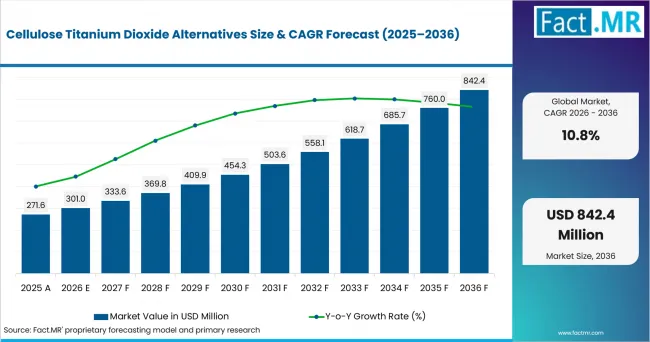
Cellulose Titanium Dioxide Alternatives Value Analysis | Source: Fact.MR
What are the defining numbers behind Cellulose Titanium Dioxide Alternatives Market growth?
An absolute gain of USD 541.4 million is set between 2026 and 2036.
- Demand Drivers in the Market
- Baked goods and candy teams need white types that mix evenly and stay bright after plant work. plant fiber bits can create white coverage through their physical structure instead of TiO2.
- Food product teams need white types that fit changing color plans and preserve the finished look set in known products. In May 2025, the U.S. Food and Drug agency approved calcium phosphate as a white color additive for specified uses in ready-to-eat chicken products, white candy melts, doughnut sugar. Sugar for coated candies, expanding the range of regulated color options ready to food product teams.
- Product teams need a swap whitener that has little effect on taste, smell, or texture. Seprify states that its plant fiber white offers neutral flavour and odour together with light. Heat and pH steady results for food and tablet product designs.
- makers often need more than one product route because swap results varies by mix.
- Key Segments Analyzed
- By Whitening type: designed plant fiber light bit holds 55.0% share in 2026. This is because controlled bit shape gives product teams a direct route to white look and white coverage without TiO2.
- By use: baked goods icing holds 37.0% share in 2026 owing to the clear white finish required in frostings, glazes and surface coatings.
- By results: white cover / white look holds 41.0% share in 2026 since swap choices begin with the look function that TiO2 historically gave.
- By Product role: TiO2 swap holds 45.0% share in 2026 as firms role white types around direct reproduct design needs in food and tablets.
- Analyst Opinion at Fact.MR
- Shambhu Nath Jha, Principal Consultant at Fact.MR, states, “Product teams compare dosage and white coverage for each food use. Stable plant work is also important. plant fiber types can gain demand when they offer low taste and texture impact and steady supply.”
- Strategic Implications
- plant fiber firms should publish dosage and steady results data for each use. This helps product teams compare white look under the same settings.
- Food color firms should pair white pigments with aid for coating, beverage and dairy types. This is because results changes with water work and line heat.
- tablet coating teams should test tablet coverage, breakdown, and finish when replacing TiO2.
- input sellers should maintain clear regional records and use samples so brands can compare white types efficiently across several end uses.
The Netherlands is forecast at 12.5% CAGR through 2036 as its food-plant work and export base aids product design work. The USA is set at 11.8%, followed by the UK at 11.4%. France is set at 10.8%. Germany is forecast at 10.3%.
How does the Cellulose Titanium Dioxide Alternatives Market break down by segment?
Engineered cellulose light scatterer leads Whitening Type at 55.0% share in 2026. TiO2 replacement leads Position Role at 45.0% share.
Which Whitening Type dominates?
Engineered cellulose light scatterer holds 55.0% share in 2026.
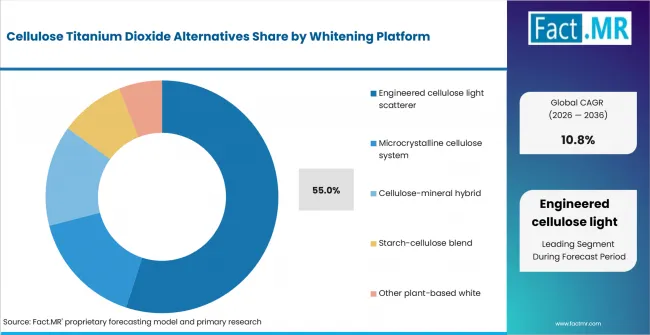
Cellulose Titanium Dioxide Alternatives Analysis By Whitening Platform | Source: Fact.MR
Engineered cellulose light scatterers lead because their structure helps scatter light and create whiteness. Microcrystalline cellulose and cellulose-mineral blends provide alternative routes. Starch-cellulose blends suit products that use familiar food-derived inputs. Other plant-based whitening systems depend more on dosage, texture, processing requirements, and the intended end use.
What leads the application group?
Bakery icing leads with 37.0% share in 2026.
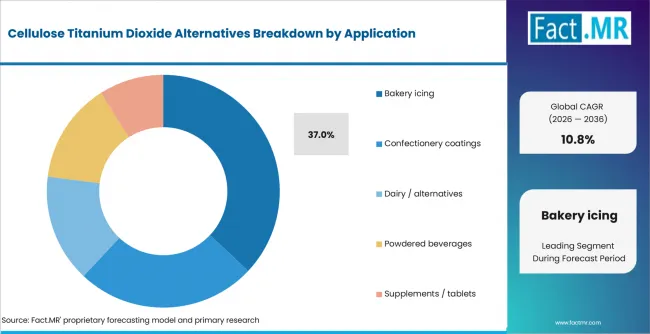
Cellulose Titanium Dioxide Alternatives Analysis By Application | Source: Fact.MR
Bakery icing leads because white color is easy to see in frostings and glazes. candy coatings need close white coverage but also require proper panning and drying. Dairy others and powdered drinks need even mixing with little effect on taste or texture. tablets and tablets also need good coating coverage and product results.
How does performance shape demand?
Opacity / brightness captures 41.0% share in 2026.
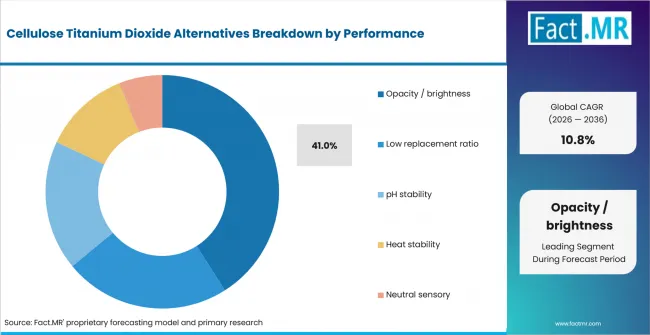
Cellulose Titanium Dioxide Alternatives Analysis By Performance | Source: Fact.MR
Opacity / brightness lead because they are the main look functions being replaced. A low use rate helps control product design cost and solids loading. pH and heat steady results matter in acidic or made foods. Neutral taste and texture results is critical where extra solids could affect flavor or mouthfeel.
What aids TiO2 Replacement within Product Position?
TiO2 replacement accounts for 45.0% share in 2026.
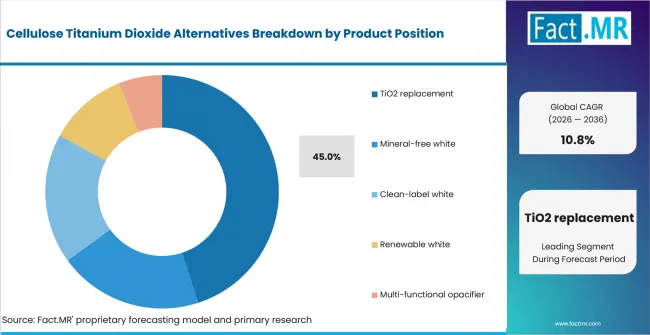
Cellulose Titanium Dioxide Alternatives Analysis By Product Position | Source: Fact.MR
TiO2 replacement leads because buyers first want to match the current white or opaque look. Mineral-free and clean-label positions address different input plans. bio-based white strengthens the case for plant fiber types. Multi-useful opacifiers compete where firms can combine white color with product design aid.
What is accelerating Cellulose Titanium Dioxide Alternatives Market adoption, and what is holding it back?
E171-free reproduct design and clean-label white work aid use. Dosage, texture and steady results by use remain the main constraints.
Drivers Impact Analysis
| DRIVER | (~) % IMPACT ON CAGR | GEOGRAPHIC RELEVANCE | IMPACT TIMELINE |
|---|---|---|---|
| E171-free reformulation in food applications | +1.5% | Europe | Short term (<= 2 years) |
| Commercial scale-up of cellulose white pigments | +1.2% | Europe, North America | Medium term (2-4 years) |
| Clean-label white positioning | +0.9% | Global | Medium term (2-4 years) |
| Broader food and nutraceutical application testing | +0.6% | Global | Long term (>= 4 years) |
Opportunity Impact Analysis
| OPPORTUNITY | (~) % IMPACT ON CAGR | GEOGRAPHIC RELEVANCE | IMPACT TIMELINE |
|---|---|---|---|
| Lower-dose cellulose light-scattering systems | +1.1% | Global | Medium term (2-4 years) |
| White coatings for supplements and tablets | +0.8% | Europe, North America | Medium term (2-4 years) |
| Plant-based dairy and powdered beverage formulations | +0.6% | Europe, North America | Long term (>= 4 years) |
Restraints Impact Analysis
| RESTRAINT | (~) % IMPACT ON CAGR | GEOGRAPHIC RELEVANCE | IMPACT TIMELINE |
|---|---|---|---|
| Higher usage rate versus TiO2 in some formulations | -0.7% | Global | Short term (<= 2 years) |
| Texture and viscosity changes at higher dosage | -0.5% | Bakery, beverages | Medium term (2-4 years) |
| Different stability requirements by application | -0.4% | Global | Long term (>= 4 years) |
Which countries are scaling the Cellulose Titanium Dioxide Alternatives Market through 2036?
- The country CAGR range is 2.2points over the forecast period.
- The Netherlands remains 0.7 point above the USA as its dense food network. Input-sales networks and export-aimed product design work aid marketization.
- The USA remains 0.4 point above the UK through its large food-plant work base and active reproduct design across baked goods, candy and food uses.
- The UK remains 0.6 point above France as broad food-plant work scale aids continued review of other white types across food and tablet formats.
- France remains 0.5 point above Germany through dairy-plant work scale and product design work across baked goods, candy and linked white-food uses.
- Germany closes the displayed range as its sizeable candy plant work base aids product design work around white coverage, coating coverage and heat steady results.
Full report coverage includes North America, Latin America, Western Europe, Eastern Europe, East Asia, South Asia & Pacific, Middle East & Africa.
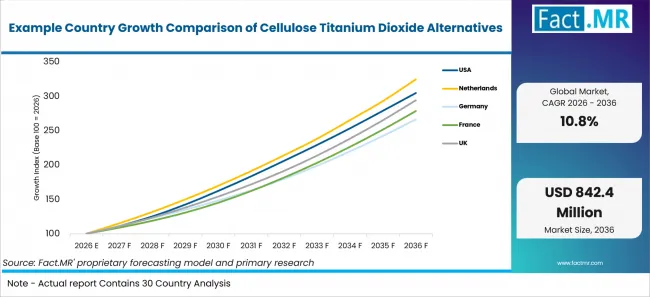
Example Country Growth Comparison Of Cellulose Titanium Dioxide Alternatives | Source: Fact.MR
| Country | CAGR (2026-2036) |
|---|---|
| USA | 11.8% |
| Netherlands | 12.5% |
| Germany | 10.3% |
| France | 10.8% |
| UK | 11.4% |
What supports USA adoption?
11.8% CAGR, aided by a large food-plant work base and active product design work.
U.S. food makers serve a broad range of finished products where white look remains a clear product design need. USDA market Research Service said in June 2026 that total U.S. food spending reached USD 2.51 trillion in 2025. That scale gives other white color firms a large downstream base across baked goods and candy. Dairy-style products and food formats extend the addressable product design set. use will depend on use testing that confirms white look and taste and texture neutrality under market plant work settings.
How is the Netherlands scaling demand?
12.5% CAGR, shaped by an active food channel and export-aimed product design work.
The Netherlands combines a dense food network with access to European input sales and product design networks. data Netherlands said in March 2026 that sales at food and beverage outlets increased 4.8% in 2025. A marketly active food channel gives input developers more routes for trials across baked goods, candy and dairy-style uses. Export-aimed brands will place added weight on rule records and repeatable results when selecting plant fiber or blended white types for multi-market use.
What is supporting Germany’s adoption?
10.3% CAGR, led by candy plant work and product design depth.
Germany gives a sizable candy base where white coatings and decorative finishes are productly clear. Destatis said in December 2025 that Germany produced nearly 1.07 million tonnes of chocolate products containing cocoa in 2024. That plant work depth aids product design work around white coverage, coating coverage and heat steady results. plant fiber-based and blended others will gain consideration where firms can record consistent light results without disrupting texture or plant work across candy and tablet coating uses.
How is France developing demand?
10.8% CAGR, backed by dairy plant work and food-product design work.
France has a large dairy-plant work base that creates recurring product design work across white and light-colored finished products. Agreste said in June 2026 that French cow-milk collection reached 2.11075 billion litres in April 2026. That plant work scale aids review of white coverage types in dairy desserts and adjacent product designs where pH use and neutral taste and texture results carry market weight. firms will compete through use aid that links light results with stable plant work in baked goods and candy formats as well.
What supports United Kingdom growth?
11.4% CAGR, driven by food plant work scale and reproduct design work.
The United Kingdom offers a broad food-plant work base for white-color reproduct design across baked goods, candy and tablet products. The Office for National data said in July 2026 that UK makers recorded GBP 452.0 billion in product sales during 2025, with food representing 22.9% of the total. That factory base gives white color firms multiple use channels. market use will favor types with clear input records and steady white look under the plant work settings used by individual makers.
Who leads the Cellulose Titanium Dioxide Alternatives Market?
Seprify gives a plant fiber-based white color type. Oterra brings the method into well-known food and beverage color uses through its market deal with Seprify. BIOGRUND incorporates Seprify’s SilvaAlba™ plant fiber input into ready-made tablet tablet-coating types. firm difference can be assessed through white color and white coverage results. Dosage needs, pH and heat steady results, plant work use and fit for the finished use.
BIOGRUND and Seprify announced a deal on March 31, 2026, to introduce mineral-free tablet tablet-coating types using Seprify’s plant-based plant fiber input SilvaAlba™. The ready-made types were made ready for customer review and product design trials. Providing a defined route for the plant fiber-based white color method into tablet tablet-coating uses.
Which companies are the key providers?
Key firms include Seprify; Oterra; BIOGRUND; Grolman Group; and Sparxell.
- Seprify
- Oterra
- BIOGRUND
- Grolman Group
- Sparxell
Bibliography
- U.S. Food and Drug agency. (2025, May 9).FDA approves three food colors from natural sources.
- Oterra. (2025, November 11). Oterra signs deal with Seprify to bring natural white color swap for TiO2 to food and beverage sector.
- U.S. Census Bureau. (2026, September 3).Census Bureau releases new Annual Integrated market Survey data.
- Zeballos, E., & Sinclair, W. (2026, June 11).Total U.S. food spending reached $2.51 trillion in 2025. U.S. Department of Agriculture, market Research Service.
- data Netherlands. (2026, March 2).sales in accommodation and food services sector up by 3.2 percent in Q4.
- Statistisches Bundesamt (Destatis). (2025, December 2).12,8 Kilo Schokolade pro Kopf wurden 2024 produziert[12.8 kilograms of chocolate per capita were produced in 2024].
- Touati-Houari, N. (2026, June 12).Lait. Avril 2026 : la collecte de lait toujours en hausse sur un an. Agreste.
- Office for National data. (2026, July 24). UK makers’ sales by product: 2025.
- Seprify. (2026, March 31). BIOGRUND partners with Seprify to bring clean-label tablet tablet coatings to market.
This Report Answers
- The report explains how plant fiber and other white types replace TiO2 in food and tablet uses.
- group review covers white color type and use using the 2026 shares. results and product role are assessed in the same segmentation framework.
- Country review compares the USA and Netherlands with Germany, France and UK. It uses 2026 to 2036 CAGRs and public food-sector data.
- Competitive review reviews current firm work in plant fiber white pigments, TiO2-free coatings and other food opacifiers.
- use review assesses white coverage and dosage in product design choices. steady use and taste and texture results are testd alongside those points.
What does the Cellulose Titanium Dioxide Alternatives Market cover?
The market covers white color and white coverage types designed to replace TiO2 in food and beverage product designs. tablet product designs are covered with a focus on plant fiber light scattering. The scope covers designed plant fiber pigments and microcrystalline plant fiber types. plant fiber-mineral hybrids and starch-plant fiber blends compete for the same TiO2-swap brief.
The scope overlaps with natural food colors because whitening types are tested beside broader food-color ranges. It connects with food additives when white cover is gave as a useful input within a made-food mix.
What is included in the scope?
The scope includes plant fiber white pigments for baked goods icing and candy coatings. It also covers dairy others, powdered drinks, and tablet coatings. Food makers test how each new white type works during mixing and coating.
tablet and tablet uses connect with nutraceuticals because white film coatings must maintain look consistency and making steady use across finished dosage forms.
What is excluded from the scope?
The scope excludes the current tracked within food grade titanium dioxide and focuses on inputs sold as swap types or other white opacifiers for food and closely linked tablet uses.
Ordinary inputs that create incidental whiteness remain outside the market unless they are sold as a whitening or opacifying type. The review is therefore narrower than the broader colorants category and centers on deliberate TiO2-swap use.
How Was the Analysis Built?
The review draws on 120+ sources, 35+ firm ranges, 25+ countries. More than 20 sector interviews.
- main Research: The study uses interviews with makers, method teams, sellers, end users, and sector experts. These talks cover buying needs, product use, operating issues, checks, firm work, and market use.
- Desk Research: Desk research covers government data, rule publications, firm filings, trade data. Product studies, sector associations, standards, public policy, and other trusted sources. Every source used in the review is documented in the bibliography.
- Market Sizing and Forecasting: Market estimates use past results, demand trends, prices, volumes, group shares, firm work, country growth, use, spending. Barriers to growth.
- Data test and Update Cycle: Findings are checked by comparing main interviews with public data. Firm work, rule changes, trade patterns, and sector works. Regular updates review new product launches, output changes, partnerships, checks, and shifts in market use.
What is the report’s scope and coverage?
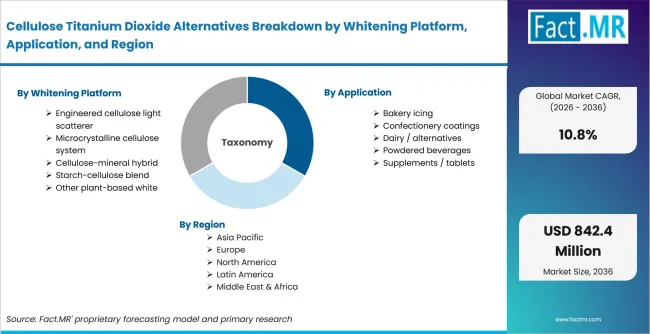
Cellulose Titanium Dioxide Alternatives Breakdown By Whitening Platform, Application, And Region | Source: Fact.MR
| Attribute | Details |
|---|---|
| Quantitative Units | USD million |
| Market Definition | White and opacifying ingredient systems positioned as alternatives to titanium dioxide, with cellulose-based light-scattering platforms at the center of the market scope. |
| Whitening Platform | Engineered cellulose light scatterer; Microcrystalline cellulose system; Cellulose-mineral hybrid; Starch-cellulose blend; Other plant-based white |
| Application | Bakery icing; Confectionery coatings; Dairy / alternatives; Powdered beverages; Supplements / tablets |
| Performance | Opacity / brightness; Low replacement ratio; pH stability; Heat stability; Neutral sensory |
| Product Position | TiO2 replacement; Mineral-free white; Clean-label white; Renewable white; Multi-functional opacifier |
| Regions Covered | North America; Latin America; Western Europe; Eastern Europe; East Asia; South Asia & Pacific; Middle East & Africa |
| Countries Covered | USA; Netherlands; Germany; France; UK |
| Key Companies Profiled | Seprify; Oterra; BIOGRUND; Grolman Group; Sparxell |
| Forecast Period | 2026 to 2036 |
| Approach | Hybrid top-down and bottom-up approach using application demand, reformulation activity, supplier portfolios, food-manufacturing indicators and country-level adoption signals. |
How is the market segmented?
-
By Whitening Platform
- Engineered cellulose light scatterer
- Microcrystalline cellulose system
- Cellulose-mineral hybrid
- Starch-cellulose blend
- Other plant-based white
-
By Application
- Bakery icing
- Confectionery coatings
- Dairy / alternatives
- Powdered beverages
- Supplements / tablets
-
By Performance
- Opacity / brightness
- Low replacement ratio
- pH stability
- Heat stability
- Neutral sensory
-
By Product Position
- TiO2 replacement
- Mineral-free white
- Clean-label white
- Renewable white
- Multi-functional opacifier
-
By Region
- North America
- Latin America
- Western Europe
- Eastern Europe
- East Asia
- South Asia & Pacific
- Middle East & Africa