- Base Value(2025): 12.7 Bn
- Estimated Value(2026): 13.2 Bn
- Forecast Value (2036): 20.1 Bn
- CAGR (2026 - 2036): 4.3%
Food Grade Titanium Dioxide Market Forecast and Outlook By Fact.MR
In 2025, the food grade titanium dioxide market was valued at USD 12.7 billion. Based on Fact.MR analysis, demand for food grade titanium dioxide is estimated to grow to USD 13.2 billion in 2026 and USD 20.1 billion by 2036. FACT.MR projects a CAGR of 4.3% during the forecast period.
The market is expected to generate USD 6.9 billion in incremental revenue during the forecast period, reflecting steady rather than transformational expansion. Growth is driven by expanding bakery and confectionery production in Asia Pacific and the sustained use of TiO2 in dairy coatings and sauce applications where EU-equivalent bans have not yet been adopted. EU reformulation costs and regulatory pressure on nano-form TiO2 moderate faster growth. Chloride-process producers retain pricing advantage over sulphate-process competitors in regulated export markets.
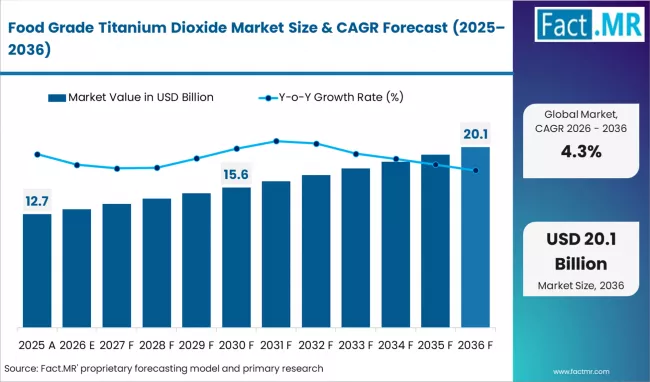
Food Grade Titanium Dioxide Market Market Value Analysis | Source: Fact.MR
| Metric | Value |
|---|---|
| Estimated Value in 2026 | USD 13.2 billion |
| Forecast Value in 2036 | USD 20.1 billion |
| Forecast CAGR (2026 to 2036) | 4.3% |
Source: Fact.MR analysis. Updated Mar 25, 2026
India leads country-level growth at 6.8% CAGR through 2036, driven by rapidly expanding bakery and packaged food production and the absence of an EU-style E171 ban enabling sustained TiO2 use in domestic food processing. China follows at 5.8% CAGR, supported by large-scale confectionery and dairy manufacturing and domestic TiO2 production overcapacity that keeps input costs competitive. The United States records 5.0% CAGR, generating structured replacement demand as FDA continues to permit TiO2 use in food under GRAS status while monitoring EU regulatory developments. Germany at 4.3% CAGR reflects EU E171 ban compliance reformulation demand rather than volume growth. The United Kingdom at 4.0% records the slowest growth as post-Brexit alignment with EU food additive restrictions constrains TiO2 application scope across processed food categories.
Summary of Food Grade Titanium Dioxide Market
- Market Definition
- The market covers food-grade TiO2 pigment manufactured to food additive purity specifications and used as a whitening, brightening, and opacity agent in bakery, dairy, confectionery, sauce, and processed food product formulations globally.
- Demand Drivers
- Growth in bakery and confectionery production in India and Southeast Asia is sustaining high-volume TiO2 demand, especially in markets without EU-style restrictions.
- China’s expanding food processing sector is supporting steady TiO2 demand, backed by low-cost domestic production from local manufacturers.
- FDA GRAS status in the United States continues to support TiO2 usage, with manufacturers monitoring EU regulations but delaying reformulation.
- Key Segments Analyzed
- • By Form: Micro-scale pigments hold 70% share in 2026 due to widespread use in bakery coatings, dairy whitening, and confectionery shells.
- • By Extraction Method: Chloride method holds 58% share in 2026 due to higher purity and lower heavy metal content.
- • By Geography: India leads growth at 6.8% CAGR, driven by strong food manufacturing expansion and permissive regulatory standards.
- Analyst Opinion at FACT.MR
- Shambhu Nath Jha notes that the EU ban is creating a split market, with reformulation in Europe and continued volume growth in Asia Pacific and North America.
- Strategic Implications
- Producers should expand chloride-process capacity to serve growing demand in India and Southeast Asia.
- Suppliers in Europe must develop alternative whitening ingredients to maintain customer relationships.
- Companies sourcing from China should ensure compliance with international purity and certification standards.
- Methodology
- Market sizing is based on shipment volumes, pricing trends, and food production data validated through industry and company reports.
- Regulatory inputs include EFSA, EU ban rules, FDA GRAS status, FSSAI standards, and UK guidance.
- Forecasts incorporate food production trends, EU reformulation impact, and expert insights from industry stakeholders.
Report Scope
Food Grade Titanium Dioxide Market Analysis by Form
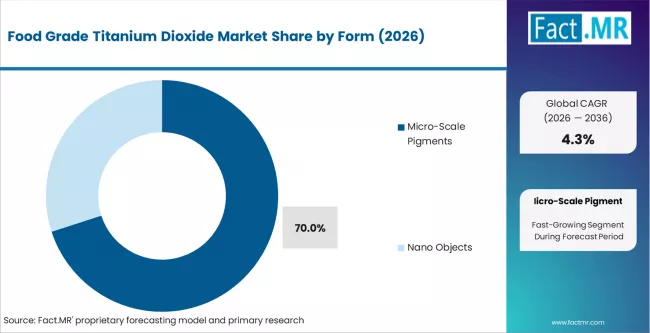
Food Grade Titanium Dioxide Market Analysis By Form | Source: Fact.MR
Micro-scale pigments are expected to hold ~70% share in 2026. They are widely used in bakery icing, dairy products, and confectionery coatings. They provide high brightness and meet regulatory limits without nano-form restrictions.
- Tronox Capacity Expansion: Tronox increased output at its Mississippi facility to meet rising demand from food manufacturers. [4]
- CNNC Hua Yuan Food Grade Launch: CNNC expanded food-grade TiO2 certification to support confectionery and dairy applications in China. [5]
- Nano-Form Restriction Trend: Increasing regulatory scrutiny on nano-TiO2 is shifting demand toward micro-scale pigment grades. [6]
Food Grade Titanium Dioxide Market Analysis by Extraction Method
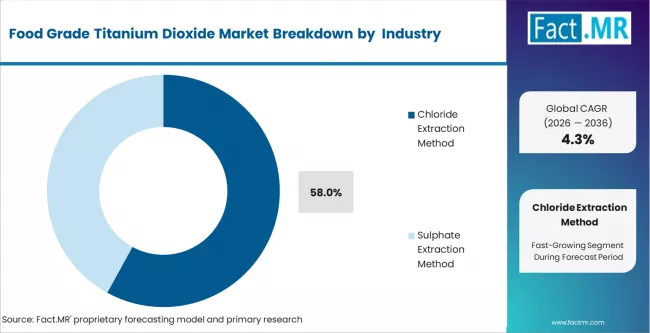
Food Grade Titanium Dioxide Market Analysis By Extraction Method | Source: Fact.MR
Chloride extraction is expected to hold ~58% share in 2026. It produces higher-purity TiO2 with lower contaminant levels. This makes it suitable for regulated export markets.
- Chemours Ti-Pure Investment: Chemours is expanding chloride-process TiO2 capacity to meet demand for certified food-grade products. [1]
- Sulphate Process Quality Gap: Sulphate-process TiO2 faces stricter quality requirements, prompting manufacturers to upgrade processes. [7]
- Chloride Extraction Adoption Trend: India increased imports of chloride-process TiO2 by 14% in 2024, reflecting preference for high-purity grades. [8]
Drivers, Restraints, and Opportunities
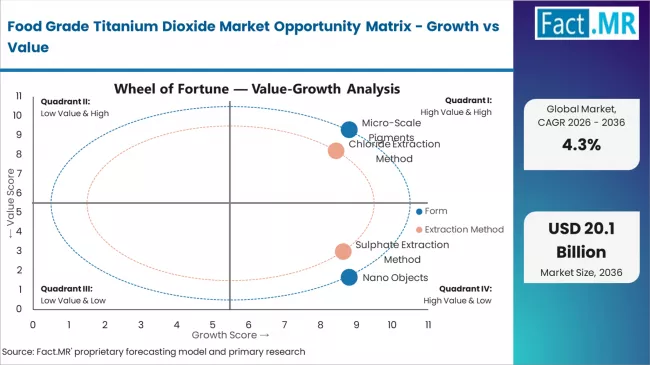
Food Grade Titanium Dioxide Market Opportunity Matrix Growth Vs Value | Source: Fact.MR
FACT.MR identifies two distinct regulatory environments shaping the market. Europe has banned TiO2 in food, forcing reformulation across key applications. In contrast, regions like the US, India, and China continue to permit usage, sustaining global demand.
Demand in Europe and the UK is shifting toward natural alternatives. Meanwhile, Asia Pacific and North America continue to see volume growth. Chloride-process TiO2 is gaining share due to higher purity and compliance advantages. This is supporting price premiums despite reduced EU volumes.
- EU E171 Regulatory Ban: EU Regulation 2022/63 banned TiO2 from August 2022, forcing major food companies to reformulate products. [2]
- India FSSAI Permitted Status: India continues to allow TiO2 use under food regulations, supporting strong domestic demand growth. [3]
- Chemours Chloride Process Investment: Chemours is investing in chloride-process TiO2 capacity to supply high-purity product to non-EU markets. [1]
Regional Analysis
The food grade titanium dioxide market is analysed across North America, Europe, Asia Pacific, Latin America, and Middle East and Africa, covering 40+ country-level demand profiles shaped by food additive regulatory frameworks, bakery and confectionery manufacturing output, TiO2 production ecosystem depth, and EU E171 ban compliance reformulation timelines. The full report offers market attractiveness analysis based on food manufacturing growth rates, regulatory compliance requirements, and chloride versus sulphate process adoption benchmarks.
.webp "Top Country Growth Comparison Food Grade Titanium Dioxide Market Cagr (2026 2036)")
Top Country Growth Comparison Food Grade Titanium Dioxide Market Cagr (2026 2036) | Source: Fact.MR
| Country | CAGR (2026 to 2036) |
|---|---|
| India | 6.8% |
| China | 5.8% |
| United States | 5.0% |
| Germany | 4.3% |
| United Kingdom | 4.0% |
Source: Fact.MR analysis. Updated Mar 25, 2026
Source: Fact.MR (FACT.MR) analysis, based on proprietary forecasting model and primary research
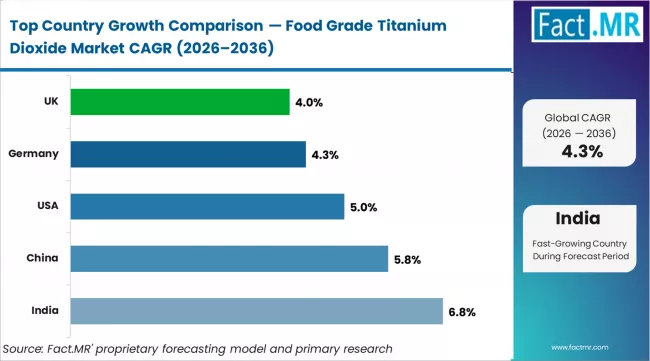
Food Grade Titanium Dioxide Market Cagr Analysis By Country | Source: Fact.MR
Asia Pacific Food Grade Titanium Dioxide Market Analysis
Asia Pacific is the largest volume growth region, supported by India’s food manufacturing expansion and China’s domestic TiO2 production ecosystem. Regional producers like Sichuan Lomon, CNNC Hua Yuan, and Jinan Yuxing supply both domestic and export demand across food applications.
- India: India driven by strong food processing expansion: Food grade TiO2 demand in India is projected to grow at a 6.8% CAGR through 2036. FSSAI confirmed TiO2 remains a permitted additive in 2024. This supports continued use in bakery, confectionery, and dairy applications. Major players like Britannia and Parle expanded production in 2024, sustaining TiO2 demand. India’s regulatory model differs from Europe, as growth is driven by food production rather than reformulation.
- China: China supported by integrated domestic supply: Food grade TiO2 demand in China is projected to grow at a 5.8% CAGR through 2036. Strong confectionery and dairy production drives steady demand. Domestic producers expanded certification programmes in 2024. GB 2760-2024 standards continue to permit TiO2 use in food. This supports stable demand through a national regulatory framework.
FACT.MR's analysis of Asia Pacific includes India, China, Japan, ASEAN, and Australia and New Zealand. It covers regulatory status, production trends, and forecasts.
Europe Food Grade Titanium Dioxide Market Analysis
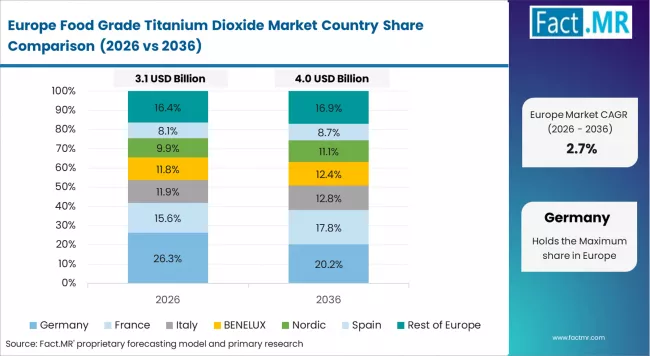
Food Grade Titanium Dioxide Market Europe Country Market Share Analysis, 2026 & 2036 | Source: Fact.MR
Europe is shaped by regulatory restrictions, with the EU banning TiO2 in food applications. Market activity is driven by reformulation rather than new demand. Producers focus on non-food and permitted applications.
- Germany: Germany shaped by strict enforcement: Food grade TiO2 demand in Germany is projected to grow at a 4.3% CAGR through 2036. EU Regulation 2022/63 requires full reformulation of food products. Authorities conducted compliance testing in 2024. Manufacturers like Haribo and Bahlsen completed product reformulation. Germany follows a strict enforcement model led by federal agencies.
- United Kingdom: United Kingdom influenced by independent regulation: Food grade TiO2 demand in the UK is projected to grow at a 4.0% CAGR through 2036. The FSA implemented a TiO2 ban under retained EU law. Food manufacturers completed reformulation by 2024. Alternatives like calcium carbonate and rice starch are widely used. Growth is limited to non-food and residual applications.
FACT.MR's analysis of Europe includes Germany, France, the UK, Italy, Spain, and Western Europe. It covers reformulation trends, compliance data, and forecasts.
North America Food Grade Titanium Dioxide Market Analysis
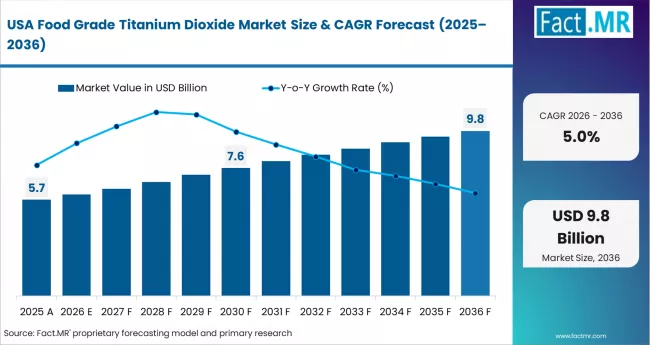
Food Grade Titanium Dioxide Market Country Value Analysis | Source: Fact.MR
North America shows steady demand supported by FDA approval of TiO2 in food. Domestic producers like Chemours and Tronox lead supply. The market is driven by stable usage rather than regulatory disruption.
- United States: United States supported by stable regulatory approval: Food grade TiO2 demand in the United States is projected to grow at a 5.0% CAGR through 2036. FDA continues to permit TiO2 use under defined limits. A 2024 update confirmed no regulatory change. Chemours supplies food-grade TiO2 to major manufacturers. Demand remains stable across bakery, confectionery, and dressing applications.
FACT.MR's analysis of North America includes the United States, Canada, and Mexico. It covers FDA status, supply trends, and forecasts.
Competitive Aligners for Market Players
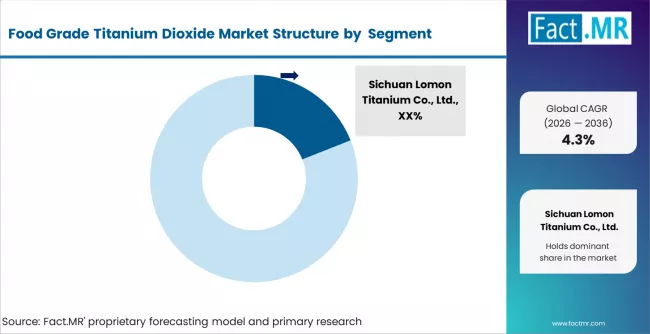
Food Grade Titanium Dioxide Market Analysis By Company | Source: Fact.MR
The global food grade titanium dioxide market is fairly concentrated, with a few large producers controlling most of the supply. Companies like Chemours, Tronox, and Kronos dominate in North America and Europe, while Chinese players such as Sichuan Lomon and CNNC Hua Yuan lead in Asia Pacific. Their scale and integrated operations allow them to supply both domestic and export markets efficiently, especially in price-sensitive regions like India and Southeast Asia.
Chemours has a strong advantage due to its Ti-Pure brand, which meets multiple global food safety standards. This gives buyers confidence, especially in regulated export markets. Tronox benefits from owning its raw material sources, which helps maintain stable costs and consistent product quality. Chinese manufacturers, on the other hand, compete on pricing and production scale, but they increasingly face pressure to meet international quality and certification standards. Large food companies like Mars, Mondelez, and Nestlé manage supplier risk by working with multiple vendors and conducting regular audits.
In Europe, the TiO2 ban has reduced demand and shifted focus to alternatives. However, in North America and Asia, buyers still negotiate based on volume. Higher-purity chloride-process TiO2 continues to command premium pricing, particularly in applications where quality and compliance are critical.
Key Players of Food Grade Titanium Dioxide Market
- Sichuan Lomon Titanium Co., Ltd.
- The Chemours Company
- Parshwanath Group of Industries
- Henan Millions Chemicals Co., Ltd.
- CNNC Hua Yuan Titanium Dioxide Co., Ltd.
- Cristal Australind Plant
- Huntsman Pigments and Additive Manufacturing
- Tronox TiO2 Manufacturing Facility
- Jinan Yuxing Chemical Co., Ltd.
- Shandong Dawn Group Co., Ltd.
- Kronos Manufacturing Facility
Bibliography
- [1] The Chemours Company. (2024). Annual Report 2024: Ti-Pure Titanium Dioxide Food-Grade Product Line Capacity Optimisation at DeLisle Mississippi Chloride-Process Facility and Food Pharmaceutical Purity Certification Programme Update. March 2024.
- [2] European Food Safety Authority. (2024). Follow-Up Assessment on Titanium Dioxide E171 Genotoxicity Concerns and EU Regulation 2022/63 Food Additive Ban Status Confirmation: No Reversal Recommended Based on Unresolved Nano-Form Safety Data. June 2024.
- [3] National Health Commission of the People's Republic of China. (2024). GB 2760-2024 Food Safety National Standard: Food Additive Use Standards Update Confirming Titanium Dioxide Permitted Status in Candy, Dairy, and Seasoning Food Categories. January 2024.
- [4] Tronox Holdings plc. (2024). Q3 2024 Earnings Report: Hamilton Mississippi Chloride-Process TiO2 Facility Food-Grade Output Levels and North American Food Manufacturer Customer Demand Update. October 2024.
- [5] CNNC Hua Yuan Titanium Dioxide Co., Ltd. (2024). Product Certification Expansion: Food-Grade TiO2 GB/T Standard Certification for Chloride-Process Micro-Scale Pigment Grades Targeting Chinese Confectionery and Dairy Manufacturer Customers. 2024.
- [6] European Chemicals Agency. (2024). Nanomaterials Regulatory Update 2024: Nano-Form Titanium Dioxide Heightened Restrictions Across Food Contact Materials and Food Additive Applications, French ANSES Precautionary Limit Recommendation for Nano-TiO2 in Food Packaging Materials. October 2024.
- [7] Kronos Worldwide Inc. (2024). Q4 2024 Financial Report: European Sulphate-Process TiO2 Facility Impurity Reduction Investment Programme Targeting Food-Grade Quality Documentation Requirements for Export Market Compliance. February 2025.
- [8] Indian TiO2 Manufacturers Association. (2024). Annual Industry Data Update 2024: Domestic Food-Grade TiO2 Import Statistics Including 14% Year-on-Year Increase in Chloride-Process Certified Grade Imports from China for Indian Bakery and Confectionery Export Production. December 2024.
This Report Addresses
- Strategic intelligence on EU Regulation 2022/63 E171 food additive ban enforcement, UK FSA post-Brexit TiO2 restriction alignment, FDA GRAS status monitoring for TiO2 in food, India FSSAI food additive permitted standards, and China GB 2760-2024 food additive regulations shaping food-grade TiO2 procurement through 2036.
- Market forecast projecting growth from USD 13.2 billion in 2026 to USD 20.1 billion by 2036 at a 4.3% CAGR, segmented by form, extraction method, application, and region.
- Growth opportunity analysis across India's bakery and confectionery manufacturing expansion, China domestic food-grade TiO2 production scale, U.S. FDA-permitted food additive procurement channels, and chloride-process premium product positioning in Asia Pacific export markets.
- Country CAGR outlook highlighting India (6.8%), China (5.8%), United States (5.0%), Germany (4.3%), and United Kingdom (4.0%), supported by TiO2 producer revenue disclosures, food manufacturer reformulation announcements, and regulatory authority publications.
- Competitive landscape analysis covering Chemours, Tronox, Kronos, Sichuan Lomon, CNNC Hua Yuan, Huntsman, Cristal, and Shandong Dawn, focusing on chloride versus sulphate process positioning, food-grade certification strategies, and geographic market expansion priorities.
- Technology tracking including chloride-process food-grade purity improvement, nano-form restriction compliance documentation, heavy metal contaminant reduction in sulphate-process grades, and natural whitening substitute performance benchmarking against TiO2 opacity standards.
- Regulatory coverage of EU E171 ban and EFSA genotoxicity assessment, UK FSA food additive restriction implementation, FDA 21 CFR 73.575 GRAS status monitoring, India FSSAI Schedule 1 food additive standards, China GB 2760-2024 updates, and JECFA international food additive safety evaluations.
- Report deliverables include PDF report, Excel datasets, PowerPoint summary, and dashboards using data from Chemours, Tronox, and Kronos financial filings, EFSA and FDA regulatory publications, FSSAI and NHC food additive standards, and primary research interviews.
Food Grade Titanium Dioxide Market Definition
The food grade titanium dioxide market includes TiO2 pigment produced to food-safe purity standards and used as a whitening and opacity agent in bakery products, dairy coatings, confectionery shells, sauces, and other processed food applications approved under national food additive regulations.
Food Grade Titanium Dioxide Market Inclusions
Global and regional forecasts from 2026 to 2036 by form, extraction method, and application. Covers micro-scale and nano-form TiO2 produced via chloride and sulphate extraction routes for dairy, bakery, confectionery, and sauce applications across major regions.
Food Grade Titanium Dioxide Market Exclusions
Excludes industrial-grade TiO2 used in paints, coatings, plastics, and cosmetics not certified to food additive standards. Also excludes natural whitening substitutes such as calcium carbonate, rice starch, and titanium-free opacity agents positioned as E171 replacement ingredients.
Food Grade Titanium Dioxide Market Research Methodology
- Primary Research: Interviews with food additive procurement managers, confectionery ingredient buyers, TiO2 manufacturers, and food safety compliance officers across North America, Europe, China, and India.
- Desk Research: Sources include EFSA E171 safety assessment reports, FDA GRAS status documentation, FSSAI food additive standards, Chemours and Tronox annual reports, and EU food additive regulation publications from 2024 to 2025.
- Market Sizing and Forecasting: Hybrid top-down and bottom-up approach based on food-grade TiO2 shipment volumes by application category, average selling prices by extraction method and form, and regional food manufacturing output benchmarks.
- Data Validation and Update Cycle: Validated using TiO2 producer revenue disclosures, food manufacturer reformulation announcements, EFSA and FDA regulatory database updates, and expert interviews with food safety compliance specialists.
Segmentation
Scope of Report
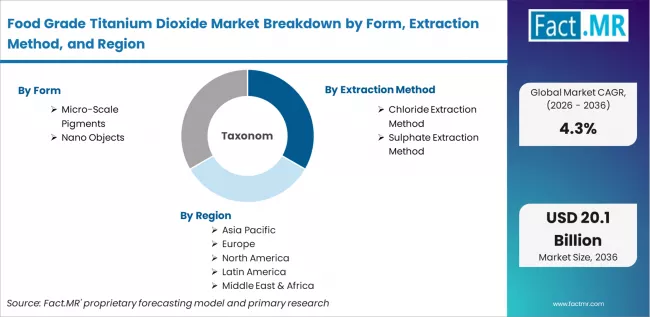
Food Grade Titanium Dioxide Market Breakdown By Form, Extraction Method, And Region | Source: Fact.MR
| Attribute | Details |
|---|---|
| Quantitative Units | USD 13.2 billion (2026) to USD 20.1 billion (2036), at a CAGR of 4.3% |
| Market Definition | Food-grade titanium dioxide pigment manufactured to food additive purity specifications and used as a whitening, brightening, and opacity agent in bakery, dairy, confectionery, sauce, and processed food product formulations under national food additive regulatory approvals. |
| Form Segmentation | Micro-Scale Pigments, Nano Objects |
| Extraction Method Segmentation | Chloride Extraction Method, Sulphate Extraction Method |
| Application Segmentation | Dairy Products, Bakery and Confectionery, Sauces and Savoury Products, Others |
| Application Coverage | Bakery icing and coating whitening, confectionery sugar shell opacity, dairy product brightness enhancement, salad dressing and sauce whitening, chewing gum brightening, and processed food additive certification applications. |
| Regions Covered | North America, Europe, Asia Pacific, Latin America, Middle East and Africa |
| Countries Covered | USA, Canada, Mexico, Germany, UK, France, Italy, Spain, Nordic, BENELUX, Eastern Europe, Japan, South Korea, China, India, ASEAN, Australia and New Zealand, Brazil, Argentina, Chile, KSA, GCC, Turkey, South Africa, Rest of MEA |
| Key Companies Profiled | Sichuan Lomon Titanium Co. Ltd., The Chemours Company, Parshwanath Group of Industries, Henan Millions Chemicals Co. Ltd., CNNC Hua Yuan Titanium Dioxide Co. Ltd., Cristal Australind Plant, Huntsman Pigments and Additive Manufacturing, Tronox TiO2 Manufacturing Facility, Jinan Yuxing Chemical Co. Ltd., Shandong Dawn Group Co. Ltd., Kronos Manufacturing Facility |
| Forecast Period | 2026 to 2036 |
| Approach | Hybrid top-down and bottom-up model using food-grade TiO2 shipment volumes by application and geography, average selling prices by extraction method and form, food manufacturing output benchmarks, and primary interviews with food additive procurement managers, TiO2 producers, and food safety compliance officers. |
Source: Fact.MR analysis. Updated Mar 25, 2026
Food Grade Titanium Dioxide Market by Segments
-
By Form :
- Micro-Scale Pigments
- Nano Objects
-
By Extraction Method :
- Chloride Extraction Method
- Sulphate Extraction Method
-
By Application :
- Dairy Products
- Bakery and Confectionery
- Sauces and Savoury Products
- Others
-
By Region :
- North America
- United States
- Canada
- Mexico
- Latin America
- Brazil
- Mexico
- Argentina
- Chile
- Rest of Latin America
- Western Europe
- Germany
- United Kingdom
- France
- Italy
- Spain
- Nordic Countries
- BENELUX
- Rest of Western Europe
- Eastern Europe
- Russia
- Poland
- Hungary
- Balkan and Baltic
- Rest of Eastern Europe
- East Asia
- China
- Japan
- South Korea
- South Asia and Pacific
- India
- ASEAN
- Australia and New Zealand
- Rest of South Asia and Pacific
- Middle East and Africa
- Kingdom of Saudi Arabia
- Other GCC Countries
- Turkey
- South Africa
- Rest of Middle East and Africa
- North America
Frequently Asked Questions
How large is the food grade titanium dioxide market in 2025?
What will the market size be in 2026?
What is the projected market size by 2036?
What is the expected CAGR?
Which form segment leads the food grade titanium dioxide market?
Which extraction method dominates?
Which country shows the fastest growth?
Why is the food-grade TiO2 market concentrated among a few players?
What gives Chemours a competitive advantage in this market?
Why do chloride-process TiO2 products command premium pricing?
How do Chinese producers compete in the global TiO2 market?
How has the EU E171 ban impacted the global TiO2 market?
Why do food manufacturers use dual sourcing for TiO2?
Who worked on this report


Preview the report firsthand - request a free sample
Free SampleGet the brochure for pricing and purchase details
Download PDF