- Market Value (2025): USD 151.0 Mn
- Estimated Value (2026): USD 162.0 Mn
- Forecast Value (2036): USD 326.4 Mn
- CAGR (2026-2036): 7.3%
What is the Ceramic Insulating Membrane Market forecast to be worth by 2036?
USD 162.0 million in 2026 to USD 326.4 million by 2036 at a 7.3% CAGR.
- As per Fact.MR analysis, the ceramic insulating membrane market was valued at USD 151.0 million in 2025.
- Demand is projected to increase from USD 162.0 million in 2026 to USD 326.4 million by 2036.
- The forecast records a 7.3% CAGR from 2026 to 2036 as demand for specialized insulating materials expands across electronics, industrial equipment, energy systems, and other applications.
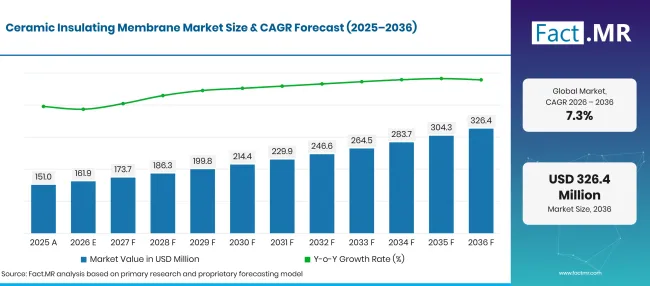
Ceramic Insulating Membrane Market Forecast Global | Source: Fact.MR
| Year | Basis | Market Value (USD million) |
|---|---|---|
| 2025 | Actual | 151.0 |
| 2026 | Estimate | 162.0 |
| 2036 | Forecast | 326.4 |
| CAGR 2026 to 2036 | Forecast period | 7.3% |
Source: Fact.MR analysis. Updated Oct 23, 2026
What are the defining numbers behind Ceramic Insulating Membrane Market growth?
USD 164.4 million absolute opportunity between 2026 and 2036.
- Demand Drivers in the Market
- Rising Electronics manufacturing has driven the market growth. Ceramic insulating materials are used in components that require electrical isolation, dimensional stability, and resistance to elevated temperatures. The Semiconductor Industry Association reported in February 2026 that global semiconductor sales reached USD 791.7 billion in 2025, an increase of 25.6% from 2024 [1].
- Growth in industrial electrification has increased the demand for the ceramic insulating membrane. Electrical equipment, power conversion systems, and industrial installations require materials that maintain insulation performance under specified operating conditions. The International Energy Agency reported in its 2026 electricity review that global electricity demand grew by approximately 3% in 2025, providing broader context for continued investment in electricity infrastructure and related equipment [2].
- High-temperature performance requirements have risen the demand for ceramic insulating membrane. Ceramic materials are considered where polymer-based alternatives may not meet required temperature, chemical-resistance, or dimensional-stability specifications.
- Key Segments Analyzed
- By Material Type: Alumina captures 38.5% share 2026
- By Application: Electronics will account for 65.0% of the market in 2026, reflecting the concentration of demand in electronic and electrically insulating applications.
- By End-User Industry: Industrial applications represent 58.3% of the market in 2026, reflecting the importance of industrial equipment and specialized manufacturing.
- By Sales Channel: Direct Sales holds 52.1% share in 2026, indicating the importance of direct supplier-to-customer relationships.
- Analyst Opinion at Fact.MR
- Shambhu Nath Jha, Principal Consultant at Fact.MR, states, “Ceramic insulating membrane suppliers are likely to find opportunities in applications that require stable electrical and thermal performance under demanding operating conditions. Material selection, application-specific testing, and consistent manufacturing quality will remain important as buyers evaluate ceramic solutions against their technical and cost requirements.”
- Strategic Implications
- Manufacturers should prioritize alumina, zirconia, silica, and other ceramic formulations using verified performance data covering dielectric strength, thermal stability, chemical compatibility, and mechanical durability.
- Electronics suppliers need to validate membrane dimensions, electrical properties, and material compatibility against the operating conditions of the intended component.
- Industrial buyers can prioritize total operating performance and replacement requirements rather than comparing suppliers on purchase price alone.
- Distributors benefit from maintaining clear technical documentation and helping customers identify the appropriate grade for their equipment and operating environment.
- Companies can explore opportunities for customized products and direct technical engagement where application requirements demand close coordination between the buyer and manufacturer.
Germany is projected to record an 8.3% CAGR through 2036. Brazil is set to post 7.6%, followed by the USA at 6.8%. The UK is estimated to advance at 6.1%, while Japan is forecast at 5.4%.
How does the Ceramic Insulating Membrane Market break down by segment?
Fact.MR finds that Alumina leads Material Type at 38.5%; Electronics leads Application at 65.0%; Industrial leads End-User Industry at 58.3%; and Direct Sales Leads Sales Channel at 52.1%.
Which Material Type dominates?
Alumina hold a 38.5% share in 2026.
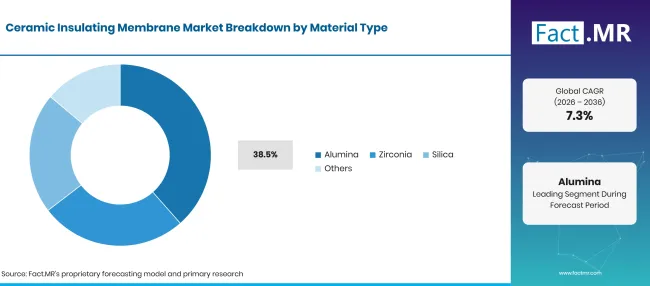
Ceramic Insulating Membrane Market Breakdown Material Type | Source: Fact.MR
| Material Type | Share (2026) |
|---|---|
| Alumina (Leading segment) | 38.5% |
| Other segments combined | 61.5%* |
| Total | 100.0% |
Source: Fact.MR analysis. Updated Oct 23, 2026
Alumina is widely used in technical ceramics because it offers electrical insulation, hardness, wear resistance, and thermal stability. Its suitability depends on purity, grain structure, density, and the required electrical and mechanical performance. Zirconia may be selected where fracture toughness and mechanical strength are important, while silica-based formulations serve applications with different thermal, chemical, or structural requirements. The precise performance of an insulating membrane depends on its composition and manufacturing process.
What leads the Application segment?
Electronics is set to represent 65.0% share in 2026.
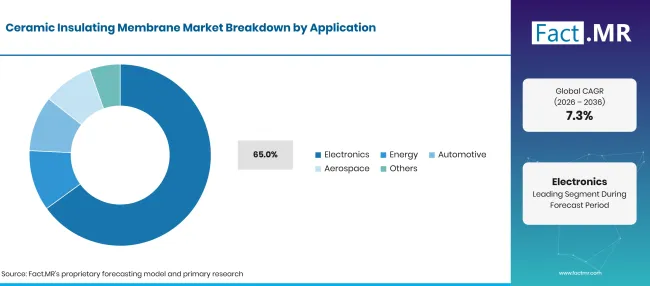
Ceramic Insulating Membrane Market Breakdown Application | Source: Fact.MR
| Application | Share (2026) |
|---|---|
| Electronics (Leading segment) | 65.0% |
| Other segments combined | 35.0%* |
| Total | 100.0% |
Source: Fact.MR analysis. Updated Oct 23, 2026
Electronic applications may require ceramic materials for electrical isolation, component protection, thermal management, or separation functions within specialized devices. The choice of ceramic depends on dielectric strength, operating temperature, chemical exposure, membrane geometry, and the required level of dimensional stability. Energy, automotive, aerospace, and other applications can have distinct qualification requirements and procurement cycles.
How does End-User Industry shape demand?
Industrial applications are likely to account for 58.3% share in 2026.
Ceramic Insulating Membrane Market Breakdown End User Industry | Source: Fact.MR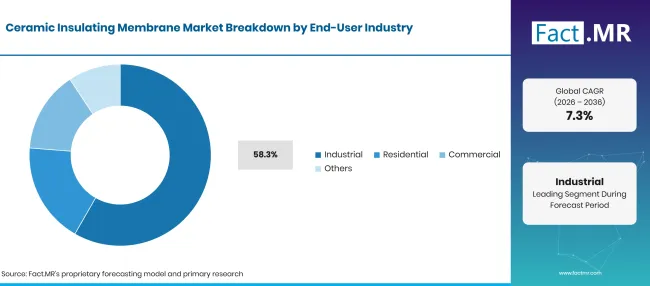
Industrial customers may use ceramic insulating materials in electrical equipment, process systems, specialized machinery, and installations exposed to elevated temperatures or corrosive environments. Purchasing decisions often depend on operating life, equipment reliability, maintenance requirements, and compatibility with existing systems. Residential and commercial applications follow different purchasing patterns, while aerospace and other specialized sectors can require extensive material qualification.
Which Sales Channel leads?
Direct Sales is expected to account for 52.1% share in 2026.
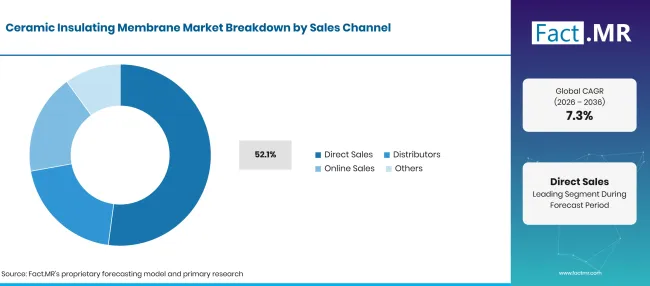
Ceramic Insulating Membrane Market Breakdown Sales Channel | Source: Fact.MR
| Sales Channel | Share (2026) |
|---|---|
| Direct Sales (Leading segment) | 52.1% |
| Other segments combined | 47.9%* |
| Total | 100.0% |
Source: Fact.MR analysis. Updated Oct 23, 2026
Direct sales can support technical discussions between manufacturers and industrial buyers, particularly where products require customized dimensions, specific ceramic grades, or documented performance characteristics. Distributors help broaden geographic reach and serve smaller orders, while online sales can support product discovery and standard-product purchasing. The relative importance of each channel depends on order size, technical complexity, delivery requirements, and after-sales support.
What is accelerating Ceramic Insulating Membrane Market adoption, and what is holding it back?
Demand for high-performance insulation and the expansion of electronic equipment support adoption, while manufacturing costs, qualification requirements, and application-specific performance constraints can limit growth.
Drivers Impact Analysis
| DRIVER | Approx. Impact on CAGR | Geographic Relevance | Impact Timeline |
|---|---|---|---|
| Increasing demand for electronic components | +1.0% | Global | Medium term (2–4 years) |
| Requirements for high-temperature electrical insulation | +0.8% | Europe, Asia, Americas | Medium term (2–4 years) |
| Industrial electrification and equipment modernization | +0.7% | Global | Long term (≥ 4 years) |
| Demand for chemically resistant technical materials | +0.5% | Global | Medium term (2–4 years) |
| Direct technical collaboration with equipment manufacturers | +0.4% | Global | Short term (≤ 2 years) |
Source: Fact.MR analysis. Updated Oct 23, 2026
Opportunity Impact Analysis
| OPPORTUNITY | Approx. Impact on CAGR | Geographic Relevance | Impact Timeline |
|---|---|---|---|
| Customized ceramic formulations for electronics | +0.8% | Global | Medium term (2–4 years) |
| Improved manufacturing consistency and yield | +0.6% | Global | Medium term (2–4 years) |
| Applications in energy and electrical systems | +0.5% | Europe, Asia, Americas | Long term (≥ 4 years) |
| Technical partnerships with equipment manufacturers | +0.4% | Global | Medium term (2–4 years) |
Source: Fact.MR analysis. Updated Oct 23, 2026
Restraints Impact Analysis
| RESTRAINT | Approx. Impact on CAGR | Geographic Relevance | Impact Timeline |
|---|---|---|---|
| High material and processing costs | -0.8% | Global | Short term (≤ 2 years) |
| Complex product qualification and testing | -0.6% | Global | Medium term (2–4 years) |
| Brittleness and sensitivity to mechanical stress | -0.5% | Global | Medium term (2–4 years) |
| Limited interchangeability between material grades | -0.4% | Global | Short term (≤ 2 years) |
Source: Fact.MR analysis. Updated Oct 23, 2026
Which countries are scaling the Ceramic Insulating Membrane Market through 2036?
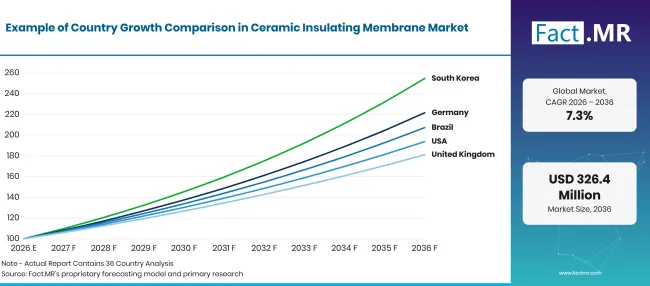
Ceramic Insulating Membrane Market Growth Index | Source: Fact.MR
| Country | CAGR (2026–2036) |
|---|---|
| Germany | 8.3% |
| Brazil | 7.6% |
| USA | 6.8% |
| UK | 6.1% |
| Japan | 5.4% |
Source: Fact.MR analysis. Updated Oct 23, 2026
What supports Germany adoption?
8.3% CAGR, supported by demand for advanced industrial materials and precision manufacturing.
Germany's technical manufacturing base provides a relevant setting for ceramic insulation products used in electrical equipment, electronics, and specialized industrial systems. Buyers may prioritize reliable insulation performance, dimensional consistency, and compliance with component specifications.
How is Brazil developing ceramic insulating membrane adoption?
7.6% CAGR, led by potential demand from industrial equipment, energy infrastructure, and electronics-related applications.
Brazil's industrial and energy sectors provide potential use cases for ceramic materials in equipment requiring insulation and resistance to demanding operating conditions. The Brazilian Institute of Geography and Statistics reported that industrial production increased by 0.6% in 2025 [3].
What supports United States adoption?
6.8% CAGR, backed by electronics manufacturing, advanced equipment, and industrial investment.
The United States has a substantial electronics and semiconductor ecosystem, creating potential opportunities for specialized ceramic materials used in electronic components and associated equipment. The U.S. Bureau of Economic Analysis reported that the foreign direct investment position in U.S. computers and electronic products manufacturing increased from USD 39.0 billion in 2013 to USD 222.5 billion in 2025 [4].
How is the United Kingdom building adoption?
6.1% CAGR, shaped by specialized manufacturing and demand for high-performance engineering materials.
The UK's electronics, optical equipment, and industrial manufacturing sectors provide possible application areas for ceramic insulating membranes. The Office for National Statistics reported that computer, electronic, and optical products output increased by 5.2% in July 2026 [5]. The monthly change indicates activity in a relevant downstream manufacturing category, but it does not directly measure ceramic membrane purchases.
What supports Japan adoption?
5.4% CAGR, driven by electronics production, precision components, and advanced manufacturing.
Japan's electronics and industrial component industries provide a relevant base for ceramic materials used in electrical insulation and specialized equipment. The Ministry of Economy, Trade and Industry reported that the production index for electronic parts and devices increased by 5.8% year on year in the first quarter of 2026 [6]. Ceramic insulating membrane demand will depend on how much of this downstream production uses the specific products included in the market definition.
Who leads the Ceramic Insulating Membrane Market?
Fact.MR identifies Pall Corporation, METAWATER Co., Ltd., TAMI Industries, CoorsTek, Nanostone Water (Acuriant Technologies), and LiqTech International, Inc. as companies for competitive assessment across ceramic membrane technologies and related advanced ceramic materials.
These companies represent a mix of ceramic membrane filtration, separation technologies, and advanced ceramic materials used in industrial applications. Pall Corporation and Nanostone Water (Acuriant Technologies) have direct relevance to ceramic membrane filtration, while METAWATER Co., Ltd., TAMI Industries, CoorsTek, and LiqTech International, Inc. operate in broader ceramic technology and engineered materials markets.
Commercial competition depends on membrane performance, manufacturing consistency, material durability, and the ability to meet application-specific technical requirements. Relevant evaluation criteria include electrical insulation where required, thermal stability, mechanical strength, chemical resistance, separation efficiency, and operational reliability. Manufacturers must demonstrate that their products meet the performance specifications and operating conditions of their intended applications.
Which companies are the key providers?
Key companies profiled include Nanostone Water (Acuriant Technologies); Pall Corporation; METAWATER Co., Ltd.; TAMI Industries; CoorsTek; and LiqTech International, Inc.
- Nanostone Water (Acuriant Technologies)
- Pall Corporation
- METAWATER Co., Ltd.
- TAMI Industries
- CoorsTek
- LiqTech International, Inc.
Bibliography
- [1] Semiconductor Industry Association. (2026, February 6). Global annual semiconductor sales increase 25.6% to $791.7 billion in 2025.
- [2] International Energy Agency. (2026, April 20). Electricity demand. In Global Energy Review 2026.
- [3] Instituto Brasileiro de Geografia e Estatística. (2026, February 3). Produção industrial recua 1,2% em dezembro.
- [4] Smith, R., & Colantoni, J. (2026, September 10). Direct investment by country and industry for 2025. U.S. Bureau of Economic Analysis.
- [5] Office for National Statistics. (2026, September 11). Index of Production, UK: July 2026.
- [6] Ministry of Economy, Trade and Industry. (2026). Indices of industrial production: April 2026 final report.
- [7] Press Information Bureau, Ministry of Chemicals and Fertilizers, Government of India. (2026, January 30). Economic Survey 2025–26 highlights steady growth of chemicals and petrochemicals sector.
This Report Answers
- The report examines ceramic insulating membrane demand across the specified materials, applications, end-user industries, and sales channels.
- Segment analysis identifies the leading material, application, end-user, and sales-channel segmentation.
- Country analysis discusses Germany, Brazil, the USA, the UK, and Japan alongside relevant official industrial indicators.
- The competitive overview profiles six companies active in related advanced ceramics and engineered materials markets, subject to product-level verification.
- Market analysis evaluates the role of material performance, manufacturing consistency, application qualification, and technical support in purchasing decisions.
What does the Ceramic Insulating Membrane Market cover?
The market covers ceramic insulating membrane products within the defined product scope and application boundaries. It evaluates material categories such as alumina and zirconia alongside silica-based and other ceramic materials. Applications span electronics and energy systems as well as automotive and aerospace uses. The analysis considers product performance requirements and end-user demand alongside commercial distribution patterns.
What is included in the scope?
Included products are ceramic insulating membranes that meet the report's defined material and application criteria. The analysis considers products sold through direct sales, distributors, online channels, and other commercial routes. It also examines industrial, residential, commercial, and other end-user categories.
The final scope should distinguish membrane products from conventional solid ceramic insulation components, ceramic coatings, and general-purpose ceramic filtration membranes unless those products are explicitly included in the underlying market-sizing methodology.
What is excluded from the scope?
Unless explicitly included in the underlying dataset, the analysis excludes conventional solid ceramic electrical insulators, ceramic substrates, ceramic coatings, and unrelated technical ceramic components sold outside the defined membrane category. Standard ceramic filtration products without the specified insulating function are also outside the scope. Equipment used to manufacture or install ceramic membranes is excluded from product revenue.
How Was the Analysis Built?
The analysis draws on 120+ sources, 35+ company portfolios, 25+ countries, and more than 20 industry interviews.
- Primary Research: Primary research includes discussions with manufacturers, service providers, technology developers, distributors, end users, and subject-matter experts. These conversations examine purchasing priorities, product adoption, operational challenges, approval requirements, competitive positioning, and the factors that influence wider market acceptance.
- Desk Research: Desk research covers government statistics, regulatory publications, company filings, trade data, technical studies, industry associations, standards, public policy, and other authoritative sources. Every source used in the analysis is documented in the bibliography.
- Market Sizing and Forecasting: Market estimates combine historical performance, demand indicators, pricing and volume trends, segment shares, company participation, country-level growth, adoption patterns, investment activity, and barriers to market expansion.
- Data Validation and Update Cycle: Findings are validated by comparing primary interviews with public data, company activity, regulatory changes, trade patterns, and industry developments. Regular updates review new product launches, capacity changes, partnerships, approvals, and shifts in commercial adoption.
Segmentation
What is the report's scope and coverage?
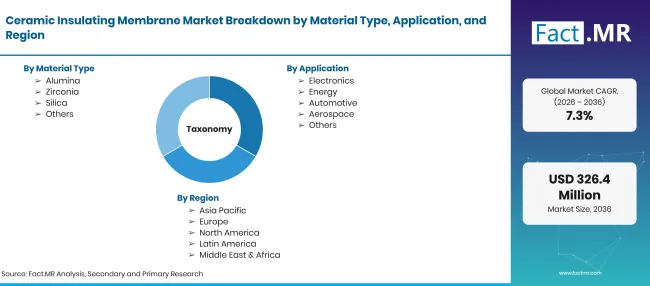
Ceramic Insulating Membrane Market Taxonomy | Source: Fact.MR
| Attribute | Details |
|---|---|
| Quantitative Units | USD million in 2026 to USD million by 2036, at CAGR |
| Market Definition | Ceramic insulating membranes and related ceramic membrane products included within the specified electrical and industrial insulation market boundary |
| Material Type | Alumina; Zirconia; Silica; Others |
| Application | Electronics; Energy; Automotive; Aerospace; Others |
| End-User Industry | Industrial; Residential; Commercial; Others |
| Sales Channel | Direct Sales; Distributors; Online Sales; Others |
| Regions Covered | North America; Latin America; Western Europe; Eastern Europe; East Asia; South Asia & Pacific; Middle East & Africa |
| Countries Covered | Germany; Brazil; USA; UK; Japan |
| Companies Profiled | Pall Corporation; METAWATER Co., Ltd.; TAMI Industries; CoorsTek ; Nanostone Water (Acuriant Technologies); LiqTech International, Inc. |
| Forecast Period | 2026 to 2036 |
| Approach | Market segmentation and scenario-based forecasting supported by official downstream industry statistics and company-level research |
Source: Fact.MR analysis. Updated Oct 23, 2026
How is the market segmented?
-
By Material Type
- Alumina
- Zirconia
- Silica
- Others
-
By Application
- Electronics
- Energy
- Automotive
- Aerospace
- Others
-
By End-User Industry
- Industrial
- Residential
- Commercial
- Others
-
By Sales Channel
- Direct Sales
- Distributors
- Online Sales
- Others
-
By Region
- North America
- Latin America
- Western Europe
- Eastern Europe
- East Asia
- South Asia & Pacific
- Middle East & Africa
Frequently Asked Questions
How big is the Ceramic Insulating Membrane Market in 2026?
What is the CAGR from 2026 to 2036?
What was the market value in 2025?
Which material type has the largest share?
Which application leads the market?
Which end-user industry has the largest share?
Which sales channel leads?
Which countries are forecast to grow fastest?
Which companies are covered?
Who worked on this report


Preview the report firsthand - request a free sample
Free SampleGet the brochure for pricing and purchase details
Download PDF