- Market Value (2025): USD 3.06 Bn
- Estimated Value (2026): USD 3.22 Bn
- Forecast Value (2036): USD 5.41 Bn
- CAGR (2026-2036): 5.3%
What is the Ceramics and Glass Testing Equipment Market forecast to be worth by 2036?
USD 3.2 billion in 2026 to USD 5.4 billion by 2036, at a 5.3% CAGR.
- According to Fact.MR analysis, the ceramics and glass testing equipment market was valued at USD 3.06 billion in 2025.
- Sales are projected to rise from USD 3.22 billion in 2026 to USD 5.41 billion by 2036.
- The market is forecast to record a 5.3% CAGR from 2026 to 2036.
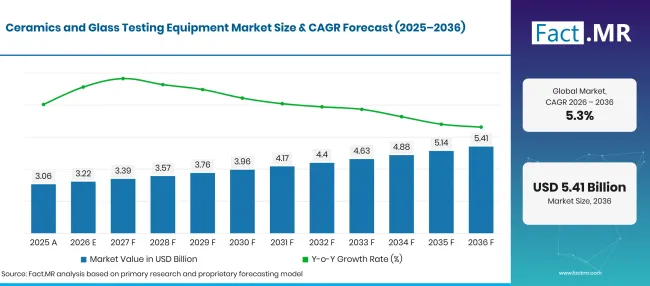
Factmr Ceramics And Glass Testing Equipment Market Forecast Global | Source: Fact.MR
| Year | Basis | Market Value (USD billion) |
|---|---|---|
| 2025 | Historical | 3.06 |
| 2026 | Estimate | 3.22 |
| 2036 | Forecast | 5.41 |
| CAGR 2026 to 2036 | Forecast period | 5.3% |
Source: Fact.MR analysis. Updated Oct 15, 2026
What are the defining numbers behind Ceramics and Glass Testing Equipment Market growth?
USD 2.2 billion additional market value between 2026 and 2036, with mechanical testing and materials development making up major buying areas.
- Demand Drivers in the Market
- Automotive component labs test glass strength and ceramic durability before allowing a new part into a vehicle design. Repeatable load settings help engineering teams compare production lots without changing approval methods.
- Glass producers use inspection and mechanical tests to confirm whether panes meet the strength requirements set by their customers. Early testing helps find damaged edges before expensive finishing work begins. Broader test and measurement equipment includes devices used for industrial checks.
- University and industrial labs purchase instruments that hold both research results and quality-control records. Software fit and calibration support become deciding factors when several departments share a testing platform.
- Key Segments Analyzed
- By Product Type: Universal Testing Machines hold 28.5% share in 2026 because labs use controlled forces to examine material strength.
- By Application: Materials Development make up 34.2% share in 2026 as designers compare new glass and ceramic formulations.
- By End-User: Automotive holds 28.3% share in 2026 where component approval requires repeated material testing.
- Analyst Opinion at Fact.MR
- Shambhu Nath Jha, Principal Consultant at Fact.MR, states, “Ceramic and glass testing equipment purchases often follow changes in component requirements, rather than higher factory output alone. One research hypothesis is that laboratory managers place more value on consistent measurements than on a machine’s advertised testing speed.”
- Strategic Implications
- Testing labs should compare equipment by sample preparation time and calibration records before choosing a replacement system.
- Glass converters should match bend and fracture testing methods to the intended pane design so quality checks remain useful in production.
- Ceramic developers should retain similar datasets across formulation changes to reduce repeated validation work.
- Equipment suppliers should support operator training and local repairs because lab downtime can delay product qualification.
Germany is projected at 6.7% CAGR and Brazil at 6.1%. The USA follows at 5.5%, while the UK records 4.9% and Japan 4.4%.
How does the Ceramics and Glass Testing Equipment Market break down by segment?
Universal Testing Machines 28.5%; Material Development 34.2%; Automotive 28.3% in 2026.
Which Product Type?
Universal Testing Machines holds 28.5% share in 2026.
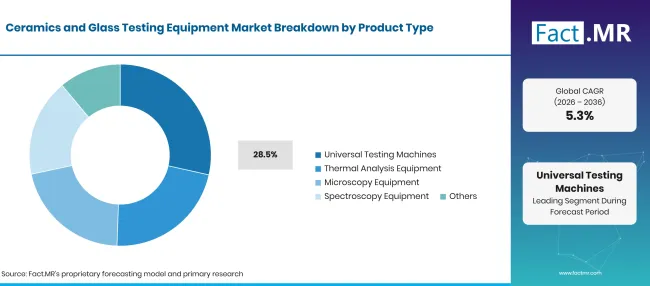
Factmr Ceramics And Glass Testing Equipment Market Breakdown Product Type | Source: Fact.MR
| Product Type | Share (2026) |
|---|---|
| Universal Testing Machines (Leading segment) | 28.5% |
| Other segments combined | 71.5% |
| Total | 100.0% |
Source: Fact.MR analysis. Updated Oct 15, 2026
Universal testing machines apply controlled tension or compression to test specimens and record their response. Ceramic manufacturers examine fracture resistance while glass producers compare strength after changes in processing. Thermal analysis equipment is useful for expansion and heat-related changes in materials. Microscopy helps labs locate surface cracks, while spectroscopy helps find composition and impurities. These instruments are often complementary rather than direct substitutes because each measures a different material property.
What leads the Application?
Materials Development holds 34.2% share in 2026.
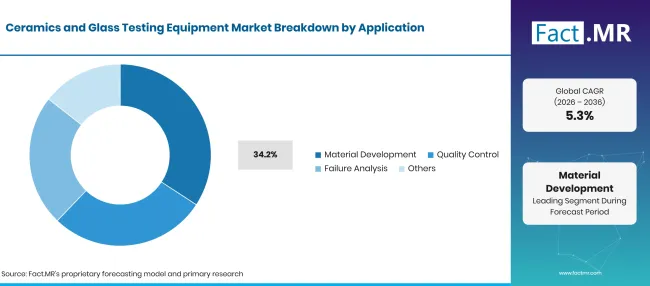
Factmr Ceramics And Glass Testing Equipment Market Breakdown Application | Source: Fact.MR
| Application | Share (2026) |
|---|---|
| Material Development (Leading segment) | 34.2% |
| Other segments combined | 65.8% |
| Total | 100.0% |
Source: Fact.MR analysis. Updated Oct 15, 2026
Material design labs study whether changes in glass chemistry or ceramic processing deliver the intended performance. Mechanical tests show whether a design tolerates expected loads and thermal analysis helps engineers understand heat response. Quality control teams concentrate on repeatability across production batches. Failure analysis starts with a specific defect and combines imaging with targeted measurement to investigate its origin.
How does End-User purchasing shape sales?
Automotive holds 28.3% share in 2026.
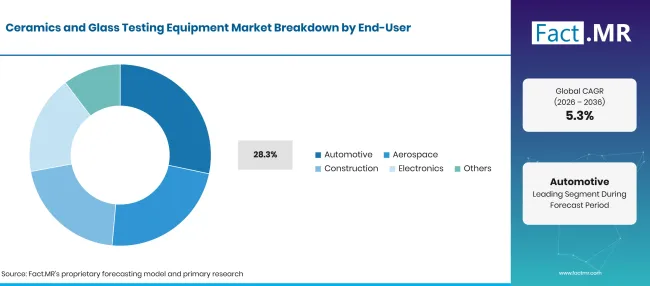
Factmr Ceramics And Glass Testing Equipment Market Breakdown End User | Source: Fact.MR
| End-User | Share (2026) |
|---|---|
| Automotive (Leading segment) | 28.3% |
| Other segments combined | 71.7% |
| Total | 100.0% |
Source: Fact.MR analysis. Updated Oct 15, 2026
Automotive labs test glazing and ceramic parts against demanding use conditions before production approval. Aerospace teams work with material systems where test procedures and traceable results receive particular attention. Construction-related labs check architectural glass and ceramic building products for specified performance. Electronics manufacturers examine ceramic parts used in assemblies exposed to thermal stress. Instrument choice changes by specimen dimensions and required resolution, so one platform rarely covers every possible measurement.
What is accelerating Ceramics and Glass Testing Equipment Market adoption, and what is holding it back?
Material qualification and repeatable strength testing support purchases; instrument costs and operator training limit some lab budgets.
Drivers Impact Analysis
| DRIVER | (~) % IMPACT ON CAGR | GEOGRAPHIC RELEVANCE | IMPACT TIMELINE |
|---|---|---|---|
| Automotive glass validation | +1.0% | Germany, USA, Japan | Medium term (2–4 years) |
| Ceramic materials research | +0.8% | Japan, Germany | Long term (≥ 4 years) |
| Production batch quality | +0.7% | Global | Short term (≤ 2 years) |
| Component failure analysis | +0.5% | Global | Medium term (2–4 years) |
| Shared laboratory upgrades | +0.4% | UK, USA | Medium term (2–4 years) |
Source: Fact.MR analysis. Updated Oct 15, 2026
Opportunity Impact Analysis
| OPPORTUNITY | (~) % IMPACT ON CAGR | GEOGRAPHIC RELEVANCE | IMPACT TIMELINE |
|---|---|---|---|
| Combined testing workflows | +0.8% | Global | Medium term (2–4 years) |
| Automated test documentation | +0.6% | Germany, USA | Short term (≤ 2 years) |
| Ceramic substrate inspection | +0.5% | Japan | Long term (≥ 4 years) |
| Local calibration services | +0.4% | Brazil, UK | Medium term (2–4 years) |
Source: Fact.MR analysis. Updated Oct 15, 2026
Restraints Impact Analysis
| RESTRAINT | (~) % IMPACT ON CAGR | GEOGRAPHIC RELEVANCE | IMPACT TIMELINE |
|---|---|---|---|
| High instrument purchase cost | -0.8% | Global | Short term (≤ 2 years) |
| Specialist operator requirements | -0.6% | Global | Medium term (2–4 years) |
| Long qualification cycles | -0.5% | Automotive, aerospace | Medium term (2–4 years) |
| Uneven factory investment | -0.4% | Europe | Long term (≥ 4 years) |
Source: Fact.MR analysis. Updated Oct 15, 2026
Which countries are scaling the Ceramics and Glass Testing Equipment Market through 2036?
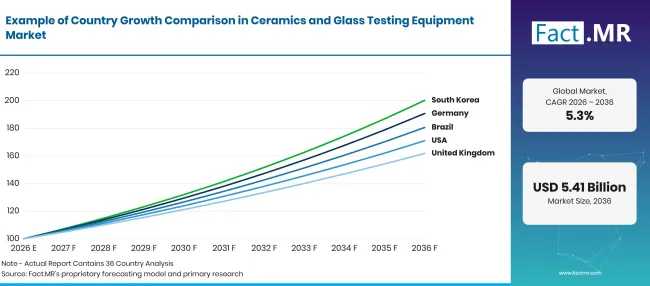
Factmr Ceramics And Glass Testing Equipment Market Growth Index | Source: Fact.MR
| Country | CAGR (2026–2036) |
|---|---|
| Germany | 6.7% |
| Brazil | 6.1% |
| USA | 5.5% |
| UK | 4.9% |
| Japan | 4.4% |
Source: Fact.MR analysis. Updated Oct 15, 2026
Why does Germany support testing equipment sales?
6.7% CAGR, supported by industrial glass production, technical ceramics, and repeatable quality testing.
German glass and ceramics manufacturers rely on strength, heat, and fracture testing to maintain consistent product performance. Destatis reported in February 2026 that automotive production declined 1.7% in 2025 [1], which may make replacement decisions more selective. Even so, factory laboratories and research teams continue to value instruments that deliver repeatable results and dependable calibration across production and material-development work.
How is Brazil developing ceramics and glass testing?
6.1% CAGR, shaped by glass-product verification and growing use of specialist laboratory services.
Brazilian glass processors use testing equipment to check strength and technical properties across building, household, and industrial products. In September 2026, Brazil’s Ministry of Development, Industry, Trade and Services opened an investigation covering tempered glass for selected household appliances under tariff code 7007.19.00 [2]. Shared laboratories also give smaller manufacturers access to specialist fracture and heat testing without requiring every company to own dedicated equipment.
What supports testing demand in the United States?
5.5% CAGR, linked to construction glazing, industrial laboratories, and advanced material development.
U.S. architectural glass and ceramics producers use impact, thermal, and microscopy testing before materials enter demanding applications. The U.S. Census Bureau reported annualized construction spending of USD 2,167.7 billion in June 2026 [3]. Building activity creates a broad downstream base for tested materials, while contract laboratories remain useful for manufacturers that need occasional high-cost measurements during qualification or failure analysis.
How are United Kingdom laboratories approaching equipment purchases?
4.9% CAGR, influenced by specialized testing requirements and the country’s glass and ceramics manufacturing base.
UK laboratories use strength, microscopy, and thermal testing to support construction glass, ceramics, and failure analysis work. The Office for National Statistics recorded GBP 8,602.5 million in 2025 turnover for glass, clay, porcelain, ceramics, and stone products [4]. Buyers also consider service availability and calibration support because dependable maintenance is important when instruments are used across repeated customer and research projects.
Why does Japan retain a specialized testing base?
4.4% CAGR, supported by fine ceramics research, precise material inspection, and established manufacturing expertise.
Japanese fine ceramics manufacturers rely on thermal, mechanical, and microscopy testing when checking specialist components for industrial and electronic applications. Japan’s Statistics Bureau listed 10,873 ceramic, stone, and clay manufacturing establishments in its 2025 Statistical Handbook [5]. Laboratories also favor equipment that reproduces familiar results and fits established testing methods, especially where new material approvals involve long qualification cycles.
Who leads the Ceramics and Glass Testing Equipment Market?
Competition includes universal testing suppliers and companies that specialize in material testing. Shimadzu offers mechanical test instruments alongside broader lab equipment, while Mettler-Toledo offers thermal analysis systems used to study material behavior. Bruker and Rigaku serve X-ray analytical applications that help research labs find crystal structures. Product coverage changes by measurement method and lab need.
Thermo Fisher Scientific and Hitachi High-Tech serve microscopy and analytical instrument categories. HORIBA and Agilent Tools supply spectroscopy and related analytical systems. Malvern Panalytical supports materials analysis including particle measurement and diffraction, while PerkinElmer has longstanding analytical equipment activities. Equipment reviews should focus on the exact installed product and available local support rather than an assumed common product line.
Which companies are the key providers?
Key companies include Thermo Fisher Scientific Inc.; Mettler-Toledo International Inc.; Shimadzu Corporation; Bruker Corporation; Malvern Panalytical Ltd; HORIBA Ltd.; PerkinElmer; Agilent Tools Inc.; Hitachi High-Tech Corporation; Rigaku Corporation.
- Thermo Fisher Scientific Inc.
- Mettler-Toledo International Inc.
- Shimadzu Corporation
- Bruker Corporation
- Malvern Panalytical Ltd
- HORIBA Ltd.
- PerkinElmer
- Agilent Technologies Inc.
- Hitachi High-Tech Corporation
- Rigaku Corporation
Bibliography
- [1] Statistisches Bundesamt (Destatis). (2026, February 6). Production in December 2025: -1.9% on the previous month.
- [2] Ministério do Desenvolvimento, Indústria, Comércio e Serviços. (2026, September 4). Vidros temperados para uso em eletrodomésticos da linha quente e molhada.
- [3] U.S. Census Bureau. (2026, September 1). Construction Spending (Construction Put in Place): July 2026.
- [4] Office for National Statistics. (2026, September 11). UKProdTO: 23OTHER – Manufacture of glass, clay, porcelain, ceramic and stone products, total turnover (£m).
- [5] Statistics Bureau of Japan. (2025, September). Statistical Handbook of Japan 2025.
This Report Answers
- The report describes why strength and thermal testing help manufacturers approve ceramic and glass materials.
- Product analysis compares universal testing machines with thermal and analytical equipment used in other lab workflows.
- Application analysis separates material development from recurring quality control and failure investigations.
- Country outlook considers Germany, Brazil, the USA, the UK and Japan through their local industrial conditions.
- Competitive review compares suppliers by actual testing methods instead of assigning unsupported market shares.
What does the Ceramics and Glass Testing Equipment Market cover?
The market covers instruments that examine the properties and composition of finished glass and ceramic products or design samples. Universal machines record behavior under force while thermal and analytical instruments reveal other aspects of a material.
The wider lab instrument industry includes many uses outside glass and ceramics. This market focuses on equipment spending connected to those two material families and their specific testing workflows. Applications involving bioceramics can require related material analysis.
What is included in the scope?
Included equipment supports mechanical strength checks and controlled thermal measurements of ceramic and glass specimens. Microscopy and spectroscopy enter when used for material review or defect investigations. The analysis covers research and factory quality labs across the listed end-user sectors, including external labs that test components on behalf of producers.
What is excluded from the scope?
Glass furnaces and ceramic forming lines are production machinery rather than testing equipment. Routine measuring devices without a materials-testing function are outside the core scope. Other lab instruments are excluded when their use has no identified connection to ceramics or glass.
How Was the Analysis Built?
The analysis draws on 120+ sources, 35+ company portfolios, 25+ countries, and more than 20 industry interviews.
- Primary Research: Primary research includes discussions with manufacturers, service providers, technology developers, distributors, end users, and subject-matter experts. These conversations examine purchasing priorities, product adoption, operational challenges, approval requirements, competitive positioning, and the factors that influence wider market acceptance.
- Desk Research: Desk research covers government statistics, regulatory publications, company filings, trade data, technical studies, industry associations, standards, public policy, and other authoritative sources. Every source used in the analysis is documented in the bibliography.
- Market Sizing and Forecasting: Market estimates combine historical performance, demand indicators, pricing and volume trends, segment shares, company participation, country-level growth, adoption patterns, investment activity, and barriers to market expansion.
- Data Validation and Update Cycle: Findings are validated by comparing primary interviews with public data, company activity, regulatory changes, trade patterns, and industry developments. Regular updates review new product launches, capacity changes, partnerships, approvals, and shifts in commercial adoption.
Segmentation
What is the report’s scope and coverage?
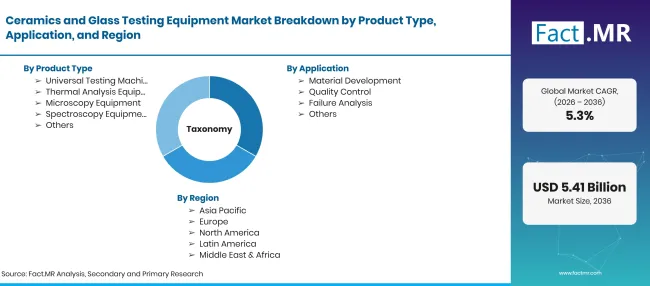
Factmr Ceramics And Glass Testing Equipment Market Taxonomy | Source: Fact.MR
| Attribute | Details |
|---|---|
| Quantitative Units | USD billion |
| Market Definition | Equipment used for mechanical, thermal, microscopic and spectroscopic assessment of glass and ceramic materials. |
| Product Type | Universal Testing Machines; Thermal Analysis Equipment; Microscopy Equipment; Spectroscopy Equipment; Others |
| Application | Material Development; Quality Control; Failure Analysis; Others |
| End-User | Automotive; Aerospace; Construction; Electronics; Others |
| Countries Covered | Germany; Brazil; USA; UK; Japan |
| Forecast Period | 2026 to 2036 |
| Companies Profiled | Thermo Fisher Scientific Inc.; Mettler-Toledo International Inc.; Shimadzu Corporation; Bruker Corporation; Malvern Panalytical Ltd; HORIBA Ltd.; PerkinElmer; Agilent Technologies Inc.; Hitachi High-Tech Corporation; Rigaku Corporation |
| Approach | Material properties, testing workflows, official industrial datasets and manufacturer product categories |
Source: Fact.MR analysis. Updated Oct 15, 2026
How is the market segmented?
-
By Product Type:
- Universal Testing Machines
- Thermal Analysis Equipment
- Microscopy Equipment
- Spectroscopy Equipment
- Others
-
By Application:
- Material Development
- Quality Control
- Failure Analysis
- Others
-
By End-User:
- Automotive
- Aerospace
- Construction
- Electronics
- Others
-
By Region:
- North America
- Latin America
- Western Europe
- Eastern Europe
- East Asia
- South Asia & Pacific
- Middle East & Africa
Frequently Asked Questions
How big is the market in 2026?
What is the forecast CAGR?
Which Product Type leads?
Which Application leads?
Who are the main companies in the ceramics and glass testing equipment market?
Who worked on this report


Preview the report firsthand - request a free sample
Free SampleGet the brochure for pricing and purchase details
Download PDF