- Market Value (2025): USD 311.4 Mn
- Estimated Value (2026): USD 331.1 Mn
- Forecast Value (2036): USD 612.3 Mn
- CAGR (2026-2036): 6.3%
What is the Ceramic Packing Film Market forecast to be worth by 2036?
USD 331.2 million in 2026 to USD 612.3 million by 2036 at a 6.3% CAGR.
- As per Fact.MR analysis, the ceramic packing film market reached USD 311.4 million in 2025.
- Demand will increase from USD 331.1 million in 2026 to USD 612.3 million by 2036.
- The ceramic packing film market will record 6.3% CAGR from 2026 to 2036.
| Year | Basis | Market Value (USD million) |
|---|---|---|
| 2025 | Actual | 311.4 |
| 2026 | Estimate | 331.1 |
| 2036 | Forecast | 612.3 |
| CAGR 2026 to 2036 | Forecast period | 6.3% |
Source: Fact.MR analysis. Updated Oct 16, 2026
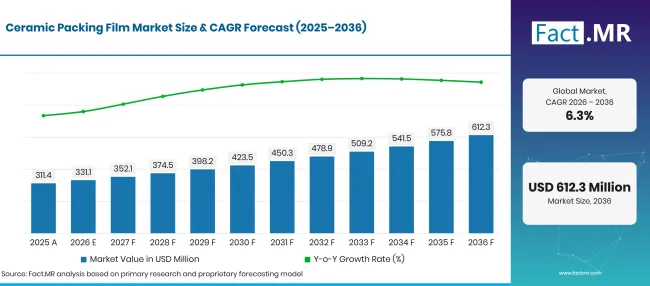
Factmr Ceramic Packing Film Market Forecast Global | Source: Fact.MR
What are the defining numbers behind Ceramic Packing Film Market growth?
An absolute opportunity of USD 281.1 million will be created between 2026 and 2036.
- Demand Drivers in the Market
- Packaging rules are tightening around recyclability. The EU Packaging and Packaging Waste Regulation generally applies from 12 August 2026 and requires all packaging to be designed for material recycling [1]. Ceramic-coated mono-material films offer a barrier option that avoids aluminium-foil laminates.
- Electronics output keeps expanding. Sensitive components, displays and batteries need transparent, high-barrier protection during storage and shipping, which supports steady film demand.
- Medical and pharmaceutical packaging needs stable barriers. Ceramic coatings protect moisture-sensitive products without blocking visibility, and they support sterilization and long shelf-life requirements.
- Better coating processes are widening use. Improved vacuum deposition and adhesion control reduce cracking and keep barrier performance consistent through converting and packing.
- Key Segments Analyzed
- By Material Type: Alumina will hold 38.5% share in 2026 since it combines strong barrier performance with transparency and mature processing.
- By Application: Electronics will account for 42.7% share in 2026, supported by the need for moisture and oxygen protection in sensitive components.
- By End-User Industry: Consumer Electronics will capture 40.1% share in 2026 owing to high product volumes and strict protection requirements.
- By Distribution Channel: Direct Sales will represent 58.3% share in 2026, given that buyers value technical support and custom film specifications.
- Analyst Opinion at Fact.MR
- Shambhu Nath Jha, Principal Consultant at Fact.MR, states, “Ceramic packing films are now bought as a measurable barrier input rather than a premium option. Converters will favor consistent coating quality, recyclable mono-material structures and technical data on oxygen and moisture transmission. Manufacturers that pair proven barrier performance with direct technical service will gain the most from electronics and medical customers.”
- Strategic Implications
- Film producers should publish barrier performance data across material types, since buyers compare ceramic films with metallized and foil-based options on results.
- Coating developers should improve flex-crack resistance and coating adhesion, so barrier performance holds through converting, packing and transport.
- Converters serving European customers should document recyclable film structures, given that packaging rules now push brand owners toward mono-material designs.
Germany will lead at 7.8% CAGR as packaging regulation and a strong electronics and engineering base support adoption. Brazil will follow at 7.1% on growing industrial and consumer demand. The United States will record 6.5% on electronics and medical packaging needs. The United Kingdom will post 5.8% with steady demand and recyclability-focused packaging rules. Japan will reach 5.1% as a mature market with established barrier film providers.
How does the Ceramic Packing Film Market break down by segment?
Alumina will lead Material Type at 38.5%; Electronics will lead Application at 42.7%; Consumer Electronics will lead End-User Industry at 40.1%; Direct Sales will lead Distribution Channel at 58.3%.
Which Material Type dominates?
Alumina will hold 38.5% share in 2026.
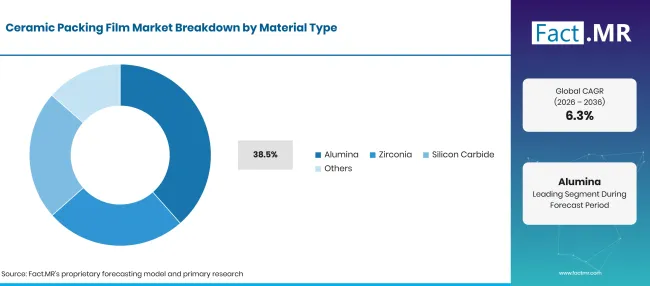
Factmr Ceramic Packing Film Market Breakdown Material Type | Source: Fact.MR
| Material Type | Share (2026) |
|---|---|
| Alumina (Leading segment) | 38.5% |
| Other segments combined | 61.5% |
| Total | 100.0% |
Source: Fact.MR analysis. Updated Oct 16, 2026
Alumina will lead because aluminium oxide coatings give a clear, stable barrier against moisture and oxygen. The material is well proven on PET and BOPP films, and it can be applied at the thin layers that converters need for flexible packaging. Zirconia and Silicon Carbide serve buyers who need higher hardness, thermal stability or specialized protection. Together with Others, these materials account for the remaining 61.5% share in 2026.
What supports Electronics within Application?
Electronics will account for 42.7% share in 2026.
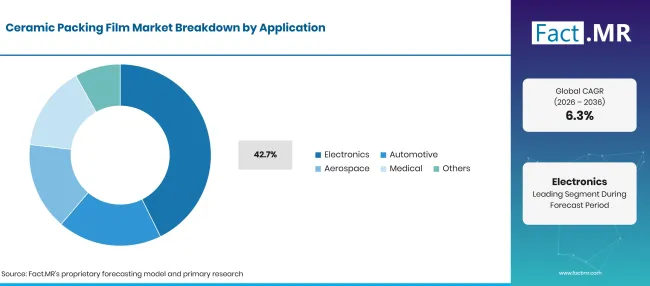
Factmr Ceramic Packing Film Market Breakdown Application | Source: Fact.MR
| Application | Share (2026) |
|---|---|
| Electronics (Leading segment) | 42.7% |
| Other segments combined | 57.3% |
| Total | 100.0% |
Source: Fact.MR analysis. Updated Oct 16, 2026
Electronics will lead since components, displays and batteries are sensitive to moisture and oxygen, and failures are costly. Transparent barrier films also allow inspection without opening the pack. Automotive applications use ceramic films for sensors, wiring and electronic modules. Aerospace and Medical applications need high-reliability protection and strict documentation. Other applications include food and general industrial packaging.
What leads the End-User Industry segment?
Consumer Electronics will capture 40.1% share in 2026.
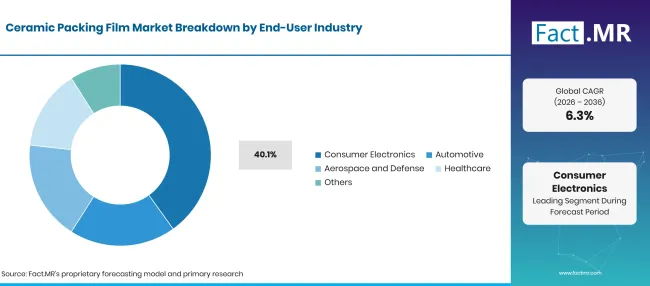
Factmr Ceramic Packing Film Market Breakdown End User Industry | Source: Fact.MR
| End-User Industry | Share (2026) |
|---|---|
| Consumer Electronics (Leading segment) | 40.1% |
| Other segments combined | 59.9% |
| Total | 100.0% |
Source: Fact.MR analysis. Updated Oct 16, 2026
Consumer electronics will lead as manufacturers ship large volumes of devices and accessories that need dependable protection from humidity during storage and transport. Short product cycles also keep film orders frequent. Automotive buyers focus on durability and supply reliability. Aerospace and Defense buyers require strict quality records, while Healthcare buyers prioritize barrier stability and cleanliness. Other industries add smaller but steady demand.
How does Distribution Channel shape demand?
Direct Sales will represent 58.3% share in 2026.
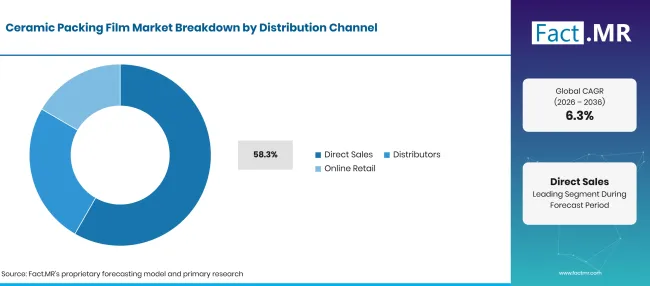
Factmr Ceramic Packing Film Market Breakdown Distribution Channel | Source: Fact.MR
| Distribution Channel | Share (2026) |
|---|---|
| Direct Sales (Leading segment) | 58.3% |
| Other segments combined | 41.7% |
| Total | 100.0% |
Source: Fact.MR analysis. Updated Oct 16, 2026
Direct sales will lead because film specifications are technical, and buyers work closely with providers on barrier targets, thickness and converting needs. Long-term supply contracts also favor direct relationships. Distributors serve smaller converters that need lower volumes and faster delivery. Online Retail serves repeat buyers of standard grades and small orders.
What is accelerating Ceramic Packing Film Market adoption, and what is holding it back?
Demand will rise through recyclability rules, electronics growth and a focus on high-barrier protection. Growth is held back by higher film cost and the capital needed for coating lines.
Drivers Impact Analysis
| DRIVER | (~) % IMPACT ON CAGR | GEOGRAPHIC RELEVANCE | IMPACT TIMELINE |
|---|---|---|---|
| Recyclability rules favoring mono-material barrier films | +1.9% | Global | Short term (<= 2 years) |
| Growth of electronics and battery production | +1.5% | East Asia, North America | Medium term (2-4 years) |
| Demand for transparent high-barrier medical packaging | +1.1% | Global | Medium term (2-4 years) |
| Improved vacuum coating and adhesion technology | +0.7% | Western Europe, East Asia | Long term (>= 4 years) |
Source: Fact.MR analysis. Updated Oct 16, 2026
Opportunity Impact Analysis
| OPPORTUNITY | (~) % IMPACT ON CAGR | GEOGRAPHIC RELEVANCE | IMPACT TIMELINE |
|---|---|---|---|
| Replacement of aluminium-foil laminates with ceramic-coated films | +1.1% | Western Europe, North America | Medium term (2-4 years) |
| Growth in automotive electronics and sensors | +0.8% | Western Europe, East Asia | Long term (>= 4 years) |
| Expansion of medical and healthcare packaging | +0.5% | Global | Medium term (2-4 years) |
| Online purchasing of standard film grades | +0.3% | North America, Latin America | Short term (<= 2 years) |
Source: Fact.MR analysis. Updated Oct 16, 2026
Restraints Impact Analysis
| RESTRAINT | (~) % IMPACT ON CAGR | GEOGRAPHIC RELEVANCE | IMPACT TIMELINE |
|---|---|---|---|
| Higher cost than conventional films | -0.8% | Global | Short term (<= 2 years) |
| Coating brittleness and flex-crack risk | -0.6% | Global | Medium term (2-4 years) |
| High capital cost of coating equipment | -0.4% | Global | Long term (>= 4 years) |
Source: Fact.MR analysis. Updated Oct 16, 2026
Which countries are scaling the Ceramic Packing Film Market through 2036?
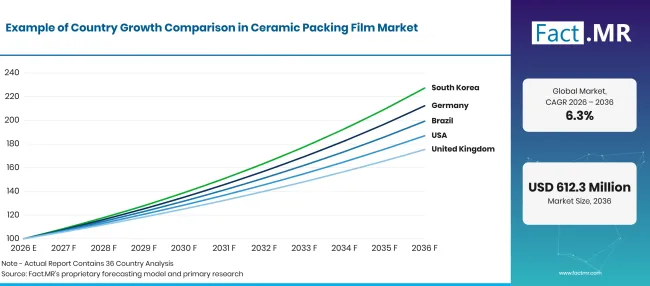
Factmr Ceramic Packing Film Market Growth Index | Source: Fact.MR
| Country | CAGR (2026-2036) |
|---|---|
| Germany | 7.8% |
| Brazil | 7.1% |
| United States | 6.5% |
| United Kingdom | 5.8% |
| Japan | 5.1% |
Source: Fact.MR analysis. Updated Oct 16, 2026
What supports Germany adoption?
7.8% CAGR, supported by strict emission rules and a strong automotive and chemical base.
Europe’s largest manufacturing economy is moving coating, adhesive and sealant producers toward low-solvent binders under EU emission limits. Automotive suppliers and industrial formulators favor durable aqueous dispersions, though higher costs versus solvent-borne systems may slow adoption among smaller processors.
How is Brazil scaling demand?
7.1% CAGR, driven by expanding automotive, textile and leather sectors.
Leather and textile finishers are adopting cationic grades for stronger adhesion and finishing quality, while construction activity lifts demand for low-emission coatings and sealants. Imports will keep meeting much of the supply, and currency swings and longer lead times may limit local scale.
What supports United States adoption?
6.5% CAGR, supported by automotive, construction and industrial coating needs.
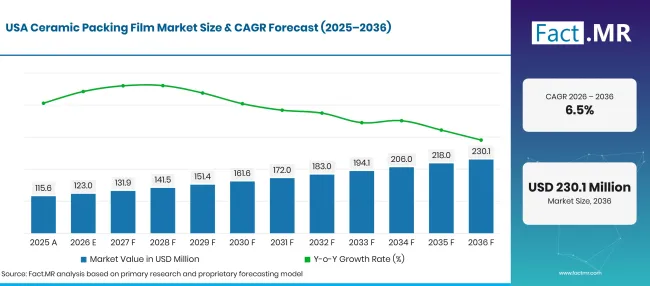
Factmr Ceramic Packing Film Market Forecast Usa | Source: Fact.MR
Formulators are replacing solvent-borne chemistries to meet volatile organic compound limits, and automotive buyers require documented, low-emission binders. Long qualification cycles and established solvent-based supply relationships slow supplier switching and temper growth.
How does the United Kingdom perform?
5.8% CAGR, shaped by steady demand and low-emission building standards.
Indoor air quality expectations and environmental compliance are lifting use of aqueous coatings and sealants in construction and refurbishment. The market is smaller than Germany’s, and limited domestic manufacturing scale restricts volume growth.
How is Japan developing demand?
5.1% CAGR, backed by an established specialty chemicals industry.
Japan hosts leading water-based dispersion producers, including Mitsui Chemicals with its Takelac range, and its automotive and electronics sectors already use aqueous binders widely. A mature base leaves less room for new demand, so growth stays moderate.
Who leads the Ceramic Packing Film Market?
Competition falls into two groups.
Specialist barrier film producers compete on coating technology and product performance: Toppan supplies GL Film, Toray Advanced Film offers Barrialox, Dai Nippon Printing markets IB-Film, and Mitsubishi Chemical Group provides Tech-Barrier. Broad film and packaging groups compete on scale, regional reach and converting services: Cosmo Films, Uflex, Jindal Poly Films, Polyplex Corporation and Amcor serve a wide range of packaging customers. Barrier consistency, recyclable film design and technical service will decide competition through 2036.
Which companies are the key providers?
Key companies include Toppan Inc. (GL Film); Toray Advanced Film Co., Ltd. (Barrialox); Dai Nippon Printing (DNP) (IB-Film); Mitsubishi Chemical Corporation; Celplast Metallized Products; Uflex Ltd.; Polyplex Corporation Ltd.; and Amcor plc.
- Toppan Inc. (GL Film)
- Toray Advanced Film Co., Ltd. (Barrialox)
- Dai Nippon Printing (DNP) (IB-Film)
- Mitsubishi Chemical Corporation
- Celplast Metallized Products
- Uflex Ltd.
- Polyplex Corporation Ltd.
- Amcor plc
What does the Ceramic Packing Film Market cover?
The Ceramic Packing Film Market covers plastic films coated with ceramic materials to create barrier layers for packaging. Typical coating materials include alumina, zirconia and silicon carbide. These films protect products from moisture, oxygen and other environmental factors while staying transparent where needed.
The assessment tracks ceramic-coated films used for electronics, automotive, aerospace, medical and other packaging. Film production draws on the wider polymer film and vacuum coating supply chain.
What is included in the scope?
The scope includes ceramic-coated barrier films sold to converters, brand owners and manufacturers, across all listed material types. It covers films sold through direct sales, distributors and online retail.
Combination structures are included when the ceramic layer provides the main barrier function. Laminates that pair ceramic-coated films with other layers count only for the value of the ceramic-coated film.
What is excluded from the scope?
The scope excludes metallized films, aluminium foil laminates and uncoated plastic films. Structural ceramics such as tiles, tableware, cutting tools and engineered ceramic parts are also excluded.
Ceramic powders and coating materials sold separately from finished films fall outside the revenue boundary. Packaging machinery and coating equipment are excluded.
How Was the Analysis Built?
The analysis draws on 120+ sources, 35+ company portfolios, 25+ countries, and more than 20 industry interviews.
- Primary Research: Primary research includes discussions with manufacturers, service providers, technology developers, distributors, end users, and subject-matter experts. These conversations examine purchasing priorities, product adoption, operational challenges, approval requirements, competitive positioning, and the factors that influence wider market acceptance.
- Desk Research: Desk research covers government statistics, regulatory publications, company filings, trade data, technical studies, industry associations, standards, public policy, and other authoritative sources. Every source used in the analysis is documented in the bibliography.
- Market Sizing and Forecasting: Market estimates combine historical performance, demand indicators, pricing and volume trends, segment shares, company participation, country-level growth, adoption patterns, investment activity, and barriers to market expansion.
- Data Validation and Update Cycle: Findings are validated by comparing primary interviews with public data, company activity, regulatory changes, trade patterns, and industry developments. Regular updates review new product launches, capacity changes, partnerships, approvals, and shifts in commercial adoption.
Segmentation
What is the report’s scope and coverage?
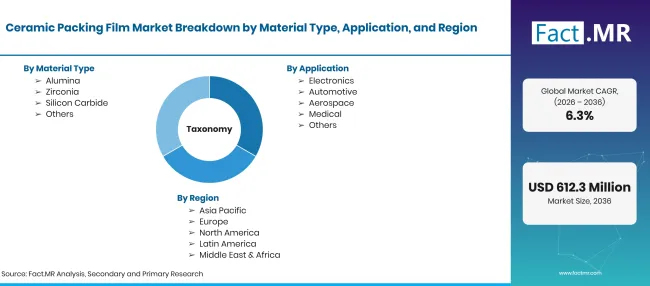
Factmr Ceramic Packing Film Market Taxonomy | Source: Fact.MR
| Attribute | Details |
|---|---|
| Quantitative Units | USD Million |
| Market Definition | Ceramic-coated films, including alumina, zirconia and silicon carbide based barrier layers, used in packaging to protect products from moisture, oxygen and environmental damage. |
| Material Type | Alumina; Zirconia; Silicon Carbide; Others |
| Application | Electronics; Automotive; Aerospace; Medical; Others |
| End-User Industry | Consumer Electronics; Automotive; Aerospace and Defense; Healthcare; Others |
| Distribution Channel | Direct Sales; Distributors; Online Retail |
| Regions Covered | North America; Latin America; Western Europe; Eastern Europe; East Asia; South Asia & Pacific; Middle East & Africa |
| Countries Covered | Germany; Brazil; United States; United Kingdom; Japan |
| Key Companies Profiled | Toppan Inc. (GL Film); Toray Advanced Film Co., Ltd. (Barrialox); Dai Nippon Printing (DNP) (IB-Film); Mitsubishi Chemical Corporation; Celplast Metallized Products; Uflex Ltd.; Polyplex Corporation Ltd.; Amcor plc |
| Forecast Period | 2026 to 2036 |
| Approach | Hybrid top-down and bottom-up approach using film demand by end-use industry; coating material share; packaging policy by country; distribution channel mix; country growth; and manufacturers portfolio review. |
Source: Fact.MR analysis. Updated Oct 16, 2026
How is the market segmented?
-
By Material Type:
- Alumina
- Zirconia
- Silicon Carbide
- Others
-
By Application:
- Electronics
- Automotive
- Aerospace
- Medical
- Others
-
By End-User Industry:
- Consumer Electronics
- Automotive
- Aerospace and Defense
- Healthcare
- Others
-
By Distribution Channel:
- Direct Sales
- Distributors
- Online Retail
-
By Region:
- North America
- Latin America
- Western Europe
- Eastern Europe
- East Asia
- South Asia & Pacific
- Middle East & Africa
Bibliography
- [1] European Parliament & Council of the European Union. (2025, January 22). Regulation (EU) 2025/40 on packaging and packaging waste, amending Regulation (EU) 2019/1020 and Directive (EU) 2019/904, and repealing Directive 94/62/EC. Official Journal of the European Union.
- [2] ZVEI. (2026, April 22). German Electro and Digital Industry – Facts & Figures [Fact sheet].
- [3] Associação Brasileira de Embalagem. (2025, February 10). Estudo Macroeconômico ABRE – Painel Interativo.
- [4] U.S. Census Bureau. (n.d.). Manufacturers’ Shipments, Inventories, & Orders: Historical time series—NAICS [Data set].
- [5] Department for Environment, Food & Rural Affairs. (2025, June 27). Extended producer responsibility for packaging: 2025 base fees [Guidance]. GOV.UK.
- [6] Japan Electronics and Information Technology Industries Association. (n.d.). December 2025 production by the Japanese electronics industry [Statistical table].
This Report Answers
- The report explains how ceramic packing films are used by material type, application, end-user industry and distribution channel.
- Segment analysis identifies the subsegment that leads each segment and the customer needs behind its 2026 share.
- Country analysis compares the five listed countries through packaging rules, electronics demand and industrial output.
- Competitive analysis reviews specialist barrier film producers and broad packaging film groups.
- Regulatory analysis tracks recyclability and packaging rules that affect film design.
Frequently Asked Questions
How big is the ceramic packing film market in 2026?
What is the CAGR of the ceramic packing film market from 2026 to 2036?
Which material type leads the ceramic packing film market?
Which application leads the ceramic packing film market?
Which end-user industry leads the ceramic packing film market?
Which distribution channel leads the ceramic packing film market?
Who worked on this report


Preview the report firsthand - request a free sample
Free SampleGet the brochure for pricing and purchase details
Download PDF