- Market Value (2025): USD 733.2 Mn
- Estimated Value (2026): USD 781.3 Mn
- Forecast Value (2036): USD 1475.0 Mn
- CAGR (2026-2036): 6.6%
What is the Chamomile Extract Market forecast to be worth by 2036?
USD 781.3 million in 2026 to USD 1475.0 million by 2036, at a 6.56% CAGR.
- As per Fact.MR analysis, the chamomile extract market reached USD 733.2 million in 2025.
- Demand will increase from USD 781.3 million in 2026 to USD 1475.0 million in 2036.
- The market is forecast to record a 6.6% CAGR during 2026 to 2036 as clean-label functional beverages, botanical skincare, and herbal sleep remedies accelerate procurement of standardized extract fractions.
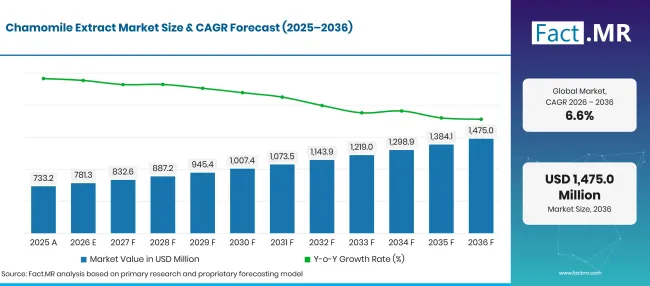
Factmr Chamomile Extract Market Forecast Global | Source: Fact.MR
| Year | Basis | Market Value (USD million) |
|---|---|---|
| 2025 | Actual | 733.2 |
| 2026 | Estimate | 781.3 |
| 2036 | Forecast | 1,475.0 |
| CAGR 2026 to 2036 | Forecast period | 6.6% |
Source: Fact.MR analysis. Updated Oct 19, 2026
What are the defining numbers behind Chamomile Extract Market growth?
USD 693.7 million absolute chance between 2026 and 2036, with powder extract variants and food and beverage applications generating the largest processing volume.
- Demand Drivers in the Market
- Clean-label beverage formulators are expanding chamomile infusion lines to address consumer demand for functional relaxation drinks and natural herbal infusions. Phytochemical clinical trials demonstrated that standardized chamomile formulations maintain consistent flavonoid bioavailability while exerting verified anxiolytic and anti-spasmodic effects in human physiological models [1]. Commercial blenders incorporate purified chamomile extracts directly into cold-pressed teas and ready-to-drink functional elixirs.
- Nutraceutical manufacturers are formulating botanical sleep aids and digestive capsules that feature standardized chamomile fractions as core active ingredients. Systematic meta-analyses of clinical trials confirmed that matricaria chamomilla extract significantly improves subjective sleep quality metrics and calms gastrointestinal distress without adverse daytime sedative carryover [2]. Supplement brands emphasize verified apigenin concentrations on front-of-pack claims to win consumer trust.
- Cosmetic brands are adopting chamomile extracts in dermatological skincare lines designed for sensitive, reactive, and eczema-prone epidermal barriers. Galenic production assessments revealed that ultrasonic extraction parameters yield dry chamomile extracts rich in matricin and bisabolol, providing potent topical protection against inflammatory skin cascades [3]. Dermatological laboratories integrate these solvent-free extracts into hypoallergenic moisturizers, serums, and soothing facial washes.
- Holistic wellness practitioners and pet supplement producers are incorporating chamomile into companion animal calming chewables and herbal homeopathic tinctures. Chronobiological studies verified that bioactive German chamomile flavonoids assist in neuroendocrine balance and liver clock regulation under metabolic stress conditions [4]. Sourcing teams expand bulk contracts with certified organic chamomile cultivation collectives across Europe and North America.
- Key Segments Analyzed
- By Product Type: Powder Extract holds 42.1% share in 2026, preferred across industrial blending plants for its elevated chemical stability, longer shelf storage, and rapid reconstitutability in dry formulation mixes.
- By Application: Food and Beverages accounts for 42.8% share in 2026 as global beverage houses scale botanical iced teas, herbal tea blends, and wellness sodas.
- By Distribution Channel: Supermarkets/Hypermarkets accounts for 38.7% share in 2026, providing high shelf visibility and multi-brand variety for everyday herbal and wellness shoppers.
- By End-User: Individual Consumers represents 68.4% share in 2026, driven by personal home brewing, wellness pantry curation, and daily self-care regimens.
- Analyst Opinion at Fact.MR
- Shambhu Nath Jha, Lead Consultant at Fact.MR, states, “The commercialization of chamomile extract is shifting rapidly from raw dried blossoms toward chromatography-purified, standardized phytochemical powders. Large food and cosmetic brand owners demand guaranteed batch-to-batch flavonoid potency and zero pesticide residues. Phytochemical extractors who invest in certified supercritical fluid extraction and maintain transparent botanical traceability from field to drum will capture premium supply agreements across North America and Europe.”
- Strategic Implications
- Botanical ingredient processors are investing in closed-loop supercritical CO2 extraction systems to eliminate hazardous petrochemical solvent residues. Research on Roman chamomile extraction revealed that supercritical techniques isolate fragile chamazulene and bisabolol oxides with superior chemical integrity compared to conventional steam distillation [5].
- Contract food and beverage packaging facilities are upgrading vacuum-drying and spray-drying equipment to prevent thermal degradation of chamomile flavonoids during powder conversion. Maintaining lower inlet temperatures preserves sensory volatile aromatics, preventing harsh off-notes in delicate ready-to-drink formulations.
- Global nutraceutical brands are establishing multi-year cultivation partnerships with cooperative agricultural farms in Egypt, Germany, and Poland to secure consistent floral yields. Agricultural forward contracts protect processing facilities from weather-induced botanical shortages while guaranteeing certified organic certification standards.
- Personal care laboratories are blending chamomile extracts with complementary soothing botanicals to engineer synergistic anti-redness complexes. Sourcing managers evaluate multi-herb blends that combine chamomile fractions with standardized botanical extracts to maximize antioxidant protection.
The United States is projected to record a 7.92% CAGR, while the United Kingdom advances at 7.35%, driven by functional health beverage innovation and widespread clean-label supplement adoption. Germany expands at 6.28%, underpinned by deep apotheke herbal traditions and strict herbal pharmacopeia standards. Japan achieves a 5.48% CAGR, fueled by premium botanical skincare and functional relaxation teas. Brazil registers a 4.77% CAGR, supported by rising consumer interest in herbal wellness infusions.
How does the Chamomile Extract Market break down by segment?
Powder Extract 42.1%; Food and Beverages 42.8%; Supermarkets/Hypermarkets 38.7%; Individual Consumers 68.4% in 2026.
Which Product Type dominates?
Powder Extract holds 42.1% share in 2026.
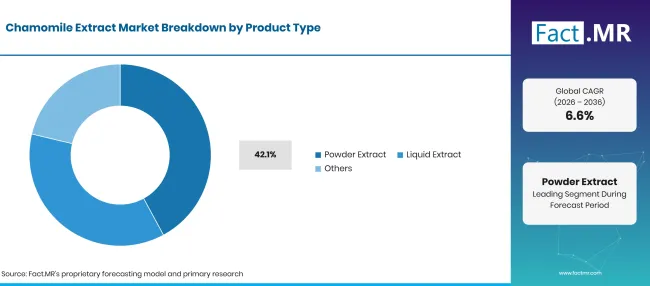
Factmr Chamomile Extract Market Breakdown Product Type | Source: Fact.MR
| Product Type | Share (2026) |
|---|---|
| Powder Extract (Leading segment) | 42.1% |
| Other segments combined | 57.9%* |
| Total | 100.0% |
Source: Fact.MR analysis. Updated Oct 19, 2026
Powder extract dominates industrial procurement schedules due to its exceptional flowability, compact freight density, and superior resistance to microbial contamination. Industrial food plants blend dry extract powders directly into bakery premixes, beverage concentrates, and encapsulated herbal supplements. Liquid extracts maintain a crucial presence in liquid cough syrups, botanical tonics, and topical facial lotions where rapid visual dispersion is necessary. Extract manufacturers also supply specialized oleoresins and volatile distillates that retain the characteristic herbaceous floral profile. Expanding commercial demand across plant based supplement manufacturing underscores why standardized dry extract powders remain the preferred processing format. Sourcing teams simultaneously evaluate certified botanical extracts to build resilient supply chains.
What leads the Application segment?
Food and Beverages accounts for 42.8% share in 2026.
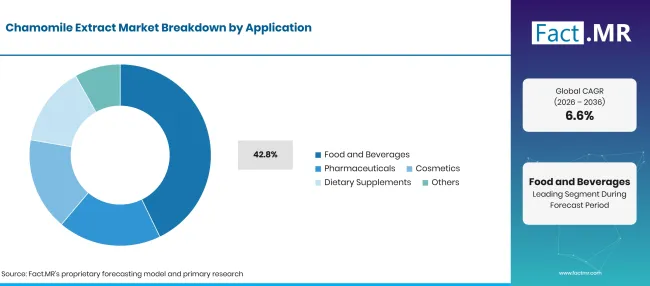
Factmr Chamomile Extract Market Breakdown Application | Source: Fact.MR
| Application | Share (2026) |
|---|---|
| Food and Beverages (Leading segment) | 42.8% |
| Other segments combined | 57.2%* |
| Total | 100.0% |
Source: Fact.MR analysis. Updated Oct 19, 2026
Food and beverage processing leads overall chamomile utilization, propelled by the worldwide resurgence in functional herbal tea infusions and relaxation beverages. Industrial tea packers blend dried extracts into instant powdered tea blends and sparkling botanical waters designed to promote daytime calm without drowsiness. Dietary supplements represent the fastest-growing application category as consumers seek natural remedies for insomnia and mild gastrointestinal cramps. Cosmetic and personal care formulations absorb significant volumes of chamomile extract to soothe irritated skin and enhance hair shine. Pharmaceutical laboratories deploy high-purity extracts in pediatric teething gels and throat gargles. Increasing development of innovative dietary supplements drives steady procurement of pharmaceutical-grade chamomile fractions. Parallel formulation trends across the functional beverage landscape confirm strong demand for soothing floral notes.
How does Distribution Channel influence sales?
Supermarkets/Hypermarkets accounts for 38.7% share in 2026.
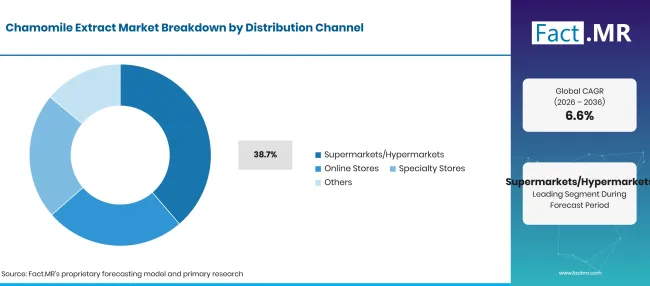
Factmr Chamomile Extract Market Breakdown Distribution Channel | Source: Fact.MR
| Distribution Channel | Share (2026) |
|---|---|
| Supermarkets/Hypermarkets (Leading segment) | 38.7% |
| Other segments combined | 61.3%* |
| Total | 100.0% |
Source: Fact.MR analysis. Updated Oct 19, 2026
Supermarket and hypermarket chains remain the primary retail conduit for chamomile extract products, offering extensive shelf frontage for herbal tea boxes, botanical skincare bottles, and over-the-counter dietary supplements. Bulk purchasing power enables large retail chains to stock competitive private-label chamomile teas alongside established global organic brands. Online retail channels are expanding rapidly as niche herbal wellness brands leverage direct-to-consumer digital marketing and subscription models. Specialty health food stores cater to knowledgeable consumers seeking organic certification and standardized apigenin potencies. Pharmacies and drug stores continue to capture steady sales of therapeutic chamomile extracts recommended by healthcare practitioners. Brand owners often pair chamomile assortments with complementary essential oils to capture impulse cross-merchandising purchases. Retailers also introduce artisanal herbal distillates to expand their organic personal care offerings.
What is accelerating Chamomile Extract Market adoption, and what is holding it back?
Consumer migration toward non-synthetic botanical stress remedies, functional relaxation drink innovations, and dermatological endorsement of bisabolol accelerate market expansion. Crop vulnerability to unseasonal rainfall, solvent residue regulatory enforcement, and raw flower price volatility restrict frictionless supply chain execution.
Drivers Impact Analysis
| DRIVER | (~) % IMPACT ON CAGR | GEOGRAPHIC RELEVANCE | IMPACT TIMELINE |
|---|---|---|---|
| Surge in functional relaxation tea consumption | +1.3% | North America, Europe | Short term (<= 2 years) |
| Dermatological validation of soothing bisabolol bioactives | +1.1% | Global | Medium term (2–4 years) |
| Expanding pediatric and digestive nutraceutical formulations | +0.9% | Europe, East Asia | Medium term (2–4 years) |
| Consumer preference for clean-label botanical ingredients | +0.8% | Global | Medium term (2–4 years) |
| Proliferation of organic herbal e-commerce platforms | +0.6% | North America, Latin America | Long term (>= 4 years) |
Source: Fact.MR analysis. Updated Oct 19, 2026
Opportunity Impact Analysis
| OPPORTUNITY | (~) % IMPACT ON CAGR | GEOGRAPHIC RELEVANCE | IMPACT TIMELINE |
|---|---|---|---|
| Standardized high-apigenin powders for functional gummies | +1.2% | North America, Europe | Short term (<= 2 years) |
| Supercritical CO2 extraction scaling for zero-residue actives | +1.0% | Western Europe, USA | Medium term (2–4 years) |
| Synergistic botanical blends for companion animal calming | +0.7% | North America, UK | Medium term (2–4 years) |
| Ready-to-drink sparkling chamomile botanical waters | +0.6% | Global | Long term (>= 4 years) |
Source: Fact.MR analysis. Updated Oct 19, 2026
Restraints Impact Analysis
| RESTRAINT | (~) % IMPACT ON CAGR | GEOGRAPHIC RELEVANCE | IMPACT TIMELINE |
|---|---|---|---|
| Seasonal harvest volatility and weather vulnerability | -1.0% | Global | Short term (<= 2 years) |
| Strict regulatory limits on agricultural pesticide residues | -0.8% | Europe, North America | Medium term (2–4 years) |
| Variable flavonoid potencies across unstandardized raw crops | -0.6% | Global | Medium term (2–4 years) |
| Rising logistics costs for delicate dry flower shipments | -0.4% | Latin America, Asia | Long term (>= 4 years) |
Source: Fact.MR analysis. Updated Oct 19, 2026
Which countries are scaling the Chamomile Extract Market through 2036?
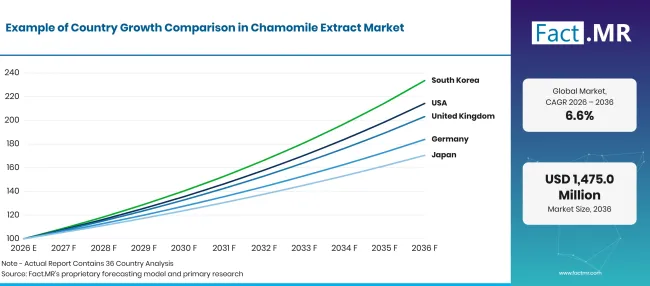
Factmr Chamomile Extract Market Growth Index | Source: Fact.MR
| Country | CAGR (2026–2036) |
|---|---|
| USA | 7.9% |
| UK | 7.35% |
| Germany | 6.28% |
| Japan | 5.48% |
| Brazil | 4.77% |
Source: Fact.MR analysis. Updated Oct 19, 2026
Why is the United States leading global market expansion?
7.9% CAGR, driven by functional beverage innovation, expanding botanical gummy supplement lines, and clean-label cosmetic formulations.
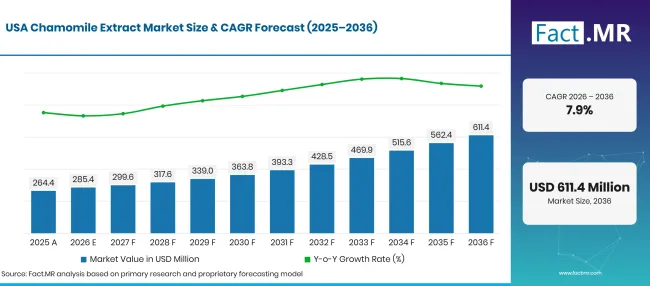
Factmr Chamomile Extract Market Forecast Usa | Source: Fact.MR
American beverage innovators and nutraceutical brand owners are aggressively incorporating standardized chamomile extract into wellness shots, sleep support gummies, and adaptogenic relaxation beverages. Large beverage corporations are introducing zero-calorie sparkling waters infused with chamomile and lavender extracts to capture health-conscious millennials seeking alternatives to alcohol. Contract manufacturers across California, Utah, and New Jersey report substantial order growth for standardized chamomile powders containing verified apigenin concentrations. Sourcing managers also integrate complementary tocopherol rich extract fractions to protect delicate beverage formulations against oxidation.
How is the United Kingdom advancing chamomile extract procurement?
7.35% CAGR, supported by traditional herbal infusion drinking habits, premium organic cosmetic developments, and pharmaceutical sleep remedies.
British consumers maintain an enduring cultural affinity for herbal teas, with organic chamomile tea ranking among the nation's most consumed non-caffeinated hot beverages. Major UK grocery retailers and specialty apothecaries are expanding their private-label botanical offerings to feature single-origin and biodynamic chamomile lines. British natural skincare formulators in London and Gloucestershire formulate chamomile flower extracts into certified soothing facial balms and sensitive scalp shampoos. Expanding healthcare practitioner recommendations for natural sleep hygiene further boost retail sales of pharmacy-dispensed chamomile capsules and tinctures.
What sustains consistent botanical demand in Germany?
6.28% CAGR, rooted in Germany's established herbal medicine pharmacopeia, domestic extraction infrastructure, and strict apotheke distribution networks.
Germany represents the technical and processing heartland of European botanical extraction, housing global leaders in herbal tea blending and phytopharmaceutical manufacturing. German consumers regularly purchase standardized chamomile teas and tinctures from local apotheken to soothe upper respiratory irritations and relieve gastrointestinal inflammation. Regulatory bodies in Germany enforce rigorous Commission E and European Pharmacopoeia quality monographs, compelling extractors to maintain exemplary batch consistency. Leading extract facilities across Bavaria and Lower Saxony continuously refine solvent-free percolation technologies.
Why is Japan registering steady adoption across personal care?
5.48% CAGR, propelled by the premium J-beauty soothing skincare sector, functional relaxation confections, and aging population health products.
Japanese cosmetic laboratories specialize in minimalist, hypoallergenic formulations that utilize purified chamomile extract to calm environmental skin irritation and improve barrier resilience. Tokyo beauty brands formulate chamomile extract into soothing essence lotions, brightening emulsions, and sheet masks designed for sensitive urban skin. Japanese confectionery makers also incorporate chamomile powders into functional hard candies and relaxation drinking jellies marketed to stressed office workers. Strict safety and traceability standards established by Japan's Ministry of Health ensure that imported chamomile extracts comply with meticulous residue screenings.
What opportunities are unfolding across Brazil?
4.77% CAGR, backed by Brazil's expanding organic herbal tea market, domestic cosmetic manufacturing, and rising interest in natural wellness alternatives.
Brazilian consumers across São Paulo and Rio de Janeiro are adopting organic chamomile infusions as daily evening wellness rituals to alleviate urban stress. Domestic personal care companies utilize chamomile extracts in baby care shampoos, gentle soaps, and post-sun soothing lotions to meet demand for gentle, natural ingredients. Expanding middle-class purchasing power and the proliferation of specialty natural food stores throughout southern Brazil drive steady distribution of packaged chamomile products. Local extract distributors increasingly import standardized European extracts to satisfy the quality requirements of Brazilian cosmetic laboratories.
Who leads the Chamomile Extract Market?
Indena S.p.A. maintains a prominent global position in pharmaceutical-grade botanical extraction, leveraging advanced chromatography purification and standardized apigenin profiling. Kemin Industries Inc. supplies certified organic chamomile extracts engineered for functional food, pet wellness, and human dietary supplements. Martin Bauer Group operates one of the world's most extensive botanical sourcing and processing networks, supplying thousands of tons of herbal tea blends and botanical extracts globally.
Arjuna Natural Pvt Ltd specializes in standardized extracts with verified bioactivity profiles for the global nutraceutical and dietary supplement sectors. Mountain Rose Herbs and Herbo Nutra distribute certified organic and wildcrafted chamomile fractions catering to artisanal skincare formulators and herbal practitioners. New Zealand Extracts Ltd and Bio-Botanica Inc. supply advanced botanical distillates and botanical complexes utilizing proprietary low-temperature extraction technologies. Formulators frequently combine chamomile with specialized caralluma extract and targeted pygeum bark extract to address comprehensive metabolic wellness. Producers also blend chamomile with herbal yeast complexes to boost enzymatic digestion.
Which companies are the key providers?
Key companies include Indena S.p.A.; Kemin Industries Inc.; Martin Bauer Group; Arjuna Natural Pvt Ltd; Mountain Rose Herbs; Herbo Nutra; New Zealand Extracts Ltd; and Bio-Botanica Inc.
- Indena S.p.A.
- Kemin Industries Inc.
- Martin Bauer Group
- Arjuna Natural Pvt Ltd
- Mountain Rose Herbs
- Herbo Nutra
- New Zealand Extracts Ltd
- Bio-Botanica Inc.
Bibliography
- [1] PMC. (2024, July 15). 3D-printed chamomile formulations and phytochemical characterization. PMC11311743.
- [2] PMC. (2025, February 20). Systematic review and meta-analysis of chamomile clinical trials in sleep and anxiety disorders. PMC12269088.
- [3] PMC. (2024, January 10). Optimization of galenic dry chamomile extract production and flavonoid extraction kinetics. PMC10857454.
- [4] PMC. (2025, March 18). German chamomile extract regulates peripheral circadian clocks and liver metabolic function. PMC13388513.
- [5] PMC. (2025, April 12). Supercritical extraction and bioactive fractions of Roman chamomile. PMC12552861.
This Report Answers
- The report evaluates processing efficiencies and yield economics across powder and liquid chamomile extraction formats.
- Application assessments detail why functional beverages and dietary supplements consume the largest share of standardized extract batches.
- Country-level analysis investigates the regulatory and consumer factors enabling the United States and the United Kingdom to achieve faster growth rates.
- Phytochemical comparisons examine the therapeutic stability of apigenin, chamazulene, and bisabolol under industrial heating and drying conditions.
- Competitive profiling benchmarks solvent extraction capacities, organic agricultural contracts, and clean-label certifications across primary botanical ingredient producers.
What does the Chamomile Extract Market cover?
The market encompasses commercial shipments of purified, standardized, and crude chamomile extracts manufactured from German chamomile (Matricaria chamomilla) and Roman chamomile (Chamaemelum nobile) floral inflorescences. It evaluates ingredient flows into packaged herbal teas, functional ready-to-drink beverages, dietary supplement capsules, pediatric healthcare syrups, and soothing cosmetic formulations. The analysis evaluates value creation across both wholesale botanical ingredient supply chains and consumer-packaged wellness products.
What is included in the scope?
The scope covers merchant sales of chamomile extract powders, aqueous distillates, hydroalcoholic tinctures, and supercritical CO2 extracts sold to industrial manufacturing end users and retail packaged distributors. Revenues reflect finished botanical ingredient shipments valued at factory-gate and wholesale distribution pricing. Value-added standardized extracts with guaranteed flavonoid percentages are fully evaluated within the market revenue boundaries.
What is excluded from the scope?
The scope excludes raw unharvested chamomile agricultural acreage and unprocessed loose dried floral heads sold without extraction processing. Synthetically synthesized bisabolol or synthetic fragrance compounds mimicking chamomile scents are excluded from botanical extract totals. Farm harvesting machinery, industrial distillation boilers, and packaging machinery are outside the scope of this ingredient assessment.
How Was the Analysis Built?
The analysis draws on 120+ sources, 35+ company portfolios, 25+ countries, and more than 20 industry interviews.
- Primary Research: Primary research includes discussions with manufacturers, service providers, technology developers, distributors, end users, and subject-matter experts. These conversations examine purchasing priorities, product adoption, operational challenges, approval requirements, competitive positioning, and the factors that influence wider market acceptance.
- Desk Research: Desk research covers government statistics, regulatory publications, company filings, trade data, technical studies, industry associations, standards, public policy, and other authoritative sources. Every source used in the analysis is documented in the bibliography.
- Market Sizing and Forecasting: Market estimates combine historical performance, demand indicators, pricing and volume trends, segment shares, company participation, country-level growth, adoption patterns, investment activity, and barriers to market expansion.
- Data Validation and Update Cycle: Findings are validated by comparing primary interviews with public data, company activity, regulatory changes, trade patterns, and industry developments. Regular updates review new product launches, capacity changes, partnerships, approvals, and shifts in commercial adoption.
Segmentation
What is the report’s scope and coverage?
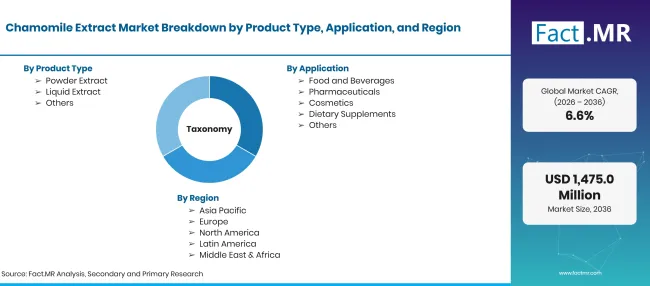
Factmr Chamomile Extract Market Taxonomy | Source: Fact.MR
| Attribute | Details |
|---|---|
| Quantitative Units | USD million |
| Market Definition | Standardized botanical extracts derived from dried Matricaria chamomilla or Chamaemelum nobile inflorescences, processed into powder or liquid formats for industrial formulations. |
| Product Type | Powder Extract; Liquid Extract; Others |
| Application | Food and Beverages; Pharmaceuticals; Cosmetics; Dietary Supplements; Others |
| Distribution Channel | Supermarkets/Hypermarkets; Online Stores; Specialty Stores; Others |
| End-User | Individual Consumers; Commercial |
| Regions Covered | North America; Latin America; Western Europe; Eastern Europe; East Asia; South Asia & Pacific; Middle East & Africa |
| Countries Covered | USA; UK; Germany; Japan; Brazil |
| Companies Profiled | Indena S.p.A.; Kemin Industries Inc.; Martin Bauer Group; Arjuna Natural Pvt Ltd; Mountain Rose Herbs; Herbo Nutra; New Zealand Extracts Ltd; Bio-Botanica Inc. |
| Forecast Period | 2026 to 2036 |
| Approach | Primary interviews with botanical extractors, phytochemical analytical labs, herbal tea blenders, and cosmetic formulators combined with trade import-export data analysis |
Source: Fact.MR analysis. Updated Oct 19, 2026
How is the market segmented?
-
By Product Type:
- Powder Extract
- Liquid Extract
- Others
-
By Application:
- Food and Beverages
- Pharmaceuticals
- Cosmetics
- Dietary Supplements
- Others
-
By Distribution Channel:
- Supermarkets/Hypermarkets
- Online Stores
- Specialty Stores
- Others
-
By End-User:
- Individual Consumers
- Commercial
-
By Region:
- North America
- Latin America
- Western Europe
- Eastern Europe
- East Asia
- South Asia & Pacific
- Middle East & Africa
Frequently Asked Questions
How big is the chamomile extract market in 2026?
What is the CAGR from 2026 to 2036?
Which product type leads?
Which application leads?
Which companies participate in chamomile extract?
Who worked on this report


Preview the report firsthand - request a free sample
Free SampleGet the brochure for pricing and purchase details
Download PDF