
- Market Value (2025): USD 41.8 Mn
- Estimated Value (2026): USD 45.0 Mn
- Forecast Value (2036): USD 93.6 Mn
- CAGR (2026-2036): 7.6%
Changeover Grinding Units Market Forecast and Outlook 2026 to 2036
Fact.MR estimates that the changeover grinding units market was valued at USD 41.8 million in 2025 and is projected to grow from USD 45.0 million in 2026 to USD 93.6 million by 2036. Demand for changeover grinding units is likely to grow at a CAGR of 7.6% over the forecast period.
Demand for changeover grinding units is rising as plants that grind many products on one mill want to switch recipes in minutes rather than hours. These mills use quick-release grinding chambers, tool-free rotors, swappable screens and automated cleaning, cutting downtime and cross-contamination risk. For example, nutraceutical, spice and pharmaceutical makers often run dozens of short campaigns a week, each requiring full cleaning between allergens or active ingredients. Similar campaign patterns are projected to drive sales of changeover grinding units through 2036.
Key Takeaways from the Changeover Grinding Units Market
- Changeover Grinding Units Market Value (2025): USD 41.8 million
- Changeover Grinding Units Market Value (2026): USD 45.0 million
- Changeover Grinding Units Market Forecast Value (2036): USD 93.6 million
- Changeover Grinding Units Market Forecast CAGR (2026-2036): 7.6%
- Leading Grinding changeover: Quick-release chamber (21.0%)
- Key Market Participants: GEA, JBT Marel, Heat and Control, Bühler, Baker Perkins, tna solutions
- Key Growth Regions: Switzerland, Germany, China, Japan, United States
Swiss and German mill makers such as Frewitt, Bühler and Hosokawa Alpine have developed mills with fast-opening chambers and validated cleaning for multi-product plants. Demand for changeover grinding units is growing as contract manufacturers serve many brands from the same equipment. The key players are offering wash-in-place and containment options. Similar outsourcing trends are projected to drive sales of changeover grinding units worldwide.
Changeover Grinding Units Market
| Metric | Value |
|---|---|
| Estimated Value in (2026) | USD 45.0 million |
| Forecast Value in (2036) | USD 93.6 million |
| Forecast CAGR (2026 to 2036) | 7.6% |
Source: Fact.MR analysis.
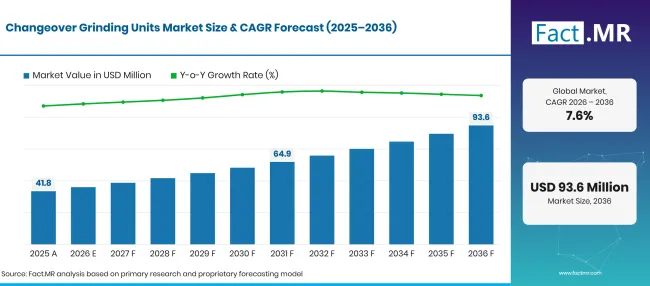
Changeover Grinding Units Forecast Global | Source: Fact.MR
Category
| Category | Segments |
|---|---|
| Grinding changeover | Tool-free rotor, Interchangeable screen, Quick-release chamber, Automated CIP, Modular mill head |
| Processing scale | Pilot / lab, Small commercial, Mid-scale, High-throughput, Ultra-high-throughput |
| Operating configuration | Batch, Semi-continuous, Continuous, Modular skid, Integrated line |
| Food / process application | Bakery / wafers, Confectionery / cocoa, Snacks / seasoning, Brewing / grains, Other food / industrial |
| Region | Switzerland; Germany; China; Japan; United States |
Source: Fact.MR analysis.
Segmental Analysis
What is increasing demand for quick-release chamber designs in the Changeover Grinding Units Market?
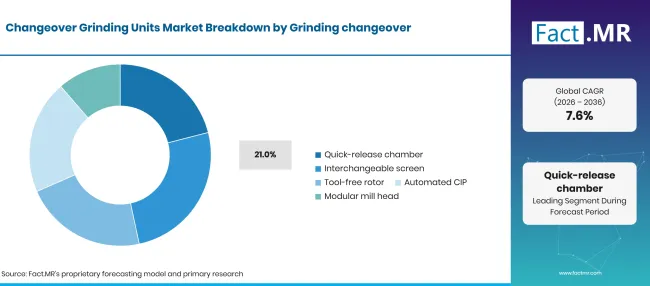
Changeover Grinding Units Breakdown Grinding Changeover | Source: Fact.MR
Quick-release chamber designs account for 21.0% of revenue in 2026, about USD 9.4 million, as the entire grinding chamber can be opened or removed by hand for cleaning and inspection. Interchangeable screens, modular heads and tool-free rotors follow closely. Manufacturers are offering quick-release mill bodies. India's Ministry of Statistics and Programme Implementation reported that registered manufacturing industrial output increased by 7.81% in FY 2024–25, while manufacturing employment grew by 7.19%. These developments indicate expanding industrial production and equipment utilization across manufacturing facilities. In food, pharmaceutical and specialty chemical operations, removable grinding chambers and tool-free access support faster cleaning and inspection between campaigns. Equipment suppliers are emphasizing quick-release mill bodies, interchangeable screens and modular grinding heads to improve changeover efficiency.
Which laboratory and pilot-plant requirements are supporting changeover grinding unit sales?
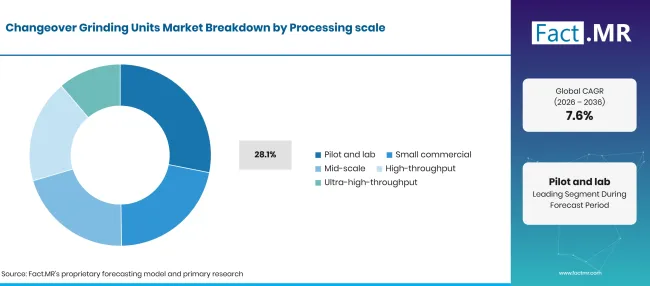
Changeover Grinding Units Breakdown Processing Scale | Source: Fact.MR
The pilot and laboratory segment accounts for 28.1% of revenue in 2026, about USD 12.6 million, as R&D labs and pilot plants grind many small samples and need fast cleaning. High-throughput and mid-scale plants follow. The key players are offering lab mills with quick changeover. Pilot / lab applications segment growth is driven by research facilities and product development teams require flexible grinding equipment for smaller batches. India's Department of Science and Technology reported gross expenditure on research and development of INR 244,767.81 crore in FY 2023–24, according to its Research and Development Statistics 2025–26 publication released in 2026. Private-sector R&D expenditure reached INR 126,906.60 crore. This investment supports research activity across pharmaceuticals, chemicals, food ingredients and materials. Laboratory mills with removable chambers, interchangeable grinding elements and simplified cleaning are relevant to these applications.
How is batch processing shaping configuration demand in the Changeover Grinding Units Market?
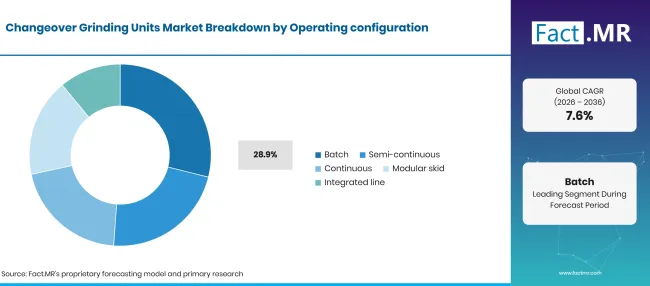
Changeover Grinding Units Breakdown Operating Configuration | Source: Fact.MR
Batch operation accounts for 28.9% of revenue in 2026, about USD 13.0 million, as discrete campaigns separated by cleaning are standard in multi-product grinding. Continuous operation follows. The key manufacturers design for fast batch turnaround. India's Reserve Bank of India reported that the manufacturing index for food products reached 105.0 in FY 2025–26, compared with 101.8 in FY 2024–25. The pharmaceutical manufacturing index also increased from 120.3 to 120.8 during the same period. These production indicators support demand for flexible grinding equipment capable of handling different materials and batch sizes. Manufacturers are prioritizing removable chambers, accessible grinding surfaces and faster cleaning arrangements to shorten production changeovers.
What is expanding demand for changeover grinding units across food and industrial applications?
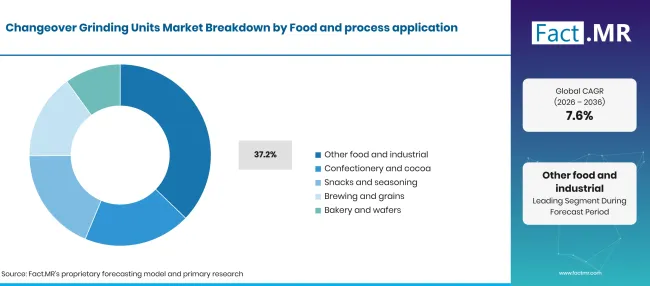
Changeover Grinding Units Breakdown Food And Process Application | Source: Fact.MR
Other food / industrial accounts for 37.2% of revenue in 2026, about USD 16.7 million, covering nutraceuticals, pharmaceuticals, spices and specialty chemicals that run many short campaigns. Bakery follows. India's Annual Survey of Industries 2024–25, released by MoSPI in September 2026, reported that pharmaceutical, chemical, food and basic metal industries together contributed more than 45% of manufacturing gross value added. This highlights the importance of diversified industrial production and processing requirements. Manufacturers handling different ingredients and formulations require grinding systems that support hygienic cleaning, controlled particle sizes and reduced cross-contamination risks. Demand for changeover-ready mills is therefore supported by production flexibility requirements across multiple industrial applications.
Changeover Grinding Units Market-Drivers, Restraints & Trends
Drivers:
Shorter Production Campaigns and Equipment Changeovers -: Demand for changeover grinding units is rising as product ranges widen and campaigns shorten, so cleaning time becomes a larger share of mill time. The manufacturing companies are presenting changeover time savings. The U.S. Bureau of Labor Statistics (BLS), in its 2026 manufacturing employment outlook, projects pharmaceutical and medicine manufacturing employment to increase from 350,500 workers in 2024 to 369,500 by 2034, adding approximately 19,000 jobs. This represents projected growth of 5.4% over the decade. Expanding pharmaceutical manufacturing activity increases the importance of production equipment capable of handling different formulations while maintaining product quality and operational efficiency. For manufacturers using shared grinding equipment, efficient product changeovers and validated cleaning procedures can help manage production flexibility and equipment utilization.
Restraints:
Sales of changeover grinding units is limited by higher prices than standard mills and by validation work needed for cleaning procedures. Similar costs are projected to slow adoption in single-product plants. Manufacturers must offer validation support. The FDA's 2026 enforcement activities demonstrate the operational importance of equipment-cleaning validation in pharmaceutical manufacturing. In its January 21, 2026 warning letter to Signature Formulations, the FDA identified deficiencies involving cleaning and disinfection procedures, residue removal and cleaning validation. The agency required improvements covering equipment cleaning effectiveness, verification and product changeovers. These requirements illustrate the additional validation, documentation and quality-control responsibilities associated with multiproduct manufacturing. Such compliance requirements can increase implementation costs for facilities adopting specialized changeover grinding equipment, particularly when existing standard mills require modifications or additional cleaning procedures.
Opportunity: Wash-in-Place Mills
Demand for mills cleaned automatically in place is rising. Manufacturers are offering WIP systems. The U.S. FDA issued its updated Compliance Program 7346.832M on April 14, 2026, outlining inspection expectations for pharmaceutical manufacturing equipment and cleaning systems. The guidance specifically directs inspection teams to evaluate the effectiveness of cleaning-in-place (CIP) systems, washer cycles and manual cleaning operations in removing product residues and cleaning agents. It also gives priority to shared equipment and machinery handling high-risk products. These requirements support opportunities for wash-in-place grinding mills that automate cleaning operations, reduce manual intervention and provide documented cleaning performance during product changeovers.
Trend: Containment Grinding for Potent and Allergenic Powders
Demand for mills that contain potent or allergenic powders is rising. Manufacturers are offering contained designs. The FDA's 2026 preapproval inspection guidance, issued on June 29, 2026, emphasizes manufacturing equipment qualification, process changes and contamination-control measures. The document requires inspectors to evaluate whether equipment and manufacturing processes are suitable for commercial production and whether changes are supported by appropriate risk assessments and validation studies. Additionally, FDA's 2026 warning letter to Dabur India Limited identified inadequate cleaning validation involving shared manufacturing equipment and potential product carryover. These regulatory developments reinforce the importance of controlled processing environments, effective residue management and equipment designs that limit cross-contamination risks when handling potent or sensitive materials.
Changeover Grinding Units Market Analysis by Key Country
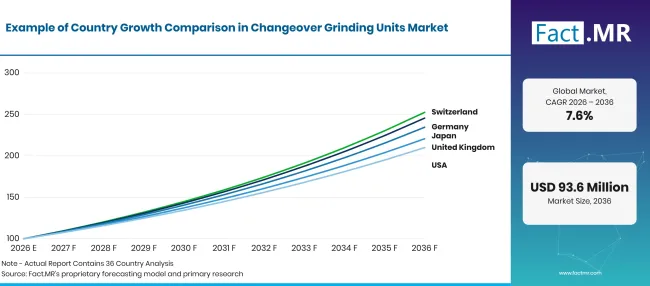
Changeover Grinding Units Growth Index | Source: Fact.MR
| Country | CAGR (2026-2036) |
|---|---|
| Switzerland | 9.6% |
| Germany | 9.4% |
| China | 9.2% |
| Japan | 8.9% |
| United States | 7.7% |
Source: Fact.MR analysis.
Why is Switzerland the fastest-growing market for changeover grinding units?
Demand in Switzerland is projected to record a 9.6% CAGR, the fastest among the five key countries, as pharmaceutical, nutrition and flavor companies run multi-product plants and Swiss mill makers such as Frewitt develop fast-changeover designs.
Switzerland's changeover grinding units market is the fastest among the five profiled countries, supported by its established pharmaceutical and specialty chemical manufacturing base. The Swiss Federal Statistical Office reported that pharmaceutical industry employment increased by 6.1% in 2024, while the sector contributed 12.6% of secondary-sector turnover. Furthermore, the Swiss government reported that chemical and pharmaceutical exports reached CHF 152 billion in 2025. Multi-product manufacturing and specialised production requirements create opportunities for Frewitt and other equipment suppliers offering rapid cleaning, flexible milling and shorter product changeovers.
Which manufacturing developments are supporting changeover grinding unit sales in Germany?
Sales in Germany is estimated to represent at a 9.4% CAGR as contract manufacturers and spice processors such as Fuchs seek faster changeovers.
Hosokawa Alpine, based in Augsburg, and NETZSCH supply grinding units. Germany's market growth is supported as pharmaceutical and nutritional supplement manufacturers increase production flexibility and equipment utilisation. According to Destatis, German manufacturers produced approximately 241,000 tonnes of dietary supplements in 2025, representing a 48.4% increase over 2019. The number of producing companies also reached 72. This expanding manufacturing base creates opportunities for grinding equipment that can handle different formulations with shorter cleaning intervals. Hosokawa Alpine and NETZSCH benefit from demand for specialised milling solutions, while contract manufacturers and spice processors increasingly value flexible equipment configurations for shorter production campaigns.
How is China's contract manufacturing expansion influencing grinding equipment demand?
Demand in China are projected to record a 9.2% CAGR as nutraceutical and pharmaceutical contract makers expand, and GMP rules require cleaning validation between products.
Local mill makers compete on price. China's changeover grinding units market is shaped by pharmaceutical contract manufacturing and stricter production-quality requirements. The National Medical Products Administration strengthened contract manufacturing supervision through Announcement No. 134 of 2025, updated in April 2026. It requires contract manufacturers to maintain GMP-compliant quality systems, evaluate product compatibility before accepting manufacturing assignments and assess the feasibility of co-line production. These requirements increase the importance of validated cleaning procedures and flexible equipment configurations. Domestic grinding equipment manufacturers can benefit as pharmaceutical and nutraceutical producers seek cost-effective mills capable of handling multiple formulations.
What is shaping changeover grinding unit demand in Japan?
Demand in Japan is forecast to increase at an 8.9% CAGR as supplement makers run many small campaigns under the Foods with Function Claims system.
Following the 2024 red yeast rice incident, Japan's Consumer Affairs Agency strengthened GMP requirements for supplements marketed under its Foods with Function Claims framework. Its May 2026 implementation review reported that 226 manufacturing facilities had been visited, with 140 broadly implementing GMP and 67 still developing their compliance systems. The revised requirements took effect on September 1, 2026. These developments encourage manufacturers to improve cleaning validation, batch separation and production flexibility, supporting specialised grinding equipment demand.
What is keeping United States changeover grinding unit growth comparatively moderate?
Demand in the United States is projected to grow at a 7.7% CAGR, the slowest among the five key countries, as large plants favor dedicated mills for long runs.
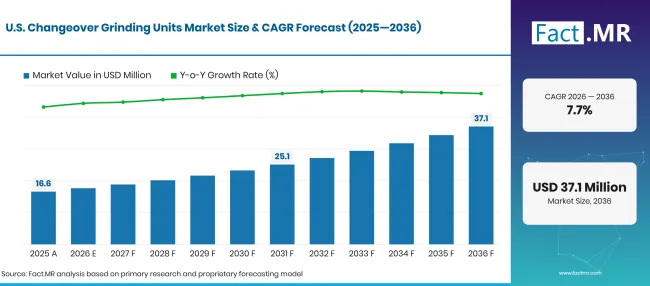
Changeover Grinding Units Forecast Usa | Source: Fact.MR
Demand comes mainly from contract manufacturers and supplement makers running many small batches. The United States changeover grinding units market is the slowest among the five profiled countries. Large pharmaceutical manufacturers often operate established production facilities with equipment configured for specialised or extended manufacturing campaigns, limiting the immediate need for frequent mill changeovers. Nevertheless, the US Census Bureau's 2024 Economic Surveys, published in 2026, recorded USD 259.5 billion in sales, shipments and revenue for pharmaceutical and medicine manufacturing. This substantial manufacturing base offers opportunities for flexible milling equipment among contract manufacturers and supplement producers handling multiple formulations, smaller production batches and more frequent cleaning requirements.
Competitive Landscape for Changeover Grinding Units Market
The changeover grinding units market is characterized by competition between diversified process-equipment manufacturers and specialist powder-processing companies. GEA, JBT Marel and Bühler offer integrated food and pharmaceutical processing capabilities, while WAB-GROUP specializes in wet grinding, mixing and dispersion technologies. Hosokawa Alpine and Hosokawa Micron Powder Systems compete through specialized milling, classification and containment solutions for pharmaceutical, chemical and food applications. Buyers prioritize rapid equipment changeovers, cleaning accessibility, particle-size consistency, containment and operating costs.
From 2024 onward, competition has increasingly emphasized flexible processing platforms, modular equipment and automated changeover procedures. In July 2026, Hosokawa Alpine expanded its multi-processing systems with the UPZ 100 III fine impact mill, enabling up to seven mill types to operate on one system platform. In August 2026, GEA introduced Changeover Assist, a digital application providing step-by-step changeover instructions to reduce errors, waste and downtime. These developments highlight the industry's shift toward faster, more reliable and flexible production operations.
Recent Developments
- On August 24, 2026, GEA introduced Changeover Assist, a digital application that provides step-by-step instructions for product and recipe changeovers on SmartControl-based machines. The application helps operators reduce changeover errors, product waste and unplanned downtime. It also documents completed procedures to improve traceability and operational consistency. Initially available for PowerPak thermoformers and MaxiFormer drum formers, the application is planned for expansion to additional equipment.
- On January 2, 2025, JBT completed its combination with Marel, creating JBT Marel Corporation. The transaction brought together food-processing, automation and equipment technologies across multiple food-production applications. The combined company expanded its capabilities across processing, production efficiency and integrated manufacturing solutions.
- On October 7, 2025, Bühler launched Cenomic Horizon 3, a new wet-grinding bead mill designed to improve product quality, throughput and energy efficiency. The system features an active chamber volume of 20 litres and 30 kW drive power. Its improved temperature control, reduced wear and flexible processing capabilities support consistent grinding performance. The launch strengthens Bühler's wet-grinding portfolio and demonstrates continued investment in advanced milling technology.
- On November 17, 2026, Hosokawa Alpine introduced a new isolator system for its Picoline laboratory milling platform to support the processing of sensitive materials, including active pharmaceutical ingredients (APIs), highly potent active pharmaceutical ingredients (HPAPIs), rare earths and battery materials. The system provides OEB Level 5 containment, an integrated wash-in-place facility and compatibility with several milling systems. This development directly supports contained grinding and automated cleaning requirements in pharmaceutical powder processing.
Key Players in Changeover Grinding Units Market
Key companies operating in the market include GEA, JBT Marel, Bühler, WAB-GROUP, Hosokawa Alpine, and Hosokawa Micron Powder Systems.
- GEA
- JBT Marel
- Bühler
- WAB-GROUP
- Hosokawa Alpine
- Hosokawa Micron Powder Systems
Bibliography
- Bühler AG. (2025). Annual report 2024.
- Bühler Group. (2025, October 7). Bühler expands wet grinding portfolio with Cenomic Horizon 3.
- Consumer Affairs Agency, Japan. (2026, May). 機能性表示食品におけるGMP実施状況の確認について [Review of GMP implementation status for foods with function claims].
- Department of Science and Technology, Government of India. (2026, July 30). Research & development statistics at a glance 2025–26.
- Federal Statistical Office (Destatis). (2026, November 3). Produktion von Nahrungsergänzungsmitteln seit 2019 um 48,4 % gestiegen [Production of dietary supplements has increased by 48.4% since 2019].
- GEA Group Aktiengesellschaft. (2026, August 24). GEA expands digital portfolio in Food segment: Changeover Assist reduces errors, waste and downtime during product changeovers.
- Hosokawa Alpine AG. (2026, November 17). Picoline now also available for sensitive products.
- Hosokawa Micron Corporation. (2025). Integrated report 2025.
- JBT Marel Corporation. (2025, February 27). Current report on Form 8-K: Completion of the voluntary takeover offer for Marel hf.
- Ministry of Statistics and Programme Implementation, Government of India. (2026, September 30). Release of the Annual Survey of Industries (2024–25) results. Press Information Bureau.
- National Medical Products Administration. (2026, April 14). Announcement on strengthening supervision and administration of contract manufacturing of drugs (No. 134, 2025). Reserve Bank of India. (2026, July 31). Table 27: Index numbers of twenty-three major industry groups of the manufacturing sector.
- State Secretariat for Economic Affairs (SECO). (2026, September 3). Gross domestic product in the second quarter of 2026: Strong, broad-based growth – large contribution from the chemical and pharmaceutical industry.
Segmentation
Scope of Report
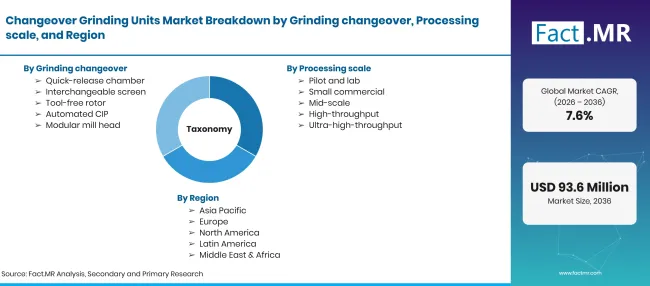
Changeover Grinding Units Taxonomy | Source: Fact.MR
| Items | Values |
|---|---|
| Quantitative Units (2026) | USD 45.0 Million |
| Grinding changeover | Tool-free rotor, Interchangeable screen, Quick-release chamber, Automated CIP, Modular mill head |
| Processing scale | Pilot / lab, Small commercial, Mid-scale, High-throughput, Ultra-high-throughput |
| Operating configuration | Batch, Semi-continuous, Continuous, Modular skid, Integrated line |
| Food / process application | Bakery / wafers, Confectionery / cocoa, Snacks / seasoning, Brewing / grains, Other food / industrial |
| Regions Covered | North America, Latin America, Europe, East Asia, South Asia and Pacific, Middle East & Africa |
| Countries Covered | Switzerland, Germany, China, Japan, United States, and other countries |
| Key Companies Profiled | • GEA • JBT Marel • Bühler • WAB-GROUP • Hosokawa Alpine • Hosokawa Micron Powder Systems |
| Additional Attributes | Dollar revenue in the Changeover Grinding Units Market is segmented by grinding changeover (tool-free rotor, interchangeable screen, quick-release chamber, automated cip, modular mill head); processing scale (pilot / lab, small commercial, mid-scale, high-throughput, ultra-high-throughput); operating configuration (batch, semi-continuous, continuous, modular skid, integrated line); food / process application (bakery / wafers, confectionery / cocoa, snacks / seasoning, brewing / grains, other food / industrial) and region. |
Source: Fact.MR analysis.
Changeover Grinding Units Market by Segments
-
Grinding changeover
- Tool-free rotor
- Interchangeable screen
- Quick-release chamber
- Automated CIP
- Modular mill head
-
Processing scale
- Pilot / lab
- Small commercial
- Mid-scale
- High-throughput
- Ultra-high-throughput
-
Operating configuration
- Batch
- Semi-continuous
- Continuous
- Modular skid
- Integrated line
-
Food / process application
- Bakery / wafers
- Confectionery / cocoa
- Snacks / seasoning
- Brewing / grains
- Other food / industrial
-
Region:
- North America
- United States
- Canada
- Mexico
- Europe
- Germany
- United Kingdom
- France
- Italy
- Spain
- Rest of Europe
- Asia Pacific
- China
- India
- Japan
- South Korea
- Australia
- Rest of Asia Pacific
- Latin America
- Brazil
- Argentina
- Rest of Latin America
- Middle East & Africa
- GCC Countries
- South Africa
- Rest of Middle East & Africa
- North America
Table of Contents
Key Takeaways
- Market Size and CAGR
- Top Growth Driver
- Fastest Growing Segment
- Leading Region
- Key Companies
- Emerging Opportunities

