
- Market Value (2025): USD 41.7 Mn
- Estimated Value (2026): USD 45.0 Mn
- Forecast Value (2036): USD 95.4 Mn
- CAGR (2026-2036): 7.8%
Foam-Free Batter Curtains Market Forecast and Outlook 2026 to 2036
As per the Fact.MR analysis, the foam-free batter curtains market surpassed a value of USD 41.7 million in 2025 and is projected to grow from USD 45.0 million in 2026 to USD 95.4 million by 2036. Demand for foam-free batter curtains is likely to grow at a CAGR of 7.8% over the forecast period.
Demand for foam-free batter curtains is rising as processors of fish fingers, nuggets, onion rings and tempura vegetables find that air bubbles in batter curtains leave voids and thin spots, which absorb more oil in the fryer and look poor. Foam-free systems degas batter by vacuum or low-shear handling before it falls over the product. For example, Germany's frozen fish industry around Bremerhaven, home to plants of Frosta and Nomad Foods' Iglo, runs high-volume battered and breaded lines. Similar coating volumes are projected to drive sales of foam-free batter curtains through 2036.
Key Takeaways from the Foam-Free Batter Curtains Market
- Foam-Free Batter Curtains Market Value (2025): USD 41.7 million
- Foam-Free Batter Curtains Market Value (2026): USD 45.0 million
- Foam-Free Batter Curtains Market Forecast Value (2036): USD 95.4 million
- Foam-Free Batter Curtains Market Forecast CAGR (2026-2036): 7.8%
- Leading Batter defoaming mechanism: Vacuum degassing (36.3%)
- Key Market Participants: GEA, JBT Marel, Heat and Control, Bühler, Baker Perkins, tna solutions
- Key Growth Regions: Germany, India, United States, China, Thailand
Food makers are under pressure to cut fat content in fried and coated foods, and even coatings help limit oil uptake. Demand for foam-free batter curtains is growing as processors look for small process changes that improve nutrition and appearance. The key players such as JBT Marel, GEA and Heat and Control are offering degassing units for batter applicators. Similar health trends are projected to drive sales of foam-free batter curtains across Europe and Asia.
Foam-Free Batter Curtains Market
| Metric | Value |
|---|---|
| Estimated Value in (2026) | USD 45.0 million |
| Forecast Value in (2036) | USD 95.4 million |
| Forecast CAGR (2026 to 2036) | 7.8% |
Source: Fact.MR analysis.
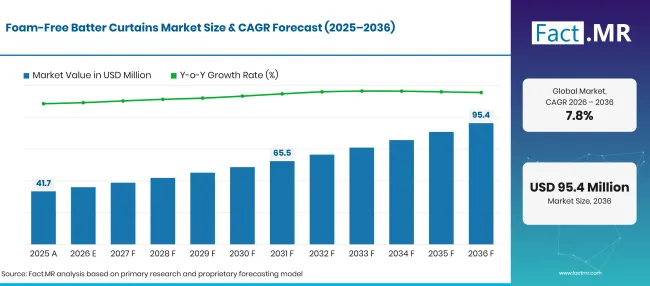
Foam Free Batter Curtains Forecast Global | Source: Fact.MR
Category
| Category | Segments |
|---|---|
| Batter defoaming mechanism | Vacuum degassing, Mechanical deaeration, Low-shear curtain, Antifoam-assisted, Ultrasonic |
| Processing scale | Pilot / lab, Small commercial, Mid-scale, High-throughput, Ultra-high-throughput |
| Operating configuration | Batch, Semi-continuous, Continuous, Modular skid, Integrated line |
| Food / process application | Bakery / wafers, Confectionery / cocoa, Snacks / seasoning, Brewing / grains, Other food / industrial |
| Region | Germany; India; United States; China; Thailand |
Source: Fact.MR analysis.
Segmental Analysis
What is strengthening vacuum degassing demand in the Foam-Free Batter Curtains Market?
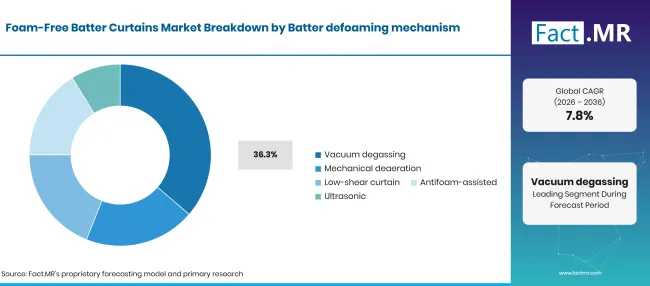
Foam Free Batter Curtains Breakdown Batter Defoaming Mechanism | Source: Fact.MR
Demand for vacuum degassing accounts for 36.3% of revenue in 2026, about USD 16.3 million, as removing air under vacuum gives a dense, even curtain without adding antifoam agents. Low-shear curtains and ultrasonic systems follow. The key players are offering inline vacuum degassers. Removing entrapped air helps reduce coating inconsistencies and improves product appearance. India's Reserve Bank of India reported a food-products manufacturing production index of 105.0 for FY2025-26, against a 2022-23 base of 100, indicating expansion in the broader food manufacturing sector. This production environment supports investment in improved batter preparation technologies. Inline vacuum degassers are gaining relevance among processors seeking continuous operations and predictable coating quality.
Which production requirements are increasing high-throughput segment sales?
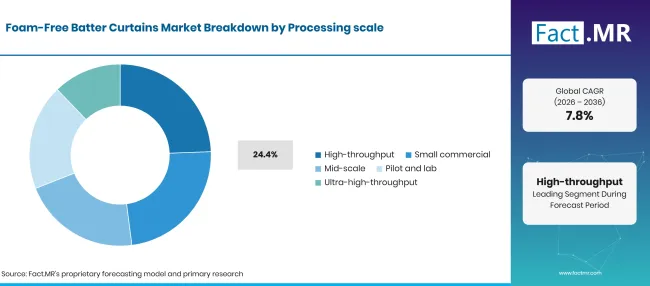
Foam Free Batter Curtains Breakdown Processing Scale | Source: Fact.MR
The high-throughput segment accounts for 24.4% of revenue in 2026, about USD 11.0 million, as large frozen-food lines lose the most product to poor coating. Ultra-high-throughput plants follow closely. The key players are offering high-capacity degassing. High-volume processing facilities require stable batter flow to maintain coating thickness across successive batches. India's Ministry of Food Processing Industries reported that 402 integrated cold-chain projects had been taken up by December 31, 2025, with 301 completed. The infrastructure was expected to create 331 MT per hour of individual quick-freezing capacity. This expansion in frozen-food handling infrastructure supports the broader requirement for higher-capacity processing and coating equipment.
How are integrated production systems shaping configuration demand?
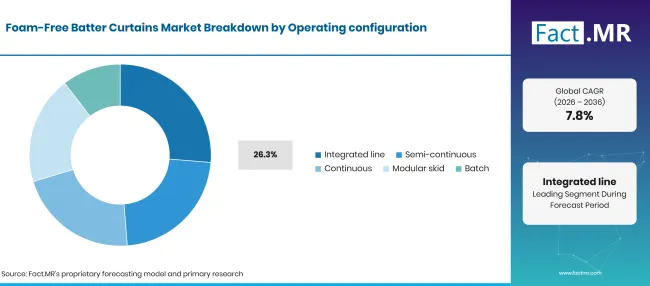
Foam Free Batter Curtains Breakdown Operating Configuration | Source: Fact.MR
Integrated lines account for 26.3% of revenue in 2026, about USD 11.8 million, as batter preparation, degassing and application are built into one line with breading and frying. Continuous standalone units follow. Manufacturers are offering integrated coating lines. Combining these stages helps manufacturers maintain consistent product flow, reduce manual handling and improve production coordination. India's Ministry of Food Processing Industries reported food-processing sector growth of 6.55% average annually over the nine years ending FY2023-24. Its 2025-26 Annual Report also documented investments in integrated processing and cold-chain infrastructure. These developments support demand for connected manufacturing equipment, creating opportunities for suppliers offering complete coating-line solutions rather than standalone machinery.
What is keeping bakery and wafer applications ahead of other end uses?
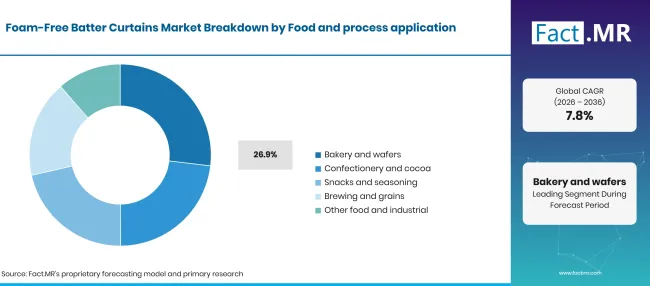
Foam Free Batter Curtains Breakdown Food And Process Application | Source: Fact.MR
The bakery and wafers segment accounts for 26.9% of revenue in 2026, about USD 12.1 million, as cake, wafer and pancake batters deposited as curtains need bubble-free flow for even thickness. Confectionery follows. The key manufacturing companies serve bakeries with degassed depositors. Entrapped air can create uneven thickness, surface defects and inconsistent product structures, increasing interest in foam-free deposition. India's Ministry of Food Processing Industries recorded 1,910 registered bakery-product manufacturing units in 2022-23 in its industry-wise processing-unit statistics. Additionally, the RBI's food-products manufacturing index reached 105.0 in FY2025-26, against a 2022-23 base of 100. These indicators support the wider bakery-processing investment environment and demand for consistent batter-handling equipment.
Drivers: Higher Production Speeds and Automated Food Processing
Drivers: Higher Production Speeds and Automated Food Processing
The U.S. Bureau of Labor Statistics (BLS), in its June 2026 Monthly Labor Review, projects food and beverage manufacturing output to increase from USD 872.5 billion in 2024 to USD 1,062.4 billion by 2034, representing approximately 21.8% growth. The report also identifies automated mixing, forming, compacting and processing equipment as technologies supporting manufacturing output. Additionally, approximately 6.6% of food manufacturing plants used robots in 2022, exposing nearly one-quarter of employees to robotic operations. These findings support the growing importance of automated production processes and consistent batter handling in high-throughput food manufacturing.
Restraints: Additional Equipment and Cleaning Costs-
Sales of foam-free batter curtains is limited by the added cost and cleaning of vacuum units and by processors who manage foam through recipe changes. Similar habits are projected to slow adoption. Manufacturers must show reduced oil and batter use. The U.S. Environmental Protection Agency (EPA) identifies equipment cleaning as a significant operational requirement in food and beverage manufacturing. Its Lean and Water Toolkit reports that cleaning process equipment can account for approximately 50% to 70% of total facility water consumption in many food, beverage and pharmaceutical companies. This highlights the resource requirements associated with maintaining food-processing equipment and production hygiene. For processors considering foam-free batter curtains, additional vacuum-degassing equipment may introduce further installation, maintenance and cleaning expenses.
Opportunity: Reduced Oil Uptake
Demand for even coatings that absorb less oil is rising. Manufacturers are presenting fat-reduction data. The U.S. Department of Agriculture's Economic Research Service (USDA ERS), in its May 2026 Oil Crops Outlook, forecasts global consumption of major vegetable oils at 211.2 million metric tons for marketing year 2026/27, an increase of 6.9 million metric tons from the previous year. Food consumption is expected to account for 71% of total major vegetable oil consumption. The report also forecasts global soybean oil consumption to increase by 3% to nearly 73 million metric tons. These figures highlight the substantial scale of food-related vegetable oil demand and provide supporting context for technologies that help food processors improve coating consistency and manage oil absorption.
Trend: Clean-Label Batters and Additive Transparency
Demand for batters without antifoam additives is rising. Manufacturers are offering mechanical degassing. The U.S. Food and Drug Administration (FDA), on August 10, 2026, proposed a rule to strengthen oversight of food ingredients claimed to be Generally Recognized as Safe (GRAS). The proposal seeks greater transparency concerning substances added to human and animal food and their safety assessments. Under the Federal Food, Drug, and Cosmetic Act, substances added to food generally require premarket approval unless they qualify for an applicable exemption, including GRAS status. This regulatory development provides supporting evidence of continued government attention to food ingredient transparency and safety documentation. It offers relevant context for manufacturers exploring mechanically degassed batters that reduce dependence on formulation-based antifoam additives.
Foam-Free Batter Curtains Market Analysis by Key Country
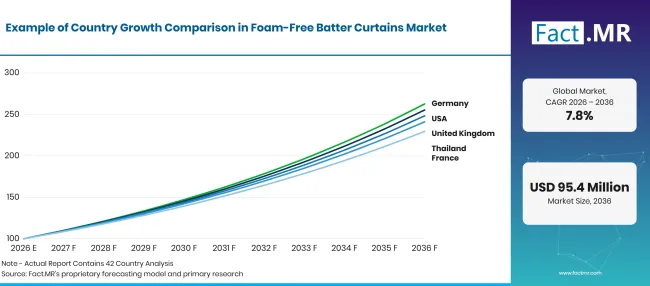
Foam Free Batter Curtains Growth Index | Source: Fact.MR
| Country | CAGR (2026-2036) |
|---|---|
| Germany | 11.5% |
| India | 10.1% |
| United States | 9.8% |
| China | 9.4% |
| Thailand | 9.2% |
Source: Fact.MR analysis.
Why is Germany the fastest-growing market for foam-free batter curtains?
Demand in Germany is projected to grow at an 11.5% CAGR, the fastest among the five key countries, as frozen fish and vegetable processors in Bremerhaven and elsewhere upgrade coating lines for quality and lower oil uptake.
Germany's foam-free batter curtain demand is driven by frozen food consumption and food-processing activity. According to Germany's Federal Ministry of Food and Agriculture (BMEL), frozen vegetable consumption reached 522,200 tonnes in 2024, while fish and fish product consumption stood at 293,400 tonnes. Frozen ready-meal consumption also reached 834,300 tonnes. These volumes indicate substantial processing requirements across vegetable, seafood and prepared-food categories. As manufacturers seek consistent coating application and reduced batter waste, demand for foam-free batter curtain equipment is expected to benefit from production-line modernization.
What is driving foam-free batter curtain demand in India?
Demand in India is estimated to increase at a 10.1% CAGR as frozen snacks and coated products expand, led by McCain India and Haldiram's frozen ranges.
Quick-service chains add coated items to menus. The Ministry of Commerce and Industry reported that India's seafood exports reached a record ₹73,890.46 crore in FY 2025–26, representing 19.72 lakh tonnes. Frozen shrimp contributed USD 5.62 billion in export earnings, demonstrating the scale of export-oriented seafood processing. APEDA also reported processed-food exports of USD 8.03 billion in FY 2025–26. These developments strengthen opportunities for coating equipment suppliers serving seafood, frozen snacks and prepared-food manufacturers seeking consistent batter coverage and efficient material utilization.
How are poultry processing volumes influencing foam-free batter curtain sales in the United States?
Sales in the United States are projected to grow at a 9.8% CAGR as chicken and seafood processors such as Tyson and Pilgrim's improve coating yield.
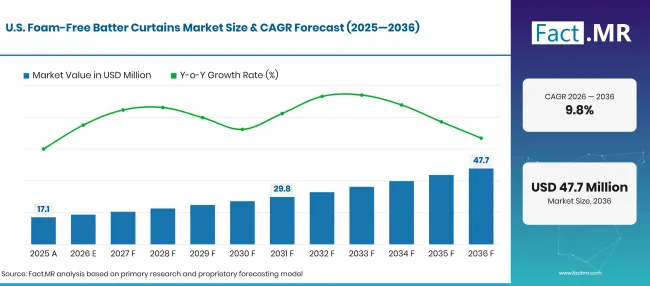
Foam Free Batter Curtains Forecast Usa | Source: Fact.MR
Batter savings matter on high-volume nugget and tender lines. US foam-free batter curtain sales are projected to seek better coating consistency and lower batter consumption across high-volume production lines. According to the USDA National Agricultural Statistics Service, American broiler production reached 9.40 billion birds in 2025, representing a 1% annual increase. The combined value of broiler production was USD 44.57 billion. These figures demonstrate the scale of poultry manufacturing and the importance of efficient coating operations. Processors producing nuggets, tenders and breaded chicken products provide opportunities for equipment suppliers offering controlled batter application and reduced production losses.
What is driving foam-free batter curtain demand in China?
Sales in China are anticipated to increase at a 9.4% CAGR as frozen coated foods grow in retail and food service, and chicken processors such as Fujian Sunner supply KFC.
Coating losses are a key cost. China's foam-free batter curtain demand is supported by expanding poultry production and the country's large processed-food manufacturing base. According to the National Bureau of Statistics of China, poultry meat production reached 28.37 million tonnes in 2025, increasing 6.7% year over year. Total meat production reached 100.72 million tonnes, representing 4.2% growth. These production volumes create opportunities for automated coating equipment across chicken processing, frozen prepared foods and food-service supply chains. Manufacturers seeking consistent batter distribution, reduced coating losses and improved throughput are likely to support equipment sales across industrial processing facilities.
Which factors are limiting the pace of foam-free batter curtain sales in Thailand?
Demand in Thailand is estimated to grow at a 9.2% CAGR, the slowest among the five key countries, as export coating lines are already modern as Thai processors supply Japanese and European buyers.
Upgrades are tied to replacement cycles. Thailand's foam-free batter curtain demand is comparatively slower than the other four countries, despite its established poultry export industry. According to the USDA Foreign Agricultural Service's Thailand food-processing report, prepared or preserved chicken meat exports reached USD 2.94 billion in 2024, while frozen chicken cuts and edible offal exports reached USD 1.33 billion. Established export processors may already operate automated production facilities, making future purchases increasingly dependent on capacity expansion, equipment replacement and efficiency improvements.
Competitive Landscape for Foam-Free Batter Curtains Market
The foam-free batter curtains market is characterized by competition among food-processing equipment manufacturers offering specialized batter application and coating systems. GEA holds a strong position through its ProCoater, which uses a patent-pending guided return-flow system to reduce foam formation by up to 80% and improve coating uniformity. JBT Marel competes through its Active Batter Applicator and integrated battering solutions, while Heat and Control offers SureCoat systems with curtain-fall and multi-curtain configurations. Hiwell Machinery, FMT and ANKO strengthen competition through specialized battering machines designed for poultry, seafood, meat and prepared-food processing. Their equipment focuses on consistent batter coverage, controlled application, excess-batter recovery and production efficiency. Bühler has broader food-processing capabilities but is less directly positioned in dedicated foam-free batter curtain equipment.
Competition is increasingly shaped by foam reduction, coating consistency, hygienic design, processing flexibility and reduced ingredient waste. Manufacturers offering reliable batter circulation, adjustable curtain formation and integration with automated breading and frying lines are better positioned to attract industrial food processors.
Recent Developments
- In January 2025, JBT completed its acquisition of Marel.
- On June 2, 2025, Heat and Control acquired Fabcon Food Systems, a manufacturer of customized food-processing and handling equipment. Fabcon's portfolio includes vibratory conveyors and processing systems for snack foods, French fries and protein applications. The acquisition expands Heat and Control's food-processing capabilities and strengthens its integrated equipment offering.
- On May 7, 2026, Bühler announced new and upgraded food-processing technologies, emphasizing hygienic design, automation, AI and production efficiency. Its Nutrex 7 Series extrusion system incorporates improvements in process stability, integrated intelligence and cleaning accessibility. The company reported approximately 50% shorter cleaning times at selected customer sites.
- On October 1, 2026, JBT Marel presented an industrial air-frying solution combining coating, controlled oil application, high-airflow impingement cooking, spiral freezing and packaging. The company reports that its solution can reduce oil pickup by more than 50%, supporting manufacturers seeking lower-fat coated food products. This development is relevant to batter curtain manufacturers because consistent coating application and controlled oil uptake are important parts of the overall processing line.
- On October 19, 2026, GEA introduced the ProCoater, a new wet coating machine designed to improve batter stability, coating consistency and production efficiency. Its patent-pending guided return flow system reduces air entrainment and foam formation by up to 80%. The machine also incorporates adjustable scrapers, smart air knives and a batter retention plate to improve coating accuracy and reduce batter waste.
- In April 2025, Heat and Control announced the acquisition of Tek-Dry Systems and Hunt Heat Exchangers, which provide thermal-processing and heat-transfer technologies. Tek-Dry specializes in drying, toasting, cooling and roasting equipment. The acquisition broadens the company's food-processing technology portfolio and complements its existing production-line solutions.
Key Players in Foam-Free Batter Curtains Market
Key companies operating in the market include GEA, JBT Marel, Heat and Control, Bühler, Hiwell Machinery, FMT, and ANKO Food Machine.
- GEA
- JBT Marel
- Heat and Control
- Bühler
- Hiwell Machinery
- FMT
- ANKO Food Machine
Bibliography
- Agricultural and Processed Food Products Export Development Authority. (2026). Processed foods: Export statistics 2025–26. Government of India.
- Bühler Group. (2026, May 6). Bühler ushers in a new era of extrusion systems with Nutrex 7 Series.
- Food and Agriculture Organization / Federal Ministry of Food and Agriculture. (2025). Statistical data on frozen food consumption in Germany.
- GEA Group Aktiengesellschaft. (2026, October 19). New GEA ProCoater offers advanced wet coating quality and efficiency.
- Heat and Control. (2025, April 8). Heat and Control announces acquisition of Tek-Dry Systems Ltd. and Hunt Heat Exchangers.
- Heat and Control. (2025, June 2). Heat and Control announces acquisition of Fabcon Food Systems Ltd.
- JBT Marel Corporation. (2026, October 1). JBT Marel industrial air frying solution.
- JBT Marel Corporation. (2025, January 3). JBT Corporation completes settlement of its voluntary takeover offer of Marel hf. and commences trading as JBT Marel Corporation.
- Ministry of Commerce and Industry. (2026, June 1). India’s seafood exports reach record high of ₹73,890 crore in FY 2025–26. Press Information Bureau, Government of India.
- Ministry of Food Processing Industries. (2026). Annual report 2025–26. Government of India.
- Ministry of Food Processing Industries. (2026, February 6). Status and progress of food processing sector. Press Information Bureau, Government of India.
- National Bureau of Statistics of China. (2026, February 28). Statistical communiqué of the People's Republic of China on the 2025 national economic and social development.
- Reserve Bank of India. (2026, July 31). Index numbers of twenty-three major industry groups of manufacturing sector (Base: 2022–23 = 100).
- U.S. Bureau of Labor Statistics. (2026, June). Feeding the economy: Employment growth in food and beverage manufacturing expected to continue through the 2024–34 decade. Monthly Labor Review.
- U.S. Department of Agriculture, Economic Research Service. (2026, May 14). Oil crops outlook: May 2026 (OCS-26e).
- U.S. Department of Agriculture, National Agricultural Statistics Service. (2026, April 30). Poultry production and value.
- U.S. Food and Drug Administration. (2026, August 10). Generally recognized as safe (GRAS): Proposed rule.
- U.S. Department of Agriculture, Foreign Agricultural Service. (2025, November 21). Food processing ingredients annual: Thailand (Report No. TH2025-0030).
Segmentation
Scope of Report
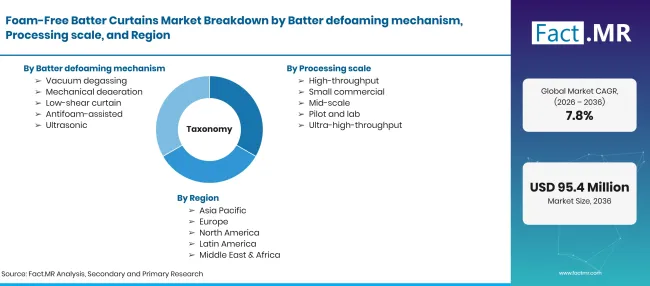
Foam Free Batter Curtains Taxonomy | Source: Fact.MR
| Items | Values |
|---|---|
| Quantitative Units (2026) | USD 45.0 Million |
| Batter defoaming mechanism | Vacuum degassing, Mechanical deaeration, Low-shear curtain, Antifoam-assisted, Ultrasonic |
| Processing scale | Pilot / lab, Small commercial, Mid-scale, High-throughput, Ultra-high-throughput |
| Operating configuration | Batch, Semi-continuous, Continuous, Modular skid, Integrated line |
| Food / process application | Bakery / wafers, Confectionery / cocoa, Snacks / seasoning, Brewing / grains, Other food / industrial |
| Regions Covered | North America, Latin America, Europe, East Asia, South Asia and Pacific, Middle East & Africa |
| Countries Covered | Germany, India, United States, China, Thailand, and other countries |
| Key Companies Profiled | GEA, JBT Marel, Heat and Control, Bühler, Baker Perkins, tna solutions |
| Additional Attributes | Dollar revenue in the Foam-Free Batter Curtains Market is segmented by batter defoaming mechanism (vacuum degassing, mechanical deaeration, low-shear curtain, antifoam-assisted, ultrasonic); processing scale (pilot / lab, small commercial, mid-scale, high-throughput, ultra-high-throughput); operating configuration (batch, semi-continuous, continuous, modular skid, integrated line); food / process application (bakery / wafers, confectionery / cocoa, snacks / seasoning, brewing / grains, other food / industrial) and region. |
Source: Fact.MR analysis.
Foam-Free Batter Curtains Market by Segments
-
Batter defoaming mechanism
- Vacuum degassing
- Mechanical deaeration
- Low-shear curtain
- Antifoam-assisted
- Ultrasonic
-
Processing scale
- Pilot / lab
- Small commercial
- Mid-scale
- High-throughput
- Ultra-high-throughput
-
Operating configuration
- Batch
- Semi-continuous
- Continuous
- Modular skid
- Integrated line
-
Food / process application
- Bakery / wafers
- Confectionery / cocoa
- Snacks / seasoning
- Brewing / grains
- Other food / industrial
-
Region:
- North America
- United States
- Canada
- Mexico
- Europe
- Germany
- United Kingdom
- France
- Italy
- Spain
- Rest of Europe
- Asia Pacific
- China
- India
- Japan
- South Korea
- Australia
- Rest of Asia Pacific
- Latin America
- Brazil
- Argentina
- Rest of Latin America
- Middle East & Africa
- GCC Countries
- South Africa
- Rest of Middle East & Africa
- North America
Table of Contents
Key Takeaways
- Market Size and CAGR
- Top Growth Driver
- Fastest Growing Segment
- Leading Region
- Key Companies
- Emerging Opportunities

