
- Market Value (2025): USD 540.0 Mn
- Estimated Value (2026): USD 564.3 Mn
- Forecast Value (2036): USD 919.2 Mn
- CAGR (2026-2036): 5.0%
Universal Head Mounted Temperature Transmitters Market Forecast and Outlook 2026 to 2036
According to the Fact.MR analysis, the universal head mounted temperature transmitter market was valued at USD 540.0 million in 2025 and is projected to grow from USD 564.3 million in 2026 to USD 919.2 million by 2036. Demand for universal head mounted temperature transmitters is likely to grow at a CAGR of 5.0% over the forecast period.
Demand for universal head mounted temperature transmitters is rising as process plants replace direct-wired sensors with transmitters that convert RTD and thermocouple signals to standard outputs close to the measuring point. The key players are offering devices that accept many sensor types, with HART, fieldbus and wireless options and intrinsically safe and safety-rated versions.
Key Takeaways from the Universal Head Mounted Temperature Transmitters Market
- Universal Head Mounted Temperature Transmitters Market Value (2025): USD 540.0 million
- Universal Head Mounted Temperature Transmitters Market Value (2026): USD 564.3 million
- Universal Head Mounted Temperature Transmitters Market Forecast Value (2036): USD 919.2 million
- Universal Head Mounted Temperature Transmitters Market Forecast CAGR (2026-2036): 5.0%
- Leading Output Signal: 4-20 mA analog (34.0%)
- Key Market Participants: Emerson, Endress+Hauser, ABB, Siemens, Yokogawa
- Key Growth Countries: India, China, South Korea, United States, Japan
Plant modernization, industrial automation and the growing adoption of digital communication protocols are expected to strengthen demand for industrial transmitters across manufacturing and process industries. India's industrial expansion provides a supportive demand environment. According to the Ministry of Statistics and Programme Implementation, manufacturing output increased by 7.6% year-on-year in September 2026, while overall industrial production grew by 6.7%. Additionally, the Government's Annual Survey of Industries 2024-25, released in September 2026, reported 10.54% growth in fixed capital investment and 7.81% growth in industrial output. These developments encourage factories to upgrade process monitoring, replace ageing analog equipment and adopt digitally compatible transmitters. Stricter operational safety requirements further support demand for accurate, reliable measurement systems.
Universal Head Mounted Temperature Transmitters Market
| Metric | Value |
|---|---|
| Estimated Value in (2026) | USD 564.3 million |
| Forecast Value in (2036) | USD 919.2 million |
| Forecast CAGR (2026 to 2036) | 5.0% |
Source: Fact.MR analysis.
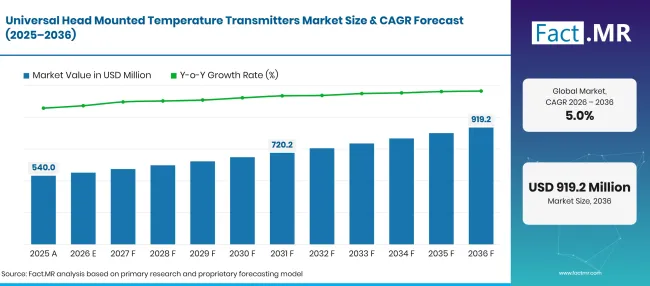
Universal Head Mounted Temperature Transmitters Market Forecast Global | Source: Fact.MR
Category
| Category | Segments |
|---|---|
| Output Signal | 4-20 mA analog, HART, IO-Link and wireless, Profibus PA and Modbus digital, Foundation fieldbus |
| Sensor Input | RTD (Pt100, Pt1000), Thermocouple, Dual and multi-sensor input, Resistance and voltage |
| Certification | General purpose, Intrinsically safe, SIL-rated functional safety, Flameproof and non-incendive |
| End Use | Oil and gas, Chemicals and petrochemicals, Power generation, Food and beverage, Pharmaceutical and life sciences |
| Region | India; China; South Korea; United States; Japan |
Source: Fact.MR analysis.
Segmental Analysis
What is sustaining sales of 4-20 mA analog output transmitters in the Universal Head Mounted Temperature Transmitters Market?
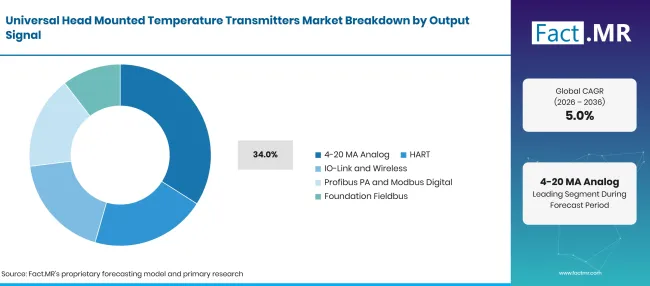
Universal Head Mounted Temperature Transmitters Market Breakdown Output Signal | Source: Fact.MR
Demand for 4-20 mA analog segment is estimated to retain its leading position, accounting for 34.0% of revenue in 2026, about USD 191.9 million. Continued investment in industrial electrical equipment and compatibility with installed control infrastructure support purchasing activity. India's Ministry of Statistics and Programme Implementation reported that manufacturing output increased by 7.6% year-on-year in September 2026, while electrical equipment manufacturing recorded particularly strong growth of 33.9%. This expansion supports demand for temperature measurement devices that integrate with existing process-control systems. Replacement requirements and relatively straightforward installation further sustain recurring sales of analog transmitters.
Which industrial requirements are increasing demand for RTD (Pt100, Pt1000) sensor input transmitters?
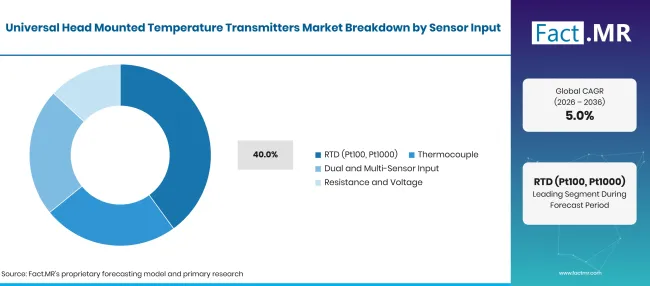
Universal Head Mounted Temperature Transmitters Market Breakdown Sensor Input | Source: Fact.MR
RTD (Pt100, Pt1000) inputs account for 40.0% of market revenue in 2026, about USD 225.7 million. Their measurement accuracy, repeatability and long-term stability make them suitable for temperature monitoring in chemical processing, pharmaceutical production and food manufacturing. India's Annual Survey of Industries 2024-25, released by MoSPI in September 2026, reported 7.81% growth in industrial output and 10.54% growth in fixed capital investment. Chemical, pharmaceutical and food industries collectively contributed more than 45% of manufacturing gross value added. Expanding production capacity and investment in process monitoring create additional opportunities for RTD-compatible transmitter suppliers.
How are industrial purchasing patterns supporting general-purpose certified transmitters?
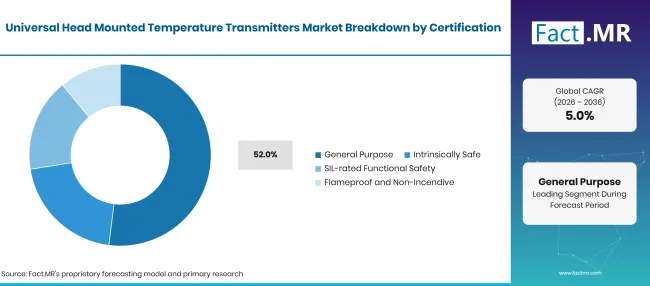
Universal Head Mounted Temperature Transmitters Market Breakdown Certification | Source: Fact.MR
Sales of general-purpose transmitters hold 52.0% of revenue in 2026, about USD 293.4 million, reflecting their suitability for conventional industrial installations that do not require specialized hazardous-area certification. Their comparatively economical installation and compatibility with standard temperature-monitoring applications support wider procurement across manufacturing facilities. According to MoSPI, India's manufacturing sector recorded 7.6% year-on-year growth in September 2026, with 17 of 23 manufacturing industry groups reporting positive growth. This broad-based industrial activity creates opportunities for standard instrumentation across production facilities, utilities and processing operations. Consequently, general-purpose transmitters benefit from both new equipment purchases and replacement demand.
What is driving oil and gas procurement of universal head mounted temperature transmitters?
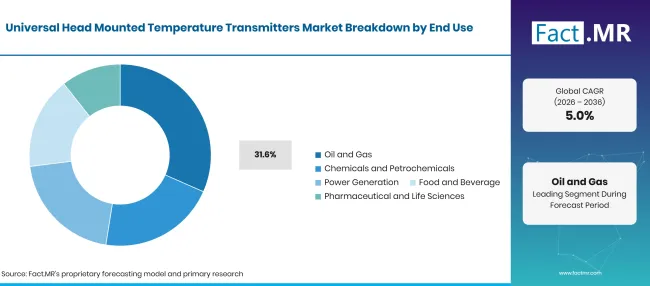
Universal Head Mounted Temperature Transmitters Market Breakdown End Use | Source: Fact.MR
Demand for oil and gas represents the largest end-use segment, representing 31.6% of revenue in 2026, about USD 178.3 million. Refineries, processing facilities and pipeline operations require continuous temperature monitoring to maintain process stability, equipment reliability and operational safety. India's Ministry of Petroleum and Natural Gas reported in May 2026 that the country had 258.1 million tonnes per annum of installed refining capacity across 22 operational refineries. Domestic petroleum product consumption reached 243.2 million tonnes in FY 2025-26. This substantial refining infrastructure supports procurement of temperature instrumentation for process monitoring, maintenance and equipment replacement, creating recurring sales opportunities for transmitter manufacturers.
Universal Head Mounted Temperature Transmitters Market-Drivers, Restraints & Trends
Drivers: Industrial Modernization and Process Automation
Demand for universal head mounted temperature transmitters is gaining support from industrial modernization, automation investments and the need for accurate process monitoring. India's Ministry of Statistics and Programme Implementation reported 6.7% growth in industrial production and 7.6% growth in manufacturing output in September 2026. Additionally, the Annual Survey of Industries 2024-25, released in September 2026, recorded 10.54% growth in fixed capital investment across registered manufacturing establishments. Expanding industrial capacity encourages manufacturers to upgrade temperature measurement systems, improve process reliability and integrate transmitters with existing control infrastructure. These investments create opportunities for new installations and replacement of outdated instrumentation.
Restraints: Replacement Cycles and Equipment Cost Pressures
Sales growth faces challenges from long equipment replacement cycles, competitive instrument pricing and the continued use of functioning analog control systems. Industrial operators often prioritize maintenance and calibration over replacing transmitters that continue to meet operational requirements, limiting immediate purchasing demand. The Government's Annual Survey of Industries 2024-25 reported 10.54% growth in fixed capital investment, indicating increasing industrial investment but also highlighting the importance of capital allocation decisions. Buyers must balance instrumentation upgrades against other production and infrastructure expenses. Consequently, suppliers face pressure to demonstrate measurable benefits through improved accuracy, lower maintenance requirements and compatibility with installed equipment.
Opportunity: Digital Protocols and Advanced Diagnostic Capabilities
Growing industrial digitalization is creating opportunities for transmitters equipped with HART, IO-Link, fieldbus communication and sensor-fault diagnostics. In May 2026, the Government of India's Technology Development Board supported the commercialization of indigenous Industrial AIoT solutions incorporating temperature monitoring, machine-condition sensing and real-time industrial analytics. The initiative specifically targets predictive maintenance, energy optimization and industrial productivity. This development highlights increasing institutional support for connected industrial monitoring technologies. Transmitter manufacturers can capitalize on this transition by offering digitally compatible products that support remote configuration, equipment diagnostics and integration with plant automation systems.
Trend: Wireless Monitoring and Connected Industrial Infrastructure
Wireless monitoring is emerging as an attractive option for industrial facilities seeking to monitor difficult-to-access locations without extensive signal cabling. India's Department of Telecommunications reported that 5G services were available in 99.9% of districts across the country as of February 2026, supported by approximately 523,000 installed 5G base stations. Separately, TRAI reported 1,066.43 million wireless internet subscribers in June 2026. Although these figures measure national connectivity rather than industrial wireless instrumentation adoption, they demonstrate the expanding communications infrastructure supporting connected industrial applications. This environment creates opportunities for wireless temperature monitoring and remote equipment supervision.
Universal Head Mounted Temperature Transmitters Market Analysis by Key Country
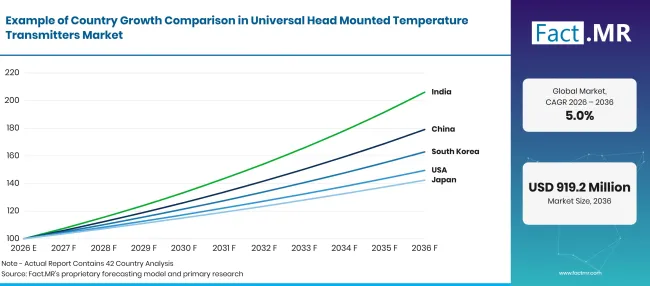
Universal Head Mounted Temperature Transmitters Market Growth Index | Source: Fact.MR
| Country | CAGR (2026-2036) |
|---|---|
| India | 7.5% |
| China | 6.0% |
| South Korea | 5.0% |
| United States | 4.1% |
| Japan | 3.6% |
Source: Fact.MR analysis.
Why is India the fastest-growing market for universal head mounted temperature transmitters?
Demand for universal head mounted temperature transmitters in India is projected to grow at a 7.5% CAGR through 2036, the fastest among the five countries.
Rapid growth in chemicals, power and manufacturing capacity supports demand for process instrumentation across new and existing plants. India's universal head mounted temperature transmitters market is projected to expand at a 7.5% CAGR through 2036, the fastest among the five countries. Rising investment in chemicals, power generation and manufacturing is increasing demand for reliable process-temperature measurement. According to the Ministry of Statistics and Programme Implementation, India's Index of Industrial Production increased by 8.0% in August 2026, supported by 9.0% manufacturing growth and 12.3% growth in electricity and gas supply. Expanding industrial output strengthens demand for temperature transmitters used in boilers, processing equipment, pipelines and automated production systems.
What is shaping universal head mounted temperature transmitters demand in China?
Sales of universal head mounted temperature transmitters in China is forecast to rise at a 6.0% CAGR through 2036, above the global rate of 5.0%.
Large-scale industrial investment and expanding process industries support demand, with local suppliers competing with global instrument groups. The National Bureau of Statistics reported that China's manufacturing value added increased by 5.7% during January–August 2026, while high-technology manufacturing grew by 14.2%. This expansion supports opportunities for universal head mounted transmitters in production equipment, chemical facilities and process-control applications. The key players are offering reliable sensor compatibility and digital communication capabilities can benefit from industrial instrumentation upgrades.
How is demand for universal head mounted temperature transmitters developing in South Korea?
Demand for universal head mounted temperature transmitters in South Korea is likely to increase at a 5.0% CAGR through 2036, in line with the global rate.
Chemical, semiconductor and electronics plants sustain demand for accurate and reliable temperature measurement. Semiconductor fabrication, electronics manufacturing and chemical processing require accurate temperature monitoring to maintain production consistency and equipment reliability. The Ministry of Finance and Economy reported that manufacturing production increased by 1.6% year on year in September 2026, while semiconductor-led exports contributed to a 93.7% increase in overall exports during October. These developments reinforce the importance of process instrumentation across advanced manufacturing facilities, supporting demand for compact head mounted transmitters with stable measurement performance and digital integration.
What is driving universal head mounted temperature transmitters demand in United States?
Sales of universal head mounted temperature transmitters in United States is expected to advance at a 4.1% CAGR through 2036, below the global rate of 5.0%.
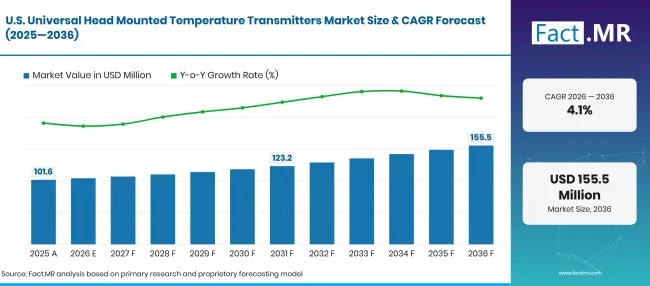
Universal Head Mounted Temperature Transmitters Market Forecast Usa | Source: Fact.MR
A large process-industry base, including energy and chemicals, supports steady replacement and upgrade demand. Demand is supported by established chemical, energy and manufacturing industries that require continuous temperature measurement across processing operations. The Federal Reserve reported that US manufacturing output increased by 0.3% in October 2026 and remained 2.2% above its October 2025 level. This industrial activity supports recurring requirements for instrument maintenance, replacement and automation upgrades. Manufacturers increasingly consider transmitters offering digital diagnostics and compatibility with existing process-control infrastructure
Why is growth slower for universal head mounted temperature transmitters in Japan?
Demand for universal head mounted temperature transmitters in Japan is set to expand at a 3.6% CAGR through 2036, the slowest among the five countries.
Established manufacturing and process-control industries sustain demand for high-quality instrumentation and early adoption of digital communication. Established manufacturing facilities, mature process-control infrastructure and long equipment replacement cycles moderate additional transmitter purchases. Nevertheless, precision manufacturing, chemicals and electronics continue to require dependable temperature measurement. Japan's Cabinet Office reported in its September 2026 economic assessment that industrial production was showing signs of recovery, with production machinery picking up. METI's September 2026 industrial production release also recorded a 2.2% month-on-month increase in industrial production. These developments support selective instrumentation upgrades rather than rapid market-wide replacement.
Competitive Landscape for Universal Head Mounted Temperature Transmitters Market
The universal head mounted temperature transmitter market is relatively concentrated, with Emerson, Endress+Hauser, ABB, Siemens and Yokogawa together hold about 72% of 2026 revenue, based on Fact.MR estimates. Competition centers on accuracy, sensor flexibility, hazardous-area certification, digital communication options and global service coverage. Large automation and instrumentation groups lead, with specialist sensor and interface makers competing on niche features.
Recent Developments
- On August 19, 2025, Emerson launched the Rosemount 3144S Temperature Transmitter, featuring 0.05°C accuracy, optional 20-year stability, Bluetooth connectivity and advanced diagnostics. ReadyConnect technology simplifies sensor configuration and commissioning across industrial process applications.
- On May 20, 2026, Emerson introduced its Synchros IIoT platform, featuring the Rosemount Synchros Temperature Monitor and Wireless Repeater. The solution enables wireless temperature monitoring, asset visibility and predictive maintenance without extensive infrastructure modifications.
- On June 10, 2026, ABB introduced NINVA Integrated, NINVA Remote and NINVA Compact for non-invasive temperature measurement. The portfolio supports chemical, oil and gas, marine and power applications, reducing installation requirements and avoiding pipe modifications.
- In June 2026, ABB's 2026 field-instrumentation portfolio update identifies the TTF100 modular temperature transmitter as a Q1 2026 introduction. The development expands ABB's temperature instrumentation offering for chemical and oil and gas applications.
- On June 15, 2026, Endress+Hauser reported filing 294 initial patent applications during 2025 and launching 41 new products. Its 2026 Innovators' Meeting highlighted continued investment in industrial measurement and automation technologies.
- In June 2025, Siemens' 2025 product documentation covers SITRANS TH320 and TH420 universal head-mounted transmitters, supporting RTD and thermocouple inputs, HART communication and advanced diagnostics. The TH420 additionally offers dual-input measurement and sensor-drift detection.
- In November 2026, Endress+Hauser integrated SICK's gas analysis and flow measurement business in 2025, adding approximately 1,600 employees and expanding its industrial measurement portfolio. This is an adjacent instrumentation development, not a temperature-transmitter acquisition.
Key Players in Universal Head Mounted Temperature Transmitters Market
Key companies operating in the market include Emerson, Endress+Hauser, ABB, Siemens, and Yokogawa.
- Emerson
- Endress+Hauser
- ABB
- Siemens
- Yokogawa
Bibliography
- Cabinet Office, Government of Japan. (2026, September). Monthly economic report executive summary (September 2026).
- Federal Reserve Board. (2026, November 17). Industrial production and capacity utilization (G.17).
- Ministry of Commerce & Industry, Government of India. (2026, July 21). PLI schemes attract over ₹2.40 lakh crore investment, generate more than 14.15 lakh jobs. Press Information Bureau.
- Ministry of Communications, Government of India. (2026, March 12). Status of 5G rollout. Press Information Bureau.
- Ministry of Finance and Economy, Republic of Korea. (2026, November 13). Current economic situation, November 2026.
- Ministry of Science & Technology, Government of India. (2026, May 27). TDB-DST supports M/s IDT Innovation Technologies Pvt. Ltd., Nagpur, for commercialization of indigenous industrial AIoT solutions. Press Information Bureau.
- Ministry of Statistics & Programme Implementation, Government of India. (2026a, September 30). Release of the Annual Survey of Industries (2024-25) results. Press Information Bureau.
- Ministry of Statistics & Programme Implementation, Government of India. (2026b, September 28). Quick estimates of Index of Industrial Production and use-based index for the month of August 2026 (Base 2022-23=100). Press Information Bureau.
- Ministry of Statistics & Programme Implementation, Government of India. (2026c, October 28). Quick estimates of Index of Industrial Production and use-based index for the month of September 2026 (Base 2022-23=100).
- National Bureau of Statistics of China. (2026, September 16). Industrial production operation in August 2026.
- Telecom Regulatory Authority of India. (2026, October 12). Indian telecom services performance indicator report: April-June 2026. Press Information Bureau.
Segmentation
Scope of Report
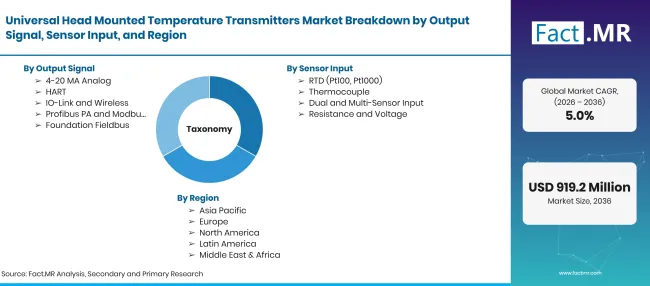
Universal Head Mounted Temperature Transmitters Market Taxonomy | Source: Fact.MR
| Items | Values |
|---|---|
| Quantitative Units (2026) | USD 564.3 Million |
| Output Signal | 4-20 mA analog, HART, IO-Link and wireless, Profibus PA and Modbus digital, Foundation fieldbus |
| Sensor Input | RTD (Pt100, Pt1000), Thermocouple, Dual and multi-sensor input, Resistance and voltage |
| Certification | General purpose, Intrinsically safe, SIL-rated functional safety, Flameproof and non-incendive |
| End Use | Oil and gas, Chemicals and petrochemicals, Power generation, Food and beverage, Pharmaceutical and life sciences |
| Regions Covered | North America, Latin America, Europe, Asia Pacific, Middle East & Africa |
| Countries Covered | India, China, South Korea, United States, Japan, and other countries |
| Key Companies Profiled | Emerson, Endress+Hauser, ABB, Siemens, Yokogawa |
| Additional Attributes | Dollar revenue in the Universal Head Mounted Temperature Transmitters Market is segmented by output signal, sensor input, certification and end use and region. |
Source: Fact.MR analysis.
Universal Head Mounted Temperature Transmitters Market by Segments
-
Output Signal
- 4-20 mA analog
- HART
- IO-Link and wireless
- Profibus PA and Modbus digital
- Foundation fieldbus
-
Sensor Input
- RTD (Pt100, Pt1000)
- Thermocouple
- Dual and multi-sensor input
- Resistance and voltage
-
Certification
- General purpose
- Intrinsically safe
- SIL-rated functional safety
- Flameproof and non-incendive
-
End Use
- Oil and gas
- Chemicals and petrochemicals
- Power generation
- Food and beverage
- Pharmaceutical and life sciences
-
Region:
- North America
- United States
- Canada
- Mexico
- Europe
- Germany
- United Kingdom
- France
- Italy
- Spain
- Rest of Europe
- Asia Pacific
- China
- India
- Japan
- South Korea
- Australia and New Zealand
- Rest of Asia Pacific
- Latin America
- Brazil
- Argentina
- Rest of Latin America
- Middle East & Africa
- GCC Countries
- South Africa
- Rest of Middle East & Africa
- North America
Table of Contents
Key Takeaways
- Market Size and CAGR
- Top Growth Driver
- Fastest Growing Segment
- Leading Region
- Key Companies
- Emerging Opportunities

