
- Market Value (2025): USD 172.0 Mn
- Estimated Value (2026): USD 184.0 Mn
- Forecast Value (2036): USD 362.0 Mn
- CAGR (2026-2036): 7.0%
High-Recovery Processing Lines Market Forecast and Outlook 2026 to 2036
The high-recovery processing lines market is valued at USD 184.0 million in 2026, with revenue forecast to reach USD 362.0 million by 2036. The market is set to register a CAGR of 7.0% over the ten-year period.
Directive (EU) 2024/1785 revises the European Union’s Industrial Emissions Directive (2010/75/EU) by incorporating resource efficiency into environmental permitting requirements for covered industrial installations. It entered into force on 4 August 2024, and Member States were required to transpose it by 1 July 2026. For food-processing facilities within its scope, these provisions increase attention to efficient raw material use, waste reduction and production practices.
Key Takeaways from High-Recovery Processing Lines Market
- Sales of high-recovery processing lines stood at USD 172.0 million in 2025
- High-Recovery Processing Lines Market Value (2026): USD 184.0 million
- High-Recovery Processing Lines Market Forecast Value (2036): USD 362.0 million
- High-Recovery Processing Lines Market Forecast CAGR (2026-2036): 7.0%
- Leading Recovery process: Recirculating liquid (26.7%)
- Key Market Participants: GEA, JBT Marel, Heat and Control, Bühler, tna solutions
- Key Growth Countries: China, Netherlands, United States, Germany, Japan
Cocoa prices rose sharply in 2024, which increased attention to raw-material efficiency in confectionery production. The International Cocoa Organization reported December 2024 nearby futures at USD 11,441 per tonne in London and USD 11,545 per tonne in New York on the final trading day. By November 2026, cocoa futures had fallen to about USD 5,000 per tonne, still a level that keeps ingredient recovery relevant.
High-Recovery Processing Lines Market
| Metric | Value |
|---|---|
| Estimated Value in (2026) | USD 184.0 million |
| Forecast Value in (2036) | USD 362.0 million |
| Forecast CAGR (2026 to 2036) | 7.0% |
Source: Fact.MR analysis.
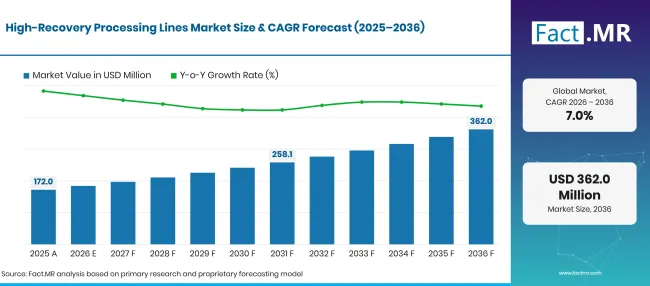
High Recovery Processing Lines Forecast Global | Source: Fact.MR
Category
| Category | Segments |
|---|---|
| Recovery process | Recirculating liquid, Powder reclaim, Heat recovery, Solvent recovery, Integrated multi-recovery |
| Processing scale | Pilot / lab, Small commercial, Mid-scale, High-throughput, Ultra-high-throughput |
| Operating configuration | Batch, Semi-continuous, Continuous, Modular skid, Integrated line |
| Food / process application | Bakery / wafers, Confectionery / cocoa, Snacks / seasoning, Brewing / grains, Other food / industrial |
| Key Countries | China; Netherlands; United States; Germany; Japan |
Source: Fact.MR analysis.
Segmental Analysis
Why does recirculating liquid recovery lead process demand in the High-Recovery Processing Lines Market?
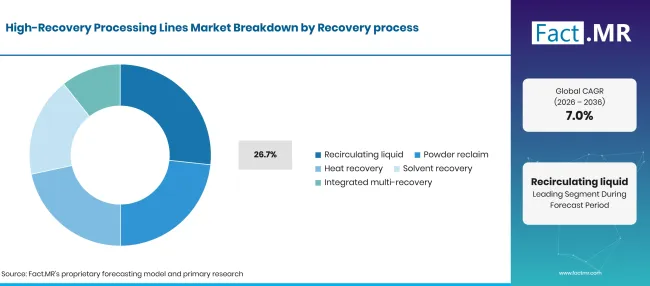
High Recovery Processing Lines Breakdown Recovery Process | Source: Fact.MR
Recirculating liquid recovery accounts for 26.7% of revenue in 2026, approximately USD 49.1 million, as food processors reclaim excess batter, glazing liquids and coating materials. Gpi Process Technology offers batter preparation systems that return unused material to circulation tanks. Controlled recirculation helps maintain ingredient consistency and reduce waste. Manufacturers assess filtration, temperature stability and recovered material quality.
Why does the pilot / lab segment lead scale demand in the High-Recovery Processing Lines Market?
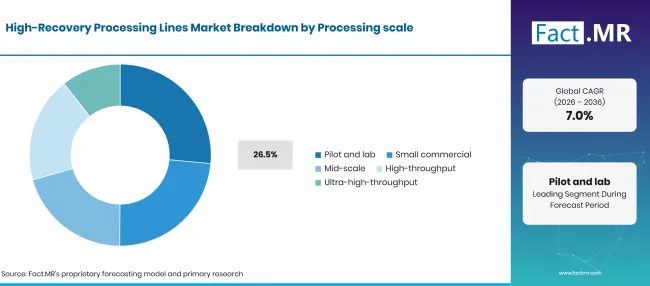
High Recovery Processing Lines Breakdown Processing Scale | Source: Fact.MR
Pilot and laboratory systems represent 26.5% of revenue in 2026, valued at approximately USD 48.8 million. Before installing recovery equipment across production lines, manufacturers need to establish whether reclaimed materials retain suitable quality. GEA and Bühler operate application and test centers where processors evaluate processing performance. These trials help determine recovery efficiency, product consistency and suitable operating conditions for commercial installations.
Why do modular skid units lead configuration demand in the High-Recovery Processing Lines Market?
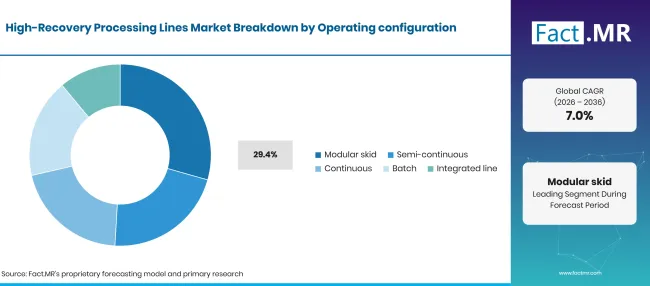
High Recovery Processing Lines Breakdown Operating Configuration | Source: Fact.MR
Modular skid units hold 29.4% of revenue in 2026, equivalent to approximately USD 54.1 million, reflecting their suitability for installation within existing manufacturing facilities. Skid-mounted systems can combine recovery equipment, pumps and process controls in compact arrangements. GEA’s GSI 260 separator skid, introduced in September 2025, combines modular equipment, direct drive and a water-saving unit for beverage separation. Plant engineers evaluate connection requirements, available space, cleaning accessibility and integration costs.
Why does confectionery / cocoa lead application demand in the High-Recovery Processing Lines Market?
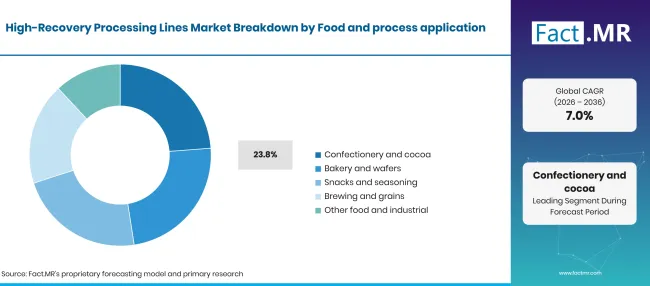
High Recovery Processing Lines Breakdown Food And Process Application | Source: Fact.MR
Confectionery and cocoa applications contribute 23.8% of revenue in 2026, approximately USD 43.8 million, as chocolate coating operations require careful management of excess material. Enrobing equipment collects unused chocolate for controlled reuse where processing conditions permit. Bühler's ChoCoat Pro enrober emphasizes coating consistency, air-temperature control and easy cleaning. Chocolate manufacturers examine material recovery, tempering stability and finished product appearance.
High-Recovery Processing Lines Market- Drivers, Restraints & Trends
Drivers
Food processors are examining material recovery systems to reduce ingredient losses, water consumption and energy expenses. Recovery equipment can improve resource utilization across manufacturing operations. Suppliers, including Bühler through its Performance Assessment Workshop, are offering performance assessments that measure recoverable materials, processing efficiency and potential operating cost savings.
Restraints
Recovered ingredients must maintain suitable quality, safety and processing characteristics before reuse. Contamination risks, filtration requirements and changes in material properties can restrict recirculation. Equipment manufacturers must demonstrate effective cleaning, reliable separation and consistent product quality under actual operating conditions.
Trend: Water Reuse in Food Plants
Food manufacturers are exploring membrane filtration technologies to recover process water and reduce freshwater requirements. Reverse osmosis and other filtration methods enable suitable water streams to be treated for selected applications. Suppliers are developing integrated recovery systems with controlled water quality.
Trend
Heat Recovery from Ovens and Fryers: Food processors are examining heat recovery technologies to capture thermal energy from cooking equipment and exhaust streams. Heat exchangers can transfer recovered energy to suitable heating applications. Equipment developers are improving thermal efficiency, temperature control and integration with existing production systems.
High-Recovery Processing Lines Market by Key Country
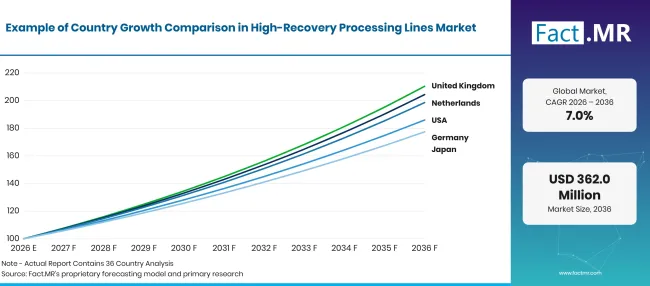
High Recovery Processing Lines Growth Index | Source: Fact.MR
| Country | CAGR (2026-2036) |
|---|---|
| China | 8.6% |
| Netherlands | 7.2% |
| United States | 7.1% |
| Germany | 6.4% |
| Japan | 5.9% |
Source: Fact.MR analysis.
Why is China the fastest-growing market for high-recovery processing lines?
Demand for high-recovery processing lines in China carries an 8.6% CAGR through 2036, the fastest among the five countries.
Industrial water conservation initiatives are encouraging food manufacturers to examine resource recovery technologies. In October 2025, China’s Ministry of Industry and Information Technology and Ministry of Water Resources issued the 2025 catalog of nationally encouraged industrial water-saving processes, technologies and equipment, listing 150 items, together with a plan for water-saving equipment through 2030. Manufacturers are exploring systems that reclaim processing liquids, recover thermal energy and reduce wastewater volumes.
What is driving high-recovery processing line demand in the Netherlands?
Demand for high-recovery processing lines in the Netherlands is forecast to increase at a 7.2% CAGR through 2036 as food manufacturers pursue circular production practices.
The European Environment Agency's 2025 Netherlands country profile describes mixed environmental outcomes, with the country on track for some EU goals such as the circular economy transition. Dutch processors facing constraints on factory expansion may examine recovery technologies that increase material utilization within existing facilities. Liquid recirculation, filtration and heat recovery provide different opportunities.
What is shaping high-recovery processing line sales in the United States?
Sales of high-recovery processing lines in the United States are set to advance at a 7.1% CAGR through 2036, supported by efforts to reduce manufacturing waste and operating expenses.
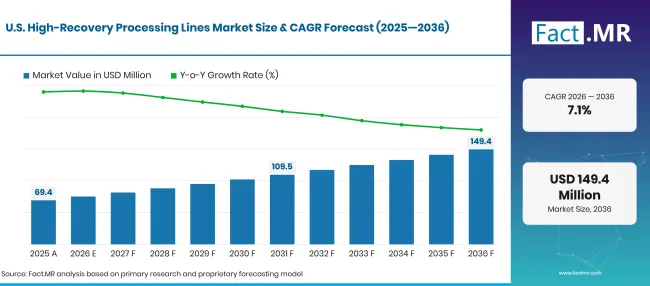
High Recovery Processing Lines Forecast Usa | Source: Fact.MR
Food manufacturers can recover excess coatings, cooking heat and suitable processing liquids through specialized equipment. Such investments offer opportunities to improve material utilization without expanding production capacity.
What is shaping high-recovery processing line demand in Germany?
Demand for high-recovery processing lines in Germany is forecast to expand at a 6.4% CAGR through 2036 as manufacturers evaluate energy-saving opportunities. Section 9 of Germany's Energy Efficiency Act requires companies with average annual final energy consumption above 2.5 GWh to prepare and publish implementation plans for economically viable energy-saving measures. Heat recovery systems can help food processors address identified energy losses. Equipment manufacturers are developing solutions for ovens, dryers and processing lines.
Why is high-recovery processing line growth slower in Japan?
Demand for high-recovery processing lines in Japan is likely to increase at a 5.9% CAGR through 2036, the slowest among the five countries. Established food recycling practices create a more developed resource management environment. Japan's Food Recycling Law encourages food businesses to reduce waste generation and promote resource recovery. Manufacturers are examining equipment upgrades that improve heat utilization and reduce material losses during processing.
Competitive Landscape for High-Recovery Processing Lines Market
Competition in the high-recovery processing lines market depends on how effectively equipment manufacturers reduce ingredient losses while preserving food quality. GEA offers VARICOVER pigging systems that recover product from pipelines in liquid processing, alongside wet coating equipment. Heat and Control specializes in frying oil filtration, de-oiling and exhaust heat recovery technologies. JBT Marel, formed when JBT completed its acquisition of Marel in January 2025, competes through integrated food processing and yield management solutions, while Bühler and tna solutions address material handling and process efficiency in confectionery, bakery and snack production.
Recent equipment development has placed greater attention on recovering usable ingredients during production. In October 2026, GEA introduced its ProCoater wet coating machine, designed to stabilize batter flow and reduce batter carryover. Heat and Control's Oil Sweep technology offers another approach by recovering surface frying oil from fried potato products.
Recent Developments
- In September 2025, GEA introduced the GSI 260 separator skid for breweries and other beverage producers. The system combines modular equipment, a larger clarification area and a water-saving unit that GEA says cuts freshwater use by up to 99.9%.
- In April 2025, Heat and Control acquired Tek-Dry Systems and Hunt Heat Exchangers, expanding its thermal processing portfolio. The acquisition strengthened drying, roasting, cooling, and heat transfer capabilities for integrated food manufacturing operations.
- In October 2026, GEA introduced the ProCoater wet coating machine for poultry, pork, fish, cheese and plant-based products, aimed at more stable batter flow and lower batter carryover.
Key Players in High-Recovery Processing Lines Market
Key companies operating in the High-Recovery Processing Lines Market include GEA, JBT Marel, Heat and Control, Bühler, and tna solutions.GEA
- JBT Marel
- Heat and Control
- Bühler
- tna solutions
Bibliography
- GEA Group. (2025, September 12). New GEA separator skid for the beverage industry: Higher yield, lower consumption.
- Heat and Control. (2025, April 10). Heat and Control announces acquisition of Tek-Dry Systems Ltd and Hunt Heat Exchangers.
- International Cocoa Organization. (2025, January 20). Cocoa Market Report for December 2024.
- Trading Economics. (2026, November 12). Cocoa futures cross $5,200.
- European Parliament and Council of the European Union. (2024, July 15). Directive (EU) 2024/1785 amending Directive 2010/75/EU on industrial emissions and Council Directive 1999/31/EC.
- Bundesamt für Justiz. (n.d.). Energieeffizienzgesetz (EnEfG), § 9 Umsetzungspläne von Endenergieeinsparmaßnahmen.
- Ministry of Industry and Information Technology and Ministry of Water Resources of China. (2025, October 22). Catalog of nationally encouraged industrial water-saving processes, technologies and equipment (2025 edition), Announcement No. 32.
- European Environment Agency. (2025). Europe’s environment 2025: Netherlands country profile.
- Food Engineering. (2026, October 19). GEA debuts ProCoater.
- GEA Group. (n.d.). VARICOVER product recovery systems.
- Bühler Group. (n.d.). ChoCoat Pro enrober.
- Heat and Control. (n.d.). Oil Sweep De-oiling System brochure.
Segmentation
Scope of Report
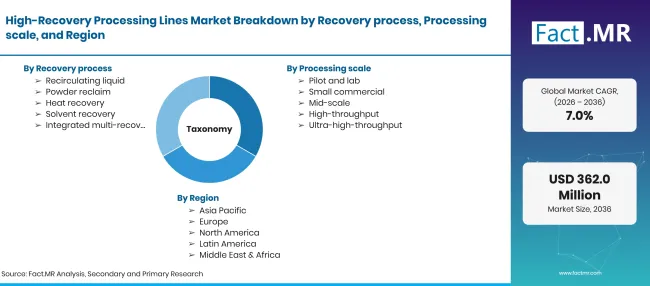
High Recovery Processing Lines Taxonomy | Source: Fact.MR
| Items | Values |
|---|---|
| Quantitative Units (2026) | USD 184.0 Million |
| Recovery process | Recirculating liquid, Powder reclaim, Heat recovery, Solvent recovery, Integrated multi-recovery |
| Processing scale | Pilot / lab, Small commercial, Mid-scale, High-throughput, Ultra-high-throughput |
| Operating configuration | Batch, Semi-continuous, Continuous, Modular skid, Integrated line |
| Food / process application | Bakery / wafers, Confectionery / cocoa, Snacks / seasoning, Brewing / grains, Other food / industrial |
| Regions Covered | North America, Latin America, Europe, Asia Pacific, Middle East & Africa |
| Countries Covered | China, Netherlands, United States, Germany, Japan, and other countries |
| Key Companies Profiled | GEA, JBT Marel, Heat and Control, Bühler, tna solutions |
| Additional Attributes | Dollar revenue in the High-Recovery Processing Lines Market is segmented by recovery process (recirculating liquid, powder reclaim, heat recovery, solvent recovery, integrated multi-recovery); processing scale (pilot / lab, small commercial, mid-scale, high-throughput, ultra-high-throughput); operating configuration (batch, semi-continuous, continuous, modular skid, integrated line); food / process application (bakery / wafers, confectionery / cocoa, snacks / seasoning, brewing / grains, other food / industrial) and region. |
Source: Fact.MR analysis.
High-Recovery Processing Lines Market by Segments
-
Recovery process
- Recirculating liquid
- Powder reclaim
- Heat recovery
- Solvent recovery
- Integrated multi-recovery
-
Processing scale
- Pilot / lab
- Small commercial
- Mid-scale
- High-throughput
- Ultra-high-throughput
-
Operating configuration
- Batch
- Semi-continuous
- Continuous
- Modular skid
- Integrated line
-
Food / process application
- Bakery / wafers
- Confectionery / cocoa
- Snacks / seasoning
- Brewing / grains
- Other food / industrial
-
Region:
- North America
- United States
- Canada
- Mexico
- Europe
- Germany
- United Kingdom
- France
- Italy
- Spain
- Netherlands
- Rest of Europe
- Asia Pacific
- China
- India
- Japan
- South Korea
- Australia
- Rest of Asia Pacific
- Latin America
- Brazil
- Argentina
- Rest of Latin America
- Middle East & Africa
- GCC Countries
- South Africa
- Rest of Middle East & Africa
- North America
Table of Contents
Key Takeaways
- Market Size and CAGR
- Top Growth Driver
- Fastest Growing Segment
- Leading Region
- Key Companies
- Emerging Opportunities

