- Market Value (2025): USD 293.1 Mn
- Estimated Value (2026): USD 330.0 Mn
- Forecast Value (2036): USD 1080.0 Mn
- CAGR (2026-2036): 12.6%
What is the Chiplet Underfill Dispensing Market forecast to be worth by 2036?
USD 330.0 million in 2026 to USD 1,080.0 million by 2036, at a 12.6% CAGR.
- The Chiplet Underfill Dispensing Market crossed a valuation of USD 293.1 million in 2025, supported by demand from OSAT providers serving 3D stacked die workflows that require filling narrow, topographically complex gaps without voids while controlling fillet geometry, cure stress and keep-out zones.
- Demand is projected to increase from USD 330.0 million in 2026 to USD 1,080.0 million by 2036.
- The market is forecast to record a 12.6% CAGR from 2026 to 2036 as why underfill is structurally required in chiplet/emib assembly, fine-pitch drives fluxless + underfill co-design and wafer-level underfill in hbm manufacture remain central purchase reasons.
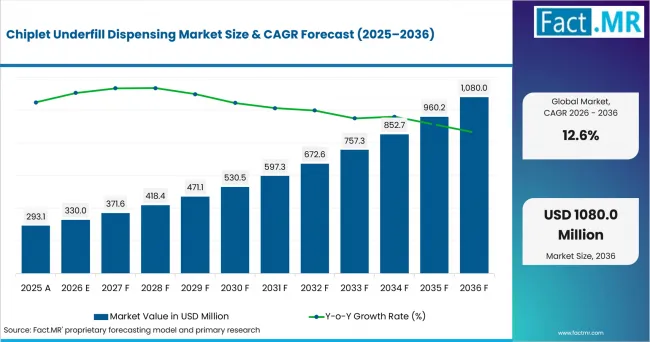
Chiplet Underfill Dispensing Market Value Analysis | Source: Fact.MR
What are the defining numbers behind Chiplet Underfill Dispensing Market growth?
USD 750.0 million absolute opportunity is expected by 2036.
- Demand Drivers in the Market
- Underfill protects microbumps, strengthens the package, and helps maintain uniform joints beneath each die. It becomes especially important where embedded bridges create uneven package surfaces and added mechanical stress.
- Smaller bump pitches reduce standoff height and make flux-residue cleaning more difficult. This raises the risk of poor adhesion and dendritic growth, encouraging the use of fluxless attachment processes that work reliably with underfill materials.
- HBM manufacturing increasingly uses wafer-level underfill before dicing and thermocompression bonding. This approach supports fine bump pitches, improves process control, and avoids some of the flow limits associated with conventional capillary underfill.
- Key Segments Analyzed
- By Dispensing Technology: Jetting dispensers are projected to hold 34.0% share in 2026, supported by a clear process advantage: Jetting dispenses small, repeatable droplets without touching the package, supporting rapid paths around dense chiplet arrays and delicate edges. Recipe control can vary dot size and location as the underfill front develops.
- By Underfill Type: Capillary underfill is projected to hold 47.0% share in 2026, supported by a clear process advantage: Capillary underfill uses surface tension to draw liquid through the assembled gap and can conform to complex die outlines after bonding. It remains the reference process for protecting interconnects against thermo-mechanical stress.
- By Gap Height: <10 um is projected to hold 43.5% share in 2026, supported by a clear process advantage: Gaps below 10 micrometers increase viscous resistance and make trapped air, filler size and wetting behavior decisive. Precise droplet placement and thermal control are needed to complete the fill without voids.
- By Package Type: 3D stacked die is projected to hold 45.8% share in 2026, supported by a clear process advantage: Three-dimensional die stacks concentrate thermal stress and create multiple narrow interfaces where a void can become a reliability failure. Underfill delivery must work around limited access and often after several expensive die placements.
- By End User: OSAT providers are projected to hold 30.6% share in 2026, supported by a clear process advantage: OSAT providers qualify underfill materials and dispensing recipes across many die sizes, substrate finishes and customer reliability requirements. Their commercial value lies in achieving repeatable fill without slowing the assembly line.
- Analyst Opinion at Fact.MR
- Shambhu Nath Jha, Sr. Consultant at Fact.MR, states, 'Buyers should evaluate the complete process sequence around filling narrow, topographically complex gaps without voids while controlling fillet geometry, cure stress and keep-out zones. Technical review should focus on repeatability, integration, defect control and production throughput rather than a single headline specification.
- Strategic Implications
- The relevant metric is filled-volume consistency and void performance on the actual package stack, including warpage and local gap variation.
- Equipment suppliers should document how their systems address the challenge of filling narrow, topographically complex gaps without voids while controlling fillet geometry, cure stress and keep-out zones across production-representative wafers, panels, dies or packages.
- Procurement teams can compare process capability, integration burden, service coverage and qualification evidence before prioritizing nominal throughput or a single accuracy claim.
Taiwan is projected to record a 13.8% CAGR as leading foundry production, advanced packaging and a dense OSAT and substrate supply chain supports relevant capital spending; Malaysia is projected to record a 13.7% CAGR as large-scale outsourced assembly, test and package manufacturing supports relevant capital spending; Singapore is projected to record a 12.8% CAGR as advanced-packaging R&D, specialty fabs and regional assembly and test operations supports relevant capital spending; Vietnam is projected to record a 14.8% CAGR as expanding back-end assembly and electronics manufacturing capacity supports relevant capital spending; while South Korea is projected to record a 13.3% CAGR as high-volume memory, HBM and vertically integrated semiconductor manufacturing supports relevant capital spending through 2036.
How does the Chiplet Underfill Dispensing Market break down by segment?
Jetting dispensers leads Dispensing Technology with a 34.0% share, while Capillary underfill accounts for 47.0% of Underfill Type in 2026.
Why do Jetting dispensers lead Dispensing Technology?
Jetting dispensers are projected to account for 34.0% share in 2026.
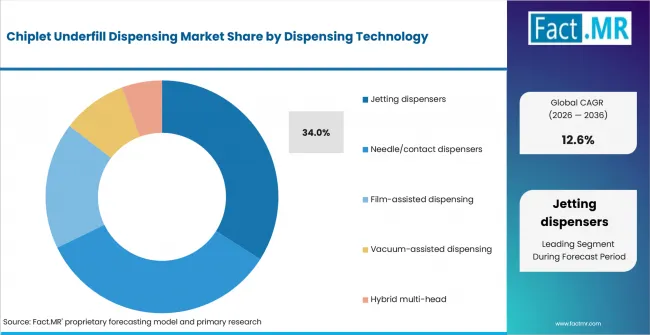
Chiplet Underfill Dispensing Market Analysis By Dispensing Technology | Source: Fact.MR
Jetting dispensers deliver small, controlled droplets without contacting the package surface. This approach supports fast movement around closely spaced chiplets and reduces the risk of damaging delicate die edges. Programmable recipes also allow the system to adjust droplet size, spacing, and placement as the underfill moves through the package gap. These benefits place jetting ahead where manufacturers require high throughput and accurate material control across complex package layouts.
Why does Capillary underfill lead Underfill Type?
Capillary underfill is projected to account for 47.0% share in 2026.
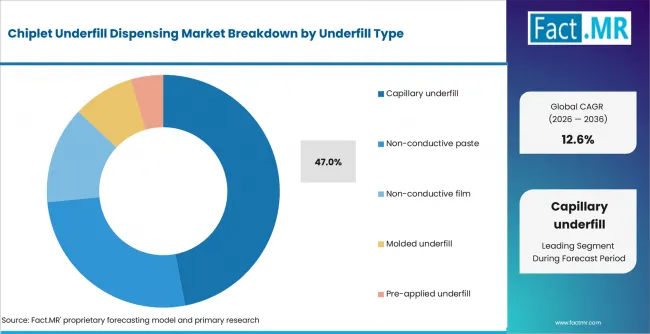
Chiplet Underfill Dispensing Market Analysis By Underfill Type | Source: Fact.MR
Capillary underfill uses surface tension to draw liquid through the assembled gap and can conform to complex die outlines after bonding. It remains the reference process for protecting interconnects against thermo-mechanical stress. Non-conductive paste can combine placement and encapsulation functions, but it requires tighter control of pre-applied volume and bond squeeze-out. Wafer-level underfill lamination (HBM) and non-conductive film for TCB eliminate the capillary-flow bottleneck at <40 µm bump pitch.
Why does <10 um lead Gap Height?
<10 um is projected to account for 43.5% share in 2026.
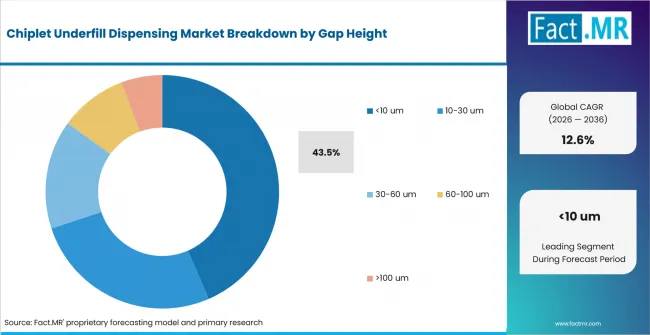
Chiplet Underfill Dispensing Market Analysis By Gap Height | Source: Fact.MR
Gaps below 10 micrometers increase viscous resistance and make trapped air, filler size and wetting behavior decisive. Precise droplet placement and thermal control are needed to complete the fill without voids. Larger gaps fill more easily and tolerate a broader material set, reducing the need for the most advanced dispensing control.
Why does 3D stacked die lead Package Type?
3D stacked die is projected to account for 45.8% share in 2026.
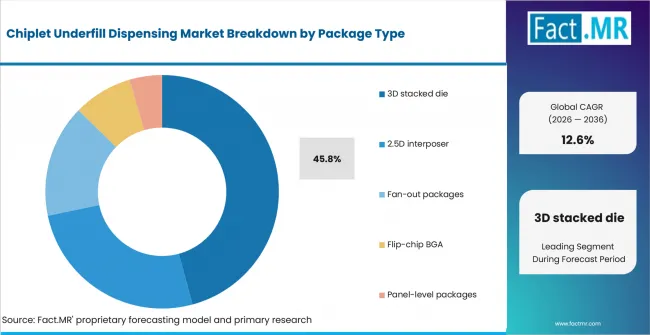
Chiplet Underfill Dispensing Market Analysis By Package Type | Source: Fact.MR
Three-dimensional die stacks concentrate thermal stress and create multiple narrow interfaces where a void can become a reliability failure. Underfill delivery must work around limited access and often after several expensive die placements. A 2.5D interposer offers more lateral access around the dies, making capillary flow and inspection less constrained. Package warpage is driven by die/EMC/substrate CTE and modulus (bimetallic model); underfill choice (filler loading, Tg, modulus) is a first-order input - dynamic warpage metrology (shadow moiré per JESD22-B112, at least 2 °C/s ramps) is used to qualify underfill/material sets.
Why do OSAT providers lead End User?
OSAT providers are projected to account for 30.6% share in 2026.
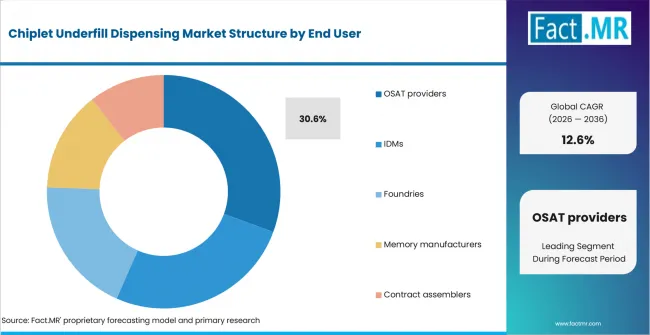
Chiplet Underfill Dispensing Market Analysis By End User | Source: Fact.MR
OSAT providers qualify underfill materials and dispensing recipes across many die sizes, substrate finishes and customer reliability requirements. Their commercial value lies in achieving repeatable fill without slowing the assembly line. IDMs can optimize one product family more deeply, while OSATs need flexible multi-product dispensing platforms.
What is accelerating Chiplet Underfill Dispensing Market adoption, and what is holding it back?
The strongest accelerator is the structural need for underfill in chiplet and EMIB assembly. The main restraint is the risk that high-viscosity materials, narrow gaps, and rapid curing can trap air or leave incomplete fill beneath large dies.
Drivers Impact Analysis
| DRIVER | (~) % IMPACT ON CAGR | GEOGRAPHIC RELEVANCE | IMPACT TIMELINE |
|---|---|---|---|
| Structural need for underfill in chiplet and EMIB assembly | +3.5% | Global leading-edge fabs | Medium term (2-4 years) |
| Fine-pitch drives fluxless + underfill co-design | +2.9% | Global leading-edge fabs | Medium term (2-4 years) |
| Wafer-level underfill in HBM manufacture | +2.4% | Global leading-edge fabs | Short term (<=2 years) |
| Adhesive-layer void mitigation (C2W hybrid bonding) | +1.9% | Global leading-edge fabs | Medium term (2-4 years) |
Source: Fact.MR analysis. Updated Jul 22, 2026
- Fine-pitch drives fluxless + underfill co-design: SMTA-documented fluxless reflow work states the problem directly: the decreasing standoff height of flip-chip devices makes residue cleaning difficult which can result in dendritic growth and poor compatibility with underfill materials - i.e., underfill performance is now co-specified with the attach process, and fluxless (formic acid) attach exists partly to make underfill adhesion reliable. [3]
- Wafer-level underfill in HBM manufacture: Documented HBM fabrication flow: memory wafer thinned to 50 µm, then a wafer level underfill material was laminated over the Cu pillar bumps before dicing and TCB stacking onto the logic wafer - pre-applied underfill is already a production technique for chiplet-class stacks (20 µm bump diameter, 40 µm pitch).
- Adhesive-layer void mitigation (C2W hybrid bonding): To combat void formation, adhesive materials with tailored viscosity and curing profiles are applied after cleaning.
Opportunity Impact Analysis
| OPPORTUNITY | (~) % IMPACT ON CAGR | GEOGRAPHIC RELEVANCE | IMPACT TIMELINE |
|---|---|---|---|
| Pre-applied underfill displacing capillary for fine pitch | +2.1% | Global leading-edge fabs | Medium term (2-4 years) |
| Vacuum-assisted dispensing | +1.6% | Global leading-edge fabs | Medium term (2-4 years) |
| Molded underfill / compression molding | +1.3% | Global leading-edge fabs | Medium term (2-4 years) |
Source: Fact.MR analysis. Updated Jul 22, 2026
- Pre-applied underfill displacing capillary for fine pitch: Wafer-level underfill lamination (HBM) and non-conductive film for TCB eliminate the capillary-flow bottleneck at <40 µm bump pitch.
- Vacuum-assisted dispensing helps remove trapped air before or during material flow, which improves fill consistency beneath large dies and across narrow gaps. The approach is relevant where conventional capillary flow leaves voids or requires long process times.
- Molded underfill and compression molding combine encapsulation with mechanical protection across larger package areas. The process is suited to high-volume packages where manufacturers require controlled material distribution, lower void risk, and shorter assembly cycles.
Restraints Impact Analysis
| RESTRAINT | (~) % IMPACT ON CAGR | GEOGRAPHIC RELEVANCE | IMPACT TIMELINE |
|---|---|---|---|
| Primary qualification constraint | -1.9% | Global leading-edge fabs | Medium term (2-4 years) |
| Contamination and defect risk | -1.5% | Global leading-edge fabs | Medium term (2-4 years) |
| Buried-defect escape | -1.1% | Global leading-edge fabs | Medium term (2-4 years) |
Source: Fact.MR analysis. Updated Jul 22, 2026
- Primary qualification constraint: High-viscosity material, tiny gaps and rapid cure kinetics can trap air or leave incomplete fill beneath large dies.
- Contamination and defect risk: As flip-chip standoff heights become smaller, cleaning residues from narrow gaps becomes more difficult. Remaining flux or process contamination can promote dendritic growth, weaken electrical reliability and interfere with underfill adhesion. For this reason, the attach process and underfill material are often evaluated together.
Which countries are scaling Chiplet Underfill Dispensing Market fastest?
Vietnam is projected to record the fastest CAGR of 14.8%, supported by expanding back-end assembly and electronics manufacturing capacity.
- Countries differ less by the headline CAGR than by the type of semiconductor work creating demand for the Chiplet Underfill Dispensing Market.
- Vietnam follows a pathway shaped by expanding back-end assembly and electronics manufacturing capacity. China takes a different path through rapid domestic capacity build-out, local-equipment substitution and tighter access to controlled foreign tools.
- Taiwan and Malaysia remain aligned through distinct combinations of device production, equipment development and advanced packaging investment.
- South Korea develops through high-volume memory, HBM and vertically integrated semiconductor manufacturing, while Singapore relies on advanced-packaging R&D, specialty fabs and regional assembly and test operations.
- Markets with similar CAGRs can follow different development paths because installed fabs, device mix, local equipment capability, export controls and qualification cycles differ.
The full report compares the six named country markets within the wider regional coverage of North America, Latin America, Europe, East Asia, South Asia & Oceania, and the Middle East & Africa.
| COUNTRY | CAGR 2026 to 2036 |
|---|---|
| Vietnam | 14.8% |
| Taiwan | 13.8% |
| Malaysia | 13.7% |
| South Korea | 13.3% |
| Singapore | 12.8% |
Source: Fact.MR analysis. Updated Jul 22, 2026
What is driving Vietnam's growth through 2036?
14.8% CAGR, supported by expanding back-end assembly and electronics manufacturing capacity.
Vietnam combines expanding back-end assembly and electronics manufacturing capacity with a 9.5% share of 2026 demand across the six profiled countries. Wafer-level underfill lamination (HBM) and non-conductive film for TCB eliminate the capillary-flow bottleneck at <40 µm bump pitch. The commercial link is the need to solve the problem of filling narrow, topographically complex gaps without voids while controlling fillet geometry, cure stress and keep-out zones as capacity and process complexity increase.
What is driving Taiwan's growth through 2036?
13.8% CAGR, supported by leading foundry production, advanced packaging and a dense OSAT and substrate supply chain.
Taiwan’s established foundry and outsourced semiconductor assembly base creates demand for capillary, molded, and pre-applied underfill processes used in advanced packaging. Equipment qualification focuses on repeatable material flow, low void levels, and compatibility with high-volume package assembly.
What is driving Malaysia's growth through 2036?
13.7% CAGR, supported by large-scale outsourced assembly, test and package manufacturing.
Malaysia combines large-scale outsourced assembly, test and package manufacturing with a 19.5% share of 2026 demand across the six profiled countries. Assembly operations in Malaysia require underfill materials and dispensing recipes that limit voids, maintain bond-line consistency, and remain compatible with fine-pitch attachment processes.The commercial link is the need to solve the problem of filling narrow, topographically complex gaps without voids while controlling fillet geometry, cure stress and keep-out zones as capacity and process complexity increase.
What is driving South Korea's growth through 2036?
13.3% CAGR, supported by high-volume memory, HBM and vertically integrated semiconductor manufacturing.
South Korea’s memory and advanced-packaging operations support demand for pre-applied underfill, non-conductive film, and precision dispensing systems used in HBM and stacked-die assembly. This environment creates a clear qualification pathway for the Chiplet Underfill Dispensing Market because buyers must solve the problem of filling narrow, topographically complex gaps without voids while controlling fillet geometry, cure stress and keep-out zones at production scale.
What is driving Singapore's growth through 2036?
12.8% CAGR, supported by advanced-packaging R&D, specialty fabs and regional assembly and test operations.
Singapore combines advanced-packaging R&D, specialty fabs, and regional assembly and test operations with an 11.5% share share of 2026 demand across the six profiled countries. The commercial link is the need to solve the problem of filling narrow, topographically complex gaps without voids while controlling fillet geometry, cure stress and keep-out zones as capacity and process complexity increase.
Who leads the Chiplet Underfill Dispensing Market?
Nordson ASYMTEK and Musashi Engineering are relevant participants in the competitive landscape followed by Nagase and Protec as the next tier of challengers.
Nordson ASYMTEK and Musashi Engineering are directly relevant providers of precision fluid-dispensing equipment for semiconductor packaging and underfill applications. Nordson ASYMTEK offers advanced dispensing platforms for semiconductor and wafer-level packaging, while Musashi Engineering supplies dedicated automatic underfill dispensing systems.
Mycronic participates in the broader electronics dispensing and production-automation field, although its direct exposure to chiplet underfill requires clearer product evidence. Nagase is more closely associated with advanced packaging materials and process support than with dispensing equipment. Protec requires a complete legal company name and verified product reference, while Speedline Technologies should be removed unless its current ownership and active semiconductor-underfill product line are confirmed.
Competition centers on droplet control, material-flow consistency, void reduction, recipe stability, integration with package handling, and technical support during process qualification.
Which companies are the key providers?
Key companies include Nordson ASYMTEK; Musashi Engineering; Nagase; Protec; Speedline Technologies; Mycronic.
- Nordson ASYMTEK
- Musashi Engineering
- Nagase
- Protec
- Speedline Technologies
- Mycronic
Bibliography
- Intel — official EMIB packaging documentation
- Nordson — official ASYMTEK semiconductor dispensing platform pages
- Musashi Engineering — official underfill dispenser product documentation
- IEEE, IMAPS, or SMTA — original conference papers, not third-party summaries
- JEDEC — relevant package-warpage test standard
- Akrometrix — dated official warpage-metrology technical document
- NHanced Semiconductors — complete dated SMTA hybrid-bonding paper
This Report Addresses
- The report provides strategic intelligence on Chiplet Underfill Dispensing Market across Dispensing Technology and Underfill Type choices that shape purchasing decisions.
- Segment analysis covers Jetting dispensers as the share leader within the 2026 market structure.
- Regional outlook evaluates China and Taiwan alongside Malaysia and Singapore, while Vietnam and South Korea complete the growth comparison.
- Competitive analysis profiles Nordson ASYMTEK and Musashi Engineering alongside Nagase and Protec, followed by additional active providers.
- Use-case assessment covers the categories and applications that shape demand in the Chiplet Underfill Dispensing Market across the forecast period.
What does the Chiplet Underfill Dispensing Market cover?
The market covers equipment and process systems configured to address the challenge of filling narrow, topographically complex gaps without voids while controlling fillet geometry, cure stress and keep-out zones.
Chiplet underfill dispensing covers jetting/needle dispensing systems, vacuum-assisted dispense, and pre-applied film processes (non-conductive film/paste, wafer-level underfill) that fill the gap beneath chiplets after flip-chip, TCB, or micro-bump attach - at standoff heights and bump pitches where capillary flow is slow, void-prone, and warpage-sensitive.
Commercial value arises from the complete configured system, including process control, handling, software and integrated modules required for repeatable operation. Finished semiconductor devices, package value and unrelated parent-market equipment are excluded.
What is included in the scope?
The scope includes systems used by osat providers and the other end-user groups listed in the segmentation.
The market is segmented by Dispensing Technology, including Jetting dispensers, Needle/contact dispensers, Film-assisted dispensing, Vacuum-assisted dispensing, Hybrid multi-head; Underfill Type, including Capillary underfill, Non-conductive paste, Non-conductive film, Molded underfill, Pre-applied underfill; Gap Height, including <10 um, 10-30 um, 30-60 um, 60-100 um, >100 um; Package Type, including 3D stacked die, 2.5D interposer, Fan-out packages, Flip-chip BGA, Panel-level packages; End User, including OSAT providers, IDMs, Foundries, Memory manufacturers, Contract assemblers.
Integrated handling, metrology, cleaning, activation, process-control or support modules are included when delivered as part of the configured market system.
What is excluded from the scope?
The scope excludes unrelated semiconductor equipment, standalone materials and components sold independently of the configured system.
It also excludes facility construction, cleanroom infrastructure, the value of processed wafers or packages, and adjacent process steps that are not part of the defined equipment category.
How Was the Analysis Built?
Fact.MR is of the opinion that this assessment combines structured market analysis with a review of public information and industry evidence relevant to the market.
- Market Assessment: The analysis considers demand patterns, supply conditions, segment mix, country activity, company participation, and adoption trends.
- Evidence Review: Public company disclosures, government and regulatory publications, trade information, technical literature, and industry records inform the assessment.
- Validation and Updates: Findings are cross-checked against available market indicators and reviewed when material market developments emerge.
Segmentation
What is the report's scope and coverage?
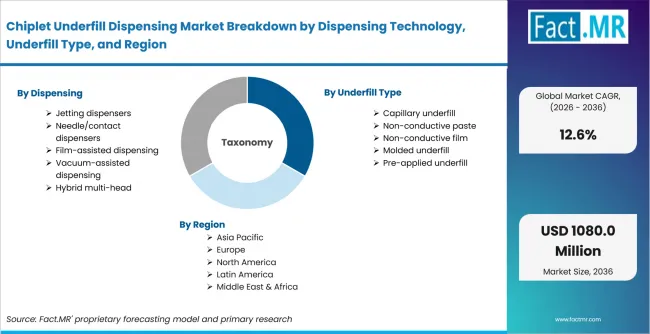
Chiplet Underfill Dispensing Market Breakdown By Dispensing Technology, Underfill Type, And Region | Source: Fact.MR
| Attribute | Details |
|---|---|
| Quantitative Units | USD 330.0 million in 2026 to USD 1,080.0 million by 2036 at a 12.6% CAGR |
| Market Definition | Chiplet underfill dispensing covers jetting/needle dispensing systems, vacuum-assisted dispense, and pre-applied film processes (non-conductive film/paste, wafer-level underfill) that fill the gap beneath chiplets after flip-chip, TCB, or micro-bump attach - at standoff heights and bump pitches where capillary flow is slow, void-prone, and warpage-sensitive. |
| Dispensing Technology | Jetting dispensers; Needle/contact dispensers; Film-assisted dispensing; Vacuum-assisted dispensing; Hybrid multi-head |
| Underfill Type | Capillary underfill; Non-conductive paste; Non-conductive film; Molded underfill; Pre-applied underfill |
| Gap Height | <10 um; 10-30 um; 30-60 um; 60-100 um; >100 um |
| Package Type | 3D stacked die; 2.5D interposer; Fan-out packages; Flip-chip BGA; Panel-level packages |
| End User | OSAT providers; IDMs; Foundries; Memory manufacturers; Contract assemblers |
| Regions Covered | North America; Latin America; Europe; East Asia; South Asia & Oceania; Middle East & Africa |
| Countries Covered | Taiwan; Malaysia; Singapore; Vietnam; South Korea |
| Key Companies Profiled | Nordson ASYMTEK; Musashi Engineering; Nagase; Protec; Speedline Technologies; Mycronic |
| Forecast Period | 2026 to 2036 |
| Approach | Hybrid top-down and bottom-up approach using demand indicators across Dispensing Technology; Underfill Type; Gap Height; Package Type; End User; country-level growth; company participation and adoption trends |
Source: Fact.MR analysis. Updated Jul 22, 2026
How is the market segmented?
-
By Dispensing Technology:
- Jetting dispensers
- Needle/contact dispensers
- Film-assisted dispensing
- Vacuum-assisted dispensing
- Hybrid multi-head
-
By Underfill Type:
- Capillary underfill
- Non-conductive paste
- Non-conductive film
- Molded underfill
- Pre-applied underfill
-
By Gap Height:
- <10 um
- 10-30 um
- 30-60 um
- 60-100 um
- >100 um
-
By Package Type:
- 3D stacked die
- 2.5D interposer
- Fan-out packages
- Flip-chip BGA
- Panel-level packages
-
By End User:
- OSAT providers
- IDMs
- Foundries
- Memory manufacturers
- Contract assemblers
-
By Region:
- North America
- Latin America
- Europe
- East Asia
- South Asia & Oceania
- Middle East & Africa
Frequently Asked Questions
Which Dispensing Technology leads the Chiplet Underfill Dispensing Market?
Which Underfill Type leads the Chiplet Underfill Dispensing Market?
Which Gap Height leads the Chiplet Underfill Dispensing Market?
Which Package Type leads the Chiplet Underfill Dispensing Market?
Which End User leads the Chiplet Underfill Dispensing Market?
What CAGR is projected for Vietnam in the Chiplet Underfill Dispensing Market?
What CAGR is projected for Taiwan in the Chiplet Underfill Dispensing Market?
What CAGR is projected for Malaysia in the Chiplet Underfill Dispensing Market?
What CAGR is projected for South Korea in the Chiplet Underfill Dispensing Market?
What CAGR is projected for Singapore in the Chiplet Underfill Dispensing Market?
What is the main restraint in the Chiplet Underfill Dispensing Market?
Who worked on this report


Preview the report firsthand - request a free sample
Free SampleGet the brochure for pricing and purchase details
Download PDF