- Base Value(2025): 929.0 Mn
- Estimated Value(2026): 980.0 Mn
- Forecast Value (2036): 1674.0 Mn
- CAGR (2026 - 2036): 5.5%
Chloride Barrier Coatings Market Forecast and Outlook 2026 to 2036
In 2025, the chloride barrier coatings market was valued at USD 929.0 million. Based on Fact.MR analysis, demand for chloride barrier coatings is estimated to grow to USD 980.0 million in 2026 and USD 1,674.0 million by 2036. Fact.MR projects a CAGR of 5.5% during the forecast period. Growth is linked to sustained investment in transport, marine, and parking infrastructure where chloride induced corrosion directly affects asset life and maintenance cost.
The market adds approximately USD 745.0 million in value over the decade, reflecting steady compounding tied to long term infrastructure preservation programs. Demand progression follows bridge deck protection, coastal concrete exposure, and deicing salt mitigation, while pricing reflects compliance with EN 1504-2 and ASTM chloride resistance criteria. Value expansion is supported by greater use of verified barrier systems over generic surface coatings, even where treated surface area grows at a measured pace.
As Greg Poux-Guillaume, Chief Executive Officer of AkzoNobel, stated in the 2024 Annual Report while discussing performance of the Marine and Protective division, “Within Coatings, our Marine and Protective business experienced strong demand and clear share gains in marine new-build, with a particularly dynamic Chinese market.” [1] The statement reflects demand conditions in marine and bridge protection segments where chloride barrier coatings are specified for long-life concrete and steel assets, as assessed by Fact.MR.
India records the fastest growth at 6.7% CAGR due to coastal infrastructure and highway expansion. Vietnam follows at 6.5% through port and transport projects, while Indonesia grows at 6.4% tied to marine exposure mitigation. Thailand posts 6.0% as expressway and port maintenance programs expand, and China reaches 5.8% through reinforced concrete durability requirements. Mature markets including the United States at 3.5% and Germany at 2.8% remain replacement led, constrained by long inspection intervals and strict specification approval processes.
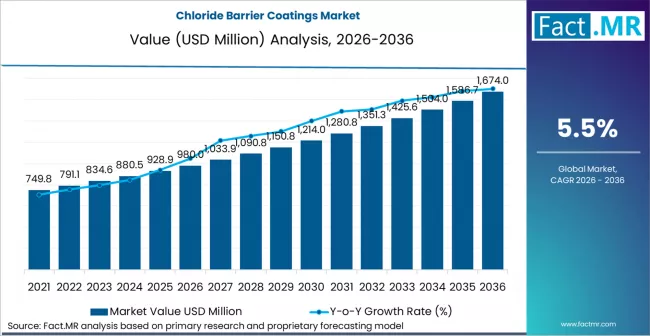
Chloride Barrier Coatings Market Market Value Analysis | Source: Fact.MR
Chloride Barrier Coatings Market Definition
The chloride barrier coatings market covers protective coating materials applied to concrete surfaces to limit the penetration of chloride ions from seawater, deicing salts, or industrial exposure. Chlorides reduce the alkalinity around steel reinforcement and increase corrosion risk, which shortens the service life of concrete structures. These coatings create a surface barrier that slows ion diffusion while remaining compatible with concrete substrates, as defined in EN 1504-2 requirements for surface protection systems issued by CEN [2]. Typical uses include bridges, marine structures, parking decks, and coastal infrastructure.
Chloride Barrier Coatings Market Inclusions
The report covers global and regional market size estimates in volume and value terms with a forecast period from 2026 to 2036. Segmentation includes coating type such as epoxy, polyurethane, and acrylic systems referenced in EN 1504-2 [3], application areas including marine and transport infrastructure, and end use sectors such as construction and public works. The scope also includes regional demand patterns, pricing benchmarks, and trade flows linked to concrete protection materials.
Chloride Barrier Coatings Market Exclusions
The scope excludes waterproofing membranes and coatings designed mainly for moisture control rather than chloride ion resistance. Decorative architectural paints without verified chloride diffusion resistance are not included. Integral concrete admixtures, cathodic protection systems, and downstream repair packages sold as complete refurbishment solutions are excluded. Consumer grade coatings, laboratory scale materials, and experimental surface treatments without documented use under recognized concrete protection standards are also outside the scope.
Chloride Barrier Coatings Market Research Methodology
- Primary Research: Primary research involved interviews with coating manufacturers, concrete repair contractors, civil engineers, and asset owners managing marine and transport infrastructure.
- Desk Research: Desk research used EN 1504 standards from CEN, technical documents from the American Concrete Institute, bridge maintenance guidance from the US Federal Highway Administration, and company annual reports and technical datasheets filed with securities regulators.
- Market Sizing and Forecasting: Market sizing applied a hybrid top down and bottom up model using concrete surface area data from public infrastructure inventories and coating consumption rates specified in EN 1504-2.
Summary of chloride barrier coatings market
Market Definition
- The chloride barrier coatings market covers protective coatings applied to concrete surfaces to restrict chloride ion penetration from seawater, deicing salts, or industrial exposure, in line with EN 1504-2 surface protection requirements issued by CEN
Demand drivers
- Transport authorities and infrastructure owners specify chloride barrier coatings for bridges, decks, and parking structures to manage chloride-induced corrosion under durability and inspection thresholds, based on Fact.MR analysis.
- Coastal infrastructure operators and port authorities apply chloride barrier systems to reinforced concrete exposed to marine aerosols, where long-term corrosion control is embedded in maintenance planning, as per Fact.MR.
- Use of deicing salts on highways and bridge decks in cold regions sustains demand for barrier coatings that reduce chloride ingress and extend inspection intervals, according to Fact.MR.
Key segments analyzed
- Technology: Penetrating sealers based on silane or siloxane chemistry lead with an estimated 39% share in 2026 due to their ability to limit chloride ingress while maintaining vapor permeability, based on Fact.MR.
- Structure type: Bridges and decks account for around 35% of demand, reflecting continuous exposure to deicing salts and marine environments that accelerate reinforcement corrosion, as per Fact.MR.
- Geography: Asia Pacific records the fastest growth led by India, Vietnam, Indonesia, and Thailand, while North America and Europe remain replacement-driven markets, based on Fact.MR analysis.
Analyst opinion at Fact.MR
- Shambhu Nath Jha, Principal Consultant at Fact.MR, opines, ‘CXOs will find that chloride barrier coating demand is governed by chloride exposure management, inspection cycles, and compliance with concrete durability standards rather than discretionary coating activity.’
Strategic implications and executive takeaways
- Fact.MR is of the opinion that suppliers should prioritize solutions aligned with bridge decks, marine structures, and parking infrastructure where chloride exposure directly affects asset life.
- Fact.MR opines that expanding portfolios of EN 1504-2 compliant penetrating sealers and barrier systems can improve specification acceptance in public infrastructure projects.
- Fact.MR analysts recommend strengthening performance documentation tied to chloride resistance test methods to secure repeat inclusion in transport and coastal tenders.
Methodology
- Based on Fact.MR’s report, estimates draw on primary interviews with coating manufacturers, concrete repair contractors, civil engineers, and asset owners.
- Fact.MR analysis integrates EN 1504 standards and chloride resistance guidance from ASTM, including rapid chloride permeability and penetration test methods
[4] - Outputs were validated through cross-checks against public infrastructure inventories, procurement disclosures, and regulatory documentation.
Segmental Analysis
Chloride Barrier Coatings Market Analysis by Technology
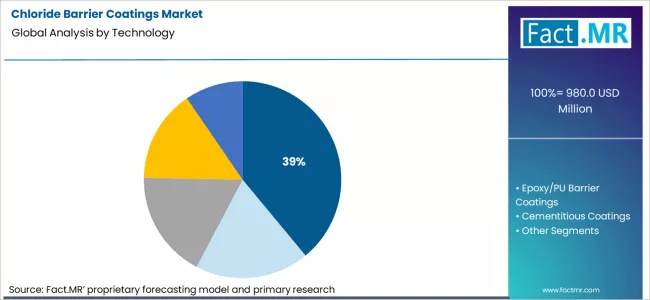
Chloride Barrier Coatings Market Analysis By Technology | Source: Fact.MR
Based on FACT.MR's chloride barrier coatings market report, consumption of penetrating sealers based on silane and siloxane chemistry is estimated to hold 39% share in 2026. FACT.MR analysts link this lead position to the ability of penetrating sealers to reduce chloride ion ingress while preserving vapor permeability of concrete surfaces. As per FACT.MR, these systems address buyer requirements for corrosion mitigation in reinforced concrete without altering surface appearance or requiring thick film application.
- Product certification: Evonik supplies silane and siloxane raw materials used in penetrating sealers that meet EN 1504-2 requirements for hydrophobic impregnation, as documented in its construction chemicals technical literature.
- Technology deployment: W. R. Grace publishes product data for silane-based penetrating sealers designed to limit chloride penetration in bridge decks and marine concrete structures.
- Application practice: Fact.MR analysis references transportation agency maintenance manuals that specify penetrating sealers as a preferred preventive treatment for chloride exposure due to ease of application and minimal traffic disruption.
Chloride Barrier Coatings Market Analysis by Structure Type
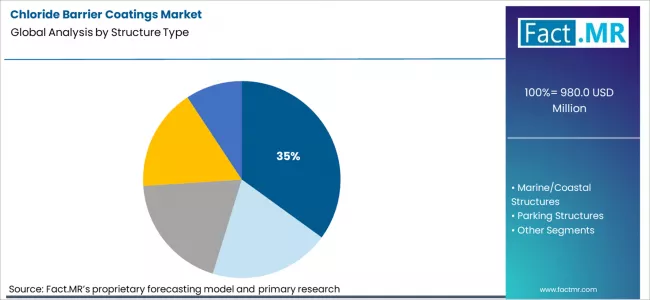
Chloride Barrier Coatings Market Analysis By Structure Type | Source: Fact.MR
Based on FACT.MR's chloride barrier coatings market report, consumption for bridges and decks is estimated to hold 35% share in 2026. FACT.MR is of the opinion that this segment leads due to continuous exposure of bridge substructures to de-icing salts and marine aerosols that accelerate chloride-induced reinforcement corrosion. As per FACT.MR, asset owners prioritize barrier systems that extend inspection intervals and reduce life-cycle repair frequency for critical transport infrastructure.
- Public infrastructure demand: Federal Highway Administration guidelines identify chloride ingress as a primary durability risk for bridge decks and reference surface treatments and coatings as mitigation measures.
- System specification: Sika documents chloride barrier coating systems for bridge decks and traffic-bearing concrete in its protective coating technical manuals.
- Maintenance cycles: FACT.MR analysts reference national bridge preservation programs that allocate recurring funding for deck protection and rehabilitation, sustaining ongoing demand for chloride barrier coatings in this structure category.
Chloride Barrier Coatings Market Drivers, Restraints, And Opportunities
Fact.MR analysis indicates that the chloride barrier coatings market exists as a protective coatings segment within concrete infrastructure and marine exposure applications, driven by the need to limit chloride ingress that accelerates reinforcing steel corrosion in reinforced concrete structures. As per FACT.MR, chloride ions are a principal driver of corrosion risk in coastal and deicing salt environments, and standards such as ASTM C1202 for rapid chloride permeability testing and ASTM C1543 for chloride ion penetration resistance inform specification requirements for coatings designed to reduce chloride mobility in concrete. FACT.MR analysts observe that valuation in recent years reflects demand from infrastructure maintenance and rehabilitation programmes in regions where long-term performance against chloride attack is a budgeted priority.
FACT.MR is of the opinion that the market is transitioning from general concrete coatings toward specialized barrier systems that deliver measurable chloride resistance and durability in aggressive environments. Based on FACT.MR’s report, conventional protective coatings that primarily serve aesthetic or basic moisture resistance functions are losing ground where project specifications call for documented chloride penetration resistance using standardized test methods. Chloride barrier formulations that incorporate hydrophobic binders, nanofillers, and pore blockers generally carry higher per-unit pricing due to advanced chemistries and quality assurance protocols; this means that total realised value can increase even if bulk shipment growth remains moderate, reflecting value contribution from performance alignment rather than simple volume expansion.
- Performance test standards influence specifications: FACT.MR analysts note that ASTM C1202 and ASTM C1543 test methods for chloride permeability and penetration resistance shape engineering specifications, driving demand toward coatings verified to limit chloride ingress in bridge decks and marine structures
- Infrastructure asset maintenance programmes: Based on FACT.MR’s report, ongoing rehabilitation and lifecycle preservation initiatives for roads, bridges, and coastal facilities in North America and Europe sustain demand for chloride barrier coatings because reducing chloride-induced corrosion is integral to long-term maintenance planning.
- Asia Pacific coastal construction activity: FACT.MR opines that rapid expansion of coastal infrastructure and port facilities in China, India, and Southeast Asia increases specification of chloride barrier coatings to reduce repair costs and align with international durability expectations referenced by infrastructure owners.
Regional Analysis
Based on regional assessment, the chloride barrier coatings sector is analyzed across North America, Latin America, Europe, East Asia, South Asia, Oceania, and the Middle East & Africa, spanning more than 40+ countries. Regional performance varies according to coastal infrastructure exposure, industrial corrosion protection needs, and regulatory standards governing concrete durability. The report also presents a comparative market attractiveness evaluation grounded in region-specific demand trends.
Chloride Barrier Coatings Market CAGR Analysis by Country (2026-2036)
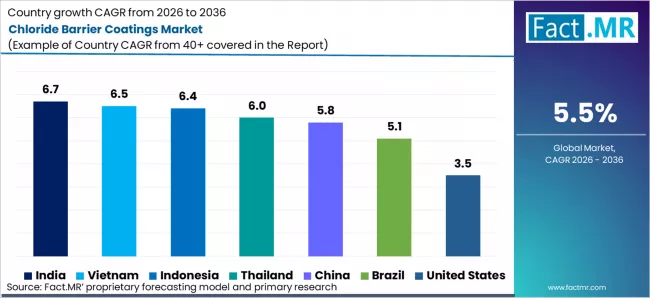
Chloride Barrier Coatings Market Cagr Analysis By Country | Source: Fact.MR
| Country | CAGR |
|---|---|
| India | 6.7% |
| Vietnam | 6.5% |
| Indonesia | 6.4% |
| Thailand | 6.0% |
| China | 5.8% |
| Brazil | 5.1% |
| United States | 3.5% |
| Germany | 2.8% |
Source: Fact.MR analysis. Updated Feb 16, 2026
Source: Fact.MR (FACT.MR) analysis, based on proprietary forecasting models and primary research.
Asia Pacific Chloride Barrier Coatings Market Analysis
Asia Pacific operates as an infrastructure execution-driven region for chloride barrier coatings, with use tied to coastal structures, transport assets, and reinforced concrete durability standards. Demand follows government-issued construction codes and tender specifications for public works, ports, and urban infrastructure projects across multiple countries.
- India: Demand for chloride barrier coatings in India is projected to rise at 6.7% CAGR through 2036. Application is specified under CPWD concrete durability provisions updated in April 2021 and reinforced through coastal bridge and port tenders issued by the Ministry of Ports, Shipping and Waterways during August 2022, as per Fact.MR.
- Vietnam: Demand for chloride barrier coatings in Vietnam is projected to rise at 6.5% CAGR through 2036. Use is referenced in reinforced concrete durability standards issued by the Ministry of Construction in June 2020 and applied in coastal highway and port upgrade packages approved in September 2022, according to Fact.MR.
- Indonesia: Demand for chloride barrier coatings in Indonesia is projected to rise at 6.4% CAGR through 2036. Application is documented under coastal infrastructure protection norms within National Strategic Projects released in July 2021 and reinforced through port rehabilitation tenders issued in March 2023, based on Fact.MR.
- Thailand: Demand for chloride barrier coatings in Thailand is projected to rise at 6.0% CAGR through 2036. Usage is specified in marine concrete protection guidelines issued by the Department of Highways in May 2020 and reinforced through port and expressway maintenance contracts tendered in October 2022, as per Fact.MR.
- China: Demand for chloride barrier coatings in China is projected to rise at 5.8% CAGR through 2036. Application follows reinforced concrete durability requirements under GB standards revised in October 2020 and applied in coastal infrastructure and bridge maintenance programs tendered during May 2022, according to Fact.MR.
Fact.MR’s analysis of the chloride barrier coatings market in Asia Pacific consists of country-wise assessment that includes India, Vietnam, Indonesia, Thailand, and China. Readers can find concrete durability standards, coastal infrastructure tenders, and application-level specification references.
Latin America Chloride Barrier Coatings Market Analysis
Latin America functions as a refurbishment-oriented region for chloride barrier coatings, with demand linked to aging transport assets and marine-exposed concrete structures. Usage is governed by public works specifications and national infrastructure maintenance programs.
- Brazil: Demand for chloride barrier coatings in Brazil is projected to rise at 5.1% CAGR through 2036. Application is specified under bridge maintenance guidelines issued by DNIT in May 2020 and reinforced through port rehabilitation and coastal infrastructure projects approved in August 2022, as per Fact.MR.
Fact.MR’s analysis of the chloride barrier coatings market in Latin America consists of country-wise assessment that includes Brazil. Readers can find infrastructure maintenance programs, durability standards, and application references.
North America Chloride Barrier Coatings Market Analysis
North America operates as a standards-led repair market for chloride barrier coatings, with use tied to reinforced concrete durability in transport and marine infrastructure. Demand follows federal and state-issued specifications applied to publicly funded projects.
- United States: Demand for chloride barrier coatings in the United States is projected to rise at 3.5% CAGR through 2036. Use is referenced in concrete durability guidance issued by the Federal Highway Administration in March 2022 and applied in coastal bridge rehabilitation projects funded under federal infrastructure programs, according to Fact.MR.
Fact.MR’s analysis of the chloride barrier coatings market in North America consists of country-wise assessment that includes the United States. Readers can find federal standards references and public infrastructure documentation.
Europe Chloride Barrier Coatings Market Analysis
Europe functions as a regulated maintenance market for chloride barrier coatings, where use is specified under harmonized concrete durability and transport infrastructure standards. Demand follows scheduled refurbishment cycles across public assets.
- Germany: Demand for chloride barrier coatings in Germany is projected to rise at 2.8% CAGR through 2036. Application is specified in concrete protection standards under DIN norms revised in June 2020 and reinforced through bridge and rail infrastructure refurbishment programs tendered in February 2022, as per Fact.MR.
Fact.MR’s analysis of the chloride barrier coatings market in Europe consists of country-wise assessment that includes Germany. Readers can find standards adoption, refurbishment activity, and application-level references.
Competitive aligners for market players
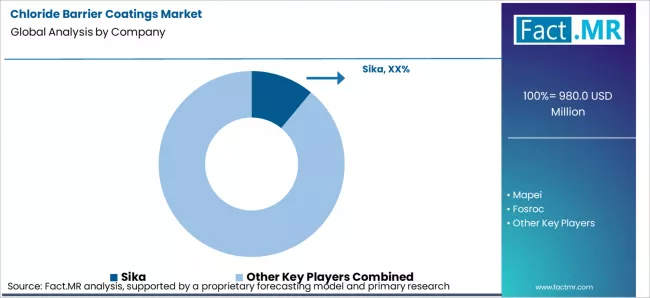
Chloride Barrier Coatings Market Analysis By Company | Source: Fact.MR
The chloride barrier coatings segment is moderately concentrated, with competition clustered around multinational construction chemicals suppliers that offer protective coatings for concrete exposed to chloride environments such as bridges, seawalls, and parking structures. Competition is specification led, and performance against ASTM and EN durability criteria influences contractor and owner approval. Companies with documented field performance tend to secure larger project commitments.
Structural advantages are held by firms that combine broad formulation portfolios, global R&D, and regional technical support networks. Suppliers with captive development functions and local manufacturing can maintain consistent product quality and testing support, which helps meet project specification requirements. Smaller regional players often lack the same level of formulation breadth and laboratory certification, which limits their penetration into major infrastructure frameworks.
Buyer leverage is reinforced through tender frameworks and approved supplier lists. Large contractors and public owners typically require dual sourcing and documented performance data before contract awards, which limits dependency on single suppliers. Negotiations focus on long term maintenance cost outcomes and delivery reliability.
Recent developments
- Saint-Gobain Finalizes Fosroc Acquisition (February 2025): Saint-Gobain officially completed its acquisition of Fosroc, a global specialist in construction chemicals and chloride barrier solutions (Dekguard series). This $1.025 billion deal consolidates Saint-Gobain's presence in high-growth infrastructure markets like India and the Middle East, where chloride-induced rebar corrosion is a primary threat to concrete longevity. [5]
- Sika Opens Five New Global Production Plants (February 2026): In early February 2026, Sika AG inaugurated five new manufacturing facilities across the United States (Florida), Argentina, Colombia, Bangladesh, and Tanzania. These plants are designed with "Industry 4.0" automation to produce advanced concrete admixtures and protective coatings, including high-performance chloride barriers. The Florida plant alone features advanced water-saving systems expected to reduce carbon emissions by 8,000 tons by 2032. [6]
Key Players in Chloride Barrier Coatings Market
- Sika
- Mapei
- Fosroc
- Master Builders Solutions
- Saint-Gobain Weber
- RPM International (Tremco CPG)
- Pidilite Industries
- Kryton International
- Ardex Group
- Nippon Paint
Bibliography
- [1] AkzoNobel N.V. (2024). AkzoNobel annual report 2024. AkzoNobel.
- [2] European Committee for Standardization. (2018). EN 1504-2: Products and systems for the protection and repair of concrete structures - Surface protection systems for concrete. CEN.
- [3] European Committee for Standardization. (2018). EN 1504-2: Products and systems for the protection and repair of concrete structures - Definitions, requirements, quality control and evaluation of conformity. CEN.
- [4] ASTM International. (2023). ASTM standards for chloride resistance and permeability of concrete. ASTM International.
- [5] Saint-Gobain. (2025). Saint-Gobain completes acquisition of Fosroc, a leading player in construction chemicals in Asia and emerging markets. Saint-Gobain.
- [6] ChemAnalyst. (2026). Sika broadens its global manufacturing network with five new production facilities. ChemAnalyst.
Segmentation
Scope of the Report
| Metric | Value |
|---|---|
| Quantitative Units | USD 420 million (2026) to USD 811 million (2036), at a CAGR of 6.8% |
| Market Definition | The chloride barrier coatings market covers protective coating materials applied to concrete surfaces to limit chloride ion penetration from seawater, deicing salts, or industrial exposure. These coatings reduce corrosion risk to steel reinforcement, extend service life, and comply with EN 1504-2 surface protection requirements for reinforced concrete. Typical applications include bridges, marine structures, parking decks, and coastal infrastructure. |
| Technology Segmentation | Penetrating Sealers (Silane/Siloxane), Epoxy/PU Barrier Coatings, Cementitious Coatings, Crack-Bridging Membranes, Other |
| Structure Type Segmentation | Bridges & Decks, Marine/Coastal Structures, Parking Structures, Industrial Floors, Water Tanks/Reservoirs |
| Protection Approach Segmentation | Surface Coating, Penetrating Treatment, System Repair + Barrier, Other |
| Regions Covered | Asia Pacific, Europe, North America, Latin America, Middle East & Africa |
| Countries Covered | India, Vietnam, Indonesia, Thailand, China, Brazil, United States, Germany, Japan, South Korea, Australia & New Zealand, ASEAN, Rest of Asia Pacific, Italy, France, United Kingdom, Spain, Benelux, Nordics, Central & Eastern Europe, Rest of Europe, Canada, Mexico, Argentina, Chile, Rest of Latin America, U.A.E., South Africa, Turkey, Rest of Middle East & Africa |
| Key Companies Profiled | Sika, Mapei, Fosroc, Master Builders Solutions, Saint-Gobain Weber, RPM International (Tremco CPG), Pidilite Industries, Kryton International, Ardex Group, Nippon Paint |
| Forecast Period | 2026 to 2036 |
| Approach | Hybrid top-down and bottom-up market modeling validated through primary interviews with coating manufacturers, concrete repair contractors, civil engineers, and asset owners, supported by EN 1504-2, ASTM C1202/C1543 performance standards, public infrastructure tender data, and material trade statistics. |
Source: Fact.MR analysis. Updated Feb 16, 2026
Chloride Barrier Coatings Market Analysis by Segments
-
By Technology :
- Penetrating Sealers (Silane/Siloxane)
- Epoxy/PU Barrier Coatings
- Cementitious Coatings
- Crack-Bridging Membranes
- Other
-
By Structure Type :
- Bridges & Decks
- Marine/Coastal Structures
- Parking Structures
- Industrial Floors
- Water Tanks/Reservoirs
-
By Protection Approach :
- Surface Coating
- Penetrating Treatment
- System Repair + Barrier
- Other
-
Region :
- Asia Pacific
- India
- China
- Japan
- South Korea
- Indonesia
- Australia & New Zealand
- ASEAN
- Rest of Asia Pacific
- Europe
- Germany
- Italy
- France
- United Kingdom
- Spain
- Benelux
- Nordics
- Central & Eastern Europe
- Rest of Europe
- North America
- United States
- Canada
- Mexico
- Latin America
- Brazil
- Argentina
- Chile
- Rest of Latin America
- Middle East & Africa
- Kingdom of Saudi Arabia
- United Arab Emirates
- South Africa
- Turkey
- Rest of Middle East & Africa
- Asia Pacific
Frequently Asked Questions
How large is the chloride barrier coatings market in 2026?
What will the chloride barrier coatings market size be by 2036?
What is the expected CAGR of the chloride barrier coatings market during the forecast period?
What was the market valuation of chloride barrier coatings in 2025?
How much absolute value growth will the chloride barrier coatings market add over the decade?
Which technology segment is poised to lead the market in 2026?
How significant are bridges and decks as a structure type segment?
Which country is expected to record the fastest growth in chloride barrier coatings?
What is the growth outlook for Vietnam in this market?
How fast is the chloride barrier coatings market expected to grow in Indonesia?
What is the projected growth rate for Thailand?
How strong is the growth outlook for China?
What is the expected CAGR for Brazil in this market?
How does the United States market perform in growth terms?
What is the projected growth rate for Germany?
Which region functions as the primary growth engine for chloride barrier coatings?
How does growth in emerging markets compare with mature markets?
What is the value trajectory of the market over the forecast period?
Is growth driven by discretionary coating activity or durability-led demand?
How should executives assess the long-term opportunity size in chloride barrier coatings?
Who worked on this report


Preview the report firsthand - request a free sample
Free SampleGet the brochure for pricing and purchase details
Download PDF