- Estimated Value(2026): 2.6 Bn
- Forecast Value (2036): 3.9 Bn
- CAGR (2026 - 2036): 4.2%
Calcium Chloride Market Forecast and Outlook 2026 to 2036
In 2025, the calcium chloride market value crossed USD 2.5 billion. Based on Fact.MR analysis, demand for calcium chloride is estimated to grow to USD 2.6 billion in 2026 and USD 3.9 billion by 2036. Fact.MR projects a CAGR of 4.2% during the forecast period.
Over the ten-year period from 2026 to 2036, the market is anticipated to generate an absolute dollar opportunity of roughly USD 1.3 billion. Growth will be supported by expanding construction activities across Asia Pacific and the Middle East, consistent drilling activity in the oil and gas sector, and rising demand from the global food processing industry. At the same time, certain structural challenges remain. Price volatility in natural gas feedstock’s used in synthetic calcium chloride production may affect cost stability, while alternative de-icing chemicals such as magnesium chloride and potassium acetate could create substitution pressure in environmentally regulated municipalities.
Brady Murphy, CEO of TETRA Technologies, "Our completion fluids segment revenue surged... as our calcium chloride business achieved record revenue driven by chip manufacturing demand. We are focusing on operational excellence and strategic progress toward our 2030 targets."
Country-level growth in the calcium chloride market reflects trends in construction activity, oil and gas investment, food processing expansion, and winter maintenance demand. China leads with a 5.8% CAGR, supported by large construction volumes and chemical processing uses, followed by India at 5.3% driven by infrastructure development and food processing demand. The United States grows at 5.1% due to de-icing procurement and oil and gas applications, while Canada records 4.9%. Germany posts 4.2%, whereas France, the UK, and Japan show stable but substitution-sensitive demand.
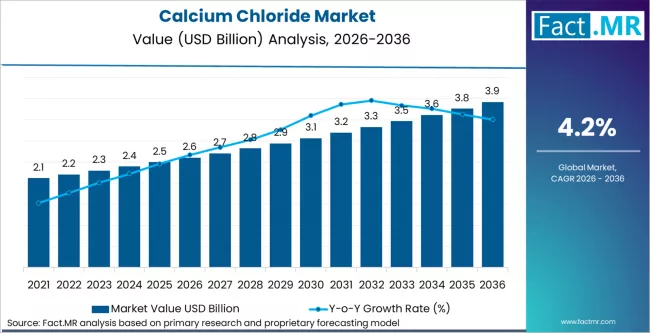
Calcium Chloride Market Market Value Analysis | Source: Fact.MR
| Metric | Value |
|---|---|
| Estimated Value in 2026 | USD 2.6 billion |
| Forecast Value in 2036 | USD 3.9 billion |
| Forecast CAGR (2026 to 2036) | 4.2% |
Source: Fact.MR analysis. Updated Mar 9, 2026
Market Definition
The calcium chloride market covers commercial production and sales of calcium chloride (CaCl₂) in anhydrous, dihydrate, and hexahydrate forms as solids and liquid solutions. Its hygroscopic and exothermic properties support applications in de-icing, dust control, construction stabilisation, oil well fluids, food processing, and water treatment across industrial, food, and pharmaceutical grades.
Market Inclusions
Includes global and regional revenue forecasts (2026-2036) by grade, form, application, and end use, along with pricing trends, trade flow analysis, supply chain costs, and substitution dynamics across major applications.
Market Exclusions
Excludes calcium chloride produced for captive internal use and downstream products where it acts only as a minor additive without separate pricing.
Research Methodology
- Primary Research: Interviews with calcium chloride producers, municipal winter maintenance buyers, construction chemical purchasers, oilfield service specialists, food ingredient procurement managers, and chemical distributors across North America, Europe, and Asia Pacific.
- Desk Research: Analysis of producer earnings reports, USGS mineral summaries, government infrastructure records, USDA food processing statistics, EIA well completion data, and chemical industry publications from 2024-2025.
- Market Sizing and Forecasting: A hybrid model combining top-down consumption estimates by application with bottom-up pricing by grade and form. Seasonal de-icing demand, construction activity indices, and oil and gas rig counts were used to project regional demand.
- Data Validation and Update Cycle: Forecasts validated using producer revenues, USGS production data, municipal procurement records, and global trade statistics, with yearly updates reflecting feedstock price changes and substitution trends.
Summary
- Market Definition
- Calcium chloride is an inorganic salt sold in food, industrial, and pharmaceutical grades in anhydrous, dihydrate, and hexahydrate forms for de-icing, construction, food processing, oil and gas, and water treatment applications.
- Demand Drivers
- Infrastructure growth in India, China, and the Middle East is increasing demand for calcium chloride in concrete acceleration, soil stabilisation, and dust control.
- Ongoing North American oil and gas well completion activity is supporting demand for high-purity calcium chloride brines.
- Expansion of food processing in Asia Pacific, especially cheese and tofu production, is driving food-grade calcium chloride demand.
- Key Segments Analyzed
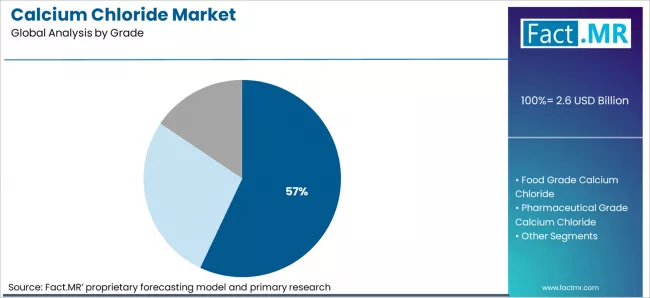
- By Grade: Industrial grade holds about 57% market share in 2026 due to strong demand from de-icing, construction, and oil and gas sectors.
- By Application: De-icing and dust control account for roughly 45% of total market value, supported by municipal winter maintenance programmes.
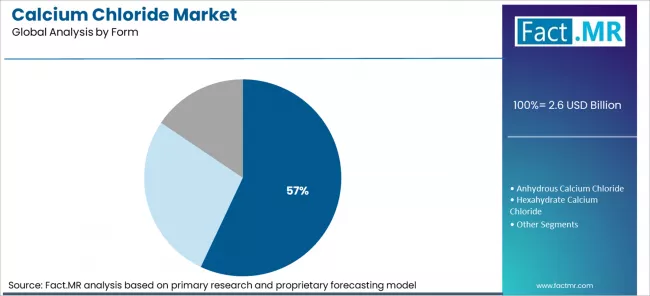
- By Form: Dihydrate calcium chloride leads due to cost efficiency and easier handling across multiple applications.
- By End Use: Municipalities and government agencies dominate procurement through large road de-icing tenders.
- By Geography: North America leads in value, while Asia Pacific leads in volume growth driven by China and India.
- Analyst Opinion at FACT.MR
- Shambhu Nath Jha, Principal Consultant at Fact.MR, states that companies investing in multi-grade production and food or pharmaceutical certifications can capture higher margins in food processing and oilfield fluid markets.
- Strategic Implications
- Producers should expand food and pharmaceutical grade certification to access higher-margin demand.
- Long-term supply contracts with oil and gas operators can stabilize revenue.
- Developing liquid calcium chloride distribution in Asia can support construction and dust control demand.
- Methodology
- Market size estimated using production volumes by grade and form with average selling price benchmarks.
- Municipal procurement data, oil and gas rig counts, and construction activity indices guided demand forecasts.
- Regional projections validated using trade data, infrastructure spending records, food industry output, and industry interviews.
Segmental Analysis
Calcium Chloride Market Analysis by Grade
Calcium Chloride Market Analysis By Grade | Source: Fact.MR
Based on FACT.MR analysis, industrial-grade calcium chloride is expected to hold about 57% market share in 2026 due to its cost efficiency and large-scale use in de-icing, construction, dust control, and oilfield applications.
- OxyChem Industrial Grade Capacity: Occidental Petroleum’s OxyChem division continued stable production of industrial-grade calcium chloride as a co-product of chlor-alkali operations, supporting North American de-icing and construction demand. [4]
- Solvay Food Grade Expansion: In 2025, Solvay expanded food and pharmaceutical grade calcium chloride production in Europe to supply growing cheese, tofu, and food ingredient markets in Europe and Southeast Asia. [5]
- Chinese Industrial Grade Export Growth: China’s calcium chloride exports increased 11% in 2024, driven by demand from construction and dust control projects in Southeast Asia, the Middle East, and Africa. [6]
Calcium Chloride Market Analysis by Form
Calcium Chloride Market Analysis By Form | Source: Fact.MR
According to FACT.MR, dihydrate calcium chloride is projected to dominate the form segment in 2026 due to its balanced concentration, cost efficiency, and ease of handling across major applications.
- Compass Minerals Pellet Investment: In 2024, Compass Minerals upgraded its Michigan facility to expand dihydrate pellet production for the US Midwest de-icing market. [7]
- Anhydrous Brine Technology: In 2025, Tetra Technologies expanded anhydrous calcium chloride processing for high-density brines used in deepwater well completion fluids. [1]
- Liquid Solution Distribution Trend: US Midwest and Northeast municipalities increased procurement of liquid calcium chloride for anti-icing road treatment, with tender volumes rising 9% in 2024-2025. [8]
Key Dynamics
Drivers, Restraints, and Opportunities
FACT.MR analysts view the calcium chloride market as a mature but steadily growing commodity chemical segment driven by diversified demand across construction, food processing, and oil and gas applications. While seasonal de-icing demand in North America and Northern Europe remains the revenue base, rising industrial and food-grade consumption in Asia Pacific is gradually shifting market growth toward emerging economies.
- US EPA Clean Water Act Substitution Pressure: Runoff management policies identifying chloride-based de-icers as contributors to water pollution are encouraging municipalities to reduce usage. Minnesota’s 2024 Chloride Reduction Plan targets a 20% road salt reduction by 2030, increasing substitution with potassium acetate and organic alternatives. [2]
- India Infrastructure Construction Boom: India’s National Infrastructure Pipeline with USD 1.4 trillion investment through 2030 is increasing calcium chloride demand for concrete acceleration, dust control, and soil stabilisation in highway and industrial construction projects. [3]
- Oil and Gas Completion Fluid Demand: The US EIA reported 580 active rigs in North America in January 2025. Growing deepwater and unconventional well completions are sustaining demand for high-density calcium chloride brines used in completion and workover fluids. [1]
Regional Analysis
The calcium chloride market is analysed across Asia Pacific, Europe, North America, Latin America, and Middle East and Africa, spanning 40+ countries with distinct demand profiles shaped by winter maintenance programme scale, construction sector output, oil and gas activity cycles, food processing industry growth, and environmental regulation frameworks. The full report offers market attractiveness analysis across all segments and countries.
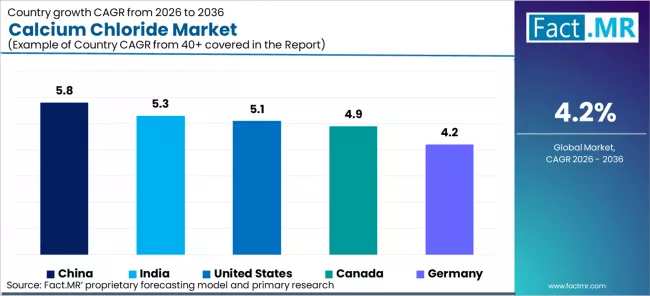
Calcium Chloride Market Cagr Analysis By Country | Source: Fact.MR
| Country | CAGR (2026-2036) |
|---|---|
| China | 5.8% |
| India | 5.3% |
| United States | 5.1% |
| Canada | 4.9% |
| Germany | 4.2% |
Source: Fact.MR analysis. Updated Mar 9, 2026
Source: Fact.MR (FACT.MR) analysis, based on proprietary forecasting model and primary research
North America Calcium Chloride Market Analysis
North America remains the largest calcium chloride market due to extensive winter road maintenance demand and oil and gas completion fluid consumption. Companies such as Compass Minerals International, OxyChem, and Cargill benefit from long-term municipal supply contracts and integrated chlor-alkali production that ensures stable industrial-grade supply.
- United States: The United States calcium chloride market is forecast to expand at around 5.1% CAGR through 2036. Annual de-icing usage exceeds 22 million tonnes of materials across federal, state, and municipal road networks, with calcium chloride used for extreme winter conditions. Infrastructure upgrades funded under the IIJA programme and continued Gulf of Mexico drilling activity are also supporting demand from construction stabilization and completion fluid applications.
- Canada: Canada’s calcium chloride market is expected to grow at approximately 4.9% CAGR through 2036. Demand is supported by large winter road maintenance programmes and extensive unpaved mining access roads requiring dust suppression. Alberta oil sands operations also maintain year-round consumption of calcium chloride brines used in water treatment and well completion processes.
FACT.MR’s North American analysis of the calcium chloride market covers the United States and Canada and includes municipal de-icing procurement data, oilfield brine demand estimates, and application-level growth forecasts.
Asia Pacific Calcium Chloride Market Analysis
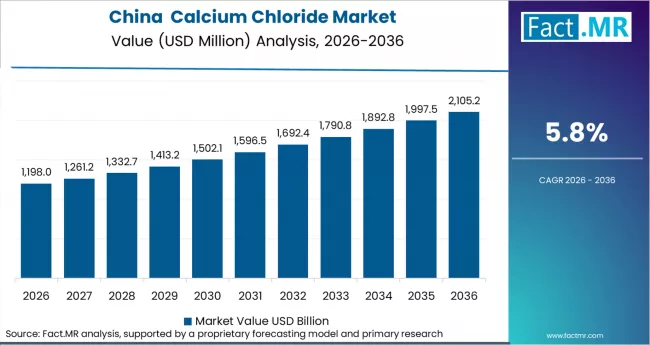
Calcium Chloride Market Country Value Analysis | Source: Fact.MR
Asia Pacific is the fastest-growing calcium chloride region due to expanding infrastructure construction, rising food processing output, and increasing industrial chemical consumption. Chinese manufacturers benefit from integrated soda ash production that lowers calcium chloride manufacturing costs.
- China: China’s calcium chloride market is projected to expand at a CAGR of around 5.8% through 2036, supported by strong infrastructure investment and the world’s largest construction sector. Large infrastructure spending and high cement consumption are sustaining demand for calcium chloride used as a concrete accelerator and site stabilisation agent. The country’s expanding food manufacturing sector is also increasing procurement of food-grade calcium chloride for tofu, dairy, and beverage applications.
- India: India’s calcium chloride market is anticipated to expand at nearly 5.3% CAGR through 2036. Government infrastructure programmes such as the National Infrastructure Pipeline and Bharatmala highway projects are increasing usage for soil stabilisation, dust control, and construction additives. Growing dairy and processed food production is also supporting demand for food-grade calcium chloride.
FACT.MR’s Asia Pacific analysis covers China, India, Japan, South Korea, ASEAN, Australia and New Zealand, and Rest of Asia Pacific, including construction benchmarks, food processing demand trends, and country-level growth forecasts.
Europe Calcium Chloride Market Analysis
Europe represents a balanced calcium chloride market combining food-grade industrial demand with winter de-icing procurement. Producers such as Solvay and Zirax maintain strong positions due to certified high-purity production aligned with EU food and pharmaceutical standards.
- Germany: Germany’s calcium chloride market is expected to register around 4.2% CAGR through 2036. Demand is driven by the country’s large food and beverage industry using calcium chloride for cheese processing, preservation, and water treatment. Winter motorway maintenance programmes also sustain steady municipal procurement volumes.
FACT.MR’s European analysis of the calcium chloride market covers Germany, France, the United Kingdom, Italy, Spain, the Nordics, and Rest of Europe, including certification compliance benchmarks, municipal procurement trends, and environmental regulation impacts.
Competitive Aligners for Market Players
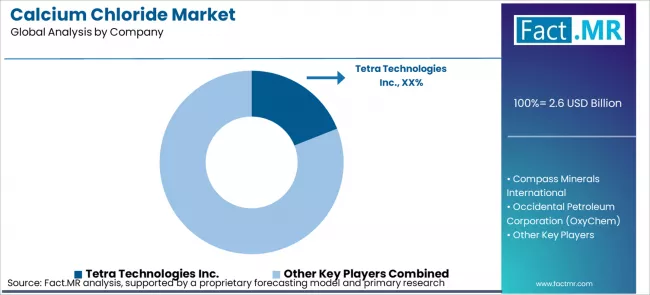
Calcium Chloride Market Analysis By Company | Source: Fact.MR
The global calcium chloride market is moderately fragmented, with a mix of large integrated chemical companies, specialised calcium chloride producers, and regional distributors competing across multiple application segments. Major players such as OxyChem, Solvay, and Compass Minerals hold strong positions in North America and Europe, particularly in higher-value industrial and food-grade segments. At the same time, Chinese manufacturers including Qingdao Huadong, Tangshan Sanyou, and Weifang Haibin operate large production facilities that allow them to supply cost-competitive industrial-grade calcium chloride to global export markets. Together, the top five companies account for roughly 40-45% of total market revenue.
Integrated production structures provide an important competitive advantage in this market. Companies that produce calcium chloride as a by-product of soda ash or chlor-alkali operations often achieve lower production costs than standalone producers. OxyChem’s Gulf Coast chlor-alkali facilities and Solvay’s soda ash-linked production illustrate this cost-efficient model. Meanwhile, Tetra Technologies has developed specialised expertise in high-density completion brines, giving it a strong position in oil and gas well completion applications.
Customer purchasing behavior also shapes competition. Municipal buyers prioritise cost and supply reliability through annual tenders, while food and pharmaceutical industries rely on long-term relationships with certified suppliers.
Recent Development
- In January 2025, Compass Minerals International announced the renewal of multi-year municipal calcium chloride supply contracts with state departments of transportation in Ohio, Michigan, and Illinois covering liquid and solid de-icing product supply for the 2025-2027 winter seasons, reinforcing its position as the primary institutional de-icing calcium chloride supplier in the US Midwest.
- In February 2025, Solvay S.A. confirmed commercial launch of its expanded food-grade and pharmaceutical-grade calcium chloride product line from its Rheinberg, Germany facility, targeting European dairy processors and pharmaceutical excipient buyers with EN 233 and BP/USP pharmacopoeia-certified calcium chloride dihydrate grades.
Key Players
- Tetra Technologies Inc.
- Compass Minerals International
- Occidental Petroleum Corporation (OxyChem)
- Solvay S.A.
- Cargill Incorporated
- Ward Chemical Limited
- Zirax Limited
- Qingdao Huadong Calcium Producing Co.
- Tangshan Sanyou Chemical Industries Co.
- Weifang Haibin Chemical Co.
Bibliography
- [1] Tetra Technologies Inc. 2024. Q3 2024 Earnings Call Transcript: Completion Fluids Division Revenue Commentary and Calcium Chloride Brine Demand Outlook. Tetra Technologies Investor Relations, October 2024. tetratec.com
- [2] Minnesota Pollution Control Agency. 2024. Chloride Reduction Plan 2024 Update: Road Salt Application Reduction Targets for Priority Watershed Districts. MPCA Environmental Quality Division, December 2024. pca.state.mn.us
- [3] National Highways Authority of India. 2025. Annual Report FY2024-25: Bharatmala Pariyojana Contract Award Summary and Highway Construction Progress. NHAI Publications, March 2025. nhai.gov.in
- [4] Occidental Petroleum Corporation. 2024. Q3 2024 Earnings Release: OxyChem Chlor-Alkali and Calcium Chloride Co-Product Operations Update. OxyChem Investor Relations, October 2024. oxy.com
- [5] Solvay S.A. 2025. Product Launch Announcement: Expanded Food and Pharmaceutical Grade Calcium Chloride Dihydrate from Rheinberg Facility with EN 233 and BP/USP Certification. Solvay Press Release, February 2025. solvay.com
- [6] General Administration of Customs, People's Republic of China. 2025. China Chemical Export Statistics 2024: Calcium Chloride Export Volume and Destination Market Data. GACC Trade Statistics Release, January 2025. customs.gov.cn
- [7] Compass Minerals International. 2024. Q4 2024 Earnings Call Transcript: Calcium Chloride Production Capacity Investment and Municipal De-icing Contract Renewal Update. Compass Minerals Investor Relations, November 2024. compassminerals.com
- [8] American Public Works Association. 2025. Winter Maintenance Operations Survey 2024-2025: Liquid Calcium Chloride Anti-Icing Procurement Volume Trends Across US State DOTs. APWA Infrastructure Services Research, January 2025. apwa.net
- [9] Cargill Incorporated. 2025. Press Release: Calcium Chloride Winter Road Safety Product Distribution Expansion and Municipal Contract Awards for 2025-2026 Season. Cargill Corporate Communications, January 2025. cargill.com
- [10] Ultratech Cement Ltd. 2024. Q2 FY2025 Earnings Release: Construction Chemical Admixture Demand Commentary and Infrastructure Project Pipeline Execution. Ultratech Investor Relations, October 2024. ultratechcement.com
This Report Addresses
- Strategic insights on US IIJA construction demand, India NIP infrastructure procurement, China soda ash-linked production, Germany food-grade demand, and oil and gas brine usage in Canada and the Middle East.
- Market size and forecast from USD 2.6 billion in 2026 to USD 3.9 billion by 2036 at a 4.2% CAGR, segmented by grade, form, application, end use, and region.
- Growth opportunities in Asian food-grade certification, deepwater anhydrous brine demand, North American liquid anti-icing adoption, and Middle East infrastructure supply.
- Country CAGR outlook including China (5.8%), India (5.3%), United States (5.1%), Canada (4.9%), and Germany (4.2%) with application and regulatory analysis.
- Competitive analysis of OxyChem, Solvay, Compass Minerals, Tetra Technologies, Cargill, Zirax, Ward Chemical, Qingdao Huadong, Tangshan Sanyou, and Weifang Haibin.
- Product and technology developments including high-density brine formulations, food-grade certified production, liquid anti-icing distribution, and pharmaceutical-grade certification.
- Regulatory impact analysis covering US EPA runoff rules, Minnesota Chloride Reduction Plan, Germany UBA guidelines, EU E509 compliance, API brine standards, and India BIS certification.
- Report delivered through Excel datasets, PowerPoint summary, and detailed PDF supported by USGS data, industry reports, procurement records, and primary interviews.
Segmentation
Scope of Report
| Items | Values |
|---|---|
| Quantitative Units | USD 2.6 billion (2026) to USD 3.9 billion (2036), at a CAGR of 4.2% |
| Market Definition | Calcium chloride is an inorganic salt available in food, industrial, and pharmaceutical grades in anhydrous, dihydrate, and hexahydrate forms, used for de-icing, dust control, construction, oil and gas fluids, food processing, and water treatment globally. |
| Grade Segmentation | Food Grade Calcium Chloride, Industrial Grade Calcium Chloride (57%), Pharmaceutical Grade Calcium Chloride |
| Form Segmentation | Anhydrous Calcium Chloride, Dihydrate Calcium Chloride, Hexahydrate Calcium Chloride |
| Application Segmentation | De-icing and Dust Control (45%), Construction, Food and Beverages, Oil and Gas, Water Treatment, Others |
| End Use Segmentation | Municipalities and Government Agencies, Construction Companies, Food and Beverage Manufacturers, Oil and Gas Companies, Chemical Processing Companies, Others |
| Application Coverage | Municipal road de-icing, construction dust control, concrete acceleration, soil stabilisation, oil and gas completion brines, cheese and tofu coagulation, beverage fortification, and water treatment. |
| Regions Covered | Asia Pacific, Europe, North America, Latin America, Middle East and Africa |
| Countries Covered | United States, China, Canada, India, Germany, Japan, South Korea, France, United Kingdom, Italy, Spain, Brazil, ASEAN, Australia & New Zealand, Rest of regions |
| Key Companies Profiled | Tetra Technologies Inc., Compass Minerals International, Occidental Petroleum Corporation (OxyChem), Solvay S.A., Cargill Incorporated, Ward Chemical Limited, Zirax Limited, Qingdao Huadong Calcium Producing Co., Tangshan Sanyou Chemical Industries Co., Weifang Haibin Chemical Co. |
| Forecast Period | 2026 to 2036 |
| Approach | A hybrid top-down and bottom-up approach was used. Top-down inputs included construction activity, municipal road maintenance budgets, oil and gas rig counts, food processing output, and winter severity data, while bottom-up analysis used average selling prices, procurement volumes, brine pricing, and distributor margin insights from primary research. |
Source: Fact.MR analysis. Updated Mar 9, 2026
Calcium Chloride Market by Segments
-
Grade :
- Food Grade Calcium Chloride
- Industrial Grade Calcium Chloride
- Pharmaceutical Grade Calcium Chloride
-
Form :
- Anhydrous Calcium Chloride
- Dihydrate Calcium Chloride
- Hexahydrate Calcium Chloride
-
Application :
- De-icing and Dust Control
- Construction
- Food and Beverages
- Oil and Gas
- Water Treatment
- Others
-
End Use :
- Municipalities and Government Agencies
- Construction Companies
- Food and Beverage Manufacturers
- Oil and Gas Companies
- Chemical Processing Companies
- Others
-
Region :
- North America
- USA
- Canada
- Mexico
- Latin America
- Brazil
- Chile
- Rest of Latin America
- Western Europe
- Germany
- UK
- Italy
- Spain
- France
- Nordic
- BENELUX
- Rest of Western Europe
- Eastern Europe
- Russia
- Poland
- Hungary
- Balkan & Baltic
- Rest of Eastern Europe
- East Asia
- China
- Japan
- South Korea
- South Asia and Pacific
- India
- ASEAN
- Australia & New Zealand
- Rest of South Asia and Pacific
- Middle East & Africa
- Kingdom of Saudi Arabia
- Other GCC Countries
- Turkiye
- South Africa
- Other African Union
- Rest of Middle East & Africa
- North America
Frequently Asked Questions
How large is the calcium chloride market in 2025?
What will the market size be in 2026?
What is the projected market size by 2036?
What is the expected CAGR for the forecast period 2026 to 2036?
Which grade segment leads the calcium chloride market?
Which application holds the largest market share?
Which country shows the fastest growth rate?
How fast is the market expected to expand in India?
What is the forecast CAGR for the United States?
What are the primary restraints in this market?
Who worked on this report


Preview the report firsthand - request a free sample
Free SampleGet the brochure for pricing and purchase details
Download PDF