- Market Value (2025): USD 1.47 Bn
- Estimated Value (2026): USD 1.58 Bn
- Forecast Value (2036): USD 3.25 Bn
- CAGR (2026-2036): 7.5%
What is the Cholesterol Management Devices Market forecast to be worth by 2036?
USD 1.58 billion in 2026 to USD 3.25 billion by 2036 at a 7.5% CAGR.
- Cholesterol management devices revenue came to USD 1.47 billion in 2025, with spending spread across hospital, laboratory, pharmacy and homecare users.
- Revenue will move from USD 1.58 billion in 2026 to USD 3.25 billion by 2036, more than doubling as lipid checks become a standard step in cardiovascular prevention.
- A 7.5% CAGR reflects wider point-of-care testing, growing interest in home monitoring and new screening routes through community pharmacies.
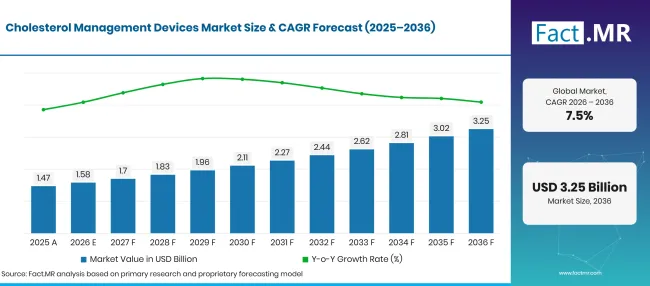
Cholesterol Management Devices Market Forecast Global | Source: Fact.MR
| Year | Basis | Market Value (USD billion) |
|---|---|---|
| 2025 | Actual | 1.47 |
| 2026 | Estimate | 1.58 |
| 2036 | Forecast | 3.25 |
| CAGR 2026 to 2036 | Forecast period | 7.5% |
Source: Fact.MR analysis. Updated Nov 5, 2026
What are the defining numbers behind Cholesterol Management Devices Market growth?
The 2026 to 2036 period adds USD 1.7 billion in new value, with portable monitors, hospital lipid profiling and pharmacy screening carrying most of the gain.
- Demand Drivers in the Market
- Cardiovascular disease keeps lipid testing on every prevention agenda. WHO reports that 19.8 million people died from cardiovascular diseases in 2022, about 32% of all global deaths [1]. Raised blood lipids are one of the main modifiable risk factors, so clinicians order more cholesterol checks as part of routine risk assessment.
- Undiagnosed dyslipidaemia leaves a wide testing gap. An estimated 39% of adults worldwide have raised total cholesterol, and elevated LDL cholesterol caused an estimated 3.6 million deaths in 2023 [2]. WHO also notes that guidance increasingly permits non-fasting lipid tests, which makes a quick finger-prick check more practical.
- Point-of-care analysers shorten the path from sample to decision. Compact systems give total cholesterol, HDL, LDL and triglycerides from a few drops of capillary blood. A clinician can then discuss the result and start treatment in the same visit.
- Community pharmacies are becoming screening sites. NHS England plans seven-minute cholesterol checks in around 100 pharmacies for people aged 40 to 84, following a north London pilot that tested 2,493 patients [3]. Each new pharmacy site adds demand for analysers, strips and controls.
- Key Segments Analyzed
- By Product Type: Monitors will hold 56.7% of 2026 value, since a single analyser generates repeat strip and control purchases at every testing site.
- By End-User: Hospitals will account for 35.6% in 2026, given their role in full lipid profiling, specialist review and inpatient cardiovascular care.
- By Distribution Channel: Pharmacies will capture 39.2% of 2026 sales, as shoppers can buy a home monitor and get a professional check at the same counter.
- Analyst Opinion at Fact.MR
- Shambhu Nath Jha, Principal Consultant at Fact.MR, states, “Cholesterol testing will follow the path glucose testing took a generation ago, with the first check happening in a pharmacy or at home and the laboratory confirming the result. Suppliers that pair accurate handheld analysers with dependable strip supply and simple data links into patient records will win the repeat business. Price per test will stay the deciding factor in Brazil and other cost-sensitive health systems, so low-cost formats will carry much of the volume gain there.”
- Strategic Implications
- Manufacturers should prove that handheld results agree closely with laboratory methods, since pharmacy and primary care buyers now ask for comparison data before they sign a supply contract.
- Distributors should keep strips, controls and capillary tubes in stock across pharmacy chains, because a monitor without consumables stops earning on the day supply runs short.
- Healthcare buyers should weigh cost per reportable result over instrument price, and should check whether the analyser can send readings to the patient record.
- Investors should track national screening programmes in England, Germany and Japan, where written test requirements create steady and predictable strip volumes.
Germany will lead the five countries at 8.7%, as statutory check-ups every three years from age 35 include a full laboratory lipid panel. Brazil follows at 8.0%, where a low testing base and a public clinical protocol for dyslipidaemia leave room for fast catch-up. The United States, at 7.2%, combines a large installed base with a rising share of adults told they have high cholesterol. The United Kingdom will grow at 6.5% as pharmacy checks spread beyond the pilot stage. Japan closes the range at 5.7%, since its mandatory workplace examinations already cover lipids and leave less untested demand.
How does the Cholesterol Management Devices Market break down by segment?
Monitors will lead Product Type at 48.3%; Hospitals will head End-User at 35.6%; Pharmacies will top Distribution Channel at 39.2% in 2026.
Which Product Type leads?
Monitors take 48.3% of 2026 sales.
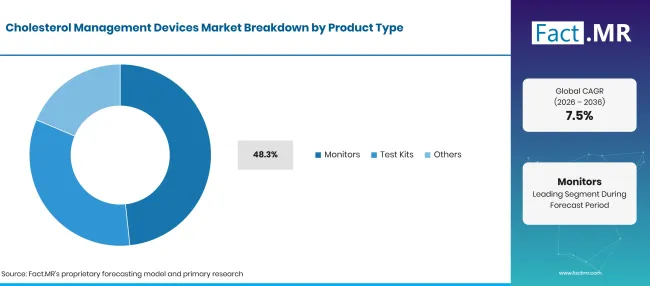
Cholesterol Management Devices Market Breakdown Product Type | Source: Fact.MR
| Product Type | Share (2026) |
|---|---|
| Monitors (Leading segment) | 48.3% |
| Other segments combined | 43.3%* |
| Total | 100.0% |
Source: Fact.MR analysis. Updated Nov 5, 2026
Clinics, pharmacies and home users want a reading they can act on during the same visit, and a handheld analyser delivers that from a finger-prick sample. Abbott’s Afinion Lipid Panel reports a full lipid profile, including non-HDL cholesterol, on its point-of-care system. Roche’s cobas b 101 runs a lipid panel and HbA1c on one benchtop unit. Buyers comparing formats often start from the wider point-of-care lipid test category. Test kits and strips follow the installed base of monitors, so their sales rise with every new screening site. The other product group covers lipid controls, calibrators and single-use home kits. Many of these products borrow design and supply models from blood glucose monitoring devices, where strip revenue has long outpaced meter revenue.
What supports Hospitals within End-User?
Hospitals represent 35.6% of 2026 revenue.
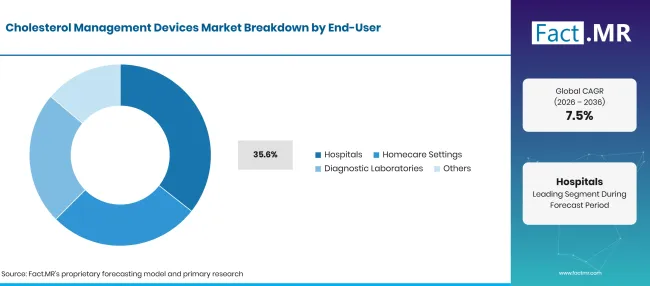
Cholesterol Management Devices Market Breakdown End User | Source: Fact.MR
| End-User | Share (2026) |
|---|---|
| Hospitals (Leading segment) | 35.6% |
| Other segments combined | 64.4%* |
| Total | 100.0% |
Source: Fact.MR analysis. Updated Nov 5, 2026
Hospital laboratories run the confirmatory profiles that guide statin and injectable therapy, and they add newer markers to the panel. Roche received FDA 510(k) clearance in January 2025 for the first U.S. test that measures lipoprotein(a) in molar units, available on its cobas c chemistry analysers [4]. Beckman Coulter issued an updated LDL cholesterol assay instruction for its AU and DxC AU analysers in November 2025 [5]. Homecare settings and diagnostic laboratories each draw on different products. Home users buy compact meters for regular self-checks, while reference laboratories process high volumes on automated chemistry lines that also run cardiac biomarkers. Patients on cholesterol lowering biologic drugs need repeat LDL monitoring, which keeps hospital and laboratory test volumes steady.
What leads the Distribution Channel segment?
Pharmacies hold 39.2% of 2026 demand.
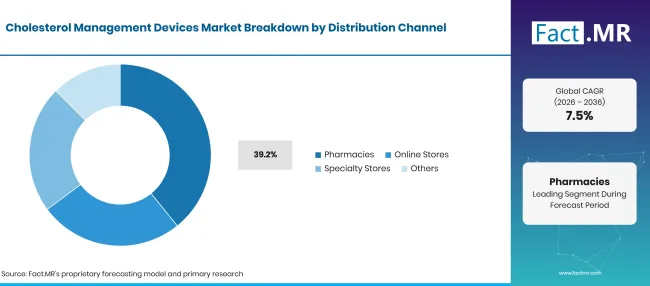
Cholesterol Management Devices Market Breakdown Distribution Channel | Source: Fact.MR
| Distribution Channel | Share (2026) |
|---|---|
| Pharmacies (Leading segment) | 39.2% |
| Other segments combined | 60.8%* |
| Total | 100.0% |
Source: Fact.MR analysis. Updated Nov 5, 2026
A shopper who wants a quick check can walk into a pharmacy without an appointment and leave with a result and advice from a pharmacist. The same counter sells home monitors, strips and lancets, so one visit often produces both a service test and a product sale. Pharmacists can also refer people with high readings to a general practitioner. Online stores serve repeat buyers of strips and home meters, though shoppers there lose the face-to-face guidance a pharmacist gives. Specialty stores and other channels supply clinics, workplaces and screening providers that buy in bulk.
What is accelerating Cholesterol Management Devices Market adoption, and what is holding it back?
Wider awareness of cardiovascular risk, new pharmacy screening routes and demand for same-visit results are drawing more people into cholesterol testing. Instrument prices and recurring strip costs still slow uptake in cost-sensitive systems. Differences in accuracy between formats, together with thin diagnostic infrastructure in parts of Latin America and Africa, limit how far decentralised testing can reach.
Drivers Impact Analysis
| DRIVER | (~) % IMPACT ON CAGR | GEOGRAPHIC RELEVANCE | IMPACT TIMELINE |
|---|---|---|---|
| Increasing cardiovascular disease burden and demand for early lipid assessment | +2.4% | Global | Medium term (2-4 years) |
| Expansion of point-of-care cholesterol testing | +1.9% | North America, Western Europe, East Asia | Short term (<=2 years) |
| Greater availability of pharmacy-based screening services | +1.5% | Western Europe, North America | Medium term (2-4 years) |
| Rising adoption of portable and home-based cholesterol monitoring | +1.2% | Global | Long term (>=4 years) |
Source: Fact.MR analysis. Updated Nov 5, 2026
Opportunity Impact Analysis
| OPPORTUNITY | (~) % IMPACT ON CAGR | GEOGRAPHIC RELEVANCE | IMPACT TIMELINE |
|---|---|---|---|
| Development of compact monitors with multi-parameter lipid testing | +1.1% | Global | Medium term (2-4 years) |
| Expansion of pharmacy-based cholesterol screening programmes | +0.9% | Western Europe, North America | Medium term (2-4 years) |
| Affordable cholesterol testing solutions for emerging healthcare markets | +0.7% | Latin America, South Asia & Pacific | Long term (>=4 years) |
| Integration of portable lipid testing with digital health records | +0.5% | North America, Western Europe, East Asia | Long term (>=4 years) |
Source: Fact.MR analysis. Updated Nov 5, 2026
Restraints Impact Analysis
| RESTRAINT | (~) % IMPACT ON CAGR | GEOGRAPHIC RELEVANCE | IMPACT TIMELINE |
|---|---|---|---|
| High instrument and recurring test-strip costs | -0.8% | Global | Short term (<=2 years) |
| Variations in measurement accuracy and quality across testing formats | -0.6% | Global | Medium term (2-4 years) |
| Limited access to diagnostic infrastructure and trained personnel | -0.5% | Latin America, South Asia & Pacific, Middle East & Africa | Medium term (2-4 years) |
Source: Fact.MR analysis. Updated Nov 5, 2026
Which countries are scaling the Cholesterol Management Devices Market through 2036?
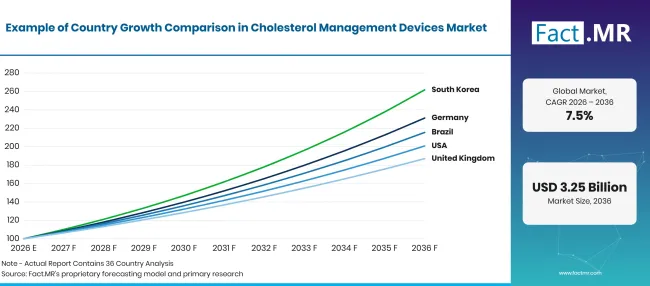
Cholesterol Management Devices Market Growth Index | Source: Fact.MR
| Country | CAGR (2026 to 2036) |
|---|---|
| Germany | 8.7% |
| Brazil | 8.0% |
| United States | 7.2% |
| United Kingdom | 6.5% |
| Japan | 5.7% |
Source: Fact.MR analysis. Updated Nov 5, 2026
What supports adoption in Germany?
8.7% CAGR, backed by statutory check-ups that include a full lipid panel.
Germany’s statutory health insurance gives adults a general health examination once between 18 and 34 and every three years from age 35. From 35 onward the examination includes laboratory tests of total, LDL and HDL cholesterol, according to a February 2026 Bundestag report [6]. Federal Statistical Office data show that the ten most common cardiovascular causes of death accounted for 252,506 deaths in 2025 [7]. This combination keeps laboratory analysers busy and opens space for point-of-care checks in general practice.
How is Brazil developing demand?
8.0% CAGR, driven by catch-up testing in the public health system.
Brazil’s Ministry of Health maintains a clinical protocol and therapeutic guideline for dyslipidaemia within the SUS, with the official page updated in January 2025 [8]. The Ministry’s Vigitel 2025 results show diagnosed hypertension in adults rising to 29.7% and diagnosed diabetes to 12.9% in 2024 [9]. Patients with these conditions need regular lipid checks, so primary care units are adding low-cost analysers and test strips to their routine.
What is supporting adoption in the United States?
7.2% CAGR, reflecting rising awareness of high cholesterol.
A CDC study published in March 2026 found that the share of screened adults told they have high cholesterol rose from 29.2% to 33.2% between 2019 and 2023, a 13.7% relative increase [10]. The relative rise reached 28.3% among adults aged 18 to 44, a group that rarely visits a laboratory. Retail clinics and employer wellness programmes reach these younger adults with handheld analysers.
How is the United Kingdom developing demand?
6.5% CAGR, helped by the move of cholesterol checks into pharmacies.
An NHS pilot tested 2,493 people at 61 community pharmacies in north London between January 2025 and March 2026, and about one in five were at high risk of heart attack or stroke within ten years [3]. NHS England will now offer the seven-minute check in around 100 pharmacies until spring 2027. Each site needs a compact analyser, strips and quality controls.
What supports Japan’s adoption?
5.7% CAGR, as workplace health examinations keep lipid tests mandatory.
A Ministry of Health, Labour and Welfare notice issued in July 2026 confirmed that blood lipid testing in periodic health examinations will continue to cover LDL cholesterol, HDL cholesterol and triglycerides [11]. Employers must arrange these examinations every year, so lipid test volumes are high but already well established. Growth will come mainly from replacing older laboratory systems and from home monitoring among older adults.
Who leads the Cholesterol Management Devices Market?
Competition splits into two tiers that meet at the clinic door. Abbott, Roche, Siemens Healthineers and Beckman Coulter form the first tier and supply hospital chemistry lines. Abbott and Roche also sell widely used professional point-of-care analysers. They compete on assay accuracy, menu breadth and service contracts, and they keep adding cardiovascular markers: Roche gained FDA clearance for a molar-unit lipoprotein(a) test in January 2025 [4] and ran an ADLM 2025 workshop on closing gaps in Lp(a) testing [12].
Focused suppliers such as PTS Diagnostics with CardioChek and ACON Laboratories with Mission Cholesterol win in pharmacies, wellness screening and home use on low cost per test. Randox supplies lipid reagents and controls that run on many laboratory platforms. Over the forecast period, the suppliers that link handheld results to patient records while holding strip prices down will gain share from pharmacy and primary care growth.
Which companies are the key providers?
Key companies in the Cholesterol Management Devices Market include Abbott, Roche, Siemens Healthineers, Beckman Coulter, PTS Diagnostics, ACON Laboratories and Randox Laboratories.
- Abbott
- Roche
- Siemens Healthineers
- Beckman Coulter
- PTS Diagnostics
- ACON Laboratories
- Randox Laboratories
Bibliography
- [1] World Health Organization. (2025, July 31). Cardiovascular diseases (CVDs).
- [2] World Health Organization. (2026, September 15). Dyslipidaemia.
- [3] NHS England. (2026, August). High-street pharmacies to launch seven-minute cholesterol checks.
- [4] Roche Diagnostics. (2025, January 29). Roche receives FDA 510(k) clearance for the first blood test in the U.S. measuring Lp(a) in molar units.
- [5] Beckman Coulter. (2025, November). LDL-Cholesterol (OSR6196, OSR6296): Instructions for Use.
- [6] Deutscher Bundestag. (2026, February 3). Früherkennung von erhöhten Cholesterinwerten.
- [7] Statistisches Bundesamt. (2026, October 9). Häufigste Todesfälle durch Herz-Kreislauf-Erkrankungen 2025.
- [8] Ministério da Saúde. (2025, January 20). Dislipidemia: Protocolo Clínico e Diretrizes Terapêuticas.
- [9] Ministério da Saúde. (2026). Viva Mais Brasil: mais saúde na vida dos brasileiros (Resultados Vigitel 2025).
- [10] Centers for Disease Control and Prevention. (2026, March 5). Increase in Prevalence of Self-Reported High Blood Cholesterol Among Adults, United States, 2019 to 2023.
- [11] Ministry of Health, Labour and Welfare. (2026, July 31).
- [12] Roche Diagnostics. (2025, July 24). Roche Diagnostics showcases science-driven leadership and innovation at ADLM 2025.
This Report Answers
- How do monitors, test kits and other cholesterol testing products divide market revenue?
- Why do hospitals and pharmacies lead their segments, and which reasons explain their 2026 shares?
- Where do Germany, Brazil, the United States, the United Kingdom and Japan differ on screening rules and test access?
- Which suppliers compete in hospital chemistry and which ones win in pharmacy and home testing?
- What do strip costs, accuracy requirements and consumable supply mean for adoption outside the laboratory?
- How will pharmacy screening and record-linked results change buying decisions to 2036?
What does the Cholesterol Management Devices Market cover?
This market tracks devices and testing systems that measure total cholesterol, LDL cholesterol, HDL cholesterol and triglycerides. Portable monitors, point-of-care analysers, compatible test strips and laboratory lipid testing systems form the core product groups.
Revenue is valued at manufacturer selling prices across all four end-user groups and all four distribution channels. Units are in USD billion.
What is included in the scope?
Portable cholesterol monitors and point-of-care lipid analysers used by professionals and by patients at home.
Cholesterol test kits, strips, cartridges and capillary tubes designed for those monitors.
Laboratory lipid assays, calibrators and controls used for cholesterol measurement on chemistry analysers.
Home monitoring kits sold through pharmacies and online stores, including devices that share readings with home healthcare services.
What is excluded from the scope?
Cholesterol-lowering medicines, including statins and products tracked under lipid metabolism modulators.
Cardiovascular treatment devices that do not measure lipid levels.
Laboratory testing services billed without device, reagent or strip revenue.
General blood collection products and health software with no cholesterol measurement function.
How Was the Analysis Built?
The analysis draws on 120+ sources, 35+ company portfolios, 25+ countries, and more than 20 industry interviews.
- Primary Research: Primary research includes discussions with manufacturers, service providers, technology developers, distributors, end users, and subject-matter experts. These conversations examine purchasing priorities, product adoption, operational challenges, approval requirements, competitive positioning, and the factors that influence wider market acceptance.
- Desk Research: Desk research covers government statistics, regulatory publications, company filings, trade data, technical studies, industry associations, standards, public policy, and other authoritative sources. Every source used in the analysis is documented in the bibliography.
- Market Sizing and Forecasting: Market estimates combine historical performance, demand indicators, pricing and volume trends, segment shares, company participation, country-level growth, adoption patterns, investment activity, and barriers to market expansion.
- Data Validation and Update Cycle: Findings are validated by comparing primary interviews with public data, company activity, regulatory changes, trade patterns, and industry developments. Regular updates review new product launches, capacity changes, partnerships, approvals, and shifts in commercial adoption.
Segmentation
What is the report’s scope and coverage?
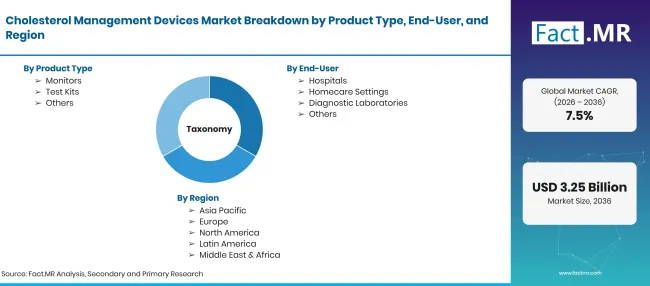
Cholesterol Management Devices Market Taxonomy | Source: Fact.MR
| Attribute | Details |
|---|---|
| Quantitative Units | USD billion |
| Market Definition | Devices and testing systems used to measure and monitor blood cholesterol and related lipid parameters, including portable monitors, test kits and laboratory lipid testing systems. |
| Product Type | Monitors; Test Kits; Others |
| End-User | Hospitals; Homecare Settings; Diagnostic Laboratories; Others |
| Distribution Channel | Pharmacies; Online Stores; Specialty Stores; Others |
| Regions Covered | North America; Latin America; Western Europe; Eastern Europe; East Asia; South Asia & Pacific; Middle East & Africa |
| Countries Covered | Germany; Brazil; United States; United Kingdom; Japan |
| Companies Profiled | Abbott; Roche; Siemens Healthineers; Beckman Coulter; PTS Diagnostics; ACON Laboratories; Randox Laboratories |
| Forecast Period | 2026 to 2036 |
| Approach | Hybrid top-down and bottom-up model built on cholesterol testing volumes by country, monitor and test-kit installed base, end-user demand and channel mix. |
Source: Fact.MR analysis. Updated Nov 5, 2026
How is the market segmented?
-
By Product Type
- Monitors
- Test Kits
- Others
-
By End-User
- Hospitals
- Homecare Settings
- Diagnostic Laboratories
- Others
-
By Distribution Channel
- Pharmacies
- Online Stores
- Specialty Stores
- Others
-
By Region
- North America
- Latin America
- Western Europe
- Eastern Europe
- East Asia
- South Asia & Pacific
- Middle East & Africa
Frequently Asked Questions
How large is the cholesterol management devices market in 2026?
What growth rate will the cholesterol management devices market record?
Which product type leads?
Which end-user leads?
Which distribution channel leads?
Which country will grow quickest?
Who are the main companies?
What holds the market back?
Who worked on this report


Preview the report firsthand - request a free sample
Free SampleGet the brochure for pricing and purchase details
Download PDF