Chromium VI Reduction Chemicals Market

Chromium VI Reduction Chemicals Market Size and Share Forecast Outlook 2026 to 2036

Chromium vi reduction chemicals market is projected to grow from USD 410.0 million in 2026 to USD 927.0 million by 2036, at a CAGR of 8.5%. Sodium Metabisulfite / Bisulfite will dominate with a 30.0% market share, while industrial wastewater (textile, tanneries, chemicals) will lead the end-use industry segment with a 38.0% share.

Chromium VI Reduction Chemicals Market Forecast and Outlook 2026 to 2036

The global market for chromium VI (hexavalent chromium) reduction chemicals is projected to reach USD 927.00 million by 2036. The market is valued at USD 410.00 million in 2026 and is set to rise at a compound annual growth rate (CAGR) of 8.5% during the assessment period.

Key Takeaways from the Chromium VI Reduction Chemicals Market

  • Market Value for 2026: USD 410.00 Million
  • Market Value for 2036: USD 927.00 Million
  • Forecast CAGR (2026-2036): 8.5%
  • Leading Chemical Type Share (2026): Sodium Metabisulfite / Bisulfite (30%)
  • Leading End-Use Industry Share (2026): Industrial Wastewater (Textile, Tanneries, Chemicals) (38%)
  • Leading Treatment Method Share (2026): Chemical Reduction & Precipitation (42%)
  • Key Players in the Market: Kemira Oyj., Solenis, Ecolab Inc., Kurita Water Industries, Aditya Birla Chemicals
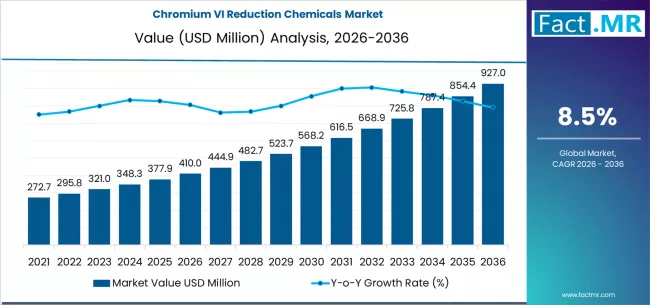
Chromium Vi Reduction Chemicals Market Market Value Analysis

By chemical type, sodium metabisulfite and bisulfite hold a leading 30% share. The end-use industry for industrial wastewater treatment represents the dominant application at 38%. Chemical reduction and precipitation is the foremost treatment method, accounting for a 42% share.

This growth is driven by stringent global regulations classifying Cr(VI) as a carcinogen and enforcing strict discharge limits. Industries generating Cr(VI) in their waste streams are mandated to treat it by reducing it to the less toxic and less mobile trivalent form (Cr III) before disposal or further treatment.

Chromium VI reduction chemicals are critical for environmental compliance and occupational safety. Their application ensures that hazardous hexavalent chromium is converted into a stable, precipitable form, mitigating risks to human health and the environment from industrial effluents and contaminated sites.

Chromium VI Reduction Chemicals Market

Metric Value
Market Value (2026) USD 410.00 Million
Market Forecast Value (2036) USD 927.00 Million
Forecast CAGR (2026-2036) 8.5%

Category

Category Segments
Chemical Type Sodium Metabisulfite/Bisulfite, Ferrous Sulfate/Iron-Based Reductants, Sulfur Dioxide & Sulfite Systems, Zero-Valent Iron/Nano-Iron, Other Specialty Reduction Chemicals
End-Use Industry Industrial Wastewater (Textile, Tanneries, Chemicals), Metal Plating & Surface Treatment, Mining & Metallurgical Waste Streams, Municipal/Groundwater Remediation, Other Environmental Services
Treatment Method Chemical Reduction & Precipitation, In-Situ Soil & Groundwater Remediation, Batch/Continuous Reactor Systems, Hybrid Chemical–Biological Reduction, Other Advanced Reduction Techniques
Region North America, Latin America, Western Europe, Eastern Europe, East Asia, South Asia & Pacific, MEA

Segmental Analysis

By Chemical Type, Which Reducing Agent is Most Prevalent in Industrial Applications?
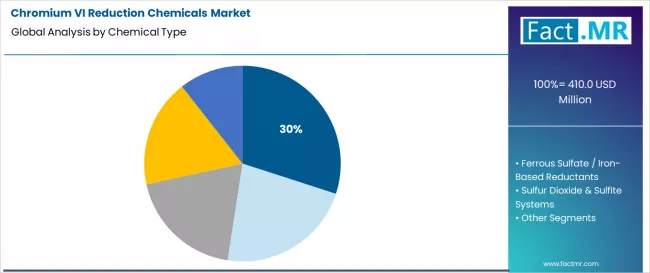
Chromium Vi Reduction Chemicals Market Analysis By Chemical Type

Sodium metabisulfite and bisulfite lead the segment with a 30% share. Their dominance is due to their high reduction efficiency, rapid reaction kinetics, ease of handling in liquid or solid form, and cost-effectiveness.

These sulfite-based chemicals provide reliable and predictable reduction of Cr(VI) to Cr(III) across a range of pH levels commonly encountered in industrial wastewater, making them the standard choice for many electroplating, tannery, and chemical manufacturing facilities.

By End-Use Industry, Which Sector Generates the Highest Volume of Cr(VI) Waste?
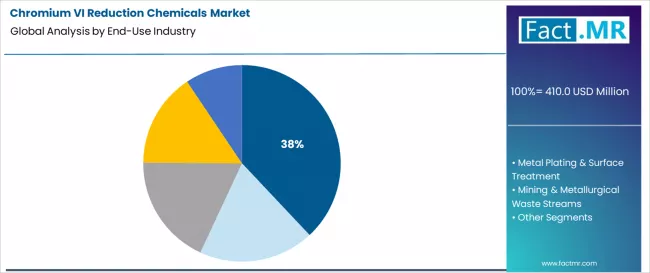
Chromium Vi Reduction Chemicals Market Analysis By End Use Industry

Industrial wastewater treatment, particularly from textiles, tanneries, and chemical production, represents the largest end-use industry with a 38% share. These industries use chromium compounds in dyes, tanning agents, and catalysts, resulting in effluent streams with significant Cr(VI) concentrations.

Strict, enforceable discharge permits and the high toxicity of the contaminant create non-negotiable demand for effective reduction chemicals to achieve compliance and avoid severe penalties.

By Treatment Method, Which Process is the Industry Standard for Compliance?
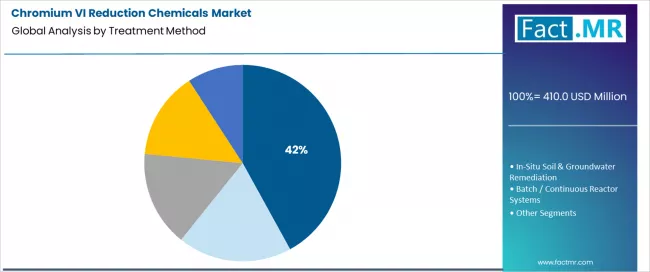
Chromium Vi Reduction Chemicals Market Analysis By Treatment Method

Chemical reduction followed by precipitation is the leading treatment method with a 42% share. This two-step process is well-established, effective, and widely accepted by regulators. First, a reducing agent converts soluble Cr(VI) to Cr(III).

Then, the pH is adjusted to precipitate Cr(III) as chromium hydroxide, which can be removed as sludge. The method's reliability, scalability, and clear validation pathway make it the default compliance technology for most point-source industrial discharges.

What are the Drivers, Restraints, and Key Trends of the Chromium VI Reduction Chemicals Market?

The primary market driver is the global expansion and tightening of regulations governing Cr(VI) emissions and occupational exposure, such as OSHA standards in the USA and REACH in Europe. Increasing environmental liability and the high costs associated with site remediation for historical Cr(VI) contamination are compelling industries to invest in robust treatment solutions. Growing awareness of the severe health risks, including cancer, also pressures industries to adopt best practices.

A significant market restraint is the generation of hazardous sludge containing precipitated chromium, which requires costly and regulated disposal. The process control for chemical reduction is critical; incomplete reduction or re-oxidation of Cr(III) back to Cr(VI) can lead to compliance failures. The handling and storage of some reducing agents, like sulfur dioxide gas or acidic solutions, also pose safety and logistical challenges.

Key trends include the development of integrated one-step treatment chemicals that combine reduction, precipitation, and coagulation. There is growing research into catalytic and enhanced reduction processes using nano-zero-valent iron or UV-assisted systems for more efficient treatment. The market is also shifting toward on-site generation of reducing agents (like electrolytically generated ferrous ions) to improve safety and reduce chemical transportation costs. Real-time ORP monitoring and control is becoming standard to optimize reductant dosing and ensure consistent treatment performance.

Analysis of the Chromium VI Reduction Chemicals Market by Key Countries
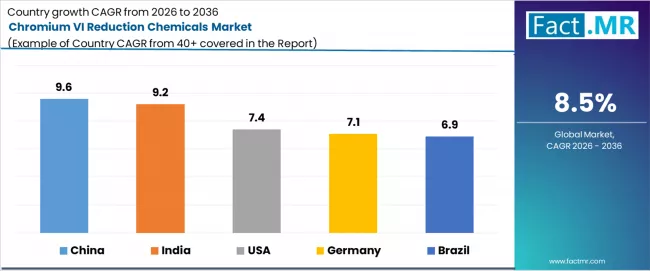
Chromium Vi Reduction Chemicals Market Cagr Analysis By Country

Country CAGR (2026-2036)
China 9.60%
India 9.20%
USA 7.40%
Germany 7.10%
Brazil 6.90%

How do China's Environmental Crackdowns Drive Demand for Cr(VI) Treatment?

China's leading CAGR of 9.60% is fueled by its ongoing "war on pollution" and stringent enforcement of new discharge standards for heavy metals, including chromium. The massive scale of its manufacturing base, particularly in textiles, plating, and leather, generates substantial volumes of Cr(VI)-laden wastewater. Mandatory upgrades to treatment facilities and the shuttering of non-compliant plants create concentrated demand for reliable reduction chemicals and technologies.

What is the Impact of India's Expanding Industrial Base and Regulatory Push on the Market?

India's 9.20% growth is underpinned by the rapid growth of its tannery, textile, and metal finishing sectors alongside stronger enforcement by the Central Pollution Control Board (CPCB). As clusters of small and medium enterprises are brought under stricter regulatory scrutiny, the need for affordable and effective chemical treatment solutions to manage Cr(VI) waste surges, driving market expansion.

How is the USA's Regulatory Framework and Remediation Activity Influencing the Market?
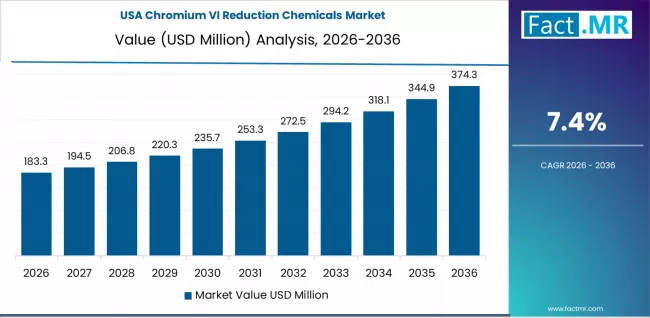
Chromium Vi Reduction Chemicals Market Country Value Analysis

The USA's 7.40% growth is supported by well-established regulations under the Clean Water Act and Resource Conservation and Recovery Act (RCRA), which mandate pretreatment and hazardous waste management. Ongoing remediation of legacy sites, such as those related to chrome plating or chemical manufacturing, provides a steady demand for reduction chemicals used in both ex-situ and in-situ groundwater treatment projects.

Why is Germany a Market for High-Efficiency and Precision Treatment Solutions?

Germany's 7.10% CAGR reflects its rigorous implementation of EU directives (e.g., the Industrial Emissions Directive) and high standards for wastewater quality. German industries and environmental engineering firms seek highly efficient, automated reduction systems with precise control to minimize chemical consumption and sludge generation, favoring advanced chemical blends and integrated treatment approaches.

What Role does Brazil's Industrial and Mining Sector Play in Driving Demand?

Brazil's 6.90% growth is anchored in its significant mining, metallurgy, and tannery industries, which are major sources of chromium-containing waste. Environmental licensing processes are becoming more stringent, requiring proven treatment solutions. This, combined with initiatives to clean up historically contaminated areas, stimulates demand for reduction chemicals tailored to challenging waste streams.

Competitive Landscape of the Chromium VI Reduction Chemicals Market
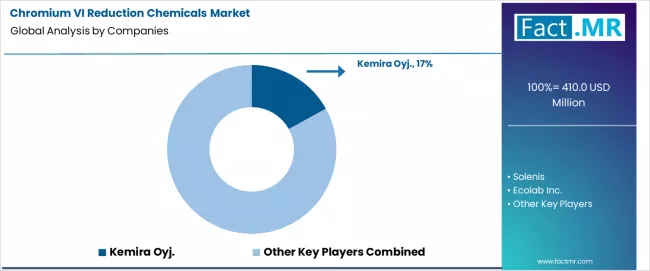
Chromium Vi Reduction Chemicals Market Analysis By Company

The competitive landscape features global water treatment chemical companies and specialty chemical manufacturers. Leaders like Kemira and Solenis compete on the breadth of their reduction chemistries, application expertise, and ability to provide complete treatment programs that include pH adjustment and coagulants.

Competition intensifies around providing technical support for system optimization, helping customers navigate complex regulations, and offering products that reduce total lifecycle costs by minimizing sludge volume or improving dewaterability.

Key Players in the Chromium VI Reduction Chemicals Market

  • Kemira Oyj.
  • Solenis
  • Ecolab Inc.
  • Kurita Water Industries
  • Aditya Birla Chemicals

Scope of Report

Items Values
Quantitative Units USD Million
Chemical Type Sulfite-Based, Iron-Based, Sulfur Dioxide, Zero-Valent Iron, Other
End-Use Industry Industrial Wastewater, Metal Plating, Mining, Groundwater Remediation, Other
Treatment Method Chemical Reduction/Precipitation, In-Situ Remediation, Reactor Systems, Hybrid, Other
Key Countries China, India, USA, Germany, Brazil
Key Companies Kemira Oyj., Solenis, Ecolab Inc., Kurita Water Industries, Aditya Birla Chemicals
Additional Analysis Analysis of reduction kinetics and optimal pH ranges; sludge minimization and stabilization techniques; monitoring for re-oxidation potential; regulatory compliance testing protocols (e.g., EPA Method 7196A); comparative cost analysis of different reductants.

Market by Segments

  • Chemical Type :

    • Sodium Metabisulfite/Bisulfite
    • Ferrous Sulfate/Iron-Based Reductants
    • Sulfur Dioxide & Sulfite Systems
    • Zero-Valent Iron/Nano-Iron
    • Other Specialty Reduction Chemicals
  • End-Use Industry :

    • Industrial Wastewater (Textile, Tanneries, Chemicals)
    • Metal Plating & Surface Treatment
    • Mining & Metallurgical Waste Streams
    • Municipal/Groundwater Remediation
    • Other Environmental Services
  • Treatment Method :

    • Chemical Reduction & Precipitation
    • In-Situ Soil & Groundwater Remediation
    • Batch/Continuous Reactor Systems
    • Hybrid Chemical–Biological Reduction
    • Other Advanced Reduction Techniques
  • Region :

    • North America

      • USA
      • Canada
    • Latin America

      • Brazil
      • Mexico
      • Argentina
      • Rest of Latin America
    • Western Europe

      • Germany
      • UK
      • France
      • Spain
      • Italy
      • BENELUX
      • Rest of Western Europe
    • Eastern Europe

      • Russia
      • Poland
      • Czech Republic
      • Rest of Eastern Europe
    • East Asia

      • China
      • Japan
      • South Korea
      • Rest of East Asia
    • South Asia & Pacific

      • India
      • ASEAN
      • Australia
      • Rest of South Asia & Pacific
    • MEA

      • Saudi Arabia
      • UAE
      • Turkiye
      • Rest of MEA

Table of Content

  1. Executive Summary
    • Global Market Outlook
    • Demand to side Trends
    • Supply to side Trends
    • Technology Roadmap Analysis
    • Analysis and Recommendations
  2. Market Overview
    • Market Coverage / Taxonomy
    • Market Definition / Scope / Limitations
  3. Market Background
    • Market Dynamics
      • Drivers
      • Restraints
      • Opportunity
      • Trends
    • Scenario Forecast
      • Demand in Optimistic Scenario
      • Demand in Likely Scenario
      • Demand in Conservative Scenario
    • Opportunity Map Analysis
    • Product Life Cycle Analysis
    • Supply Chain Analysis
    • Investment Feasibility Matrix
    • Value Chain Analysis
    • PESTLE and Porter’s Analysis
    • Regulatory Landscape
    • Regional Parent Market Outlook
    • Production and Consumption Statistics
    • Import and Export Statistics
  4. Global Market Analysis 2021 to 2025 and Forecast, 2026 to 2036
    • Historical Market Size Value (USD Million) Analysis, 2021 to 2025
    • Current and Future Market Size Value (USD Million) Projections, 2026 to 2036
      • Y to o to Y Growth Trend Analysis
      • Absolute $ Opportunity Analysis
  5. Global Market Pricing Analysis 2021 to 2025 and Forecast 2026 to 2036
  6. Global Market Analysis 2021 to 2025 and Forecast 2026 to 2036, By Chemical Type
    • Introduction / Key Findings
    • Historical Market Size Value (USD Million) Analysis By Chemical Type, 2021 to 2025
    • Current and Future Market Size Value (USD Million) Analysis and Forecast By Chemical Type, 2026 to 2036
      • Sodium Metabisulfite / Bisulfite
      • Ferrous Sulfate / Iron-Based Reductants
      • Sulfur Dioxide & Sulfite Systems
      • Zero-Valent Iron / Nano-Iron
      • Other Specialty Reduction Chemicals
    • Y to o to Y Growth Trend Analysis By Chemical Type, 2021 to 2025
    • Absolute $ Opportunity Analysis By Chemical Type, 2026 to 2036
  7. Global Market Analysis 2021 to 2025 and Forecast 2026 to 2036, By End-Use Industry
    • Introduction / Key Findings
    • Historical Market Size Value (USD Million) Analysis By End-Use Industry, 2021 to 2025
    • Current and Future Market Size Value (USD Million) Analysis and Forecast By End-Use Industry, 2026 to 2036
      • Industrial Wastewater (Textile, Tanneries, Chemicals)
      • Metal Plating & Surface Treatment
      • Mining & Metallurgical Waste Streams
      • Municipal / Groundwater Remediation
      • Other Environmental Services
    • Y to o to Y Growth Trend Analysis By End-Use Industry, 2021 to 2025
    • Absolute $ Opportunity Analysis By End-Use Industry, 2026 to 2036
  8. Global Market Analysis 2021 to 2025 and Forecast 2026 to 2036, By Treatment Method
    • Introduction / Key Findings
    • Historical Market Size Value (USD Million) Analysis By Treatment Method, 2021 to 2025
    • Current and Future Market Size Value (USD Million) Analysis and Forecast By Treatment Method, 2026 to 2036
      • Chemical Reduction & Precipitation
      • In-Situ Soil & Groundwater Remediation
      • Batch / Continuous Reactor Systems
      • Hybrid Chemical–Biological Reduction
      • Other Advanced Reduction Techniques
    • Y to o to Y Growth Trend Analysis By Treatment Method, 2021 to 2025
    • Absolute $ Opportunity Analysis By Treatment Method, 2026 to 2036
  9. Global Market Analysis 2021 to 2025 and Forecast 2026 to 2036, By Region
    • Introduction
    • Historical Market Size Value (USD Million) Analysis By Region, 2021 to 2025
    • Current Market Size Value (USD Million) Analysis and Forecast By Region, 2026 to 2036
      • North America
      • Latin America
      • Western Europe
      • Eastern Europe
      • East Asia
      • South Asia and Pacific
      • Middle East & Africa
    • Market Attractiveness Analysis By Region
  10. North America Market Analysis 2021 to 2025 and Forecast 2026 to 2036, By Country
    • Historical Market Size Value (USD Million) Trend Analysis By Market Taxonomy, 2021 to 2025
    • Market Size Value (USD Million) Forecast By Market Taxonomy, 2026 to 2036
      • By Country
        • USA
        • Canada
        • Mexico
      • By Chemical Type
      • By End-Use Industry
      • By Treatment Method
    • Market Attractiveness Analysis
      • By Country
      • By Chemical Type
      • By End-Use Industry
      • By Treatment Method
    • Key Takeaways
  11. Latin America Market Analysis 2021 to 2025 and Forecast 2026 to 2036, By Country
    • Historical Market Size Value (USD Million) Trend Analysis By Market Taxonomy, 2021 to 2025
    • Market Size Value (USD Million) Forecast By Market Taxonomy, 2026 to 2036
      • By Country
        • Brazil
        • Chile
        • Rest of Latin America
      • By Chemical Type
      • By End-Use Industry
      • By Treatment Method
    • Market Attractiveness Analysis
      • By Country
      • By Chemical Type
      • By End-Use Industry
      • By Treatment Method
    • Key Takeaways
  12. Western Europe Market Analysis 2021 to 2025 and Forecast 2026 to 2036, By Country
    • Historical Market Size Value (USD Million) Trend Analysis By Market Taxonomy, 2021 to 2025
    • Market Size Value (USD Million) Forecast By Market Taxonomy, 2026 to 2036
      • By Country
        • Germany
        • UK
        • Italy
        • Spain
        • France
        • Nordic
        • BENELUX
        • Rest of Western Europe
      • By Chemical Type
      • By End-Use Industry
      • By Treatment Method
    • Market Attractiveness Analysis
      • By Country
      • By Chemical Type
      • By End-Use Industry
      • By Treatment Method
    • Key Takeaways
  13. Eastern Europe Market Analysis 2021 to 2025 and Forecast 2026 to 2036, By Country
    • Historical Market Size Value (USD Million) Trend Analysis By Market Taxonomy, 2021 to 2025
    • Market Size Value (USD Million) Forecast By Market Taxonomy, 2026 to 2036
      • By Country
        • Russia
        • Poland
        • Hungary
        • Balkan & Baltic
        • Rest of Eastern Europe
      • By Chemical Type
      • By End-Use Industry
      • By Treatment Method
    • Market Attractiveness Analysis
      • By Country
      • By Chemical Type
      • By End-Use Industry
      • By Treatment Method
    • Key Takeaways
  14. East Asia Market Analysis 2021 to 2025 and Forecast 2026 to 2036, By Country
    • Historical Market Size Value (USD Million) Trend Analysis By Market Taxonomy, 2021 to 2025
    • Market Size Value (USD Million) Forecast By Market Taxonomy, 2026 to 2036
      • By Country
        • China
        • Japan
        • South Korea
      • By Chemical Type
      • By End-Use Industry
      • By Treatment Method
    • Market Attractiveness Analysis
      • By Country
      • By Chemical Type
      • By End-Use Industry
      • By Treatment Method
    • Key Takeaways
  15. South Asia and Pacific Market Analysis 2021 to 2025 and Forecast 2026 to 2036, By Country
    • Historical Market Size Value (USD Million) Trend Analysis By Market Taxonomy, 2021 to 2025
    • Market Size Value (USD Million) Forecast By Market Taxonomy, 2026 to 2036
      • By Country
        • India
        • ASEAN
        • Australia & New Zealand
        • Rest of South Asia and Pacific
      • By Chemical Type
      • By End-Use Industry
      • By Treatment Method
    • Market Attractiveness Analysis
      • By Country
      • By Chemical Type
      • By End-Use Industry
      • By Treatment Method
    • Key Takeaways
  16. Middle East & Africa Market Analysis 2021 to 2025 and Forecast 2026 to 2036, By Country
    • Historical Market Size Value (USD Million) Trend Analysis By Market Taxonomy, 2021 to 2025
    • Market Size Value (USD Million) Forecast By Market Taxonomy, 2026 to 2036
      • By Country
        • Kingdom of Saudi Arabia
        • Other GCC Countries
        • Turkiye
        • South Africa
        • Other African Union
        • Rest of Middle East & Africa
      • By Chemical Type
      • By End-Use Industry
      • By Treatment Method
    • Market Attractiveness Analysis
      • By Country
      • By Chemical Type
      • By End-Use Industry
      • By Treatment Method
    • Key Takeaways
  17. Key Countries Market Analysis
    • USA
      • Pricing Analysis
      • Market Share Analysis, 2025
        • By Chemical Type
        • By End-Use Industry
        • By Treatment Method
    • Canada
      • Pricing Analysis
      • Market Share Analysis, 2025
        • By Chemical Type
        • By End-Use Industry
        • By Treatment Method
    • Mexico
      • Pricing Analysis
      • Market Share Analysis, 2025
        • By Chemical Type
        • By End-Use Industry
        • By Treatment Method
    • Brazil
      • Pricing Analysis
      • Market Share Analysis, 2025
        • By Chemical Type
        • By End-Use Industry
        • By Treatment Method
    • Chile
      • Pricing Analysis
      • Market Share Analysis, 2025
        • By Chemical Type
        • By End-Use Industry
        • By Treatment Method
    • Germany
      • Pricing Analysis
      • Market Share Analysis, 2025
        • By Chemical Type
        • By End-Use Industry
        • By Treatment Method
    • UK
      • Pricing Analysis
      • Market Share Analysis, 2025
        • By Chemical Type
        • By End-Use Industry
        • By Treatment Method
    • Italy
      • Pricing Analysis
      • Market Share Analysis, 2025
        • By Chemical Type
        • By End-Use Industry
        • By Treatment Method
    • Spain
      • Pricing Analysis
      • Market Share Analysis, 2025
        • By Chemical Type
        • By End-Use Industry
        • By Treatment Method
    • France
      • Pricing Analysis
      • Market Share Analysis, 2025
        • By Chemical Type
        • By End-Use Industry
        • By Treatment Method
    • India
      • Pricing Analysis
      • Market Share Analysis, 2025
        • By Chemical Type
        • By End-Use Industry
        • By Treatment Method
    • ASEAN
      • Pricing Analysis
      • Market Share Analysis, 2025
        • By Chemical Type
        • By End-Use Industry
        • By Treatment Method
    • Australia & New Zealand
      • Pricing Analysis
      • Market Share Analysis, 2025
        • By Chemical Type
        • By End-Use Industry
        • By Treatment Method
    • China
      • Pricing Analysis
      • Market Share Analysis, 2025
        • By Chemical Type
        • By End-Use Industry
        • By Treatment Method
    • Japan
      • Pricing Analysis
      • Market Share Analysis, 2025
        • By Chemical Type
        • By End-Use Industry
        • By Treatment Method
    • South Korea
      • Pricing Analysis
      • Market Share Analysis, 2025
        • By Chemical Type
        • By End-Use Industry
        • By Treatment Method
    • Russia
      • Pricing Analysis
      • Market Share Analysis, 2025
        • By Chemical Type
        • By End-Use Industry
        • By Treatment Method
    • Poland
      • Pricing Analysis
      • Market Share Analysis, 2025
        • By Chemical Type
        • By End-Use Industry
        • By Treatment Method
    • Hungary
      • Pricing Analysis
      • Market Share Analysis, 2025
        • By Chemical Type
        • By End-Use Industry
        • By Treatment Method
    • Kingdom of Saudi Arabia
      • Pricing Analysis
      • Market Share Analysis, 2025
        • By Chemical Type
        • By End-Use Industry
        • By Treatment Method
    • Turkiye
      • Pricing Analysis
      • Market Share Analysis, 2025
        • By Chemical Type
        • By End-Use Industry
        • By Treatment Method
    • South Africa
      • Pricing Analysis
      • Market Share Analysis, 2025
        • By Chemical Type
        • By End-Use Industry
        • By Treatment Method
  18. Market Structure Analysis
    • Competition Dashboard
    • Competition Benchmarking
    • Market Share Analysis of Top Players
      • By Regional
      • By Chemical Type
      • By End-Use Industry
      • By Treatment Method
  19. Competition Analysis
    • Competition Deep Dive
      • Kemira Oyj.
        • Overview
        • Product Portfolio
        • Profitability by Market Segments (Product/Age /Sales Channel/Region)
        • Sales Footprint
        • Strategy Overview
          • Marketing Strategy
          • Product Strategy
          • Channel Strategy
      • Solenis
      • Ecolab Inc.
      • Kurita Water Industries
      • Aditya Birla Chemicals
  20. Assumptions & Acronyms Used
  21. Research Methodology

List Of Table

  • Table 1: Global Market Value (USD Million) Forecast by Region, 2021 to 2036
  • Table 2: Global Market Value (USD Million) Forecast by Chemical Type, 2021 to 2036
  • Table 3: Global Market Value (USD Million) Forecast by End-Use Industry, 2021 to 2036
  • Table 4: Global Market Value (USD Million) Forecast by Treatment Method, 2021 to 2036
  • Table 5: North America Market Value (USD Million) Forecast by Country, 2021 to 2036
  • Table 6: North America Market Value (USD Million) Forecast by Chemical Type, 2021 to 2036
  • Table 7: North America Market Value (USD Million) Forecast by End-Use Industry, 2021 to 2036
  • Table 8: North America Market Value (USD Million) Forecast by Treatment Method, 2021 to 2036
  • Table 9: Latin America Market Value (USD Million) Forecast by Country, 2021 to 2036
  • Table 10: Latin America Market Value (USD Million) Forecast by Chemical Type, 2021 to 2036
  • Table 11: Latin America Market Value (USD Million) Forecast by End-Use Industry, 2021 to 2036
  • Table 12: Latin America Market Value (USD Million) Forecast by Treatment Method, 2021 to 2036
  • Table 13: Western Europe Market Value (USD Million) Forecast by Country, 2021 to 2036
  • Table 14: Western Europe Market Value (USD Million) Forecast by Chemical Type, 2021 to 2036
  • Table 15: Western Europe Market Value (USD Million) Forecast by End-Use Industry, 2021 to 2036
  • Table 16: Western Europe Market Value (USD Million) Forecast by Treatment Method, 2021 to 2036
  • Table 17: Eastern Europe Market Value (USD Million) Forecast by Country, 2021 to 2036
  • Table 18: Eastern Europe Market Value (USD Million) Forecast by Chemical Type, 2021 to 2036
  • Table 19: Eastern Europe Market Value (USD Million) Forecast by End-Use Industry, 2021 to 2036
  • Table 20: Eastern Europe Market Value (USD Million) Forecast by Treatment Method, 2021 to 2036
  • Table 21: East Asia Market Value (USD Million) Forecast by Country, 2021 to 2036
  • Table 22: East Asia Market Value (USD Million) Forecast by Chemical Type, 2021 to 2036
  • Table 23: East Asia Market Value (USD Million) Forecast by End-Use Industry, 2021 to 2036
  • Table 24: East Asia Market Value (USD Million) Forecast by Treatment Method, 2021 to 2036
  • Table 25: South Asia and Pacific Market Value (USD Million) Forecast by Country, 2021 to 2036
  • Table 26: South Asia and Pacific Market Value (USD Million) Forecast by Chemical Type, 2021 to 2036
  • Table 27: South Asia and Pacific Market Value (USD Million) Forecast by End-Use Industry, 2021 to 2036
  • Table 28: South Asia and Pacific Market Value (USD Million) Forecast by Treatment Method, 2021 to 2036
  • Table 29: Middle East & Africa Market Value (USD Million) Forecast by Country, 2021 to 2036
  • Table 30: Middle East & Africa Market Value (USD Million) Forecast by Chemical Type, 2021 to 2036
  • Table 31: Middle East & Africa Market Value (USD Million) Forecast by End-Use Industry, 2021 to 2036
  • Table 32: Middle East & Africa Market Value (USD Million) Forecast by Treatment Method, 2021 to 2036

List Of Figures

  • Figure 1: Global Market Pricing Analysis
  • Figure 2: Global Market Value (USD Million) Forecast 2021 to 2036
  • Figure 3: Global Market Value Share and BPS Analysis by Chemical Type, 2026 and 2036
  • Figure 4: Global Market Y to o to Y Growth Comparison by Chemical Type, 2026 to 2036
  • Figure 5: Global Market Attractiveness Analysis by Chemical Type
  • Figure 6: Global Market Value Share and BPS Analysis by End-Use Industry, 2026 and 2036
  • Figure 7: Global Market Y to o to Y Growth Comparison by End-Use Industry, 2026 to 2036
  • Figure 8: Global Market Attractiveness Analysis by End-Use Industry
  • Figure 9: Global Market Value Share and BPS Analysis by Treatment Method, 2026 and 2036
  • Figure 10: Global Market Y to o to Y Growth Comparison by Treatment Method, 2026 to 2036
  • Figure 11: Global Market Attractiveness Analysis by Treatment Method
  • Figure 12: Global Market Value (USD Million) Share and BPS Analysis by Region, 2026 and 2036
  • Figure 13: Global Market Y to o to Y Growth Comparison by Region, 2026 to 2036
  • Figure 14: Global Market Attractiveness Analysis by Region
  • Figure 15: North America Market Incremental Dollar Opportunity, 2026 to 2036
  • Figure 16: Latin America Market Incremental Dollar Opportunity, 2026 to 2036
  • Figure 17: Western Europe Market Incremental Dollar Opportunity, 2026 to 2036
  • Figure 18: Eastern Europe Market Incremental Dollar Opportunity, 2026 to 2036
  • Figure 19: East Asia Market Incremental Dollar Opportunity, 2026 to 2036
  • Figure 20: South Asia and Pacific Market Incremental Dollar Opportunity, 2026 to 2036
  • Figure 21: Middle East & Africa Market Incremental Dollar Opportunity, 2026 to 2036
  • Figure 22: North America Market Value Share and BPS Analysis by Country, 2026 and 2036
  • Figure 23: North America Market Value Share and BPS Analysis by Chemical Type, 2026 and 2036
  • Figure 24: North America Market Y to o to Y Growth Comparison by Chemical Type, 2026 to 2036
  • Figure 25: North America Market Attractiveness Analysis by Chemical Type
  • Figure 26: North America Market Value Share and BPS Analysis by End-Use Industry, 2026 and 2036
  • Figure 27: North America Market Y to o to Y Growth Comparison by End-Use Industry, 2026 to 2036
  • Figure 28: North America Market Attractiveness Analysis by End-Use Industry
  • Figure 29: North America Market Value Share and BPS Analysis by Treatment Method, 2026 and 2036
  • Figure 30: North America Market Y to o to Y Growth Comparison by Treatment Method, 2026 to 2036
  • Figure 31: North America Market Attractiveness Analysis by Treatment Method
  • Figure 32: Latin America Market Value Share and BPS Analysis by Country, 2026 and 2036
  • Figure 33: Latin America Market Value Share and BPS Analysis by Chemical Type, 2026 and 2036
  • Figure 34: Latin America Market Y to o to Y Growth Comparison by Chemical Type, 2026 to 2036
  • Figure 35: Latin America Market Attractiveness Analysis by Chemical Type
  • Figure 36: Latin America Market Value Share and BPS Analysis by End-Use Industry, 2026 and 2036
  • Figure 37: Latin America Market Y to o to Y Growth Comparison by End-Use Industry, 2026 to 2036
  • Figure 38: Latin America Market Attractiveness Analysis by End-Use Industry
  • Figure 39: Latin America Market Value Share and BPS Analysis by Treatment Method, 2026 and 2036
  • Figure 40: Latin America Market Y to o to Y Growth Comparison by Treatment Method, 2026 to 2036
  • Figure 41: Latin America Market Attractiveness Analysis by Treatment Method
  • Figure 42: Western Europe Market Value Share and BPS Analysis by Country, 2026 and 2036
  • Figure 43: Western Europe Market Value Share and BPS Analysis by Chemical Type, 2026 and 2036
  • Figure 44: Western Europe Market Y to o to Y Growth Comparison by Chemical Type, 2026 to 2036
  • Figure 45: Western Europe Market Attractiveness Analysis by Chemical Type
  • Figure 46: Western Europe Market Value Share and BPS Analysis by End-Use Industry, 2026 and 2036
  • Figure 47: Western Europe Market Y to o to Y Growth Comparison by End-Use Industry, 2026 to 2036
  • Figure 48: Western Europe Market Attractiveness Analysis by End-Use Industry
  • Figure 49: Western Europe Market Value Share and BPS Analysis by Treatment Method, 2026 and 2036
  • Figure 50: Western Europe Market Y to o to Y Growth Comparison by Treatment Method, 2026 to 2036
  • Figure 51: Western Europe Market Attractiveness Analysis by Treatment Method
  • Figure 52: Eastern Europe Market Value Share and BPS Analysis by Country, 2026 and 2036
  • Figure 53: Eastern Europe Market Value Share and BPS Analysis by Chemical Type, 2026 and 2036
  • Figure 54: Eastern Europe Market Y to o to Y Growth Comparison by Chemical Type, 2026 to 2036
  • Figure 55: Eastern Europe Market Attractiveness Analysis by Chemical Type
  • Figure 56: Eastern Europe Market Value Share and BPS Analysis by End-Use Industry, 2026 and 2036
  • Figure 57: Eastern Europe Market Y to o to Y Growth Comparison by End-Use Industry, 2026 to 2036
  • Figure 58: Eastern Europe Market Attractiveness Analysis by End-Use Industry
  • Figure 59: Eastern Europe Market Value Share and BPS Analysis by Treatment Method, 2026 and 2036
  • Figure 60: Eastern Europe Market Y to o to Y Growth Comparison by Treatment Method, 2026 to 2036
  • Figure 61: Eastern Europe Market Attractiveness Analysis by Treatment Method
  • Figure 62: East Asia Market Value Share and BPS Analysis by Country, 2026 and 2036
  • Figure 63: East Asia Market Value Share and BPS Analysis by Chemical Type, 2026 and 2036
  • Figure 64: East Asia Market Y to o to Y Growth Comparison by Chemical Type, 2026 to 2036
  • Figure 65: East Asia Market Attractiveness Analysis by Chemical Type
  • Figure 66: East Asia Market Value Share and BPS Analysis by End-Use Industry, 2026 and 2036
  • Figure 67: East Asia Market Y to o to Y Growth Comparison by End-Use Industry, 2026 to 2036
  • Figure 68: East Asia Market Attractiveness Analysis by End-Use Industry
  • Figure 69: East Asia Market Value Share and BPS Analysis by Treatment Method, 2026 and 2036
  • Figure 70: East Asia Market Y to o to Y Growth Comparison by Treatment Method, 2026 to 2036
  • Figure 71: East Asia Market Attractiveness Analysis by Treatment Method
  • Figure 72: South Asia and Pacific Market Value Share and BPS Analysis by Country, 2026 and 2036
  • Figure 73: South Asia and Pacific Market Value Share and BPS Analysis by Chemical Type, 2026 and 2036
  • Figure 74: South Asia and Pacific Market Y to o to Y Growth Comparison by Chemical Type, 2026 to 2036
  • Figure 75: South Asia and Pacific Market Attractiveness Analysis by Chemical Type
  • Figure 76: South Asia and Pacific Market Value Share and BPS Analysis by End-Use Industry, 2026 and 2036
  • Figure 77: South Asia and Pacific Market Y to o to Y Growth Comparison by End-Use Industry, 2026 to 2036
  • Figure 78: South Asia and Pacific Market Attractiveness Analysis by End-Use Industry
  • Figure 79: South Asia and Pacific Market Value Share and BPS Analysis by Treatment Method, 2026 and 2036
  • Figure 80: South Asia and Pacific Market Y to o to Y Growth Comparison by Treatment Method, 2026 to 2036
  • Figure 81: South Asia and Pacific Market Attractiveness Analysis by Treatment Method
  • Figure 82: Middle East & Africa Market Value Share and BPS Analysis by Country, 2026 and 2036
  • Figure 83: Middle East & Africa Market Value Share and BPS Analysis by Chemical Type, 2026 and 2036
  • Figure 84: Middle East & Africa Market Y to o to Y Growth Comparison by Chemical Type, 2026 to 2036
  • Figure 85: Middle East & Africa Market Attractiveness Analysis by Chemical Type
  • Figure 86: Middle East & Africa Market Value Share and BPS Analysis by End-Use Industry, 2026 and 2036
  • Figure 87: Middle East & Africa Market Y to o to Y Growth Comparison by End-Use Industry, 2026 to 2036
  • Figure 88: Middle East & Africa Market Attractiveness Analysis by End-Use Industry
  • Figure 89: Middle East & Africa Market Value Share and BPS Analysis by Treatment Method, 2026 and 2036
  • Figure 90: Middle East & Africa Market Y to o to Y Growth Comparison by Treatment Method, 2026 to 2036
  • Figure 91: Middle East & Africa Market Attractiveness Analysis by Treatment Method
  • Figure 92: Global Market - Tier Structure Analysis
  • Figure 93: Global Market - Company Share Analysis

- FAQs -

How big is the chromium vi reduction chemicals market in 2026?

The global chromium vi reduction chemicals market is estimated to be valued at USD 410.0 million in 2026.

What will be the size of chromium vi reduction chemicals market in 2036?

The market size for the chromium vi reduction chemicals market is projected to reach USD 927.0 million by 2036.

How much will be the chromium vi reduction chemicals market growth between 2026 and 2036?

The chromium vi reduction chemicals market is expected to grow at a 8.5% CAGR between 2026 and 2036.

What are the key product types in the chromium vi reduction chemicals market?

The key product types in chromium vi reduction chemicals market are sodium metabisulfite / bisulfite, ferrous sulfate / iron-based reductants, sulfur dioxide & sulfite systems, zero-valent iron / nano-iron and other specialty reduction chemicals.

Which end-use industry segment to contribute significant share in the chromium vi reduction chemicals market in 2026?

In terms of end-use industry, industrial wastewater (textile, tanneries, chemicals) segment to command 38.0% share in the chromium vi reduction chemicals market in 2026.

Chromium VI Reduction Chemicals Market