- Market Value (2025): USD 597.2 Mn
- Estimated Value (2026): USD 639.6 Mn
- Forecast Value (2036): USD 1270.0 Mn
- CAGR (2026-2036): 7.1%
What is the Chromosomal Phasing Non-Invasive Prenatal Testing Market forecast to be worth by 2036?
USD 639.6 million in 2026 to USD 1,270.0 million by 2036 at a 7.1% CAGR from 2026 to 2036.
- The chromosomal phasing non-invasive prenatal testing market crossed a valuation of USD 597.2 million in 2025 influenced by single-gene screening and inheritance analysis use cases.
- Demand is projected to increase from USD 639.6 million in 2026 to USD 1,270.0 million by 2036.
- The market is forecast to record a 7.1% CAGR from 2026 to 2036 due to wider use of parental haplotyping in defined prenatal genetics pathways.
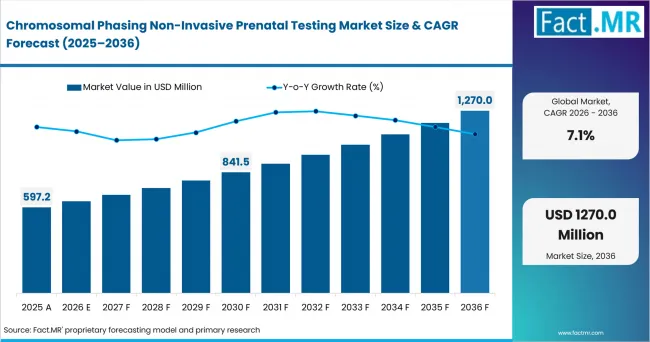
Chromosomal Phasing Non Invasive Prenatal Testing Market Value Analysis | Source: Fact.MR
What are the defining numbers behind Chromosomal Phasing Non-Invasive Prenatal Testing Market growth?
USD 630.4 million absolute opportunity by 2036 is linked to Single-Gene NIPT and Parental Haplotyping alongside Monogenic Disorders applications.
- Demand Drivers in the Market
- Maternal and fetal care teams need a clear difference between a screening result and a confirmed diagnosis. This is important before single-gene NIPT is used beyond common chromosome conditions.
- Reference laboratories need a clear way to compare the mother’s blood test with genetic information from both parents. This helps estimate the risk of inherited conditions in families with a history of recessive disease.
- Hospital genetics clinics need tests with few failed results. They also need clear fetal DNA limits before doctors use phasing results during patient counseling.
- Public screening programs need strict reporting rules under NHS FASP guidance. Routine NIPT screening must follow set eligibility rules for T21, T18 and T13 so that results can be checked and reviewed.
- Key Segments Analyzed
- By Test Type: Single-Gene NIPT is expected to hold 30.0% share in 2026 supported by clearer use in pregnancies with known inherited disease questions.
- By Technology: Parental Haplotyping is projected to represent 30.0% share in 2026 owing to its role in family-specific inheritance mapping.
- By Indication: Monogenic Disorders is anticipated to capture 30.0% share in 2026 due to demand for risk assessment beyond common trisomies.
- By End User: Hospitals are estimated to represent 30.0% share in 2026 attributable to referral depth and access to genetics counseling.
- Analyst Opinion at Fact.MR
- Shambhu Nath Jha, Senior Analyst at Fact.MR, states, “Chromosomal phasing is helping prenatal tests show how a genetic condition may pass from parents to a baby. Laboratories are expected to prefer tests that clearly explain the difference between a risk result and a confirmed diagnosis. They also need reliable fetal DNA limits and fewer failed tests. Wider use depends on checking genetic information from both parents, reviewing results carefully and giving families clear guidance.”
- Strategic Implications
- Laboratories must clearly show when a chromosomal phasing result is only a screening result. They must also state when chorionic villus sampling or amniotic fluid testing is required for confirmation.
- Hospitals should build enough counseling support before offering more single-gene NIPT options to families with a known history of inherited disease.
- Test developers must publish the minimum fetal DNA level used by the test and explain how chromosome mixing is handled. Clear rules for failed or unclear results also help prevent doctors and insurance reviewers from drawing the wrong conclusion.
- Commercial teams should avoid broad claims about large test panels. Insurance approval often depends on one clear medical question and a stated next step.
Natera launched Fetal Focus in August 2025 to screen for inherited conditions using a blood sample from the mother. The first version covered five tested genes, and the company expanded it to 21 genes in January 2026. This launch shows how single-gene NIPT is moving into wider commercial use with support from a forward-looking blinded study.
Germany is expected to record a 9.6% CAGR from 2026 to 2036, supported by strong hospital genetics services and clear steps from screening to diagnosis. Brazil is projected to post an 8.9% CAGR as private laboratories expand testing and more families seek guidance on inherited conditions. The USA is anticipated to grow at an 8.2% CAGR, helped by specialist centers and commercial test developers. South Korea is estimated at 7.5%, while the United Kingdom is forecast at 6.7%. Japan is projected to record a 6.0% CAGR through specialist prenatal care services.
How does the Chromosomal Phasing Non-Invasive Prenatal Testing Market break down by segment?
Single-Gene NIPT is expected to lead the Test Type segment at 30.0% share in 2026. Parental Haplotyping is projected to lead the Technology segment at 30.0%.
Which test type dominates?
Single-Gene NIPT holds 30.0% share in 2026.
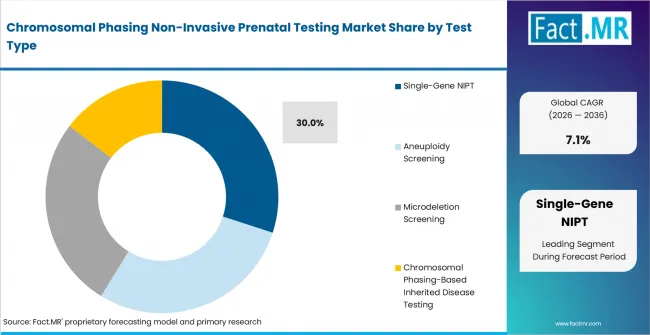
Chromosomal Phasing Non Invasive Prenatal Testing Market Analysis By Test Type | Source: Fact.MR
Single-Gene NIPT is expected to hold 30.0% share in 2026 as it focuses on a known inherited condition found through carrier screening or family history. Aneuploidy Screening remains widely used for common chromosome conditions such as T21, T18 and T13. Microdeletion Screening has a narrower role where specialist advice is available before and after testing. Chromosomal Phasing-Based Inherited Disease Testing is anticipated to expand when doctors already know which family gene change must be tracked.
What leads the Technology segment?
Parental Haplotyping accounts for 30.0% share in 2026.
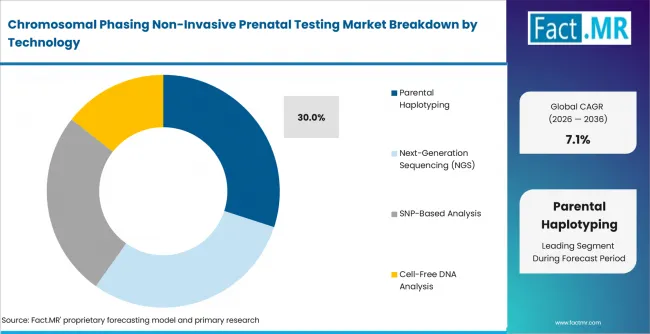
Chromosomal Phasing Non Invasive Prenatal Testing Market Analysis By Technology | Source: Fact.MR
Parental Haplotyping is projected to account for 30.0% share in 2026 because it helps show which genetic change may pass from each parent to the baby. Next-Generation Sequencing allows laboratories to examine small DNA changes in prenatal blood samples. SNP-Based Analysis helps follow inherited gene patterns within a family. Cell-Free DNA Analysis provides the blood-based sample used in most non-invasive prenatal tests and keeps testing separate from procedures that enter the womb.
How do Monogenic Disorders shape demand?
Monogenic Disorders lead with 30.0% share in 2026.
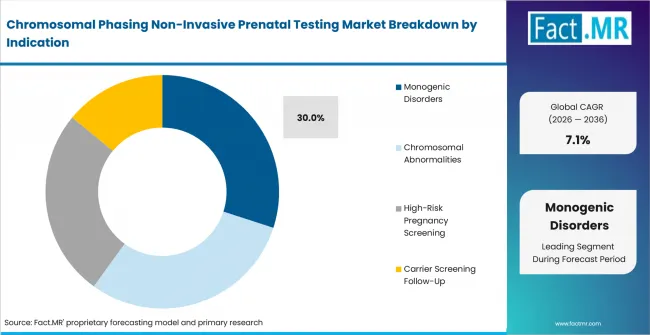
Chromosomal Phasing Non Invasive Prenatal Testing Market Analysis By Indication | Source: Fact.MR
Monogenic Disorders are anticipated to capture 30.0% share in 2026 as testing often begins with one known gene change in the mother or father. Chromosomal Abnormalities continue to form the main base for routine NIPT. High-Risk Pregnancy Screening supports closer testing after an earlier result or medical review raises concern. Carrier Screening Follow-Up links tests taken before or during pregnancy with a clearer check of inherited risk for the baby.
What supports Hospitals within the End User segment?
Hospitals are projected to hold 30.0% share in 2026.
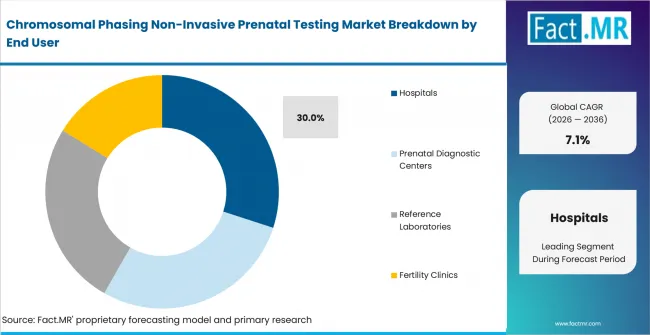
Chromosomal Phasing Non Invasive Prenatal Testing Market Analysis By End User | Source: Fact.MR
Hospitals are estimated to represent 30.0% share in 2026 because they can bring prenatal doctors, laboratory services and genetic counseling together. Prenatal Diagnostic Centers focus on pregnancies that require closer review or follow-up testing. Reference Laboratories process samples for hospitals and clinics that do not run these tests on-site. Fertility Clinics are expected to use phasing results when family history, carrier status or earlier pregnancies point to a known inherited condition.
What is accelerating Chromosomal Phasing Non-Invasive Prenatal Testing Market adoption, and what is holding it back?
Inherited-disease screening pathways are anticipated to drive market growth when carrier results define the fetal-risk question. Confirmation burden is expected to restrain wider clinical use.
Drivers Impact Analysis
| DRIVER | (~) % IMPACT ON CAGR | GEOGRAPHIC RELEVANCE | IMPACT TIMELINE |
|---|---|---|---|
| Single-gene NIPT use after carrier screening | +0.8% | USA and Western Europe | Medium term (2-4 years) |
| Parental haplotyping for inheritance-resolved fetal risk | +0.7% | Germany; U.K.; Japan | Medium term (2-4 years) |
| Hospital genetics counseling capacity | +0.5% | North America and Europe | Short term (<= 2 years) |
| Defined NHS and public screening pathways | +0.3% | U.K. and selected public systems | Medium term (2-4 years) |
| Prospective validation for expanded gene panels | +0.3% | USA and South Korea | Long term (>= 4 years) |
Source: Fact.MR analysis. Updated Jul 20, 2026
- Single-gene NIPT expansion: Testing has a clearer role when a parent already carries a known gene change. Demand is expected to grow when carrier screening raises a specific question about the baby’s risk.
- Parental haplotyping: This method helps laboratories track whether the baby inherited a disease-related gene change from either parent. It is likely to gain wider use when doctors require more detail than a simple positive or negative result.
- Counseling capacity: Hospitals with prenatal specialists and genetics staff are better prepared to explain failed tests and the next testing steps. Use is expected to increase faster where counseling services are already available.
- Public pathway discipline: NHS FASP guidance sets clear rules for who qualifies for NIPT and how samples move through the testing process. These rules also make it easier for hospitals and laboratories to check how results are handled. Wider use is expected to remain careful because each medical decision must be properly recorded.
Opportunity Impact Analysis
| OPPORTUNITY | (~) % IMPACT ON CAGR | GEOGRAPHIC RELEVANCE | IMPACT TIMELINE |
|---|---|---|---|
| Expanded single-gene panels tied to known parental variants | +0.5% | USA and Germany | Medium term (2-4 years) |
| Non-invasive confirmation after high-risk screens | +0.4% | USA and Brazil | Short term (<= 2 years) |
| Reference laboratory reporting tools for fetal fraction limits | +0.3% | Global reference labs | Medium term (2-4 years) |
| Fertility-clinic use in inherited-risk pregnancies | +0.2% | Japan and South Korea | Long term (>= 4 years) |
Source: Fact.MR analysis. Updated Jul 20, 2026
- Expanded panels: Single-gene NIPT panels are expected to find wider use when the genes tested match a known concern in the family. Very broad panels are less likely to become part of routine care when counseling support is not available.
- Confirmation alternatives: GOV.UK guidance updated in April 2026 explains the next steps after a higher-chance NIPT result. It makes clear that screening alone is not enough and that a diagnostic test is still required before medical decisions are made.
- Reporting tools: Reference laboratories must present fetal DNA levels and explain how the result was reached in clear medical language. Any remaining doubt should be shown before the report suggests the next step. Better reports are expected to reduce confusion after complex phasing results.
- Fertility pathways: Fertility clinics are expected to use these tests in selected cases. This is more likely when donor eggs, IVF history or a known inherited condition affects the baby’s risk and helps guide counseling.
Restraints Impact Analysis
| RESTRAINT | (~) % IMPACT ON CAGR | GEOGRAPHIC RELEVANCE | IMPACT TIMELINE |
|---|---|---|---|
| Need for confirmatory invasive diagnosis after positive screening | -0.6% | Global clinical pathways | Short term (<= 2 years) |
| No-call risk tied to fetal fraction and sample timing | -0.4% | Hospitals and reference labs | Medium term (2-4 years) |
| Counseling and reimbursement gaps for complex results | -0.4% | Brazil and USA | Medium term (2-4 years) |
| Regulatory caution around expanded screening scope | -0.3% | Europe and Japan | Long term (>= 4 years) |
Source: Fact.MR analysis. Updated Jul 20, 2026
- Confirmatory testing burden: A high-risk screening result often has to be checked with a diagnostic test before doctors change care. Use may stay limited where CVS or amniocentesis is not easy to access.
- Fetal fraction limits: Some samples contain too little fetal DNA for a clear result. Placental factors can also make findings harder to read. Laboratories must have clear rules for failed tests before offering the service across more hospitals and testing centers.
- Counseling gaps: Results linked to family inheritance can be difficult for patients to understand. Trained staff and enough consultation time are important when explaining the remaining risk. Growth may slow where clinics cannot discuss these findings clearly during prenatal visits.
- Regulatory caution: Public health systems are careful when adding rare conditions to prenatal screening. Wider use is expected to remain limited where proof standards are strict and patients must receive clear information before choosing a test.
Which countries are scaling Chromosomal Phasing Non-Invasive Prenatal Testing Market fastest?
The country comparison shows a steady decline in growth across the markets covered. Germany and Brazil sit at the top of the range, while the USA and South Korea form a closely grouped second tier. The United Kingdom and Japan follow with slightly lower growth. The six-country spread shows that all markets have a positive outlook, although their positions reflect different levels of laboratory access, counseling support and readiness for wider clinical use.
- Germany and Brazil lead the comparison and form the strongest growth group among the markets shown.
- The USA and South Korea follow closely, which shows that both markets remain strong without matching the pace of the leading pair.
- The United Kingdom and Japan make up the next growth band and maintain a relatively small gap from the middle group.
- The pattern forms a gradual downward slope rather than a sharp split between faster- and slower-growing markets.
Countries with similar CAGRs can still have different entry conditions due to insurance coverage, access to confirmatory testing, laboratory capacity and the number of trained genetics staff. The full report provides country-level analysis across North America, Latin America, Western Europe, Eastern Europe, East Asia, South Asia and Pacific, and the Middle East and Africa.
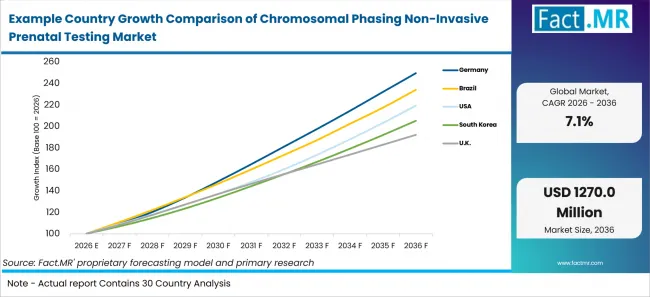
Example Country Growth Comparison Of Chromosomal Phasing Non Invasive Prenatal Testing Market | Source: Fact.MR
| COUNTRY | CAGR |
|---|---|
| Germany | 9.6% |
| Brazil | 8.9% |
| USA | 8.2% |
| South Korea | 7.5% |
| U.K. | 6.7% |
| Japan | 6.0% |
Source: Fact.MR analysis. Updated Jul 20, 2026
What is driving Germany’s growth through 2036?
9.6% CAGR, driven by university-hospital genetics capacity and defined prenatal referral routes.
Germany combines specialist prenatal genetics services with structured links between screening, counseling and confirmatory diagnosis. University hospitals provide the clinical depth needed to interpret inheritance patterns and explain uncertain results. The market is projected to record a 9.6% CAGR from 2026 to 2036 as hospitals introduce chromosomal phasing within carefully controlled pathways instead of treating it as broad routine screening.
How is Brazil scaling Chromosomal Phasing NIPT demand?
8.9% CAGR, supported by private laboratory expansion and inherited-risk counseling needs.
Brazil has a large patient base, but access to specialist genetics services differs across regions and care settings. Private laboratories are expected to shape early adoption by giving clinicians faster answers when carrier results or family history raise a specific inherited-disease question. Demand is projected to post an 8.9% CAGR through 2036 as testing providers connect sample processing with clearer referral and counseling support.
What supports the USA outlook?
8.2% CAGR, owing to commercial test development and prospective clinical validation.
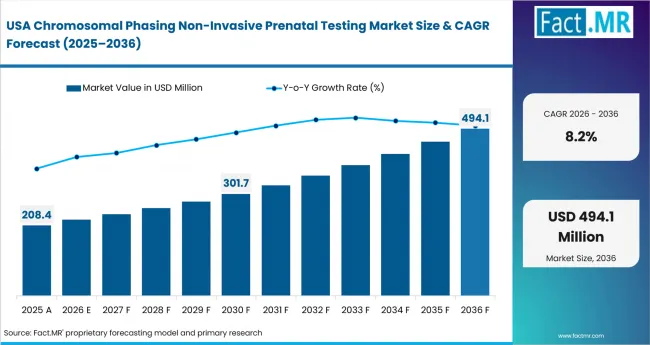
Chromosomal Phasing Non Invasive Prenatal Testing Market Country Value Analysis | Source: Fact.MR
The USA has active prenatal-test developers, maternal-fetal medicine networks and a strong base of specialist laboratories. Natera and BillionToOne are extending maternal-blood testing beyond common chromosome conditions into inherited-disease assessment. The market is anticipated to advance at an 8.2% CAGR from 2026 to 2036 as commercial acceptance depends on validation evidence, reimbursement review and clear follow-up after a high-risk result.
What underpins South Korea’s growth?
7.5% CAGR, driven by concentrated hospital systems and established genomics capacity.
South Korea’s major medical centers bring specialist obstetric care, sequencing capability and laboratory review into a smaller number of advanced hospital networks. This concentration gives test providers a direct route to clinical adoption when reporting standards and fetal-DNA limits fit existing care processes. The market is estimated to record a 7.5% CAGR by 2036 as phasing assays become easier to connect with hospital-based prenatal decision-making.
How is the U.K. developing Chromosomal Phasing NIPT demand?
6.7% CAGR, supported by national screening rules and defined laboratory controls.
The U.K. separates prenatal screening from diagnostic confirmation through a tightly governed public pathway. NHS guidance sets eligibility, sample handling and follow-up expectations, which limits unsupported expansion while giving laboratories a clear operating framework. The market is forecast to post a 6.7% CAGR from 2026 to 2036 as chromosomal phasing develops within documented counseling and confirmatory-testing routes.
What supports Japan’s Chromosomal Phasing NIPT outlook?
6.0% CAGR, backed by specialist review and careful evidence requirements.
Japan is expected to introduce broader inherited-disease testing through specialist hospitals rather than rapid panel expansion. Clinical use depends on local evidence, clear counseling and detailed review before a phasing result influences prenatal decisions. The market is projected to record a 6.0% CAGR from 2026 to 2036 as providers align testing with established diagnostic practice and cautious hospital approval processes.
Who leads the Chromosomal Phasing Non-Invasive Prenatal Testing Market?
The company landscape includes Natera Inc.; BillionToOne Inc.; Illumina Inc.; Roche; BGI Genomics; Labcorp; Quest Diagnostics
Competition depends on how reliable the test results are and how clearly they can be explained. Laboratories also compare the support available after a high-risk result. Access to sequencing equipment alone does not decide provider choice because patients may still require counseling and follow-up testing.
Natera competes through its SNP-based and LinkedSNP prenatal tests for inherited conditions. The company uses carrier screening results and a blood sample from the mother to estimate the baby’s risk within its women’s health business.
BillionToOne offers UNITY prenatal testing through its molecular counting platform. The test connects carrier screening with fetal risk assessment from the mother’s blood for recessive conditions. Illumina supports laboratories with sequencing systems and NIPT testing tools. Its September 2025 article on access in Abu Dhabi shows how platform companies work with public health programs and hospital genetics services.
Which companies are the key providers?
Natera and BillionToOne are key providers. Illumina and F. Hoffmann-La Roche are also profiled. BGI Genomics, Labcorp, and Quest Diagnostics, complete the company set.
- Natera, Inc.
- BillionToOne, Inc.
- Illumina, Inc.
- F. Hoffmann-La Roche Ltd.
- BGI Genomics Co., Ltd.
- Laboratory Corporation of America Holdings (Labcorp)
- Quest Diagnostics Incorporated
Bibliography
- BillionToOne, Inc. (2025, March 18). BillionToOne celebrates major milestone: 1 million UNITY tests.
- Illumina, Inc. (2025, September 22). Expanding access to noninvasive prenatal testing in Abu Dhabi
- U.S. Food and Drug Administration. (2025, September 19). Laboratory developed tests.
- National Health Service. (2025, June 26). Screening for Down’s syndrome, Edwards’ syndrome and Patau’s syndrome.
This Report Addresses
- The report provides strategic intelligence on Chromosomal Phasing Non-Invasive Prenatal Testing across Test Type and Technology choices that shape inherited-risk assessment during pregnancy.
- Segment analysis covers Single-Gene NIPT and Parental Haplotyping as the share within the 2026 market.
- Regional outlook evaluates Germany and Brazil alongside the USA, South Korea, the United Kingdom and Japan, while wider regional coverage completes the growth comparison.
- Competitive analysis profiles Natera and BillionToOne alongside Illumina and F. Hoffmann-La Roche, followed by additional active prenatal testing, sequencing and reference laboratory providers.
- Test Type assessment covers Single-Gene NIPT, Aneuploidy Screening, Microdeletion Screening and Chromosomal Phasing-Based Inherited Disease Testing across different prenatal risk questions.
- Use-case assessment covers Monogenic Disorders and Chromosomal Abnormalities alongside High-Risk Pregnancy Screening and Carrier Screening Follow-Up.
What does the Chromosomal Phasing Non-Invasive Prenatal Testing Market cover?
Single-Gene NIPT, parental haplotyping and cell-free DNA tests used to assess fetal inheritance risk from maternal blood.
The Chromosomal Phasing Non-Invasive Prenatal Testing Market covers prenatal tests designed to assess how disease-related genetic changes may pass from parents to the fetus. Coverage includes Single-Gene NIPT, Aneuploidy Screening, Microdeletion Screening and Chromosomal Phasing-Based Inherited Disease Testing supported by parental haplotyping, sequencing, SNP analysis and cell-free DNA analysis.
The market differs from general prenatal screening because commercial value comes from inheritance-resolved fetal-risk assessment and family-specific interpretation. Routine ultrasound, carrier screening performed without fetal-risk assessment and invasive diagnostic procedures remain outside the boundary unless they support a defined chromosomal phasing NIPT pathway.
What is included in the scope?
Maternal-blood prenatal tests used to assess inherited disease risk across specialist clinical and laboratory settings.
The scope includes Single-Gene NIPT, Aneuploidy Screening, Microdeletion Screening and Chromosomal Phasing-Based Inherited Disease Testing. Coverage spans Parental Haplotyping, Next-Generation Sequencing, SNP-Based Analysis and Cell-Free DNA Analysis used for Monogenic Disorders, Chromosomal Abnormalities, High-Risk Pregnancy Screening and Carrier Screening Follow-Up.
Hospitals, Prenatal Diagnostic Centers, Reference Laboratories and Fertility Clinics are included when the purchased function involves fetal-risk assessment from maternal blood. The scope also considers fetal-fraction limits, parental sample requirements, failed-result rules, genetic counseling and confirmatory testing because these factors influence clinical use across the segmentation framework.
What is excluded from the scope?
Routine prenatal care and standalone diagnostic procedures without a chromosomal phasing NIPT function are outside the scope.
The scope excludes ultrasound, standard blood tests, carrier screening and reproductive genetic tests that do not assess fetal inheritance risk. Chorionic villus sampling and amniocentesis are excluded as market products because they are invasive diagnostic procedures used to confirm screening results.
General sequencing equipment, laboratory services and conventional NIPT remain outside the strict boundary unless they support parental haplotyping, single-gene fetal-risk assessment or another defined chromosomal phasing workflow. Broad genetic panels are also excluded when they lack a clear prenatal indication, reporting pathway or counseling requirement.
How Was the Analysis Built?
The analysis draws on 120+ sources, 35+ company portfolios, 25+ countries, and more than 20 industry interviews.
- Primary Research: Primary research includes discussions with manufacturers, service providers, technology developers, distributors, end users, procurement teams, and subject-matter experts. These conversations examine purchasing priorities, product adoption, operational challenges, approval requirements, competitive positioning, and the factors that influence wider market acceptance.
- Desk Research: Desk research covers government statistics, regulatory publications, company filings, trade data, technical studies, industry associations, standards, public policy, and other authoritative sources. Every source used in the analysis is documented in the bibliography.
- Market Sizing and Forecasting: Market estimates combine historical performance, demand indicators, pricing and volume trends, segment shares, company participation, country-level growth, adoption patterns, investment activity, and barriers to market expansion.
- Data Validation and Update Cycle: Findings are validated by comparing primary interviews with public data, company activity, regulatory changes, trade patterns, and industry developments. Regular updates review new product launches, capacity changes, partnerships, approvals, procurement trends, and shifts in commercial adoption.
Segmentation
What is the report's scope and coverage?
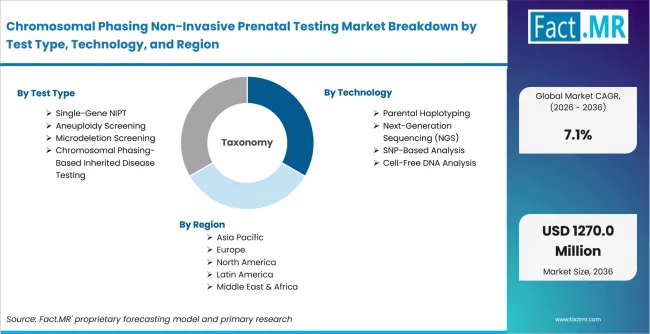
Chromosomal Phasing Non Invasive Prenatal Testing Market Breakdown By Test Type, Technology, And Region | Source: Fact.MR
| Attribute | Details |
|---|---|
| Quantitative Units | USD Million in 2026 to USD Million by 2036 at CAGR |
| Market Definition | Maternal-blood prenatal tests that use cell-free DNA, parental haplotypes, sequencing and statistical phasing to assess fetal inheritance risk |
| Test Type | Single-Gene NIPT; Aneuploidy Screening; Microdeletion Screening; Chromosomal Phasing-Based Inherited Disease Testing |
| Technology | Parental Haplotyping; Next-Generation Sequencing (NGS); SNP-Based Analysis; Cell-Free DNA Analysis |
| Indication | Monogenic Disorders; Chromosomal Abnormalities; High-Risk Pregnancy Screening; Carrier Screening Follow-Up |
| End User | Hospitals; Prenatal Diagnostic Centers; Reference Laboratories; Fertility Clinics |
| Regions Covered | North America; Latin America; Western Europe; Eastern Europe; East Asia; South Asia and Pacific; Middle East and Africa |
| Countries Covered | Germany; Brazil; USA; South Korea; United Kingdom; Japan |
| Key Companies Profiled | Natera, Inc.; BillionToOne, Inc.; Illumina, Inc.; F. Hoffmann-La Roche Ltd.; BGI Genomics Co., Ltd.; Laboratory Corporation of America Holdings; Quest Diagnostics Incorporated |
| Forecast Period | 2026 to 2036 |
| Approach | Hybrid top-down and bottom-up approach using prenatal screening activity; single-gene testing adoption; parental haplotyping use; fetal-fraction requirements; carrier-screening follow-up; hospital genetics capacity; counseling access; confirmatory-testing pathways; reimbursement conditions; country growth trends and company participation |
Source: Fact.MR analysis. Updated Jul 20, 2026
How is the market segmented?
-
By Test Type
- Single-Gene NIPT
- Aneuploidy Screening
- Microdeletion Screening
- Chromosomal Phasing-Based Inherited Disease Testing
-
By Technology
- Parental Haplotyping
- Next-Generation Sequencing (NGS)
- SNP-Based Analysis
- Cell-Free DNA Analysis
-
By Indication
- Monogenic Disorders
- Chromosomal Abnormalities
- High-Risk Pregnancy Screening
- Carrier Screening Follow-Up
-
By End User
- Hospitals
- Prenatal Diagnostic Centers
- Reference Laboratories
- Fertility Clinics
-
By Region
- North America
- Latin America
- Western Europe
- Eastern Europe
- East Asia
- South Asia and Pacific
- Middle East and Africa
Frequently Asked Questions
Which Test Type leads the Chromosomal Phasing Non-Invasive Prenatal Testing Market?
Which Technology leads the Chromosomal Phasing Non-Invasive Prenatal Testing Market?
Which Indication leads the Chromosomal Phasing Non-Invasive Prenatal Testing Market?
Which End User leads the Chromosomal Phasing Non-Invasive Prenatal Testing Market?
Which country records the highest CAGR in the Chromosomal Phasing Non-Invasive Prenatal Testing Market?
How does Brazil perform in the Chromosomal Phasing Non-Invasive Prenatal Testing Market?
How does the USA perform in the Chromosomal Phasing Non-Invasive Prenatal Testing Market?
How does South Korea perform in the Chromosomal Phasing Non-Invasive Prenatal Testing Market?
How does the United Kingdom perform in the Chromosomal Phasing Non-Invasive Prenatal Testing Market?
How does Japan perform in the Chromosomal Phasing Non-Invasive Prenatal Testing Market?
What is the primary driver in the Chromosomal Phasing Non-Invasive Prenatal Testing Market?
What is the main restraint in the Chromosomal Phasing Non-Invasive Prenatal Testing Market?
Why is Single-Gene NIPT important?
Why is Parental Haplotyping important?
Why do hospitals lead End User demand?
Who worked on this report


Preview the report firsthand - request a free sample
Free SampleGet the brochure for pricing and purchase details
Download PDF