- Market Value (2025): USD 1.6 Bn
- Estimated Value (2026): USD 1.9 Bn
- Forecast Value (2036): USD 9.8 Bn
- CAGR (2026-2036): 17.6%
What is the Chronic Kidney Disease Early Diagnosis Genomics Market forecast to be worth by 2036?
USD 1.9 billion in 2026 to USD 9.8 billion by 2036, at 17.6% CAGR.
- The chronic kidney disease early diagnosis genomics market is estimated at USD 1.6 billion in 2025.
- Demand is projected to increase from USD 1.9 billion in 2026 to USD 9.8 billion by 2036.
- The market is forecast to record a 17.6% CAGR from 2026 to 2036 owing to earlier etiologic diagnosis and better hereditary-risk evaluation.
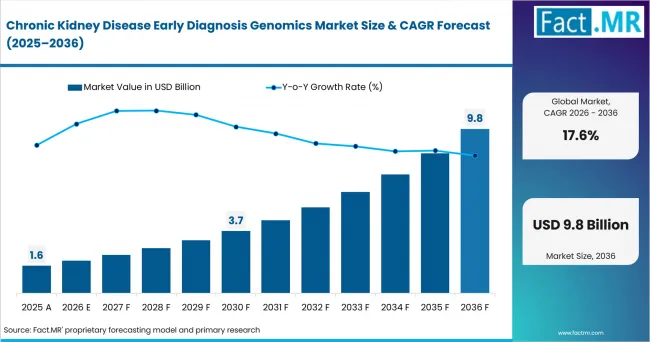
Chronic Kidney Disease Early Diagnosis Genomics Market Value Analysis | Source: Fact.MR
What are the defining numbers behind Chronic Kidney Disease Early Diagnosis Genomics Market growth?
USD 7.9 billion absolute opportunity by 2036, led by Next-Generation Sequencing (NGS) and Early CKD Detection alongside Genetic Variants and Hospitals.
- Demand Drivers in the Market
- Kidney specialists often know that damage is present, but standard tests do not always show whether it comes from an inherited condition or what it could mean for other family members.
- Hospitals benefit from short and clear genetic reports that guide referrals, patient discussions and decisions made before treatment or transplant planning.
- Diagnostic laboratories must cover genes linked to kidney disease and present results in a form that doctors can use during regular appointments.
- Large genetic studies are expected to improve understanding of APOL1 and combined genetic risk across people from different backgrounds over time.
- Key Segments Analyzed
- By Technology: Next-Generation Sequencing (NGS) is expected to hold 25.0% share in 2026 supported by broad gene coverage and flexible panel design.
- By Application: Early CKD Detection is projected to account for 30.0% share in 2026 owing to the clinical need to identify risk before irreversible loss.
- By Biomarker Type: Genetic Variants are anticipated to capture 25.0% share in 2026 due to direct use in hereditary kidney disease interpretation.
- By End User: Hospitals are estimated to represent 30.0% share in 2026 attributable to nephrology referrals and transplant workups that require specialist review capacity.
- Analyst Opinion at Fact.MR
- Shambhu Nath Jha, Senior Analyst at Fact.MR, states, “Genetic testing for chronic kidney disease is most useful when doctors review it with creatinine levels, urine albumin, scans and biopsy results. Tests that show inherited risk, explain an unclear cause and identify family members who may require counseling are likely to see wider use. Kidney-specific reports also give doctors clearer support during transplant review and treatment decisions than broad panels with results that are hard to understand.”
- Strategic Implications
- Hospitals can set clear rules for which CKD patients are suitable for genetic testing before use spreads across general kidney clinics.
- Diagnostic laboratories should combine NGS panels with careful result review and access to genetic counseling. Kidney-focused notes can then help doctors understand the findings.
- Payers can look at whether testing shortens the time to diagnosis and reduces repeat specialist visits. The evidence should also show whether it avoids unnecessary checks of possible kidney donors.
In March 2024, KDIGO published the 2024 Clinical Practice Guideline for the Evaluation and Management of Chronic Kidney Disease. The guideline covers CKD classification and risk assessment across diverse clinical settings. This guidance is expected to support genomics use when clinicians need cause-specific evaluation beyond routine kidney function testing.
Germany is expected to record a 23.8% CAGR from 2026 to 2036, helped by specialist kidney care networks and strong hospital laboratories. Brazil is projected to post a 22.0% CAGR as more families seek testing across a large patient base. The USA is anticipated to grow at a 20.2% CAGR through large genetic studies and broad clinical testing access. South Korea is estimated to reach an 18.5% CAGR through major hospitals and advanced medical testing. The United Kingdom is forecast at 16.7%, while Japan is projected to record a 15.0% CAGR through specialist kidney care and transplant reviews.
How does the Chronic Kidney Disease Early Diagnosis Genomics Market break down by segment?
Next-Generation Sequencing (NGS) is expected to lead Technology at 25.0% share in 2026. Early CKD Detection is projected to lead Application at 30.0% share in 2026.
Which technology dominates?
Next-Generation Sequencing (NGS) is estimated to hold 25.0% share in 2026.
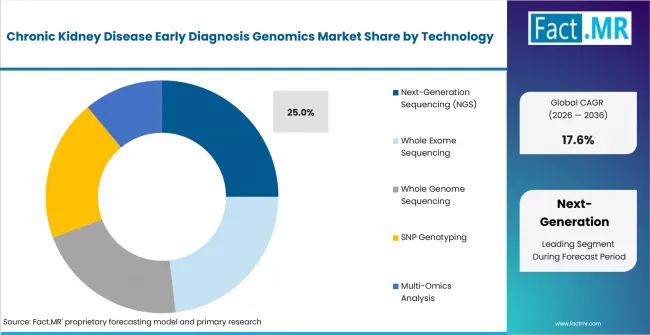
Chronic Kidney Disease Early Diagnosis Genomics Market Analysis By Technology | Source: Fact.MR
Kidney gene panels make NGS useful for finding inherited causes of kidney disease. Whole Exome Sequencing covers a wider group of genes when routine panels do not give a clear answer. Whole Genome Sequencing can detect harder-to-find changes and is often linked to research programs. SNP Genotyping checks selected risk markers, while Multi-Omics Analysis combines genetic findings with earlier laboratory records.
What leads the Application segment?
Early CKD Detection is projected to account for 30.0% share in 2026.
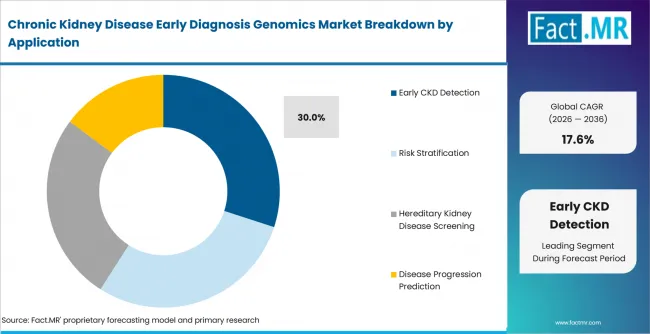
Chronic Kidney Disease Early Diagnosis Genomics Market Analysis By Application | Source: Fact.MR
Finding inherited risk before kidney function falls sharply gives Early CKD Detection a strong role in patient care. Risk Stratification adds genetic findings to eGFR, urine protein results and family history. Hereditary Kidney Disease Screening helps identify relatives who may carry the same condition. It can also support kidney donor reviews. Disease Progression Prediction depends on long-term studies that show how well the result supports future care.
How does Biomarker Type shape demand?
Genetic Variants are anticipated to lead with 25.0% share in 2026.
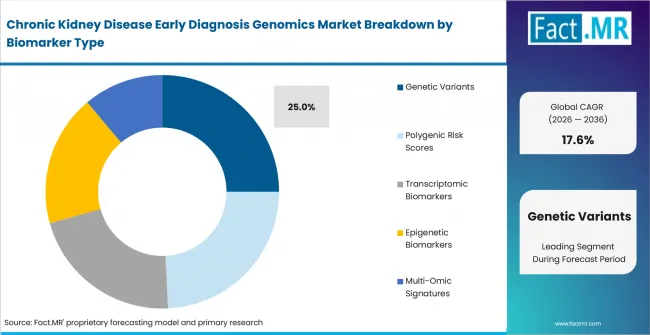
Chronic Kidney Disease Early Diagnosis Genomics Market Analysis By Biomarker Type | Source: Fact.MR
A clearly harmful genetic change gives doctors a direct link to the possible cause of disease. Polygenic Risk Scores still require stronger evidence from people with different family backgrounds. Transcriptomic and Epigenetic Biomarkers remain mainly in research until doctors have clear steps for using the findings. Multi-Omic Signatures may gain wider use when genetic and gene activity results can be reviewed together. Methylation findings also have to match scans and routine laboratory tests.
What supports Hospitals within End User?
Hospitals are projected to hold 30.0% share in 2026 within the End User segment.
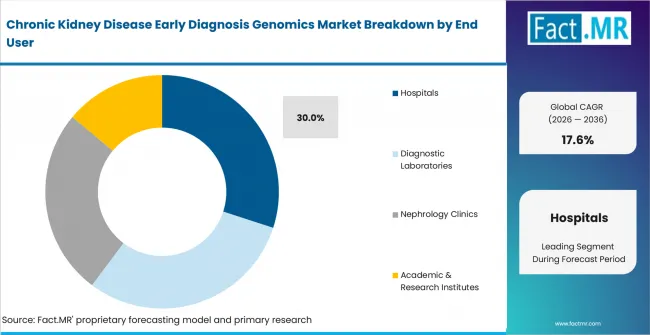
Chronic Kidney Disease Early Diagnosis Genomics Market Analysis By End User | Source: Fact.MR
Specialist kidney care and transplant services place hospitals at the center of genetic testing. Doctors from different departments can review difficult cases together before making a care decision. Diagnostic Laboratories carry out sequencing and prepare the reports. Nephrology Clinics manage referrals and explain results during follow-up visits. Academic & Research Institutes support larger patient studies and the testing of newer methods.
What is accelerating Chronic Kidney Disease Early Diagnosis Genomics Market adoption, and what is holding it back?
Guideline alignment and diverse genomic evidence are expected to drive adoption, although calibration gaps and reimbursement limits are expected to restrain it.
Drivers Impact Analysis
| DRIVER | (~) % IMPACT ON CAGR | GEOGRAPHIC RELEVANCE | IMPACT TIMELINE |
|---|---|---|---|
| Updated CKD guideline alignment | +3.0% | Germany; USA; specialist nephrology networks | Short term (<= 2 years) |
| Diverse population genomics evidence | +2.4% | USA and Brazil | Medium term (2-4 years) |
| Sequencing-to-phenotype pipelines | +1.9% | United Kingdom and Germany | Medium term (2-4 years) |
| Hospital-based early detection | +1.5% | Germany; South Korea; Japan | Long term (>= 4 years) |
| NGS panel evidence expansion | +1.1% | USA and South Korea | Long term (>= 4 years) |
Source: Fact.MR analysis. Updated Jul 20, 2026
- Updated CKD guideline alignment: KDIGO’s March 2024 guideline covers CKD classification and risk assessment. That framework supports testing when clinicians still need cause-specific evidence after routine kidney workup.
- Diverse population genomics evidence: NIH reported in June 2026 that All of Us included more than 535,000 whole genome sequences. The release linked those sequences to nearly 482,000 electronic health records.
- Sequencing-to-phenotype pipelines: Genomics England links rare disease sequencing with phenotype records and specialist review, which fits inherited kidney disorder diagnosis.
- Hospital-based early detection: Specialist hospitals are expected to order tests where results guide transplant decisions and family screening. Trial referral and treatment selection add further practical use cases.
Opportunity Impact Analysis
| OPPORTUNITY | (~) % IMPACT ON CAGR | GEOGRAPHIC RELEVANCE | IMPACT TIMELINE |
|---|---|---|---|
| Family cascade testing programs | +1.4% | Brazil and mixed public-private health systems | Long term (>= 4 years) |
| Multi-omic integration platforms | +1.1% | South Korea and hospital-concentrated systems | Long term (>= 4 years) |
| Transplant donor genetic evaluation | +0.9% | Japan and transplant referral centers | Medium term (2-4 years) |
| Genetic counseling service expansion | +0.7% | United Kingdom and NHS genomic laboratory networks | Medium term (2-4 years) |
Source: Fact.MR analysis. Updated Jul 20, 2026
- Family cascade testing programs: Brazil offers room for familial kidney disease identification where testing is paired with counseling and follow-up for relatives.
- Multi-omic integration platforms: South Korean hospitals are expected to use genomic and transcriptomic data when clinical systems support one patient view. Laboratory and imaging data strengthen clinical interpretation.
- Transplant donor genetic evaluation: Japan’s specialist referral base supports genomic review when living donation and inherited risk affect care. Surveillance decisions require clearer evidence before routine expansion.
- Genetic counseling service expansion: United Kingdom genomic laboratory networks are expected to increase practical use when consent and return of results are planned early. Family communication remains part of the same pathway because inherited findings often affect relatives.
Restraints Impact Analysis
| RESTRAINT | (~) % IMPACT ON CAGR | GEOGRAPHIC RELEVANCE | IMPACT TIMELINE |
|---|---|---|---|
| Unresolved polygenic risk calibration | -1.3% | USA and multi-ancestry population studies | Short term (<= 2 years) |
| Conventional test overlap | -1.0% | Global | Short term (<= 2 years) |
| Reimbursement and evidence-of-utility gaps | -0.8% | Germany; United Kingdom; other public systems | Medium term (2-4 years) |
| Staffing and infrastructure shortfalls | -0.6% | Brazil and capacity-constrained health systems | Long term (>= 4 years) |
Source: Fact.MR analysis. Updated Jul 20, 2026
- Unresolved polygenic risk calibration: Polygenic tools are expected to move unevenly until developers show dependable performance across different ancestry groups.
- Conventional test overlap: Genomics remains tied to cases where routine tests do not explain cause or risk. Donor suitability and family exposure need the same level of diagnostic uncertainty.
- Reimbursement and evidence-of-utility gaps: Public systems need proof that testing changes decisions before routine payment expands across nephrology pathways.
- Staffing and infrastructure shortfalls: Genetic counseling and variant review create workload for clinical teams. Long-term follow-up adds pressure that some health systems cannot absorb quickly without dedicated genetics capacity.
Which countries are scaling Chronic Kidney Disease Early Diagnosis Genomics Market fastest?
The global growth rate combines results from every country covered in the study. Germany, Brazil, the USA and South Korea grow faster than the global average. The United Kingdom and Japan grow at a slower pace. Other countries included in the full analysis help bring these different rates into one worldwide figure. The six countries shown are examples and do not cover the full market.
- Growth also follows a different path in each country. Wider use of genetic testing in kidney care depends on local hospitals, laboratories and care systems.
- Germany benefits from university hospitals, specialist kidney centers and strong laboratory services. These resources support the review of inherited disease and possible kidney donors. Brazil follows a family-testing approach. Its large and varied patient population creates demand for testing, counseling and follow-up among relatives.
- The USA has broad commercial laboratory access, large genetic databases and strong academic kidney research. South Korea relies more on major hospitals that can review genetic results with scans, routine test results and long-term patient records.
- The United Kingdom uses a nationally organized system through shared genetic laboratories and clear rules for returning results. Japan depends on specialist kidney and transplant centers. Local evidence and careful hospital review guide wider use.
Countries with similar growth rates can still develop in very different ways. Laboratory access, insurance coverage, counseling services, evidence across different population groups and transplant use can all affect how quickly testing expands. The complete report covers North America, Latin America, Western Europe, Eastern Europe, East Asia, South Asia and Pacific, and the Middle East and Africa.
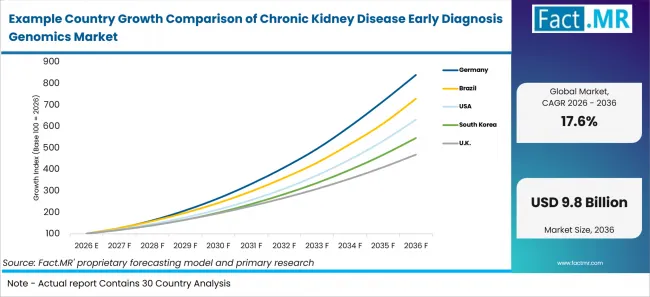
Example Country Growth Comparison Of Chronic Kidney Disease Early Diagnosis Genomics Market | Source: Fact.MR
| COUNTRY | CAGR |
|---|---|
| Germany | 23.8% |
| Brazil | 22.0% |
| USA | 20.2% |
| South Korea | 18.5% |
| United Kingdom | 16.7% |
| Japan | 15.0% |
Source: Fact.MR analysis. Updated Jul 20, 2026
What is driving Germany’s growth from 2026 to 2036?
23.8% CAGR, supported by specialist nephrology networks and hospital laboratory capacity.
Germany’s 23.8% CAGR is tied to a specialist system that connects nephrology, clinical genetics and rare-kidney-disease expertise. German university hospitals participate in the European Rare Kidney Disease Reference Network, where genetic testing supports cases that remain unexplained after routine examination. This structure gives hospitals a practical route to use genomic findings in inherited-disease diagnosis, family assessment and transplant review.
How is Brazil scaling demand?
22.0% CAGR, driven by family testing needs and hereditary-risk assessment across a diverse patient base.
Brazil’s 22.0% CAGR reflects the need to identify inherited kidney disorders across a large population served through both public and private care. The national SUS system covers specialist and high-complexity services, including transplantation, but genetic testing has limited value when relatives cannot obtain counseling or follow-up. Growth is therefore expected to depend on affordable family testing pathways that connect an initial result with referrals for other at-risk relatives.
What supports USA adoption?
20.2% CAGR, led by population-scale genomic data and broad clinical testing access.
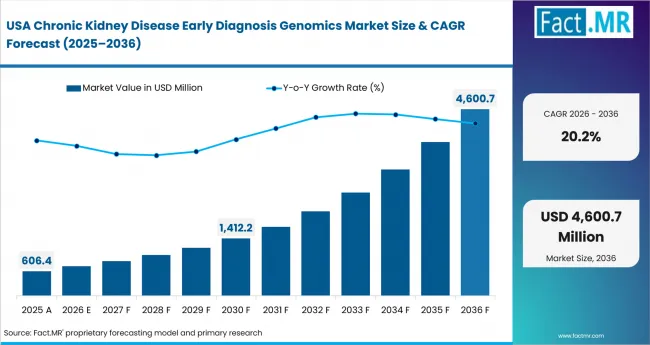
Chronic Kidney Disease Early Diagnosis Genomics Market Country Value Analysis | Source: Fact.MR
The USA gains a research advantage from linking genomic information with long-term clinical records. In June 2026, the NIH All of Us program reported more than 535,000 whole-genome sequences connected with nearly 482,000 electronic health records, with most participants drawn from groups historically underrepresented in biomedical research. This scale strengthens work on APOL1, ancestry-related risk and genetic findings that can be compared with kidney function history, supporting a 20.2% CAGR through 2036.
How is South Korea developing demand?
18.5% CAGR, driven by major hospital networks and integrated genomic testing infrastructure.
South Korea’s 18.5% CAGR is linked to care concentrated in major hospitals rather than widespread ordering across smaller clinics. These centers can review sequence findings beside eGFR, urine results, imaging and earlier patient records within one clinical setting. Wider use is expected to follow only after specialist hospitals establish repeatable rules for deciding which variants explain disease and which remain uncertain.
What shapes United Kingdom growth?
16.7% CAGR, backed by national genomics programs and NHS laboratory networks.
The United Kingdom has a national route for moving genomic tests into regular patient care. The NHS Genomic Medicine Service uses one National Genomic Test Directory and aims to provide consistent access across a population of 55 million, while eligible rare-disease patients can receive whole-genome sequencing through the service. This coordinated structure supports kidney-disease referrals, consent, specialist interpretation and the return of results, underpinning a 16.7% CAGR through 2036.
How does Japan perform?
15.0% CAGR, driven by specialist kidney care and transplant evaluation needs.
Japan’s 15.0% CAGR reflects the importance of genomics in specialist nephrology and living-donor transplant assessment. A hereditary finding can affect the patient’s diagnosis and reveal whether a related donor carries the same risk, making interpretation and family history central to the testing decision. Adoption is expected to progress through specialist hospitals as local evidence confirms that results improve donor review, surveillance or treatment selection.
Who leads the Chronic Kidney Disease Early Diagnosis Genomics Market?
Natera and Illumina lead direct kidney-genomics relevance, while Labcorp and Quest Diagnostics strengthen clinical laboratory reach.
Natera supports kidney genetic testing through its Renasight panel and evidence presented at ASN Kidney Week 2024. Illumina provides sequencing systems used by research centers and clinical laboratories. Labcorp strengthened its genetic testing business after completing the purchase of selected Invitae assets in August 2024. Quest Diagnostics and Thermo Fisher Scientific add broad laboratory and testing-system reach. QIAGEN and Roche provide testing materials and equipment, while Revvity, Exact Sciences and Eurofins support specialist testing services.
From 2026 to 2036, competition is expected to depend on how clearly results are explained and how many kidney-related genes each panel covers. Hospitals are also likely to compare the quality of result review, insurance evidence and counseling support. Providers that turn genetic findings into clear kidney care decisions may gain stronger hospital demand.
Which companies are the key providers?
Natera Inc.; Illumina Inc.; Thermo Fisher Scientific Inc.; QIAGEN N.V.; Quest Diagnostics Incorporated; Laboratory Corporation of America Holdings (Labcorp); Revvity Inc.; and Eurofins Scientific SE.
- Natera, Inc.
- Illumina, Inc.
- Thermo Fisher Scientific Inc.
- QIAGEN N.V.
- Quest Diagnostics Incorporated
- Laboratory Corporation of America Holdings (Labcorp)
- Revvity, Inc.
- Eurofins Scientific SE
Bibliography
- Illumina, Inc. (2025, December 11). Illumina and MyOme strike collaboration deal including strategic investment to support MyOme’s clinical trial that could save US healthcare $200 billion annually.
- National Institutes of Health. (2026, June 30). NIH’s All of Us Research Program is now the largest integrated genomics and health database in the world.
- National Kidney Foundation. (2025, November 10). Your genes, your family, and kidney health.
- Centers for Disease Control and Prevention. (2026, March 31). Chronic kidney disease in the United States.
- National Institute of Diabetes and Digestive and Kidney Diseases. (2025). Research updates, winter 2025. National Institutes of Health.
This Report Answers
- The report provides strategic intelligence on CKD early diagnosis genomics across Technology and Application choices that shape nephrology testing programs.
- Segment analysis covers Next-Generation Sequencing (NGS) and Early CKD Detection as the share within the 2026 market.
- Regional outlook evaluates Germany and Brazil alongside the USA and South Korea. The United Kingdom and Japan complete the growth comparison across the profiled markets.
- Competitive analysis profiles Natera and Illumina alongside Labcorp and Quest Diagnostics. Six additional active genomics and diagnostics providers complete the provider set.
- Biomarker assessment covers Genetic Variants and Polygenic Risk Scores. Transcriptomic and epigenetic approaches complete the biomarker view alongside multi-omic approaches.
What does the Chronic Kidney Disease Early Diagnosis Genomics Market cover?
Genomic and multi-omic tests are used to identify inherited kidney disease and genetic susceptibility before routine workups fully explain CKD cause or progression.
The Chronic Kidney Disease Early Diagnosis Genomics Market covers tests and interpretation services used to clarify CKD etiology and hereditary risk. Coverage extends to progression risk and transplant-related decisions. Coverage includes NGS panels and whole exome sequencing. It includes whole genome sequencing and SNP genotyping. Multi-omic analysis is included within defined nephrology use cases.
The market differs from routine kidney function testing because commercial value comes from genetic or molecular interpretation. Creatinine testing and urine albumin testing remain outside the boundary. Imaging and biopsy procedure spending remain outside the boundary. General nephrology care is excluded unless tied to genomic diagnostic interpretation.
What is included in the scope?
CKD genomic testing is used across hospitals and diagnostic laboratories. Nephrology clinics and academic or research settings are included.
The scope includes Technology and Application alongside Biomarker Type and End User. Coverage spans Early CKD Detection and Risk Stratification. Hereditary Kidney Disease Screening and Disease Progression Prediction complete the application scope. It includes Genetic Variants and Polygenic Risk Scores. Transcriptomic Biomarkers and Epigenetic Biomarkers are included when the purchased function supports CKD diagnosis. Multi-Omic Signatures follow the same clinical-use rule.
What is excluded from the scope?
Routine kidney function testing and unrelated genomic services remain outside the scope of this market.
The scope excludes standalone creatinine testing and urine albumin testing. Imaging and general laboratory panels are excluded. Biopsy procedure spending and treatment expenditure remain outside the scope. Oncology-only genomic testing and pharmacogenomic services without CKD diagnostic relevance are excluded. Public evidence is used to explain adoption context and does not replace Fact.MR market values.
How Was the Analysis Built?
The analysis draws on 120+ sources, 35+ company portfolios, 25+ countries, and more than 20 industry interviews.
- Primary Research: Primary research includes discussions with manufacturers, service providers, technology developers, distributors, end users, procurement teams, and subject-matter experts. These conversations examine purchasing priorities, product adoption, operational challenges, approval requirements, competitive positioning, and the factors that influence wider market acceptance.
- Desk Research: Desk research covers government statistics, regulatory publications, company filings, trade data, technical studies, industry associations, standards, public policy, and other authoritative sources. Every source used in the analysis is documented in the bibliography.
- Market Sizing and Forecasting: Market estimates combine historical performance, demand indicators, pricing and volume trends, segment shares, company participation, country-level growth, adoption patterns, investment activity, and barriers to market expansion.
- Data Validation and Update Cycle: Findings are validated by comparing primary interviews with public data, company activity, regulatory changes, trade patterns, and industry developments. Regular updates review new product launches, capacity changes, partnerships, approvals, procurement trends, and shifts in commercial adoption.
Segmentation
What is the report’s scope and coverage?
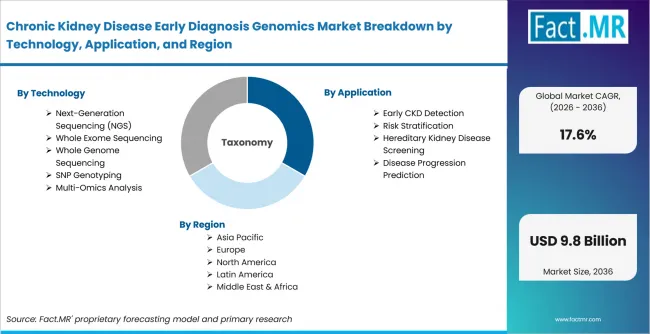
Chronic Kidney Disease Early Diagnosis Genomics Market Breakdown By Technology, Application, And Region | Source: Fact.MR
| Attribute | Details |
|---|---|
| Quantitative Units | USD Billion in 2026 to USD Billion by 2036 at CAGR |
| Market Definition | Genomic and multi-omic tests and interpretation services used to identify inherited kidney disease, clarify uncertain CKD causes, assess hereditary risk and support transplant-related decisions |
| Technology | Next-Generation Sequencing (NGS); Whole Exome Sequencing; Whole Genome Sequencing; SNP Genotyping; Multi-Omics Analysis |
| Application | Early CKD Detection; Risk Stratification; Hereditary Kidney Disease Screening; Disease Progression Prediction |
| Biomarker Type | Genetic Variants; Polygenic Risk Scores; Transcriptomic Biomarkers; Epigenetic Biomarkers; Multi-Omic Signatures |
| End User | Hospitals; Diagnostic Laboratories; Nephrology Clinics; Academic & Research Institutes |
| Regions Covered | North America; Latin America; Western Europe; Eastern Europe; East Asia; South Asia and Pacific; Middle East and Africa |
| Countries Covered | Germany; Brazil; USA; South Korea; United Kingdom; Japan |
| Key Companies Profiled | Natera, Inc.; Illumina, Inc.; Thermo Fisher Scientific Inc.; QIAGEN N.V.; Quest Diagnostics Incorporated; Laboratory Corporation of America Holdings; Revvity, Inc.; Eurofins Scientific SE |
| Forecast Period | 2026 to 2036 |
| Approach | Hybrid top-down and bottom-up approach using CKD diagnostic volumes; hereditary kidney disease testing pathways; NGS and exome sequencing adoption; hospital and laboratory capacity; transplant evaluation use; genetic counseling availability; reimbursement conditions; ancestry-aware risk evidence; country adoption patterns and company portfolio review |
Source: Fact.MR analysis. Updated Jul 20, 2026
How is the market segmented?
-
By Technology:
- Next-Generation Sequencing (NGS)
- Whole Exome Sequencing
- Whole Genome Sequencing
- SNP Genotyping
- Multi-Omics Analysis
-
By Application:
- Early CKD Detection
- Risk Stratification
- Hereditary Kidney Disease Screening
- Disease Progression Prediction
-
By Biomarker Type:
- Genetic Variants
- Polygenic Risk Scores
- Transcriptomic Biomarkers
- Epigenetic Biomarkers
- Multi-Omic Signatures
-
By End User:
- Hospitals
- Diagnostic Laboratories
- Nephrology Clinics
- Academic & Research Institutes
-
By Region:
- North America
- Latin America
- Western Europe
- Eastern Europe
- East Asia
- South Asia and Pacific
- Middle East and Africa
Frequently Asked Questions
Which Technology leads the Chronic Kidney Disease Early Diagnosis Genomics Market?
Which Application leads the Chronic Kidney Disease Early Diagnosis Genomics Market?
Which Biomarker Type leads the Chronic Kidney Disease Early Diagnosis Genomics Market?
Which End User leads the Chronic Kidney Disease Early Diagnosis Genomics Market?
Which country records the largest listed CAGR in this market?
How does Brazil perform in this market?
How does the USA perform in this market?
What is the primary driver in this market?
What is the main restraint in this market?
Why do hospitals dominate demand?
Who worked on this report


Preview the report firsthand - request a free sample
Free SampleGet the brochure for pricing and purchase details
Download PDF