- Base Value(2025): 110.2 Bn
- Estimated Value(2026): 114.3 Bn
- Forecast Value (2036): 166.0 Bn
- CAGR (2026 - 2036): 3.8%
Cider and Perry Market Forecast and Outlook By Fact.MR
In 2025, the cider and perry market was valued at USD 110.2 billion. Based on Fact.MR analysis, demand for cider and perry is estimated to grow to USD 114.3 billion in 2026 and USD 166.0 billion by 2036. FACT.MR projects a CAGR of 3.8% during the forecast period.
The market is projected to generate USD 55.8 billion in incremental revenue during the forecast period. Growth remains steady but moderate due to apple crop volatility, alcohol duty pressures in the UK and EU, and competition from RTD cocktails and hard seltzers. However, expansion in Asia Pacific and flavour-driven premiumisation in North America continue to support long-term category growth.
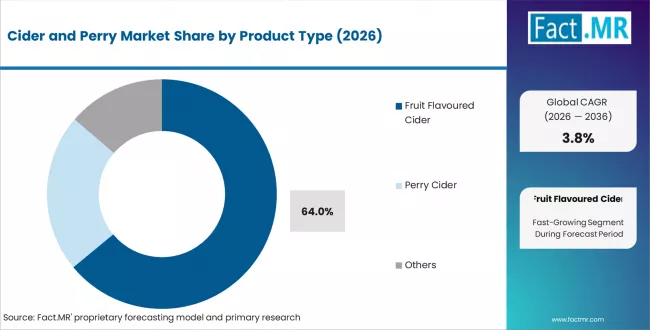
The global cider and perry market benefits from its positioning as a gluten-free, fruit-based alternative to beer. Heineken’s Strongbow remained the leading global cider brand in 2024 by both volume and value. Strongbow Dark Fruit continues to dominate the UK on-trade flavoured draught cider segment. Flavoured cider accounts for about 64% of the category in 2025, with berry, citrus, and tropical variants driving shelf expansion in global retail channels.
Country growth varies based on craft penetration, regulations, and distribution maturity. India leads with 5.6% CAGR due to rising urban demand for flavoured ciders among younger consumers. The USA grows at 5.8% supported by craft cider producers and wider distribution of European brands. Canada records 4.8% growth through increased imports and on-trade menus. The UK grows at 5.0% driven mainly by premiumisation despite duty pressures. Japan grows at 4.0% as a mature premium RTD-adjacent market with stable demand.
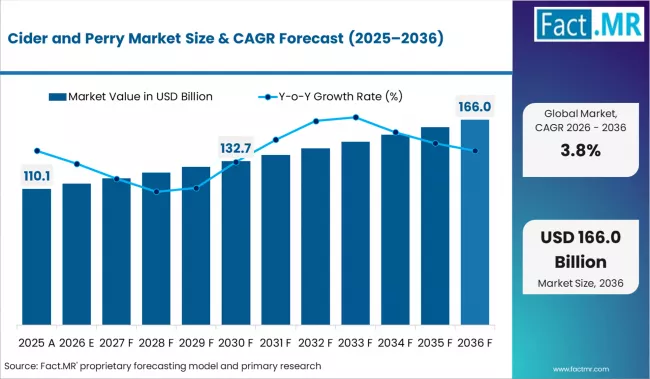
Cider And Perry Market Market Value Analysis | Source: Fact.MR
| Metric | Value |
|---|---|
| Estimated Value in 2026 | USD 114.3 billion |
| Forecast Value in 2036 | USD 166.0 billion |
| Forecast CAGR (2026 to 2036) | 3.8% |
Source: Fact.MR analysis. Updated Mar 23, 2026
Cider and Perry Market Definition
The cider and perry market includes fermented alcoholic and non-alcoholic beverages made from apple, pear, or other fruit bases. Products include traditional apple cider, perry, flavoured cider, and low or zero-alcohol variants. These beverages are sold through both retail (off-trade) and hospitality (on-trade) channels worldwide.
Market Inclusions
Includes global and regional revenue forecasts from 2026-2036 by product type, packaging, and distribution channel. Covers apple cider, flavoured cider, perry, and other fruit variants. Packaging formats include glass bottles, cans, and plastic. Regions include North America, Europe, Asia Pacific, Latin America, and MEA.
Market Exclusions
Excludes non-fermented apple juice and fruit beverages not marketed as cider. Apple cider vinegar and apple wine outside the cider category are excluded. Distilled apple spirits such as calvados and applejack are not included. Cider accessories and merchandise are excluded from market sizing.
Research Methodology
- Primary Research: Interviews with cider brand managers, retail buyers, hospitality procurement managers, cidery owners, and distributors across the UK, USA, Canada, India, and Japan.
- Desk Research: Data sources include CGA on-trade data, HMRC duty records, TTB cider shipment reports, Heineken and Carlsberg annual reports, and trade publications from 2024-2025.
- Market Sizing and Forecasting: Hybrid top-down and bottom-up model using shipment volumes, average selling prices, and channel distribution analysis.
- Data Validation and Update Cycle: Forecasts validated using company disclosures, CGA data, HMRC duty receipts, TTB statistics, and expert interviews.
Summary of Cider and Perry Market
- Market Definition
- The market includes apple cider, flavoured cider, perry, and zero-alcohol cider sold through retail and hospitality channels worldwide.
- Demand Drivers
- Flavoured cider innovation such as berry, citrus, and tropical variants is expanding category demand among younger consumers.
- Rising interest in low- and zero-alcohol beverages is encouraging product launches like Somersby Zero.
- Urbanisation and imported cider availability are expanding demand in India and Asia Pacific.
- Key Segments Analyzed
- By Product Type: Flavoured cider leads with about 64% share in 2026 due to strong appeal among younger consumers.
- By Packaging: Glass bottles hold about 48% share, while cans are the fastest-growing format.
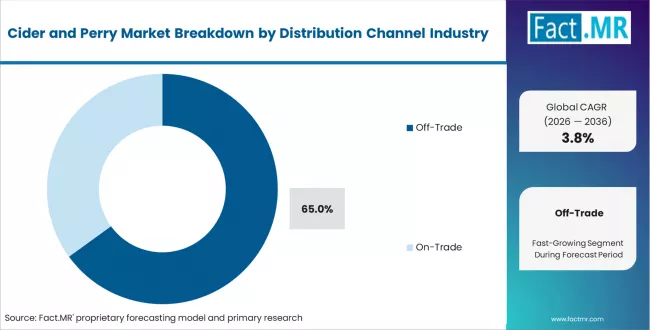
- By Distribution Channel: Off-trade leads with about 65% share, while on-trade generates higher premium margins.
- Analyst Opinion at Fact.MR
- Shambhu Nath Jha, Principal Consultant at Fact.MR, states that the report helps CXOs identify premiumisation, craft expansion, and distribution opportunities in high-growth markets.
- Strategic Implications
- Brands should expand low- and zero-alcohol cider ranges to compete with RTD cocktails and hard seltzers.
- Producers should explore local production or partnerships in Asia Pacific to reduce import costs.
- Heritage cider brands should highlight craft origin and orchard sourcing to sustain margins.
- Methodology
- Market sizing uses shipment volumes, average selling prices, packaging formats, and channel mix.
- Data sources include CGA, HMRC, TTB shipment reports, and company financial disclosures.
- Forecasts incorporate craft growth trends, low-alcohol innovation, Asia Pacific expansion, and expert interviews.
Segmental Analysis
Cider and Perry Market Analysis by Product Type
Cider And Perry Market Analysis By Product Type | Source: Fact.MR
FACT.MR estimates fruit flavoured cider will hold about 64% share in 2026. Flavoured variants attract new consumers and expand category demand beyond traditional apple cider.
- Heineken Strongbow Zest Launch: In March 2024, Heineken introduced Strongbow Zest. The lower-calorie flavoured cider blends citrus and apple flavours. It targets health-conscious younger consumers in Europe and the UK. [4]
- Carlsberg Somersby Zero Innovation: In February 2025, Carlsberg launched Somersby Zero in Germany. The product offers zero alcohol, zero sugar, and zero calories. It expands cider consumption into non-alcohol occasions. [2]
- Flavoured Draught Cider Growth: CGA data for 2024 shows flavoured draught cider generates about GBP 9,700 per pub annually in the UK on-trade. Strongbow Dark Fruit, Old Mout Berries and Cherries, and Rekorderlig Strawberry and Lime lead the segment. [5]
Cider and Perry Market Analysis by Distribution Channel
Cider And Perry Market Analysis By Distribution Channel | Source: Fact.MR
FACT.MR estimates off-trade will account for about 65% share in 2026. Supermarkets, convenience stores, and e-retailers drive strong packaged cider sales.
- C&C Group Magners Investment: In May 2025, C&C Group invested heavily in Magners. The investment funded television advertising and national campaigns. The goal is to strengthen off-trade cider sales during peak summer demand. [1]
- Molson Coors Fever-Tree Partnership: In January 2025, Molson Coors partnered with Fever-Tree in the United States. The partnership expands premium flavoured beverage offerings across retail and hospitality channels. [6]
- On-Trade Draught Cider Recovery: Heineken UK reported a 42.1% value share in the UK on-trade cider market in 2024. CGA data recorded 342 million pints and 11 million bottles sold through hospitality venues, confirming strong on-trade demand.
Drivers, Restraints, and Opportunities
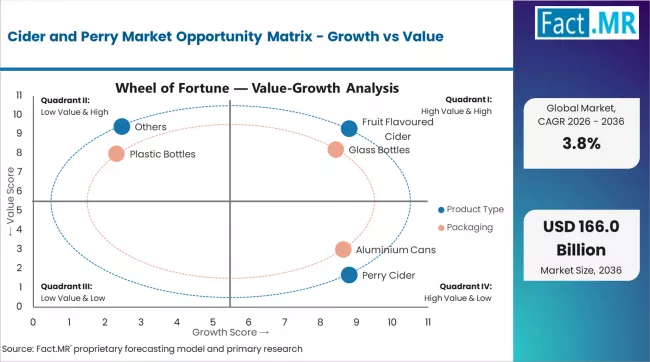
Cider And Perry Market Opportunity Matrix Growth Vs Value | Source: Fact.MR
FACT.MR analysts note the cider and perry market is supported by strong on-trade presence in the UK and Europe and rising demand in North America and Asia Pacific. Europe’s heritage production base provides stable volumes. Growth increasingly comes from flavoured, low-alcohol, and craft premium products. Traditional apple cider volumes remain stable, while premium variants drive revenue. However, competition from hard seltzers and RTD cocktails creates pressure, especially in off-trade retail.
- UK Alcohol Duty Restructure: The UK alcohol duty reform introduced lower duty for draught cider below 3.5% ABV. This encouraged investment in low-alcohol cider innovation. Thatchers planted 13,000 apple trees in Somerset in 2024 to meet demand. C&C Group invested in Magners in May 2025 following strong volume and value growth reported by CGA.
- Zero-Alcohol Category Growth: In February 2025, Carlsberg launched Somersby Zero in Germany. The product is marketed as zero alcohol, zero sugar, and zero calories. The launch reflects rising demand for alcohol-free options across Europe.
- Asia Pacific Distribution Expansion: In January 2024, Carlsberg opened a Somersby production line at its ThaiBev joint venture facility in Thailand. This reduced supply lead times by about 30%. The move supports cider growth in India, Japan, and ASEAN markets. [3]
Regional Analysis
The cider and perry market is analysed across North America, Europe, Asia Pacific, Latin America, and Middle East and Africa, covering 40+ key cider producing and consuming countries with distinct demand profiles shaped by heritage production, distribution regulation, duty structures, and craft beverage trends. The full report offers market attractiveness analysis based on on-trade penetration rates, off-trade per capita consumption, and flavour innovation pipeline data.
.webp "Top Country Growth Comparison Cider And Perry Market Cagr (2026 2036)")
Top Country Growth Comparison Cider And Perry Market Cagr (2026 2036) | Source: Fact.MR
| Country | CAGR (2026 to 2036) |
|---|---|
| USA | 5.8% |
| UK | 5.0% |
| Canada | 4.8% |
| India | 5.6% |
| Japan | 4.0% |
Source: Fact.MR analysis. Updated Mar 23, 2026
Source: Fact.MR (FACT.MR) analysis, based on proprietary forecasting model and primary research
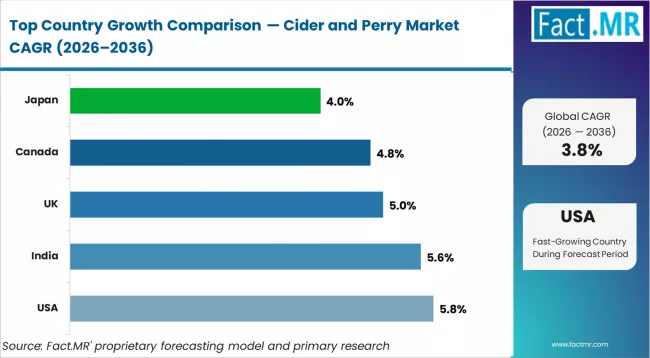
Cider And Perry Market Cagr Analysis By Country | Source: Fact.MR
North America Cider and Perry Market Analysis
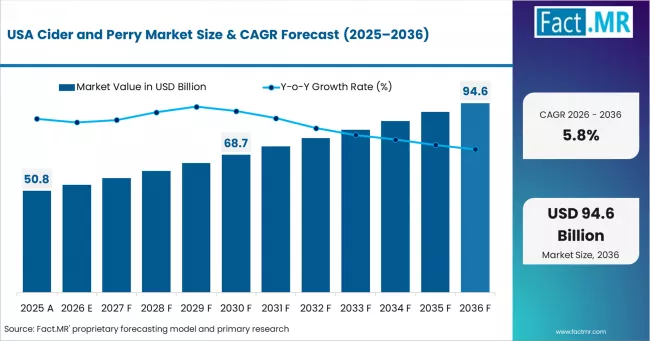
Cider And Perry Market Country Value Analysis | Source: Fact.MR
North America represents a fast-growing developed cider region. Growth is supported by the US craft cider movement and increasing popularity of imported European brands. Angry Orchard leads the US market, while Strongbow and Magners continue expanding retail distribution.
- USA: The United States cider market is expected to grow at 5.8% CAGR through 2036. Craft cider producers in the Pacific Northwest are expanding distribution nationwide. TTB shipment data recorded steady growth in 2024 across domestic and imported categories. Heineken introduced Strongbow Zest in March 2024, targeting younger consumers with a lower-calorie citrus cider. US cider taxation continues to remain lower than still wine, supporting competitive pricing in retail channels.
- Canada: Canada’s cider market growth is supported by expanding premium imports and craft production. Demand is projected to rise at 4.8% CAGR through 2036. Provincial liquor boards, especially LCBO in Ontario, increased listings for imported cider brands in 2024. Craft cider producers in British Columbia and Ontario expanded capacity to meet demand. Canada’s updated alcoholic beverage labelling rules for 2025 require clearer ingredient disclosure on cider products.
FACT.MR’s North America analysis includes the United States, Canada, and Mexico. The report covers TTB shipment statistics, craft cider market share trends, provincial liquor board distribution systems, and country-level revenue forecasts.
Europe Cider and Perry Market Analysis
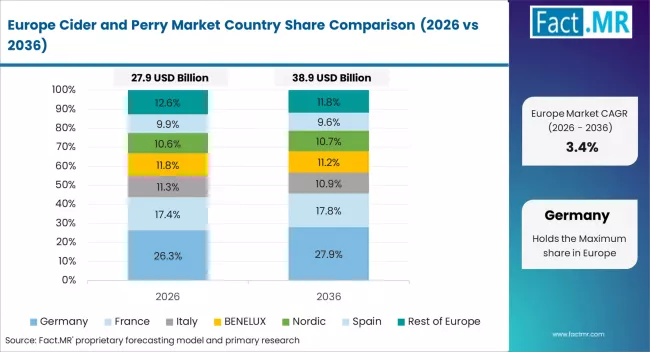
Cider And Perry Market Europe Country Market Share Analysis, 2026 & 2036 | Source: Fact.MR
Europe remains the global centre for cider production and consumption. The UK, France, Germany, and Ireland account for most global cider volume and strong on-trade demand. Major brands include Heineken (Strongbow, Inch’s, Bulmers), C&C Group (Magners), and Thatchers in the UK, while Carlsberg’s Somersby leads in continental Europe.
- UK: The UK continues to be the world’s largest cider market by per capita consumption. Demand is projected to grow at 5.0% CAGR through 2036. CGA reported 342 million pints sold in the on-trade in 2024. Heineken held 42.1% value share, followed by Molson Coors and Thatchers. Thatchers planted 13,000 apple trees in Somerset in 2024 to support rising demand. The UK alcohol duty reform introduced lower duty for draught cider below 3.5% ABV, encouraging low-alcohol innovation. Premium flavoured draught ciders such as Strongbow Dark Fruit and Old Mout continue to generate higher pub revenues.
FACT.MR’s European analysis covers the UK, Germany, France, Ireland, Spain, Nordic countries, BENELUX, and other Western Europe markets. The report includes CGA on-trade benchmarks, EU duty structure insights, zero-alcohol product trends, and country-level forecasts by product type and channel.
Asia Pacific Cider and Perry Market Analysis
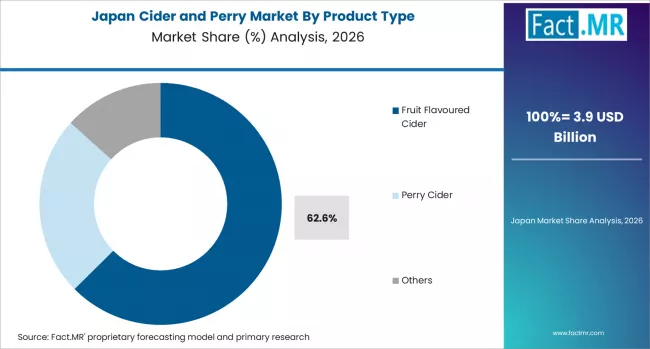
Cider And Perry Market Japan Market Share Analysis By Product Type | Source: Fact.MR
Asia Pacific is the fastest-growing cider region globally by CAGR. Growth is driven by rising urban incomes, expanding retail channels, and strong interest in flavoured beverages. International brands such as Strongbow, Somersby, and Asahi are expanding regional distribution through partnerships and local production.
- India: India’s cider market is still emerging but growing steadily. Demand is projected to expand at 5.6% CAGR through 2036. Young urban consumers in cities like Mumbai, Delhi, Bengaluru, and Hyderabad are driving adoption through bars and premium retail outlets. Strongbow and Somersby dominate imported brand awareness. Regional supply improvements from Carlsberg’s ThaiBev joint venture have strengthened product availability across Southeast Asia and nearby markets including India.
- Japan: Japan’s cider market operates within a mature RTD beverage environment. Demand is projected to grow at 4.0% CAGR through 2036. Cider competes with chu-hi and other flavoured canned drinks. Heineken introduced Strongbow Ultra in Japan in 2023, targeting health-conscious consumers with a low-carb cider. Convenience store networks such as 7-Eleven Japan and FamilyMart play a key role in distribution. Premium Scandinavian brands like Kopparberg and Rekorderlig have expanded placement in Tokyo and Osaka specialty retailers.
FACT.MR’s Asia Pacific coverage includes Japan, India, China, Australia and New Zealand, ASEAN, and other regional markets. The report provides country CAGR forecasts, distribution channel benchmarks, e-commerce adoption insights, and urban consumer demand trends.
Competitive Aligners for Market Players
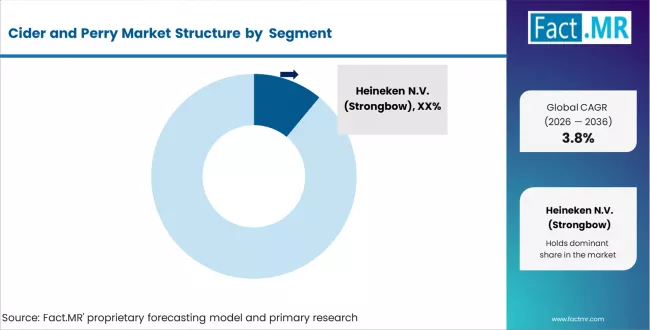
Cider And Perry Market Analysis By Company | Source: Fact.MR
The global cider and perry market shows moderate concentration among major international brands, while remaining highly fragmented at the regional craft and private-label level. Large multinational brewers such as Heineken, Carlsberg Group, C&C Group, and Asahi Group Holdings together account for roughly 55-65% of global cider revenue. In this market, brand recognition and flavour variety matter more than price, since cider consumers often remain loyal to specific brands across retail and hospitality channels.
Large brewers such as Heineken and Carlsberg benefit from global distribution networks, allowing them to expand cider brands into regions like Asia Pacific and Latin America without building separate logistics systems. Meanwhile, companies such as C&C Group maintain strong positions in the UK and Irish pub sectors through long-standing draught cider partnerships. Smaller producers like Thatchers Cider and Westons Cider gain an advantage from owning orchards and emphasising traditional cider-making authenticity. Premium flavoured brands such as Kopparberg and Rekorderlig also command higher retail prices due to strong brand appeal.
In the UK hospitality sector, pubs often stock multiple cider brands to maintain supplier competition. Retailers such as Tesco and Sainsbury's also use private-label ciders alongside well-known brands to negotiate pricing and promotional terms.
Key Players
- Heineken N.V. (Strongbow)
- Asahi Group Holdings Ltd. (Somersby)
- C&C Group plc (Magners, Bulmers)
- Thatchers Cider Company Ltd.
- Westons Cider
- Angry Orchard (Boston Beer Company)
- Aspall Cyder
- Rekorderlig (Molson Coors Beverage Company)
- Kopparberg Brewery AB
Bibliography
- [1] C&C Group plc / The Drinks Business. (2025). C&C Group Makes Multi-Million Pound Investment into Magners Cider Brand to Support Summer Marketing Campaign, Citing CGA Volume and Value Growth Data. May 2025.
- [2] Carlsberg Group. (2025). Press Release: Somersby Zero Launch in Germany-World's First Zero Alcohol, Zero Sugar, Zero Calorie Cider Product. February 2025.
- [3] Carlsberg Group. (2024). Annual Report 2024: Somersby Production Line Inauguration at ThaiBev Joint Venture Facility in Thailand, Supply Lead Time Reduction and Asia Pacific Distribution Capacity. January 2024.
- [4] Heineken N.V. (2024). Press Release: Strongbow Zest Launch-New Lower Calorie Citrus-Apple Cider Targeting Health-Conscious Younger Consumer Segment Across UK and European Markets. March 2024.
- [5] CGA by NIQ / Morning Advertiser. (2025). Heineken UK On-Trade Cider Market Share Report: 42.1% Value Share, 342 Million Pints and 11 Million Bottles Sold in 12 Months to December 2024, Draught and Flavoured Category Performance. March 2025.
- [6] Molson Coors Beverage Company. (2025). Press Release: Strategic Partnership with Fever-Tree to Enhance Flavoured Beverage Portfolio Distribution Across United States On-Trade and Off-Trade Channels. January 2025.
This Report Addresses
- Strategic intelligence on UK alcohol duty restructuring, EU moderation trends, TTB cider taxation frameworks, India import duty dynamics, and Japan convenience store distribution dynamics influencing cider demand and pricing.
- Market forecast from USD 114.3 billion in 2026 to USD 166.0 billion by 2036 at 3.8% CAGR across product type, packaging, distribution channel, and region. Perry and pear cider dynamics are analysed as a distinct product type within the broader cider and perry category.
- Growth opportunity mapping across flavoured and zero-alcohol cider innovation in Europe, craft cider expansion in the US Pacific Northwest, Somersby and Strongbow Asia Pacific distribution investments, and India urban lifestyle market development.
- Country CAGR outlook including USA 5.8%, India 5.6%, UK 5.0%, Canada 4.8%, and Japan 4.0%, supported by channel-level volume benchmarks and regulatory framework analysis.
- Competitive analysis of Heineken, C&C Group, Carlsberg, Thatchers, Kopparberg, Rekorderlig, and Angry Orchard based on brand equity, on-trade share, product innovation, and geographic expansion strategies.
- Technology and product tracking covering zero-alcohol cider development, flavoured draught innovation, sustainable apple orchard investment, aluminium can sustainability credentials, and e-commerce cider distribution growth.
- Regulatory analysis of UK alcohol duty reform, EU food labelling standards, TTB cider excise classifications, CFIA Canadian labelling guidelines, and ABAC responsible alcohol advertising standards.
- Report delivery includes PDF, Excel datasets, PowerPoint summary, and dashboard tools supported by CGA on-trade data, HMRC alcohol receipts, TTB shipment statistics, and primary interviews with retail buyers and brand managers.
Segmentation
Scope of Report
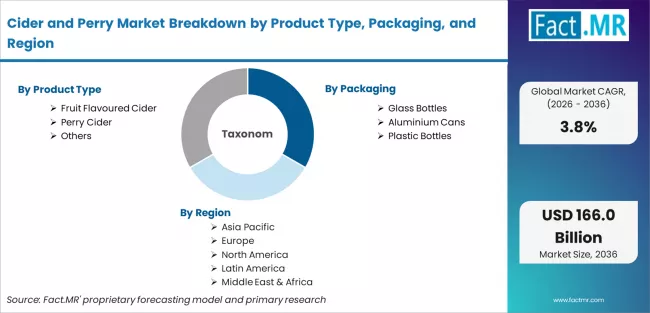
Cider And Perry Market Breakdown By Product Type, Packaging, And Region | Source: Fact.MR
| Attribute | Details |
|---|---|
| Quantitative Units | USD 114.3 billion (2026) to USD 166.0 billion (2036), at a CAGR of 3.8% |
| Market Definition | Fermented fruit-based alcoholic and low/zero-alcohol beverages including apple cider, flavoured cider, perry, and variants consumed in on-trade and off-trade globally. Perry encompasses both traditional craft perry from heritage perry pear varieties and mainstream pear cider produced from concentrate. |
| Product Type Segmentation | Apple Cider, Fruit Flavoured Cider, Perry Cider, Others |
| Packaging Segmentation | Glass Bottles, Aluminium Cans, Plastic Bottles |
| Distribution Segmentation | Off-Trade, On-Trade |
| Application Coverage | On-trade licensed hospitality, off-trade grocery and convenience retail, e-commerce, premium specialty retail, and international export markets. |
| Regions Covered | North America, Europe, Asia Pacific, Latin America, Middle East and Africa |
| Countries Covered | USA, Canada, Mexico, UK, Germany, France, Ireland, Spain, Nordic, BENELUX, Rest of Western Europe, Japan, India, China, Australia and New Zealand, ASEAN, Brazil, Rest of Latin America, GCC, South Africa, Rest of MEA |
| Key Companies Profiled | Heineken, Asahi, C&C Group, Thatchers, Westons, Angry Orchard, Aspall, Rekorderlig, Kopparberg |
| Forecast Period | 2026 to 2036 |
| Approach | Hybrid top-down and bottom-up model using volume shipment data, average selling prices by product type and packaging, distribution channel splits, and primary interviews. |
Source: Fact.MR analysis. Updated Mar 23, 2026
Cider and Perry Market by Segments
-
By Product Type :
- Apple Cider
- Fruit Flavoured Cider
- Perry Cider
- Others
-
By Packaging :
- Glass Bottles
- Aluminium Cans
- Plastic Bottles
-
By Distribution Channel :
- Off-Trade
- On-Trade
-
By Region :
- North America
- United States
- Canada
- Mexico
- Latin America
- Brazil
- Rest of Latin America
- Western Europe
- United Kingdom
- Germany
- France
- Ireland
- Spain
- Nordic
- BENELUX
- Rest of Western Europe
- East Asia
- China
- Japan
- South Korea
- South Asia and Pacific
- India
- ASEAN
- Australia and New Zealand
- Rest of South Asia and Pacific
- Middle East and Africa
- GCC Countries
- South Africa
- Rest of Middle East and Africa
- North America
Frequently Asked Questions
How large is the cider and perry market in 2025?
What will the market size be in 2026?
What is the projected market size by 2036?
What is the expected CAGR?
Which product type segment leads the market?
Which distribution channel dominates?
Which country shows the fastest growth?
What is the primary restraint?
Who worked on this report


Preview the report firsthand - request a free sample
Free SampleGet the brochure for pricing and purchase details
Download PDF