- Base Value(2026): 295.4 Mn
- Estimated Value(2025): 295.4 Mn
- Forecast Value (2035): 356.7 Mn
- CAGR (2025 - 2035): 1.9%
Demand for Canned Meat in UK 2026 to 2036
Canned meat consumption value in UK will to rise from USD 295.4 million in 2026 to USD 356.7 million by 2036, reflecting a 1.9% CAGR. Consumers are leaning toward ready-to-eat proteins that fit busy lifestyles, and this shift is lifting uptake of shelf-stable formats across supermarkets, convenience stores, and online grocery platforms. Retailers are responding with broader assortments, private-label extensions, and merchandising strategies that strengthen visibility and encourage repeat purchases.
Key Takeaways for UK Canned Meat Industry
- UK Canned Meat Sales Value (2026): USD 295.4 million
- UK Canned Meat Forecast Value (2036): USD 356.7 million
- UK Canned Meat Forecast CAGR: 1.9%
- Leading Product Type in UK Canned Meat Industry: Poultry (38.6%)
- Key Growth Regions in UK Canned Meat Industry: England, Scotland, Wales, and Northern Ireland
- Regional Leadership: England holds the leading position in demand
- Key Players in UK Canned Meat Industry: JBS S.A., Tyson Foods Inc., Hormel Foods Corporation, Smithfield Foods, Campbell Soup Company, Bolton Group, Vion Food Group, Wild Planet Foods, Valleyfresh Global, Mundella Foods

Uk Canned Meat Market Market Value Analysis | Source: Fact.MR
Product development is moving toward premium, healthier, and more specialised formulations as dietary preferences evolve. Seafood-infused variants and blended protein SKUs are entering the market, while cleaner-label recipes appeal to shoppers seeking clarity around ingredients. Advances in packaging and traceability are also reinforcing trust and improving replenishment cycles for retailers.
Foodservice operators require versatile, high-protein ingredients, and this is prompting manufacturers to create formats suited for both household use and commercial menus. Supply chain modernization supported by warehouse automation and integrated distribution networks is improving product availability and reducing lead times. Regional retail behaviour across England and Scotland continues to influence category depth, pricing patterns, and promotional frequency.
Suppliers are prioritizing differentiated products, reliable omnichannel distribution, and transparent sourcing. Companies that combine convenience with strong quality signals are likely to gain momentum as the market progresses toward a more refined demand structure.
UK Canned Meat Industry
| Metric | Value |
|---|---|
| UK Canned Meat Sales Value (2026) | USD 295.4 million |
| UK Canned Meat Forecast Value (2036) | USD 356.7 million |
| UK Canned Meat Forecast CAGR (2026-2036) | 1.9% |
Source: Fact.MR analysis. Updated Dec 16, 2025
Category
| Category | Segments |
|---|---|
| Product Type | Poultry, Seafood, Pork, Beef, Others |
| Distribution Channel | Supermarket and Hypermarket, Online, Specialty Stores, Others |
| Region | England, Scotland, Wales, Northern Ireland |
Source: Fact.MR analysis. Updated Dec 16, 2025
Segmental Analysis
Which Product Category occupies the Leading Position in UK’s Canned Meat Landscape?
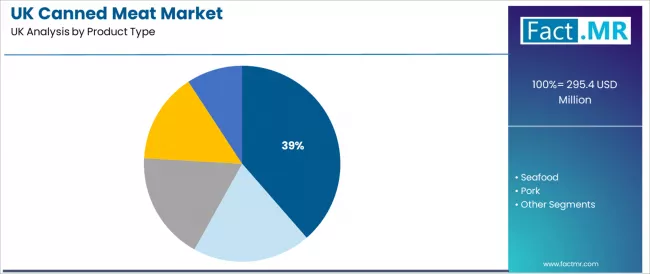
Uk Canned Meat Market Analysis By Product Type | Source: Fact.MR
Poultry is projected to capture 38.6% of UK canned meat consumption in 2026. Its cost profile, familiar flavour range, and consistent protein value keep it aligned with household preferences and retail stocking strategies. Brands rely on poultry because the category adapts well to established processing standards and offers predictable formulation performance. These qualities create stable consumer acceptance across regions and support steady product rotation in mainstream retail settings.
- Poultry suits routine dietary habits and reinforces dependable household usage.
- Strong processing consistency strengthens retailer confidence and supports repeat placement.
By Distribution Channel, Which Segment accounts for Maximum Canned Meat Sales in UK?
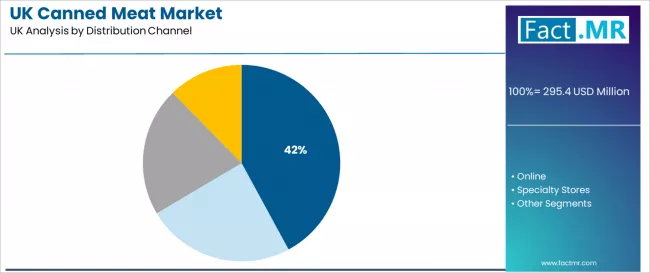
Uk Canned Meat Market Analysis By Distribution Channel | Source: Fact.MR
Supermarkets and hypermarkets are expected to represent 42.1% of consumption in 2026. Their broad shelf capacity, structured sourcing systems, and nationwide reach sustain high product visibility for canned meat. Retail chains maintain stable category rotation by offering wide assortments that meet varied shopper expectations. This environment enables faster uptake of new formats while maintaining continuity for established lines.
- Extensive store networks improve product access and strengthen category turnover.
- Large retail formats support variety, steady merchandising, and reliable consumer engagement.
What are the Drivers, Restraints, and Key Trends in the UK Canned Meat Industry?
Convenience led eating habits continue to strengthen canned meat consumption across the UK. Stable protein availability plays an important role in retail planning as households look for reliable and long lasting options. England remains a strong contributor to product development activity through its concentrated retail ecosystem. The sector faces pressure from fresh protein choices and rising operational expenses. Retailers continue to review sourcing requirements and quality protocols, which adds complexity for producers seeking predictable supply pathways. Regulatory scrutiny also demands consistent investment in testing and compliance.
Retail programs in England and Scotland guide purchasing behaviour through nutrition messaging and procurement standards. These initiatives shape product visibility and influence long term adoption. Distribution upgrades are gaining pace. Producers are investing in centralized quality facilities and digital logistics tools. These systems strengthen consistency, support wider retail coverage, and create space for emerging protein formats that require tighter control and validation.
Analysis of UK Canned Meat Industry by Key Countries

Uk Canned Meat Market Cagr Analysis By Country | Source: Fact.MR
| Region | CAGR (2026-2036) |
|---|---|
| England | 2.1% |
| Scotland | 1.9% |
| Wales | 1.7% |
| Northern Ireland | 1.5% |
Source: Fact.MR analysis. Updated Dec 16, 2025
Why does England Lead Canned Meat Demand?

Uk Canned Meat Market Country Value Analysis | Source: Fact.MR
England records a CAGR of 2.1% through 2036. Progressive preferences and steady retail development sustain interest in canned formats. London and nearby metropolitan areas continue to anchor growth due to dense retail networks and strict quality expectations. Businesses rely on consistent supply structures suited for large retail environments. Suppliers are broadening distribution programs that match professional requirements across food retail, food service, and private-label portfolios.
England’s established logistics, advanced packaging capabilities, and continuous product rotation cycles strengthen adoption. Retailers prefer solutions that reduce operational friction while securing predictable throughput in fast-paced channels.
- Large retail networks shape household strategies and drive interest in reliable canned formats with clear nutrition value.
- Investment activity across retail corridors supports next-generation processing technologies and broader commercial use.
Why does Scotland Show Strong Growth?
Scotland records a CAGR of 1.9%. Edinburgh, Glasgow, and regional distribution routes host concentrated retail assets suited for canned meat integration. Broad food infrastructure gives suppliers a stable platform for specialized offerings. Regional operators benefit from predictable handling, strong shelf resilience, and adaptable packaging suited for mixed consumer profiles.
Distribution clusters enhance supplier access to both urban and semi-urban demand pockets. Growing investment in storage upgrades and product rotation practices helps Scotland maintain dependable supply continuity while supporting wider commercial applications.
- Retail concentration creates openings for suppliers that offer protein systems aligned with established operations.
- Strong awareness and consistent positioning strengthen Scotland’s retail competitiveness across product clusters.
Why does Wales Show Consistent Expansion?
Wales records a CAGR of 1.7%. Regional operators and distribution companies continue to integrate canned formats to maintain performance and meet evolving expectations. Expanding supply capabilities support adoption across food channels with varied throughput levels. Stable retail networks help suppliers introduce new packaging formats and nutrition-focused product lines suited for regional requirements.
A growing emphasis on efficiency, predictable storage conditions, and controlled handling environments strengthens Wales’ position as a steady adopter of canned formats across retail and food service.
- Modernization priorities are encouraging use of canned solutions that support operational consistency.
- Regional optimization efforts are enabling diversified applications across retail facilities.
What Factors Underpin Canned Meat Demand in Northern Ireland?
Northern Ireland records a CAGR of 1.5%. Retail expansion and broadening food activity sustain interest in protein-based canned formats across multiple distribution settings. Suppliers are enhancing regional capabilities to support deployment across varied retail footprints.
Businesses value formats with long shelf life, predictable rotation cycles, and reliable storage requirements. Strengthening logistics corridors, ongoing upgrades to food facilities, and rising interest in cost-efficient protein solutions reinforce Northern Ireland’s steady adoption trajectory.
- Food diversification and steady retail investment are encouraging adoption of canned technologies.
- Collaborative retail development is building stable environments for shared product initiatives across the region.
Competitive Landscape of UK Canned Meat Industry
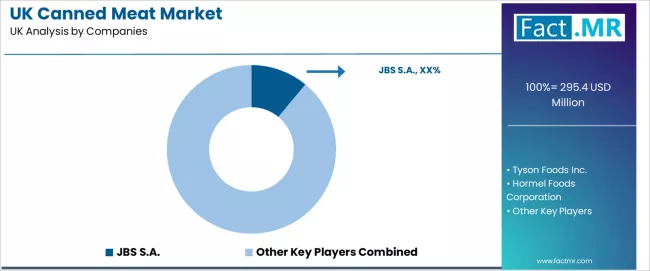
Uk Canned Meat Market Analysis By Company | Source: Fact.MR
The canned meat landscape in UK features active participation from specialized processors, integrated protein suppliers, and established consumer brands. Each group shapes product lifecycles through research capability, formulation expertise, and application development across retail and food service channels.
Companies are advancing formulation performance, strengthening quality systems, and refining distribution structures to support reliable and stable canned protein portfolios across UK operations. Investment in partnerships, research facilities, and early-stage application deployment continues to influence positioning across retail shelves and quality-driven service environments.
JBS S.A. supports a broad canned meat portfolio built around development capability, quality oversight, and coordinated distribution across UK retail and service channels. Tyson Foods Inc. supplies integrated protein solutions with retail coverage, custom project support, and technical resources linked to wider international operations.
Hormel Foods Corporation provides advanced formulation capability, strong quality management practices, and application support backed by long-standing food production experience. Smithfield Foods focuses on application design, nutrition refinement, and operational support aligned with retail and food service needs across the UK.
Key Players in UK Canned Meat Industry
- JBS S.A.
- Tyson Foods Inc.
- Hormel Foods Corporation
- Smithfield Foods
- Campbell Soup Company
- Bolton Group
- Vion Food Group
- Wild Planet Foods
- Valleyfresh Global
- Mundella Foods
Segmentation
Scope of the Report
| Item | Value |
|---|---|
| Quantitative Units | USD 356.7 million |
| Product Type | Poultry, Seafood, Pork, Beef, Others |
| Distribution Channel | Supermarket and Hypermarket, Online, Specialty Stores, Others |
| Regions Covered | England, Scotland, Wales, Northern Ireland |
| Key Companies | JBS S.A., Tyson Foods Inc., Hormel Foods Corporation, Smithfield Foods, Campbell Soup Company, Bolton Group, Vion Food Group, Wild Planet Foods, Valleyfresh Global, Mundella Foods, Regional canned meat specialists |
| Additional Attributes | Sales by product type and distribution channel segment; regional demand trends across England, Scotland, Wales, and Northern Ireland; competitive landscape with established canned meat suppliers and specialized food developers; quality preferences for poultry versus seafood technologies; integration with retail programs and advanced food policies, particularly advanced in the England region |
Source: Fact.MR analysis. Updated Dec 16, 2025
UK Canned Meat Industry by Segments
-
Product Type :
- Poultry
- Seafood
- Pork
- Beef
- Others
-
Distribution Channel :
- Supermarket and Hypermarket
- Online
- Specialty Stores
- Others
-
Region :
- England
- Scotland
- Wales
- Northern Ireland
Frequently Asked Questions
How big is the demand for canned meat in UK in 2026?
What will be the size of canned meat in UK in 2036?
How much will be the demand for canned meat in UK growth between 2026 and 2036?
What are the key product types in the canned meat in UK?
Which distribution channel segment is expected to contribute significant share in the canned meat in UK in 2026?
Who worked on this report


Preview the report firsthand - request a free sample
Free SampleGet the brochure for pricing and purchase details
Download PDF