- Base Value(2026): 287.3 Mn
- Estimated Value(2026): 287.3 Mn
- Forecast Value (2036): 493.8 Mn
- CAGR (2026 - 2036): 5.6%
Demand for Malted Milk in UK 2026 to 2036
The demand for malted milk in the UK is projected to grow from USD 287.3 million in 2026 to approximately USD 493.8 million by 2036, with demand forecast to expand at a compound annual growth rate (CAGR) of 5.6% between 2026 and 2036. Growth is driven by expanding consumer awareness of nutritional supplementation and increasing adoption of fortified beverage formulations across UK food sectors, particularly in England where retail chains and specialty food distributors are accelerating malted milk product deployment.
Increasing integration of wheat-based ingredients in beverage applications and growing adoption of liquid malted milk approaches continue to drive demand. Food manufacturers and beverage companies are expanding their malted milk investments to address the growing complexity of modern consumer requirements and clean label specifications, with UK facilities leading investments in advanced fortification systems.
Quick Stats for UK Malted Milk Industry
- UK Malted Milk Sales Value (2026): USD 287.3 million
- UK Malted Milk Forecast Value (2036): USD 493.8 million
- UK Malted Milk Forecast CAGR: 5.6%
- Leading Product Type in UK Malted Milk Industry: Liquid (56.2%)
- Key Growth Regions in UK Malted Milk Industry: England, Scotland, Wales, and Northern Ireland
- Regional Leadership: England holds the leading position in demand
- Key Players in UK Malted Milk Industry: Nestlé S.A., Unilever PLC, GSK plc, Aveeno (Johnson & Johnson Consumer Inc.), Briess Malt & Ingredients Co., Imperial Malts Ltd., SSP Private Limited, Family Cereal Sdn. Bhd., Muntons Plc, Food And Biotech Engineers India Pvt. Ltd.
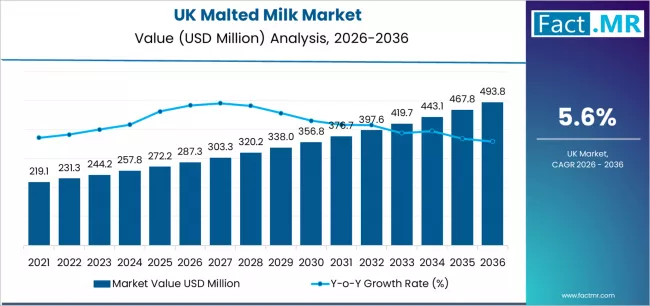
Uk Malted Milk Market Market Value Analysis | Source: Fact.MR
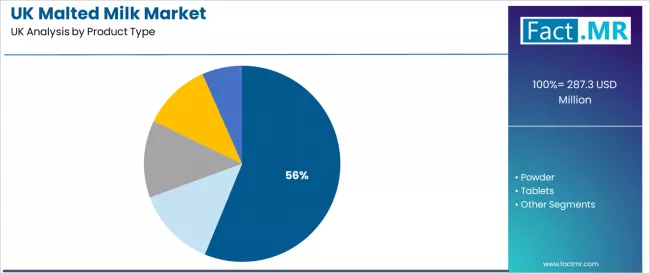
The liquid segment is projected to register 56.2% of malted milk demand in 2026. Malted milk products are widely used in liquid configurations because they enable convenient consumption, reliable nutritional delivery, and proven formulation stability that enhance product quality. They also support diverse consumer applications and beverage preferences across retail environments, improving convenience characteristics and product effectiveness.
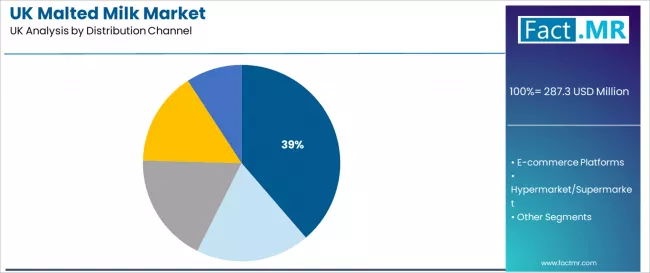
Specialty food stores are expected to account for 38.7% of malted milk demand in 2026. Malted milk products are widely used through specialty food stores because they provide proven product consultation and comprehensive performance support for demanding consumer requirements. Their integration enhances brand positioning, product education capabilities, and consumer outcomes by enabling improved product differentiation and authentic performance positioning during purchase.
From 2030 to 2036, demand is forecast to grow from USD 373.2 million to USD 493.8 million, adding another USD 120.6 million, which constitutes 58.4% of the overall ten-year expansion. This period is expected to be characterized by expansion of advanced fortification integration, development of specialized beverage formulations and customized nutritional products, and implementation of quality assurance systems across different food applications. The growing adoption of personalized nutrition principles and enhanced consumer customization requirements, particularly in England and Scotland regions, will drive demand for more sophisticated malted milk systems and integrated beverage platforms.
The malted milk industry is experiencing steady growth in the UK primarily due to the increasing adoption of scientifically validated nutritional alternatives and the expansion of clean label initiatives. The country's emphasis on dietary advancement and ingredient innovation necessitates investment in effective malted milk systems (nutritional support, energy delivery) and advanced beverage products (efficacy enhancement, clinical verification) for consumer operations and nutritional functions.
UK Malted Milk Industry Key Takeaways
| Metric | Value |
|---|---|
| UK Malted Milk Sales Value (2026) | USD 287.3 million |
| UK Malted Milk Forecast Value (2036) | USD 493.8 million |
| UK Malted Milk Forecast CAGR (2026-2036) | 5.6% |
Source: Fact.MR analysis. Updated Dec 16, 2025
Why is the UK Malted Milk Industry Growing?
Modern food brands and beverage practitioners rely on professional malted milk systems to ensure product competitiveness, consumer satisfaction, and optimal pathway achievement toward nutritional health goals. Advanced consumer requirements necessitate comprehensive malted milk solutions including specialized fortification capabilities, energy delivery systems, and efficacy enhancement infrastructure to address diverse application needs and performance specifications.
Food brands and beverage practitioners are emphasizing sourcing and integrated fortification solutions to enhance consumer profiles, access clean label optimization trends, and demonstrate product leadership in competitive food environments. Advanced quality policies and malted milk performance requirements are establishing standardized formulation pathways that require professional systems and performance assurance, with UK facilities often pioneering large-scale implementation of advanced nutritional beverage technologies.
The Food Standards Agency (FSA) guidelines and the Committee on Toxicity (COT) standards provide the definitive safety, efficacy, and quality-of-care requirements for malted milk interventions and formulation modalities, i.e., the regulatory and clinical specifications demanded by food products and service providers. Technical reviews in journals like British Journal of Nutrition further explain why these advanced systems improve nutritional delivery and health outcomes versus conventional beverage therapy, citing superior vitamin absorption and long-term energy maintenance rates, reinforcing their role as a FSA-aligned, evidence-based clinical component within the NHS and private sectors.
Segmental Analysis
The industry is segmented by product type, distribution channel, and region. By product type, the industry is divided into liquid, powder, tablets, capsules, and others categories. In terms of distribution channel, industry is segmented into specialty food stores, e-commerce platforms, hypermarket/supermarket, pharmacy/drugstores, and others. Regionally, the industry is divided into England, Scotland, Wales, and Northern Ireland.
Why is Liquid Malted Milk the Preferred Product among UK’s Consumers?
Uk Malted Milk Market Analysis By Product Type | Source: Fact.MR
Liquid malted milk accounts for 56.2% of UK’s demand in 2026, making it the leading product category across the sector. This dominance reflects the formulation performance requirements and proven capabilities of liquid systems for existing food operations and beverage applications where nutritional precision is optimized through established delivery capabilities and integrated quality architecture.
In the UK, where substantial consumer populations require malted milk integration without complete dietary modification, liquid platforms provide practical pathways for nutritional enhancement while maintaining beverage integrity. Continuous innovations are improving product consistency, nutritional characteristics, and formulation integration parameters, enabling food brands to achieve high performance standards while maximizing reliability. The segment's strong position is reinforced by the extensive existing retail infrastructure requiring malted milk adoption and growing availability of liquid suppliers with proven commercial experience.
- Nutritional compatibility and existing beverage integration make liquid platforms the preferred product type for enhancing consumer operations and food installations.
- Performance reliability and commercial demonstration track records are enhancing consumer confidence and system viability across large-scale adoption initiatives.
Which Distribution Channels Accounts for Maximum Sales of Malted Milk in UK?
Uk Malted Milk Market Analysis By Distribution Channel | Source: Fact.MR
Specialty food stores account for 38.7% of malted milk demand in UK in 2026, demonstrating the significant role of expert consultation and curated product selection requiring comprehensive food support solutions. Specialty food stores including major retail chains, independent outlets, food advisors, and professional consultation services generate consistent demand for malted milk systems that are technically and operationally favorable for consumer applications.
The segment benefits from performance characteristics that provide product optimization and consultation capabilities for consumer care. In the UK, where specialty food stores represent substantial portions of premium beverage retail, product excellence requires malted milk integration across diverse retail facilities. In England regions, where food concentrations are significant, malted milk demand is elevated by emphasis on maintaining product excellence while achieving consumer targets.
- Consumer requirements and product optimization drive consistent demand across major retail chains, independent outlets, food advisors, and professional consultation services.
- The integration of malted milk-based solutions enhances the accessibility, expertise, and effectiveness of consumer care, further supporting the sector's need for high-performance products in both specialty food stores and mainstream retail applications.
What are the Drivers, Restraints, and Key Trends in the UK Malted Milk Industry?
The country's malted milk demand is advancing steadily due to increasing clean label requirements and growing recognition of nutritional necessity for health development, with England region serving as a key driver of innovation and application development.
The sector faces challenges including competition from conventional beverage systems, need for specialized efficacy validation development, and ongoing concerns regarding product costs and regulatory considerations. National food guidelines and regional-level consumer initiatives, particularly nutritional programs in England and Scotland regions, continue to influence malted milk selection and adoption timelines.
Expansion of Clean Label Requirements and Performance Standards
The enhancement of ingredient regulations, gaining particular significance through food standards and advanced consumer programs, is enabling malted milk suppliers to achieve differentiation without prohibitive development costs, providing predictable demand patterns through nutritional requirements and consumer preferences.
Enhanced quality standards offering substantial opportunities for professional malted milk systems and integrated applications provide foundational dynamics while allowing suppliers to secure retail agreements and food partnerships. These trends are particularly valuable for first-mover suppliers and advanced system development that require substantial technical investments without immediate cost advantages.
Incorporation of Biotechnology and Quality Validation Systems
Modern malted milk suppliers and food companies are establishing advanced formulation networks and centralized quality management facilities that improve product effectiveness through technical standardization and performance validation. Integration of efficacy optimization systems, high-precision nutritional technologies, and coordinated quality management enables more efficient malted milk delivery across multiple retail locations.
Advanced formulation concepts also support next-generation food applications including specialized fortification integration, consumer optimization, and regional malted milk supply networks that optimize system-level economics while enabling comprehensive performance monitoring across retail regions, with UK developments increasingly adopting collaborative research models to reduce individual supplier costs and accelerate validation.
Analysis of UK Malted Milk Industry by Key Countries
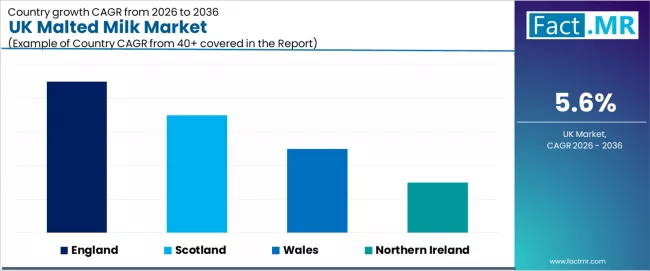
Uk Malted Milk Market Cagr Analysis By Country | Source: Fact.MR
| Region | CAGR (2026 to 2036) |
|---|---|
| England | 5.7% |
| Scotland | 5.5% |
| Wales | 5.3% |
| Northern Ireland | 5.1% |
Source: Fact.MR analysis. Updated Dec 16, 2025
The UK malted milk industry is witnessing steady growth, supported by rising clean label requirements, expanding consumer initiatives, and the deployment of advanced malted milk technologies across regions. England leads the nation with a 5.7% CAGR, reflecting progressive food trends, substantial retail innovation, and early adoption of professional malted milk systems.
Scotland follows with a 5.5% CAGR, driven by extensive retail infrastructure, favorable consumer demographics, and concentration of specialized operations that enhance application development. Wales grows at 5.3%, as retail modernization and food opportunities increasingly drive malted milk adoption. Northern Ireland demonstrates growth at 5.1%, supported by expanding food facilities and regional consumer initiatives.
Why Does England Lead Malted Milk Demand?
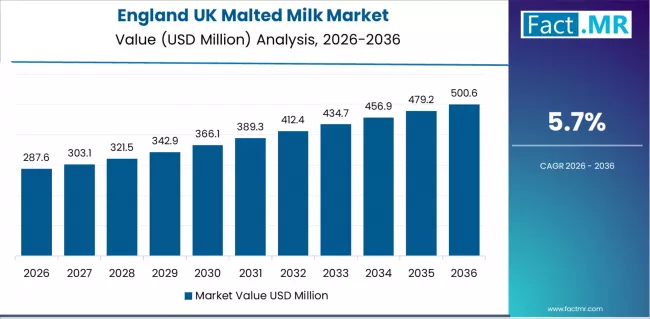
Uk Malted Milk Market Country Value Analysis | Source: Fact.MR
Demand for malted milk in England is projected to exhibit strong growth with a CAGR of 5.7% through 2036, driven by progressive food preferences, substantial retail development creating advanced malted milk opportunities, and concentration of food advancement across London and surrounding metropolitan areas.
As the dominant region with extensive retail infrastructure and quality-focused food policies, England's emphasis on comprehensive product excellence and food leadership is creating significant demand for professional malted milk systems with proven effectiveness and reliable application potential. Major malted milk suppliers and food companies are establishing comprehensive retail development programs to support innovation advancement and advanced system deployment across diverse applications.
- Retail development trends and food preferences are requiring comprehensive consumer management strategies and malted milk solutions, driving demand for systems with demonstrated nutritional enhancement capabilities and permanent product assurance throughout diverse food operations.
- Innovation ecosystem strength and retail capital availability are supporting deployment of next-generation malted milk technologies and novel application pathways that enhance commercial viability, reduce product costs, and create new food opportunities across beverage and quality-focused applications, positioning England as a national food leadership region.
Why Does Scotland Show Strong Growth?
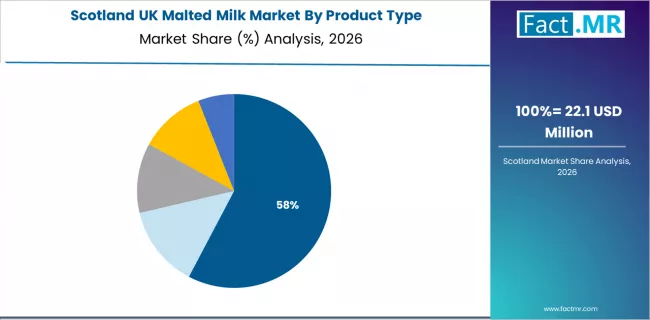
Uk Malted Milk Market Scotland Market Share Analysis By Product Type | Source: Fact.MR
Demand for malted milk in Scotland is expanding at a CAGR of 5.5%, supported by extensive retail facilities including large-scale food programs, beverage operations, and consumer companies generating concentrated demand favorable for malted milk systems. The region's retail characteristics, featuring substantial food infrastructure and consumer requirements ideal for malted milk integration, provide natural advantages.
Food expertise concentrated in Edinburgh, Glasgow, and regional retail corridors facilitates application development and consumer management. Malted milk suppliers and food companies are implementing comprehensive retail strategies to serve expanding quality-focused requirements throughout Scotland.
- Retail concentration and favorable application economics are creating opportunities for specialized malted milk suppliers that can integrate nutritional systems with existing food operations.
- Malted milk positioning and food awareness are building regional competitive advantages in retail applications, enabling comprehensive food development and product cluster enhancement that meets consumer targets while accessing advanced pricing opportunities.
Why Does Wales Show Consistent Expansion?
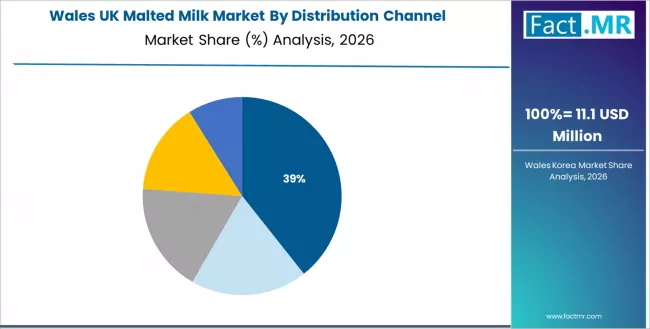
Uk Malted Milk Market Wales Market Share Analysis By Distribution Channel | Source: Fact.MR
Demand for malted milk in Wales is growing at a CAGR of 5.3%, driven by substantial retail facilities from food operations, beverage distributors, and regional operators requiring malted milk pathways.
The region's retail base, supporting critical food operations, is increasingly adopting malted milk technologies to maintain competitiveness while meeting consumer expectations. Food companies and malted milk suppliers are investing in product integration systems and regional supply infrastructure to address growing consumer management requirements.
- Retail modernization imperatives and food competitiveness concerns are facilitating adoption of malted milk technologies that enable continued food operations while achieving product enhancement across food operations, beverage distributors, and operator facilities.
- Product optimization opportunities including regional retail development and malted milk utilization for enhanced food operations are creating unique regional advantages and diversified application types throughout Wales food operations.
What Factors Underpin Malted Milk Demand in Northern Ireland?
Demand for malted milk in Northern Ireland is advancing at a CAGR of 5.1%, supported by expanding retail facilities, regional food development including beverage and product operations, and growing emphasis on nutritional solutions across the region.
Retail modernization and food facility expansion are driving consideration of malted milk systems as product enhancement pathways. Food companies and malted milk suppliers are developing regional capabilities to support emerging product deployment requirements.
- Retail expansion and food diversification are creating economic drivers for malted milk technologies and system adoption across beverage and food facilities seeking competitive differentiation pathways.
- Regional food cooperation and coordinated retail development are establishing consistent malted milk environments and shared nutritional infrastructure that support multi-regional product projects throughout Northern Ireland food operations.
Competitive Landscape of UK Malted Milk Industry
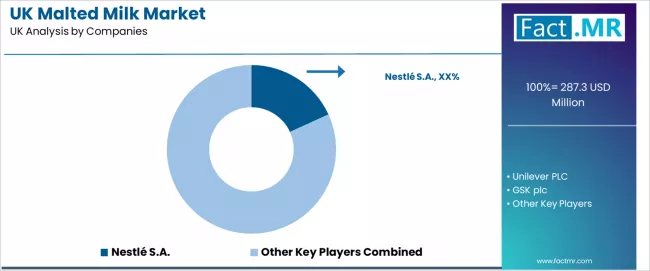
Uk Malted Milk Market Analysis By Company | Source: Fact.MR
UK malted milk industry is defined by competition among specialized food manufacturers, nutritional ingredient companies, and integrated solution providers, with major consumer corporations maintaining significant influence through research resources and application development capabilities.
Companies are investing in product advancement, quality assurance infrastructure optimization, distribution network structures, and comprehensive technical validation services to deliver effective, reliable, and accessible nutritional enhancement solutions across UK food and beverage applications. Strategic partnerships, research infrastructure development, and first-mover application execution are central to strengthening competitive positioning and presence across retail, quality-focused, and food applications.
Nestlé S.A. leads with an 18.2% share, offering comprehensive malted milk solutions including product development, quality assurance, and distribution services with focus on beverage applications, food, and accessibility across UK operations. Unilever PLC delivers full-service nutritional supply including retail distribution, custom integration, and technical support serving UK and international food projects.
GSK plc emphasizes comprehensive advanced solutions with integrated nutritional capabilities, quality management, and formulation features leveraging food sector expertise. Aveeno (Johnson & Johnson Consumer Inc.) offers malted milk application development and nutritional optimization operations for beverage and food applications across UK operations.
Key Players in UK Malted Milk Industry
- Nestlé S.A.
- Unilever PLC
- GSK plc
- Aveeno (Johnson & Johnson Consumer Inc.)
- Briess Malt & Ingredients Co.
- Imperial Malts Ltd.
- SSP Private Limited
- Family Cereal Sdn. Bhd.
- Muntons Plc
- Food and Biotech Engineers India Pvt. Ltd.
Segmentation
Scope of the Report
| Item | Value |
|---|---|
| Quantitative Units | USD 493.8 million |
| Product Type | Liquid, Powder, Tablets, Capsules, Others |
| Distribution Channel | Specialty Food Stores, E-commerce Platforms, Hypermarket/Supermarket, Pharmacy/Drugstores, Others |
| Regions Covered | England, Scotland, Wales, Northern Ireland |
| Key Companies | Nestlé S.A., Unilever PLC, GSK plc, Aveeno (Johnson & Johnson Consumer Inc.), Briess Malt & Ingredients Co., Imperial Malts Ltd., SSP Private Limited, Family Cereal Sdn. Bhd., Muntons Plc, Food And Biotech Engineers India Pvt. Ltd., Regional malted milk specialists |
| Additional Attributes | Sales by product type and distribution channel segment; regional demand trends across England, Scotland, Wales, and Northern Ireland; competitive landscape with established malted milk suppliers and specialized food developers; quality preferences for liquid versus powder technologies; integration with food programs and advanced beverage policies, particularly advanced in the England region |
Source: Fact.MR analysis. Updated Dec 16, 2025
UK Malted Milk Industry by Segments
-
Product Type :
- Liquid
- Powder
- Tablets
- Capsules
- Others
-
Distribution Channel :
- Specialty Food Stores
- E-commerce Platforms
- Hypermarket/Supermarket
- Pharmacy/Drugstores
- Others
-
Country :
- England
- Scotland
- Wales
- Northern Ireland
Frequently Asked Questions
How big is the demand for malted milk in UK in 2026?
What will be the size of malted milk in UK in 2036?
How much will be the demand for malted milk in UK growth between 2026 and 2036?
What are the key product types in the malted milk in UK?
Which distribution channel segment is expected to contribute significant share in the malted milk in UK in 2026?
Who worked on this report


Preview the report firsthand - request a free sample
Free SampleGet the brochure for pricing and purchase details
Download PDF