- Market Value (2025): USD 273.0 Mn
- Estimated Value (2026): USD 302.2 Mn
- Forecast Value (2036): USD 835.9 Mn
- CAGR (2026-2036): 10.7%
What is the Circadian Wellness Lighting Market forecast to be worth by 2036?
USD 302.2 million in 2026 to USD 835.92 million by 2036, at a CAGR of 10.7%.
- As per Fact.MR analysis, the market is estimated to be valued at USD 273.0 million in 2025.
- Demand is projected to rise from USD 302.2 million in 2026 to USD 835.9 million by 2036.
- The forecast records a 10.7% CAGR from 2026 to 2036 as organizations and consumers place greater emphasis on lighting that responds to daily routines and wellness needs.
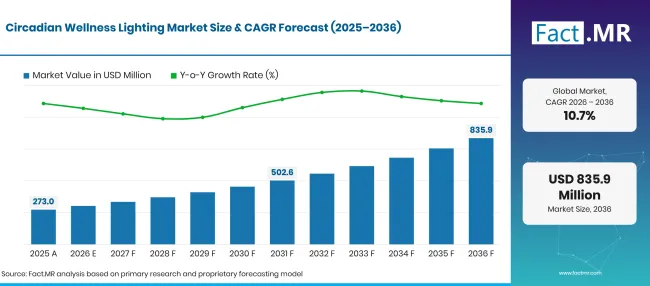
Circadian Wellness Lighting Market Forecast Global | Source: Fact.MR
| Year | Basis | Market Value (USD million) |
|---|---|---|
| 2025 | Actual | 273.0 |
| 2026 | Estimate | 302.2 |
| 2036 | Forecast | 835.9 |
| CAGR 2026 to 2036 | Forecast period | 10.7% |
Source: Fact.MR analysis. Updated Nov 10, 2026
What are the defining numbers behind Circadian Wellness Lighting Market growth?
USD 533.72 million in absolute opportunity is projected between 2026 and 2036.
- Demand Drivers in the Market
- Greater attention to indoor lighting quality has driven the market growth. People spend substantial time in indoor environments where access to natural daylight may be limited. Circadian-oriented lighting systems can vary brightness and color temperature throughout the day to create lighting conditions that better reflect natural daylight patterns. Signify's NatureConnect system is designed to bring daylight effects into indoor spaces [1].
- Growing use of human-centric lighting in workplaces has increased the demand for the circadian wellness lighting. Offices and educational facilities are adopting tunable lighting to adjust color temperature and brightness according to activities and time of day. Fagerhult's human-centric lighting approach considers visual and biological lighting requirements [2].
- Healthcare and institutional applications supports the market growth. Hospitals and care facilities need lighting that can accommodate patient routines and staff activities. Dynamic lighting can be incorporated into patient rooms and common areas, although health-related benefits depend on exposure conditions.
- Advances in smart lighting controls has created lucrative opportunity for the market growth. Connected lighting platforms allow users and facility managers to schedule changes in light intensity and spectrum. Integration with sensors and building management systems can make lighting adjustments more responsive to occupancy and daylight availability.
- Key Segments Analyzed
- By Circadian Lighting Spectral Control: Amber / blue-depleted lighting leads with a 24.8% share in 2026, followed closely by automated daylight integration at 24.1%.
- By Device Form Factor: Head / ear wearables account for the largest share at 25.8%.
- By Data Processing: Clinician-linked dashboards lead with a 25.7% share in 2026, reflecting the role of professional monitoring and interpretation in selected wellness and healthcare applications.
- By Sales Channel: Clinical / professional channels account for 26.0% of the market in 2026, narrowly ahead of retail electronics at 24.6%.
- Analyst Opinion at Fact.MR
- Shambhu Nath Jha, Principal Consultant at Fact.MR, states, “Circadian wellness lighting is gaining attention as consumers and organizations look beyond basic illumination toward lighting that can be adjusted to daily routines. The market includes established lighting manufacturers and connected wellness technology providers. Suppliers need to demonstrate measurable lighting performance and provide clear information about spectral output and control features. They should also distinguish lighting designed to support daily routines from products making medical or sleep-treatment claims.”
- Strategic Implications
- Lighting manufacturers need to develop products that offer reliable control over color temperature and light intensity throughout the day. Designing systems that support gradual lighting adjustments and customizable spectral settings can help address different residential, commercial and institutional requirements while improving product suitability for circadian-focused lighting applications.
- Technology providers should make lighting schedules simple to configure while ensuring compatibility with occupancy sensors, daylight sensors and connected home platforms. Developing intuitive control interfaces and automated adjustment capabilities can improve user convenience, support consistent lighting routines and encourage wider adoption across smart residential and commercial environments.
- Healthcare and institutional suppliers must provide comprehensive technical documentation covering spectral output and light exposure at the user's eye level. Clearly communicating intensity levels and color temperature characteristics can help facility operators assess lighting suitability and select solutions that align with specific environmental and occupant requirements.
- Retailers can clearly explain the differences between conventional tunable-white lighting and systems specifically designed around circadian lighting principles. Demonstrating variations in spectral characteristics and automated daily lighting adjustments can help customers understand product functionality and make informed purchasing decisions based on their intended applications.
The USA is projected to record an 11.2% CAGR through 2036. China is forecast to grow at 12.3%, followed by South Korea at 12.0%. Germany is expected to advance at 10.3%, while Japan is projected to record a 9.3% CAGR.
How does the Circadian Wellness Lighting Market break down by segment?
Fact.MR identifies Amber / blue-depleted lighting as the leading Circadian Lighting Spectral Control category at 24.8%. Head / ear wearables lead Device Form Factor at 25.8%. Clinician-linked dashboards account for the largest Data Processing share at 25.7%, while Clinical / professional channels lead Sales Channel at 26.0%.
Which Circadian Lighting Spectral Control category dominates?
Amber / blue-depleted lighting is set to hold a 24.8% share in 2026.
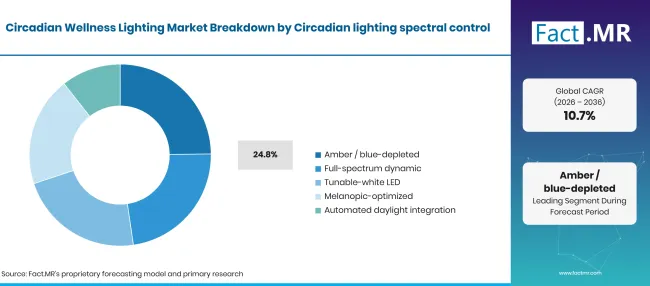
Circadian Wellness Lighting Market Breakdown Circadian Lighting Spectral Control | Source: Fact.MR
| Circadian Lighting Spectral Control | Share (2026) |
|---|---|
| Amber / blue-depleted (Leading segment) | 24.8% |
| Other segments combined | 75.2%* |
| Total | 100.0% |
Source: Fact.MR analysis. Updated Nov 10, 2026
Amber / blue-depleted lighting is designed to reduce shorter-wavelength light output in selected evening or nighttime settings. It can be used in bedrooms and other environments where users want warmer lighting before sleep. Full-spectrum dynamic systems change the spectral composition of light across different periods of the day. Tunable-white LED systems adjust color temperature and brightness, while melanopic-optimized lighting focuses on spectral characteristics relevant to melanopsin-sensitive photoreception. Automated daylight integration combines electric lighting with available natural light and adjusts output according to changing daylight conditions.
Which Device Form Factor leads?
Head / ear wearables are projected to account for 25.8% of the market in 2026.
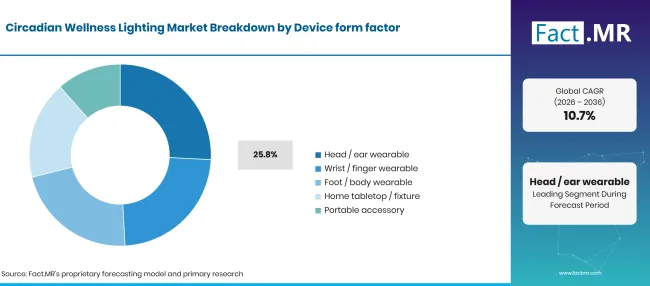
Circadian Wellness Lighting Market Breakdown Device Form Factor | Source: Fact.MR
| Device form factor | Share (2026) |
|---|---|
| Head / ear wearable (Leading segment) | 25.8% |
| Other segments combined | 74.2%* |
| Total | 100.0% |
Source: Fact.MR analysis. Updated Nov 10, 2026
Head/ ear wearables can be positioned close to the user's visual environment and may incorporate sensors or light-emitting elements for personalized use. Wrist and finger wearables can collect activity, sleep and light-exposure information for personalized lighting schedules. These monitoring devices should be distinguished from products that actively deliver controlled illumination; their inclusion depends on the defined product scope. Home tabletop fixtures provide stationary lighting for personal spaces, while portable accessories allow users to carry light-based products between locations.
Which Data Processing category accounts for the largest share?
Clinician-linked dashboards are expected to account for 25.7% of the market in 2026.
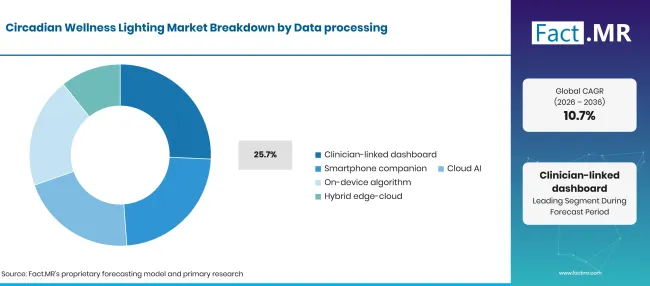
Circadian Wellness Lighting Market Breakdown Data Processing | Source: Fact.MR
| Data Processing | Share (2026) |
|---|---|
| Clinician-linked dashboard (Leading segment) | 25.7% |
| Other segments combined | 74.3%* |
| Total | 100.0% |
Source: Fact.MR analysis. Updated Nov 10, 2026
Clinician-linked dashboards can present lighting exposure and wellness-related information for review by healthcare or professional users. Smartphone companion applications allow consumers to manage lighting schedules and adjust connected devices. Cloud AI systems can analyze data from connected products and support personalized recommendations. On-device algorithms process information locally and can provide responsive control without continuous cloud access. Hybrid edge-cloud systems combine local processing with cloud-based data analysis.
Which Sales Channel leads the market?
Clinical / professional channels are projected to account for 26.0% of the market in 2026.
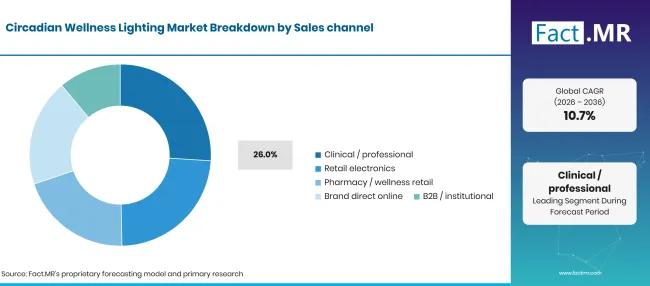
Circadian Wellness Lighting Market Breakdown Sales Channel | Source: Fact.MR
| Sales Channel | Share (2026) |
|---|---|
| Clinical / professional (Leading segment) | 26.0% |
| Other segments combined | 74.0%* |
| Total | 100.0% |
Source: Fact.MR analysis. Updated Nov 10, 2026
Clinical and professional channels serve healthcare facilities and wellness providers that specify lighting for particular environments. Retail electronics stores give consumers access to connected lamps and smart lighting systems. Pharmacy and wellness retailers can offer products positioned around sleep routines and personal well-being. Brand-direct online channels allow manufacturers to explain product features and sell connected lighting directly. B2B and institutional sales support larger projects across offices and other commercial facilities.
What is accelerating Circadian Wellness Lighting Market adoption, and what is holding it back?
Growing interest in indoor wellness and smart lighting supports adoption. High installation costs and uncertainty around health-related claims can limit broader acceptance.
Drivers Impact Analysis
| DRIVER | (~) % IMPACT ON CAGR | GEOGRAPHIC RELEVANCE | IMPACT TIMELINE |
|---|---|---|---|
| Growing adoption of human-centric lighting in workplaces | +1.0% | North America, Europe, Asia | Medium term (2–4 years) |
| Increasing use of connected and tunable lighting | +0.8% | Global | Short term (≤ 2 years) |
| Greater focus on lighting in healthcare environments | +0.7% | North America, Europe | Medium term (2–4 years) |
| Rising consumer interest in home wellness products | +0.6% | Global | Short term (≤ 2 years) |
| Integration with smart building management systems | +0.5% | North America, Europe, Asia | Long term (≥ 4 years) |
Source: Fact.MR analysis. Updated Nov 10, 2026
Opportunity Impact Analysis
| OPPORTUNITY | (~) % IMPACT ON CAGR | GEOGRAPHIC RELEVANCE | IMPACT TIMELINE |
|---|---|---|---|
| Automated daylight-responsive lighting systems | +0.8% | Global | Medium term (2–4 years) |
| Integration with wearable wellness devices | +0.7% | North America, Asia | Medium term (2–4 years) |
| Circadian lighting installations in healthcare facilities | +0.6% | North America, Europe | Long term (≥ 4 years) |
| Affordable tunable lighting for residential use | +0.5% | Global | Short term (≤ 2 years) |
| Melanopic performance measurement and reporting | +0.4% | Europe, North America | Medium term (2–4 years) |
Source: Fact.MR analysis. Updated Nov 10, 2026
Restraints Impact Analysis
| RESTRAINT | (~) % IMPACT ON CAGR | GEOGRAPHIC RELEVANCE | IMPACT TIMELINE |
|---|---|---|---|
| High initial cost of advanced lighting systems | -0.8% | Global | Short term (≤ 2 years) |
| Limited awareness of circadian lighting specifications | -0.6% | Emerging markets | Medium term (2–4 years) |
| Installation and system integration complexity | -0.5% | Global | Medium term (2–4 years) |
| Uncertainty around health-related product claims | -0.4% | Global | Long term (≥ 4 years) |
Source: Fact.MR analysis. Updated Nov 10, 2026
Which countries are scaling the Circadian Wellness Lighting Market through 2036?
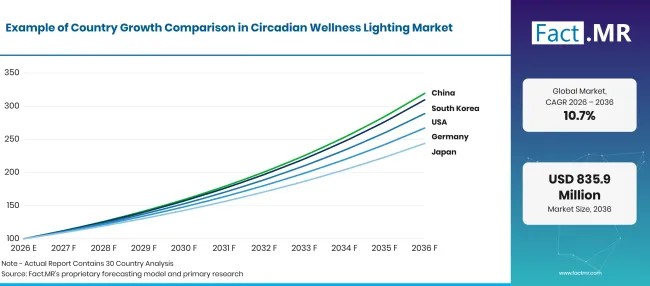
Circadian Wellness Lighting Market Growth Index | Source: Fact.MR
| Country | CAGR (2026–2036) |
|---|---|
| China | 12.3% |
| South Korea | 12.0% |
| USA | 11.2% |
| Germany | 10.3% |
| Japan | 9.3% |
Source: Fact.MR analysis. Updated Nov 10, 2026
What supports USA adoption?
11.2% CAGR, supported by growing interest in smart buildings and human-centric workplace lighting.
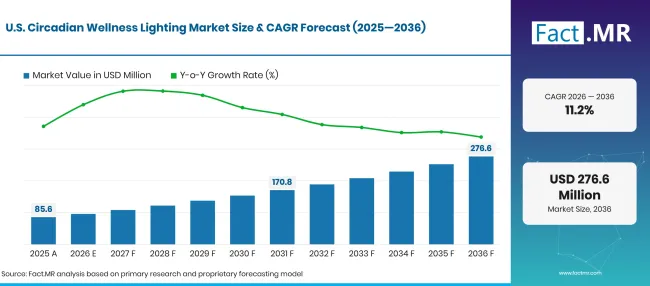
Circadian Wellness Lighting Market Forecast Usa | Source: Fact.MR
The U.S. market benefits from demand for connected lighting across offices and healthcare facilities as well as residential environments. Tunable-white products and automated lighting controls allow users to adjust brightness and color temperature throughout the day. Lutron and Acuity Brands offer relevant lighting and control technologies that can support these applications. Wider adoption will depend on installation costs and clear evidence of lighting performance.
How is China developing the market?
12.3% CAGR, shaped by large-scale electronics manufacturing and growing smart building development.
China has a substantial lighting and electronics manufacturing base. Demand can increase as commercial buildings and residential projects incorporate connected lighting systems. Local production capabilities can support the supply of tunable LED fixtures and smart controls. Manufacturers can strengthen adoption by offering affordable systems with straightforward installation and scheduling features.
What supports South Korea's market growth?
12.0% CAGR, driven by advanced electronics capabilities and connected home technology adoption.
South Korea's electronics industry provides opportunities for integrating lighting with connected devices and home automation platforms. Demand can develop across residential projects and commercial environments where users want greater control over indoor lighting. Manufacturers can benefit from combining lighting schedules with sensors and smart device applications.
How is Germany expanding adoption?
10.3% CAGR, led by energy-efficient building upgrades and human-centric lighting design.
Germany's market opportunity is linked to workplace modernization and demand for high-quality indoor lighting. Commercial and healthcare facilities can incorporate dynamic lighting to manage color temperature and intensity according to occupancy and daily schedules. Zumtobel Group and Fagerhult offer human-centric lighting solutions relevant to this market. Product selection will depend on energy performance and documented lighting characteristics.
What supports Japan's market growth?
9.3% CAGR, backed by residential lighting innovation and connected home applications.
Japan has an established lighting industry and a consumer market for advanced home lighting products. Panasonic's residential lighting portfolio includes scheduled lighting and gradual brightening features that support morning routines. Further adoption can come from products that combine automated controls with adjustable color temperature and brightness. Suppliers need to provide clear information about product functions rather than presenting all scheduled lighting as a dedicated circadian system.
Who leads the Circadian Wellness Lighting Market?
Fact.MR identifies Signify N.V., Lutron Electronics Co., Inc., Acuity Brands, Inc., Zumtobel Group AG, Fagerhult Group, and Panasonic Corporation as companies with relevant lighting products or technologies.
Signify N.V. offers NatureConnect, a human-centric lighting system designed to bring daylight effects indoors. Its lighting scenes change throughout the day and are intended to support more natural indoor lighting conditions. Signify launched NatureConnect in India in 2024 for professional environments including hospitality and healthcare.
Lutron Electronics Co., Inc. offers Ketra lighting and Athena control systems. Ketra products provide a broad range of color temperatures and can change intensity and color throughout the day. Lutron describes Ketra as a human-centric lighting solution and explicitly distinguishes this positioning from making direct circadian health claims [3] [4]. Acuity Brands, Inc. offers tunable-white luminaires and nLight lighting controls. Its Lithonia Lighting products allow adjustments to color temperature and intensity. The company also positions tunable-white lighting for educational and healthcare environments [5] [6].
Zumtobel Group AG has developed human-centric lighting solutions through its Zumtobel and other lighting brands. Its SPECTRUM lighting concept addresses spectral characteristics associated with daylight, while its Activating Light project focuses on adapting LED output to different phases of the day [7]. Fagerhult Group promotes human-centric lighting based on visual, biological, and emotional lighting requirements. Its portfolio and technical guidance include daylight-inspired lighting and melanopic measurement considerations for workplaces and healthcare facilities [8] [9].
Panasonic Corporation offers residential LED lighting with scheduled operation and gradual brightening features. Its Life Conditioning lighting series allows light and sound to change according to a daily schedule. [10].
Competition is shaped by lighting quality and the ability to control spectral output and intensity. Suppliers with connected controls can address projects requiring automated schedules and integration with building systems. Manufacturers also need to provide clear technical documentation so buyers can distinguish general tunable-white lighting from systems designed specifically around integrative lighting principles.
Which companies are the key providers?
The key companies covered are: Signify N.V., Lutron Electronics Co., Inc., Acuity Brands, Inc., Zumtobel Group AG, Fagerhult Group, and Panasonic Corporation.
- Signify N.V.
- Lutron Electronics Co., Inc.
- Acuity Brands, Inc.
- Zumtobel Group AG
- Fagerhult Group
- Panasonic Corporation
Bibliography
- [1] Signify. (2024, June 21). Signify launches NatureConnect lighting at India Light Festival 2024.
- [2] Signify. (n.d.). NatureConnect – Natural lighting solutions.
- [3] Lutron Electronics Co., Inc. (n.d.). Ketra Lighting FAQs.
- [4] Lutron Electronics Co., Inc. (n.d.). Athena technical document: Architected for Natural Light.
- [5] Acuity Brands Lighting, Inc. (n.d.). The BLWP Wrap provides intuitive lighting solutions with Tunable White.
- [6] Acuity Brands Lighting, Inc. (n.d.). CPX with Tunable White – LED Panel.
- [7] Zumtobel Group AG. (2024). Annual Financial Report 2023/24.
- [8] Fagerhult. (n.d.). Human Centric Lighting.
- [9] Fagerhult. (n.d.). Lighting for healthcare.
- [10] Panasonic Corporation. (2024, September 12).[New Palook LED ceiling light panel series introduced with lighting modes designed to change mood].
- [11] International Commission on Illumination. (2024, August 30). CIE position statement on integrative lighting: Recommending proper light at the proper time (3rd ed.; CIE PS 001:2024).
This Report Answers
- The report examines the growth outlook for circadian wellness lighting from 2026 to 2036.
- Segment analysis compares spectral control technologies and device form factors using the s2026 shares.
- Data processing analysis examines clinician-linked dashboards and smartphone applications as well as cloud and on-device processing.
- Country analysis compares the USA, China, Japan, Germany, and South Korea using the country CAGRs.
- The competitive overview profiles six lighting manufacturers with relevant human-centric or tunable lighting portfolios.
- Sales channel analysis compares professional and retail distribution with direct online and institutional sales.
What does the Circadian Wellness Lighting Market cover?
The market covers lighting products and connected systems that adjust light intensity and spectral characteristics according to time of day or user requirements. It includes dynamic and tunable-white lighting as well as systems that incorporate daylight-responsive controls. The scope also includes the specified wearable and home lighting formats and related data processing solutions.
What is included in the scope?
Included products are lighting systems and devices designed to provide adjustable spectral output or scheduled lighting conditions for wellness-oriented applications.
The market includes connected fixtures and portable devices as well as relevant wearable formats. It covers products sold through professional and clinical channels and consumer retail as well as direct online and institutional channels.
What is excluded from the scope?
The analysis excludes conventional fixed-output lighting products that do not offer relevant spectral or intensity control.
General smart bulbs without a wellness-oriented or scheduled lighting function are excluded unless they meet the defined product criteria. Standalone sleep trackers and wellness applications without a lighting component are outside the market boundary. Medical devices used solely for diagnosis or treatment of sleep disorders are also excluded.
How Was the Analysis Built?
The analysis draws on 120+ sources, 35+ company portfolios, 25+ countries, and more than 20 industry interviews.
- Primary Research: Primary research includes discussions with manufacturers, service providers, technology developers, distributors, end users, and subject-matter experts. These conversations examine purchasing priorities, product adoption, operational challenges, approval requirements, competitive positioning, and the factors that influence wider market acceptance.
- Desk Research: Desk research covers government statistics, regulatory publications, company filings, trade data, technical studies, industry associations, standards, public policy, and other authoritative sources. Every source used in the analysis is documented in the bibliography.
- Market Sizing and Forecasting: Market estimates combine historical performance, demand indicators, pricing and volume trends, segment shares, company participation, country-level growth, adoption patterns, investment activity, and barriers to market expansion.
- Data Validation and Update Cycle: Findings are validated by comparing primary interviews with public data, company activity, regulatory changes, trade patterns, and industry developments. Regular updates review new product launches, capacity changes, partnerships, approvals, and shifts in commercial adoption
Segmentation
What is the report's scope and coverage?
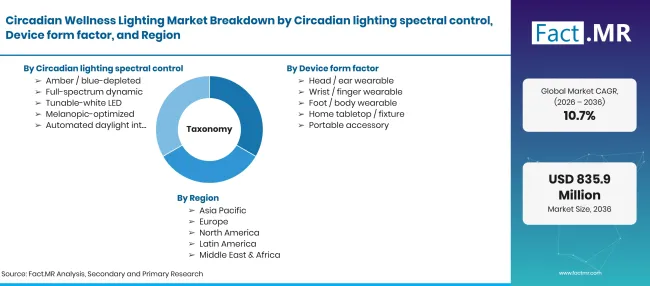
Circadian Wellness Lighting Market Taxonomy | Source: Fact.MR
| Attribute | Details |
|---|---|
| Quantitative Units | USD million |
| Market Definition | The Circadian Wellness Lighting Market comprises lighting products and connected control systems designed to adjust light intensity and spectral characteristics, including color temperature, in alignment with natural daily light patterns. These solutions use programmable schedules, sensors and automated controls to support day-to-night lighting transitions across residential, commercial, healthcare and institutional environments. |
| Circadian Lighting Spectral Control | Amber / blue-depleted; Full-spectrum dynamic; Tunable-white LED; Melanopic-optimized; Automated daylight integration |
| Device Form Factor | Head / ear wearable; Wrist / finger wearable; Foot / body wearable; Home tabletop / fixture; Portable accessory |
| Data Processing | Clinician-linked dashboard; Smartphone companion; Cloud AI; On-device algorithm; Hybrid edge-cloud |
| Sales Channel | Clinical / professional; Retail electronics; Pharmacy / wellness retail; Brand direct online; B2B / institutional |
| Regions Covered | North America; Latin America; Western Europe; Eastern Europe; East Asia; South Asia & Pacific; Middle East & Africa |
| Countries Covered | USA; China; Japan; Germany; South Korea |
| Companies Profiled | Signify; Lutron Electronics; Acuity Brands; Zumtobel Group; Fagerhult Group; Panasonic |
| Forecast Period | 2026 to 2036 |
| Approach | Market segmentation and scenario-based analysis supported by company product information and lighting standards |
Source: Fact.MR analysis. Updated Nov 10, 2026
How is the market segmented?
-
By Circadian Lighting Spectral Control
- Amber / blue-depleted
- Full-spectrum dynamic
- Tunable-white LED
- Melanopic-optimized
- Automated daylight integration
-
By Device Form Factor
- Head / ear wearable
- Wrist / finger wearable
- Foot / body wearable
- Home tabletop / fixture
- Portable accessory
-
By Data Processing
- Clinician-linked dashboard
- Smartphone companion
- Cloud AI
- On-device algorithm
- Hybrid edge-cloud
-
By SalesChannel
- Clinical / professional
- Retail electronics
- Pharmacy / wellness retail
- Brand direct online
- B2B / institutional
-
By Region
- North America
- Latin America
- Western Europe
- Eastern Europe
- East Asia
- South Asia & Pacific
- Middle East & Africa
Frequently Asked Questions
How big is the Circadian Wellness Lighting Market in 2026?
What is the CAGR from 2026 to 2036?
Which Circadian Lighting Spectral Control category has the largest share?
Which Device Form Factor leads?
Which Data Processing category leads?
Which Sales Channel has the largest share?
Which country is projected to grow fastest?
Which companies are covered?
Who worked on this report


Preview the report firsthand - request a free sample
Free SampleGet the brochure for pricing and purchase details
Download PDF