- Forecast Value (2036): 18.5 Bn
- CAGR (2036): 24.9%
What is the sleep tourism and circadian wellness services market forecast to be worth by 2036?
USD 2.0 billion in 2026 to USD 18.5 billion by 2036, at 24.9% CAGR.
- The sleep tourism and circadian wellness services market crossed a valuation of USD 1.7 billion in 2025. Demand is expected to increase from USD 2.0 billion in 2026 to USD 18.5 billion by 2036.
- The market is forecast to record 24.9% CAGR during 2026 to 2036 because hotels and wellness resorts are packaging sleep support into bookable travel programs.
- The parent wellness tourism economy gives the market a clear ceiling and a useful size check. The Global Wellness Institute reported wellness tourism expenditure of USD 894.0 billion in 2024.
- The sleep-focused service share remains small against that parent base. This keeps the 2026 estimate within a realistic range. [1]
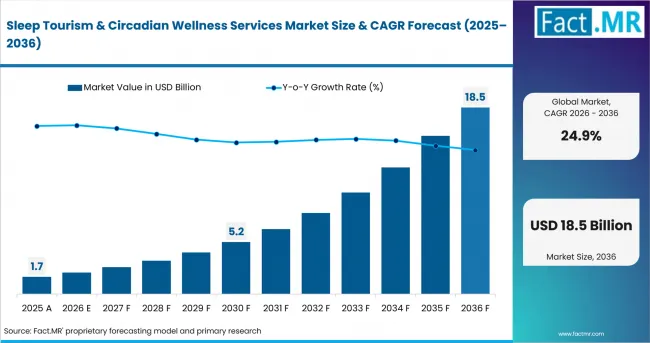
Sleep Tourism & Circadian Wellness Services Market Value Analysis | Source: Fact.MR
What are the defining numbers behind sleep tourism and circadian wellness services growth?
USD 16.5 billion absolute opportunity by 2036, led by China and India.
- Demand Drivers in the Market
- Hotels need paid sleep packages because room comfort alone is hard to price as a service.
- Long-haul travelers need jet lag recovery support because time-zone change can reduce trip value.
- Wellness resorts need guided sleep programs because guests are comparing outcomes rather than amenities.
- Travel advisors need clearer packages because clients want rest recovery explained before booking.
- Key Segments Analyzed
- By Service Type: Sleep Retreats are expected to hold 31.0% share in 2026 because resorts can bundle rooms with guided recovery routines.
- By Delivery Setting: Luxury Resorts lead because premium guests already buy paid wellness support. The segment is projected to capture 36.0% share in 2026.
- By Customer Type: Leisure Travelers are likely to account for 39.0% share in 2026 as rest is often part of the trip goal.
- By Program Length: Two-Night Stays are projected to hold 34.0% share in 2026 since guests can test sleep services without booking a long retreat.
- By Wellness Modality: Light Programs are expected to hold 28.0% share in 2026 due to timed light is linked with body-clock adjustment.
- By Booking Channel: Hotel Direct is projected to hold 42.0% share in 2026 because brands can attach sleep packages to room bookings.
- By Geography: China is projected to record 26.5% CAGR through 2036 as domestic travel scale supports faster service rollout.
- Analyst Opinion at Fact.MR
- Shambhu Nath Jha, Principal Analyst at Fact.MR states, "I see sleep tourism becoming a paid service test for hotel brands. Guests now ask whether the stay helps them sleep after travel. They are asking whether the stay helps them sleep after travel and recover from time-zone change. Providers that combine room design with simple sleep evidence are better placed than brands that only add a pillow menu."
- Strategic Implications
- Hotel operators should turn sleep upgrades into bookable packages instead of keeping them as room amenities.
- Wellness resorts need clear screening and follow-up because guests want visible improvement from paid sleep programs.
- Technology partners should keep tools simple because travelers do not want complex monitoring during a short stay.
- Travel advisors can position sleep programs as recovery support for long-haul travelers and executive guests.
Sleep health evidence also supports the service logic behind the forecast. The Centers for Disease Control and Prevention reported that 30.5% of United States adults slept less than seven hours in 2024. This gives hotels a clear buyer problem to address through recovery-led stays. [3]
China is projected to record 26.5% CAGR through 2036 as domestic travel scale supports faster rollout. India is expected to expand at 25.9% CAGR because wellness travel and medical travel channels overlap. Japan is forecast to grow at 25.4% CAGR because long-haul arrivals create a clear jet lag recovery use case. The United States is expected to advance at 24.7% CAGR because hotel groups can sell sleep content through loyalty channels. The United Kingdom is projected to rise at 24.3% CAGR because inbound nights support short rest-led packages.
How does the sleep tourism and circadian wellness services market break down by segment?
Sleep Retreats lead at 31.0%; Luxury Resorts lead at 36.0%.
Segmentation follows how buyers actually book and compare services. Some guests choose a retreat package. Others buy a room upgrade inside a medical wellness stay. The segment structure also reflects who controls the guest experience.
Which service type leads?
Sleep Retreats hold 31.0% share in 2026.
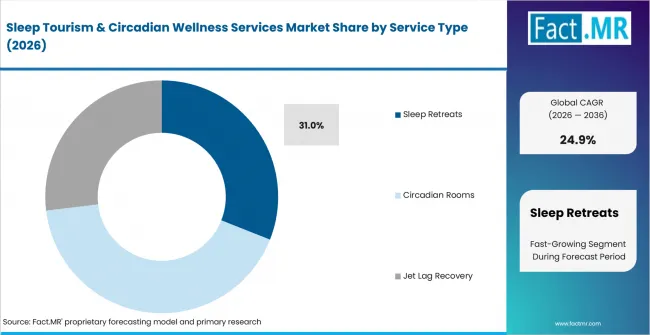
Sleep Tourism & Circadian Wellness Services Market Analysis By Service Type | Source: Fact.MR
Sleep Retreats account for 31.0% share because they bundle rooms with coaching and recovery routines. Jet Lag Recovery grows faster within the service mix because long-haul guests need help soon after arrival. The service mix also overlaps with hotel and resort upgrades where room design is sold as part of the stay.
Which delivery setting leads?
Luxury Resorts hold 36.0% share in 2026.
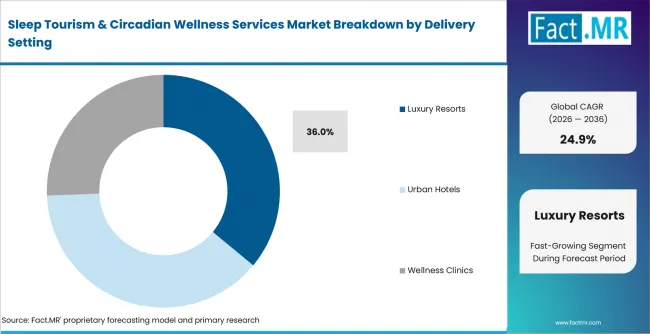
Sleep Tourism & Circadian Wellness Services Market Analysis By Delivery Setting | Source: Fact.MR
Luxury Resorts are projected to hold 36.0% share because guests already expect paid wellness support at premium properties. Urban Hotels remain important because business travelers often need short recovery support after long flights. Resort operators also borrow service depth from spa services when sleep programs include guided routines.
Which customer type leads?
Leisure Travelers hold 39.0% share in 2026.
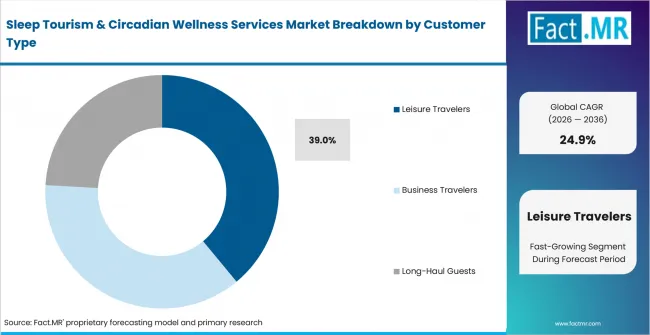
Sleep Tourism & Circadian Wellness Services Market Analysis By Customer Type | Source: Fact.MR
Leisure Travelers is expected to hold 39.0% share because rest is often part of the reason for taking a wellness trip. Business Travelers add a different purchase pattern because meeting performance can depend on sleep after travel. Some offers sit near medical wellness when screening and recovery planning are included.
Which program length leads?
Two-Night Stays hold 34.0% share in 2026.
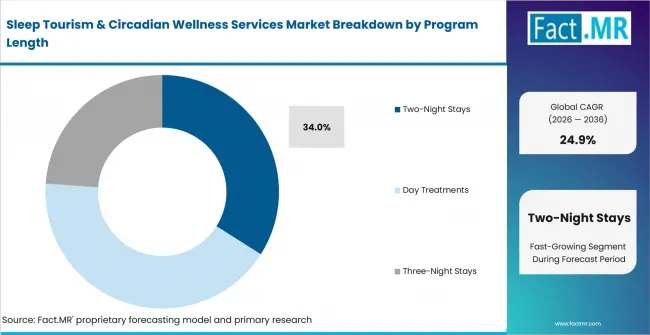
Sleep Tourism & Circadian Wellness Services Market Analysis By Program Length | Source: Fact.MR
Two-Night Stays account for 34.0% share because guests can test sleep services without booking a long retreat. Seven-Day Programs support higher revenue because clinics can add screening and follow-up inside the stay.
Which wellness modality leads?
Light Programs hold 28.0% share in 2026.
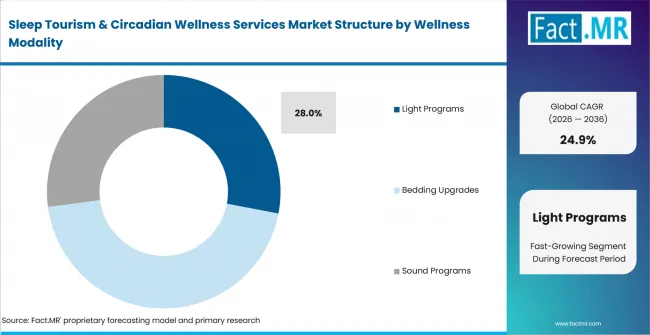
Sleep Tourism & Circadian Wellness Services Market Analysis By Wellness Modality | Source: Fact.MR
Light Programs lead at 28.0% share because light timing is closely linked with circadian rhythm adjustment. Bedding Upgrades remain useful because guests understand comfort faster than they understand body-clock support. Adjacent sleeping aids remain outside scope unless they are attached to a paid travel service.
Which booking channel leads?
Hotel Direct holds 42.0% share in 2026.
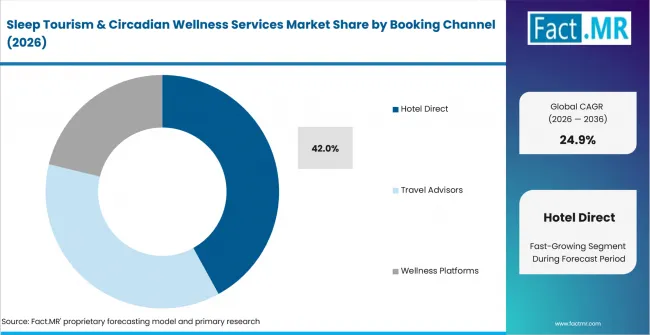
Sleep Tourism & Circadian Wellness Services Market Analysis By Booking Channel | Source: Fact.MR
Hotel Direct holds 42.0% share because brands can attach sleep packages to rooms during the booking path. Travel Advisors remain relevant because high-value guests need help comparing resort programs and clinic support.
What is accelerating sleep tourism demand, and what is holding it back?
Sleep health need and hotel service design drive it. Proof gaps and staff training restrain it.
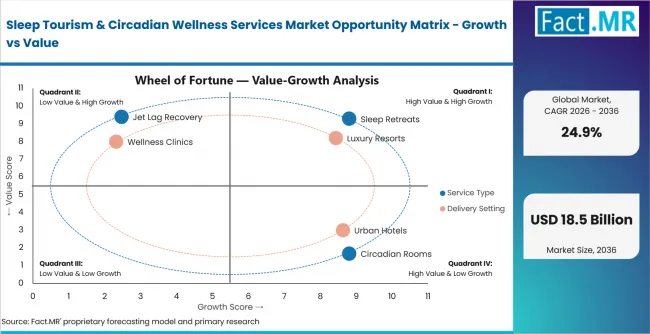
Sleep Tourism & Circadian Wellness Services Market Opportunity Matrix Growth Vs Value | Source: Fact.MR
A significant demand driver is the move from comfort amenities to paid sleep support. Hotels can pair room controls with sleep routine education without selling clinical treatment. The broader wellness tourism category gives sleep services a parent travel base. Another factor is long-haul travel recovery because guests need body-clock support after crossing time zones. Hyatt reported in November 2024 that its sleep series was available in nearly 400 hotels. This shows how hotel groups can scale content without building clinics. [16] The main restraint is the risk of overclaiming. Services that sound like insomnia treatment need stronger clinical evidence and trained staff. This limits how aggressively hotels can describe results.
Where do the biggest sleep tourism opportunities exist?
Jet lag recovery, circadian rooms and measured sleep retreats.
- Jet Lag Recovery: Hotels can sell recovery support to long-haul travelers because the need appears soon after arrival.
- Circadian Rooms: Operators can lift room value because the guest sees light and sound features during the stay.
- Sleep Retreats: Resorts can raise yield because coaching and programming create paid service depth.
Which countries are scaling sleep tourism services fastest?
China 26.5% and India 25.9%. Japan 25.4% and USA 24.7%. United Kingdom 24.3%. Germany 24.0% and Australia 23.6%.
.webp "Top Country Growth Comparison Sleep Tourism & Circadian Wellness Services Market Cagr (2026 2036)")
Top Country Growth Comparison Sleep Tourism & Circadian Wellness Services Market Cagr (2026 2036) | Source: Fact.MR
Based on regional analysis, the sleep tourism and circadian wellness services market is segmented into North America and Europe. It also covers Asia Pacific, Latin America and Middle East and Africa.
| Country | CAGR |
|---|---|
| China | 26.5% |
| India | 25.9% |
| Japan | 25.4% |
| United States | 24.7% |
| United Kingdom | 24.3% |
| Germany | 24.0% |
| Australia | 23.6% |
Source: Fact.MR analysis. Updated Jun 22, 2026
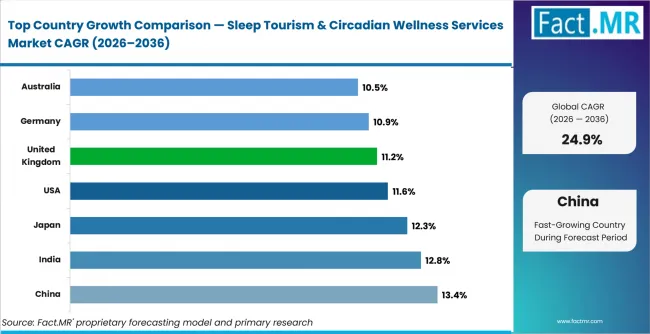
Sleep Tourism & Circadian Wellness Services Market Cagr Analysis By Country | Source: Fact.MR
What is powering China’s lead?
26.5% CAGR, supported by domestic travel scale and hotel wellness rollout.
China’s sleep tourism outlook starts with the scale of its domestic travel base. The National Bureau of Statistics of China reported 6.52 billion domestic trips in 2025. China is projected to record a 26.5% CAGR through 2036 because large travel flows give hotel groups more chances to test paid sleep packages. Local operators can win by making programs simple enough for city hotels and resort properties. [10]
Why does India matter for sleep tourism?
25.9% CAGR, led by wellness travel and medical travel channel overlap.
India’s buyer base is shaped by wellness stays and clinic-linked travel. The Ministry of Tourism of the Government of India reported 9.66 million foreign tourist arrivals in 2024. India is expected to expand at 25.9% CAGR through 2036 because wellness hotels can combine sleep programs with yoga and recovery-led stays. The country also connects naturally with medical tourism channels. [11]
How does Japan scale circadian wellness services?
25.4% CAGR, supported by inbound travel and jet lag recovery need.
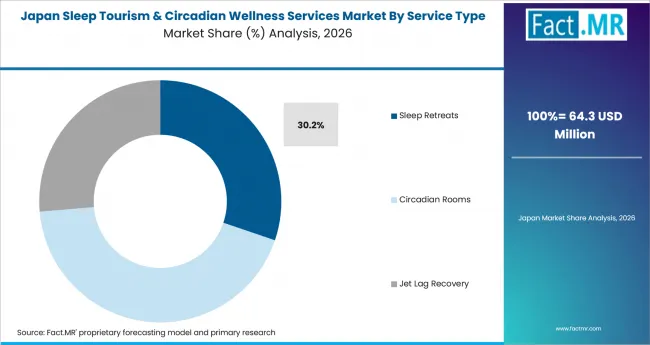
Sleep Tourism & Circadian Wellness Services Market Japan Market Share Analysis By Service Type | Source: Fact.MR
Japan’s sleep tourism case begins with long-haul arrival patterns and high service standards. Japan National Tourism Organization data show 36.87 million foreign visitors in 2024. Japan is forecast to grow at 25.4% CAGR from 2026 to 2036 because overseas arrivals create a practical use case for jet lag recovery. Hotels that explain light timing in plain terms can reach guests without medicalizing the stay. [9]
What supports the USA outlook?
24.7% CAGR, backed by inbound recovery and sleep-health need.
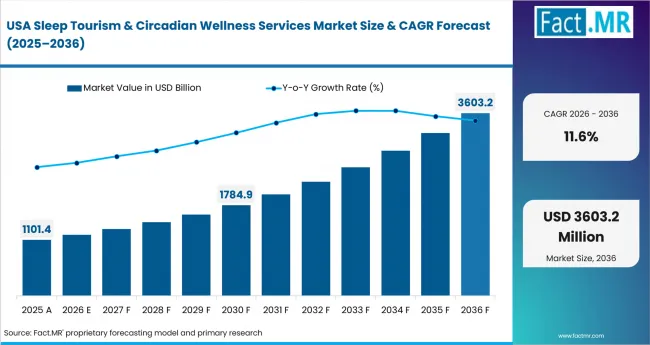
Sleep Tourism & Circadian Wellness Services Market Country Value Analysis | Source: Fact.MR
United States buyers already recognize sleep as a health and travel issue. The National Travel and Tourism Office reported 72.4 million international visitors in 2024 and forecast 85.0 million visitors in 2026. The United States is expected to advance at 24.7% CAGR by 2036 because hotel groups can sell sleep content through loyalty apps and connected rooms. Supplier wins depend on proof that the service improves guest experience. [6]
Why is the United Kingdom a steady market?
24.3% CAGR, supported by inbound nights and short wellness breaks.
The United Kingdom combines inbound city travel with a short-break culture. VisitBritain reported 42.6 million inbound visits and GBP 32.5 billion in visitor spend in 2024. The United Kingdom is projected to rise at 24.3% CAGR through 2036 because hotels can sell quiet-room and rest-led packages to weekend travelers and overseas guests. The steadier pace reflects a more developed hotel base and tighter consumer spending. [7]
What underpins Germany’s sleep wellness outlook?
24.0% CAGR, supported by wellness infrastructure and inbound nights.
Germany’s sleep tourism base is tied to wellness hotels, spa towns and business travel. Federal Statistical Office data show 496.1 million overnight stays in accommodation establishments in 2024. Germany is forecast at 24.0% CAGR by 2036 because operators can attach sleep services to wellness weekends and business stays. Growth is lower than China because the hotel base is already better developed. [13]
How is Australia building sleep tourism services?
23.6% CAGR, supported by long-haul travel and resort wellness demand.
Australia has a clear long-haul travel problem because many visitors arrive after extended flights. The Australian Bureau of Statistics reported 8.4 million visitor arrivals during the 2024 to 2025 financial year. Australia is expected to post 23.6% CAGR from 2026 to 2036 because resort hotels can sell recovery-led stays to international guests. The rate sits below Asia Pacific peers because distance raises trip cost and narrows repeat travel. [12]
Who leads the sleep tourism and circadian wellness services landscape?
Hilton and Hyatt lead through room control and branded wellness content. IHG Hotels & Resorts / Six Senses and Accor add scale through wellness-led brands.
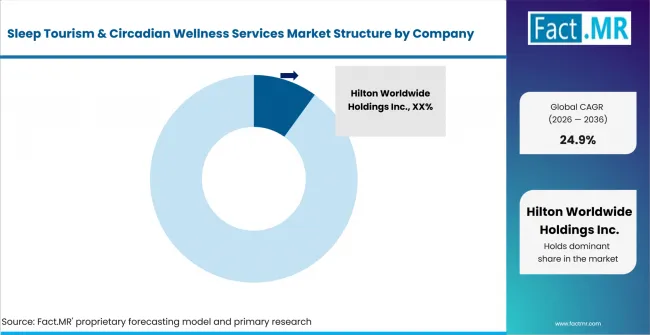
Sleep Tourism & Circadian Wellness Services Market Analysis By Company | Source: Fact.MR
Sleep tourism services are used by hotel groups and resorts that need trusted guest-facing recovery offers. Hilton uses retreats and in-room content to give guests a clear rest proposition. Hyatt uses Headspace content to connect the guest room with the sleep service provider space. Accor is building sleep into wellness and longevity programs across several brands.
Wellness clinics compete differently because they can add screening and specialist support. Their service depth can connect with sleep aid supplements only when products remain an add-on to a travel service. The main buyer test is whether the program is easy to book and explain.
Smaller resorts can still win when they explain the program in simple terms and track guest experience. They often lose against large hotel groups when loyalty distribution and connected rooms matter more than local service quality. Stand-alone sleep gummies remain outside scope unless the package is sold as part of a paid stay.
Providers best placed through 2036 are those that combine room design, content delivery and credible sleep guidance. The buyer decision is moving toward proof and ease of booking rather than broad wellness language.
Which companies are the key players?
Hilton and Hyatt lead the hotel group tier. IHG Hotels & Resorts / Six Senses, Accor and Marriott add distribution scale.
- Hilton Worldwide Holdings Inc.
- Hyatt Hotels Corporation
- IHG Hotels & Resorts / Six Senses
- Accor SA
- Marriott International Inc.
- SHA Wellness Clinic
- Canyon Ranch
- Calm
- Headspace
Bibliography
- [1] Global Wellness Institute. (n.d.). What is wellness tourism?
- [2] Global Wellness Institute. (2025). 2025 Global Wellness Economy Monitor.
- [3] Ng, A. E., Black, L. I., & Adjaye-Gbewonyo, D. (2026, April). Short sleep duration and sleep difficulties among adults: United States, 2024 (NCHS Data Brief No. 559). National Center for Health Statistics.
- [4] National Institute of General Medical Sciences. (2025, May 20). Circadian rhythms. National Institutes of Health.
- [5] United Nations Tourism. (2025, January 21). International tourism recovers pre-pandemic levels in 2024.
- [6] U.S. International Trade Administration, National Travel and Tourism Office. (2025). NTTO forecast of international visitation to the United States. U.S. Department of Commerce.
- [7] VisitBritain. (2025, August 26). Inbound visits and spend: annual, UK.
- [8] Office for National Statistics. (2025, August 26). Travel trends: 2024.
- [9] Japan National Tourism Organization. (n.d.). Japan tourism statistics.
- [10] National Bureau of Statistics of China. (2026, February 28). Statistical communiqué of the People’s Republic of China on the 2025 national economic and social development. Government of China.
- [11] Ministry of Tourism, Government of India. (2025). Annual report 2024–25.
- [12] Australian Bureau of Statistics. (2025, August 14). Overseas arrivals and departures, Australia: 2024–25 financial year.
- [13] German Federal Statistical Office. (n.d.). Overnight stays in accommodation establishments. Destatis.
- [14] Hilton Worldwide Holdings Inc. (2024, March 15). In search of sleep: Hilton caters to rising number of sleep tourists with debut of Hilton Sleep Retreats.
- [15] Hilton Worldwide Holdings Inc. (2024, August 12). Rest assured: 6 Hilton experiences meeting the demand for sleep tourism.
- [16] Hyatt Hotels Corporation. (2024, November 14). World of Hyatt and Headspace launch new series to help travelers find a good night’s sleep.
- [17] InterContinental Hotels Group PLC. (2024, November 14). IHG’s EVEN Hotels opens in Bozeman, with plans for Beaverton, putting wellness within reach for more travelers.
- [18] Accor SA. (2026, January 20). Novotel unveils “Longevity Everyday”: A transformative strategy to democratize longevity for everyday travellers.
- [19] SHA Wellness Clinic. (n.d.). Sleep Well.
This Report Answers
- Strategic intelligence on sleep tourism and circadian wellness services across six segment groups.
- Forecast mapping from USD 2.0 billion in 2026 to USD 18.5 billion by 2036.
- Segment analysis covering Sleep Retreats and Luxury Resorts. Leisure Travelers and Hotel Direct booking are also covered.
- Regional outlook covering China and India. Japan and the United States are also covered. United Kingdom, Germany and Australia are included.
- Competitive analysis of Hilton and Hyatt with IHG Hotels & Resorts / Six Senses. Accor and Marriott are also covered.
- Service assessment covering sleep retreats and circadian rooms. Jet lag recovery and sleep coaching are also covered.
- Research validation using official tourism data, sleep-health sources and company service launches.
What does the sleep tourism and circadian wellness services market cover?
Paid sleep retreats and circadian wellness services attached to travel stays.
The sleep tourism and circadian wellness services market covers hotel and resort programs built around better rest. It includes sleep retreats and circadian rooms. Jet lag recovery and sleep coaching form separate service lines. The market differs from general wellness tourism because the paid outcome is sleep quality or time-zone adjustment.
What is included in the scope?
Sleep retreats and circadian rooms. Jet lag recovery and guided rest programs.
The scope includes paid sleep programs offered by hotels and resorts. Destination spas and wellness clinics are included when the service is attached to travel. It covers sleep-focused room upgrades and light timing plans. Coached bedtime routines and sound programs form the second service layer.
What is excluded from the scope?
General hotel stays and stand-alone sleep products without a travel service.
The scope excludes ordinary hotel room revenue unless a paid sleep service is attached to the booking. It excludes mattresses and supplements sold outside a travel stay. Hospital sleep studies remain outside the scope unless packaged with wellness travel.
How was the analysis built?
120+ sources and 55+ company service pages. 30+ countries and 25+ expert checks.
- Primary Research: Primary research includes interviews with hotel wellness heads and resort operators. It also includes input from travel advisors and sleep service partners.
- Desk Research: Desk research reviews official tourism statistics and sleep-health sources. It also covers hotel service launches and wellness resort service pages.
- Market-Sizing and Forecasting: Forecasting uses a top-down share of wellness tourism and a bottom-up check from premium hotel service pricing. Results were reconciled against inbound travel recovery and company launches after January 2024.
- Data Validation and Update Cycle: Forecasts are validated through provider checks and company service updates. Country tourism data and sleep-health publications support the update cycle.
Segmentation
What is the report’s scope and coverage?
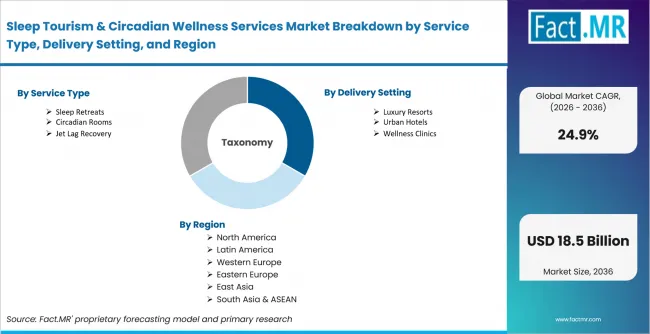
Sleep Tourism & Circadian Wellness Services Market Breakdown By Service Type, Delivery Setting, And Region | Source: Fact.MR
| Attribute | Details |
|---|---|
| Quantitative Units | USD Billion in 2026 to USD Billion by 2036 at CAGR |
| Market Definition | Paid travel services that improve sleep quality or body-clock adjustment during a stay |
| Service Type | Sleep Retreats, Circadian Rooms, Jet Lag Recovery, Sleep Coaching, Sound Therapies |
| Delivery Setting | Luxury Resorts, Urban Hotels, Wellness Clinics, Destination Spas, Airline Partners |
| Customer Type | Leisure Travelers, Business Travelers, Long-Haul Guests, Wellness Groups, Corporate Groups |
| Program Length | Two-Night Stays, Day Treatments, Three-Night Stays, Seven-Day Programs, Subscription Access |
| Wellness Modality | Light Programs, Bedding Upgrades, Sound Programs, Nutrition Plans, Mindfulness Sessions |
| Booking Channel | Hotel Direct, Travel Advisors, Wellness Platforms, Loyalty Apps, Corporate Booking |
| Regions Covered | North America, Europe, Asia Pacific, Latin America, Middle East and Africa |
| Countries Covered | China, India, Japan, United States, United Kingdom, Germany, Australia |
| Key Companies Profiled |
Hilton Worldwide Holdings Inc., Hyatt Hotels Corporation, IHG Hotels & Resorts / Six Senses,Accor SA, Marriott International Inc., SHA Wellness Clinic, Canyon Ranch, Calm, Headspace |
| Forecast Period | 2026 to 2036 |
| Approach | Top-down wellness tourism check and bottom-up premium service pricing validation |
Source: Fact.MR analysis. Updated Jun 22, 2026
How is the market segmented?
-
By Service Type:
- Sleep Retreats
- Circadian Rooms
- Jet Lag Recovery
- Sleep Coaching
- Sound Therapies
-
By Delivery Setting:
- Luxury Resorts
- Urban Hotels
- Wellness Clinics
- Destination Spas
- Airline Partners
-
By Customer Type:
- Leisure Travelers
- Business Travelers
- Long-Haul Guests
- Wellness Groups
- Corporate Groups
-
By Program Length:
- Two-Night Stays
- Day Treatments
- Three-Night Stays
- Seven-Day Programs
- Subscription Access
-
By Wellness Modality:
- Light Programs
- Bedding Upgrades
- Sound Programs
- Nutrition Plans
- Mindfulness Sessions
-
By Booking Channel:
- Hotel Direct
- Travel Advisors
- Wellness Platforms
- Loyalty Apps
- Corporate Booking
-
By Region:
- North America
- United States
- Canada
- Mexico
- Europe
- Germany
- United Kingdom
- France
- Italy
- Spain
- Rest of Europe
- Asia Pacific
- China
- India
- Japan
- South Korea
- Australia
- ASEAN
- Latin America
- Brazil
- Argentina
- Rest of Latin America
- Middle East and Africa
- GCC Countries
- South Africa
- UAE
- Rest of Middle East and Africa
- North America
Frequently Asked Questions
Which service type leads the Sleep Tourism & Circadian Wellness Services Market?
Which country expands faster in the Sleep Tourism & Circadian Wellness Services Market?
How does India perform in the Sleep Tourism & Circadian Wellness Services Market?
How does Japan perform in the Sleep Tourism & Circadian Wellness Services Market?
How does the United States perform in the Sleep Tourism & Circadian Wellness Services Market?
What is the primary driver in the Sleep Tourism & Circadian Wellness Services Market?
What is the main restraint in the Sleep Tourism & Circadian Wellness Services Market?
Why are circadian rooms important in this market?
Who worked on this report


Preview the report firsthand - request a free sample
Free SampleGet the brochure for pricing and purchase details
Download PDF