- Market Value (2025): USD 247.0 Mn
- Estimated Value (2026): USD 273.4 Mn
- Forecast Value (2036): USD 754.2 Mn
- CAGR (2026-2036): 10.7%
What is the AI Wellness Mirrors Market forecast to be worth by 2036?
USD 273.4 million in 2026 to USD 754.2 million by 2036 at a 10.7% CAGR.
- As per Fact.MR analysis, the AI wellness mirrors market crossed a valuation of USD 247.0 million in 2025.
- Demand will growth from USD 273.4 million in 2026 to USD 754.2 million by 2036 as consumers and wellness providers adopt connected assessment and coaching systems.
- The forecast records a 10.7% CAGR from 2026 to 2036, supported by interest in personalized wellness insights and AI-enabled home assessment.
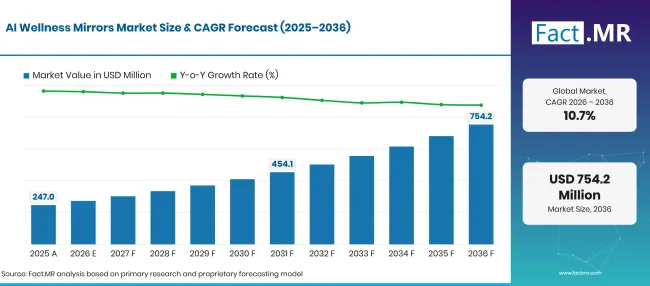
Ai Wellness Mirrors Market Forecast Global | Source: Fact.MR
| Year | Basis | Market Value (USD million) |
|---|---|---|
| 2025 | Actual | 247.0 |
| 2026 | Estimate | 273.4 |
| 2036 | Forecast | 754.2 |
| CAGR 2026 to 2036 | Forecast period | 10.7% |
Source: Fact.MR analysis. Updated Nov 9, 2026
What are the defining numbers behind AI Wellness Mirrors Market growth?
USD 480.8 million absolute opportunity between 2026 and 2036.
- Demand Drivers in the Market
- Rising consumer interest in personalized wellness: Consumers are showing greater interest in tools that provide individualized health and lifestyle insights. The Global Wellness Institute estimated that the global wellness economy reached USD 6.8 trillion in 2024, increasing 7.9% from 2023 [1].
- Growing use of AI in beauty and skincare: Beauty brands are exploring AI-based skin assessment to help consumers understand skin characteristics and select suitable products. In October 2026, South Korea announced a policy initiative to support AI-based skin diagnosis and personalized cosmetics services, including the development of AI-ready skin data [2].
- Demand for convenient, contactless assessment: Mirror-based cameras can collect selected wellness indicators without requiring users to wear a device or operate a separate measurement instrument. NuraLogix's Anura MagicMirror, for example, uses a camera-based facial scan and cloud AI to generate wellness insights [3].
- Expansion of connected fitness and movement coaching: Selected AI-enabled fitness mirrors use computer vision to assess exercise movements and provide feedback on technique. Available functions depend on the product design. MAGIC AI's fitness mirror uses computer vision to track movement and provide form correction during workouts [4].[4].
- Integration of digital wellness platforms: Smart mirrors can connect to mobile applications, cloud services, and other connected devices. CareOS describes a platform that combines mirror-based experiences with gesture recognition, voice control, wellness information, and connected-device services [5].
- Key Segments Analyzed
- By Mirror Assessment Feature: Posture / Movement Analysis is projected to account for 24.9% of the market in 2026, reflecting demand for visual feedback during exercise and everyday movement.
- By Device Form Factor: The existing 30.8% Head / Ear Wearables allocation requires methodological review because these wearables are accessories rather than mirror hardware. No mirror form-factor leader is independently established by this classification.
- By Data Processing: Cloud AI is set to hold 25.6% of the market in 2026, supported by the use of remote processing and model updates for image-based assessment.
- By Sales Channel: Retail Electronics is projected to represent 33.2% of the market in 2026, reflecting consumer access to connected devices through electronics retailers.
- Analyst Opinion at Fact.MR
- Shambhu Nath Jha, Principal Consultant at Fact.MR, states, “AI wellness mirrors can make personalized assessment more accessible by combining visual analysis with clear feedback and practical coaching. Their commercial success will depend on the reliability of the insights, user privacy, and the ability to connect assessment results with useful wellness services.”
- Strategic Implications
- Mirror manufacturers should prioritize accurate image capture and consistent sensor performance while developing transparent assessment outputs that consumers can easily understand. Improving measurement reliability and explaining how AI-generated insights are derived can strengthen consumer confidence and encourage wider adoption of AI wellness mirrors across residential and commercial settings.
- AI developers should validate individual assessment features separately to establish their reliability across different users and operating conditions. Companies should clearly distinguish general wellness estimates from clinically validated measurements while communicating model limitations and assessment accuracy to prevent misleading interpretations and strengthen trust in AI-generated recommendations.
- Retailers should demonstrate how mirror-based wellness assessments translate into practical skincare recommendations and personalized fitness guidance. Interactive product demonstrations can help consumers understand assessment capabilities and potential benefits while allowing sales teams to explain feature differences, subscription options and compatibility with connected wellness applications.
- Healthcare and wellness providers should assess data privacy requirements and consent management practices before deploying AI wellness mirrors. Evaluating compatibility with existing professional workflows and establishing clear protocols for handling sensitive user information can support responsible adoption while maintaining transparency and appropriate oversight of AI-generated wellness assessments.
- Device companies should provide flexible options for on-device data processing and cloud connectivity to address varying consumer privacy preferences and performance requirements. Clearly communicating data storage practices and connectivity dependencies can improve product transparency while allowing users and commercial operators to select configurations suited to their security and operational needs.
South Korea is projected to record a 13.3% CAGR through 2036. The USA is set to post 13.1%, followed by China at 12.7%. Japan is forecast to advance at 11.8%, while Germany is expected to register 9.9%.
How does the AI Wellness Mirrors Market break down by segment?
Fact.MR reports Posture / Movement Analysis at 24.9%, Cloud AI at 25.6%, and Retail Electronics at 33.2% in their respective segments. The reported 30.8% allocation to Head / Ear Wearables needs reclassification because it does not represent mirror hardware.
Which Mirror Assessment Feature dominates?
Posture / Movement Analysis is set to hold a 24.9% share in 2026.
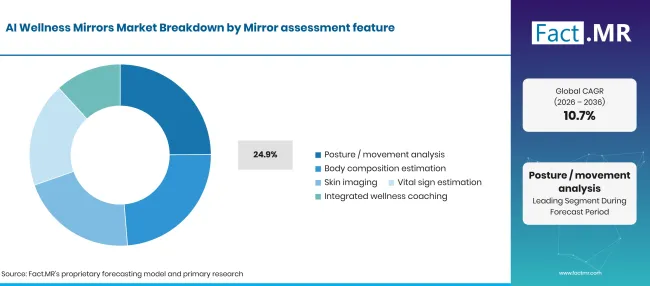
Ai Wellness Mirrors Market Breakdown Mirror Assessment Feature | Source: Fact.MR
| Mirror Assessment Feature | Share (2026) |
|---|---|
| Posture / Movement Analysis (Leading segment) | 24.9% |
| Other segments combined | 75.1%* |
| Total | 100.0% |
Source: Fact.MR analysis. Updated Nov 9, 2026
Posture and movement analysis allows a mirror system to assess body positioning and exercise technique through camera-based tracking. It can support fitness coaching by identifying movement patterns and providing feedback during workouts. Integrated wellness coaching also represents a significant feature category because it combines assessment outputs with recommendations or structured guidance. Body composition estimation and skin imaging serve users with different objectives, while vital sign estimation requires particular attention to measurement validation and the intended use of the device.
What leads the Device Form Factor segment?
The reported 30.8% Head / Ear Wearables category requires segmentation review before it can be treated as a mirror form factor.
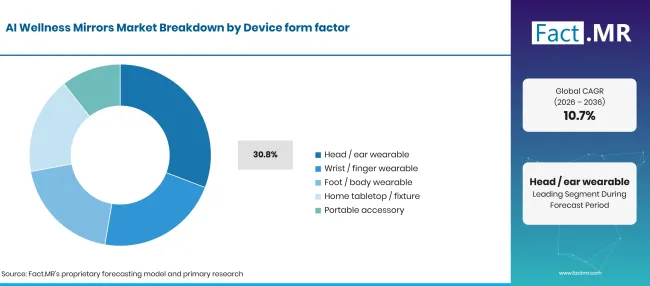
Ai Wellness Mirrors Market Breakdown Device Form Factor | Source: Fact.MR
| Device Form Factor | Share (2026) |
|---|---|
| Head / Ear Wearable (Leading segment) | 30.8% |
| Other segments combined | 69.2%* |
| Total | 100.0% |
Source: Fact.MR analysis. Updated Nov 9, 2026
Wearable sensors may complement AI wellness mirror systems by supplying additional movement or physiological information. They should be classified separately from mirror hardware. Head- and ear-worn devices can capture additional biometric signals such as heart rate, temperature, movement and other physiological indicators, depending on the sensor configuration. Their ability to collect data continuously or during specific assessment sessions helps AI wellness mirrors generate more comprehensive wellness insights. Integration with smart mirrors also enables synchronized monitoring and personalized recommendations related to fitness, recovery and general well-being.
How does Data Processing shape demand?
Cloud AI is likely to account for 25.6% share in 2026.
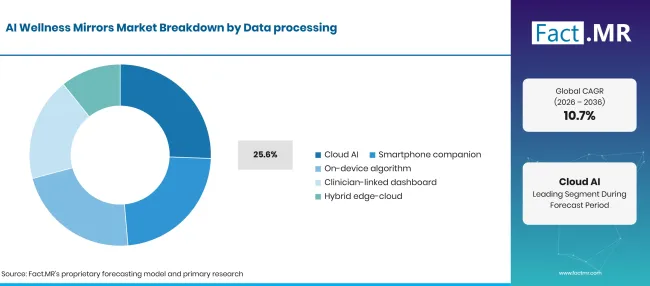
Ai Wellness Mirrors Market Breakdown Data Processing | Source: Fact.MR
| Data Processing | Share (2026) |
|---|---|
| Cloud AI (Leading segment) | 25.6% |
| Other segments combined | 74.4%* |
| Total | 100.0% |
Source: Fact.MR analysis. Updated Nov 9, 2026
Cloud AI enables mirror platforms to send captured information to remote systems for processing and analysis. This approach can support model updates and more computationally intensive features. On-device algorithms process information locally and may reduce reliance on continuous connectivity. Hybrid edge-cloud systems combine local processing with selected cloud functions. Clinician-linked dashboards can connect assessment outputs to professional workflows, but they require appropriate consent, security controls, and clarity about whether the data are intended for wellness or clinical use.
Which Sales Channel accounts for the largest share?
Retail Electronics is expected to hold a 33.2% share in 2026.
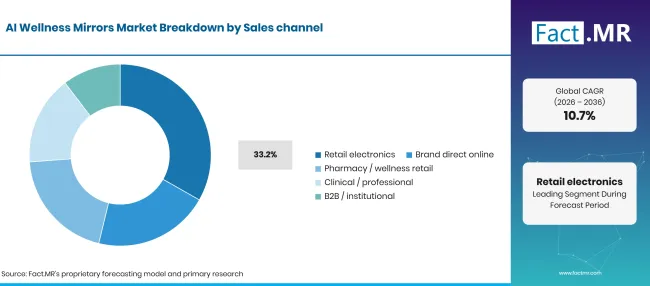
Ai Wellness Mirrors Market Breakdown Sales Channel | Source: Fact.MR
| Sales Channel | Share (2026) |
|---|---|
| Retail Electronics (Leading segment) | 33.2% |
| Other segments combined | 66.8%* |
| Total | 100.0% |
Source: Fact.MR analysis. Updated Nov 9, 2026
Retail electronics outlets can introduce consumers to smart mirrors through product demonstrations and comparisons with other connected home devices. Brand-direct online channels allow manufacturers to explain features and sell directly to consumers. Pharmacy and wellness retail can be relevant for skin assessment and consumer health awareness products, while clinical and professional channels serve facilities that require specialized workflows. B2B and institutional sales can include gyms, wellness centers, pharmacies, and selected healthcare organizations.
What is accelerating AI Wellness Mirrors Market adoption, and what is holding it back?
Growing interest in personalized wellness and AI-based assessment supports adoption, while privacy concerns, measurement accuracy, and limited product availability can restrain market development.
Drivers Impact Analysis
| DRIVER | (~) % IMPACT ON CAGR | GEOGRAPHIC RELEVANCE | IMPACT TIMELINE |
|---|---|---|---|
| Demand for personalized wellness assessment | +1.0% | USA, Germany, Japan | Medium term (2–4 years) |
| AI-based skincare and beauty analysis | +0.9% | South Korea, China, USA | Short term (≤ 2 years) |
| Growth of connected fitness and movement coaching | +0.8% | USA, China, Germany | Medium term (2–4 years) |
| Integration with digital wellness platforms | +0.6% | Global | Medium term (2–4 years) |
| Expansion of retail and professional deployments | +0.5% | South Korea, Japan, USA | Long term (≥ 4 years) |
Source: Fact.MR analysis. Updated Nov 9, 2026
Opportunity Impact Analysis
| OPPORTUNITY | (~) % IMPACT ON CAGR | GEOGRAPHIC RELEVANCE | IMPACT TIMELINE |
|---|---|---|---|
| AI-powered skin assessment and personalized beauty services | +0.9% | South Korea, Japan, China | Short term (≤ 2 years) |
| Clinician-linked wellness dashboards | +0.7% | USA, Germany, Japan | Medium term (2–4 years) |
| Privacy-focused on-device AI processing | +0.6% | Germany, USA, Japan | Medium term (2–4 years) |
| Partnerships with pharmacies and wellness retailers | +0.5% | USA, South Korea, Germany | Medium term (2–4 years) |
| Integration with connected home and wearable ecosystems | +0.4% | China, USA, Japan | Long term (≥ 4 years) |
Source: Fact.MR analysis. Updated Nov 9, 2026
Restraints Impact Analysis
| RESTRAINT | (~) % IMPACT ON CAGR | GEOGRAPHIC RELEVANCE | IMPACT TIMELINE |
|---|---|---|---|
| Concerns about facial data privacy and security | -0.9% | Global, especially Europe | Short term (≤ 2 years) |
| Inconsistent accuracy across assessment features | -0.8% | Global | Medium term (2–4 years) |
| High device development and component costs | -0.6% | Global | Medium term (2–4 years) |
| Limited consumer awareness and product availability | -0.5% | Emerging markets | Short term (≤ 2 years) |
| Regulatory requirements for health-related claims | -0.4% | USA, Germany, Japan | Long term (≥ 4 years) |
Source: Fact.MR analysis. Updated Nov 9, 2026
Which countries are scaling the AI Wellness Mirrors Market through 2036?
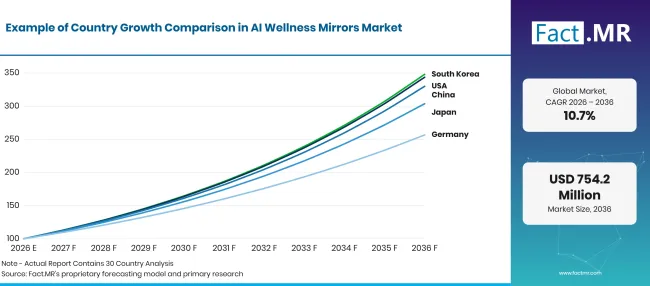
Ai Wellness Mirrors Market Growth Index | Source: Fact.MR
| Country | CAGR (2026–2036) |
|---|---|
| USA | 13.1% |
| China | 12.7% |
| Japan | 11.8% |
| Germany | 9.9% |
| South Korea | 13.3% |
Source: Fact.MR analysis. Updated Nov 9, 2026
What supports United States adoption?
13.1% CAGR, supported by consumer adoption of connected health devices and demand for personalized fitness and wellness tools.
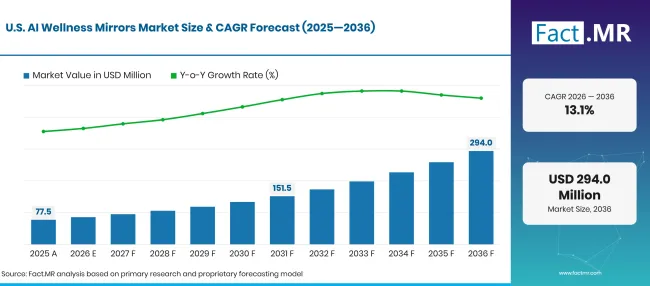
Ai Wellness Mirrors Market Forecast Usa | Source: Fact.MR
The United States has a well-established consumer market for connected health devices and activity-tracking technologies. Growing familiarity with wearable sensors and digital wellness platforms is creating a supportive ecosystem for AI wellness mirrors that combine visual assessments with connected biometric data. Companies such as MAGIC AI are demonstrating the application of computer vision for real-time movement analysis and personalized exercise guidance through fitness mirrors. Increasing consumer interest in personalized fitness monitoring and technology-assisted wellness management can encourage adoption of mirror-based assessment platforms.
What is driving growth in China?
12.7% CAGR, shaped by expanding AI use and a large connected-device ecosystem.
China's strong digital infrastructure and extensive consumer electronics manufacturing ecosystem are supporting the development and adoption of AI-enabled wellness devices. Growing consumer interest in smart home technologies and personalized digital health solutions is creating opportunities for AI wellness mirrors that integrate skin analysis and fitness tracking with customized wellness recommendations. The increasing integration of artificial intelligence into consumer electronics is further encouraging manufacturers to develop connected mirror platforms with localized software and advanced assessment capabilities.
What is driving demand in Japan?
11.8% CAGR, driven by demand for personal care technology and connected home devices.
Japan offers opportunities for AI wellness mirrors through its established consumer electronics and personal care markets. Smart mirrors can combine skincare tracking with wellness information and connected-device functions. Home tabletop and fixture-based products may appeal to consumers seeking compact assessment tools, while professional beauty and wellness settings can use mirror platforms to support customer consultations. Commercial adoption will depend on product usability, reliable assessment results, and compatibility with local consumer preferences.
What factors are supporting market growth in Germany?
9.9% CAGR, led by interest in privacy-conscious digital health and personalized wellness solutions.
Germany's opportunity is linked to the use of connected technology in personal wellness and professional services. AI mirror providers can target consumers seeking skin assessment and fitness feedback, alongside wellness centers and selected professional environments. Data protection is particularly important when devices capture facial images or generate health-related insights. Manufacturers should provide transparent consent processes and explain whether information is stored locally or transferred to cloud systems.
What supports South Korea adoption?
13.3% CAGR, backed by AI-based skin diagnosis and the country's beauty technology ecosystem.
South Korea is developing an environment for AI-enabled beauty services. South Korea's government is expanding support for AI-driven beauty technologies through initiatives focused on skin-data development and personalized cosmetics. Efforts to strengthen collaborative research between cosmetics manufacturers and AI companies are encouraging the development of advanced skin assessment and customized beauty solutions. Plans to introduce AI-powered skin diagnosis and virtual makeup experiences through K-Beauty centers in Hongdae, Myeongdong and Busan are creating opportunities for smart beauty mirrors in retail and professional beauty environments.
Who leads the AI Wellness Mirrors Market?
Fact.MR profiles NuraLogix Corporation, Nestlé Health Science, MAGIC AI, HiMirror by New Kinpo Group, CareOS by Baracoda Group across AI-enabled wellness assessment, beauty technology, connected fitness, and smart mirror platforms.
NuraLogix Corporation is a direct participant in camera-based wellness assessment through its Anura MagicMirror. The tabletop device uses facial blood-flow information and cloud-based AI to generate selected vital-sign measurements and broader wellness insights. NuraLogix states that the product is intended for wellness purposes and is not a medical device. Its published product information distinguishes FDA-cleared pulse-rate and breathing-rate measurements from other insights intended for informational wellness use [6].
Nestlé Health Science entered the smart mirror space through the Solgar Smart Mirror, launched as a personalized wellness experience in the UK in January 2026. The initiative was developed in collaboration with NuraLogix and used facial scanning to generate an Overall Wellness Score. The launch was scheduled as a one-day in-store experience at John Bell & Croyden pharmacy, while a mobile experience offered similar technology [7].
MAGIC AI develops a dedicated fitness mirror that uses its ReflectAI technology to track exercise movements, count repetitions, and provide real-time form corrections. Its platform also offers personalized workout plans and progress analytics [8].
HiMirror, associated with New Kinpo Group, developed smart beauty mirrors that analyze facial skin characteristics and track skincare changes over time. Its product range included HiMirror Plus and HiMirror Mini, with related accessories such as HiSkin and a smart body scale [9].
CareOS, part of Baracoda Group, provides a connected health and beauty platform for smart mirrors and bathroom environments. Its BMind smart mirror focuses on mental wellness and personalized experiences, while the wider CareOS platform includes gesture recognition, voice control, and selected wellness monitoring features [10]. CareOS is relevant as a platform and technology provider rather than solely as a mirror hardware manufacturer.
Which companies are the key providers?
Key companies profiled in the AI Wellness Mirrors Market include: NuraLogix Corporation, Nestlé Health Science, HiMirror (New Kinpo Group), and CareOS (Baracoda Group).
- NuraLogix Corporation
- Nestlé Health Science
- MAGIC AI
- HiMirror (New Kinpo Group)
- CareOS (Baracoda Group)
Bibliography
- [1]Global Wellness Institute. (2025, November). 2025 Global Wellness Economy Monitor.
- [2] Government of the Republic of Korea. (2026, October 14). [AI skin diagnosis and personalized cosmetics to be supported under K-Beauty service development plan].
- [3] National Cancer Institute. (2026). Health Information National Trends Survey: Wearable device use for health or activity tracking.
- [4] MAGIC AI. (n.d.). MAGIC AI Mirror: The AI Fitness Mirror.
- [5] China Internet Network Information Center. (2026, February 5). [57th Statistical Report on China’s Internet Development].
- [6] NuraLogix. (n.d.). Anura® MagicMirror™.
- [7] Nestlé Health Science. (2026, January 23). A new era in personalised wellbeing: Nestlé Health Science launches Solgar Smart Mirror.
- [8] MAGIC AI. (n.d.). MAGIC AI Fitness Smart Mirror.
- [9] State Council Information Office of the People’s Republic of China. (2026, June 1). AI-driven innovation opens new possibilities for smart living in China.
- [10] CareOS. (n.d.). CareOS: The first smart Health & Beauty platform for the bathroom.
This Report Answers
- The report describes how AI wellness mirrors are used for skin assessment, movement analysis, body composition estimation, and personalized wellness coaching.
- Segment analysis compares the specified mirror assessment features and their 2026 shares.
- Device analysis examines the form factors and their role in connected wellness ecosystems.
- Data processing analysis compares cloud AI, on-device algorithms, smartphone-linked systems, and hybrid processing models.
- Country analysis discusses the USA, China, Japan, Germany, and South Korea alongside digital wellness and technology indicators.
- The competitive overview profiles NuraLogix, Nestlé Health Science, MAGIC AI, HiMirror, CareOS.
What does the AI Wellness Mirrors Market cover?
The market covers AI-enabled mirror systems that use cameras, sensors, and software to provide wellness-related assessment or guidance. These systems may analyze posture, exercise movements, skin characteristics, selected body composition indicators, or selected vital signs. Some products also provide personalized recommendations and connect with smartphone applications or professional wellness platforms.
The market focuses on mirror-led assessment experiences rather than conventional smart mirrors that primarily display entertainment, calendars, or home automation information.
What is included in the scope?
Included products are mirror-based systems that use AI or computer vision to provide at least one defined wellness assessment or coaching function.
The scope covers home fitness mirrors, smart beauty mirrors, tabletop wellness assessment mirrors, and professional or institutional mirror platforms. Associated software and cloud services may be included when they directly support the mirror product.
What is excluded from the scope?
The analysis excludes conventional mirrors without AI-enabled assessment capabilities.
Standalone smartwatches, fitness bands, smart scales, smartphone wellness applications, and wearable sensors are excluded as independent products, even when they can connect to a mirror platform. General-purpose smart displays and virtual assistants are also excluded unless they provide a defined mirror-based wellness assessment function. Medical diagnostic systems are excluded unless their mirror-based component falls within the defined market boundary and applicable regulatory requirements.
How Was the Analysis Built?
The analysis draws on 120+ sources, 35+ company portfolios, 25+ countries, and more than 20 industry interviews.
- Primary Research: Primary research includes discussions with manufacturers, service providers, technology developers, distributors, end users, and subject-matter experts. These conversations examine purchasing priorities, product adoption, operational challenges, approval requirements, competitive positioning, and the factors that influence wider market acceptance.
- Desk Research: Desk research covers government statistics, regulatory publications, company filings, trade data, technical studies, industry associations, standards, public policy, and other authoritative sources. Every source used in the analysis is documented in the bibliography.
- Market Sizing and Forecasting: Market estimates combine historical performance, demand indicators, pricing and volume trends, segment shares, company participation, country-level growth, adoption patterns, investment activity, and barriers to market expansion.
- Data Validation and Update Cycle: Findings are validated by comparing primary interviews with public data, company activity, regulatory changes, trade patterns, and industry developments. Regular updates review new product launches, capacity changes, partnerships, approvals, and shifts in commercial adoption.
Segmentation
What is the report’s scope and coverage?
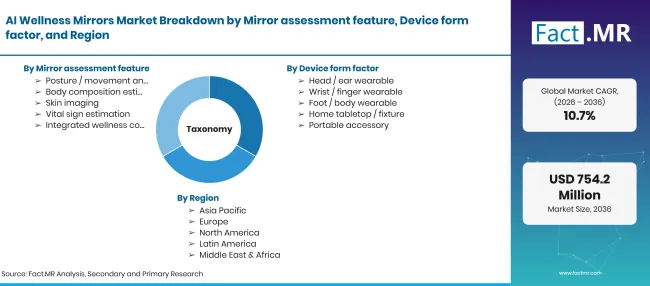
Ai Wellness Mirrors Market Taxonomy | Source: Fact.MR
| Attribute | Details |
|---|---|
| Quantitative Units | USD million |
| Market Definition | The AI Wellness Mirrors Market comprises intelligent mirror-based systems that integrate cameras, sensors and artificial intelligence software to deliver personalized wellness assessments and guidance. These systems support applications such as skin analysis, posture evaluation, movement tracking, fitness monitoring and selected physiological measurements. |
| Mirror Assessment Feature | Posture / Movement Analysis; Body Composition Estimation; Skin Imaging; Vital Sign Estimation; Integrated Wellness Coaching |
| Device Form Factor | Head / Ear Wearable; Wrist / Finger Wearable; Foot / Body Wearable; Home Tabletop / Fixture; Portable Accessory |
| Data Processing | Cloud AI; Smartphone Companion; On-Device Algorithm; Clinician-Linked Dashboard; Hybrid Edge-Cloud |
| Sales Channel | Retail Electronics; Brand Direct Online; Pharmacy / Wellness Retail; Clinical / Professional; B2B / Institutional |
| Regions Covered | North America; Latin America; Western Europe; Eastern Europe; East Asia; South Asia & Pacific; Middle East & Africa |
| Countries Covered | USA; China; Japan; Germany; South Korea |
| Companies Profiled | NuraLogix Corporation; Nestlé Health Science; MAGIC AI; HiMirror (New Kinpo Group); CareOS (Baracoda Group) |
| Forecast Period | 2026 to 2036 |
| Approach | Market segmentation and scenario-based analysis supported by company product information, consumer technology trends, and digital wellness indicators |
Source: Fact.MR analysis. Updated Nov 9, 2026
How is the market segmented?
-
By Mirror Assessment Feature
- Posture / Movement Analysis
- Body Composition Estimation
- Skin Imaging
- Vital Sign Estimation
- Integrated Wellness Coaching
-
By Device Form Factor
- Head / Ear Wearable
- Wrist / Finger Wearable
- Foot / Body Wearable
- Home Tabletop / Fixture
- Portable Accessory
-
By Data Processing
- Cloud AI
- Smartphone Companion
- On-Device Algorithm
- Clinician-Linked Dashboard
- Hybrid Edge-Cloud
-
By Sales Channel
- Retail Electronics
- Brand Direct Online
- Pharmacy / Wellness Retail
- Clinical / Professional
- B2B / Institutional
-
By Region
- North America
- Latin America
- Western Europe
- Eastern Europe
- East Asia
- South Asia & Pacific
- Middle East & Africa
Frequently Asked Questions
How big is the AI Wellness Mirrors Market in 2026?
What is the CAGR from 2026 to 2036?
Which Mirror Assessment Feature has the largest share?
Which Device Form Factor leads?
Which Data Processing category leads?
Which Sales Channel has the largest share?
Which country is expected to grow fastest?
Which companies are covered?
Who worked on this report


Preview the report firsthand - request a free sample
Free SampleGet the brochure for pricing and purchase details
Download PDF