- Market Value (2025): USD 1.5 Bn
- Estimated Value (2026): USD 1.7 Bn
- Forecast Value (2036): USD 5.1 Bn
- CAGR (2026-2036): 11.9%
What is the Circular Polypropylene Reusable Cups Market forecast to be worth by 2036?
USD 1.7 billion in 2026 to USD 5.1 billion by 2036, at an 11.9% CAGR.
- The Circular Polypropylene Reusable Cups Market crossed a valuation of USD 1.5 billion in 2025.
- Demand is projected to increase from USD 1.7 billion in 2026 to USD 5.1 billion by 2036.
- The market is forecast to record a 11.9% CAGR from 2026 to 2036 as stadiums, festivals and campus foodservice teams move toward returnable cup loops.
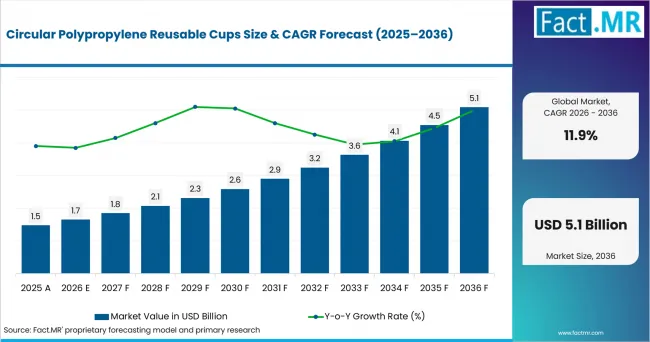
Circular Polypropylene Reusable Cups Value Analysis | Source: Fact.MR
What are the defining numbers behind Circular Polypropylene Reusable Cups Market growth?
USD 3.4 billion absolute opportunity by 2036, led by PCR polypropylene, venue deposit-return models and stadium use.
- Demand Drivers in the Market
- Stadium operators need cups that survive repeated handling while fitting cup holders and fast concession counters during peak service.
- Festival concessionaires need clear deposit systems because open-site events lose cups when return points are hard to find.
- The U.S. Department of Agriculture, Economic Research Service reported in June 2026 that inflation-adjusted food-away-from-home spending reached USD 1.41 trillion in 2025, expressed in 2025 dollars.
- China's National Bureau of Statistics reported in February 2026 that catering industry income was 5,798.2 billion yuan in 2025, up 3.2% over the previous year.
- Brand owners need reusable cups with print surfaces and digital identifiers so deposit tracking can fit into a practical guest experience.
- Key Segments Analyzed
- By Cup Material: PCR polypropylene is expected to hold 36.0% share in 2026 because it connects recycled-content goals with repeated-use durability.
- By Use Model: Venue deposit-return is projected to account for 31.0% share in 2026 as operators use a simple refund signal to bring cups back.
- By Capacity: <300 mL is anticipated to capture 29.0% share in 2026 since smaller servings suit coffee, water and soft-drink portions in many venues.
- By End-use: Stadiums are estimated to represent 33.0% share in 2026 owing to predictable footfall and controlled concession zones.
- Analyst Opinion at Fact.MR
- Shambhu Nath Jha, Principal Consultant at Fact.MR, states, "Reusable cup economics now depend on return behavior as much as cup design. A durable polypropylene cup works when the venue collects cups and redeploys them after washing. Suppliers are expected to pair material know-how with tracking. Branding and operator training help each event keep leakage low."
- Strategic Implications
- Cup manufacturers should document wash-cycle performance and food-contact compliance before approaching stadium and festival accounts.
- Venue operators should map return points before selecting cup volumes, since poor collection design raises replacement purchases.
- Concession partners should align cup size, lid fit and washing trays so service speed stays steady during peak demand.
- Recycling partners should confirm end-of-life PP routes for damaged cups before operators make circularity claims.
France is projected to post 12.8% CAGR through 2036, supported by reuse policy and event-led foodservice demand. China is anticipated to record 12.1% CAGR as catering income raises venue throughput. The USA and Japan are estimated to advance at 11.6% CAGR through concession programs and tourism recovery. Germany is forecast to reach 11.4% CAGR as reusable-offer rules support foodservice conversion.
How does the Circular Polypropylene Reusable Cups Market break down by segment?
PCR polypropylene leads Cup Material at 36.0%; venue deposit-return leads Use Model at 31.0%.
Which Cup Material dominates?
PCR polypropylene is expected to hold 36.0% share in 2026.
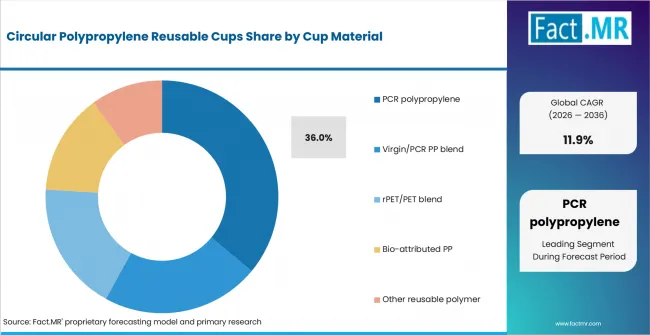
Circular Polypropylene Reusable Cups Analysis By Cup Material | Source: Fact.MR
PCR polypropylene leads because venue operators want a visible recycled-content story while keeping a durable polymer. It gives cup producers a route to balance circular claims with repeated washing and handling needs.
The German Federal Environment Ministry states that Regulation (EU) 2025/40 entered into force on February 11, 2025 and applies from August 12, 2026. It also states that plastic packaging will in future have to contain specified proportions of recycled material and that mandatory reuse targets will apply in various sectors from 2030.
What leads the Use Model segment?
Venue deposit-return is projected to account for 31.0% share in 2026.
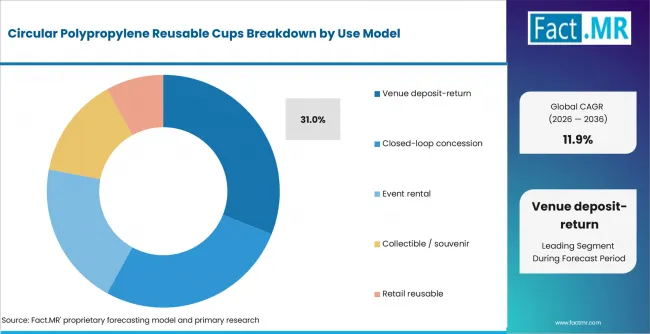
Circular Polypropylene Reusable Cups Analysis By Use Model | Source: Fact.MR
Venue deposit-return leads because it makes the cup part of the transaction. A deposit gives visitors a simple reason to return cups and gives operators a trackable method for managing losses after events.
Berry Global reported in March 2025 that Borrow Cup customers paid a GBP 1 deposit and could return cups to any participating outlet. Cups could also be dropped at dedicated return points, while used cups were collected by Reposit, washed at its facility and returned to participating stores.
How does Capacity shape demand?
<300 mL is anticipated to hold 29.0% share in 2026.
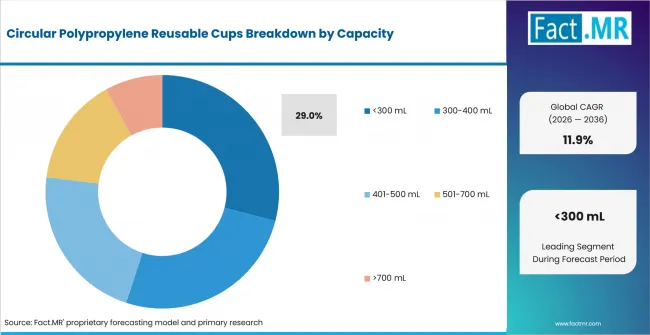
Circular Polypropylene Reusable Cups Analysis By Capacity | Source: Fact.MR
Smaller cups hold a practical position because many venues serve coffee, water tastings and short soft-drink portions in high volumes. They are easier to stack and wash, and they reduce the cost of replacement losses.
Berry Global reported in February 2025 that its reusable cup range is crafted from polypropylene and can incorporate embedded RFID chips or unique QR codes. Berry states that RFID technology can support automatic return-deposit and refill systems, wash-cycle tracking, and inventory management.
What supports Stadiums within End-use?
Stadiums are estimated to represent 33.0% share in 2026.
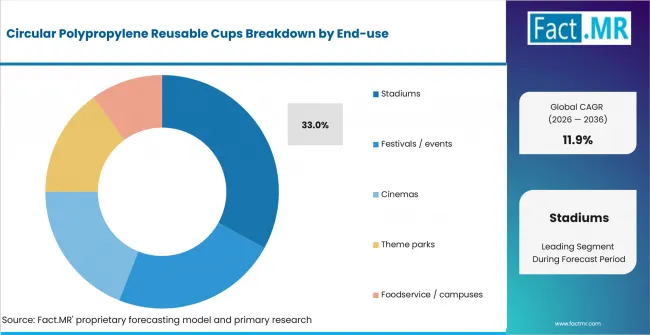
Circular Polypropylene Reusable Cups Analysis By End Use | Source: Fact.MR
Stadiums hold a clear share because they combine controlled entrances, repeated concession points and predictable return locations. Operators can train staff, place bins and test deposits with less leakage than open street events.
Greiner Packaging reported in June 2025 that its reusable polypropylene drinking cups replaced single-use plastic cups during a DTM race weekend at DEKRA Lausitzring attended by around 52,000 fans, demonstrating their use at a large-scale motorsport event.
What is accelerating Circular Polypropylene Reusable Cups Market adoption, and what is holding it back?
Demand is expected to rise through single-use reduction rules, venue deposit systems and public waste-prevention programs. Growth is constrained by cup leakage, washing cost and food-contact documentation needs.
Drivers Impact Analysis
| DRIVER | (~) % IMPACT ON CAGR | GEOGRAPHIC RELEVANCE | IMPACT TIMELINE |
|---|---|---|---|
| Single-use cup reduction rules | +1.8% | Europe, North America | Short term (<= 2 years) |
| Deposit-return behavior in venues | +1.5% | Global | Medium term (2-4 years) |
| PCR polypropylene availability | +1.2% | Europe, East Asia | Medium term (2-4 years) |
| RFID and QR-based cup tracking | +0.8% | North America, Europe | Long term (>= 4 years) |
Opportunity Impact Analysis
| OPPORTUNITY | (~) % IMPACT ON CAGR | GEOGRAPHIC RELEVANCE | IMPACT TIMELINE |
|---|---|---|---|
| Shared reuse networks across venues | +1.3% | Europe, North America | Medium term (2-4 years) |
| Reusable cups with embedded tracking | +1.0% | Global | Long term (>= 4 years) |
| Operator service bundles for washing | +0.9% | North America, East Asia | Short term (<= 2 years) |
Restraints Impact Analysis
| RESTRAINT | (~) % IMPACT ON CAGR | GEOGRAPHIC RELEVANCE | IMPACT TIMELINE |
|---|---|---|---|
| Cup loss outside controlled venues | -0.7% | Global | Short term (<= 2 years) |
| Washing and storage cost | -0.6% | North America, Europe | Medium term (2-4 years) |
| Food-contact documentation burden | -0.4% | Europe, East Asia | Long term (>= 4 years) |
Which countries are scaling the Circular Polypropylene Reusable Cups Market through 2036?
- The country comparison spans 1.4 percentage points and forms a compact growth band across the forecast period.
- France remains 0.7 percentage point above China through tourism-led venue traffic and a stricter single-use cup pathway.
- China remains 0.5 percentage point above the USA as catering income expands reusable cup occasions across large city venues.
- The USA stays level with Japan, although each market follows a different adoption route.
- Germany closes the displayed range through reusable-offer rules and established event cup pilots.
Comparable CAGRs create different entry conditions due to policy pressure and event traffic. Washing infrastructure and foodservice economics shape entry plans. Full report coverage includes North America; Latin America; Western Europe; Eastern Europe; East Asia; South Asia & Pacific; Middle East & Africa.
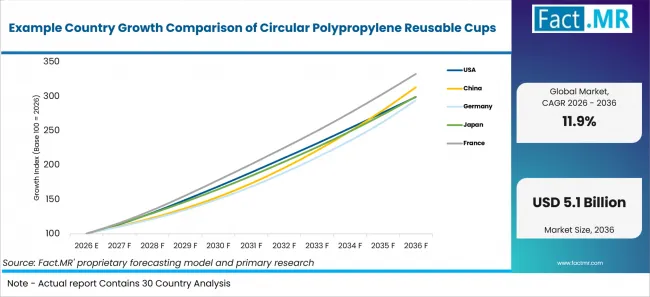
Example Country Growth Comparison Of Circular Polypropylene Reusable Cups | Source: Fact.MR
| Country | CAGR |
|---|---|
| France | 12.8% |
| China | 12.1% |
| United States | 11.6% |
| Japan | 11.6% |
| Germany | 11.4% |
What supports France adoption?
12.8% CAGR, supported by reuse rules and event-led foodservice demand.
France has a strong venue base for reusable cups because tourism keeps stadiums, festivals and attractions busy across much of the year. France’s Ministry of Economy reported in February 2026 that France received 102 million international visitors in 2025. France’s Environment Ministry reported in December 2025 that the deadline for eliminating plastic from covered single-use cups was postponed to January 1, 2030. Since January 1, 2024, those cups may contain no more than 8% plastic by weight.
How is China scaling demand?
12.1% CAGR, driven by catering income and domestic venue traffic.
China is scaling reusable cup demand through a large foodservice base and dense urban entertainment districts. The National Bureau of Statistics of China reported in February 2026 that catering industry income reached 5,798.2 billion yuan in 2025. Large malls, stadiums and attractions give operators controlled settings for cup return points and washing partners.
What supports USA adoption?
11.6% CAGR, backed by foodservice scale and venue reuse pilots.
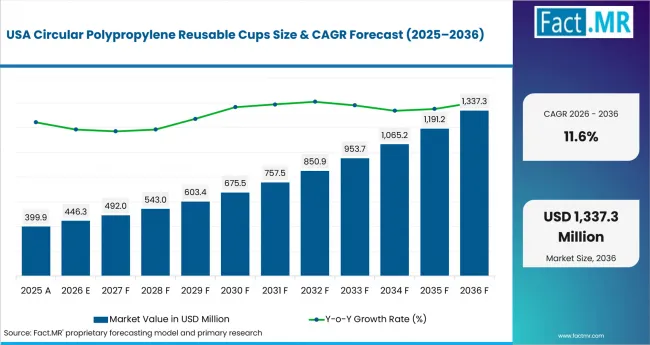
Circular Polypropylene Reusable Cups Country Value Analysis | Source: Fact.MR
The USA has a large foodservice base that makes reusable cup trials commercially visible. The U.S. Department of Agriculture, Economic Research Service reported in June 2026 that inflation-adjusted food-away-from-home spending reached USD 1.41 trillion in 2025, expressed in 2025 dollars. Stadiums, campuses and corporate dining operators can test polypropylene cups where return routes are easy to explain to guests.
How does Japan perform?
11.6% CAGR, led by tourism recovery and food-container plastic circulation work.
Japan benefits from tourism recovery and formal food-container plastic-circulation work. The Japan National Tourism Organization reported in January 2026 that inbound visitor arrivals reached 42,683,600 in 2025. MAFF listed nine meetings of its Task Force on Resource Circulation of Plastic Containers and Packaging in the Food Sector from October 2025 through June 2026. Rail hubs and compact venues create drink-service settings where small reusable cups can support return behavior.
What is supporting Germany’s adoption?
11.4% CAGR, supported by reusable-offer rules and event cup pilots.
Germany has a clear regulatory route for reusable cup adoption in immediate-consumption foodservice. The German Federal Environment Ministry states that the reusable-alternative obligation applies to final distributors of single-use plastic food packaging and single-use beverage cups when those packages are filled by the final distributor. Greiner Packaging reported in June 2025 that around 52,000 fans attended the DTM race weekend at DEKRA Lausitzring, where reusable drinking cups replaced single-use plastic cups.
Who leads the Circular Polypropylene Reusable Cups Market?
Amcor plc completed its combination with Berry Global on April 30, 2025. Amcor’s current packaging portfolio includes the former Berry Global reusable polypropylene cup range for foodservice applications.
The reusable cup range is made from polypropylene and includes options for embedded RFID chips or QR codes to support tracking and reuse-system management. In March 2025, Berry Global reported that its reusable PP cups had been selected for Glasgow’s Borrow Cup returnable-cup initiative. Separately, in April 2025, Berry announced that its polypropylene Versalite™ cups had received APR Design® for Recyclability Recognition.
Greiner Packaging directly supplies PP reusable drinking cups designed for events, including festivals, concerts and sporting events. Huhtamaki launched compostable ice-cream cups in July 2025 made from certified paperboard with a bio-based material coating and less than 10% plastic content. Faerch offers a PET Hot Cup Lid made with up to 85% recycled PET and designed for recycling into new food-grade packaging.
Which companies are the key providers?
Direct reusable polypropylene cup providers evidenced in the reviewed sources include Amcor plc, through the former Berry Global reusable-cup portfolio, Greiner Packaging, and Faerch.
- Amcor plc (including the former Berry Global reusable-cup portfolio)
- Greiner Packaging
- Faerch
Bibliography
- Amcor. (2025, April 30). Amcor completes combination with Berry Global; positioned to significantly enhance value for customers and shareholders.
- Berry Global. (2025a, February 10). Smart & intelligent: Berry's reusable cup range gains renewed attention.
- Berry Global. (2025b, March 6). Berry’s reusable cups support returnable cup initiative.
- Berry Global. (2025c, April 16). Berry Global’s Versalite™ cups receive the APR Design® for Recyclability Recognition.
- European Parliament, & Council of the European Union. (2025, January 22). Regulation (EU) 2025/40 of the European Parliament and of the Council of 19 December 2024 on packaging and packaging waste, amending Regulation (EU) 2019/1020 and Directive (EU) 2019/904, and repealing Directive 94/62/EC. Official Journal of the European Union.
- Eggharter, R. (2025, June 16). Greiner’s reusable drinking cup drives change at major Motorsport Event in Germany. Greiner Packaging.
- Huhtamäki Oyj. (2025, July 16). Huhtamaki launches new compostable ice cream cups.
- Ministère des Finances. (2026, February 19). Bilan touristique de l’année 2025 : Avec 102 millions de visiteurs, la France, pays le plus visité du monde, enregistre une nouvelle hausse massive de ses recettes touristiques (+9 %).
- Ministères Transition écologique, Aménagement du Territoire, Transports, Ville et Logement. (2025, December 31). Report de l’échéance d’interdiction des gobelets en plastique à usage unique.
- National Bureau of Statistics of China. (2026, February 28). Statistical communiqué of the People's Republic of China on the 2025 national economic and social development.
- Zeballos, E., & Sinclair, W. (2026, June 1). Total food spending reached $2.51 trillion in 2025. U.S. Department of Agriculture, Economic Research Service.
This Report Answers
- The report explains where reusable polypropylene cups are used across cup material and use model. It also covers capacity and end-use settings.
- Segment analysis identifies the leading subsegments and the operating reasons venue buyers prioritize them.
- Country analysis examines the listed markets and the policy or venue mechanisms supporting reusable cup adoption.
- Competitive analysis reviews current providers across reusable PP cups, event cup systems and circular foodservice packaging.
- Application analysis assesses how return behavior, washing logistics and food-contact documentation influence purchase decisions.
What does the Circular Polypropylene Reusable Cups Market cover?
The Circular Polypropylene Reusable Cups Market covers reusable cups made from polypropylene or related reusable polymer blends for hot and cold beverages. It includes cups used with deposit-return, closed-loop concessions, event rental and retail reusable models.
The assessment includes stadiums and festivals. It also covers cinemas, theme parks and foodservice or campus settings where cups can be collected after use. Broader reusable packaging analysis and plastic containers coverage are used only to explain material selection and system design for returnable cup programs.
What is included in the scope?
The scope includes reusable PP cups and PCR polypropylene cups. It also covers reusable lids, digital cup-tracking options and service models that help operators manage cup return. Closed event and foodservice settings are included where high durability plastic polymers are relevant to refillable and reusable food packaging systems.
Included applications cover beverage service in stadiums and festivals. Cinemas, theme parks, campuses and workplace foodservice are included when operators manage repeat cup use.
What is excluded from the scope?
The scope excludes single-use disposable cups and paper cups built for one serving. Aluminum bottles, ceramic mugs and stainless tumblers are treated as personal drinkware. General packaging outside repeated cup service is excluded.
Reusable containers for prepared meals are outside scope unless they are sold as drink cups or cup-and-lid systems. Recycling-only projects are outside scope when cups are sent directly to material recovery instead of being washed and redeployed.
How Was the Analysis Built?
The analysis draws on 120+ sources, 35+ company portfolios, 25+ countries, and more than 20 industry interviews.
- Primary Research: Primary research includes discussions with manufacturers, service providers, technology developers, distributors, end users, and subject-matter experts. These conversations examine purchasing priorities, product adoption, operational challenges, approval requirements, competitive positioning, and the factors that influence wider market acceptance.
- Desk Research: Desk research covers government statistics, regulatory publications, company filings, trade data, technical studies, industry associations, standards, public policy, and other authoritative sources. Every source used in the analysis is documented in the bibliography.
- Market Sizing and Forecasting: Market estimates combine historical performance, demand indicators, pricing and volume trends, segment shares, company participation, country-level growth, adoption patterns, investment activity, and barriers to market expansion.
- Data Validation and Update Cycle: Findings are validated by comparing primary interviews with public data, company activity, regulatory changes, trade patterns, and industry developments. Regular updates review new product launches, capacity changes, partnerships, approvals, and shifts in commercial adoption.
What is the report’s scope and coverage?
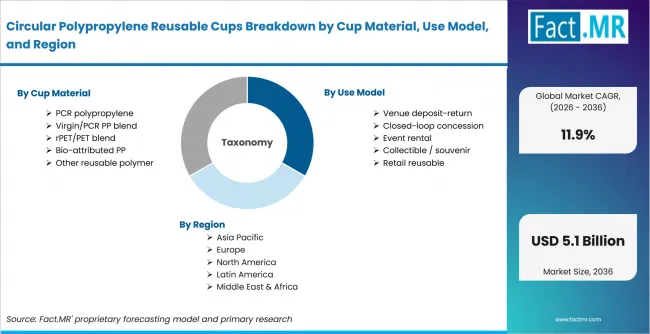
Circular Polypropylene Reusable Cups Breakdown By Cup Material, Use Model, And Region | Source: Fact.MR
| Attribute | Details |
|---|---|
| Quantitative Units | USD billion |
| Market Definition | Reusable polypropylene cups and closely related reusable polymer cup formats designed for repeated serving, collection, washing and redeployment in foodservice and event settings. |
| Cup Material | PCR polypropylene; Virgin/PCR PP blend; rPET/PET blend; Bio-attributed PP; Other reusable polymer |
| Use Model | Venue deposit-return; Closed-loop concession; Event rental; Collectible / souvenir; Retail reusable |
| Capacity | <300 mL; 300-400 mL; 401-500 mL; 501-700 mL; >700 mL |
| End-use | Stadiums; Festivals / events; Cinemas; Theme parks; Foodservice / campuses |
| Regions Covered | North America; Latin America; Western Europe; Eastern Europe; East Asia; South Asia & Pacific; Middle East & Africa |
| Countries Covered | France; China; United States; Japan; Germany |
| Key Companies Profiled | Amcor plc (including the former Berry Global reusable-cup portfolio); Greiner Packaging; Faerch |
| Forecast Period | 2026 to 2036 |
| Approach | Hybrid top-down and bottom-up approach using foodservice demand, venue adoption, reuse policy, material selection and supplier portfolio review. |
How is the market segmented?
-
By Cup Material
- PCR polypropylene
- Virgin/PCR PP blend
- rPET/PET blend
- Bio-attributed PP
- Other reusable polymer
-
By Use Model
- Venue deposit-return
- Closed-loop concession
- Event rental
- Collectible / souvenir
- Retail reusable
-
By Capacity
- <300 mL
- 300-400 mL
- 401-500 mL
- 501-700 mL
- >700 mL
-
By End-use
- Stadiums
- Festivals / events
- Cinemas
- Theme parks
- Foodservice / campuses
-
By Region
- North America
- Latin America
- Western Europe
- Eastern Europe
- East Asia
- South Asia & Pacific
- Middle East & Africa