- Market Value (2025): USD 1319.7 Mn
- Estimated Value (2026): USD 1420.0 Mn
- Forecast Value (2036): USD 2954.0 Mn
- CAGR (2026-2036): 7.6%
What is the Circular Economy Starters Market forecast to be worth by 2036?
USD 1,420.0 million in 2026 to USD 2954.0 million by 2036 at a 7.6% CAGR.
- The Circular Economy Starters Market reached USD 1319.7 million in 2025.
- Demand is projected to increase from USD 1420.0 million in 2026 to USD 2954.0 million by 2036.
- The market is forecast to record 7.6% CAGR from 2026 to 2036 as plant owners, panel builders, utilities, mining operators and building-services contractors expand qualified purchasing and deployment.
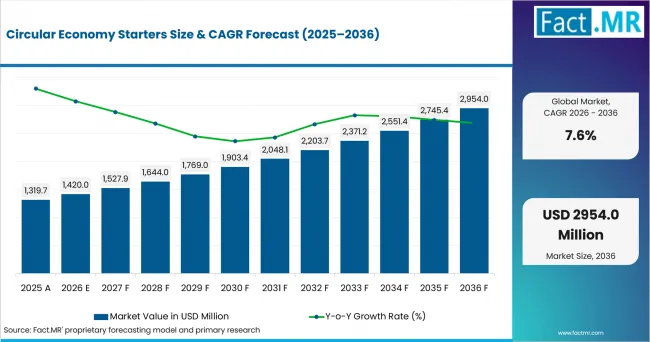
Circular Economy Starters Value Analysis | Source: Fact.MR
What are the defining numbers behind Circular Economy Starters Market growth?
The absolute opportunity from 2026 to 2036 is USD 1534.0 million.
- Demand Drivers in the Market
- OEM take-back and exchange models as a demand driver because structured return, qualification and replacement workflows can improve access to serviceable industrial motor-control equipment.
- Lifecycle obsolescence increases the importance of planned repair, replacement and alternative sourcing. IEC 62402:2019 provides requirements and guidance for establishing and implementing obsolescence-management processes across an item's life cycle.
- The EU's 2020 Circular Economy Action Plan promotes longer-lasting products, repair and stronger Green Public Procurement measures. Regulation (EU) 2024/1781 subsequently established an ecodesign framework that can address durability, repairability, refurbishment and remanufacturing through applicable product-specific requirements.
- Key Segments Analyzed
- By Circular Model: OEM take-back + remanufacture is expected to hold 31.0% share in 2026 because OEM-led programs can combine returned equipment, replacement components, qualification processes and warranty support within a controlled service model.
- By Starter Type: Soft starters are projected to account for 46.0% share in 2026 as they are widely used in pump, fan and conveyor applications where smooth motor starting helps reduce mechanical loading and starting-current effects.
- By Industry: Manufacturing is anticipated to capture 27.0% share in 2026 because motor-control equipment is widely used across production operations, where starter or panel-component failures can directly affect uptime and output.
- By Value Driver: Capex reduction is estimated to represent 33.0% share in 2026 because retrofit solutions can retain existing enclosures and accessories while replacing obsolete starter equipment, supporting upgrades without requiring complete panel replacement.
- Analyst Opinion at Fact.MR
- Shambhu Nath Jha, Principal Consultant, Fact.MR, states, "Circular starter supply will scale where test evidence is as disciplined as new-equipment documentation. The commercial advantage comes from shortening shutdowns and extending installed-panel life without weakening protection coordination."
- Strategic Implications
- Qualification plans for serialized core exchange should test lessons from motor protection devices against the evidence needed to prove lifecycle value in motor-control refurbishment.
- Commissioning risk around documented functional testing can be reduced by adapting machine condition monitoring workflows to the operating demands of lifecycle value in motor-control refurbishment.
- A sourcing brief for retrofit kits for obsolete panels should reference relevant electric power equipment practice without widening the commercial definition beyond lifecycle value in motor-control refurbishment.
- Partner selection for warranty-backed remanufacture can be sharpened by examining industrial automation systems roles connected with delivery of lifecycle value in motor-control refurbishment.
- Commercial rollout of serialized core exchange should be separated from general smart factory technologies demand by specifying outcomes tied to lifecycle value in motor-control refurbishment.
How does the Circular Economy Starters Market break down by segment?
The Circular Economy Starters Market is analyzed by Circular Model, Starter Type, Industry, and Value Driver.
Which Circular Model dominates?
OEM take-back + remanufacture is expected to hold 31.0% share in 2026.
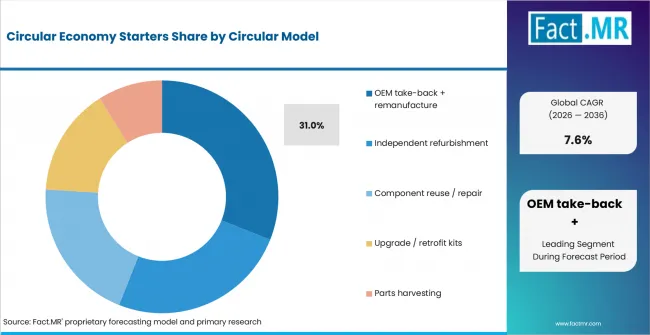
Circular Economy Starters Analysis By Circular Model | Source: Fact.MR
OEM take-back + remanufacture leads because OEM-led programs can combine returned equipment, replacement components, qualification processes and warranty support within one controlled lifecycle model. This gives buyers greater confidence in equipment condition and service accountability than less standardized refurbishment routes.
The model becomes more attractive when suppliers can document serialized core exchange, functional testing and refurbishment history. Plant owners, panel builders, utilities and other industrial buyers can therefore assess lifecycle value with clearer information on product condition, compatibility and warranty responsibility.
What leads the Starter Type segment?
Soft starters are projected to account for 46.0% share in 2026.
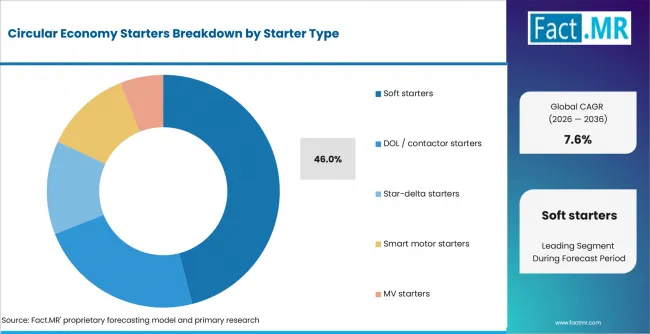
Circular Economy Starters Analysis By Starter Type | Source: Fact.MR
Soft starters lead because they are widely used in pump, fan and conveyor applications where controlled motor starting can reduce mechanical loading and starting-current effects. Their broad installed base also creates recurring opportunities for replacement, retrofit and refurbishment across industrial motor-control systems.
The segment remains attractive when suppliers combine replacement equipment with documented functional testing and clear warranty support. Retrofit programs can preserve existing panel infrastructure while restoring dependable motor-starting performance, making soft starters well suited to circular service models.
How does Industry shape demand?
Manufacturing is anticipated to lead with 27.0% share in 2026.
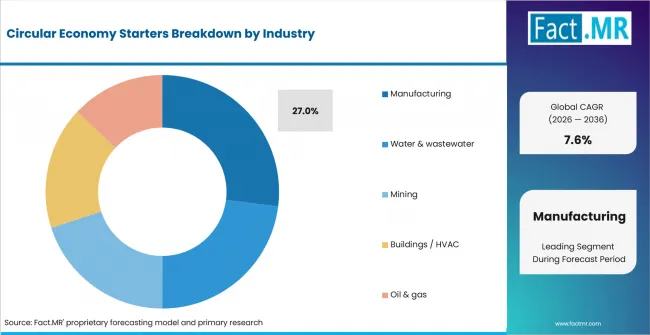
Circular Economy Starters Analysis By Industry | Source: Fact.MR
Manufacturing leads because production facilities rely on motor-control equipment across conveyors, pumps, fans and process machinery. Starter or panel-component failures can interrupt production, giving plant operators a strong incentive to maintain dependable equipment and replace obsolete components before they create extended downtime.
Demand strengthens when suppliers provide retrofit kits that fit existing panels and address obsolete firmware, semiconductors or control components. Practical field compatibility can therefore convert lifecycle-management needs into repeat orders for refurbished, remanufactured and upgraded starter systems.
What supports Capex reduction within Value Driver?
Capex reduction is estimated to represent 33.0% share in 2026.
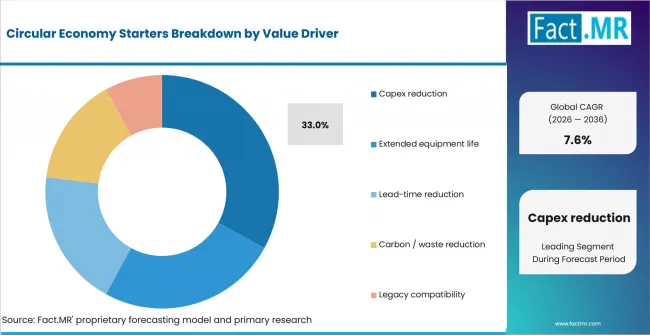
Circular Economy Starters Analysis By Value Driver | Source: Fact.MR
Capex reduction leads because starter retrofit solutions can retain existing enclosures, wiring and compatible accessories while replacing obsolete motor-control equipment. This allows facilities to upgrade critical starter functions without bearing the cost and disruption associated with complete panel replacement.
The value proposition becomes stronger when remanufactured equipment includes documented testing, warranty support and clear replacement guidance. Buyers can then compare lifecycle savings with the risk of continued legacy operation, making capital efficiency a practical driver of circular motor-control adoption.
What is accelerating Circular Economy Starters Market adoption, and what is holding it back?
OEM take-back and exchange models, lifecycle obsolescence and the EU circular-economy policy direction as adoption drivers. Its market model identifies returned-core condition, warranty allocation, component obsolescence and buyer preference for new equipment as restraints.
Drivers Impact Analysis
| DRIVER | (~) % IMPACT ON CAGR | GEOGRAPHIC RELEVANCE | IMPACT TIMELINE |
|---|---|---|---|
| OEM take-back and exchange models | +1.4% | Global | Short term (<= 2 years) |
| Lifecycle obsolescence and alternative sourcing needs | +1.1% | USA and Germany | Medium term (2-4 years) |
| EU circular-economy policy and ecodesign framework | +0.8% | Germany and UK | Long term (>= 4 years) |
Source: Fact.MR analysis. Updated Sep 9, 2026
Opportunity Impact Analysis
| OPPORTUNITY | (~) % IMPACT ON CAGR | GEOGRAPHIC RELEVANCE | IMPACT TIMELINE |
|---|---|---|---|
| Serialized core exchange | +0.9% | Global | Medium term (2-4 years) |
| Documented functional testing | +0.8% | USA and Germany | Short term (<= 2 years) |
| Retrofit kits for obsolete panels | +0.6% | Germany and UK | Long term (>= 4 years) |
| Warranty-backed remanufacture | +0.5% | Global | Medium term (2-4 years) |
Source: Fact.MR analysis. Updated Sep 9, 2026
Restraints Impact Analysis
| RESTRAINT | (~) % IMPACT ON CAGR | GEOGRAPHIC RELEVANCE | IMPACT TIMELINE |
|---|---|---|---|
| Uncertain condition of returned cores | -0.7% | Global | Short term (<= 2 years) |
| Liability and warranty allocation | -0.5% | USA and Germany | Medium term (2-4 years) |
| Obsolete firmware or semiconductors | -0.4% | Global | Long term (>= 4 years) |
| Buyer preference for new equipment | -0.3% | UK and France | Medium term (2-4 years) |
Source: Fact.MR analysis. Updated Sep 9, 2026
Which countries are scaling the Circular Economy Starters Market through 2036?
- The country comparison spans 2.0 percentage points and forms three practical growth bands across the forecast period.
- The UK remains 0.3 percentage point above Italy as retrofit opportunities are supported by legacy-equipment service, component availability and demonstrated operating value.
- Italy remains 0.6 percentage point above the USA through OEM take-back, remanufacturing and serialized core-exchange opportunities.
- The USA remains 0.3 percentage point above Germany as lifecycle-value considerations, qualification requirements and serialized core exchange support refurbishment demand.
- Germany remains 0.8 percentage point above France through documented functional testing, lifecycle extension and supplier management of qualification and warranty requirements.
- France closes the displayed range as Capex reduction, supplier qualification and warranty support shape buyer acceptance of refurbished and remanufactured starter equipment.
Comparable CAGRs can create different entry conditions due to installed-base age, qualification requirements, component availability, warranty structures and buyer acceptance of refurbished equipment. Full report coverage includes North America, Latin America, Western Europe, Eastern Europe, East Asia, South Asia & Pacific, Middle East & Africa.
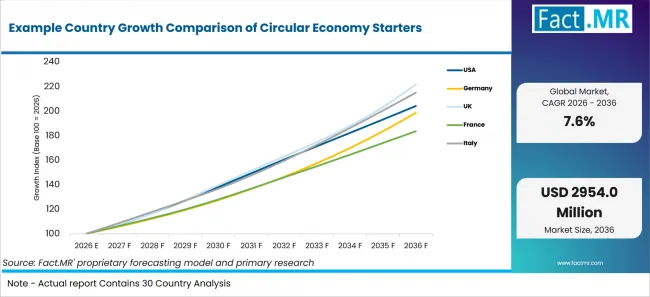
Example Country Growth Comparison Of Circular Economy Starters | Source: Fact.MR
| Country | CAGR (2026-2036) |
|---|---|
| USA | 7.4% |
| Germany | 7.1% |
| UK | 8.3% |
| France | 6.3% |
| Italy | 8.0% |
Source: Fact.MR analysis. Updated Sep 9, 2026
What supports USA adoption?
7.4% CAGR, supported by lifecycle value, qualified refurbishment and code-compliant motor-control integration.
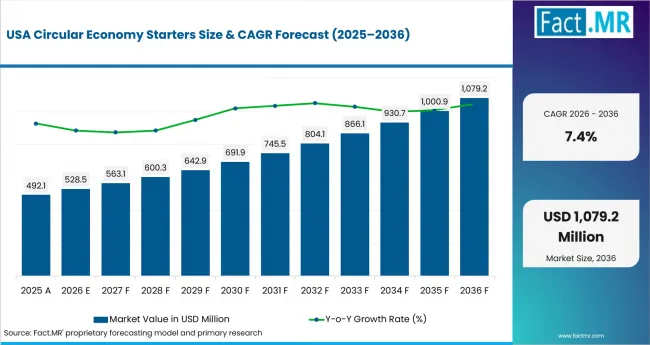
Circular Economy Starters Country Value Analysis | Source: Fact.MR
NFPA 70 provides a U.S. benchmark for safe electrical installations, making code-compliant integration, equipment approval and adherence to applicable listing and labeling requirements important when replacement motor-control equipment is installed. Demand also depends on OEM take-back, serialized core exchange and suppliers’ ability to manage returned-core condition, warranty responsibility and site-specific qualification requirements.
What is supporting Germany’s adoption?
7.1% CAGR, driven by documented functional testing and lifecycle extension of motor-control equipment.
Germany’s DIN VDE 0100-410 establishes requirements for protection against electric shock in low-voltage installations. This supports demand for safely integrated and thoroughly tested replacement equipment, while suppliers that provide documented functional testing, lifecycle support and clear warranty arrangements are better positioned for refurbishment and retrofit projects.
What supports the United Kingdom’s growth?
8.3% CAGR, backed by legacy-equipment retrofit opportunities and documented electrical-installation requirements.
BS 7671 provides the UK national standard for the safe design, alteration, verification, inspection and testing of electrical installations. This creates a structured environment for motor-control retrofits, while adoption depends on supplier support for legacy equipment, component availability and evidence that refurbished or remanufactured starters can deliver dependable operating value.
How is France developing demand?
6.3% CAGR, supported by lifecycle value and Capex reduction in motor-control refurbishment.
France’s NF C15-100 series sets requirements for the design, installation, inspection and maintenance of low-voltage electrical systems. This supports qualified additions and modifications to existing installations, while demand for circular starters depends on supplier qualification, warranty support and buyer acceptance of refurbished or remanufactured equipment.
How does Italy perform?
8.0% CAGR, driven by OEM take-back, remanufacturing and qualified low-voltage equipment integration.
Italy’s CEI 64-8 provides the national reference for low-voltage electrical installations and covers electrical safety, equipment selection and verification. This supports structured qualification of replacement equipment, while OEM take-back and remanufacturing opportunities depend on returned-equipment condition, field support and the ability to document safe integration.
Who leads the Circular Economy Starters Market?
Competitive set includes ABB, Siemens, Schneider Electric, Rockwell Automation, WEG, and Eaton. Public manufacturer materials show active motor-control or starter portfolios and broader lifecycle services, with repair, retrofit, refurbishment, exchange and remanufacturing coverage varying by product and geography.
Competition around qualification depth, installed-base access and lifecycle support. Vendors that can support documented testing, field integration and service continuity are better placed to compete for repeat orders from plant owners, panel builders, utilities, mining operators and building-services contractors.
Which companies are the key providers?
Key companies includes ABB, Siemens, Schneider Electric, Rockwell Automation, WEG, and Eaton.
- ABB
- Siemens
- Schneider Electric
- Rockwell Automation
- WEG
- Eaton.
Bibliography
- European Parliament, & Council of the European Union. (2024, June 13). Regulation (EU) 2024/1781 of the European Parliament and of the Council establishing a framework for the setting of ecodesign requirements for sustainable products, amending Directive (EU) 2020/1828 and Regulation (EU) 2023/1542 and repealing Directive 2009/125/EC.
- National Fire Protection Association. (2026). NFPA 70®: National Electrical Code® (NEC®), 2026 edition.
- AFNOR. (2026, March 30). Low-voltage electrical installations: The NF C15-100 series has been published.
- Institution of Engineering and Technology, & British Standards Institution. (2026, April 15). Requirements for Electrical Installations: IET Wiring Regulations, Eighteenth Edition (BS 7671:2018+A4:2026).
- Comitato Elettrotecnico Italiano. (2024, September). CEI 64-8: Impianti elettrici a tensione nominale non superiore a 1 000 V in corrente alternata e a 1 500 V in corrente continua (9th ed.).
This Report Answers
- The report explains how the Circular Economy Starters Market develops across Circular Model and Starter Type.
- Segment analysis identifies OEM take-back + remanufacture and Soft starters as the principal 2026 reference points.
- Country analysis examines USA, Germany, UK, France, and Italy.
- Competitive analysis reviews ABB, Siemens, Schneider Electric, Rockwell Automation, WEG, and Eaton.
- Opportunity analysis covers serialized core exchange, documented functional testing, retrofit kits for obsolete panels, and warranty-backed remanufacture.
- Risk analysis evaluates uncertain condition of returned cores, liability and warranty allocation, obsolete firmware or semiconductors, and buyer preference for new equipment.
What does the Circular Economy Starters Market cover?
The Circular Economy Starters Market covers sales of tested refurbished or remanufactured starters, reusable starter assemblies, replacement modules and upgrade kits placed into commercial service.
Commercial coverage follows purchases made by plant owners, panel builders, utilities, mining operators and building-services contractors. Revenue is counted when the qualifying product, platform or integrated system is supplied for an in-scope application.
What is included in the scope?
The scope includes sales of tested refurbished or remanufactured starters, reusable starter assemblies, replacement modules and upgrade kits placed into commercial service across Circular Model, Starter Type, Industry, and Value Driver.
Inclusions extend to configuration and integration elements that are inseparable from the in-scope commercial offer. The boundary is applied consistently across USA, Germany, UK, France, and Italy and the seven global regions.
What is excluded from the scope?
The scope excludes ordinary repair labor without a supplied starter or kit, scrap-only recovery, new drives sold without a circular route, and informal resale without functional testing.
Adjacent categories enter the Circular Economy Starters Market only when the sold product or service performs the defining function described above. This prevents broader equipment, chemical, software or project revenue from being counted twice.
How Was the Analysis Built?
The analysis draws on 120+ sources, 35+ company portfolios, 25+ countries, and more than 20 industry interviews.
- Primary Research: Primary research includes discussions with manufacturers, service providers, technology developers, distributors, end users, and subject-matter experts. These conversations examine purchasing priorities, product adoption, operational challenges, approval requirements, competitive positioning, and the factors that influence wider market acceptance.
- Desk Research: Desk research covers government statistics, regulatory publications, company filings, trade data, technical studies, industry associations, standards, public policy, and other authoritative sources. Every source used in the analysis is documented in the bibliography.
- Market Sizing and Forecasting: Market estimates combine historical performance, demand indicators, pricing and volume trends, segment shares, company participation, country-level growth, adoption patterns, investment activity, and barriers to market expansion.
- Data Validation and Update Cycle: Findings are validated by comparing primary interviews with public data, company activity, regulatory changes, trade patterns, and industry developments. Regular updates review new product launches, capacity changes, partnerships, approvals, and shifts in commercial adoption.
Segmentation
What is the report's scope and coverage?
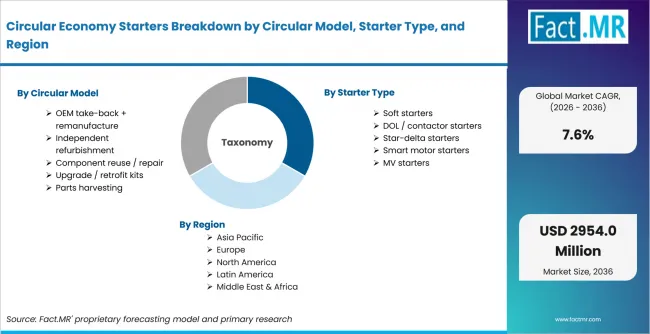
Circular Economy Starters Breakdown By Circular Model, Starter Type, And Region | Source: Fact.MR
| Attribute | Details |
|---|---|
| Quantitative Units | USD Million in 2026 and 2036; CAGR from 2026 to 2036 |
| Market Definition | Motor-starting equipment returned to service through OEM take-back, independent refurbishment, component repair, retrofit or parts recovery. |
| Circular Model | OEM take-back + remanufacture; Independent refurbishment; Component reuse / repair; Upgrade / retrofit kits; Parts harvesting |
| Starter Type | Soft starters; DOL / contactor starters; Star-delta starters; Smart motor starters; MV starters |
| Industry | Manufacturing; Water & wastewater; Mining; Buildings / HVAC; Oil & gas |
| Value Driver | Capex reduction; Extended equipment life; Lead-time reduction; Carbon / waste reduction; Legacy compatibility |
| Regions Covered | North America; Latin America; Western Europe; Eastern Europe; East Asia; South Asia & Pacific; Middle East & Africa |
| Countries Covered | USA; Germany; UK; France; Italy |
| Key Companies | ABB; Siemens; Schneider Electric; Rockwell Automation; WEG; Eaton |
| Forecast Period | 2026 to 2036 |
| Approach | Hybrid top-down and bottom-up assessment using Circular Model, Starter Type, Industry, and Value Driver, country deployment, replacement demand and company participation. |
Source: Fact.MR analysis. Updated Sep 9, 2026
How is the market segmented?
-
By Circular Model
- OEM take-back + remanufacture
- Independent refurbishment
- Component reuse / repair
- Upgrade / retrofit kits
- Parts harvesting
-
By Starter Type
- Soft starters
- DOL / contactor starters
- Star-delta starters
- Smart motor starters
- MV starters
-
By Industry
- Manufacturing
- Water & wastewater
- Mining
- Buildings / HVAC
- Oil & gas
-
By Value Driver
- Capex reduction
- Extended equipment life
- Lead-time reduction
- Carbon / waste reduction
- Legacy compatibility
-
By Region
- North America
- Latin America
- Western Europe
- Eastern Europe
- East Asia
- South Asia & Pacific
- Middle East & Africa
Frequently Asked Questions
How big is the circular economy starters market in 2026?
What is the CAGR of the circular economy starters market from 2026 to 2036?
Which circular model leads the circular economy starters market?
Which starter type leads the circular economy starters market?
Who are the leading companies in the circular economy starters market?
Who worked on this report


Preview the report firsthand - request a free sample
Free SampleGet the brochure for pricing and purchase details
Download PDF