- Market Value (2025): USD 1072.1 Mn
- Estimated Value (2026): USD 1160.0 Mn
- Forecast Value (2036): USD 2551.1 Mn
- CAGR (2026-2036): 8.2%
What is the Circular Soft Starters Market forecast to be worth by 2036?
USD 1,160.0 million in 2026 to USD 2551.1 million by 2036, at an 8.2% CAGR.
- The Circular Soft Starters Market was valued at USD 1072.1 million in 2025.
- Demand is projected to increase from USD 1160.0 million in 2026 to USD 2551.1 million by 2036.
- The market is forecast to record 8.2% CAGR from 2026 to 2036.
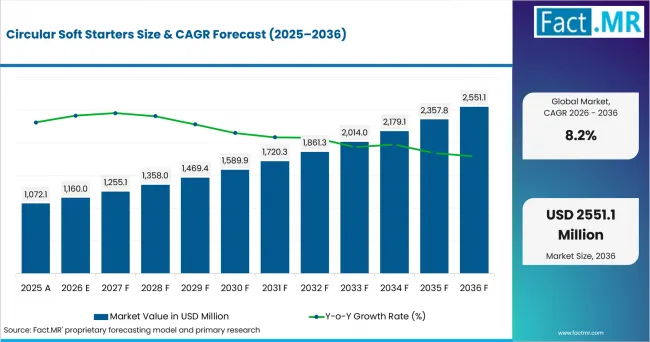
Circular Soft Starters Value Analysis | Source: Fact.MR
What are the defining numbers behind Circular Soft Starters Market growth?
USD 1391.1 million of absolute opportunity between 2026 and 2036.
- Demand Drivers in the Market
- Soft starters reduce motor starting current and can provide controlled stopping for pumps.
- Traceability is relevant to circular soft starters. Siemens states that the SIRIUS 3RW5 -Z R11 refurbished soft starter uses an ID Link, a unique QR code, to ensure traceability for both first- and second-life products.
- Electric motor systems create a large efficiency context for starter replacement and service decisions. The 4E IEA Technology Collaboration Programme reported in February 2026 that electric motor systems accounted for 53% of global electricity consumption in 2023.
- Key Segments Analyzed
- By Circularity Model: Factory-remanufactured is expected to hold 34.0% share in 2026.
- By Power Range: 15-75 kW is projected to account for 31.0% share in 2026.
- By Voltage Class: 200-480 V is anticipated to capture 48.0% share in 2026.
- By End-use: Water & wastewater is estimated to represent 24.0% share in 2026.
- Analyst Opinion at Fact.MR
- Shambhu Nath Jha, Principal Consultant at Fact.MR, states, “Circular soft starters draw attention because the buying decision falls between new equipment and emergency repair. The market is expected to reward vendors that document testing, firmware compatibility and replacement routes. Service depth, installed-base knowledge and fast availability are likely to separate dependable circular offers from simple used-equipment resale.”
- Strategic Implications
- OEMs should publish life-cycle status, replacement guidance and repair-part availability so maintenance teams can assess refurbishment and replacement options against documented product support.
- Service centers should record test procedures and component changes. Siemens' circular soft-starter process provides a current precedent by documenting testing, critical-component replacement and lifecycle traceability.
- Distributors should size exchange pools against installed-base data and service demand rather than assuming that a single voltage band will fit every site.
France leads at 10.1% CAGR through AquaPrêts-backed water-infrastructure investment. Australia follows at 9.4% as the National Water Grid Fund supports long-term water-security projects. The United Kingdom reaches 8.8% through its water-sector investment programme. The USA records 8.4% as WIFIA and SWIFIA financing supports infrastructure renewal, while Germany posts 8.1% amid energy-cost pressures that strengthen attention to industrial motor-control maintenance and lifecycle management.
How does the Circular Soft Starters Market break down by segment?
Factory-remanufactured models are expected to lead Circularity Model at 34.0% share in 2026, while the 200-480 V class leads Voltage Class at 48.0% share.
Which Circularity Model dominates?
Factory-remanufactured units are expected to hold 34.0% share in 2026.
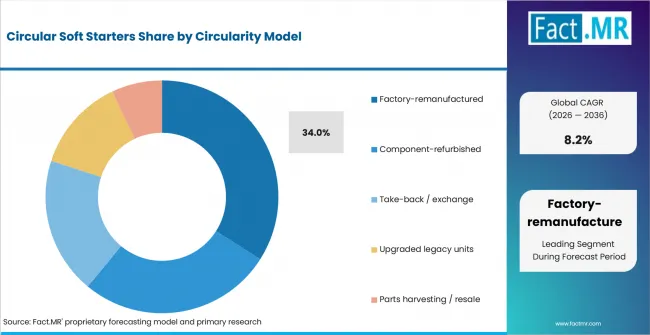
Circular Soft Starters Analysis By Circularity Model | Source: Fact.MR
Factory-remanufactured units lead because industrial buyers can extend equipment life while retaining structured testing, component replacement, and traceability. Siemens’ SIRIUS 3RW5 -Z R11 illustrates this approach, with used soft starters inspected, critical components replaced, and functions tested before returning to service.
Lifecycle support also matters because older soft-starter families can face declining spare-part availability. ABB’s lifecycle-management documentation for legacy soft starters highlights this issue, increasing the value of controlled refurbishment programs that provide clearer service history, replacement guidance, and support pathways.
What leads the Power Range segment?
15-75 kW is projected to account for 31.0% share in 2026.
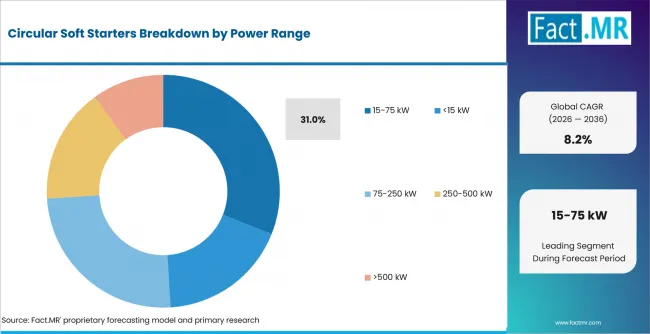
Circular Soft Starters Analysis By Power Range | Source: Fact.MR
The 15-75 kW range leads because it fits a broad base of industrial motor applications where maintenance teams can standardize testing, stocking, and exchange procedures. Repeatable service economics make this range suitable for refurbishment programs across pumps, fans, conveyors, and other fixed-speed motor loads.
Circular suppliers can also build exchange pools around commonly installed ratings, reducing the need to hold highly customized inventory. This makes refurbishment more practical where customers need faster replacement while preserving existing panel layouts and motor-control configurations.
How does Voltage Class shape demand?
200-480 V is anticipated to hold 48.0% share in 2026.
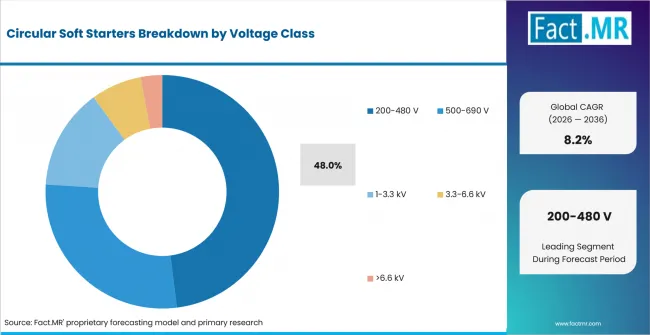
Circular Soft Starters Analysis By Voltage Class | Source: Fact.MR
The 200-480 V class leads because it is widely represented in active low-voltage soft-starter portfolios and supports common industrial motor-control applications. This gives refurbishment providers a larger installed base from which to recover, test, repair, and redeploy equipment.
Rockwell Automation’s SMC Flex 150-F201NBDB provides an active example within this voltage range and includes pump-control functionality. Such currently supported platforms strengthen the case for circular models where repairability, replacement availability, and compatibility with installed systems influence buyer decisions.
What supports Water & wastewater within End-use?
Water & wastewater is estimated to represent 24.0% share in 2026.
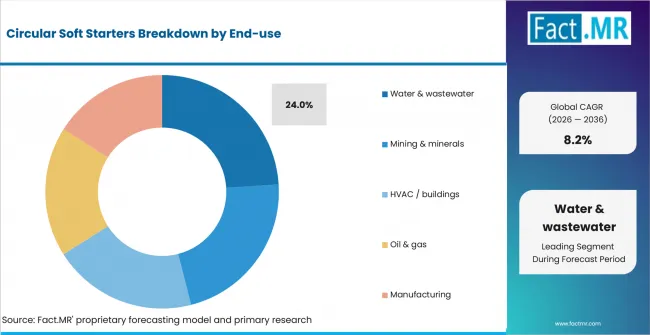
Circular Soft Starters Analysis By End Use | Source: Fact.MR
Water and wastewater leads because soft starters are well suited to pump applications where controlled starting and stopping can reduce electrical and mechanical stress.
Circular-service pathways are also established in this end-use. Danfoss documented refurbishment of VLT Soft Starter MCD 600 units used by Brazilian water utility CAESB, showing how ageing, high-load equipment can be restored rather than replaced outright when operational continuity and lifecycle management are priorities.
What is accelerating Circular Soft Starters Market adoption, and what is holding it back?
Demand to be influenced by installed-base renewal, water-infrastructure activity and OEM refurbishment or service pathways; spare-part obsolescence and documentation gaps are modeled as restraints.
Drivers Impact Analysis
| DRIVER | (~) % IMPACT ON CAGR | GEOGRAPHIC RELEVANCE | IMPACT TIMELINE |
|---|---|---|---|
| Water and wastewater pump renewal | +1.2% | North America, Western Europe, Australia | Medium term (2-4 years) |
| Industrial motor-system efficiency work | +1.0% | Global | Medium term (2-4 years) |
| OEM life-cycle and exchange programs | +0.8% | Europe, North America | Short term (<= 2 years) |
| Circular service and WEEE pressure | +0.6% | European Union | Long term (>= 4 years) |
Source: Fact.MR analysis. Updated Sep 8, 2026
- Water and wastewater pump renewal: Soft starters support pump applications by reducing starting current and enabling controlled stopping. Their ability to limit mechanical stress and reduce water hammer makes them relevant for refurbishment and replacement programs across water and wastewater infrastructure.
- Industrial motor-system efficiency work: Industrial facilities are placing greater emphasis on efficient motor operation and lifecycle management. Circular soft starters can support these efforts by extending equipment life, reducing unnecessary replacement, and maintaining reliable motor-control performance across established installations.
- OEM life-cycle and exchange programs: Manufacturer-led refurbishment, traceability, and lifecycle-support programs strengthen confidence in circular soft starters. Structured testing, component replacement, service records, and exchange pathways can make refurbished equipment more acceptable to industrial maintenance teams.
- Circular service and WEEE requirements: Re-use, refurbishment, upgrade, and responsible end-of-life treatment are becoming more important across electrical equipment markets. These requirements support circular service models where soft starters can be repaired, refurbished, exchanged, or recovered for further use instead of being discarded.
Opportunity Impact Analysis
| OPPORTUNITY | (~) % IMPACT ON CAGR | GEOGRAPHIC RELEVANCE | IMPACT TIMELINE |
|---|---|---|---|
| Documented refurbishment for 200-480 V units | +0.9% | Global | Short term (<= 2 years) |
| Take-back pools for water utilities | +0.7% | North America, Europe, Australia | Medium term (2-4 years) |
| Legacy-to-current migration kits | +0.5% | Europe, North America | Long term (>= 4 years) |
Source: Fact.MR analysis. Updated Sep 8, 2026
- Documented refurbishment for 200-480 V units: Low-voltage circular programs can expand where suppliers provide repeatable testing, component replacement, and lifecycle records. Documented refurbishment gives maintenance teams clearer evidence of equipment condition and can improve confidence in redeploying repaired soft starters.
- Take-back pools for water utilities: Standardized exchange and core-recovery programs can help water utilities reduce replacement delays and recover ageing soft starters for refurbishment. Established maintenance examples show that circular service models can support critical pump assets while improving equipment availability.
- Legacy-to-current migration kits: Replacement guidance, panel documentation, and commissioning support can reduce uncertainty when older soft starters are upgraded or exchanged. Migration kits help maintenance teams preserve existing wiring and installation layouts while moving toward currently supported equipment.
Restraints Impact Analysis
| RESTRAINT | (~) % IMPACT ON CAGR | GEOGRAPHIC RELEVANCE | IMPACT TIMELINE |
|---|---|---|---|
| Documentation gaps in used equipment | -0.6% | Global | Short term (<= 2 years) |
| Spare-part obsolescence | -0.5% | Europe, North America | Medium term (2-4 years) |
| Downtime-liability concern | -0.4% | Global | Long term (>= 4 years) |
Source: Fact.MR analysis. Updated Sep 8, 2026
- Documentation gaps in used equipment: Incomplete inspection records, firmware information, and service history can reduce buyer confidence in used or refurbished soft starters. Clear documentation is therefore important for demonstrating equipment condition, compatibility, and readiness for continued operation.
- Spare-part obsolescence: Lifecycle transitions can limit repair options for legacy soft starters when components or replacement parts are no longer readily available. This can increase refurbishment complexity and make long-term support planning more difficult for ageing installed equipment.
- Downtime-liability concern: Limited warranty coverage or insufficient testing can increase operational risk in critical pump, conveyor, and process applications. Buyers therefore place greater value on verified testing, service support, and clearly defined responsibility when considering refurbished equipment.
Which countries are scaling the Circular Soft Starters Market through 2036?
- The country comparison spans 2.0 percentage points and forms a closely grouped set of growth opportunities across the forecast period.
- France remains 0.7 percentage point above Australia through AquaPrêts-backed water-infrastructure investment and associated pump and motor-control renewal opportunities.
- Australia remains 0.6 percentage point above the United Kingdom as the National Water Grid Fund supports long-term water-security projects and infrastructure upgrades.
- The United Kingdom remains 0.4 percentage point above the USA through its water-sector investment programme and continued treatment and network asset renewal.
- The USA remains 0.3 percentage point above Germany as WIFIA and SWIFIA financing supports water-infrastructure investment and associated motor-control replacement demand.
- Germany closes the displayed range as energy-cost pressures strengthen attention to industrial motor efficiency, maintenance and lifecycle management.
Comparable CAGRs can create different entry conditions due to installed motor age, water-infrastructure spending, voltage standardization, refurbishment acceptance and service availability. Full report coverage includes North America, Latin America, Western Europe, Eastern Europe, East Asia, South Asia & Pacific, Middle East & Africa.
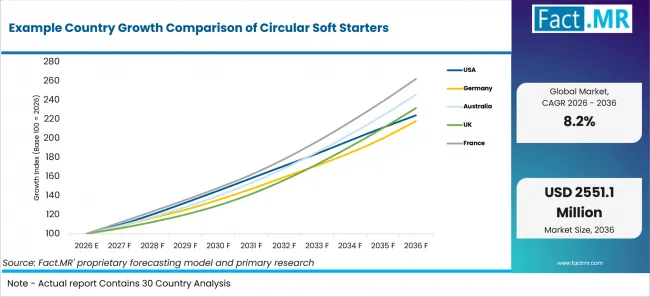
Example Country Growth Comparison Of Circular Soft Starters | Source: Fact.MR
| Country | CAGR (2026-2036) |
|---|---|
| France | 10.1% |
| Australia | 9.4% |
| United Kingdom | 8.8% |
| United States | 8.4% |
| Germany | 8.1% |
Source: Fact.MR analysis. Updated Sep 8, 2026
What supports France adoption?
10.1% CAGR, supported by water-infrastructure investment and pump-system renewal.
The French Ministry for Ecological Transition reported in July 2026 that more than EUR 6 billion of AquaPrêts would be mobilized by Banque des Territoires over 2023–2028 to support local authorities’ water projects. This investment supports treatment and network upgrades, creating replacement and refurbishment opportunities for soft starters used in pumps and other motor-driven water infrastructure.
How is Australia scaling demand?
9.4% CAGR, driven by long-term water-security investment and infrastructure renewal.
DCCEEW stated in March 2026 that the Australian Government supports long-term water security through the AUD 3.4 billion National Water Grid Fund. Continued investment in regional and remote water infrastructure supports demand for reliable motor-control equipment and circular soft-starter service models in pumping applications.
What supports the United Kingdom’s growth?
8.8% CAGR, backed by water-sector investment and treatment-network renewal.
Defra’s water white paper states that the UK water sector is delivering a GBP 104 billion investment programme. This creates a broad infrastructure base for treatment, pumping and network upgrades, supporting demand for refurbished, exchange and lifecycle-managed soft starters across water and wastewater facilities.
What supports USA adoption?
8.4% CAGR, supported by WIFIA and SWIFIA financing for water infrastructure.
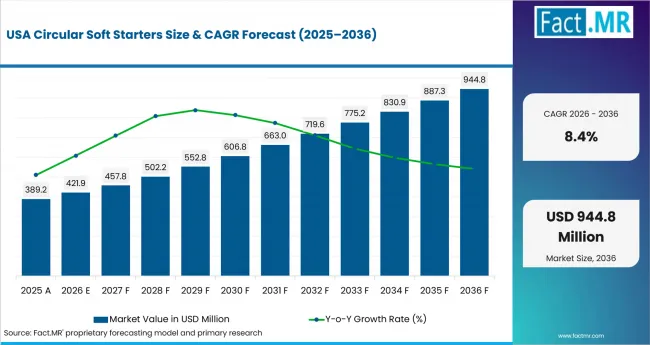
Circular Soft Starters Country Value Analysis | Source: Fact.MR
EPA reported that the most recent WIFIA and SWIFIA notices announced an estimated USD 7 billion in available financing. This funding supports water-infrastructure projects where pumps and other motor-driven assets require reliable starting, controlled stopping and lifecycle support, creating opportunities for circular soft-starter programs.
What is supporting Germany’s adoption?
8.1% CAGR, supported by energy-cost pressure and industrial motor-efficiency needs.
Bundesnetzagentur reported that Germany’s average day-ahead wholesale electricity price reached EUR 89.32 per MWh in 2025. Higher energy costs strengthen the case for efficient motor-system operation, preventive maintenance and lifecycle management, supporting refurbishment and replacement demand for soft starters across industrial installations.
Who leads the Circular Soft Starters Market?
Siemens, Schneider Electric, Danfoss, Rockwell Automation, and ABB maintain active soft-starter products and/or lifecycle service pathways. In this report, these offerings are treated as relevant to circular equipment models where manufacturers document refurbishment, repairability, lifecycle support, replacement guidance or other measures that can extend equipment service life.
Siemens launched the circular SIRIUS 3RW5 -Z R11 refurbished soft starter in March 2026, while Danfoss documented the refurbishment of several MCD 600 soft starters for CAESB in August 2025. Rockwell Automation lists the SMC Flex 150-F201NBDB as Active, Replacement Available and Repairable/Replaceable.
Competitive differentiation is likely to center on areas such as refurbishment and test documentation, spare-part and lifecycle support, traceability, repairability and replacement guidance. These competitive implications are analytical conclusions based on documented manufacturer practices rather than statements made by the manufacturers themselves.
Which companies are the key providers?
Key companies include Siemens; Schneider Electric; Danfoss; Rockwell Automation; and ABB.
- ABB
- Siemens
- Schneider Electric
- Rockwell Automation
- Danfoss
Bibliography
- Electric Motor Systems Platform. (2026, February 26). Policy brief #0 – Electric Motor Systems Platform overview. 4E Energy Efficient End-use Equipment.
- Australian Government Department of Climate Change, Energy, the Environment and Water. (2026, March 25). World Water Day highlights National Water Grid progress on water security.
- Bundesnetzagentur. (2026, January 5). Bundesnetzagentur publishes 2025 electricity market data.
- Department for Environment, Food & Rural Affairs. (2026, January 20). A new vision for water: White paper.
- Ministère de la Transition écologique. (2026, July 21). Plan Eau : le Gouvernement et la Banque des Territoires portent l’enveloppe d’AquaPrêts de 4 à 6 milliards d’euros d’ici 2028.
- Rockwell Automation. (2025, April). SMC-3, SMC Flex, and SMC-50 Smart Motor Controllers specifications (Publication 150-TD009D-EN-P).
- Schneider Electric. (2025, January 14). Altivar Soft Starter ATS490 for process and infrastructure [Catalog] (Document No. DIA2ED2240603EN, Version 1.0).
- Siemens. (2026, March 5). Siemens expands semiconductor-based circuit protection portfolio, debuts circular soft starter.
- U.S. Environmental Protection Agency. (2026, January 5). WIFIA available funding.
- WEG. (2026, June 22). Soft Starter Devices.
- Danfoss. (2025, August 25). How CAESB turned downtime risks into long-term operational reliability.
This Report Answers
- The report explains how circular soft starters relate to motor soft starters across remanufacturing and exchange models.
- Segment analysis compares circular starter use with adjacent motor protection devices where plant teams consider protection and control together.
- Country analysis examines water infrastructure and industrial motors to explain local replacement demand.
- Competitive analysis reviews current soft-starter providers and links with industrial automation control systems used in plant environments.
- Application analysis assesses pump duty, starter voltage and links with medium and high power motors in heavier installations.
What does the Circular Soft Starters Market cover?
The Circular Soft Starters Market covers circular service models for low-voltage and medium-voltage soft starters used with industrial motors. It includes factory-remanufactured units, component-refurbished devices, exchange units, upgraded legacy starters and reusable parts. Adjacent equipment context includes intelligent motor controllers where motor-control functions overlap with monitoring and automation.
The assessment covers circular supply across power ranges and voltage classes used in water and wastewater, mining, HVAC, oil and gas, and manufacturing applications. It also considers switching-adjacent equipment such as SCR power controllers where electronic power-control supply chains overlap.
What is included in the scope?
The scope includes remanufactured or refurbished starters with documented testing and conformity status, component-refurbished units, exchange-stock devices, take-back units and harvested parts used for repair. Related protection context is considered through molded case circuit breakers when soft starters operate inside broader motor-control assemblies.
The scope includes low-voltage starters for standard panels and medium-voltage units where reuse is supported by testing and engineering review. The analysis also covers demand from smart factory systems that rely on reliable motor-control hardware in automated plants.
What is excluded from the scope?
The scope excludes brand-new soft starters sold outside a circular service element. AC variable frequency drives, direct-on-line starters and star-delta starters are outside the boundary unless they form part of a circular soft-starter replacement route. Grid-side equipment such as electric power distribution automation systems is treated as adjacent context only.
Raw semiconductor components, general switchgear, electrical panels and installation labor are excluded when sold separately. Scrap recycling alone is also excluded unless recovered parts return to soft-starter repair, refurbishment or resale channels.
How Was the Analysis Built?
The analysis draws on 120+ sources, 35+ company portfolios, 25+ countries, and more than 20 industry interviews.
- Primary Research: Primary research includes discussions with manufacturers, service providers, technology developers, distributors, end users, and subject-matter experts. These conversations examine purchasing priorities, product adoption, operational challenges, approval requirements, competitive positioning, and the factors that influence wider market acceptance.
- Desk Research: Desk research covers government statistics, regulatory publications, company filings, trade data, technical studies, industry associations, standards, public policy, and other authoritative sources. Every source used in the analysis is documented in the bibliography.
- Market Sizing and Forecasting: Market estimates combine historical performance, demand indicators, pricing and volume trends, segment shares, company participation, country-level growth, adoption patterns, investment activity, and barriers to market expansion.
- Data Validation and Update Cycle: Findings are validated by comparing primary interviews with public data, company activity, regulatory changes, trade patterns, and industry developments. Regular updates review new product launches, capacity changes, partnerships, approvals, and shifts in commercial adoption.
Segmentation
What is the report’s scope and coverage?
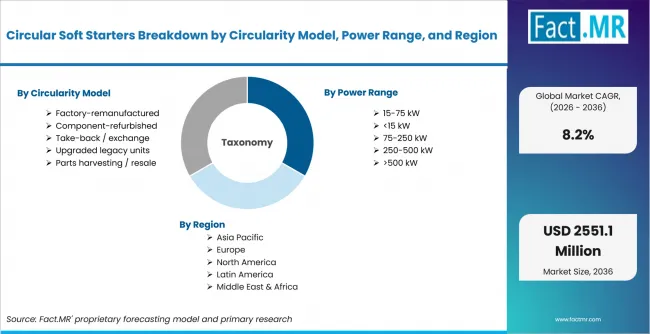
Circular Soft Starters Breakdown By Circularity Model, Power Range, And Region | Source: Fact.MR
| Attribute | Details |
|---|---|
| Quantitative Units | USD million |
| Market Definition | Circular service models for soft starters used to control industrial induction-motor starting and stopping. The scope includes remanufactured units, component-refurbished devices, take-back or exchange units, upgraded legacy starters and reusable parts recovered from retired equipment. |
| Circularity Model | Factory-remanufactured; Component-refurbished; Take-back / exchange; Upgraded legacy units; Parts harvesting / resale |
| Power Range | <15 kW; 15-75 kW; 75-250 kW; 250-500 kW; >500 kW |
| Voltage Class | 200-480 V; 500-690 V; 1-3.3 kV; 3.3-6.6 kV; >6.6 kV |
| End-use | Water & wastewater; Mining & minerals; HVAC / buildings; Oil & gas; Manufacturing |
| Regions Covered | North America; Latin America; Western Europe; Eastern Europe; East Asia; South Asia & Pacific; Middle East & Africa |
| Countries Covered | United States; Germany; Australia; United Kingdom; France |
| Key Companies Profiled | Siemens; Schneider Electric; Danfoss; Rockwell Automation; ABB |
| Forecast Period | 2026 to 2036 |
| Approach | Hybrid top-down and bottom-up approach using installed motor-control assets, soft-starter service programs, end-use replacement cycles, circularity models, country-level infrastructure indicators and provider portfolio review. |
Source: Fact.MR analysis. Updated Sep 8, 2026
How is the market segmented?
-
By Circularity Model
- Factory-remanufactured
- Component-refurbished
- Take-back / exchange
- Upgraded legacy units
- Parts harvesting / resale
-
By Power Range
- <15 kW
- 15-75 kW
- 75-250 kW
- 250-500 kW
- >500 kW
-
By Voltage Class
- 200-480 V
- 500-690 V
- 1-3.3 kV
- 3.3-6.6 kV
- >6.6 kV
-
By End-use
- Water & wastewater
- Mining & minerals
- HVAC / buildings
- Oil & gas
- Manufacturing
-
By Region
- North America
- Latin America
- Western Europe
- Eastern Europe
- East Asia
- South Asia & Pacific
- Middle East & Africa
Frequently Asked Questions
How big is the circular soft starters market in 2026?
What is the CAGR of the circular soft starters market from 2026 to 2036?
Which circularity model leads the circular soft starters market?
Which power range leads the circular soft starters market?
Who are the leading companies in the circular soft starters market?
Who worked on this report


Preview the report firsthand - request a free sample
Free SampleGet the brochure for pricing and purchase details
Download PDF